Sheet R09 Revision 1 Counted 16 October 2026
Slots free spins: the ones a reel awards are already in its percentage
540 presses at 10p is £54.00 of stake and £51.84 back at 96 pence per pound. Spins the reel itself awards are worth nothing on top of that figure, because they are a component of it. Spins a cashier hands over are a separate instrument, and at ten times they leave £31.10.
The count 540 presses One press 10p Comes to £51.84 before conditions
What a count of this size comes to
Every destination on this board is bought advertising. The site takes a fee if a reader goes on to register, and no figure printed below moves because of it.
The Spin Count
Gauge No 01
Betportal
Lowest multiple here
Priced at this site's own 10p a spin
What is counted
What is asked
No Great Britain licence
Licensed in Anjouan, Comoros, run by BetPortal Gaming Ltd, with Excite Ultra Media Ltd, reference ALSI-202601040-FI2.
Terms read 16 October 2026
Open the offer at Betportal, opens in a new tabThe Spin Count
Gauge No 02
WinBeast
Largest count here
Priced at this site's own 10p a spin
What is counted
What is asked
No Great Britain licence
Licensed in Curaçao, operator not named on the site.
Terms read 16 October 2026
Open the offer at WinBeast, opens in a new tabThe Spin Count
Gauge No 03
EliteSpin
Longest spin window
Priced at this site's own 10p a spin
What is counted
What is asked
No Great Britain licence
Licensed in Costa Rica, run by PrimeTier Limited.
Terms read 16 October 2026
Open the offer at EliteSpin, opens in a new tabThe Spin Count
Gauge No 04
Crown Jewelz
Multiple unpublished
No foot figure struck
What is counted
What is asked
No Great Britain licence
Licensed in Curaçao, number not verified, operator not named on the site.
Terms read 16 October 2026
Open the offer at Crown Jewelz, opens in a new tabThe figure in the third register is this site's own arithmetic and nothing an operator has published: the count at face, less the share a spin gives back at 96 per cent return to player, less what playing the wagering through costs at the same return. It describes the offer, not one reader's afternoon. Where the conditions price above the count the counter prints nothing rather than a negative sum, and where a figure the sum needs is unpublished it prints the condition in the operator's words instead.
A count has no unit of its own, so one is supplied. Where an operator publishes what a spin of its own is worth, that figure stands in the second register and is labelled as theirs. Where it does not, the second register carries this site's own 10p a spin and says so, and the foot figure moves in proportion: at half the price, half the money. The figure after it, what the count comes to for each spin, is the one that compares a large count against a small one.
Three words stand in the amount column where no figure can. Noted is a published condition that takes value away without leaving the sum a figure to take. Unpriced is a condition whose figure nobody has published, or a credit that is not a sum until a deposit of your own sets it. Own money is money of yours, which is never part of a foot figure.
Not one of the operators printed above holds a Great Britain licence, so the duties that licence carries do not reach them. Every online gambling company licensed in Great Britain has to be part of Gamstop Online, and a reader who has shut themselves out through the scheme is therefore not shut out here. The ceiling of ten times the bonus funds on a wagering requirement, in force since 19 January 2026, is a condition of that licence and binds the companies that hold one. Where a dispute goes instead is a matter for the authority named on the counter, and the Gambling Commission describes what a reader faces without a British licence as a lack of recourse if things go wrong. Nobody under 18 may hold an account at any of them.
Every term printed on a counter is the operator's own, and each counter carries the day it was read. The oldest of those readings is 16 October 2026. What binds a reader is the operator's own full terms, and not a line printed here.
1
Two things called free spins
One phrase, two instruments, and the arithmetic separating them is the point of this sheet. A reel awards spins to a player who lands a combination. A cashier awards spins to a player who signs up or deposits. The first costs the operator nothing it had not already budgeted. The second is a marketing expense with terms attached.
Price the cashier’s version first, since it is the one a reader can shop for. 540 presses funded at 10p is £54.00 of stake. Hand that to a reel paying back 96 pence in each pound and £51.84 is the average coming home. Conditions then subtract, and part three does the subtraction at every multiple.
Now the reel’s version, which is where most of the confusion lives. A feature round that pays ten spins at the triggering stake is a way of delivering a prize. Its value is already inside the configured return of the game, because that return is the average of everything the game pays, features included. So the correct expected value of winning a feature is not an addition to the press that triggered it. It is the value of that press.
Put a figure on it. Suppose a quarter of a game’s return arrives through its feature, so that of the 96 pence returned per pound, 24 pence comes that way. On a 10p press that is 2.4p per press delivered through features. Where the feature triggers once in 150 presses, its average payout has to be £3.60, because 2.4p multiplied by 150 is £3.60. The feature is large and frequent-sounding and it changes the total not at all.
Declared split, own working, no claim about any real game: that illustration is arithmetic and nothing else. How a title’s return divides between base game and features goes unpublished by every primary source within reach.
A tray of 540 at this end of the market means no Great Britain licence, which is fourteen separate duties rather than a vague absence. Part eight prices each of the fourteen against the figures above.
Three figures run through the page. One press costs 10p. 96 pence comes back per pound from the reel, four pence staying behind as edge. Multiply credit by edge by multiple for the cost of a requirement: 40 per cent of the credit goes at ten times, and the whole of it at twenty-five. Where the contribution rate falls below a hundred pence in the pound, divide the requirement by the rate before using any of these figures.
2
A feature round is a payout, not an addition
Work the illustration across a range of splits, because the conclusion holds at every one of them and the figures make that visible.
| Share arriving through features | Per 10p press | Triggering once in | Average feature pays | Tray of 540 totals |
|---|---|---|---|---|
| 10 per cent | 0.96p | 150 presses | £1.44 | £51.84 |
| 25 per cent | 2.40p | 150 presses | £3.60 | £51.84 |
| 50 per cent | 4.80p | 150 presses | £7.20 | £51.84 |
| 25 per cent | 2.40p | 400 presses | £9.60 | £51.84 |
| 25 per cent | 2.40p | 60 presses | £1.44 | £51.84 |
Every row of the last column reads £51.84, and that is the finding. Move the share, move the trigger frequency, move the average payout: the tray is worth what the return says it is worth and nothing in the feature’s design adds a penny to it.
What the feature does change is the shape. The fourth row triggers rarely and pays £9.60 when it does, so a tray of 540 presses expects 1.35 triggers and will often see one or none. The fifth row triggers every 60 presses and pays £1.44, so the same tray expects nine of them. Both average the same total and they behave nothing alike.
One consequence is worth stating because it runs against instinct. A game advertised on the size of its feature is advertised on its variance, not on its generosity. Across 540 presses the fourth row’s distribution is wide enough that the median outcome sits well under the mean, while the fifth row’s clusters close to it.
And the practical rule for a reader holding an awarded tray: the count and the press price tell them the whole expected value. What the reel does inside each press is a question about how the money arrives, not how much of it does.
Five different feature designs, one answer of £51.84
3
540 awarded presses, priced
The cashier’s tray is the instrument with terms on it, so this is where the subtraction happens. Scale the credit by a factor of one less the multiple’s four per cent and the expected residue falls out.
| The multiple printed | Turnover owed | Presses, 10p apiece | Floor time, 2.5 s a cycle | What is left |
|---|---|---|---|---|
| Nothing on the winnings | none | 540 for the tray | 22 m 30 s | £51.84 |
| Fivefold | £259.20 | 2,592 | 1 h 48 m | £41.47 |
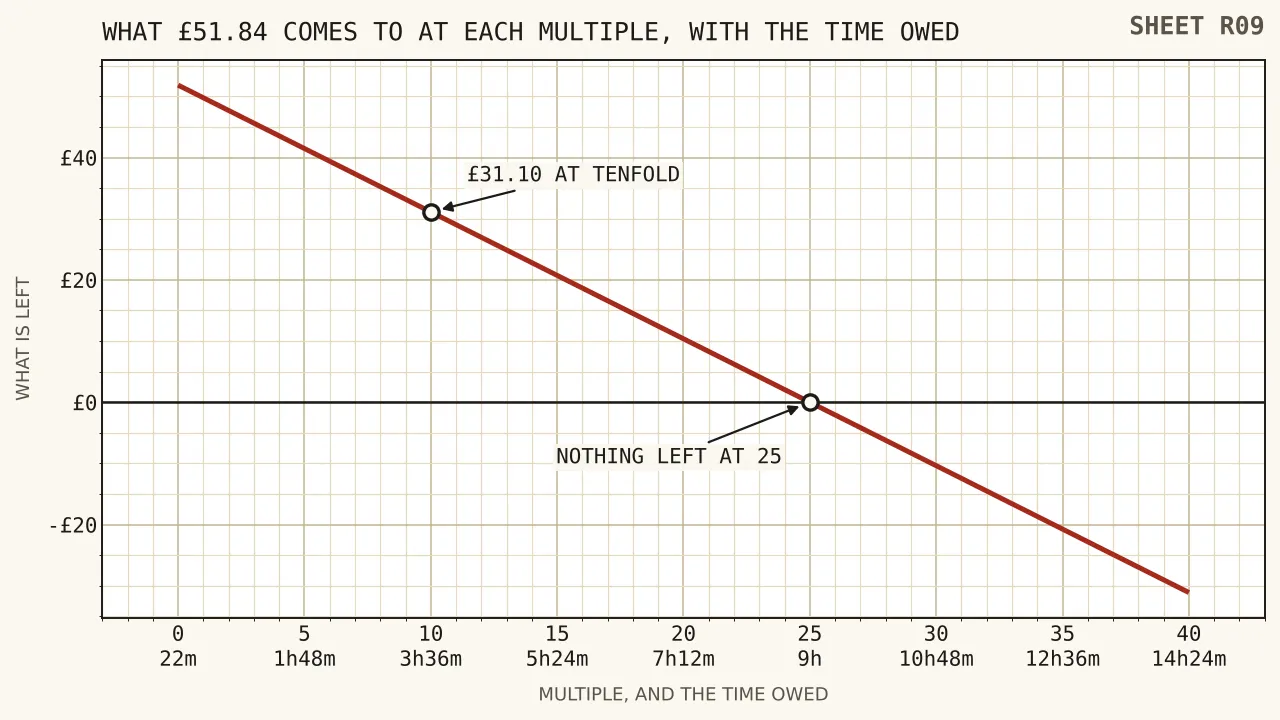
| Tenfold | £518.40 | 5,184 | 3 h 36 m | £31.10 |
| Fifteenfold | £777.60 | 7,776 | 5 h 24 m | £20.74 |
| Twentyfold | £1,036.80 | 10,368 | 7 h 12 m | £10.37 |
| Twenty-five times | £1,296.00 | 12,960 | 9 h 0 m | nothing |
| Fortyfold | £2,073.60 | 20,736 | 14 h 24 m | short by £31.10 |
Three features of that table repay attention. The last column falls in a straight line, losing £2.07 for every extra unit of multiple, which is four per cent of the credit. Nothing is where the sixth row lands, four into a hundred going twenty-five times. Only the fourth column rests on a published figure instead of this page’s arithmetic, 2.5 seconds being owed before a cycle following a game’s start may be commenced.
One more reading earns its place, since a long requirement always prompts the same question. How much of the £51.84 is still expected to be in the account part way through? At the halfway point of a tenfold requirement, 2,592 presses in, the expected balance is £41.47, because half the requirement has cost half of the 40 per cent. Three quarters of the way, 3,888 presses in, it is £36.29. The decline is linear in presses, falling 0.40p for every 10p put through, and that rate is the only thing a reader needs in order to see where they stand at any point.
Run the same line past the finish and it keeps falling at the same rate, which is what makes a requirement above twenty-five times a liability rather than a discount. At 12,960 presses the expected balance is nothing. At 20,736 presses, the fortyfold figure, the line has gone £31.10 below the axis, and every press after the twelve thousand nine hundred and sixtieth has been funded by the reader rather than by the award.
Now add the second mechanism. A requirement settles in contribution, not in stake, so a room counting a staked pound at less than a pound multiplies the staking. At forty pence in the pound, the £518.40 owed at tenfold needs £1,296.00 of staking, which is 12,960 presses and 9 hours. At twenty pence it needs £2,592.00 and 25,920 presses. At five pence it needs £10,368.00 and 103,680 presses, which is 72 hours at the floor speed.
Multiply a room’s contribution rate twenty-five-fold and out comes the heaviest multiple it carries. A hundred pence carries 25. Forty pence carries 10. Twenty pence carries 5. Five pence carries 1.25. So an awarded tray confined to the reels is in the only room where the regulated ceiling of ten times leaves anything at all.
Ten times is that ceiling, and 19 January 2026 is the date it took effect across every operating licence bar the two technical kinds. When the regulator consulted, sixty times was among the figures licensees had in use; on this tray it comes to £3,110.40 of turnover, 31,104 presses, 21 hours 36 minutes.
4
What a feature does to the clock
A feature changes nothing about the money and something real about the time, and the reason is a carve-out in the pace rules that a reader would not guess.
Where no extra stake is wagered in a bonus or feature game, the rule about shortening a result’s wait falls away. So the ten screens of a feature round can resolve faster than the base game’s floor, while every base-game press still owes its 2.5 seconds.
Price that. A tray of 540 base presses has a floor of 22 minutes 30 seconds. Suppose one press in 150 opens a feature, so the tray expects 3.6 features. For floor purposes those features add no cycles, a cycle closing once all that was staked or won has either gone or arrived with the player, the start control free once more. The tray is therefore 540 cycles and 22 minutes 30 seconds whatever the features do, and it will feel considerably longer.
Two further pace duties hold the base game in place. Shortening a result’s wait is not something to be handed to a customer, and three named features are impermissible: turbo, quick spin, slam stop. Nor may repetition proceed on its own, clarity about auto-play being unavailable to gaming online is the stated aim, and a commitment falls due at each cycle.
One presentation duty matters here more than on most pages, because a feature round is where fanfare concentrates. A return failing to exceed the total staked may not be celebrated by the system, nor may visuals or sound of a win-related kind run against it. The guidance names three things that may be done instead: show what was awarded in total, flash the winning lines briefly, and sound something short as the credit lands.
Put that against a feature. A ten-spin feature at 10p a spin stakes nothing extra and may return less than the 10p press that triggered it. On a licensed reel that outcome is reported rather than celebrated, and the figures in part two are the reason it matters: in the fifth row of that table the average feature pays £1.44 against a 10p trigger, and the distribution around £1.44 includes a great many results under 10p.
5
The maximum bet clause, in presses
Awarded trays routinely carry a ceiling on the stake a player may use while a requirement is outstanding, and the clause is best read as a constraint on the clock.
One wording, found in two licensees’ welcome terms on 15 October 2026, caps the bet during wagering at a tenth of the free spin winnings, subject to a £0.10 floor, or at £5.00, whichever of those turns out lower. Each sets the spin at £0.10 too, with the winnings from those spins carrying ten times and slots the only room that counts. Weekly change in terms is why no claim is made here about either offer running today; the clause’s arithmetic is what lasts.
Work it on this page’s credit. Ten per cent of £51.84 is £5.18, so the lower of the two figures is £5.00. The £518.40 owed at tenfold therefore needs at least 104 bets at £5.00, which is 4 minutes 20 seconds at the floor speed and no constraint at all.
Shrink the credit and the clause bites harder. On a credit of £10.00 the ceiling is £1.00 and a tenfold requirement needs at least 100 bets. On £2.00 the ceiling is £0.20 and the requirement needs at least 100 bets again, because the clause is proportional: ten per cent of the credit, turned over ten times, is always a hundred bets as a minimum.
That is the useful generalisation. Here is the generalisation. Cap the bet at a tenth of the credit, attach a requirement of W, and ten W bets become the minimum: 100 where W is ten, 200 where it is twenty, 400 where it is forty. Those two clauses together fix the floor on the number of decisions, and the credit’s size has nothing to do with it.
The floor of £0.10 in those terms is what stops the arithmetic running away on a tiny credit. Without it, ten per cent of a £0.50 credit would be 5p a bet, and the floor keeps the smallest permitted bet at the same 10p this page prices a press at.
6
A single type to each incentive
From 19 January 2026, one type of product to each incentive, and an awarded tray of reel presses is better off for it arithmetically.
Casino is the type reels belong to, so cash and reel presses together occupy a single type and one requirement may cover both. Tickets belong to bingo, a type of its own, which puts cash plus a ticket book across two types and outside any single linked condition. The rule’s four-item list is the whole basis for that reading.
Here is why that helps, in pounds. A condition nobody may export has to be served where the credit already sits. Reels count a staked pound at a hundred pence, which puts the largest clearable multiple at 25 and leaves £31.10 of this credit standing behind a tenfold condition. Send the identical condition into a five pence room and it calls for £10,368.00 of staking, finishing £362.88 below the waterline.
Three exceptions sit in the rule, each the regulator’s own. The first permits two products of a single type inside one incentive, illustrated by a raffle sitting next to a scratchcard. The second lets one email run a casino offer and a betting offer at once, where consent to marketing has been given for each. The third takes the credit outside the ban altogether wherever the customer, rather than the operator, chooses the product.
Arithmetically the third of those is the best cross-product offer available anywhere, since a reader who aims the credit can aim it at the fattest contribution rate on the site. £31.10 against a shortfall of £362.88 is what aiming well and aiming badly are worth here.
7
Two edges of the ceiling nobody has settled
Bonus funds is the expression that ceiling of ten times is written about, and two questions stay open inside that wording. Neither gets closed here.
Question one. A press handed over free: is it a fund of that sort? The record is silent both ways. Behind the cap sits a definition under which a wagering requirement arises where a customer has to place wagers totalling some particular value before funds turn withdrawable, and the multiple is the only thing the cap limits. Nothing published settles whether the press itself counts, or only its winnings.
Question two. Does the cap catch a requirement reckoned over a bonus and a deposit together? Unpublished again, since the cap addresses bonus funds and no worked example has appeared for a base built from a deposit and a bonus together.
Follow the published wording and this much holds, with nothing beyond it. Where a bonus balance takes in the proceeds of a press, the requirement over them stops at ten times, which on £51.84 means £518.40 of turnover across 5,184 presses.
Cash shows why question two matters, and one licensee’s standing terms read on 15 October 2026 supply it. Their first-deposit minimum runs to thirty times, computed on a base of bonus and qualifying deposit together instead of bonus alone. Reckoned across a whole sum, a requirement weighs more than the identical printed number reckoned across a part of it, and the printed number conceals every bit of that.
A second licensee’s general bonus policy, open the same day, credits free-spin winnings to the bonus balance and attaches a wagering requirement of ten times to them. It then adds that a player with an active bonus, wanting to withdraw, has to elect to cancel that whole bonus balance including any winnings built up with it. No multiple appears in the second of those clauses, which makes it a subtraction of a different kind: a residue turns into a choice between the money and the requirement.
Cost that choice here. £51.84 sitting in a bonus balance, ten times still outstanding, and the two options are an expected £31.10 at the end of 5,184 presses or whatever cash is held outside the balance. The headline shows neither figure, and on a tray taken without a deposit the second of them is nothing.
8
The awarded tray with nothing filed
Everything above describes a licensed reel. Off the register the duties come away one at a time, and the table sets a figure from this page beside each.
| Held in place by a licence | Priced on the figures above |
|---|---|
| A multiple halted at ten times | £31.10 standing, not a £31.10 shortfall at fortyfold |
| One product type to an incentive | 5,184 presses stay on the reels, not 103,680 at five pence |
| 2.5 seconds between cycles | 22 m 30 s floors the tray; 3 h 36 m floors the turnover |
| Neither turbo nor slam stop | 20,736 presses at fortyfold cannot be hurried |
| A commitment taken cycle by cycle | 20,736 separate decisions, not one |
| A cash figure over one cycle | 50 presses a cycle, 20 for a reader under twenty-five |
| Silence where the stake is not beaten | A feature paying 8p on a 10p trigger goes uncelebrated |
| No almost in place of a loss | 0.40p of edge a press reads as what it is |
| Acceptable randomness, no compensated game | The £51.84 stays computable from 96 pence |
| No encouragement to chase or continue | 540 presses are not a ticket back for somebody who left |
| Identity verified before any press | £54.00 of stake needs a checked account behind it |
| Credit cards turned away | £2,073.60 of turnover cannot be funded on borrowing |
| A limit prompted as the default | Something stands in front of 20,736 presses |
| A route out, eight weeks then adjudication | Some route exists for a disputed £31.10 |
Most of the weight here falls on two of those rows. The randomness row is what makes the £51.84 computable at all, since the figure comes from a stated return and a stated return means nothing where the probabilities may be adjusted. Encouragement is the row aimed squarely at an awarded tray, since a free game is what the guidance behind it names as the lure for somebody who had decided to stop.
Much of that market runs under one policy on responsible gaming issued in Curaçao, numbered 1.0, which bears 21 February 2025. Count the absences in it. Ceilings on a multiple: nil. Cash limits over a stake: nil. Minimum lengths for a game cycle: nil. Prohibitions on repetition that runs itself: nil. Sentences devoted to bonuses: two, one asking that they be communicated transparently with the conditions clear, the other barring promotion aggressive enough to encourage excessive gambling.
Two of its lines are stricter, and a comparison leaving them out would be a false one. Deposit limits: down immediately, up after a week, where the British floor on an increase is a single day. Complaints: 26 weeks of player time, four weeks of answering time, four more on a written extension, adjudication obligatory and billed to the operator rather than the player.
One line will not move. 40 per cent is the remote gaming rate, and it arrives on identical terms at a cashier holding a licence and at one holding none, since where the player ordinarily lives is what it tracks. Seven years at 21 per cent preceded it, the changeover falling on 1 April 2026.
Questions
- Are free spins won inside a slot worth anything extra?
- Nothing extra, and that is the most useful line here. A feature round is a way of delivering a prize, and its value is already inside the game’s configured return, which is the average of everything the game pays. So the expected value of triggering a feature is not an addition to the press that triggered it: it is the value of that press.
- What are 540 awarded free spins at 10p worth?
- Face value £54.00, and £51.84 on average from a reel paying 96 pence per pound. Subtractions follow. £41.47 survives five times. £31.10 survives ten. £10.37 survives twenty. Nothing survives twenty-five. Forty times ends £31.10 short.
- Does a bigger feature mean a better game?
- It means a wider spread. On a declared split where a quarter of the return arrives through the feature, a feature triggering once in 400 presses has to average £9.60 and a feature triggering once in 60 presses has to average £1.44. A tray of 540 presses totals £51.84 either way. Those are this site’s own figures on a declared split, not any real game’s internals.
- Can a feature round run faster than the base game?
- Yes, because the rule against shortening the wait for a result is disapplied for a bonus or feature game in which no extra stake is wagered. Each base press still owes its 2.5 seconds, so whatever the features do, 540 of them floor at 22 minutes 30 seconds.
- What does a maximum bet clause while wagering actually do?
- It fixes a floor on the number of bets rather than on the money. A ceiling at one tenth of the credit, with a requirement of W, puts ten W bets on the table as the minimum, giving 100 at ten times, 200 at twenty and 400 at forty. In two licensees’ terms read on 15 October 2026 that ceiling was a tenth of the free spin winnings, floored at £0.10, or else £5.00, whichever came out lower.
- Why does being confined to slots help me?
- Reels are the one room crediting a staked pound in full, and twenty-five times the contribution rate is what any room can carry. That makes 25 on the reels, leaving £31.10 of this credit behind a tenfold requirement. Push the same requirement into a room crediting five pence and £10,368.00 of staking is needed, ending £362.88 under.
- Is the ten times ceiling certain to cover my free spins?
- Not certain, and nothing is on the record either way. Bonus funds is what the ceiling addresses, and no publication in either direction settles whether a press given free is such a fund. The published wording supports this and no more: a requirement over proceeds credited to a bonus balance stops at ten times, coming to £518.40 of turnover on £51.84.
- What happens if I withdraw while a bonus is still active?
- A general bonus policy belonging to one licensee, open on 15 October 2026, puts a player with an active bonus to an election before withdrawing: cancel the bonus balance entire, winnings built up with it included. No multiple sits anywhere in that, which makes it a subtraction of another kind. Here it reduces to a choice between an expected £31.10 at the end of 5,184 presses and whatever cash lies outside that balance, which on a tray taken without a deposit is nothing.
- How long does the wagering take?
- Reckon it at 10p a press against a 2.5 second cycle floor. Five times: 2,592 presses, 1 hour 48 minutes. Ten: 5,184 presses, 3 hours 36 minutes. Twenty-five: 12,960 presses, 9 hours flat. Forty: 20,736 presses, 14 hours 24 minutes. None of it compresses, three features being impermissible by name and a commitment falling due at every cycle.
- What does an awarded tray lose off the British register?
- Fourteen rows of the table in part eight. Those rooms are absent from the register entirely. No Great Britain licence covers them, so the multiple meets no halt at ten times, no floor of 22 minutes 30 seconds under the tray, and no bar on celebrating a feature that pays 8p against a 10p trigger. Those 5,184 presses owed on the reels may turn into 103,680 in a room crediting five pence. An unchecked account may stake the £54.00. Behind a disputed £31.10 no eight-week clock exists. One thing follows the cashier regardless: remote gaming duty at 40 per cent, which attaches to the player’s usual country of residence.