Sheet O03 Revision 1 Counted 16 October 2026
No-KYC casinos: what the check is for, and what £9.22 costs without it
64 presses priced at 25p is £16.00 of stake and £15.36 expected back. Ten turnovers leave £9.22 of that, twenty leave £3.07, twenty-five leave nothing. An identity check is three questions asked once, at the front, and this page prices what happens to the £9.22 when nobody asks them.
The count 64 presses One press 25p Comes to £9.22 at ten turnovers
What a count of this size comes to
Every destination on this board is bought advertising. The site takes a fee if a reader goes on to register, and no figure printed below moves because of it.
The Spin Count
Gauge No 01
Betportal
Lowest multiple here
Priced at this site's own 10p a spin
What is counted
What is asked
No Great Britain licence
Licensed in Anjouan, Comoros, run by BetPortal Gaming Ltd, with Excite Ultra Media Ltd, reference ALSI-202601040-FI2.
Terms read 16 October 2026
Open the offer at Betportal, opens in a new tabThe Spin Count
Gauge No 02
WinBeast
Largest count here
Priced at this site's own 10p a spin
What is counted
What is asked
No Great Britain licence
Licensed in Curaçao, operator not named on the site.
Terms read 16 October 2026
Open the offer at WinBeast, opens in a new tabThe Spin Count
Gauge No 03
EliteSpin
Longest spin window
Priced at this site's own 10p a spin
What is counted
What is asked
No Great Britain licence
Licensed in Costa Rica, run by PrimeTier Limited.
Terms read 16 October 2026
Open the offer at EliteSpin, opens in a new tabThe Spin Count
Gauge No 04
Crown Jewelz
Multiple unpublished
No foot figure struck
What is counted
What is asked
No Great Britain licence
Licensed in Curaçao, number not verified, operator not named on the site.
Terms read 16 October 2026
Open the offer at Crown Jewelz, opens in a new tabThe figure in the third register is this site's own arithmetic and nothing an operator has published: the count at face, less the share a spin gives back at 96 per cent return to player, less what playing the wagering through costs at the same return. It describes the offer, not one reader's afternoon. Where the conditions price above the count the counter prints nothing rather than a negative sum, and where a figure the sum needs is unpublished it prints the condition in the operator's words instead.
A count has no unit of its own, so one is supplied. Where an operator publishes what a spin of its own is worth, that figure stands in the second register and is labelled as theirs. Where it does not, the second register carries this site's own 10p a spin and says so, and the foot figure moves in proportion: at half the price, half the money. The figure after it, what the count comes to for each spin, is the one that compares a large count against a small one.
Three words stand in the amount column where no figure can. Noted is a published condition that takes value away without leaving the sum a figure to take. Unpriced is a condition whose figure nobody has published, or a credit that is not a sum until a deposit of your own sets it. Own money is money of yours, which is never part of a foot figure.
Not one of the operators printed above holds a Great Britain licence, so the duties that licence carries do not reach them. Every online gambling company licensed in Great Britain has to be part of Gamstop Online, and a reader who has shut themselves out through the scheme is therefore not shut out here. The ceiling of ten times the bonus funds on a wagering requirement, in force since 19 January 2026, is a condition of that licence and binds the companies that hold one. Where a dispute goes instead is a matter for the authority named on the counter, and the Gambling Commission describes what a reader faces without a British licence as a lack of recourse if things go wrong. Nobody under 18 may hold an account at any of them.
Every term printed on a counter is the operator's own, and each counter carries the day it was read. The oldest of those readings is 16 October 2026. What binds a reader is the operator's own full terms, and not a line printed here.
1
64 presses at 25p, before anything else
Price the count before touching the subject. 64 presses, each costing 25p, is £16.00 of stake. Where a reel hands back 96 pence out of every staked pound, the mean return on that is £15.36, and the 64p difference is the room’s share of a tray nobody has yet attached a condition to.
One press leaves 24p behind when nothing is demanded of it. That single number carries most of the page. Multiply it by 64 and the tray comes to £15.36. Shave four per cent off it for each turnover demanded and the residue per press falls to 14.4p at ten, 4.8p at twenty, and exactly nothing at twenty-five.
So the headline survives as £9.22 where ten turnovers are asked, £3.07 where twenty are, and £0.00 where twenty-five are. Push to forty and the arithmetic goes through the floor: £9.22 is then the shortfall rather than the surplus, and the shortfall is paid out of whatever the reader deposited.
Hold £9.22 in mind, because the rest of this page is about one question asked once. An identity check is three pieces of information handed over at the front of an account. The British rule on it puts them in a fixed order and gives a licensee no discretion about the timing. A cashier holding no British licence has nothing of the sort standing over it, and the figure above is what that difference is worth on a tray of this size.
Two things this page will not do. It will not treat a check as an obstacle, because the check is three quarters of what makes £9.22 collectable at all. And it will not tell anyone how to get near a site, a cashier or an account they have shut themselves out of. What it will do is cost the check in both directions, costing being the one honest answer available to the question this page is titled with.
If the reason for reading this is that a registration with the self-exclusion scheme is in the way, the useful arithmetic is in part ten and the useful telephone number is in the care block underneath it. Three services exist for exactly that position, two of them cost nothing in Great Britain, and the sum they are being weighed against is £9.22.
Scope, stated once. The ceiling that holds a turnover condition to ten times is written about bonus funds. Whether a press handed free counts as a fund of that kind is unsettled in the published record. So is a condition reckoned across deposit and bonus together. Both are holes in the record and not findings. What the published wording does reach: proceeds landing in a bonus balance, where a condition over them stops at ten turnovers, which on £15.36 is £153.60 of turnover and 614 presses at this page’s price.
2
Three questions, and the three reasons for them
Licence condition 17.1.1 is the rule, and its content is short enough to state exactly. Before a customer may gamble, a licensee has to obtain information establishing who that customer is, and verify it. A floor sits under what that information covers, and the condition’s own phrasing on it is “must include, but is not restricted to” three things: a date of birth; an address; and the name that any payment eventually goes to.
Three items, then. One sentence of consumer wording carries the duty: every online gambling business “must ask you to prove your age and identity” ahead of any gambling. Three stated reasons sit behind that, and separating them is worthwhile because exactly one is about money.
| The reason given | What it is actually doing | Its worth on 64 presses |
|---|---|---|
| Age | Keeping a child off a reel, whether or not a prize is attached to it | £16.00 of stake cannot be placed by an under-18 |
| Self-exclusion status | Matching the person opening the account against the national register of people who have asked to be kept out | 64 presses cannot be offered to somebody excluded |
| Confirming identity | Fixing a name to the account, which is the name any payment has to be made to | £9.22 has somebody to be paid to |
Row three is the one readers underrate. Paying a balance means paying somebody, and somebody is those same three items in whatever order a form asks for them. Establish none of them and the balance has no payee at all, which means a cashier that never asked has never committed itself to any answer about whose the £9.22 is.
Reach on the condition is wide and the exclusions are specific. Every remote licence falls inside it, ancillary remote betting licences for bets taken by telephone or email included. Outside it: lottery licences confined to low-frequency or subscription lotteries, gaming machine technical licences, gambling software licences, host licences, and the ancillary remote casino and ancillary remote bingo kinds. No effective date appears on the condition’s own page, which is worth knowing before anybody cites one.
Two further limbs of the same condition get less attention than the first does. The customer has to be told, ahead of putting any money in at all, which identity documents or other information may be wanted, the point at which it might be asked for, and the way it should be supplied. Reasonable steps to keep the held information accurate are owed on top, which turns the duty into maintenance rather than a single event.
On the documents themselves the regulator declines to prescribe. Its consumer guide lists examples, three of them, and household bills are one, driving licences another, passports the third. An express refusal to specify which of them a business ought to ask for is attached to the list. That guide is also the oldest source leaned on anywhere here, its publication falling on 23 September 2020 and its last update on 13 April 2022. The licence condition, and not that guide, is where identity’s current wording sits, so the guide is read on this page as a gloss and the condition as the rule.
3
When the asking happens, and why that is the point
Everything valuable about the British identity rule is in its timing. The questions are asked at the front, which means they cannot be asked at the back. Put the £9.22 at the end of 614 presses and the difference becomes obvious: a document request arriving at that moment, after the staking is done, is a request a reader cannot refuse and cannot price.
The condition closes that trapdoor in terms. Where the same thing could reasonably have been sought earlier, a withdrawal request may not set off a fresh demand for information as the price of being paid. A single carve-out survives, covering whatever some other legal duty requires to be obtained at precisely that moment.
Put to players, the same rule says a business “can’t ask you to prove your age and identity” as the price of a withdrawal, in any case where asking sooner was possible. “Promptly” is the standard set for seeking material on money laundering, rather than the moment at which somebody asks for their funds. Exceptions are noted for information needed right then to satisfy a legal obligation. And hold a withdrawal up because the identity information held is insufficient, and the operator “may be in breach”, the condition named for that being Licence Condition 17. The modal verb belongs to the source and this page keeps it.
Price that clause on this tray and its value is the whole residue. A tenfold condition on £15.36 takes 614 presses and 25 minutes 35 seconds at the fastest lawful pace. At the end of it £9.22 is the expected balance. A rule that lets the questions be asked at that moment rather than at registration is a rule under which the £9.22 is contingent on paperwork produced under pressure, and a rule that forces them to the front is a rule under which it is not.
So the honest description of a cashier that asks nothing is not that it has removed a nuisance. It is that it has kept the option of asking later, and has not promised anybody it will not. Nothing is published that binds it either way, because nothing published binds a cashier outside the British scheme at all.
£9.22 at ten turnovers, 614 presses to reach it, 25 min 35 s at the floor
4
The 2019 change, and the 72 hours before it
Identity verification before play is not an ancient feature of British licensing. It arrived with a set of rules announced in one article, and the announcement is specific about what the duty covers.
Operators have to “verify, as a minimum” three things about a customer before that customer is allowed to gamble, and the three are the familiar ones. “A free bet or bonus” is inside the age-check limb on equal terms with a customer’s own money, and that clause is the one reaching a tray of 64 directly. The “free-to-play versions” on a licensee’s own site sit behind age verification as well, a reel paying no prize at all being covered even though it is not technically gambling, the regulator’s stated reason being that children have no legitimate reason to reach such games.
Then the figure that prices the change. Previously allowed for completing an age check: 72 hours. Convert that at this page’s pace and the arithmetic is unflattering. A cycle may not begin until 2.5 seconds after the previous one began, so 72 hours of unchecked access is 103,680 presses at the floor, and 103,680 presses at 25p apiece is £25,920.00 of stake. The tray at the head of this page is £16.00. 1,620 of them would fit inside the old window.
One caution on the date, and this page states it rather than burying it. 7 February 2019 is the date the article carries. 7 May is the day its commencement line names, and no year is set against that day anywhere on the page. A single available reading is left by the article’s own date, so 7 May 2019 is written above as this page’s reading, the source itself supplying no such wording.
| Measured as | Before the change | After it |
|---|---|---|
| Time available unchecked | 72 hours | none at all |
| Presses at the 2.5 second floor | 103,680 | zero |
| Stake at 25p a press | £25,920.00 | nothing |
| Expected loss at 4p in the pound | £1,036.80 | nothing |
| Measured against this tray | 1,620 trays of 64 | no trays at all |
That fourth row is the one to keep. 4p in every staked pound is the house’s expected take at a 96 per cent return, so 72 hours of pressing at the floor carries an expected loss of £1,036.80 before anybody has confirmed the player is old enough to be there. Closing the window to nothing is therefore not an administrative tidy-up. It is the removal of a four-figure exposure that sat, by design, ahead of any check at all.
And off the register the window is not 72 hours. There is no window, because there is no duty for a window to shorten.
5
What a condition takes off £15.36
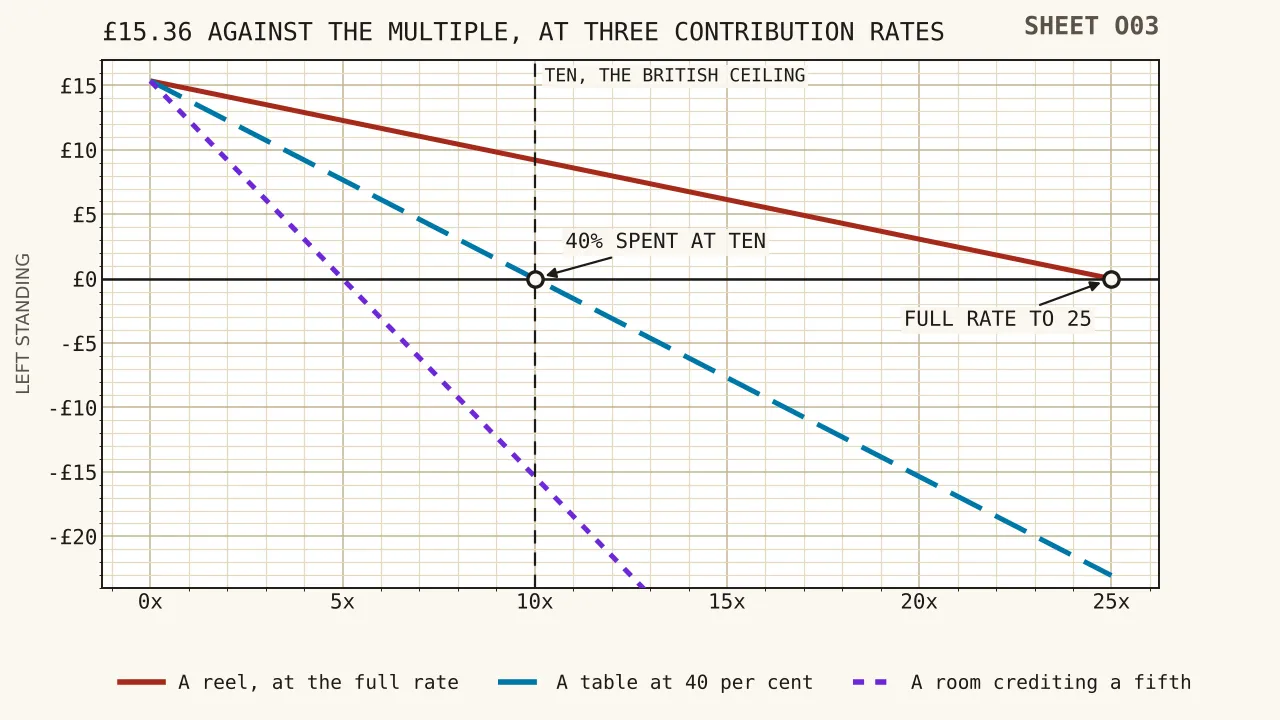
Lay the multiples in a column and the offer reads off in a single table. Residue drops by 61p for every unit added to the multiple, 61p being four per cent of £15.36.
| Turnovers asked | Turnover owed | Presses at 25p | Fastest lawful time | Left standing |
|---|---|---|---|---|
| None at all | nothing | 64, the tray itself | 2 min 40 s | £15.36 |
| Five | £76.80 | 307 | 12 min 48 s | £12.29 |
| Ten | £153.60 | 614 | 25 min 35 s | £9.22 |
| Twenty | £307.20 | 1,229 | 51 min 12 s | £3.07 |
| Twenty-five | £384.00 | 1,536 | 1 hr 4 min | nothing whatever |
| Forty | £614.40 | 2,458 | 1 hr 42 min | £9.22 adrift |
| Sixty | £921.60 | 3,686 | 2 hr 33 min | £21.50 adrift |
Note which rows are symmetrical. £9.22 is what a tenfold condition leaves and £9.22 is what a fortyfold condition costs, because forty is fifteen past the crossing point and ten is fifteen short of it. The crossing itself is twenty-five, where a hundred per cent of the credit is expected to go and the table prints nothing.
One of those five columns rests on something published, and it is the fourth. 2.5 seconds is the least a reel may leave between one cycle’s start and the next one’s, which makes every time in that column a floor and not an estimate. Nobody is obliged to press at the floor, and a reader pressing at four seconds a cycle should multiply every entry in that column by 1.6.
Three further figures fall out of the same arithmetic without a new assumption. The whole tray, pressed once through with nothing asked, is 2 minutes 40 seconds. A tenfold condition multiplies that by 9.6 rather than by 10, because the first pass through the tray is part of the turnover. And the sixty-times row, which is the practice the ceiling at ten replaced, costs 2 hours 33 minutes and finishes £21.50 below the starting line, a sum larger than the £16.00 the tray was worth at face.
6
Where a tenfold condition lands on nothing
Turnover is one number and the staking a room credits is another. A reel room crediting a staked pound in full means the two match. Anywhere else they separate, and the separation is where a tray of this size dies without anybody changing the multiple.
One operator’s published weighting schedule, read on 15 October 2026, gives the shape. Slots and scratch games count in full. Other table games count at 40 per cent. Then a 5 per cent tier, taken in the reverse of the schedule’s order: red dog, Oasis poker, three-card poker, punto banco, baccarat, blackjack, video poker, roulette, live tables. Divide the turnover owed by the rate and the presses needed follow.
| Where it is served | Rate | Staking owed | Presses at 25p | Heaviest multiple the room bears |
|---|---|---|---|---|
| A reel, or a scratch game | 100% | £153.60 | 614 | 25 turnovers |
| A table game outside the live rooms | 40% | £384.00 | 1,536 | 10 turnovers |
| A room crediting a fifth | 20% | £768.00 | 3,072 | 5 turnovers |
| A live table, or roulette | 5% | £3,072.00 | 12,288 | 1.25 turnovers |
The second row is the finding. 40 per cent is exactly the rate at which a tenfold condition lands on nothing, because the crossing weighting is the multiple divided by twenty-five and ten divided by twenty-five is 0.4. A reader who clears a tenfold condition on other table games rather than on reels has not reduced the £9.22. They have removed it.
Below 40 per cent the arithmetic is negative before the first press. On a live table at 5 per cent, a tenfold condition demands £3,072.00 of staking, which is 12,288 presses and 8 hours 32 minutes at the floor, and the expected outcome of all of it is £107.52 worse than doing nothing. The largest multiple such a room can carry is 1.25 turnovers, which no offer anywhere asks for, which is why the weighting schedule rather than the multiple is the term that decides these pages.
Two things this page will not assert. It will not give a configured return for a named game or a named studio, because no source publishes one. And it will not treat 96 pence in the pound as a measurement. It is the house assumption running through every sheet on this site, and the crossing values above move with it: at 95 pence the crossing multiple is twenty, at 97 pence it is thirty-three and a third.
7
A five pound floor, and what 64 clears
Most offers of this shape are settled by the smallest payable sum rather than by the multiple, and this count is large enough for the answer to be interesting rather than uniformly hopeless.
Reverse the arithmetic. Take the floor and divide it by one press’s residue, residue here being 25p cut to 96 per cent of itself and then cut again by the multiple’s four per cent. Unconditioned that residue is 24p, so £5.00 wants 21 presses, £10.00 wants 42 and £20.00 wants 84. A tenfold condition cuts the residue to 14.4p and the counts become 35, 70 and 139. Twenty turnovers leave 4.8p a press, which is 105, 209 and 417.
| Condition on the tray | To reach £5.00 | To reach £10.00 | To reach £20.00 | Which of the three 64 covers |
|---|---|---|---|---|
| Nothing asked | 21 | 42 | 84 | the first two, with 22 presses to spare |
| Ten turnovers | 35 | 70 | 139 | the five pound floor only |
| Twenty turnovers | 105 | 209 | 417 | none of the three |
| Twenty-five turnovers | beyond any count | beyond any count | beyond any count | nothing reaches anything |
Row two is the realistic case and the one that matters. Attach a tenfold condition, put the smallest payable sum at £10.00, and 64 lands six presses short of the 70 required. Six presses is £1.50, which the reader finds from their own money or does not get paid. Where the floor is £5.00, 35 presses do it and the tray has 29 to spare.
The bottom row is part five’s twenty-five wearing different clothes. At the crossing point the residue per press is nothing at all, so no count of any size reaches any floor whatever on the mean, and the size of the headline stops being information.
Which leaves a reader a two-figure test needing no terms-and-conditions page at all. The smallest payable sum is the first figure. The residue per press is the second, 14.4p where ten turnovers are asked and 4.8p where twenty are, on a press costing 25p. Divide the first by the second. An answer above the count being advertised means the offer’s average outcome is not payable, and no other clause in the document alters that.
And one honest qualification on all of it. These are means, not forecasts of a single session. Model a reel as one prize paid at probability 0.96 divided by the multiplier and the standard deviation on one 25p press at a 100-times prize is roughly £2.44, which is nine times the residue it leaves. Across 614 presses the spread is wide enough that a tray clearing a £10.00 floor on a particular evening tells a reader nothing about the mean. The arithmetic above is what the offer is worth on average, and the average is the only thing an offer can honestly be priced on.
8
If each duty were absent, then what
A reader weighing a cashier that asks nothing is weighing the absence of a list, and the list is long enough that it is better read as a set of conditionals than as a complaint. Each line below takes one British duty, supposes it away, and gives the consequence in the units of this page.
| If this duty did not exist | then the consequence, costed |
|---|---|
| If identity need not be established before play | then £16.00 is staked from an account nobody has matched to a person |
| If the three items were not fixed as a floor | then one of them stands in for three, a name doing duty for a birth date and an address too |
| If age need not be checked before bonus play | then 64 free presses sit outside the duty that free bets were brought inside |
| If no-prize reels were outside the duty | then a demo reel becomes the route in, which is the gap 2019 closed |
| If the 72 hour window had never been shut | then 103,680 presses and £1,036.80 of expected loss precede the first check |
| If documents could be demanded at the exit | then the £9.22 is contingent on paperwork produced after 614 presses |
| If the licensee need not say what may be asked for | then the cost of the account is unknown at the moment of depositing |
| If held information need not be kept accurate | then a stale address is the cashier’s reason rather than the cashier’s problem |
| If a turnover condition had no ceiling | then sixty times stands, which is £21.50 adrift instead of £9.22 kept |
| If a weighting schedule need not be published | then the 40 per cent that zeroes a tenfold condition is unfindable |
| If a withdrawal could be cancelled by the player | then £9.22 can be fed back to the reels at the moment of leaving |
| If a deposit balance could be capped | then the reader’s own money leaves at whatever rate suits the cashier |
| If monthly net deposit triggered no check at all | then £150.00 a month, or 600 presses, passes without anything noticing |
| If net spend and elapsed time were not shown live | then £153.60 and 25 min 35 s accumulate without being named on screen |
| If no register of licensed businesses were published | then there is nothing to look a cashier up in, and no 139 actions behind it |
| If membership of the scheme were not a licence term | then 64 presses can be offered to a person who registered to be kept out |
Sixteen conditionals, and every one of them is the position at a cashier holding no British licence. That is not a prediction about any particular operator’s conduct. It is a statement about which duties exist, and the duties in that column exist only where a licence does.
The last line is the one with no price in pounds, because what it costs is not measured in pounds. A registration with the national scheme is a decision a person made about themselves, and the licence term requiring every online operator licensed in Great Britain to be part of the scheme is what gives that decision effect. Where the term does not reach, the decision does not either.
9
The money checks, the register, the scheme
Three more pieces of the British structure bear on a tray of this size, and all three convert into figures.
First the financial side. A monthly net-deposit threshold is what brings an online customer inside a light-touch check, and the threshold has moved once. 30 August 2024 brought it in at £500 a month. 28 February 2025 cut that to £150. Measured at 25p a press, those are 2,000 presses and 600 presses, so the reduction pulled the trigger down by 1,400 presses a month. Two statements accompany it and both run against the usual assumption. Those separate assessments of enhanced financial risk remain at pilot stage rather than live, and consumers go unaffected while the pilot runs. As for a consumer’s credit rating, neither the pilot nor the checks touch it.
Then the record. Four registers are published, covering premises, regulatory actions, individuals and licensed businesses. All but the regulatory actions can be searched and downloaded: premises, personal licences, businesses. Published beside them are freedom of information requests, public statements and the regulatory actions themselves. What the register page does not print is a date, or any instruction for reading it. A domain name listed against a licensee goes uninterpreted there. So does the meaning of an active status, or an inactive one. Any page leaning on that data owes its reader the date on which the check was made, and owes them the absence of an interpretation the regulator has never published. The date here is 15 October 2026 and no interpretation is offered.
Price the register against this tray while it is in view. A reader can spend a minute looking a cashier up, against 25 minutes 35 seconds of pressing to turn £15.36 into £9.22. One minute of searching is therefore worth about 4 per cent of the time the offer itself demands, and it is the only minute in the whole exercise with a published answer at the end of it.
Then the scheme, which is the hinge this whole section turns on. Its reach rests on one sentence, and that sentence turns on a licence: every online gambling company holding one in Great Britain has to be part of the scheme. So reach follows the licence rather than the site. The scheme then states its own limit, in terms last updated 20 May 2026. It “can only assist to exclude you from engaging in gambling services offered by the participating Gambling Operators”, and as for the rest it is “unable to help prevent you from accessing gambling services” provided by “organisations which do not participate in GAMSTOP”. Those capitals belong to the source. Read it as a limit on what protection a registered person actually holds, since that is precisely what it is, and it is the most useful sentence anywhere on this page for somebody reading from inside a registration.
| Published figure | Quantity | Date it carries |
|---|---|---|
| Consumers registered | 614,738 | 16 July 2026 |
| Rise in registrations across the first half of the year | 16 per cent | 16 July 2026 |
| Monthly record for sign-ups | 12,236 | May 2026 |
| Under-25 registrations, set against the year before | 26 per cent | 16 July 2026 |
| Share of registrants taking the five-year option | more than one in two | 16 July 2026 |
| Share of under-25s taking six months | 38 per cent | 16 July 2026 |
Registration offers four periods. Five years with automatic renewal is one, the renewal being switchable off only inside the last six months of such a term; then five years plain, then a year, then six months. No registration can be cut short, a point the terms make in capitals of their own: “YOU WILL NOT BE ABLE TO DEACTIVATE YOUR SELF-EXCLUSION UNTIL THE END OF YOUR MINIMUM EXCLUSION PERIOD.” Nor does one expire quietly. A self-exclusion is not lifted automatically when its minimum period runs out. Extension is available, in five-year, one-year or six-month lengths; so is asking for deactivation; and where nothing at all is done, as much as a further seven years of exclusion follow.
One structural point that readers conflate. Two separate schemes handle the two kinds, one covering online accounts and one covering betting shops. 2016 is the founding year of the shops service, which carried the name Multi Operator Self Exclusion Scheme beforehand, and July 2023 is when it joined the group. A registration with either one does not reach the other, and no sentence here claims that it does.
10
One column of figures, and the trade in it
Everything above reduces to a comparison between two columns, and the left-hand one is short.
| On one side | Quantity | On the other |
|---|---|---|
| A tray of free presses | 64 | Sixteen duties that exist only under a licence |
| Its face value | £16.00 | Three questions asked once, at the front |
| Expected at 96 pence in the pound | £15.36 | A name any payment has to be made to |
| Surviving a tenfold condition | £9.22 | A closed trapdoor at the exit |
| Surviving twenty turnovers | £3.07 | A ceiling holding the multiple to ten |
| Surviving the crossing point | nothing | A register anybody can search |
| At forty turnovers | £9.22 adrift | A scheme 614,738 people have joined |
The best figure in that middle column is £9.22, and it arrives only where the condition is at the ceiling, the room credits a staked pound in full, and the smallest payable sum is no higher than £5.00. Move any one of those three and it falls. Move the weighting to 40 per cent and it goes entirely.
So the arithmetic answers the question rather than the page asserting an answer. No arrangement of these figures reaches a sum worth defeating a registration for, because the largest of them is £9.22 and the registration is a decision about something else.
Three services exist for a reader in that position, and here is what each one is. GamCare runs the National Gambling Helpline. 0808 8020 133 reaches it, free of charge, at any hour of any day in the year, by WhatsApp or live chat or telephone, and it is open to somebody worried about a family member, about a friend, or about themselves. Gamban is the blocking software, and the coverage it describes itself as having runs into tens of thousands of apps and gambling sites, installable across every major device platform on a single licence. TalkBanStop puts those two together with the national scheme, and its name is the three of them in order: Talk for the helpline, Ban for the software, Stop for the self-exclusion itself.
One qualification on the free route, because it matters and is easily got wrong. A seven-day free trial is what Gamban’s own site publishes, together with a free route for Ohio residents, and no British free route appears anywhere on the company’s pages. GamCare publishes the British one instead, stating the software to be free for anybody who calls the National Gambling Helpline, and for anybody inside its own support and treatment services. A news article is what that page is, it carries 12 April 2021, and no duration whatever for the free access is given on it. So what this page states is that a route at no charge is published through the helpline, with no period attached to it.
The figures on this page are small, and the smallness is the finding rather than a criticism of the offer. A cashier that asks nothing has not given a reader £9.22. It has declined to promise them anything about it, and the three questions it declined to ask are the ones that would have made the answer collectable.
Questions
- What is 64 presses at 25p actually worth?
- Face value £16.00 of stake, with £15.36 expected back where a pound returns 96 pence, and 64p held by the room. A condition then removes four pence per pound of credit for each turnover: £9.22 survives ten, £3.07 survives twenty, twenty-five leaves nothing, and forty finishes £9.22 adrift.
- What information does a British identity check cover?
- Three items as a minimum floor, the licence condition’s phrasing being that information “must include, but is not restricted to” a birth date, an address and the name on the account. Obtained and verified it must be, before the customer gambles at all, and three is the floor rather than the ceiling, so more may lawfully be sought.
- Why does an identity check exist at all?
- Three stated reasons. Age, so a reel is not pressed by a child. Self-exclusion status, so somebody who registered to be kept out is kept out. And confirming identity, which fixes the name a balance has to be paid to. Only the third is about money, and it is the one that makes £9.22 collectable.
- Can a cashier ask for documents when I try to withdraw?
- Not under a British licence, not where it could reasonably have asked sooner. A fresh demand for information may not be set off by the withdrawal request as the price of being paid; “promptly” is the standard for seeking material on money laundering, not the moment at which somebody wants their funds; and a withdrawal delayed because the identity information held is insufficient leaves the operator, in the source’s modal verb, “may be in breach” of Condition 17 of the licence. One carve-out survives, for whatever another legal duty requires at that very moment.
- Which documents will be asked for?
- The regulator declines to say. Household bills are listed in its consumer guide, along with driving licences and passports, as examples only, and an express refusal to specify which of them a business ought to ask for sits with them. 23 September 2020 is that guide’s publication date and 13 April 2022 its last update, and the condition it glosses is newer than either, so this page reads it as a gloss.
- Does the identity rule reach free presses?
- Yes, and that is the clause that matters for a tray of 64. “A free bet or bonus” is brought inside the age-check duty on equal terms with a customer’s own money. No-prize reels are reached as well, the “free-to-play versions” hosted on a licensee’s own site sitting behind age verification too.
- What happened to the 72 hours?
- It went to nothing. A 72 hour allowance is what the record gives for finishing an age check before the change, and converted at the floor that is 103,680 presses, £25,920.00 of stake and £1,036.80 of expected loss ahead of any confirmation at all. One caution on dates. 7 February 2019 sits on the article; 7 May is the day named for commencement; no year accompanies that day. So 7 May 2019 above is this page reading the date rather than quoting the source.
- Where does a tenfold condition land on nothing?
- At a 40 per cent contribution rate, exactly. The crossing weighting is the multiple divided by twenty-five, and ten over twenty-five is 0.4, so clearing a tenfold condition on other table games rather than on reels does not shrink the £9.22, it removes it. On a live table at 5 per cent the staking owed is £3,072.00, which is 12,288 presses and 8 hours 32 minutes at the floor.
- Will 64 presses clear a minimum withdrawal?
- Some of them. Unconditioned, £5.00 wants 21 presses, £10.00 wants 42 and £20.00 wants 84, so the first two clear and the third does not. At ten turnovers the counts are 35, 70 and 139, so only the five pound floor is reached. At twenty turnovers they are 105, 209 and 417, and none is reached.
- What does the scheme say about sites outside it?
- It says so itself, in terms last updated 20 May 2026. The scheme “can only assist to exclude you from engaging in gambling services offered by the participating Gambling Operators”, and beyond them it is “unable to help prevent you from accessing gambling services” provided by “organisations which do not participate in GAMSTOP”, those capitals being the source’s. Reach therefore follows the British licence and not the site. At 16 July 2026 the registered figure stood at 614,738 consumers, 12,236 of whom signed up during May 2026 alone.
- What is the whole trade on this page?
- £9.22 against sixteen duties, each of them priced in part eight as a conditional. Suppose away the check before play, the three-item floor, the age check over bonus presses and the duty reaching no-prize reels. Suppose away the closed 72 hour window, the bar on a demand at the exit, the disclosure of what may be asked for and the duty to keep it accurate. Suppose away the ceiling on the multiple and the published weighting behind it. Suppose away a withdrawal that cannot be cancelled, a deposit balance nobody may cap, a monthly threshold and a live figure on the screen. Suppose away the public register, and membership of the scheme. Sixteen suppositions, and £9.22 on the other side.