Sheet V01 Revision 1 Counted 16 October 2026
High roller online casinos: what a £5 spin is worth, and the ceiling over it
At the top of the licensed market one slot cycle costs at most £5.00, and that is a statutory figure rather than a house rule. Two hundred spins at that stake put £1,000.00 through the reels for an expected £960.00 back, so the edge on a single session is £40.00. This sheet prices the stake, the pace, the bonus and the checks that arrive once the deposits pass a published threshold.
Spins counted 200 One spin £5.00 Expected back £960.00
What a count of this size comes to
Every destination on this board is bought advertising. The site takes a fee if a reader goes on to register, and no figure printed below moves because of it.
The Spin Count
Gauge No 01
Betportal
Lowest multiple here
Priced at this site's own 10p a spin
What is counted
What is asked
No Great Britain licence
Licensed in Anjouan, Comoros, run by BetPortal Gaming Ltd, with Excite Ultra Media Ltd, reference ALSI-202601040-FI2.
Terms read 16 October 2026
Open the offer at Betportal, opens in a new tabThe Spin Count
Gauge No 02
WinBeast
Largest count here
Priced at this site's own 10p a spin
What is counted
What is asked
No Great Britain licence
Licensed in Curaçao, operator not named on the site.
Terms read 16 October 2026
Open the offer at WinBeast, opens in a new tabThe Spin Count
Gauge No 03
EliteSpin
Longest spin window
Priced at this site's own 10p a spin
What is counted
What is asked
No Great Britain licence
Licensed in Costa Rica, run by PrimeTier Limited.
Terms read 16 October 2026
Open the offer at EliteSpin, opens in a new tabThe Spin Count
Gauge No 04
Crown Jewelz
Multiple unpublished
No foot figure struck
What is counted
What is asked
No Great Britain licence
Licensed in Curaçao, number not verified, operator not named on the site.
Terms read 16 October 2026
Open the offer at Crown Jewelz, opens in a new tabThe figure in the third register is this site's own arithmetic and nothing an operator has published: the count at face, less the share a spin gives back at 96 per cent return to player, less what playing the wagering through costs at the same return. It describes the offer, not one reader's afternoon. Where the conditions price above the count the counter prints nothing rather than a negative sum, and where a figure the sum needs is unpublished it prints the condition in the operator's words instead.
A count has no unit of its own, so one is supplied. Where an operator publishes what a spin of its own is worth, that figure stands in the second register and is labelled as theirs. Where it does not, the second register carries this site's own 10p a spin and says so, and the foot figure moves in proportion: at half the price, half the money. The figure after it, what the count comes to for each spin, is the one that compares a large count against a small one.
Three words stand in the amount column where no figure can. Noted is a published condition that takes value away without leaving the sum a figure to take. Unpriced is a condition whose figure nobody has published, or a credit that is not a sum until a deposit of your own sets it. Own money is money of yours, which is never part of a foot figure.
Not one of the operators printed above holds a Great Britain licence, so the duties that licence carries do not reach them. Every online gambling company licensed in Great Britain has to be part of Gamstop Online, and a reader who has shut themselves out through the scheme is therefore not shut out here. The ceiling of ten times the bonus funds on a wagering requirement, in force since 19 January 2026, is a condition of that licence and binds the companies that hold one. Where a dispute goes instead is a matter for the authority named on the counter, and the Gambling Commission describes what a reader faces without a British licence as a lack of recourse if things go wrong. Nobody under 18 may hold an account at any of them.
Every term printed on a counter is the operator's own, and each counter carries the day it was read. The oldest of those readings is 16 October 2026. What binds a reader is the operator's own full terms, and not a line printed here.
1
The same arithmetic, fifty times the stake
Nothing about the method changes at the top of the market. A count of spins becomes money when somebody states the price of one spin, and the price is the only figure that moves. Where this site works at 10p elsewhere, this sheet works at £5.00, because that is the largest stake a licensed slot may accept in one game cycle.
Two hundred spins at that price is £1,000.00 of staking. At a 96 per cent return the expectation is £960.00, and the 4 per cent the house keeps comes to £40.00. Every figure on this page is that calculation with one factor changed.
| Price of a spin | 200 spins stake | Expected back | Edge paid |
|---|---|---|---|
| 10p, the house price elsewhere | £20.00 | £19.20 | £0.80 |
| 50p | £100.00 | £96.00 | £4.00 |
| £1 | £200.00 | £192.00 | £8.00 |
| £2, the ceiling under 25 | £400.00 | £384.00 | £16.00 |
| £5, the ceiling from 25 | £1,000.00 | £960.00 | £40.00 |
The proportions are identical down every row, which is the point a page about large stakes should make first. A high stake does not change the house edge, improve the odds or alter the structure of an offer. It multiplies everything, the loss included, and the only figure that moves in the reader’s favour is the absolute size of the expectation.
One figure in that table is a boundary fixed in law and not something observed in the market. On a British licence the total staked on any one game cycle meets a ceiling of £5, and of £2 where the individual is below 25. Regulations made on 25 February 2025 carry that. Both dates are the regulator’s: 9 April 2025 brought in the five pound limit, and 21 May the two pound one. The limits apply to online slots and not to other casino games.
The 96 per cent return used here is this site’s declared assumption rather than a published rule, and it is the single most generous assumption on the page. At 94 per cent the same 200 spins return £940.00 and the edge is £60.00. At 92 per cent the figures are £920.00 and £80.00. Two percentage points of return are worth £20.00 a session at this stake, which is why the information panel matters more here than anywhere else on the site.
2
The fastest a licensed slot can take money
Two rules combine into the most useful number on this page, and neither of them is advertised. One caps the stake in a slot cycle at £5.00. The other holds a fresh cycle back for 2.5 seconds, counted from the opening of the previous one. Multiply those together and a licensed slot can accept at most £2.00 a second.
Run the rate out over longer periods and the ceiling becomes concrete. Two pounds a second is £120.00 a minute and £7,200.00 an hour of turnover. Four per cent of that hour of turnover, at the return this site assumes, is £288.00. Nobody publishes those figures, and they follow from two published rules and one declared assumption.
| Period of continuous play | Cycles at 2.5 seconds | Turnover at £5 | Expected cost at 96% | Under the £2 ceiling |
|---|---|---|---|---|
| One minute | 24 | £120.00 | £4.80 | £1.92 |
| Ten minutes | 240 | £1,200.00 | £48.00 | £19.20 |
| Half an hour | 720 | £3,600.00 | £144.00 | £57.60 |
| One hour | 1,440 | £7,200.00 | £288.00 | £115.20 |
| Three hours | 4,320 | £21,600.00 | £864.00 | £345.60 |
The last column is the same arithmetic for a customer under 25, whose cycle is capped at £2.00. The expected hourly cost falls from £288.00 to £115.20, which is what a £3 difference in a stake ceiling is worth over 1,440 cycles.
Three product rules keep the 2.5 seconds from being compressed, and at this stake they are worth more in money than anywhere else on the site. Each cycle wants the start control let go and pressed afresh, so a held button carries nothing forward. A commitment comes from the customer at every cycle, and that is what removes automatic play. Shortening the wait before a result shows is also unavailable, with slam stop, turbo and quick spin named in the guidance. Slots on a licensed product cannot be made to take money quicker than £2.00 a second, which is a rule of design and not a courtesy.
One further prohibition matters at a stake this size: functionality facilitating play on multiple games at the same time may not be offered, for casino games excluding peer-to-peer poker, and the guidance covers split-screen and multi-screen features as well as combining games to enable simultaneous play. So the hourly ceiling cannot be doubled by opening a second window either.
£2.00 a second, £120.00 a minute, £7,200.00 an hour, and £288.00 of expected cost in that hour
3
A large bonus, priced at the ceiling
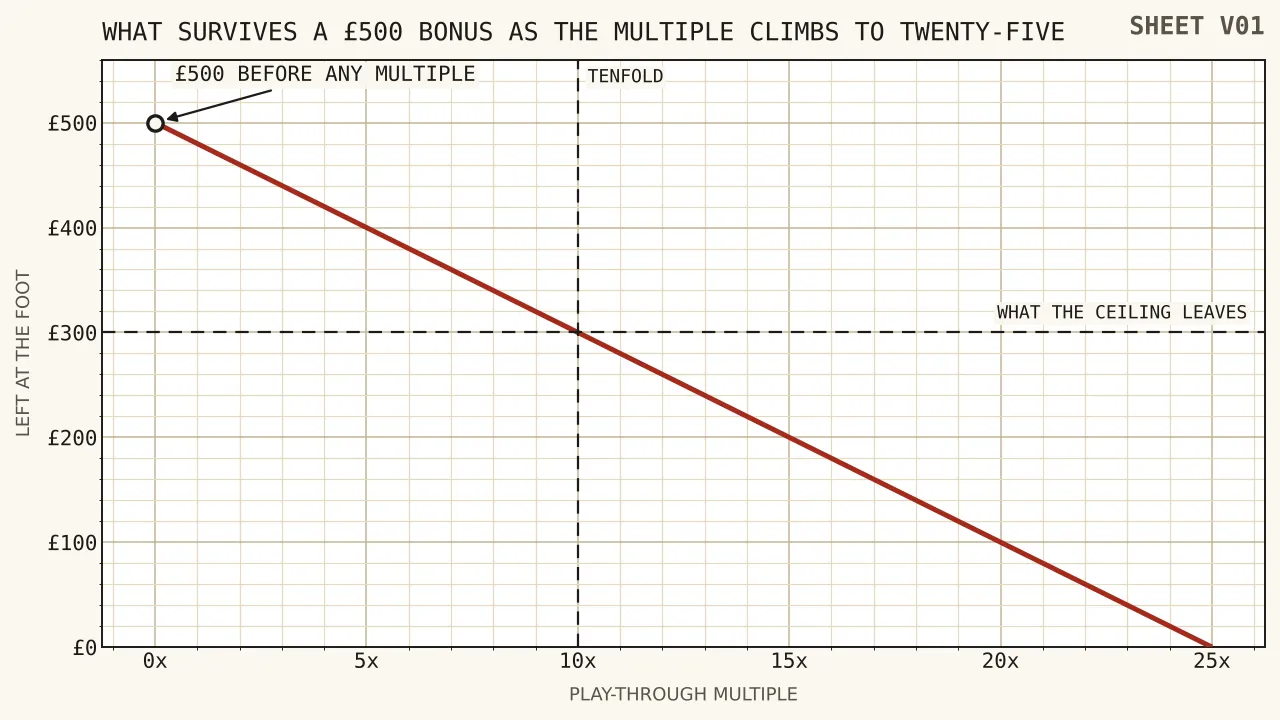
Up here the offers are quoted in hundreds rather than in spins, and the arithmetic is any bonus arithmetic with a zero added. Take a bonus of £500.00. Scale the requirement by the edge of 4 per cent, deduct the answer from 1, and apply what is left to the bonus.
| Multiple | Turnover owed | Spins at £5 | Minimum time | Expected to survive |
|---|---|---|---|---|
| Two times | £1,000.00 | 200 | 8 min 20 s | £460.00 |
| Five times | £2,500.00 | 500 | 20 min 50 s | £400.00 |
| Ten times, the ceiling | £5,000.00 | 1,000 | 41 min 40 s | £300.00 |
| Twenty times | £10,000.00 | 2,000 | 83 min 20 s | £100.00 |
| Twenty-five times | £12,500.00 | 2,500 | 1 hr 44 min | nothing |
Three things follow. What survives is the bonus multiplied by one less the multiple divided by twenty-five, so £500.00 keeps three fifths at ten times and a fifth at twenty. The time column is the honest price of the clearance: a tenfold requirement at the stake ceiling needs 1,000 cycles, which cannot be compressed below 41 minutes and 40 seconds on a licensed product. And at twenty-five times the expectation arrives at nothing, since 1 divided by 0.04 is 25.
Only the top three rows are available on a British licence, where a wagering requirement attached to an incentive is capped at ten times the bonus funds. The ceiling arrived in January 2026, on the nineteenth, and its reach extends to all licences, ancillary remote included, with exactly two exceptions, covering gaming machine technical work and gambling software. So a £500.00 bonus here cannot carry more than £5,000.00 of turnover, and an offer asking twenty times is an offer from outside this market.
Game weighting is where a large bonus quietly becomes larger. A contribution rate of 30 per cent appears in what respondents put to the consultation. At that rate, buying the £5,000.00 of progress in the tenfold row takes something near £16,666.67 of staking. At the stake ceiling that is 3,334 cycles and two hours and twenty minutes of play, for the same expected £300.00. The rate belongs to the respondents and the conversion is this sheet’s own.
4
Which conditions still bite at this size
Most of the conditions this site prices elsewhere stop mattering at a £5.00 stake, and one matters far more. Setting them out in order of effect is the quickest way to read a set of terms at this end of the market.
| Condition | Effect at 10p a spin | Effect at £5 a spin | Why it changes |
|---|---|---|---|
| A £10 smallest payout | decisive | irrelevant | the mean is 96 times it |
| A £1,000 win cap | never reached | binds past 209 spins | the mean reaches it |
| A tenfold multiple | takes 40 per cent | takes 40 per cent | proportional, so unchanged |
| A maximum bet while clearing | rarely binds | decisive | it caps the stake, not the sum |
| A 24-hour window | generous | tight on a large clearance | pace is capped, turnover is not |
Row four is the one that catches readers staking at this level. Where the terms cap the stake during a clearance at, say, a tenth of the bonus or £5.00, whichever is lower, a £500.00 bonus allows £5.00 a spin and the clearance takes 1,000 cycles. Where the cap is £2.00, the same £5,000.00 of turnover needs 2,500 cycles and one hour and forty-four minutes. The expected cost of the clearance does not change, at 4 per cent of the turnover either way, but the time more than doubles.
The second row deserves a sentence of arithmetic. A spin at £5.00 contributes £4.80 of expectation, so dividing a win cap by 4.8 names the spin where the average meets it. A £1,000.00 cap is reached at spin 209. A £5,000.00 cap is reached at spin 1,042. Beyond those points, further spins add nothing to the expectation, and the figure in the cap is the offer.
No published source gives a usual maximum-win figure for bonus winnings, so the caps above are round sums chosen to bracket the expectation at this stake. One rule nearby guards the reader’s own money instead of a bonus. Terms that cap a withdrawal from a deposit balance are prohibited, and the larger that balance the more the prohibition is worth.
5
The thresholds that trigger a check
At this stake the published thresholds for financial checks are reached quickly, and the figures convert straight into spins. Light-touch checks apply to online customers whose net deposits pass a monthly threshold. Until 28 February 2025 the figure was £500 in a month, having arrived on 30 August 2024. From that February date it fell to £150.
Convert both into cycles at the stake ceiling. A net deposit of £150 in a month is thirty spins at £5.00, which is 75 seconds of play at the lawful pace. The earlier £500 threshold is a hundred spins, so 250 seconds. At the 10p this site uses elsewhere, the same thresholds are 1,500 spins and 5,000 spins, which is 62 minutes and 208 minutes of play. The threshold is written in money, so the stake decides how long a reader takes to reach it, and a high stake reaches it in a minute and a quarter.
| Stake per cycle | Cycles to £150 of net deposit | Minimum play time |
|---|---|---|
| 10p | 1,500 | 62 min 30 s |
| 50p | 300 | 12 min 30 s |
| £2 | 75 | 3 min 7 s |
| £5 | 30 | 1 min 15 s |
Two points of accuracy belong with that. Enhanced financial risk assessments are something else again, and they remain a pilot. Three statements from the regulator cover them. They are not being rolled out live. Consumers are unaffected while the pilot runs. And nothing in the pilot, or in the light-touch checks, touches a credit rating. A page that conflates the two is describing something that is not happening.
And the reason those checks exist at all is money rather than conduct, which is why they land on this page rather than on a page about small awards. A reader staking at the ceiling crosses the monthly threshold in a minute and a quarter of continuous play. A reader staking at 10p needs an hour. The rule is the same for both; the stake decides who meets it.
6
Limits, and the two speeds they move at
The one control a reader has over a large session is a limit they set themselves, and on a British licence its mechanics are specified. Facilities for setting a financial limit have to be easy to reach and open from registration onwards, with the prompt coming during the registration itself or at the first payment in. Implementation follows as soon as practicable, and the customer learns when the limit starts to apply.
The two directions move at different speeds, and at this stake the difference is worth real money. An increase needs the customer to ask, then at least 24 hours of cooling off, then a positive act of confirmation at the end of that period. A reduction is implemented immediately unless a technical failure prevents it.
Convert the cooling-off period into turnover at the ceiling. Twenty-four hours is a day in which the old limit still applies, and at £5.00 a cycle the most that can pass through a licensed slot in that day is £172,800.00 of turnover at the lawful pace, with an expected cost of £6,912.00. Nobody plays for 24 hours without stopping, and the figure is still the right way to see what a holding period is: a brake on the direction that increases exposure, and no brake at all on the direction that reduces it.
Three further requirements shape the facility. A free text box is what the customer gets for setting a limit, or its telephone equivalent, and the floor for where a limit bites is the account. Gross deposit limits have to be available. A limit of that kind caps what the customer pays in across a period named in advance, and the standard keeps the term for limits answering that description. Prominence has to match what other limit types get, and the durations have to cover 24 hours, 7 days and 1 month. Setting a limit is the default: the facilities must present it as the default choice, require an action to decline, and obtain confirmation before moving on to deposit or gamble.
A worked example of overlapping limits is published, and it is useful at any stake. Where a £10 day limit and a £100 week limit are both set, the tighter one governs, which leaves the system permitting £10 in any day and £70 over the week. At the stake ceiling a £10 daily limit is two cycles a day, which is the clearest demonstration on this site that a limit set in money means something entirely different at £5.00 a spin than at 10p.
7
Getting the money out again
At this end of the market the withdrawal rules matter more than the bonus rules, because the sums are larger and the balances are the reader’s own. Two published rules do most of the work.
The first forbids any cap on withdrawals out of a deposit balance. No term in a consumer contract, and none in a consumer notice, is available to a licensee where it operates to cap what the consumer draws back out of money they paid in. The specimen of a prohibited term that gets published pairs a daily maximum with a weekly one. The same material gives players an entitlement to withdraw from a deposit balance whenever they choose, winnings included, bars restrictions on the maximum sum, and wants reasonableness wherever a limit touches how big or how often a withdrawal may be. Neither a publication date nor a last-updated date appears on that page, so it is good for the rule and not for a date.
The second is a prohibition on undoing a withdrawal. The option of cancelling a withdrawal request may not be put in front of a consumer. The guidance adds that once a withdrawal is requested the customer should not be given the option to deposit using those funds, and that operators should make the process to withdraw funds as frictionless as possible. At a stake of £5.00 a cycle, a cancelled withdrawal of £1,000.00 is 200 further cycles of exposure, and that is precisely the sequence the rule removes.
A win cap on a bonus and the prohibition on capping a deposit balance are two different things, and this is the page where the distinction is worth most. A cap on bonus winnings escapes the withdrawal rule, which attaches to the deposit balance instead. A single document can hold both and contradict itself nowhere, so a reader needs to know which balance a figure attaches to before judging it lawful.
One more figure, for a reader weighing whether a dispute is worth pursuing. On a British licence a complaint, internal escalation included, has eight weeks from first receipt and no longer, after which an independent dispute body carrying the regulator’s approval takes it, and eight such bodies are listed. Those timings do not scale with the sum in dispute: the same eight weeks apply to £9.60 and to £9,600.00.
8
Who pays the duty on a large session
Readers at this end of the market ask about tax more than any others, and the published position is about the operator rather than the player. The manual keeps betting and gambling outside trading, and the qualifier it uses is the phrase as such. Two qualifications travel with it. Organise an activity to take profit from the gambling public and it will normally amount to a trade. And a taxpayer on spread bets is normally not trading, so the profits escape tax and the losses attract no relief, while the bookmaker that organised the bet is taxed on its own margin.
The case law is in the same manual. The case law runs back to 1925, where a taxpayer lived entirely on horse betting at starting prices. The court found no trade, and the sentence most often lifted out of the judgment denies that a habit can be taxed. Three things are recorded as insufficient by themselves: a system behind the bets, a living drawn from the proceeds, and expertise or form study. It also notes where a gambler can be trading, giving appearance money for television programmes as an example and saying that whether such winnings are trade proceeds would depend on the facts.
Nothing published declares winnings untaxed in terms, so this sheet reports the position as the manual frames it and stops there: on their own account, betting and gambling are not a trade, and winnings are therefore not trading income. None of that is tax advice, and no sentence here reaches an individual set of circumstances.
What is charged, and on whom, is published clearly. Remote Gaming Duty falls on a gaming provider’s profits where the customer usually lives in the United Kingdom. Its rate reached 40 per cent on 1 April 2026. For the seven years before that it stood at 21 per cent, and at 15 per cent earlier still. Residence rather than licensing decides the charge. A business based anywhere falls inside it once remote gambling is offered to somebody whose ordinary home is here. An operator sitting abroad and not inside a group generally appoints an HMRC-approved representative here. The exception is a base in an exempt jurisdiction, and three examples are given: the EU member states, Norway, Gibraltar.
At the scale of this page that rate is worth stating as arithmetic. An hour of continuous play at the stake ceiling is £7,200.00 of turnover and an expected £288.00 of operator margin. Forty per cent of that margin is £115.20 of duty. The reader is not charged, and the reader is where the money came from.
9
The same stake with no ceiling over it
Offers aimed at large stakes get heavy advertising from outside Britain, where the cashier behind them has no Great Britain licence. On this page that absence has a specific and quantifiable meaning, because the two rules in part two are the rules that cap how fast money can move.
| On a session of this size | British licence | No British licence |
|---|---|---|
| Biggest stake on one slot cycle | £5.00, dropping to £2.00 under 25 | no published ceiling |
| Fastest lawful turnover on slots | £2.00 a second | no pace rule published |
| Automatic play | unavailable | unaddressed |
| Two games at once | may not be offered | unaddressed |
| Checks on net deposits | light-touch above £150 a month | no published threshold |
| Cap on withdrawing a deposit balance | prohibited | no published prohibition |
| Cancelling a withdrawal | must not be offered | unaddressed |
The first two rows are the ones that matter most, and they compound. Without a stake ceiling and without a minimum interval between cycles, there is no arithmetic ceiling on turnover at all: the rate becomes whatever the software permits, and a reader can lose in minutes what a licensed product would take an hour to accept. That is not a claim about any particular site. It is the absence of two rules, stated as arithmetic.
The offshore rulebook read for this page came from the Curaçao authority, whose responsible gaming policy stands at a first version bearing 21 February 2025, and what is absent from it is the point. No stake limit appears in it. No minimum game cycle. Nothing about automatic play or accelerated results. No cap on a wagering multiple. Bonuses get two sentences out of it. Terms are to be communicated transparently, with conditions made clear. Promotion is to stop short of the aggression that pushes excessive play.
Two provisions in it run the other way, and both belong in a fair comparison. Out there a cut to a deposit limit bites immediately while a rise waits seven days, against a British holding period of a day at the least, so the offshore brake grips harder on that one point. It also requires cooling-off at four lengths, the shortest a day and the longest three months, with a week and a month between them. One click reaches each, with no email to send and nothing to be signed off, each bites at once, each can be set product by product, and discouraging their use is forbidden to the operator.
Its deposit limit periods are daily, weekly or monthly, against a British requirement for 24 hours, 7 days and 1 month, which is the same shape. What is missing is everything in parts two and five of this sheet: the stake ceiling, the pace floor, and a published threshold at which a check on net deposits begins.
Self-exclusion is the loss that does not scale with the stake, because it is binary. Membership of the national online scheme comes with a British licence. The scheme states the reach of its assistance: the gambling services of operators that take part. Where an organisation has stayed outside, it says it cannot prevent access. Out there exclusion goes in operator by operator, taking in that operator’s domains, with encouragement to do the same elsewhere, and once confirmed the player cannot lift it before the term ends. No sentence here helps anybody work round an exclusion they set themselves, and the number below is free and answered whatever the hour.
Questions
- How large a stake does a licensed casino allow on one spin?
- £5 for one slot game cycle, with £2 applying to anybody younger than 25, under regulations dated 25 February 2025. The regulator’s guidance dates the higher limit to 9 April 2025 and the lower one to 21 May 2025. Online slots are what the limits reach, leaving roulette, blackjack and the rest of the casino outside them.
- How fast can a licensed slot take my money?
- £2.00 a second at most, which is the £5 ceiling divided by the 2.5 seconds owed between one cycle opening and the next. That comes to £120.00 a minute and £7,200.00 an hour of turnover, with an expected cost of £288.00 in that hour at a 96 per cent return.
- Does a bigger stake improve the odds?
- No. It multiplies every figure in the same proportion, the loss included. Two hundred spins at 10p stake £20.00 and cost an expected 80p; the same tally at £5.00 stakes £1,000.00 and costs an expected £40.00. The house edge is unchanged at 4 per cent throughout.
- What does a £500 bonus actually deliver?
- £300.00 in expectation at the tenfold ceiling a British licensee may ask, since ten lots of 4 per cent take 40 per cent of the bonus away. Turnover owed comes to £5,000.00: 1,000 cycles at the stake ceiling, and 41 minutes 40 seconds of play as the floor.
- Why does a maximum bet rule matter so much at this level?
- Because it caps the stake rather than the sum. Where the terms allow £5.00 a spin, £5,000.00 of turnover takes 1,000 cycles and about 42 minutes. Where they allow £2.00, the same turnover takes 2,500 cycles and one hour forty-four. The expected cost is 4 per cent of the turnover either way, so the condition buys time rather than money.
- At what point do financial checks start?
- Light-touch checks reach online customers whose net deposits pass a monthly figure. That figure started at £500 on 30 August 2024, then came down to £150 on 28 February 2025. At the stake ceiling, £150 of net deposit is thirty cycles, or 75 seconds of play. At 10p a spin it is 1,500 cycles.
- Will a check affect my credit rating?
- The regulator states that neither the light-touch checks nor the enhanced assessment pilot will affect a consumer’s credit rating. It also states that nothing has been rolled out into a live environment and that consumers go unaffected while the pilot runs, so the two should never be described as one thing.
- Can a casino cap how much of my own money I take out?
- Not from a deposit balance. Four verbs are barred where the object or the effect is a maximum on withdrawals from that balance: imposing such a term, using it, enforcing it, or seeking to rely on it. The published material adds two things: nothing may restrict the maximum sum withdrawable at any time, and reasonableness governs any limit touching how big a withdrawal may be or how many are allowed.
- Can a withdrawal be reversed so the money stays in play?
- Not on a licensed site. A consumer may not be offered the option of cancelling a withdrawal request, the funds behind such a request should not then be offered back as a deposit, and the guidance asks for a withdrawal process with as little friction in it as possible. At £5.00 a cycle, a cancelled withdrawal of £1,000.00 would be 200 further cycles of exposure.
- Am I taxed on large winnings?
- The published position puts betting and gambling outside trading on their own account, which makes winnings something other than trading income, and no page was found anywhere declaring them untaxed in terms. What is charged is a duty on the operator’s profits from remote gaming, 40 per cent from 1 April 2026, which tracks where the player ordinarily lives and not where the licence came from. None of this is tax advice.
- What is different at an offshore casino with no stake limit?
- The arithmetic ceiling disappears. Strip out the £5 cap and the 2.5 seconds between cycles and nothing published limits how quickly turnover can build, where a licensed slot halts at £2.00 a second. Gone too is the published threshold at which checks on net deposits begin, along with the prohibition on capping a deposit-balance withdrawal and the bar on offering to undo one.