Sheet D01 Revision 1 Counted 16 October 2026
Free spins no deposit: what a count is worth at 10p a press
Nothing goes in, so nothing is at stake, and nothing is weighing the award down either. That makes a no-deposit count the one kind of offer whose whole value fits inside a single multiplication: the count, the price of one press, the return. Price a hundred of them at 10p, hand them to a 96 per cent game, and the average is £9.60. Every line of small print under the headline subtracts from that figure, and this sheet works out how much each line takes.
The count 100 presses One spin 10p Comes to £9.60 before subtractions
What a count of this size comes to
Every destination on this board is bought advertising. The site takes a fee if a reader goes on to register, and no figure printed below moves because of it.
The Spin Count
Gauge No 01
Betportal
Lowest multiple here
Priced at this site's own 10p a spin
What is counted
What is asked
No Great Britain licence
Licensed in Anjouan, Comoros, run by BetPortal Gaming Ltd, with Excite Ultra Media Ltd, reference ALSI-202601040-FI2.
Terms read 16 October 2026
Open the offer at Betportal, opens in a new tabThe Spin Count
Gauge No 02
WinBeast
Largest count here
Priced at this site's own 10p a spin
What is counted
What is asked
No Great Britain licence
Licensed in Curaçao, operator not named on the site.
Terms read 16 October 2026
Open the offer at WinBeast, opens in a new tabThe Spin Count
Gauge No 03
EliteSpin
Longest spin window
Priced at this site's own 10p a spin
What is counted
What is asked
No Great Britain licence
Licensed in Costa Rica, run by PrimeTier Limited.
Terms read 16 October 2026
Open the offer at EliteSpin, opens in a new tabThe Spin Count
Gauge No 04
Crown Jewelz
Multiple unpublished
No foot figure struck
What is counted
What is asked
No Great Britain licence
Licensed in Curaçao, number not verified, operator not named on the site.
Terms read 16 October 2026
Open the offer at Crown Jewelz, opens in a new tabThe figure in the third register is this site's own arithmetic and nothing an operator has published: the count at face, less the share a spin gives back at 96 per cent return to player, less what playing the wagering through costs at the same return. It describes the offer, not one reader's afternoon. Where the conditions price above the count the counter prints nothing rather than a negative sum, and where a figure the sum needs is unpublished it prints the condition in the operator's words instead.
A count has no unit of its own, so one is supplied. Where an operator publishes what a spin of its own is worth, that figure stands in the second register and is labelled as theirs. Where it does not, the second register carries this site's own 10p a spin and says so, and the foot figure moves in proportion: at half the price, half the money. The figure after it, what the count comes to for each spin, is the one that compares a large count against a small one.
Three words stand in the amount column where no figure can. Noted is a published condition that takes value away without leaving the sum a figure to take. Unpriced is a condition whose figure nobody has published, or a credit that is not a sum until a deposit of your own sets it. Own money is money of yours, which is never part of a foot figure.
Not one of the operators printed above holds a Great Britain licence, so the duties that licence carries do not reach them. Every online gambling company licensed in Great Britain has to be part of Gamstop Online, and a reader who has shut themselves out through the scheme is therefore not shut out here. The ceiling of ten times the bonus funds on a wagering requirement, in force since 19 January 2026, is a condition of that licence and binds the companies that hold one. Where a dispute goes instead is a matter for the authority named on the counter, and the Gambling Commission describes what a reader faces without a British licence as a lack of recourse if things go wrong. Nobody under 18 may hold an account at any of them.
Every term printed on a counter is the operator's own, and each counter carries the day it was read. The oldest of those readings is 16 October 2026. What binds a reader is the operator's own full terms, and not a line printed here.
1
A count is not a quantity yet
A headline of free spins gives a reader a number and withholds the unit. Fifty, a hundred, a thousand: each is a tally of button presses, and a tally turns into money only when somebody states what one press costs. Supplying that missing unit is this site’s entire job, and the job is one multiplication long.
Use the price this site works to, which is 10p. Fifty presses at that rate carry £5.00 of staking. A hundred carry £10.00. A thousand carry £100.00. Each of those is a face value, the amount of stake somebody else has funded on the reader’s behalf, and none of them is what the count is worth, since a slot retains a share of every pound that passes through it.
Fix the share and a second figure drops out. A 96 per cent return hands back 96p in the pound and keeps 4p, so fifty presses average £4.80, a hundred average £9.60, and a thousand average £96.00. Those are long-run averages over identical presses rather than forecasts for one sitting. They are also the only figures on which two unlike counts can be compared without lying to the reader.
Why 10p, and why 96 per cent. Neither is handed down anywhere. Three things are missing from every published source that could be reached: the worth of a single free spin, the identity of whoever fixes it, and any duty to disclose it. The pence figure is the operator’s commercial decision, so this site declares its assumption rather than pretending a regulation supplied one.
What the rules do supply is narrower and more useful. A customer must be able to get at information bearing on their prospects of winning before committing to gamble. Four alternatives satisfy that duty, and an “or” joins them. One is the chance of the winning events occurring. One is the return percentage. Another is the house edge, sometimes written as the margin. The fourth is an account of the game’s workings, of how winners are settled and of how prizes get allocated. A house-edge figure therefore discharges the duty by itself, and a return percentage need never appear at all.
Two numbers do all the work on every page in this section, and both are declared rather than discovered. One press costs 10p. The game gives back 96 per cent, leaving a 4 per cent house edge. Where a count is tied to a named game with a published figure of its own, that figure displaces the 96 and the sentence says why. Everywhere else the 96 stands, and each pound of difference it makes is visible in the working instead of buried inside it.
2
Nothing is pulling against the award
A deposit match and a no-deposit count look like two sizes of one product. They are two different sums. A match hands over bonus funds with a play-through fixed to them: the bonus must be turned over some multiple of itself to become withdrawable, and the expected cost of that turnover comes off the bonus before a reader sees a penny of it. A count of presses carries no multiple on the award, because the award is not a balance. It is a set of presses, paid for already, which the reader simply uses up.
That structural difference is what gives this section its own arithmetic. For a count, the sum is the count times the press price times the return, and then it stops. A hundred presses at 10p on a 96 per cent game come to £9.60, and no play-through appears anywhere in reaching that answer.
Everything else in this sheet subtracts from that £9.60. Five shapes of subtraction exist, and naming them before pricing them is worth a paragraph: a ceiling set on what the winnings may reach, a floor beneath what may be taken out, a clock measuring how long the thing survives, a schedule dripping the presses across days, and a play-through that reappears on the winnings instead of on the award. Any one of the five can outweigh the headline count. Two of them can remove the whole of it.
One multiplication, five subtractions, and the subtractions are where the money goes
3
The ladder of counts, priced to the penny
Put the usual headline counts in one column and the arithmetic in the others, and the shape of this market becomes legible. Face value is the count times 10p. The expected column is 96 per cent of face. The last column is the shortest span the presses could lawfully occupy on a licensed slot, where two and a half seconds must elapse before a game cycle restarts. A count therefore has a minimum running time attached to it whether a reader wanted one or not.
| The count | Face value | Expected at 96% | Shortest lawful run |
|---|---|---|---|
| 5 presses | £0.50 | £0.48 | 12.5 seconds |
| 10 presses | £1.00 | £0.96 | 25 seconds |
| 20 presses | £2.00 | £1.92 | 50 seconds |
| 25 presses | £2.50 | £2.40 | 1 minute 2 seconds |
| 30 presses | £3.00 | £2.88 | 1 minute 15 seconds |
| 50 presses | £5.00 | £4.80 | 2 minutes 5 seconds |
| 70 presses | £7.00 | £6.72 | 2 minutes 55 seconds |
| 100 presses | £10.00 | £9.60 | 4 minutes 10 seconds |
| 150 presses | £15.00 | £14.40 | 6 minutes 15 seconds |
| 200 presses | £20.00 | £19.20 | 8 minutes 20 seconds |
| 500 presses | £50.00 | £48.00 | 20 minutes 50 seconds |
| 1,000 presses | £100.00 | £96.00 | 41 minutes 40 seconds |
Three readings come off that table, and all three beat the headline they replace. Reading one: face and expected worth differ by 4 per cent every time, so once the press price is settled the arithmetic produces no surprises in either direction.
Reading two: the sums are small. Twenty presses, a count that fills a great many headlines, average £1.92. A reader weighing whether a sign-up is worth the paperwork is weighing less than two pounds, and the paperwork means a name, a birth date and a postal address handed to a company they have never dealt with.
Reading three is about time, and nobody prints it. A thousand presses cannot pass through a licensed slot in under forty-one minutes and forty seconds, and that is at floor speed, with no gap between presses and no thought spared for any of them. Neither turbo nor slam stop may be sold on a licensed site, and autoplay is out as well, so each press has to be made deliberately. A headline of a thousand is an instruction to press a button roughly seven hundred times an hour.
4
A ceiling fixed on the winnings
The first subtraction is printed as a maximum win, and arithmetically it is the most brutal of the five, because it does not scale a figure down. It replaces the figure. Where no more than a fixed sum can ever leave the account, the expected value of the entire offer cannot exceed that sum, whatever the count said.
Run it backwards and the ceiling yields a count. Each press contributes 9.6p to the expectation at 10p and 96 per cent, so a ceiling of £10.00 is reached, on average, at about 104 presses. Under that count the ceiling sits above the mean and bites only on a fortunate run. Over it, the ceiling does the deciding, and further presses add nothing whatever to the expectation.
So a thousand presses beneath a £10.00 ceiling is not a hundred pounds of value. It is ten at most, and this is not an estimate. The uncapped expectation is £96.00; a capped balance cannot pass £10.00; therefore the ceiling removes at least £86.00 of it. The headline grew tenfold and the expectation stayed where it was.
| Ceiling printed | Binds beyond |
|---|---|
| £5 maximum | 53 presses |
| £10 maximum | 105 presses |
| £20 maximum | 209 presses |
| £50 maximum | 521 presses |
| £100 maximum | 1,042 presses |
Two cautions ride along. Caution one: a standard maximum-win figure for bonus winnings is published nowhere this site could read, so the ceilings in that table are round numbers chosen to make the arithmetic legible and not a report of what some cashier prints.
Caution two is the one routinely muddled. No term may put a ceiling on withdrawals from a deposit balance, and the regulator supplies a specimen of the forbidden wording in which a fifty pound day is set beside a five hundred pound week. That prohibition governs the reader’s own money. A ceiling fixed to bonus winnings governs another balance entirely, so a single document can carry both figures and contradict itself nowhere. Which figure applies turns on which balance the money is sitting in.
5
A floor under what may be taken out
The second subtraction works from underneath. Where the terms set a smallest withdrawal, a balance below that figure cannot be moved at all, and for the small counts filling most headlines the expected balance begins below it.
At 10p and 96 per cent the crossover lands where the ceiling’s did, which is a coincidence worth one sentence because it lets a single figure do two jobs. Clearing a ten pound floor needs an expected £10.00, which needs roughly 104 presses, which is the count where a ten pound ceiling begins to bind. Beneath about a hundred presses at this price, a ten pound minimum withdrawal is unreachable on the average, and the reader has to beat the average to be paid anything whatsoever.
How far they must beat it is a division. Twenty presses average £1.92, so a ten pound floor asks for 5.21 times the mean. Fifty presses average £4.80, and the same floor asks for 2.08 times. A hundred presses average £9.60, so the floor asks for 1.04 times, close enough that an ordinary session will sometimes clear it. Two hundred presses average £19.20 and clear a ten pound floor with room spare.
| The count | Expected | Multiple of the mean needed | Shortfall on the mean |
|---|---|---|---|
| 10 presses | £0.96 | 10.42 times | £9.04 short |
| 20 presses | £1.92 | 5.21 times | £8.08 short |
| 30 presses | £2.88 | 3.47 times | £7.12 short |
| 50 presses | £4.80 | 2.08 times | £5.20 short |
| 70 presses | £6.72 | 1.49 times | £3.28 short |
| 100 presses | £9.60 | 1.04 times | £0.40 short |
| 150 presses | £14.40 | cleared on the mean | none |
A reader meeting a small count and a ten pound floor in one set of terms is being offered something whose average outcome is unpayable by construction. Nothing about that is hidden and nothing about it is unlawful. It is a pair of figures which, multiplied out, describe an offer settling at nothing most of the time.
The regulator points players at precisely this pairing. Its consumer advice tells them to check for restrictions on an introductory offer, and the example it gives is a level of spend demanded before the bonus gets paid. That sentence carries a grammatical slip in the original, so it is paraphrased here rather than quoted, but the instruction inside it is the right one.
6
A clock, and what it is worth in presses
The third subtraction is time. Presses expire, winnings expire, and a window for claiming closes before either. Converted into presses, a clock on the spins themselves is usually the mildest of the five subtractions, while a clock on a play-through is the fiercest.
Start with the presses. A licensed slot may not open a new game cycle inside two and a half seconds, so a count has a floor on its own duration: twenty-five seconds for ten presses, four minutes and ten seconds for a hundred, forty-one minutes and forty seconds for a thousand. Set that against a twenty-four hour window and the window is not what binds. Even a thousand-press count needs under three quarters of an hour of button work, and the day it arrives on holds twenty-four of those.
Put a play-through on the winnings and the clock changes character entirely. Tenfold against an expected £9.60 is £96.00 of staking, which at 10p is 960 further presses and, at the lawful floor speed, forty minutes of pressing. Fortyfold is £384.00, 3,840 presses, two hours and forty minutes. A three-day window for that is generous. A twenty-four hour window is a second condition dressed as a courtesy.
A deadline of either kind counts as a significant condition in advertising terms, and the cost of burying one is on the record. Four categories make up the advertising regulator’s list of what has to be put clearly and prominently, and a no-deposit spins offer can trip every one of them. One category covers the time allowed for a claim and the time allowed for the use. A second is the deposit requirement and the wagering requirement. Eligibility is a third, taking in new customers only, an age bar and a location bar. Minimum odds or bet types make the fourth.
Three rulings put figures on it. The first fell on 17 July 2024, where a ten pound free bet needed a reply to a text message by a stated hour and the advertisement had not mentioned the deadline; the regulator treated the deadline as significant and its omission as likely to mislead. The second fell on 31 July 2024, where an excluded payment method sat in the small print among the full terms, which the regulator considered insufficiently prominent. The third fell on 27 August 2025. A voucher worth five pounds was unusable on 14 March, a race meeting being the reason, and the advertisement had kept that to itself. Of the three, only the last is recorded on the regulator’s page in the language of a breach.
3,840 presses, two hours and forty minutes, to clear fortyfold on £9.60
7
A schedule, and the attendance it asks for
The fourth subtraction does not touch the arithmetic, which is why it is the most underrated of the five. A count paid in instalments has precisely the expected value of the same count paid at once. A hundred presses handed over twenty a day across five days still averages £9.60. What a schedule alters is the number of occasions on which a reader must come back, and the number of separate clocks with the chance to run out.
Price the attendance instead of the presses and the schedule gives itself away. Twenty presses is fifty seconds of lawful minimum play, so a five-day drip asks for five visits of under a minute apiece. Ten a day for thirty days is twenty-five seconds a visit and thirty visits. Ten a week for a year is fifty-two visits and 520 presses, which is £52.00 of face value and an expected £49.92 spread over twelve months. The sums have not moved and the commitment is a wholly different thing.
Each instalment also tends to bring its own expiry, and that is where a schedule becomes a subtraction with a real number against it. Where a tranche must be used on the day it lands, a missed day removes that tranche’s entire contribution. One missed day in a thirty-day drip of ten presses removes 96p from an expected £28.80. Five missed days remove £4.80. A reader who signs up for a month and attends three weeks of it has bought three quarters of the headline.
One rule in this corner points the other way. A licensed product is barred from urging a customer on after losses, from pressing them towards a bigger stake, and from keeping them going past the point where they have said they are done. The guidance beneath that requirement adds that somebody who has chosen to exit should not be tempted back, and it names a free game as the way that happens. A daily spins calendar is an invitation to return, and on a licensed site the invitation has to stop where the customer has.
An instalment schedule is the one subtraction that bumps into the licence’s timing rules rather than its arithmetic. An account showing activity across a rolling twelve months brings a duty to prompt its holder to look over their own account and transaction history, at intervals no longer than six months, with facilities for setting more frequent reminders than that. The readers who stay signed up to a year-long drip are exactly the readers those prompts were written for.
8
A play-through that lands on the winnings
The fifth subtraction puts a multiple back into a sum that started without one. The presses cannot carry a play-through, but what they win can, and where the proceeds are credited as bonus funds a requirement against those funds is the arithmetic of any deposit match.
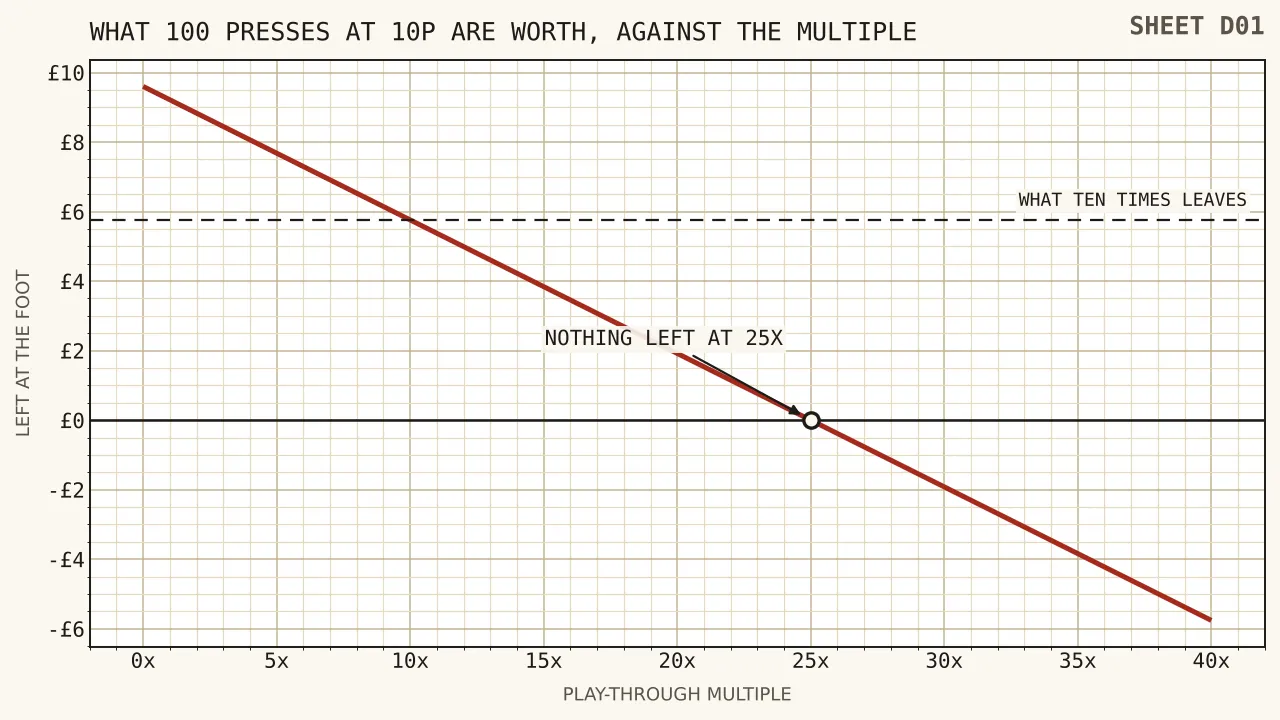
The working is one line. Take the balance. Multiply the play-through multiple by the house edge. Subtract that product from one, and multiply the balance by whatever is left. For a hundred presses that balance is £9.60, the edge is 4 per cent, and the multiple is whatever the terms name. Tenfold keeps 60 per cent of the balance. Twentyfold keeps 20 per cent. Twenty-five keeps nothing at all, because twenty-five fours make a hundred, and that reciprocal is the single most useful number a reader can take away from any bonus page. Beyond twenty-five the answer drops under zero. The balance is expected to run dry while the requirement is still outstanding, and whatever staking remains falls to the reader.
| Multiple named | Staking due | Presses at 10p | Cost of the staking | Left at the foot |
|---|---|---|---|---|
| No requirement on winnings | none | none | nothing | £9.60 |
| Tenfold | £96.00 | 960 presses | £3.84 | £5.76 |
| Twentyfold | £192.00 | 1,920 presses | £7.68 | £1.92 |
| Twenty-five times | £240.00 | 2,400 presses | £9.60 | nothing left |
| Fortyfold | £384.00 | 3,840 presses | £15.36 | a shortfall of £5.76 |
Which of those rows a reader can even meet depends on where they are standing. A tenfold limit on bonus-fund play-through binds a British licensee, and has done since 19 January 2026, which puts the first three rows inside this market and the fortyfold row at a cashier beyond it. The practice that ceiling displaced reached sixty times, on the regulator’s own record. The same code provision bars one incentive from reaching across two of the product types it lists, so casino presses and a book of bingo tickets cannot be bolted together and cleared through a single shared requirement.
Two edges of the ceiling are unsettled, and this sheet will not paper over either. Bonus funds are what the wording bites on. Whether a press given away is itself such a fund has never been published in either direction, and neither has the question of a requirement computed on a deposit plus a bonus rather than on the bonus alone. The chain of published words reaches this far and no further: proceeds credited to a bonus balance carry a requirement bounded at ten times. On a £14.40 balance that bound is £144.00 of staking, which is 1,440 presses at 10p.
Game weighting is the quiet reason an offer can sit inside the ceiling and still ask for more turnover than it appears to. A game counting below its face hands over less than a pound of credit for each pound staked. Where a game contributes at 30p in the pound, the rate quoted by respondents on the regulator’s consultation page, a ten pound balance at tenfold needs £100.00 of credit towards the requirement. At that rate the credit costs about £333.33 of actual staking, or 3,333 presses at 10p. The arithmetic there is this site’s own, and the contribution rate belongs to the respondents who supplied it.
9
What the licence pays for, line by line
Counts printed at the offshore end of this market carry no Great Britain licence. Saying what that costs means listing the duties that halt at the border, one at a time, rather than gesturing at the idea of regulation. Each sentence below states something a British licence holder must do, and therefore something a cashier without one need not.
A holder must verify a name, must verify an address, and must verify a date of birth, all of it before the customer gambles, and the condition treats those three as a floor and not a shortlist. A holder must run the identical check before play paid for by a bonus, before play on a free bet, and before a customer reaches the no-stake versions of its own games. A holder must refuse a credit card as payment for gambling, including one arriving by way of a money transfer business. A holder must ask for a financial limit during registration or at the first payment in, must make setting one the default, must require a positive act before a customer can decline it, must offer durations covering a day, a week and a month, must action a reduction at once, and must sit on an increase for a full day. A holder must leave a requested withdrawal alone, with no button to undo it, and must not cap what leaves a deposit balance. A holder must keep a slot’s game cycle at two and a half seconds or longer, must not sell turbo or slam stop, must not run two games at once, must not celebrate a return no bigger than the stake, and must not dress a loss up as a near miss. A holder must keep one slot game cycle inside a five pound stake, or two pounds where the customer has not turned twenty-five. A holder must answer a complaint inside three working days, must close the whole process within eight weeks, and must send the customer on to an approved adjudicator, of which the regulator’s list names eight. A holder must join the national online self-exclusion scheme. Its registered total was given as 614,738 in a release of 16 July 2026.
Now read the rulebook on the other side. Version 1.0 of the Curaçao authority’s responsible gaming policy is dated 21 February 2025. Read end to end, it fixes no ceiling on any multiple at all. It sets no stake limit. It prescribes no minimum game cycle. It leaves autoplay alone, and it says nothing whatever about fanfare over a return at or below the stake. On bonuses it manages two lines, and they are the whole of it: terms communicated transparently, and no encouragement of excessive gambling through aggressive promotion. No tenfold cap appears in it, no mixed-product ban and no list of significant conditions.
Two places where the offshore rulebook is not the weaker one deserve stating, since a page flattening everything into “unregulated” is as unreliable as one flattening it into “fine”. There, a cut to a deposit limit lands immediately and a rise is held for seven days; the British holding period is twenty-four hours at the least. Complaints carry a six-month window and an eight-week operator timeline, which matches the British shape, with dispute resolution mandatory and free to the player.
The two regimes part company over who writes the terms of that resolution. Here the regulator approves the adjudicators and a licensee may appoint only an approved one. There, the policy leaves the parameters to the operator. Two are named: whether the outcome is to bind the player, and whether escalation needs a claim above some minimum value.
Self-exclusion is the sharpest single loss. The national scheme reaches only the operators taking part, and its own terms concede the limit: where an organisation stays outside, the scheme is unable to help. Offshore, exclusion is arranged one operator at a time. The shortest term there runs a year where the British scheme starts at six months. For the other sites a person can still reach, the policy’s remedy is encouragement to exclude at each of them, which amounts to a register of one, repeated as often as necessary.
Tax, by contrast, follows the player and not the licence. Any operator, wherever it sits, must register for British gaming duty and pay it on remote gaming played by a person who usually lives here. On remote gaming the duty rate is 40 per cent, and 1 April 2026 is the date it became so, against 21 per cent for the seven years before and 15 per cent earlier. So an absent authorisation saves the reader no tax at all, while removing every route of recourse that the authorisation would have brought with it.
One published enforcement outcome bears directly on the small print of a no-deposit offer, and it is the sharpest fact on this page. In one operator’s rules for new casino promotions, a clause kept a discretion in hand: shut the account, or take the winnings. Three things followed. The regulator held that the term breached its licensing condition on dealing fairly and openly. It put on record that wording of that sort lacks transparency and is capable of producing unfair results for consumers. And assurance of continuing compliance was required of the operator through an independent third-party audit, taking in its money laundering controls alongside its safer gambling ones. The licensee was Taichi Tech Limited, which trades as Fafabet. The penalty was £170,000. The decision carries the date 3 July 2025. A clause of that shape is not void, because what was published is a penalty and not a striking down, but a reader meeting one now knows what it has cost somebody.
Questions
- In pence, what is a single free spin worth?
- 9.6p on average, on the two assumptions this site declares: 10p a press, and a return of 96 return. Ten presses therefore average £0.96, fifty average £4.80, and a hundred average £9.60. No published rule fixes the worth of a free spin, so the pence figure is the operator’s own commercial choice and the one used here is stated as an assumption.
- Why is a no-deposit count priced differently from a deposit match?
- Because nothing is pulling against it. A match hands over bonus funds with a play-through attached, so the expected cost of the turnover comes off the bonus before the player sees anything. A count of presses has been paid for already, so its whole worth is the count times the press price times the return, and each condition printed afterwards subtracts from that answer.
- What takes the value off a no-deposit count?
- Five things, in roughly this order of bite: a ceiling on what the winnings may reach, a floor beneath what may be withdrawn, a clock on the presses or on the wagering, a schedule dripping the presses across days, and a play-through reappearing on the winnings. A ceiling and a floor can each remove the whole expected value of a small count.
- When does a maximum win cap begin to matter?
- At 10p and 96 per cent, each press adds 9.6p to the expectation, so the ceiling divided by 9.6p gives the count where it starts to bind. Five pounds binds beyond about 53 presses, ten pounds beyond about 105, twenty pounds beyond about 209, and fifty pounds beyond about 521. Past the crossover a larger headline leaves the expectation exactly where it was.
- Can a licensed site cap how much I withdraw?
- Not where the money sits in a deposit balance. A licensee must not impose, use or rely on any term that caps what a consumer may withdraw from that balance, and the regulator prints a specimen of the banned wording in which a fifty pound day sits beside a five hundred pound week. A maximum win attached to a bonus sits on a different balance, so one document can carry both figures honestly.
- How long does a hundred free spins take to use up?
- Four minutes and ten seconds is the floor on a licensed slot, where two and a half seconds must pass before the next cycle can begin. A thousand presses need forty-one minutes and forty seconds at that same floor speed. Nothing advances without a fresh press, because turbo, slam stop and autoplay are each barred on a licensed site.
- What is the highest wagering requirement a British licensed site may set?
- Tenfold on the bonus funds, and no further. That limit arrived with code provision 5.1.1 on 19 January 2026, and earlier practice was put at sixty times in the consultation response behind it. The same provision stops one incentive from spanning two of the product types it lists, so casino presses and bingo tickets cannot be cleared through one shared requirement.
- Why does twenty-five times keep being called the end of it?
- Twenty-five is the reciprocal of a 4 per cent house edge. Each turn of a play-through multiple is expected to cost 4 per cent of the balance being cleared, so twenty-five turns consume all of it. Tenfold leaves 60 per cent of a balance, twentyfold leaves 20 per cent, and anything past twenty-five is expected to be funded out of the player’s own money.
- Does a daily or weekly instalment schedule reduce what the presses are worth?
- Not on its own. A hundred presses dripped twenty a day over five days still averages £9.60. What a schedule adds is attendance, plus one clock per tranche. On a thirty-day drip of ten presses a day, a single missed day removes 96p from an expected £28.80, and five missed days remove £4.80.
- What exactly is lost on an offshore count?
- Every duty set out in the last section of this sheet. An offer of that sort carries no Great Britain licence, and so none of the following binds the cashier printing it: joining the national self-exclusion scheme, closing a complaint within eight weeks at an approved adjudicator, checking a postal address and a birth date before bonus play, refusing a credit card, holding a game cycle to two and a half seconds, keeping one slot press under five pounds or under two for anybody below twenty-five, leaving a deposit balance uncapped, or halting at tenfold on a play-through. British gaming duty still reaches the operator, since the charge attaches to the player’s country of ordinary residence and not to the issuing jurisdiction.