Section V Revision 1 Counted 16 October 2026
What a spin is worth: 0.4p of expected cost and 2.5 seconds of clock
One press at 10p is expected to cost 0.4p and cannot be repeated for 2.5 seconds. Those two figures are the unit this whole site measures in, and the stranger consequence is that £10.00 of turnover costs 40p whatever a press is priced at. Seven pages take the unit apart.
The count 1 spin One spin 10p Comes to 0.4p
What one press is priced at where these packages come from
Every destination on this board is bought advertising. The site takes a fee if a reader goes on to register, and no figure printed below moves because of it.
The Spin Count
Gauge No 01
Betportal
Lowest multiple here
Priced at this site's own 10p a spin
What is counted
What is asked
No Great Britain licence
Licensed in Anjouan, Comoros, run by BetPortal Gaming Ltd, with Excite Ultra Media Ltd, reference ALSI-202601040-FI2.
Terms read 16 October 2026
Open the offer at Betportal, opens in a new tabThe Spin Count
Gauge No 02
WinBeast
Largest count here
Priced at this site's own 10p a spin
What is counted
What is asked
No Great Britain licence
Licensed in Curaçao, operator not named on the site.
Terms read 16 October 2026
Open the offer at WinBeast, opens in a new tabThe Spin Count
Gauge No 03
EliteSpin
Longest spin window
Priced at this site's own 10p a spin
What is counted
What is asked
No Great Britain licence
Licensed in Costa Rica, run by PrimeTier Limited.
Terms read 16 October 2026
Open the offer at EliteSpin, opens in a new tabThe Spin Count
Gauge No 04
Crown Jewelz
Multiple unpublished
No foot figure struck
What is counted
What is asked
No Great Britain licence
Licensed in Curaçao, number not verified, operator not named on the site.
Terms read 16 October 2026
Open the offer at Crown Jewelz, opens in a new tabThe figure in the third register is this site's own arithmetic and nothing an operator has published: the count at face, less the share a spin gives back at 96 per cent return to player, less what playing the wagering through costs at the same return. It describes the offer, not one reader's afternoon. Where the conditions price above the count the counter prints nothing rather than a negative sum, and where a figure the sum needs is unpublished it prints the condition in the operator's words instead.
A count has no unit of its own, so one is supplied. Where an operator publishes what a spin of its own is worth, that figure stands in the second register and is labelled as theirs. Where it does not, the second register carries this site's own 10p a spin and says so, and the foot figure moves in proportion: at half the price, half the money. The figure after it, what the count comes to for each spin, is the one that compares a large count against a small one.
Three words stand in the amount column where no figure can. Noted is a published condition that takes value away without leaving the sum a figure to take. Unpriced is a condition whose figure nobody has published, or a credit that is not a sum until a deposit of your own sets it. Own money is money of yours, which is never part of a foot figure.
Not one of the operators printed above holds a Great Britain licence, so the duties that licence carries do not reach them. Every online gambling company licensed in Great Britain has to be part of Gamstop Online, and a reader who has shut themselves out through the scheme is therefore not shut out here. The ceiling of ten times the bonus funds on a wagering requirement, in force since 19 January 2026, is a condition of that licence and binds the companies that hold one. Where a dispute goes instead is a matter for the authority named on the counter, and the Gambling Commission describes what a reader faces without a British licence as a lack of recourse if things go wrong. Nobody under 18 may hold an account at any of them.
Every term printed on a counter is the operator's own, and each counter carries the day it was read. The oldest of those readings is 16 October 2026. What binds a reader is the operator's own full terms, and not a line printed here.
1
The question this section exists to answer
Seven pages sit here and they share the narrowest question on the site: what is one press worth? Narrow, and load-bearing, because every other figure anywhere on these sheets is a multiple of the answer. Get the unit wrong by a factor of two and every tally priced against it is wrong by a factor of two.
A press has two prices and they are measured in different things. The money price is the expected cost of putting one stake through the machine, four pence in the pound where the machine returns 96 per cent: 0.4p on a tenpenny press, 2p on a fifty-pence press, 20p on a press at £5. The time price is the minimum interval before the next press is allowed, which on a licensed slot is 2.5 seconds and is set by rule rather than by preference.
Neither price appears in an advertisement. The tally appears, the percentage appears, and the unit that converts either of them into money is left to the reader to supply. These seven pages supply it.
Both prices are expectations and neither is a prediction. A tenpenny press returns 10p most of the time, nothing rather more often than that, and occasionally a great deal more; 0.4p is what the distribution averages to over a very large number of presses and is useless as a guide to the next one. The reason to use it anyway is that it is the only figure that adds up across a tally, and a tally is what this market sells.
2
Ten pounds of turnover costs 40p every time
Here is the result that surprises people. Fix the turnover at £10.00 and the expected cost of putting it through a 96 per cent machine is 40p, and the size of the unit makes no difference to that whatsoever. What the unit changes is how many presses the £10.00 is chopped into and how long the chopping takes.
| Price of one press | Presses in £10.00 | Seconds at 2.5s each | Cost of the £10.00 | Cost of one press |
|---|---|---|---|---|
| 1p | 1,000 | 2,500 | 40p | 0.04p |
| 2p | 500 | 1,250 | 40p | 0.08p |
| 5p | 200 | 500 | 40p | 0.2p |
| 10p | 100 | 250 | 40p | 0.4p |
| 25p | 40 | 100 | 40p | 1p |
| 50p | 20 | 50 | 40p | 2p |
| £1 | 10 | 25 | 40p | 4p |
| £2 | 5 | 12.5 | 40p | 8p |
| £5 | 2 | 5 | 40p | 20p |
Read the fourth column and it does not move. Read the third and it moves by a factor of five hundred, from five seconds to 2,500. A penny unit buys the longest sitting available for a given amount of money, and a five-pound unit buys the shortest, and the arithmetic cost of the sitting is identical at either end.
That is why the unit is a statement about duration and granularity rather than about value. A reader choosing a small unit is not getting better odds. They are getting the same expected cost spread over more events, which makes the result closer to the average and the session longer. A reader choosing a large unit is getting the same expected cost concentrated into a handful of events, which makes the outcome wilder in both directions.
40p of expected cost on £10.00 of turnover, from 1p a press to £5 a press
3
The statutory ceiling over a single press
The unit is one of very few things in this market carrying a figure fixed by law, and the figures are £5 and £2. Each is a per-game-cycle limit on an online slot, and the lower one applies below the age of twenty-five. The 2025 regulations that set them were made on 25 February; the £5 bound players from 9 April and the £2 from 21 May, six weeks later, because a flat five pounds covered everybody during the gap.
Two misreadings are common. The first carries the ceiling across to roulette or blackjack, where it does not reach: the regulator’s guidance keeps the limits inside slots and says as much in terms. The second treats the definition as thematic. It is mechanical, resting on whether a casino game is played online and runs off reels, or off some other way of showing images that move or change, with the arrangement they settle into deciding what gets won.
Converted, the ceiling stops being abstract. One lawful press at £5 is fifty tenpenny presses of stake squeezed into a single 2.5-second cycle, carrying the same 20p of expected cost that fifty presses would have spread over 125 seconds. At the lower figure a press costs 8p in expectation. Run an hour at the ceiling and at the quickest lawful pace: 1,440 presses in the hour, £288 of expected cost, on £7,200 of turnover.
4
Underneath, only the cashier’s own floor
There is no corresponding floor in law. Nothing obliges a cashier to accept a small stake and nothing fixes a minimum, so the bottom of the range is set commercially, by two separate numbers that readers tend to conflate: the smallest payment the cashier will take, and the smallest stake the machine will accept. Either can bind, and the one that binds decides how many presses a payment turns into.
Work it through. A payment of £1 against a machine with a 1p minimum is a hundred presses and 250 seconds. The same £1 against a machine with a 20p minimum is five presses and 12.5 seconds, a twentyfold difference produced entirely by the second number. The expected cost is 4p either way, because 4p is four per cent of a pound and the unit has nothing to do with it.
This is the reason the minimum-payment pages in this section are about stakes rather than about deposits. A cashier advertising the smallest payment in the market has told the reader almost nothing until the smallest stake is known too, and the second figure is usually further from the front page than the first.
5
Seconds are the second price
A press cannot be hurried on a licensed site, and three separate rules see to it. Begin a slot cycle and 2.5 seconds must elapse before the next one may be commenced, with a further requirement that the player act afresh on the control, by releasing it and pressing it once more or doing the equivalent, before the following cycle starts; a finger held down produces nothing. Off the reels, and setting player-against-player poker aside, the floor doubles to 5 seconds, a change dated 17 January 2025.
Autoplay has gone too. On gaming, bingo included, commitment to a cycle has to be made one cycle at a time, and the standard’s only exception lets a poker table post its blinds automatically. Shortcuts from inside the cycle are barred as well: no system may offer a customer a way of bringing the result forward, and the guidance puts three features into that category by name, slam stop, quick spin and turbo.
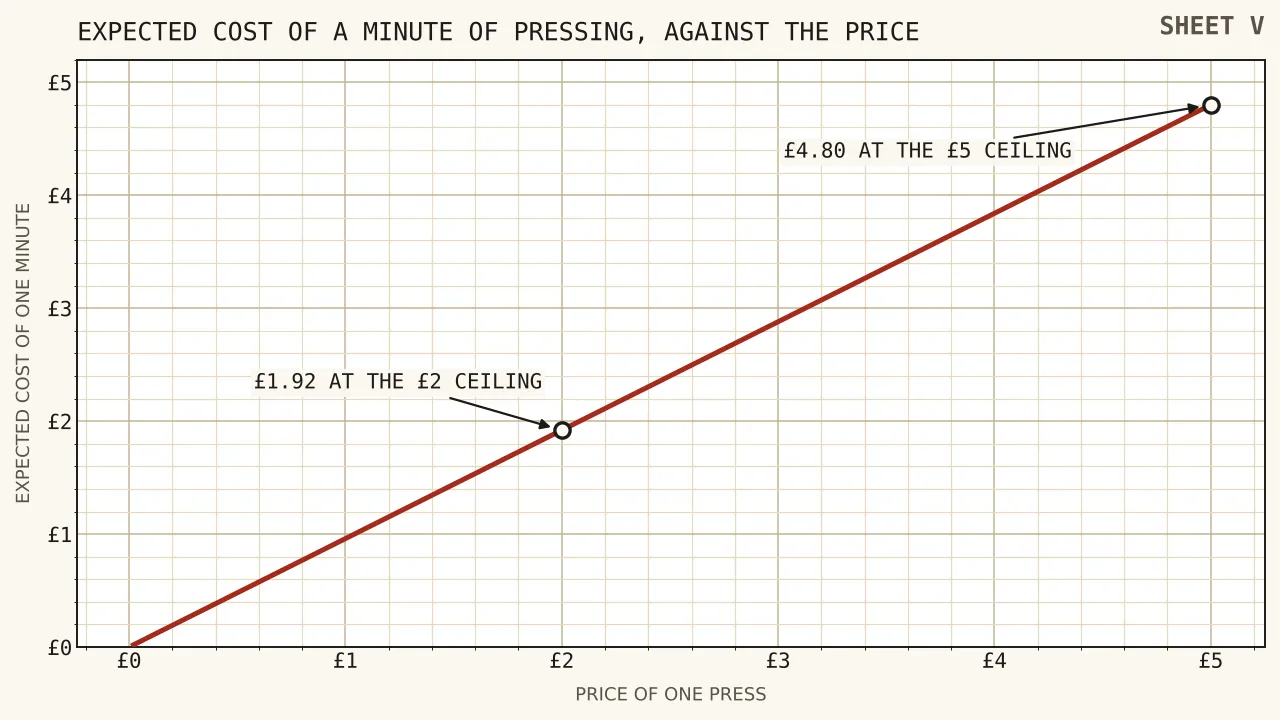
Those three together fix the pace of a licensed session from outside the player. Twenty-four presses a minute is the slot ceiling, which at 10p is £2.40 of turnover and 9.6p of expected cost in each minute of play. At the £5 stake ceiling the same minute is £120.00 of turnover and £4.80 of expected cost. The clock, not the tally, is what makes the second figure large.
6
The route: what the smallest payment buys
Three pages work upwards from the floor. Each takes a published minimum payment and asks the same thing in a different denomination: how many presses does this buy, how long do they last, and what do they cost in expectation?
A single pound at the cashier asks what the smallest payment in the market amounts to once the minimum stake has had its say. Three pounds as a minimum asks whether the extra two pounds buy anything structural or simply more of the same, which is a question about thresholds rather than about generosity. Five pounds at the cashier asks what the most common small payment in Britain is worth when converted, and it is the page where the arithmetic first produces a session long enough to measure in minutes.
7
The route: the largest unit, and the comparison
Two pages work from the other direction. Sites built for the largest stakes asks what a press costs when the unit is at or near the statutory ceiling, and why a ceiling expressed per game cycle rather than per hour is the binding constraint on that end of the market.
A comparison across the whole market asks the question this section is built to make answerable: if sites are to be set against one another at all, what is the unit of comparison? That page defends one answer, the price of a single press, on the ground that nothing else can be read off two different packages and then subtracted.
8
The route: where not one figure moves
Two pages exist to establish a negative, which is a useful thing for a reader to have established. Recently launched sites asks what a launch package is worth and what the word new actually denotes on a register entry, since a licence start date is a published fact and a marketing claim is not.
Playing on a handset asks which figures change when the screen does. The answer is none of the arithmetic: the unit is the same, the return is the same, the pace floor is the same. What does change is a short list of duties that follow the licence rather than the device, and that page sets them out.
9
The unit when nobody is setting limits
Every rule named on this page is a rule about the unit, and that makes this section the one where the offshore comparison is sharpest. The cashier printing a package out there holds no Great Britain licence, so take the five constraints above away one at a time and watch the minute figure move.
Away goes the statutory £5 over one game cycle, and the £2 that applies below twenty-five with it, so the unit has no upper bound beyond appetite. Away goes the 2.5-second floor under a slot cycle, and the 5-second floor on other casino games. Away goes the requirement to commit to each cycle by hand, so a sequence can run unattended. Away goes the prohibition on shortening a cycle from the inside, so turbo and slam stop return. And away goes the rule stopping a machine from staging a celebration where the amount returned does not exceed the amount staked, which is not an arithmetic constraint at all but is the one deciding whether a player can tell a win from a loss while it happens.
Price the first two of those. On a licensed slot the maximum lawful pace is twenty-four presses a minute, which at 20p a press is £4.80 of turnover and 19.2p of expected cost each minute. Remove the pace floor and suppose a one-second cadence, and the same 20p unit gives sixty presses a minute, £12.00 of turnover and 48p of expected cost each minute. The unit did not change. The hourly rate of loss has risen two and a half times, from £11.52 to £28.80, because the clock was the other half of the price all along.
One duty in this area is not about the unit and belongs here anyway, because it is the one readers underestimate. Online gambling companies licensed here are all required to join the national scheme, which is why one sign-up catches every one of them and, as the scheme itself sets out, nothing past them. That is a statement about the edge of the protection rather than about a way round it, and nothing on this site helps anybody return to a site they have excluded themselves from, or defeat blocking software or a bank’s own gambling block.
Questions
- What does one spin cost?
- With a press at 10p and the machine returning 96 per cent, 0.4p in expectation, plus 2.5 seconds of clock, because a licensed slot may not begin another game cycle sooner. Those two figures are the unit everything else on this site is measured in.
- Why does £10 of turnover cost the same at every stake size?
- Because the expected cost is four per cent of the turnover and nothing else. Ten pounds pushed through a 96 per cent machine is expected to cost 40p whether it goes through as a thousand presses at a penny or as two presses at £5. The unit decides how many events there are and how long they take, not what they cost.
- Is there a legal maximum stake on one spin?
- Yes, for online slots. A single game cycle may not take more than £5, or more than £2 from anybody under twenty-five. Regulations of 25 February 2025 put that condition on every remote casino licence; the £5 bound players from 9 April that year and the £2 from 21 May. The guidance keeps both figures to slots and away from other casino games.
- Is there a legal minimum stake?
- No. The floor is commercial, and it is set by two numbers rather than one: the smallest payment the cashier accepts and the smallest stake the machine accepts. A pound against a 1p minimum is a hundred presses; the same pound against a 20p minimum is five. Either way the expected cost comes to 4p, four per cent of a pound.
- How fast can a licensed slot be played?
- Twenty-four presses a minute at the outside, since the floor under a slot game cycle is 2.5 seconds and the player has to act on the control afresh for each one. Casino games away from the reels, poker between players excepted, sit behind a 5-second floor, in force since 17 January 2025.
- Can a feature be used to speed a spin up?
- Not on a licensed site. The standard forbids a system from letting a customer shorten the time before a result appears, and the named examples are turbo, slam stop and quick spin. Autoplay is separately prohibited, with each cycle having to be committed to by hand, and the one exception allows blinds to be posted automatically at a poker table.
- Does a smaller unit improve the odds?
- No. It lengthens the session and brings the result closer to the average, which are real benefits, but the expected cost of a given amount of turnover is unchanged. A larger unit concentrates the same expected cost into fewer events, which widens the spread of outcomes in both directions.
- What happens to the unit at a site with no British licence?
- Both of its prices come loose. No statutory ceiling binds the stake, no floor binds the pace of a cycle, hand-committed cycles are not required, and features that shorten a cycle are not prohibited. At 20p a press the lawful British pace gives 19.2p of expected cost a minute; at a one-second cadence the same unit gives 48p a minute, which lifts the hourly rate from £11.52 to £28.80.