Sheet W12 Revision 1 Counted 16 October 2026
Fast withdrawal casinos: what a wait costs when nobody charges for it
A delay has no tariff, so it looks free and is not. On a balance of £220.00, one trip back through the reels costs £8.80, which is 88 spins at 10p. A pending period that hands the reader a button to put the money back prices every extra day at that figure multiplied by the chance the button gets pressed.
Waiting to come out £220.00 One spin 10p Comes to 88 spins for each trip back
What a pending period comes to in spins
Every destination on this board is bought advertising. The site takes a fee if a reader goes on to register, and no figure printed below moves because of it.
The Spin Count
Gauge No 01
Betportal
Lowest multiple here
Priced at this site's own 10p a spin
What is counted
What is asked
No Great Britain licence
Licensed in Anjouan, Comoros, run by BetPortal Gaming Ltd, with Excite Ultra Media Ltd, reference ALSI-202601040-FI2.
Terms read 16 October 2026
Open the offer at Betportal, opens in a new tabThe Spin Count
Gauge No 02
WinBeast
Largest count here
Priced at this site's own 10p a spin
What is counted
What is asked
No Great Britain licence
Licensed in Curaçao, operator not named on the site.
Terms read 16 October 2026
Open the offer at WinBeast, opens in a new tabThe Spin Count
Gauge No 03
EliteSpin
Longest spin window
Priced at this site's own 10p a spin
What is counted
What is asked
No Great Britain licence
Licensed in Costa Rica, run by PrimeTier Limited.
Terms read 16 October 2026
Open the offer at EliteSpin, opens in a new tabThe Spin Count
Gauge No 04
Crown Jewelz
Multiple unpublished
No foot figure struck
What is counted
What is asked
No Great Britain licence
Licensed in Curaçao, number not verified, operator not named on the site.
Terms read 16 October 2026
Open the offer at Crown Jewelz, opens in a new tabThe figure in the third register is this site's own arithmetic and nothing an operator has published: the count at face, less the share a spin gives back at 96 per cent return to player, less what playing the wagering through costs at the same return. It describes the offer, not one reader's afternoon. Where the conditions price above the count the counter prints nothing rather than a negative sum, and where a figure the sum needs is unpublished it prints the condition in the operator's words instead.
A count has no unit of its own, so one is supplied. Where an operator publishes what a spin of its own is worth, that figure stands in the second register and is labelled as theirs. Where it does not, the second register carries this site's own 10p a spin and says so, and the foot figure moves in proportion: at half the price, half the money. The figure after it, what the count comes to for each spin, is the one that compares a large count against a small one.
Three words stand in the amount column where no figure can. Noted is a published condition that takes value away without leaving the sum a figure to take. Unpriced is a condition whose figure nobody has published, or a credit that is not a sum until a deposit of your own sets it. Own money is money of yours, which is never part of a foot figure.
Not one of the operators printed above holds a Great Britain licence, so the duties that licence carries do not reach them. Every online gambling company licensed in Great Britain has to be part of Gamstop Online, and a reader who has shut themselves out through the scheme is therefore not shut out here. The ceiling of ten times the bonus funds on a wagering requirement, in force since 19 January 2026, is a condition of that licence and binds the companies that hold one. Where a dispute goes instead is a matter for the authority named on the counter, and the Gambling Commission describes what a reader faces without a British licence as a lack of recourse if things go wrong. Nobody under 18 may hold an account at any of them.
Every term printed on a counter is the operator's own, and each counter carries the day it was read. The oldest of those readings is 16 October 2026. What binds a reader is the operator's own full terms, and not a line printed here.
1
A cost with no tariff attached
Every other sheet in this section prices a charge. This one prices a wait, which is harder because a wait arrives with no number on it, and the absence of a number is exactly why it gets left out of comparisons.
Start with the only figure that matters. A balance of £220.00 is 2,200 spins at 10p. Send that balance round a reel set once at a 96 per cent return and £8.80 of it is gone, which is 88 spins. Twenty-five such laps and the £220.00 has gone entirely, which is where the 25 on every sheet here comes from.
A wait does not take £8.80. What a wait does is create the opportunity for a lap to happen that would not otherwise have happened, and the cost of the wait is therefore the cost of a lap multiplied by the chance of one. That is the whole method of this page, and it turns a vague complaint about slow payouts into a column of pence.
The distinction worth holding on to is between the two things a reader means by a slow withdrawal. One is a transfer taking a while to clear, which costs nothing at all unless the money was needed that afternoon. The other is a balance sitting in a gambling account, reachable, with a reel set a click away. Only the second has a price, and the price is in part three.
Promises of this shape get pushed hardest by cashiers which hold no Great Britain licence, and parts six to nine price that rather than deplore it. The short version is that a licensed desk is forbidden to offer the button that part three prices, which sets the largest figure on this page to nothing.
No payout speed for any named operator appears anywhere on this site, because no such figure could be taken from a primary source and a published promise about speed is one of the first things to go stale. What this page prices is the arithmetic of a wait of a given length, with the length supplied by the reader from whatever the terms in front of them say. Three assumptions stand behind the figures: ten pence a spin, ninety-six pounds handed back for every hundred staked across a long run, and no weighting cutting what a staked pound contributes. Not one of the three is published anywhere.
2
What a day is worth with no interest on it
Money sitting in a gambling account earns nothing, so the first instinct is to price a delay as forgone interest. Do the sum and the instinct collapses. At 4 per cent a year, £220.00 earns £8.80 over twelve months, which is 2.4p a day, or a quarter of one spin.
| Length of the wait | Interest forgone at 4 per cent a year | In spins at 10p | Share of one lap through the reels |
|---|---|---|---|
| 24 hours | 2.4p | 0.24 | a 366th of it |
| 3 days | 7.2p | 0.72 | a 122nd |
| 7 days | 16.9p | 1.69 | a 52nd |
| 28 days | 67.5p | 6.75 | a 13th |
| 56 days | £1.35 | 13.5 | about a seventh |
Eight weeks of waiting costs £1.35 in interest, which is thirteen and a half spins. That is a real number and it is not the number this page is about. Anyone who tells a reader that a slow payout costs them interest is quoting the smallest quantity in the transaction, in the way that quoting a transfer fee is on every other sheet here.
So the honest answer is that a wait of itself is nearly free, and that the price comes from what the wait makes possible. A balance a reader cannot touch costs 2.4p a day. A balance a reader can put straight back on the reels costs whatever the chance of their doing so is worth, and part three puts that into pence.
One comparison puts that in its place. A rail holding back 1 per cent of £220.00 takes £2.20, and at 2.4p a day the balance would have to sit for 92 days to shed as much in forgone interest. Ninety-two days is longer than the eight-week ceiling on a complaint. So the slowest payout a licensed cashier can lawfully produce, complaint and all, still costs less in interest than a 1 per cent charge did at the entrance. Anyone picking a cashier on speed while ignoring its tariff has those two quantities the wrong way round.
2.4p a day, which is a quarter of one spin, is the whole interest cost
3
The button, priced by the day
Here is the mechanism this page exists for. A withdrawal is requested and sits pending. Somewhere on the screen there is a way to take it back and carry on, and the longer the pending period runs the more times a reader passes that screen.
One lap of £220.00 costs £8.80. If the chance of the button being pressed over the whole pending period is c, then the expected cost of the delay is c multiplied by £8.80 for each lap that follows. Nothing in that calculation needs a tariff, and nothing in it needs a view about anybody’s willpower beyond a probability the reader can set for themselves.
| Pending period | Illustrative chance of a reversal | Expected cost at one lap | In spins | Laps left of 25 |
|---|---|---|---|---|
| Instant, no button at all | nil | nothing | 0 | 25 |
| 1 day | 10 per cent | 88p | 8.8 | 24.9 |
| 2 days | 20 per cent | £1.76 | 17.6 | 24.8 |
| 5 days | 50 per cent | £4.40 | 44 | 24.5 |
| 7 days | 70 per cent | £6.16 | 61.6 | 24.3 |
| 10 days | certainty | £8.80 | 88 | 24 |
The second column is this page’s own invention and is marked as such: ten points of chance for each day of waiting, which is a straight line chosen because it is simple, not because anybody measured it. Change the slope and every figure in the third column moves in proportion. What does not change is the shape of the finding, which is that a pending period with a reversal button attached costs real money and a pending period without one costs 2.4p a day.
One lap is also the gentlest assumption available. A balance put back does not usually go round once and stop. Take the same £220.00 at five laps and the cost of a reversal rises to £44.00, at ten laps to £88.00, and at twenty-five laps to the whole £220.00. Multiply by the chance and the arithmetic gets heavy quickly.
| Laps after the money goes back | Cost if it happens | At a one-in-two chance | In spins |
|---|---|---|---|
| 1 | £8.80 | £4.40 | 44 |
| 3 | £26.40 | £13.20 | 132 |
| 5 | £44.00 | £22.00 | 220 |
| 10 | £88.00 | £44.00 | 440 |
| 25 | £220.00 | £110.00 | 1,100 |
Against those columns, set what a licensed cashier is required to do. Cancelling a withdrawal already requested is not something a consumer may be offered. Funds under request are not to be made available for depositing again, the guidance says alongside it, and it wants getting money out kept as clear of obstruction as the operator can manage. Those sentences delete the whole of the table above.
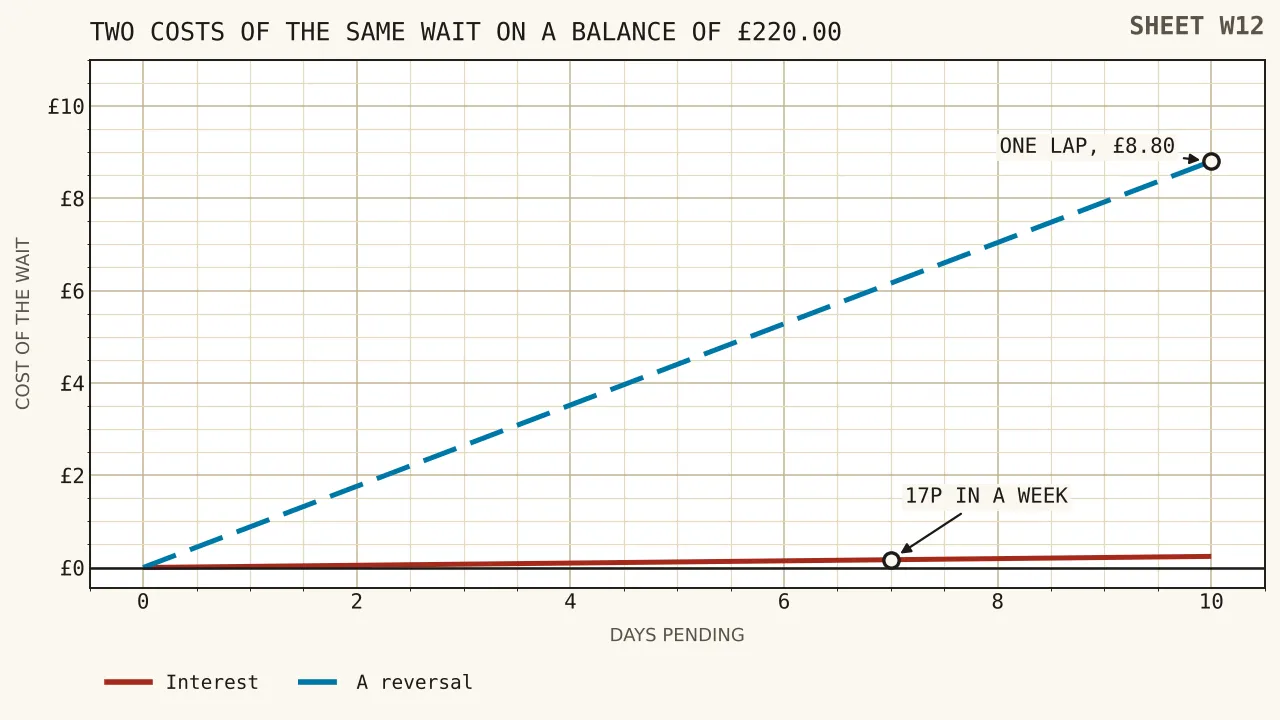
£8.80 a lap against 2.4p a day, a ratio of 366 to one
4
Three stages, and which of them a licence reaches
A payout is not one event. It is three, they run in order, and they are governed by three different sets of rules, which is why a single advertised figure for payout speed explains so little.
| Stage | Who controls the clock | What a British licence requires | Cost per day on £220.00 |
|---|---|---|---|
| Pending, before review starts | the cashier | no reversal may be offered during it | 2.4p, with the button gone |
| Review and verification | the cashier | nothing asked that the entrance should have settled | 2.4p |
| The transfer itself | the rail and its network | nothing, this sits outside the gambling rules | 2.4p |
| A complaint about any of it | the cashier, then an adjudicator | acknowledged inside 72 hours, answered inside 56 days | 2.4p |
Read down the last column and the finding is that none of the three stages is expensive in itself. Read down the third and the finding is that two of the three are governed and one is not. The rail is the part most writing about payout speed concentrates on, and it is the part no gambling rule touches at all.
The first row carries the whole of the money. A pending stage without a reversal button costs 2.4p a day; the same stage with one costs up to £8.80 a lap. So the right question to put to a cashier is not how many hours it takes. It is whether the balance can be clawed back into play while it is sitting there.
A floor under the game puts a number on the other direction. A licensed reel game leaves 2.5 seconds between cycles, so 2,200 spins at 10p need 91 minutes and 40 seconds at the very fastest. Raise the stake to the statutory ceiling of £5 a cycle and the same £220.00 is 44 cycles, which is 1 minute 50 seconds. That is the sharpest way to see why a reversal costs what it does. Putting a balance back takes one click, and sending it through the reels can take under two minutes.
One consequence of that follows for how a reader behaves rather than for how a cashier does. Where the button exists, requesting a withdrawal and then waiting is a worse plan than requesting one and closing the tab. The cost in the tables above is not charged by the cashier; it is created by the proximity of the reels to the pending balance.
5
A daily ceiling turns one wait into five
There is a second way to make a payout slow without ever quoting a speed, and it is a ceiling on how much may leave in a day. The arithmetic is division and the result is surprising the first time a reader does it.
Take the drafting the regulator publishes as an example of a term it will not allow: a limit permitting withdrawals of up to £50 in a day and up to £500 in a week. Divide a balance of £220.00 by the daily figure and the answer is 4.4, which rounds up to five days. The cashier has quoted no delay at all, and the exit still takes most of a working week.
| Ceiling per day | Days to clear £220.00 | Days to clear £1,000.00 | Interest cost on £220.00 | Days a reversal button is in reach |
|---|---|---|---|---|
| No ceiling | 1 | 1 | 2.4p | 1 |
| £200 | 2 | 5 | 4.8p | 2 |
| £100 | 3 | 10 | 7.2p | 3 |
| £50 | 5 | 20 | 12p | 5 |
| £20 | 11 | 50 | 26.4p | 11 |
The pair of figures in that published drafting interact, and only one of them ever bites. Seven days at £50 comes to £350, which never reaches the weekly ceiling of £500, so the daily figure governs the whole way down: a balance of £1,500.00 takes 30 days to leave rather than the three weeks a weekly ceiling would suggest. Where two ceilings sit over one account, the tighter of them does all of the work.
The interest column is trivial, as it was in part two. The final column is not, because every extra day is another day on which the balance is sitting in a gambling account next to a reel set. At a £50.00 ceiling and this page’s illustrative slope, five days of exposure is a one-in-two chance of a reversal, which carries £4.40 of expected cost at a single lap and £22.00 at five.
British material deals with that term directly instead of regulating the speed. No licensee may impose a term, lean on one or seek to enforce one where its effect is a ceiling over the sums a consumer draws from what they deposited. Winnings included, that money is there to be taken whenever it is asked for. A limit is allowed on the size of a withdrawal, and on how many are made, provided it is a reasonable one.
One qualification keeps this honest. Deposited money is what that rule governs. What a bonus may be turned into is governed by a separate term with a separate subject, which those words leave standing. A reader can meet the two inside one document, and taking the second to be covered by the first disappoints at precisely the wrong moment.
£220.00 divided by a £50 daily ceiling is five days at the exit
6
Fifty-six days, and what that clock is for
Eight weeks is the outside limit on a complaint at a licensed desk, from the day it arrives to the final answer, escalation inside the firm included. Written as days that is 56, and written in this page’s units it is 1,344 hours during which a disputed balance of £220.00 sits somewhere accruing 2.4p a day.
The front of that process is quicker and is worth knowing in hours. An acknowledgement is due promptly, with 72 hours, counted as three working days, standing as the outer bound. A desk whose gambling never closes owes one inside 24 hours. Those two figures are the first test of whether a cashier is engaging at all.
| Stage | Outside limit | In hours | Interest cost by then |
|---|---|---|---|
| Acknowledgement, gambling round the clock | 24 hours | 24 | 2.4p |
| Acknowledgement, otherwise | 3 working days | 72 | 7.2p |
| The process from end to end | 8 weeks | 1,344 | £1.35 |
| The window to bring one at all | at least 6 months | 4,383 | £4.40 |
Two mechanics sit inside the eight weeks. A reasonable request that goes seven days without an answer lets the clock stop, and on starting again it resumes at the point it had reached rather than running afresh. The letter at the end has three jobs: to give the decision, to say that the firm’s own process is finished, and to point the way to an independent adjudicator.
What the figures in that table are really measuring is not money. They are measuring how long a reader can be kept waiting before somebody independent has to look at the file, and the answer at a licensed desk is eight weeks and no longer. Away from the licence there is no such ceiling, because there is nobody the clock is owed to.
A comparison that runs against the usual story belongs here. One well-known offshore authority does publish a complaints framework: four weeks for an answer, with one extension of four more where the player is notified in writing, landing on eight weeks as well. The difference between the two regimes is therefore not the length of the clock. It is authorship of the process at the far end. There the operator is contemplated as setting the parameters, among them the binding quality of an outcome, the place of court proceedings, and any minimum value a claim must carry before escalation opens.
7
Identity at the exit, and why the order matters
The most common way a payout becomes slow is not a tariff, a ceiling or a rail. It is a request for documents arriving at the moment the money is leaving, and the licence condition on that point is written about the order of events rather than about the documents.
A request to withdraw is not the moment for a licensee to start demanding what it had every chance to ask for at the start. Identity gets settled before a customer gambles, and the floor on what gets collected is three particulars, being the date of birth, the residential address and the name on the account. Before depositing, the customer is told which documents may be needed, at what stage, and by what means of sending them. Keeping that information accurate is the licensee’s job as well.
The consumer-facing version of that rule says the same in plainer words and carries two dates of its own. Publication: 23 September 2020. Last revision: 13 April 2022. That makes it older than almost everything else cited here, so it is quoted with its age attached. Its substance is that age and identity checks cannot be turned into a condition of paying out where an earlier opportunity to ask existed, and that whatever money-laundering work needs doing belongs at sign-up, not at the hour a customer asks for funds.
| When the documents are asked for | What it costs the reader | Standing under a British licence |
|---|---|---|
| Before any play | time, before any money is at stake | what the condition requires |
| At the exit, having been possible earlier | days of pending, each with a button in reach | the operator may be in breach |
| At the exit, to meet a separate legal duty | the same days | permitted, the condition says so |
No list of required documents is prescribed anywhere. Household bills, driving licences and passports turn up in the guidance as examples of what a business might want, with the regulator stating that it does not specify which of them. Should a payout be delayed for want of sufficient identity information, that same guidance records the operator as possibly in breach of the identity condition.
Put that beside part three and the cost of the order of events becomes visible. Three days of documents at the exit, on this page’s illustrative slope, is a 30 per cent chance of a reversal, so £2.64 of expected cost at one lap and £13.20 at five. The same three days spent at registration costs nothing at all, because there is no balance yet to put back.
One further check belongs here for completeness, because it touches the entrance rather than the exit. A light-touch financial check attaches once net deposits in a month go past a set figure. Thirty August 2024 is when that figure started, at £500 a month; on 28 February 2025 it came down to £150. A heavier assessment sits alongside it but stays a pilot, with nothing running live, and neither exercise touches a credit rating, as the Commission states.
8
The word fast, and what can be sourced about it
A promise about speed is an advertising claim, and advertising claims attract rules rather than arithmetic. The rules worth knowing are about what a promise has to carry with it rather than about whether it is kept.
Significant conditions have to be communicated clearly and prominently in promotional material wherever leaving them out would be likely to mislead. The published working list of what counts as significant doubles as a checklist for anyone reading a payout promise, set out here in a different order from the usual one: who may take part at all; what has to be paid in or staked; what the shortest price or the permitted bet types are; and by when the thing must be claimed or spent. Full terms for an online advertisement should sit about one click away, and a link to them should not be buried in small print at the bottom.
Two rulings show how that bites. A payment method the promotion would not take was the subject of one dated 31 July 2024, recorded in small type among the full terms, with the prominence given to it judged insufficient. One dated 17 July 2024 turned on a £10.00 free bet, where a text message had to be answered before a set time. Nothing in the advertisement mentioned that time. Counted as significant, the deadline was the sort of thing whose omission is likely to mislead.
Guidance from the regulator on advertising states the consequence in one line. Give the significant conditions too little prominence, and the advertisement becomes one that will be regarded as misleading. Prominence inside the advertisement is what the guidance wants, with those conditions set beside the headline offer on whichever page a reader lands on or signs up through. A promise about speed with its conditions a scroll away from it is therefore not merely unhelpful. It is the shape of thing that guidance describes.
What cannot be sourced is a payout speed for any operator, and this site publishes none. Nothing in the licence conditions sets a number of hours for a payout. What exists instead is the frictionless direction in the guidance, the prohibition on offering a reversal, and the rule about the order of the identity check. Those three shape the clock without ever naming a figure for it.
A reader comparing two cashiers on speed therefore has one sourceable question and several unsourceable ones. The sourceable question is whether the desk holds a British licence, because the three rules above come with it. Everything else, including any published number of hours, is a commercial claim that moves whenever the operator decides it should.
9
Published failure modes, and the three-line check
Away from the licence, the regulator has published what it has actually seen at the exit, and the two failure modes it names are the two this page has been pricing. Payouts get blocked outright. And ceilings on a withdrawal get set at heights nobody is going to clear, which is the part five arithmetic with the divisor chosen to make the division impossible.
The same material lists what else is often absent: secure payment systems, checks on age, and the tools a player uses to stay in control. Three exposures are named for the consumer, which are gaming practices that are not fair, money going out of the door, and no recourse once it has. That third one is precisely the 56-day clock and the independent adjudicator beyond it, neither of which exists there.
Three lines settle whether any rule on this sheet binds the desk in front of you. One, the account number printed in the cashier’s own licence statement. Two, that number put to the public register, which either returns an entry or returns nothing. Three, the domains carried on that entry, matched against the web address in your browser. A blank, or an entry that leaves your address out, means parts four to eight bind nobody here.
Other regulators do publish complaint routes, and a page that said otherwise would be wrong. One European authority runs a player hub with a formal complaint form against the operators it licenses, reviews cases in two named languages and may ask for identification before processing one. The omissions from that page carry as much as its contents. A deadline: not given. A residency rule: not given. Any statement of how far its own powers run: not given. Whether an operator would be bound by a decision: unsaid.
Two things travel with the player whichever desk holds the balance. Duty on remote gaming profits went to 40 per cent with effect from 1 April 2026, and what decides whether it bites is where a customer ordinarily lives, not where an operator trades from. The national scheme, for its part, covers the operators taking part in it; where an organisation does not take part, its terms say, preventing access to that gambling is beyond what the scheme can do.
10
Timed, not ranked
Order on this sheet comes from a single rule used throughout the site: an entry falls the less likely a reader is to get their stake back out again. Nothing is scored, no verdict is printed, and an advertised payout time moves nothing at all, since no such time could be sourced.
Five figures carry the page. A lap of £220.00 costs £8.80 and 88 spins. A day of waiting costs 2.4p in interest, which is a quarter of a spin. A pending period with a reversal button attached costs up to £8.80 a lap, or £44.00 at five laps on a one-in-two chance. A daily ceiling of £50.00 turns one exit into five days. And eight weeks, which is 1,344 hours, is the longest a licensed complaint may run before somebody independent is reachable.
The practical reading is short. Ask whether the balance can be pulled back into play while it waits, because that is the only part of a delay with real money in it. Ask when the documents are wanted, because the order decides how many days the balance spends next to the reels. Then ask the register whether any of it is binding.
Questions
- What does waiting for a withdrawal actually cost?
- Almost nothing in interest and potentially a great deal in opportunity. On £220.00 the interest forgone at 4 per cent a year is 2.4p a day, which is a quarter of one spin. One lap of the same balance through a reel set costs £8.80, or 88 spins, so the cost of a wait is the cost of a lap multiplied by the chance of one happening.
- Why does a reversal button matter so much?
- Because it converts a delay into a chance of a lap. If the chance of pressing it over a five-day pending period is one in two, the expected cost is £4.40 at a single lap and £22.00 at five. A pending period with no such button costs 2.4p a day and nothing else.
- Can a licensed casino offer to cancel my withdrawal?
- No. Cancelling a withdrawal already requested is not something that may be offered to a consumer. Funds under request are not to be made available for depositing again, the guidance says alongside it, and it wants getting money out kept as clear of obstruction as the operator can manage.
- Which part of a payout is actually slow?
- There are three stages and only two of them are governed. The pending period and the review belong to the cashier and have rules attached. The transfer belongs to the rail and sits outside the gambling rules altogether, which is awkward, because the transfer is the part most writing about payout speed concentrates on.
- May a casino cap what leaves in a single day?
- Not where the money came out of a deposit at a licensed desk. A term whose effect is a ceiling over the sums a consumer draws from what they deposited may not be imposed, leaned on or enforced, and the drafting printed to illustrate that fault lets out £50 in the space of a day, and £500 across a week. Limits on size or on frequency are allowed where reasonable.
- What does a daily ceiling do to the time?
- It multiplies it by division. A balance of £220.00 against a £50 daily ceiling takes five days to leave, and against a £20 ceiling eleven days, with no delay quoted anywhere. Each extra day is another day the balance spends in a gambling account within reach of a reel set.
- Is a cap on bonus winnings covered by the same rule?
- It is not. Deposited money is what the ceilings rule governs, while what a bonus may be turned into is a separate term with a separate subject. A reader can meet the two inside one document, and treating the second as covered by the first leads to disappointment at precisely the wrong moment.
- May documents be demanded at the moment of payout?
- Not for a question that sign-up was the place to raise. Identity gets established before a customer gambles, the floor being three particulars, namely a name, a home address and a birth date, and the customer is told in advance which documents may be needed and by what means of sending them. Asking at the exit to satisfy a separate legal duty is permitted, which is the exception rather than the rule.
- What documents can a casino ask for?
- Household bills, driving licences and passports appear in the guidance as examples of what a business might want, with the regulator stating that it does not specify which of them. Should a payout be delayed for want of sufficient identity information, the same guidance records the operator as possibly in breach of the identity condition.
- What is the longest a complaint may run?
- Eight weeks end to end, which is 1,344 hours, escalation inside the firm included. An acknowledgement is due promptly, with 72 hours as the outer bound, falling to 24 hours at a desk whose gambling never closes. A reasonable request that goes seven days without an answer lets the clock stop, resuming at the point it had reached.
- Do you publish payout speeds for named operators?
- No, and the reason is that no such figure could be taken from a primary source. Nothing in the licence conditions sets a number of hours for a payout either. What exists instead is the ban on offering a reversal, the rule about when identity may be checked, and a direction that the exit be as frictionless as possible.
- Which of these rules survives at an unlicensed desk?
- The reversal ban, which is the costliest item on this page. The rule putting identity ahead of play instead of at the payout. The ceiling on what a staking condition may demand. A deposit balance kept clear of any maximum written over it. An acknowledgement inside 72 hours, an answer inside 56 days, an independent adjudicator beyond. Duty at 40 per cent on remote gaming profits does not go, since what it follows is where a customer ordinarily lives, not where an operator trades from.