Sheet W05 Revision 1 Counted 16 October 2026
USDT casino: a flat charge on a unit built to stand still
The unit is designed to track a currency, which takes one column out of the arithmetic and leaves the other. A flat transfer charge of £1.00 against a £45.00 payment works out at 2.22 per cent. It buys 440 spins in place of 450, and the break-even demand slides from 25 turnovers down to 24.44. On a £5.00 payment the same £1.00 is 20 per cent and the crossing falls to 20.
Transferred in £45.00 Price of a spin 10p Comes to 440 spins, not 450
What a flat transfer charge comes to
Every destination on this board is bought advertising. The site takes a fee if a reader goes on to register, and no figure printed below moves because of it.
The Spin Count
Gauge No 01
Betportal
Lowest multiple here
Priced at this site's own 10p a spin
What is counted
What is asked
No Great Britain licence
Licensed in Anjouan, Comoros, run by BetPortal Gaming Ltd, with Excite Ultra Media Ltd, reference ALSI-202601040-FI2.
Terms read 16 October 2026
Open the offer at Betportal, opens in a new tabThe Spin Count
Gauge No 02
WinBeast
Largest count here
Priced at this site's own 10p a spin
What is counted
What is asked
No Great Britain licence
Licensed in Curaçao, operator not named on the site.
Terms read 16 October 2026
Open the offer at WinBeast, opens in a new tabThe Spin Count
Gauge No 03
EliteSpin
Longest spin window
Priced at this site's own 10p a spin
What is counted
What is asked
No Great Britain licence
Licensed in Costa Rica, run by PrimeTier Limited.
Terms read 16 October 2026
Open the offer at EliteSpin, opens in a new tabThe Spin Count
Gauge No 04
Crown Jewelz
Multiple unpublished
No foot figure struck
What is counted
What is asked
No Great Britain licence
Licensed in Curaçao, number not verified, operator not named on the site.
Terms read 16 October 2026
Open the offer at Crown Jewelz, opens in a new tabThe figure in the third register is this site's own arithmetic and nothing an operator has published: the count at face, less the share a spin gives back at 96 per cent return to player, less what playing the wagering through costs at the same return. It describes the offer, not one reader's afternoon. Where the conditions price above the count the counter prints nothing rather than a negative sum, and where a figure the sum needs is unpublished it prints the condition in the operator's words instead.
A count has no unit of its own, so one is supplied. Where an operator publishes what a spin of its own is worth, that figure stands in the second register and is labelled as theirs. Where it does not, the second register carries this site's own 10p a spin and says so, and the foot figure moves in proportion: at half the price, half the money. The figure after it, what the count comes to for each spin, is the one that compares a large count against a small one.
Three words stand in the amount column where no figure can. Noted is a published condition that takes value away without leaving the sum a figure to take. Unpriced is a condition whose figure nobody has published, or a credit that is not a sum until a deposit of your own sets it. Own money is money of yours, which is never part of a foot figure.
Not one of the operators printed above holds a Great Britain licence, so the duties that licence carries do not reach them. Every online gambling company licensed in Great Britain has to be part of Gamstop Online, and a reader who has shut themselves out through the scheme is therefore not shut out here. The ceiling of ten times the bonus funds on a wagering requirement, in force since 19 January 2026, is a condition of that licence and binds the companies that hold one. Where a dispute goes instead is a matter for the authority named on the counter, and the Gambling Commission describes what a reader faces without a British licence as a lack of recourse if things go wrong. Nobody under 18 may hold an account at any of them.
Every term printed on a counter is the operator's own, and each counter carries the day it was read. The oldest of those readings is 16 October 2026. What binds a reader is the operator's own full terms, and not a line printed here.
1
Ten spins to arrive
A £45.00 transfer at 10p a spin ought to be 450 spins. A charge of £1.00 on the way in makes it 440. Ten spins have paid for the journey, and they were spent before the first result appeared. In only one sense is this page about a payment method at all, and that is the sense in which arriving has a cost, struck as a debit while no credit yet exists.
The working figures here are 10p for a spin, 96 per cent as the long-run return on staking, and £1.00 as the transfer charge. The first two are this site’s declared assumptions and nobody publishes them. The third is chosen because it divides cleanly, and no body publishes a figure for it either.
What follows from a charge of fixed size is one property, and the whole page turns on it. The charge takes the same £1.00 whatever the payment. As a share, therefore, it grows as the payment shrinks: 2.22 per cent of £45.00, 5 per cent of £20.00, 20 per cent of £5.00. The reader sending the least pays the most.
Pounds are the unit of account throughout. A sum held in the transferred unit is stated at whatever it was worth when the arithmetic was done, and no further claim is made about it. Rates, fees and chains all change; the arithmetic of a flat charge does not.
2
The column this unit removes
A unit of this kind is built to hold a fixed price against a national currency, and that design is the reason a reader might choose it over the alternatives on neighbouring pages. If it holds, the exposure a balance carries between arriving and leaving is small, and one whole column of risk comes out of the sums.
Two cautions belong beside that. The first is that a design intention is not a published guarantee, and nothing this site can cite fixes the price of any unit, now or later. The second is that removing the rate column does not remove the charge column, which is what this page prices. A flat £1.00 is a flat £1.00 whether the unit moves or not.
| Quantity | On a unit built to track a currency | On a unit that floats |
|---|---|---|
| A charge to transfer in | Yes, and flat | Yes, and flat |
| A charge to transfer out | Yes, and flat | Yes, and flat |
| Exposure while the balance sits | Small if the design holds | Whatever the market does |
| A charge set by traffic on the network | Depends on the chain used | Depends on the chain used |
| A turnover demand on a bonus | Set by the terms, not the rail | Set by the terms, not the rail |
The last row is the one that decides whether a reader keeps anything. Rails cost tenths of a turnover. Terms cost tens of them. A reader who optimises the rail and ignores the terms has solved the small half of the problem.
3
One charge, nine payments
Hold the charge at £1.00 and move the payment. Twenty-five turnovers is the point at which any credit, of whatever size, is expected to have gone: 4p off each pound, twenty-five times over, and the pound has been spent. For every 1 per cent a toll retains, a quarter turnover comes off that figure.
| Transferred | The charge as a share | Spins at 10p | Break-even demand |
|---|---|---|---|
| £5.00 | 20 per cent | 40 spins | 20 turnovers |
| £10.00 | 10 per cent | 90 spins | 22.5 turnovers |
| £15.00 | 6.67 per cent | 140 spins | 23.33 turnovers |
| £20.00 | 5 per cent | 190 spins | 23.75 turnovers |
| £45.00 | 2.22 per cent | 440 spins | 24.44 turnovers |
| £60.00 | 1.67 per cent | 590 spins | 24.58 turnovers |
| £100.00 | 1 per cent | 990 spins | 24.75 turnovers |
| £250.00 | 0.4 per cent | 2,490 spins | 24.9 turnovers |
| £1,000.00 | 0.1 per cent | 9,990 spins | 24.98 turnovers |
Ten spins is the constant. It is 25 per cent of the spins a £5.00 payment buys and one thousandth of what £1,000.00 buys. Nobody quotes a reader 20 per cent, and on the top row that is the figure they are paying.
The crossing column has a floor worth noticing. However bad the toll gets, it cannot push the crossing below nought, and at a toll of 100 per cent the crossing is nought because nothing arrived. Between those ends the relationship is a straight line: five turnovers of crossing for every 20 per cent of toll.
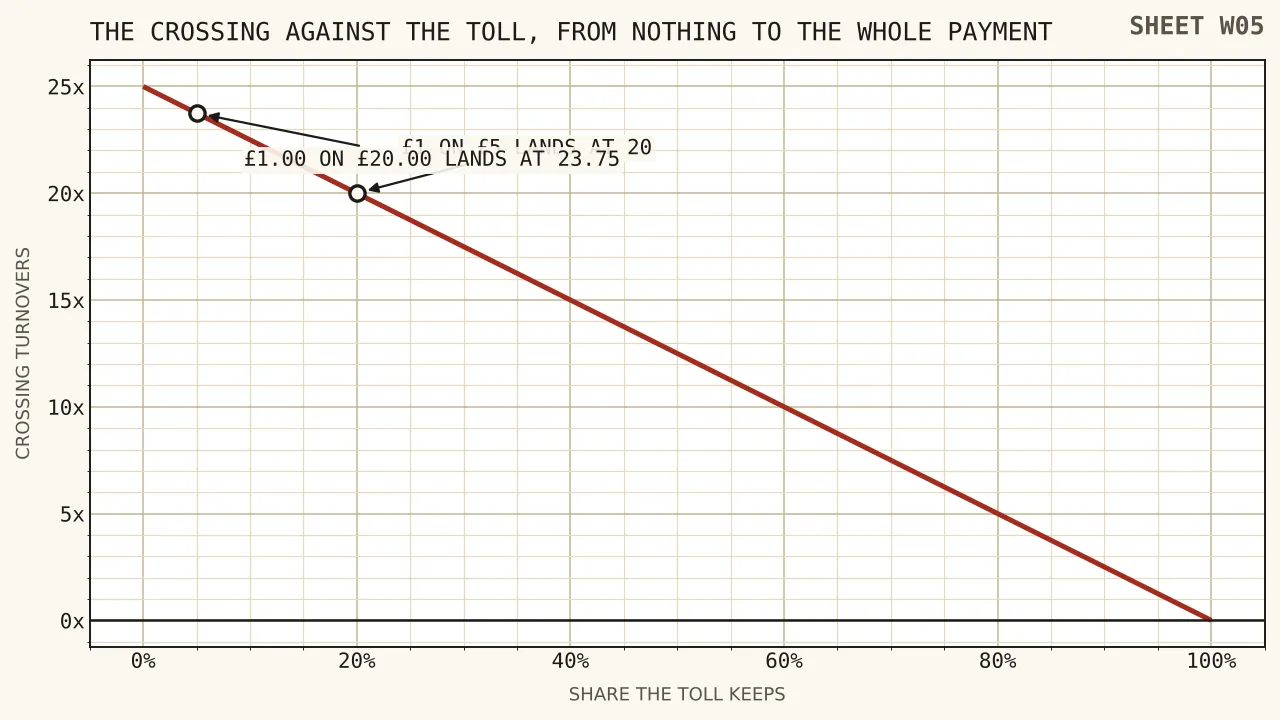
One more reading of that table is worth having. Expressed as a count of spins the charge is constant; expressed as a share of the payment it is not, so a desk quoting spins is quoting the flattering half. A reader sending £5.00 hears ten spins and pays a fifth of their money. A reader sending £1,000.00 hears the same ten spins and pays a thousandth of theirs. Identical count, entirely different transaction.
ten spins is a quarter of a £5.00 payment and a thousandth of £1,000.00
4
The chain decides the charge
A unit of this kind exists on more than one network, and what it costs to move is a property belonging to the network and not to the unit. So there is no such thing as the charge: there is the charge on whichever chain the desk happens to support, and a desk supporting one chain only has made the choice on the reader’s behalf.
| Charge to move the sum | As a share of £45.00 | Spins it costs | Break-even demand |
|---|---|---|---|
| 10p | 0.22 per cent | 1 spin | 24.94 turnovers |
| £1.00 | 2.22 per cent | 10 spins | 24.44 turnovers |
| £3.00 | 6.67 per cent | 30 spins | 23.33 turnovers |
The spread between the first and third rows is 29 spins on a £45.00 payment, and 1.61 turnovers of the crossing. That is larger than most of the differences a reader is invited to compare between one desk and another, and it is decided by a setting in the cashier rather than by anything in the promotion.
Taking money out doubles whatever the figure is. A £1.00 charge each way on a £45.00 payment is £2.00, which is 4.44 per cent and 1.11 turnovers off 25. Withdraw in five pieces of £9.00 rather than one of £45.00 and the exit charge becomes £5.00, which is 11.1 per cent of the sum and 2.78 turnovers.
So the rail prices patience. One withdrawal costs one charge; five cost five. A reader taking money out in small pieces, which is usually the more careful habit, is the reader the charge structure punishes.
5
When the charge shrinks the credit as well
A flat charge can be paid twice, and the second payment is easy to miss. Where a match is worked out on the sum that lands rather than the sum that was sent, £45.00 out of a wallet becomes £44.00 at the desk, and a doubling gives £44.00 of credit rather than £45.00. The charge has cost £1.00 of the reader’s cash and £1.00 of the house’s gift.
| Sent from the wallet | Lands at the desk | Credit if the match reads the sum sent | Credit if it reads what landed | Difference |
|---|---|---|---|---|
| £5.00 | £4.00 | £5.00 | £4.00 | £1.00 of credit |
| £20.00 | £19.00 | £20.00 | £19.00 | £1.00 of credit |
| £45.00 | £44.00 | £45.00 | £44.00 | £1.00 of credit |
| £100.00 | £99.00 | £100.00 | £99.00 | £1.00 of credit |
The difference column is another constant, and on the top row it is 20 per cent of the credit. Add the two halves together and a £1.00 charge on a £5.00 payment has cost 20 per cent of the cash and 20 per cent of the gift, which is the same 4.44 per cent problem from earlier in this page magnified by the size of the payment.
A qualifying minimum sharpens it again. Where a promotion needs £20.00 to land before it pays anything, a reader sending £20.00 on a £1.00 charge arrives with £19.00 and qualifies for nothing. The sum that has to leave the wallet is £21.00, and the promotion’s stated minimum is therefore 5 per cent higher than it appears.
£21.00 is what a £20.00 qualifying minimum costs at a £1.00 charge
6
Four hundred and forty spins, timed
Spins have a floor under them and therefore a clock. At a licensed cashier nothing is for sale that would start a further cycle of a reel game before 2.5 seconds have elapsed, and 24 cycles a minute is the cap that follows. The 440 spins a £45.00 payment buys occupy at least 18 minutes and 20 seconds.
| What is being staked | Sum through the reels | Cycles at 10p | Least time it can take |
|---|---|---|---|
| The 440 spins the payment buys | £44.00 | 440 cycles | 18 m 20 s |
| A £44.00 credit at 5 turnovers | £220.00 | 2,200 cycles | 1 h 31 m |
| The same credit at 10 turnovers | £440.00 | 4,400 cycles | 3 h 3 m |
| The same credit at 25 turnovers | £1,100.00 | 11,000 cycles | 7 h 38 m |
| The same credit at 40 turnovers | £1,760.00 | 17,600 cycles | 12 h 13 m |
Set that beside the transfer charge and the proportions are plain. The £1.00 charge costs ten spins and 25 seconds. A ten-times demand costs £17.60 of expectation and three hours. A reader shopping for a cheaper rail while accepting a longer demand is economising in the wrong currency.
Those times are floors rather than estimates, and they cannot be bought down at a licensed cashier. A commitment is owed to every cycle separately, that being the drafting of the autoplay prohibition, and a quicker route to the result is not something a cashier may sell. A desk offering a button that runs a thousand cycles unattended has lost the floor, and with the floor goes any possibility of putting a number on the time.
7
A limit set high enough to be a wall
The regulator has named what goes wrong on the way out, and it is not subtle. A post it published on 21 October 2025 records two things seen at unlicensed sites: payouts blocked, and limits on a withdrawal pitched at a height that puts them out of reach. The second of those can be priced, and pricing it beats repeating it.
Suppose the smallest withdrawal a desk will process is £500.00 and the reader arrived with £45.00. Multiplying the balance by 11.1 is the condition of the door opening. Expectation runs the other way at a 96 per cent return, downward rather than up, so variance is the only source of such a multiplication, and a larger multiple means a thinner chance of arriving at it.
| Smallest withdrawal the desk allows | Multiple of the arriving balance | Spins at 10p it represents |
|---|---|---|
| £50.00 | 1.11 times | 500 spins |
| £100.00 | 2.22 times | 1,000 spins |
| £250.00 | 5.56 times | 2,500 spins |
| £500.00 | 11.1 times | 5,000 spins |
| £1,000.00 | 22.2 times | 10,000 spins |
Concerns about the protection of players’ data are recorded in the same post, described as serious, with identity theft and fraud named as the risks. Weigh a £1.00 transfer charge against the prospect of your identity documents sitting on an unlicensed system and the two quantities are several orders of magnitude out of order.
Under a Great Britain licence the exit is drafted differently. Money sitting in the deposit balance can be taken out, and building a ceiling over it is not something a term may do; the specimen held up as failing permits a day of £50 and a week of £500. Reasonableness is the test applied to a limit, whether it goes to how big one withdrawal may be or to how many are allowed. And a withdrawal already asked for may not come back to the customer as something cancellable, the guidance wanting that process made as frictionless as it can be.
11.1 times is what a £500.00 minimum asks of a £45.00 arrival
8
What the British material addresses
On units of this kind the British material is silent in both directions. No provision permits one as payment for gambling. No provision names one to prohibit it. A reader hoping for a rule that resolves the question will not find it, and that silence is worth stating rather than filling with inference.
| Duty | What it requires | Date attached to it |
|---|---|---|
| The card refusal | No payment for gambling on a credit card, a money service business included | 14 April 2020 |
| Identity first | Three particulars verified ahead of any play, with bonus play inside the duty | no date on the condition page |
| A limit on offer | Facilities to set a financial limit, with a prompt at registration or first payment | no date on the standard |
| The exit | No ceiling on the deposit balance, no cancelling a withdrawal request | no date on the guide |
Two of those four rows decide where a desk that takes this unit can sit. A desk that opens an account on an address alone, with no name and no date of birth, is offering something a Great Britain licence does not carry. A desk that asks for documents only when a withdrawal is requested is doing the thing the identity condition exists to prevent, because a licensee may not demand at the exit what it could reasonably have asked for at the entrance.
The wagering ceiling belongs here too, because it is the term that dwarfs every charge on this page. Ten is the ceiling on a demand at a licensed cashier, and it has stood there since 19 January 2026. A £45.00 credit therefore carries at most £450.00 of staking, costing £18.00 in expectation and leaving £27.00. The £1.00 transfer charge is 5.6 per cent of that £18.00.
9
The register, and three lines of checking
No Great Britain licence is held by any desk in this bracket. A reader need not take that on trust from here, and should not: the check is public, free and quick.
| Step | Where | What would fail it |
|---|---|---|
| Copy the licence number | The statement in the site’s footer | No number, or a number given as an image only |
| Search the public register | The regulator’s own register | A number that returns nothing |
| Compare the domains | The entry, against the address bar | A domain that does not appear on the entry |
Recognising the games is not a check. Software from licensed suppliers has been found running where no licence exists at all. A supplier settled at £4.75m in July 2026, six such sites being the subject, every one of them reachable by consumers here. The case produced three findings. Its money laundering risk assessment fell short. Its controls failed to hold its games back from British players who arrived through unlicensed operators. And its due diligence on customers fell short too.
What a British licence is enforced with is published money. The same listing shows £10m against one operator in October 2025, £2m in December 2025, and £900,000 in June 2026, alongside suspensions. A reader comparing the two sides of this page is comparing a system with published penalties against one whose complaint process this site could not read.
Duty is indifferent to all of it. From 1 April 2026 the charge on remote gaming profits is 40 per cent, and location exempts nobody: what brings an operator inside is offering gambling to a person who ordinarily lives here. The unlicensed desk is inside the tax and outside the protections.
10
Priced, not ranked
The order below follows one published rule, used the same way on every page of this site: an entry sinks as a reader’s odds of recovering their own money shorten. There are no scores here, no stars, and nothing is described as the finest of anything.
The size of the rail is what this page can give a reader. Ten spins going in, ten more coming out, 4.44 per cent of a £45.00 payment, 1.11 turnovers off a crossing of 25. Those are real costs and they are small ones.
What is not small is the list of things a desk outside the British licence does not owe anybody. Nobody caps its demand at ten turnovers. Nobody holds a cycle of its reels to £5, or to £2 for a player under 25. Nobody makes it verify a name before play. Nobody stops it taking a credit card. Nobody requires it to offer a limit. Nobody prevents it writing a ceiling over the money a reader paid in. Nobody gives the reader eight weeks to a final answer, or an approved adjudicator afterwards. And nobody carries a Gamstop registration through to it, because the scheme reaches participating operators and stops there.
Questions
- What does a transfer charge cost in spins?
- Ten spins, where the charge is £1.00 and a spin is 10p. A £45.00 payment buys 440 instead of 450. The ten spins stay the same at every payment size, so the smaller the payment the worse the proportion.
- Why does the charge hurt a small payment more?
- Because it is flat. £1.00 is 2.22 per cent of £45.00, 5 per cent of £20.00 and 20 per cent of £5.00, with the charge itself unchanged throughout. A share that nobody quotes is the share a reader actually pays.
- Does a unit built to track a currency remove the risk?
- It removes one column and leaves the others. Exposure while a balance sits is small if the design holds, and nothing this site can cite guarantees that it will. The transfer charges and the turnover demand are untouched either way.
- How far does the charge move break-even?
- Retaining 1 per cent moves it one quarter of a turnover. The 25 it starts from follows from 4p, that being what a pound is expected to leave behind on a single pass. At 2.22 per cent the crossing sits at 24.44; at 20 per cent it sits at 20.
- Why do different desks quote different charges for the same unit?
- Because the cost belongs to the network the unit moves on, not to the unit. On a £45.00 payment, 10p costs one spin and £3.00 costs thirty, which is 1.61 turnovers of difference decided by which chains the cashier supports.
- What does withdrawing in pieces cost?
- One charge per withdrawal. Five withdrawals of £9.00 cost £5.00 where a single £45.00 withdrawal costs £1.00, which is 11.1 per cent against 2.22 per cent. The charge structure penalises the more careful habit.
- What is a withdrawal limit set so high it cannot be reached?
- A term the regulator has named as a failure mode at unlicensed sites, in a post dated 21 October 2025 that also records payouts being blocked. Priced: a £500.00 minimum against a £45.00 arrival asks the reader to multiply their balance by 11.1 before the exit opens.
- Is this unit allowed as payment at a licensed casino?
- The British material says nothing either way. It permits no unit of this kind for gambling payments and names none to prohibit. The rail it does address is the credit card, refused since 14 April 2020, with a money service business inside the refusal.
- Can a desk ask for documents only when I withdraw?
- Not under a Great Britain licence. Identity gets settled before a customer gambles at all, and a request to withdraw may not become the trigger for information the licensee could sensibly have sought at the start. Nor is a customer to be handed the chance of cancelling a withdrawal they have already asked for.
- How large can a licensed turnover demand be?
- Ten times the bonus funds, a ceiling standing since 19 January 2026. Against £45.00 of credit it means £450.00 of staking, £18.00 of expected cost, £27.00 left over. Against that £18.00, a £1.00 transfer charge is 5.6 per cent.
- What is lost at a desk outside the British licence?
- Its demand is capped by nothing. A cycle of its reels is held to no figure, neither £5 nor the £2 that applies below 25. No name has to be verified first. A credit card need not be turned away. A limit need not be offered. A ceiling may be written over the money paid in. Eight weeks to a final answer is promised by nobody, and no adjudicator waits past it. Gamstop extends to participating operators and no further. The 40 per cent duty stays put, following the player.