Front sheet Revision 1 Counted 9 November 2026
The Spin Count: a tally is not a quantity until one of them has a price
Take a package advertising 95 spins. At the 10p this site prices a press at, the tally is £9.50 of stake somebody else has funded, an expected £9.12 comes back off a reel set to 0.96, and £5.47 survives a tenfold play-through. Three figures, and only the third one will stand beside a rival package and be read off.
The count 95 spins One spin 10p Comes to £5.47
What a tally of this size is worth once it is priced
Each offer below is a paid placement. Whenever a reader opens an account through one, the site is paid a commission, and the order of this board is not the verdict of an independent test.

Albion
700% up to £4,000 + 700 FS
Offshore licence, verify on the registerMore about this offer
Also listed by the operator
- Monday Reload: 50 Free Spins
- MidWeek Reload: 50% Bonus up to £500
Payment methods
- Visa
- Mastercard
- Muchbetter
- Apple Pay
- Revolut
- Trustly
- ecoPayz
- Paysafecard
- BTC
- ETH
- LTC
- USDT

Tweedbet
Casino Welcome Pack 470% up to £14,000 + 470 FS
Offshore licence, verify on the registerMore about this offer
Also listed by the operator
- Crypto Welcome Bonus 110% up to 1,300 USDT + 110 FS
- VIP Welcome Pack 770% up to £13,000
Payment methods
- VISA
- Mastercard
- Maestro
- Apple Pay
- Revolut
- Trustly
- ecoPayz
- Paysafecard
- Bank transfer
- Bitcoin
- Ethereum
- Litecoin
- Tether

Winbeast
Welcome pack €5,000 + 500 FS + €650 free bet
Offshore licence, verify on the registerMore about this offer
Also listed by the operator
- Fortune Wheel unleash wild rewards on €40+ deposits with code FORTUNE
- Beast Boost Monday: use code BOOST1 with a deposit €20, 40% up to €300
Payment methods
- ecoPayz
- Tether
- Trustly
- VISA
Terms read 9 November 2026

Night Luck
Casino welcome bonus 805% up to €6,400 + 280 FS
Offshore licence, verify on the registerMore about this offer
Also listed by the operator
- Crypto welcome bonus 140% up to 1,600 USDT + 140 FS
- VIP welcome pack 800% up to €14,500
Payment methods
- VISA
- Trustly
- Tether
- Paysafecard
- NETELLER
No operator printed above holds a Gambling Commission licence. Holding that licence means taking part in GamStop, offering deposit limits and other safer gambling tools, keeping customer money in accounts apart from the company's own, and capping promotional wagering at ten times. Where the operator's own procedure leaves a complaint unresolved, an independent ADR body is the next step. The register of licence holders is public on the Commission's website, so any operator can be checked there.
The oldest date held in the Terms read field of a printed record is 9 November 2026. What binds a reader is the operator's own full terms.
1
The number that arrives with no unit
A tally answers how many and is silent on how much. Ninety-five is a number. Until somebody states what one of the ninety-five is, it will not convert into money and it will not line up against anything.
Measure the omission. Price a press at a penny and ninety-five of them are 95p of stake. Price it at ten pence and the same ninety-five are £9.50. Price it at 25p and they are £23.75. One headline, a spread of twenty-five to one across those three, and not a word in the headline about which applies.
Hence three figures on every page here instead of one. The tally, copied as advertised. The price of a single press, declared as an assumption rather than slipped in. Then the figure at the foot, meaning what the whole thing is expected to be worth once its condition has been worked off. Of the three, only the last one travels: put it next to the foot figure of some other package and the comparison holds.
Four assumptions carry every sum here and they do not shift between pages. A press is priced at 10p. A reel is taken to hand back 0.96 of the turnover put through it. Weighting is taken at unity, so £1 staked discharges £1 of any obligation. Where real terms cannot be read, the play-through is taken at forty, since forty is the sort of figure written by a cashier answerable to nobody. A page needing some other value names it, and says why, in the sentence that uses it.
2
Ninety-five presses, worked to the penny
Here is the method on one package with nothing omitted. Advertised: 95 spins. Priced at 10p the press: £9.50 of stake. The useful thing about that £9.50 is whose it is. It belongs to the cashier, nobody has paid in yet, and it is the face value. Figure one.
Figure two is the reel’s work. Push £9.50 of turnover through a machine set to 0.96 and £9.12 is the expected return, with 38p staying behind. No charge has been levied and nobody has billed anybody. The 38p is simply the arithmetic gap between volume in and expectation out. Ninety-five presses will not let an average settle, so read £9.12 as a long-run figure rather than a forecast for one sitting.
Figure three is whatever gets past the condition at the exit. Set the heaviest play-through a British licence now permits against it, tenfold, and £9.12 becomes £91.20 of staking owed. Four pence to the pound on £91.20 is an expected £3.65, and £9.12 minus £3.65 is £5.47. That is the figure at the foot, and it is the one printed in the third cell at the head of this sheet.
Restate the obligation in presses and it stops being abstract. £91.20 divided by 10p is 912 further presses. The technical standard for slots will not let a game cycle restart within 2.5 seconds, so 912 presses cannot be squeezed below 2,280 seconds: thirty-eight minutes, at the quickest the rule permits. Ninety-five presses in, nine hundred and twelve out, a ratio near nine and a half to one that no headline anywhere prints.
95 presses given, 912 presses owed, 38 minutes of clock between them
3
The multiple decides what survives
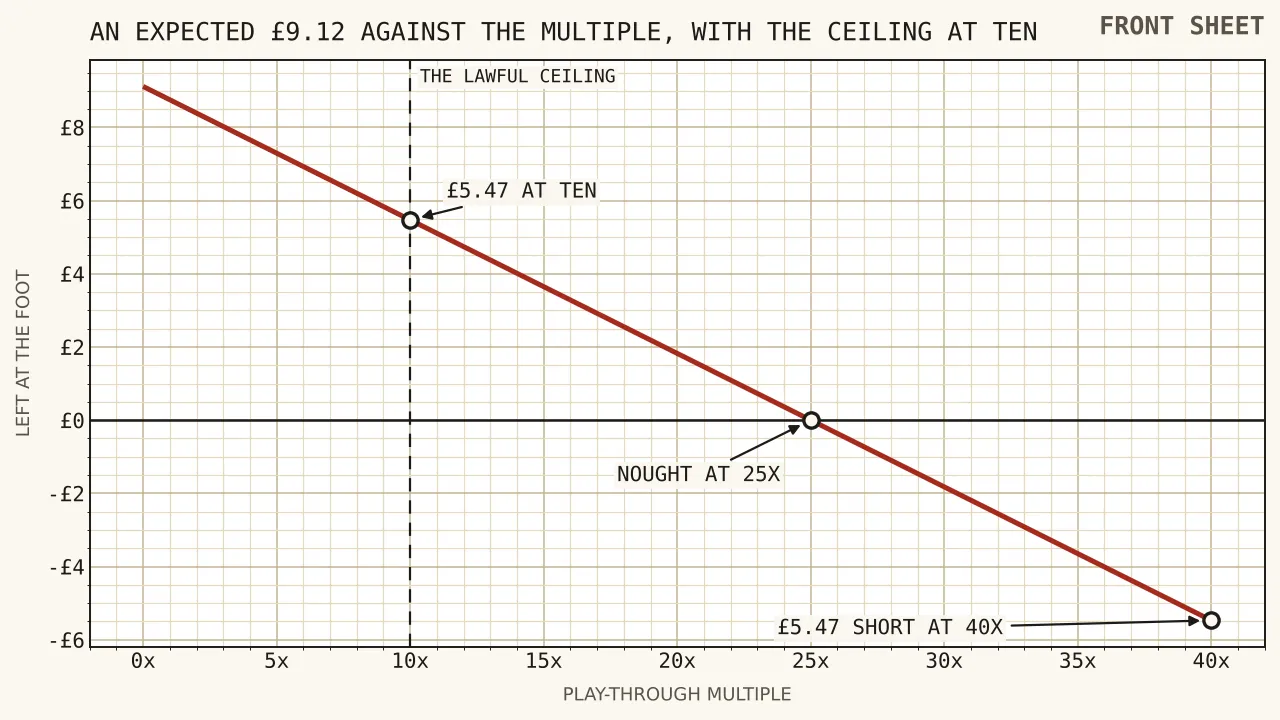
All of that turns on one number and the tally is not it. Every turn of the multiple burns four per cent of the balance under clearance, four per cent being the reel’s share. One divided by 0.04 comes to twenty-five. A requirement pitched at twenty-five is therefore expected to eat the entire balance it hangs on, however the headline described it.
That reciprocal is the most portable thing on the site. Beneath twenty-five a balance survives in part, and the share that survives is whatever four per cent a turn has not already taken. Exactly at twenty-five the expectation is nought. Past twenty-five the sum goes negative, and negative is concrete: the money runs out with the obligation unfinished, and the remaining turnover comes from the reader’s own pocket.
Set that expected £9.12 against five multiples and read the right-hand column downwards.
| Play-through | Staking owed | Presses at 10p | Minutes at 2.5s | Expected cost | At the foot |
|---|---|---|---|---|---|
| None on the winnings | £0.00 | 0 | 0 | £0.00 | £9.12 |
| Ten times | £91.20 | 912 | 38 | £3.65 | £5.47 |
| Twenty times | £182.40 | 1,824 | 76 | £7.30 | £1.82 |
| Twenty-five times | £228.00 | 2,280 | 95 | £9.12 | £0.00 |
| Forty times | £364.80 | 3,648 | 152 | £14.59 | short by £5.47 |
Two things in that table are arithmetic and not coincidence. The minutes column reads 95 at twenty-five times, matching the tally, because a balance equal to 95 tenpenny presses takes 95 minutes of lawful pressing to extinguish. And forty times produces a £5.47 hole, the exact mirror of what tenfold leaves, because forty stands as far above the crossing point as ten stands below it.
4
Nobody has to print the price of one
A reader might reasonably expect a rule fixing what a spin is worth, or at the very least one forcing a cashier to say. None exists. No licence condition, no technical standard and no section of the statute sets a floor, a ceiling or a duty of disclosure over the cash value of a single press. The pence on a spin are a commercial decision and no regulator has expressed a view on them.
Regulated instead is the information surrounding the press. The standard on game descriptions requires that whatever lets a customer judge their chances be easy to reach before they commit, and it accepts any single item from a short list in satisfaction: the margin the house keeps, the percentage handed back, the chance of a winning event, or an account of how the game resolves and allocates its prizes. Four routes, one duty, joined by or. That is why no page here says a licensed site must print a percentage.
The wrapper is regulated from a second direction. The code provision covering every reward requires its terms to be clear, transparent and fair, and to be easy for anybody offered the thing to find. The advertising code supplies prominence: a significant condition whose omission would mislead has to be put clearly and prominently inside the promotion. The advertising regulator’s own illustration of significance runs to four items, and on a no-deposit spins package every one of them bites: the deadline for claiming or using the thing, the deposit or the wagering attached to it, any floor on odds or bet type, and the limits on who may take it at all.
So the reader’s actual position is an odd one. The count is advertised. The conditions are meant to be advertised beside it with equal weight. The pence on one press, the hinge that turns the other two into pounds, need never be written down anywhere at all. Ten pence is the figure used here, and every page that leans on it says so.
5
The British ceiling, and the day it arrived
Nineteen January 2026 is the date on which the arithmetic above acquired a lid. From that date no British licensee may set a play-through on bonus funds above tenfold, under a short prohibition in the social responsibility code. The ten in the sums here is not a convenience, then. It is the top of the lawful range.
What it displaced is documented. The consultation response behind it, out on 26 March 2025 and last revised on 27 January 2026, records pre-cap practice reaching sixty. That is the one market multiple this site credits to anybody but its own working, and converting it is instructive: sixty on an expected £9.12 is £547.20 of staking at a cost of £21.89, so the holder of that balance would expect to finish £12.77 down rather than £5.47 up. The lid did not trim something generous. It deleted an obligation nobody could discharge.
A second rule commenced the same day and gets far less attention. No single incentive may carry two product types, and the four on the list read casino, betting, bingo, lottery. Three carve-outs then run against intuition. A pair of things drawn from the same type may be bundled, and the regulator’s illustration pairs a raffle with a scratchcard. Two offers sent together in one message are untouched where the recipient has opted in to both products separately. So is a credit the holder may spend on whatever product they choose. Slots fall under casino, which puts a match plus free spins inside a single type and a match plus bingo tickets across two.
Two gaps around the lid are real and neither is papered over here. The prohibition is drafted around bonus funds. Does a spin count as funds of that kind? Nothing published answers it in either direction, so no answer is improvised. What can be said is narrower and still useful: winnings off a spin that land in a bonus balance are funds of that kind, and against that balance the tenfold stop bites. Whether an obligation computed from deposit plus bonus falls inside the lid is similarly unanswered in anything issued. Where the published words stop, these pages stop.
6
Where a tally comes from, and what one is worth
The site divides into seven sections, and the division follows the arithmetic rather than the marketing. Three of them settle where a tally came from and what one unit of it is worth, which between them fix the first two of the three figures.
Counted at the door handles packages passed over before any money moves, and the question underneath it is what a tally is worth to somebody who has paid nothing for it. Twenty-three pages sit beneath that heading, running from the smallest count this market bothers to advertise up to the four-figure ones, with the pound-denominated credits treated alongside them, since a credit arrives with its unit already fitted and a tally does not.
Counted against a payment takes the half of the market where the tally is consideration for a deposit, and asks what a pound handed over is worth by the time it reaches the foot. Thirteen pages work through the two currencies that half quotes in, a percentage of the payment and a rate of spins to the pound, and show why a steeper percentage buys a proportionally steeper obligation instead of a better bargain.
What a spin is worth is the section about the unit itself, and it asks what one press costs in money and in seconds. Seven pages dismantle a press: its expected cost, its duration, the statutory lid above it and the floor that the smallest acceptable payment puts under it. Get the unit wrong and every other figure on a page is wrong in the same proportion, which is why this section is the shortest and carries the most.
7
The way in, the room, and the register
The other four sections deal with everything around the tally: the toll on money going in, the payback of the room at the far end, what alters when an address is missing from the British register, and who holds the licence a named brand actually runs on.
The way in prices the rails, and asks what a method of payment takes out before a single press has been counted. Sixteen pages insist on answering in presses rather than percentages, because 99p on a £20 payment means nothing to a reader until it has been restated as ten presses that no longer exist. The same section covers the exit, since a wait costs something even where nobody bills for it, and the one rail British rule has shut outright.
Where they are spent deals with the room, and asks what the destination does to the value of a tally. Thirteen pages show the same count worth different money according to where it is used. A return percentage multiplies the stake; a contribution weighting multiplies the turnover needed to discharge an obligation, so a game counting at five per cent converts a tenfold requirement into two hundred times of real staking.
Off the register is the plain-spoken section, and it asks what an absence from the Gambling Commission’s register actually removes. Thirteen pages set that out duty by duty and put a price on each absence. No part of it helps anybody back into a site they have registered to stay out of, and no part of it dresses such a site up as something it is not.
8
The standing pages, and how this site is paid
Four pages exist so the rest can be checked rather than taken on trust. How a count is priced writes the arithmetic out in full, with the four assumptions and the one expression every figure comes out of. How this site is paid says where the money comes from, because anybody weighing a recommendation is entitled to know who gets paid when they act on it. Who counts this says who does the sums. Staying in control gathers the tools, the national scheme and the helpline into one place.
Four more are the ordinary furniture of a published site, and they are linked here rather than buried. Terms of use sets out what this is and what it is not. Privacy and Cookies describe what gets collected and what gets set. Write to us is the route for a correction, which is the message most worth sending: a wrong figure here should be reported, and a sourced correction will be made.
One habit runs through the lot. A figure on this site is either arithmetic, in which case the working sits on the page beside it, or a fact with a primary source behind it, in which case the source is named and the date it was read is given. Nothing here rests on play at the sites it writes about. No account was opened, no spin was taken, no withdrawal was requested, and no page pretends otherwise. The work is reading published rules, reading the public register, and doing sums.
9
What an address outside the register leaves out
A cashier out at that end of the market holds no Great Britain licence at all, which is best set out as a schedule of duties stopping at the water. Nothing holds the play-through such a cashier attaches down to tenfold. Nothing caps one online slot game cycle at £5, or at £2 below the age of twenty-five, those two figures reaching every remote casino licence through a statutory instrument of 25 February 2025 whose commencement the regulator puts in guidance at 9 April and 21 May that year, slots only. Nothing enrols the place in the national self-exclusion scheme, because enrolment travels with the licence and with nothing else. And nothing owes a reader the three working days for an acknowledgement, the eight weeks for a finished complaint, or the adjudicator that waits at the close of it, chosen from eight approved names, five of them listed for every remote sector.
The self-exclusion point is worth stating as the scheme’s own boundary rather than as anybody’s gloss. Gamstop Online reaches accounts at participating operators, and whatever a non-participating firm runs lies outside what it can do. Read that as the place where the protection ends, not as an opening. Nothing here will help a registered person, or anybody with a card block or a phone blocker in place, get past either. Such material is absent by design.
One thing a missing authorisation does not deliver is a tax advantage, and the point earns space precisely because it is so often got backwards. Remote gaming duty keys off where the customer ordinarily lives rather than off whoever issued a licence, and it bills the operator and not the player. Since 1 April 2026 the rate has stood at 40 per cent; for the seven years before that, 21 per cent; before 2019, 15 per cent. A cashier taking British stakes falls inside the charge whether or not it is licensed here. HMRC’s manuals place betting and gambling short of trading, which is why a win is not income from a trade. Nothing here goes further than that, and none of it is tax advice.
Strike the duties out and what is left is the arithmetic this page opened on. At the tenfold lid a British licence enforces, 95 presses at 10p come to £5.47 at the foot. At the fortyfold requirement an unlicensed cashier may set freely, the same 95 presses are a £5.47 hole. Both headlines read 95. That is the whole case for pricing the unit before accepting the package, and it outperforms any adjective available.
£5.47 kept at the regulated lid against £5.47 lost at forty times, on the same tally of 95
Questions
- What does a package of 95 spins actually come to?
- Priced at 10p the press it is £9.50 of stake, and a reel set to 0.96 is expected to return £9.12 of that. Add the heaviest play-through a British licence permits, tenfold, and £91.20 of staking is owed at an expected £3.65, which leaves £5.47. In presses that obligation is 912, and the 2.5-second minimum in the slots standard puts at least 2,280 seconds beneath them.
- Why price a spin at 10p rather than find out what one is really worth?
- Because no primary source fixes the cash value of a spin, and none obliges a cashier to disclose it either. The pence are a commercial decision. Ten pence is the figure used throughout, it is declared on every page that relies on it, and any page needing a different unit names the value and the reason in the sentence that uses it.
- How heavy a play-through may a British licensed site attach?
- Tenfold play-through of bonus funds and no more. The date is 19 January 2026 and the prohibition sits in the social responsibility code. The consultation response behind it, out on 26 March 2025 and revised on 27 January 2026, puts pre-cap practice at sixty, which on an expected £9.12 would have meant £547.20 of staking at a cost of £21.89.
- Why does twenty-five keep turning up in these sums?
- A machine set to 96 per cent keeps 4p out of every pound. Divide 4p into £1 and twenty-five is the answer. A requirement at twenty-five is expected to absorb the whole balance it is attached to. Under it a balance survives in part; over it the expected result is a deficit funded out of the reader’s own pocket.
- Does a free spin itself rank as bonus funds under the tenfold lid?
- Nothing published answers that in either direction, and no answer is improvised here. The prohibition is drafted around bonus funds. The narrower thing that can be said is that winnings off a spin credited to a bonus balance are funds of that kind, and against that balance the tenfold stop applies.
- Which section should be read first?
- It depends what the reader is holding. A package handed over before any payment belongs in Counted at the door. One attached to a deposit belongs in Counted against a payment. Anybody who wants the unit itself dismantled should begin at What a spin is worth, because every other figure on the site scales with it.
- What does a reader give up at an address missing from the British register?
- The tenfold lid on a play-through, the £5 cap on one online slot game cycle and the £2 cap below the age of twenty-five, the enrolment in the national self-exclusion scheme that arrives with a British licence, and the eight-week limit on a complaint ending at an approved adjudicator. None of those duties crosses the water. Nor does the tax position shift in the reader’s favour.
- Is a tally of spins ever better than a credit in pounds?
- Only once both have been converted. A credit arrives with its unit fitted, so the face value is known from the start, whereas a tally has to be multiplied by a price nobody is obliged to print. Reduce each to an expected figure at the foot and they compare directly, which is what every page here does before saying anything else.