Section D Revision 1 Counted 16 October 2026
Counted at the door: what a tally is worth before any money has moved
A package of 35 presses, priced at 10p apiece, is £3.50 of stake nobody has paid for. A machine returning 96p in the pound is expected to give £3.36 of it back, and a tenfold play-through leaves £2.02 standing. Twenty-three pages under this heading run that conversion on every tally handed over at the door, from the five-press packages to the four-figure ones.
The count 35 spins One spin 10p Comes to £2.02
Packages handed over before a payment has been made
Every destination on this board is bought advertising. The site takes a fee if a reader goes on to register, and no figure printed below moves because of it.
The Spin Count
Gauge No 01
Betportal
Lowest multiple here
Priced at this site's own 10p a spin
What is counted
What is asked
No Great Britain licence
Licensed in Anjouan, Comoros, run by BetPortal Gaming Ltd, with Excite Ultra Media Ltd, reference ALSI-202601040-FI2.
Terms read 16 October 2026
Open the offer at Betportal, opens in a new tabThe Spin Count
Gauge No 02
WinBeast
Largest count here
Priced at this site's own 10p a spin
What is counted
What is asked
No Great Britain licence
Licensed in Curaçao, operator not named on the site.
Terms read 16 October 2026
Open the offer at WinBeast, opens in a new tabThe Spin Count
Gauge No 03
EliteSpin
Longest spin window
Priced at this site's own 10p a spin
What is counted
What is asked
No Great Britain licence
Licensed in Costa Rica, run by PrimeTier Limited.
Terms read 16 October 2026
Open the offer at EliteSpin, opens in a new tabThe Spin Count
Gauge No 04
Crown Jewelz
Multiple unpublished
No foot figure struck
What is counted
What is asked
No Great Britain licence
Licensed in Curaçao, number not verified, operator not named on the site.
Terms read 16 October 2026
Open the offer at Crown Jewelz, opens in a new tabThe figure in the third register is this site's own arithmetic and nothing an operator has published: the count at face, less the share a spin gives back at 96 per cent return to player, less what playing the wagering through costs at the same return. It describes the offer, not one reader's afternoon. Where the conditions price above the count the counter prints nothing rather than a negative sum, and where a figure the sum needs is unpublished it prints the condition in the operator's words instead.
A count has no unit of its own, so one is supplied. Where an operator publishes what a spin of its own is worth, that figure stands in the second register and is labelled as theirs. Where it does not, the second register carries this site's own 10p a spin and says so, and the foot figure moves in proportion: at half the price, half the money. The figure after it, what the count comes to for each spin, is the one that compares a large count against a small one.
Three words stand in the amount column where no figure can. Noted is a published condition that takes value away without leaving the sum a figure to take. Unpriced is a condition whose figure nobody has published, or a credit that is not a sum until a deposit of your own sets it. Own money is money of yours, which is never part of a foot figure.
Not one of the operators printed above holds a Great Britain licence, so the duties that licence carries do not reach them. Every online gambling company licensed in Great Britain has to be part of Gamstop Online, and a reader who has shut themselves out through the scheme is therefore not shut out here. The ceiling of ten times the bonus funds on a wagering requirement, in force since 19 January 2026, is a condition of that licence and binds the companies that hold one. Where a dispute goes instead is a matter for the authority named on the counter, and the Gambling Commission describes what a reader faces without a British licence as a lack of recourse if things go wrong. Nobody under 18 may hold an account at any of them.
Every term printed on a counter is the operator's own, and each counter carries the day it was read. The oldest of those readings is 16 October 2026. What binds a reader is the operator's own full terms, and not a line printed here.
1
The question under every page in this section
Everything filed here shares one question. A package has arrived before any money has, so what is it worth? The question looks as though the headline answers it. The headline is the one thing that cannot, because a headline of this sort is a quantity of items whose size is never stated.
This is also the one corner of the market where the word free survives inspection. The advertising regulator’s position is that nothing should be called free when the customer has to put their own money at stake to qualify for it. At the door, nothing is staked to qualify. No deposit has been made, no card has been charged and the stake in the machine belongs to the house. The honest objection to a package handed over at the door is never that the word free is wrong. It is that the number in front of the word has no unit on it.
Two pages take the question at full width. Free spins with no deposit is the one to read first: it answers what the ordinary pre-payment package comes to across the whole span of sizes this market advertises, rather than at one size. The no-deposit casino bonus answers the mirror-image question, which is what alters once the thing passed over is denominated in pounds instead of items, and why the second shape is easier to value and harder to spend.
The assumptions behind every figure on this page are the site’s, not an operator’s. The unit is 10p. A reel gives back 96p in the pound. Weighting counts at unity, so £1 through the machine discharges £1 of obligation. Where the play-through on a package cannot be read, forty is used, because that is the order of multiple written by cashiers answerable to no British regulator. The ten used in the worked sums below is a different thing entirely: it is the legal maximum in Great Britain, and it is identified as such wherever it appears.
2
Thirty-five presses, and the three figures
Take a tally of 35 and run it to the end. At 10p a press the face value is £3.50, and the only thing that figure asserts is how much stake has been put on the table by somebody other than the reader. Nobody has paid in. Nothing has been risked. That is figure one, and on its own it is a headline with a unit bolted on and no more.
Figure two comes from the machine. A reel set to 0.96 turns £3.50 of turnover into an expected £3.36 and holds back 14p. Nobody charges the 14p; it is the difference between what passes through and what is expected out the other side. Thirty-five presses is a sample far too small for that expectation to show itself in one sitting, which is why £3.36 is described as a long-run figure every time it is used.
Figure three is what gets past the condition. Where the balance has to be turned over ten times, the ceiling a British licence imposes, £3.36 becomes £33.60 of staking owed. Four pence in the pound on £33.60 is an expected £1.34, which leaves £2.02. The reel has kept 14p of the gift and the condition has taken £1.34 more, so £3.50 advertised arrives at £2.02 earned.
In presses the obligation reads 336. Divide £33.60 by the 10p unit and that is what comes out, and because the slots standard puts a 2.5-second floor under each game cycle, 336 presses occupy 840 seconds at the very least. Fourteen minutes, against fourteen pence: the reel’s share and the clock’s share happen to carry the same digits here, which is arithmetic and not a trick.
35 presses given, 336 presses owed, 14 minutes of pressing between them
3
Six prices for the same thirty-five
Nothing above depended on the tally. It depended on the unit, and the unit is the figure the advertisement leaves out. Hold the tally at 35 and move the price of a press through six settings and the whole thing stretches by a factor of twenty-five from top to bottom.
| Price of one press | Face value | Expected back | Owed at tenfold | Presses owed | At the foot |
|---|---|---|---|---|---|
| 1p | £0.35 | £0.34 | £3.36 | 336 | £0.20 |
| 2p | £0.70 | £0.67 | £6.72 | 336 | £0.40 |
| 5p | £1.75 | £1.68 | £16.80 | 336 | £1.01 |
| 10p | £3.50 | £3.36 | £33.60 | 336 | £2.02 |
| 20p | £7.00 | £6.72 | £67.20 | 336 | £4.03 |
| 25p | £8.75 | £8.40 | £84.00 | 336 | £5.04 |
Read the fifth column across and it does not move. That column is the most valuable line in the whole table. The staking owed is ten lots of 96 per cent of the tally multiplied by the unit, so dividing it back by the unit cancels the unit out, and 35 times 10 times 0.96 is 336 whatever a press costs. A cheaper unit shrinks the money on both sides of the deal and leaves the labour exactly where it was. Twenty-five rows of work, two pence of winnings: that is what a penny package looks like once the unit is written in.
The last column moves in strict proportion, because the figure at the foot is 0.0576 of the face value and nothing else. A quarter of a pound a press gives £5.04; a penny a press gives 20p. Same tally, same conditions, twenty-five to one.
4
Nothing obliges anybody to publish a unit
Read the licence conditions through looking for a figure in pence attached to a spin and there is nothing there to find. No condition, no technical standard and no part of the statute puts a floor under the cash value of a press, a ceiling over it, or a duty on anybody to say what it is. The pence are set commercially and the regulator has not spoken to them.
The terms wrapped round the tally are a different matter. The code provision reaching incentives fires the moment a licensee gives anybody, customer or not yet customer, money, goods, services or some other advantage. A quantity of presses is an advantage on any reading, so the provision bites, and what it then demands is twofold: terms drafted to be clear, transparent and fair, then put where anyone offered the thing can find them. A duty of clarity about the conditions, in other words, and no duty whatever about the unit those conditions operate on.
One misconception attaches to no-deposit packages harder than to anything else in this market, and it is worth killing. A tally handed over at the door is not an anonymous tally. Three items must be held and checked before a customer gambles at all: a name, a home address and a date of birth. The regulator announced the rules on 7 February 2019 and brought them in on 7 May that year, reaching past paid play to gambling funded by a bonus and to the demonstration versions of games carried on a licensee’s own site. A 72-hour grace period for age checks existed before that and does not now. Nothing-to-pay opens no door earlier.
One line of bonus small print carries a published price, and the line sat exactly where this section lives, among the terms governing promotions for new casino customers. Taichi Tech Limited, which trades as Fafabet, paid £170,000 on 3 July 2025. What cost that money was a discretion the operator had reserved to itself to shut accounts or take winnings away. On the regulator’s finding the condition requiring fair and open dealing had been breached, and an independent third-party audit covering money-laundering and safer gambling controls was required on top. One sentence, £170,000. No clause of that shape is struck down anywhere as a result, because the published outcome was a fine rather than a ruling on validity, but a fine is a price, and a reader meeting a sentence of that sort now knows what the regulator made of it.
5
Where the line crosses nothing
The arithmetic of a play-through is one subtraction repeated. A 96 per cent reel keeps 4p from each pound of turnover, so each turn of the multiple costs the balance 4 per cent of itself. Twenty-five such turns add up to the pound, which is why twenty-five is the number at which the whole balance is expected to be gone, and why no headline count can change that.
Against the expected £3.36 on a 35-press tally the four landmarks read as follows. Tenfold asks £33.60 of turnover, costs £1.34 and leaves £2.02. Twenty-five times asks £84.00, costs the whole £3.36 and leaves nothing. Forty times asks £134.40, costs £5.38 and opens a £2.02 hole, the exact mirror of the tenfold row. Sixty times, the pre-cap high-water mark the regulator put on record, asks £201.60, costs £8.06, and leaves the holder expecting to finish £4.70 down on a package advertising 35 free presses.
Great Britain closed the top of that range on 19 January 2026. From that date the most a licensee may demand of bonus funds is ten turns of play-through, which puts the first row of the paragraph above at the legal limit and the last two beyond anything a licensed cashier may now write. The consultation response behind the change, published 26 March 2025 and last revised 27 January 2026, is where the sixty comes from, and it is the only market multiple on this site attributed to any source but its own working.
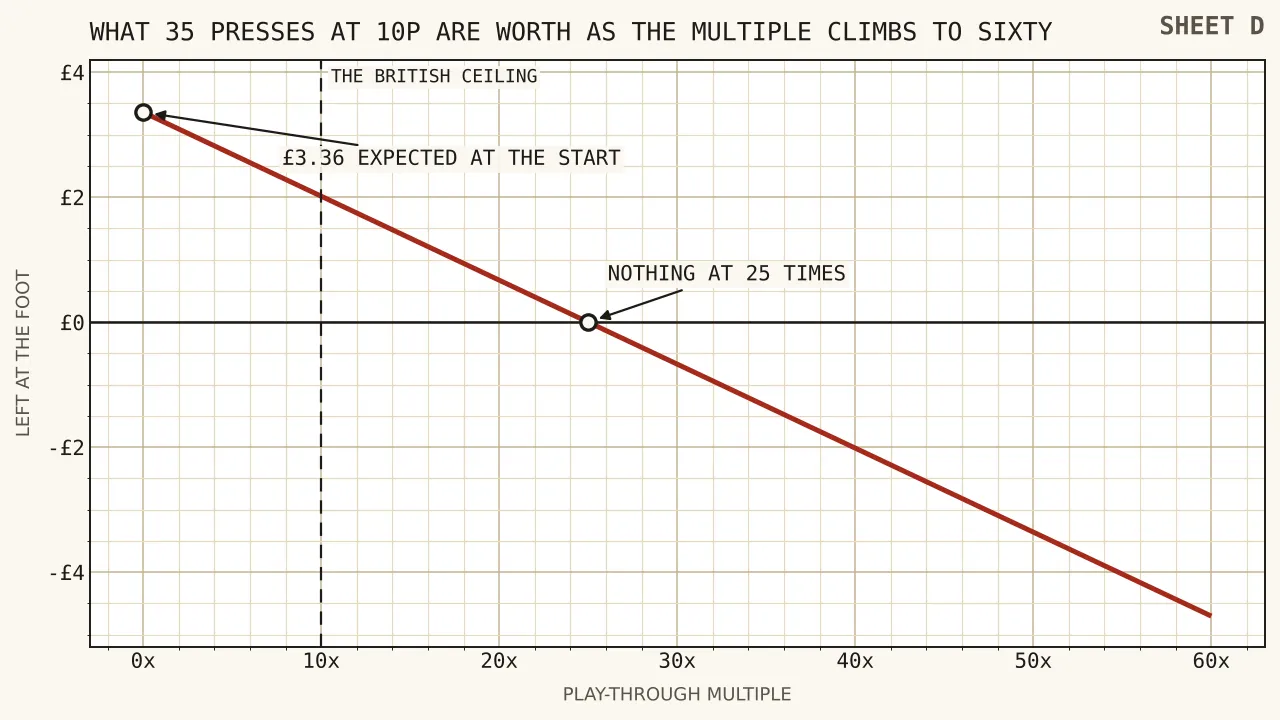
£2.02 at tenfold, nothing at twenty-five, £4.70 down at sixty
6
The route through, smallest first
Eleven pages take a tally of a stated size and price it to the foot. They are ordered here by the size of the tally, because that is the axis along which the answers actually change: at the bottom the fixed costs of claiming swamp the prize, and at the top the obligation grows faster than anybody reads.
Five presses answers the question of what happens when the admission formalities are worth more than the thing being admitted to. Ten presses asks whether a tally that small can clear any threshold a cashier is likely to set at the exit. Twenty on registration asks what the act of registering is worth on its own, since that is the entire consideration being given.
Twenty on a named reel answers a different question: what is settled, and what is not, once the machine the presses must be used on has been specified. Twenty-five on registration is the same shape one notch up, and it is where the arithmetic first produces a figure worth the paperwork. Forty presses asks what a tally in the middle of the range looks like when every condition is converted into clock time instead of money.
A hundred presses is the size at which the thresholds at the exit stop being academic, so that page asks which of them binds first. A hundred and fifty is the tally this site is named for, and its question is whether a headline that large survives its own conditions. The same hundred and fifty on one named machine asks what a named reel adds to the answer and what it cannot add.
Two hundred presses asks whose money is actually on the table once the figure is large enough to look like a sum, and a thousand presses asks the question the largest headlines invite, which is how many hours of lawful pressing a four-figure tally represents before anything can be withdrawn.
7
Where the unit arrives already attached
Five pages deal with packages quoted in sterling rather than in items. A sum of money skips the first conversion entirely: five pounds is five pounds, and no assumption about a unit is needed to know the face value. The difficulty moves one step along instead. To know what clearing it involves, the sum has to be divided by the unit, and the unit is still nowhere in the advertisement. Five pounds at 10p is fifty presses. The same five pounds at 25p is twenty.
Five pounds with nothing to pay answers what the smallest credit in this market buys once the minimum stake at the other end is taken into account. Ten pounds with nothing to pay asks why a round ten is almost never a round ten by the time it can be withdrawn. Twenty pounds asks what happens when the ceiling on conversion is expressed against what the player has deposited, which on a no-deposit credit is nothing.
Thirty pounds asks which clause sets the pace once the credit is big enough for the clock to matter more than the money. And the hundred-free headline answers the sharpest question in this section, which is what the number is even counting when the advertisement never says whether the hundred is pounds, presses or something else again.
8
Instalments, and a book of tickets
Two pages here are about shape rather than size. Delivery in instalments changes nothing about the total and everything about the time, because a tally that arrives ten presses a day is a tally whose expiry is a calendar and not a clause. Spins issued daily answers what the calendar does to a figure that the arithmetic would otherwise settle in a single sitting, and why a drip changes who ends up holding the obligation.
Tickets rather than presses is the other shape, and its question is what a unit means in a room where the thing bought is a ticket in a game against other players rather than a stake against a machine. The conversion still has to be done, and the room at the far end has no obligation to print a percentage at all, so the page is about what can honestly be said when the return figure is simply absent.
9
What the no-wagering line actually removes
A line reading no wagering on winnings is the single most valuable sentence a package of this kind can carry, and its value can be stated exactly. It removes the expected cost of the play-through, and nothing else. On the 35-press tally that cost is £1.34 at the British ceiling, so the clause is worth £1.34 and lifts the figure at the foot from £2.02 to £3.36. As a share, the clause is worth two fifths of what is left standing at tenfold. Against a twenty-five times requirement the clause is worth the entire balance, since the entire balance is what such a requirement is expected to consume.
Three pages work that premium out at different sizes. Thirty presses with the winnings kept answers what the promise is worth in pence when the tally is small enough that the fixed obstacles dominate. Fifty presses with no wagering asks what is left to go wrong once the heaviest condition has been struck out. Seventy presses with no wagering asks which of the remaining clauses then does the damage, and how many presses a ceiling at the exit throws away.
Two rules in this area look alike and are not, and the distinction has to be kept. The first forbids any limit at all on money drawn out of a deposit balance, which is the player’s own money, and the regulator’s illustration of a term it forbids is a contract clause capping that at £50 any day and £500 any week. The second rule does not exist: nothing prohibits a ceiling on winnings produced by a bonus, and ceilings of that kind are common. One set of terms can carry a lawful cap on bonus winnings and an unlawful cap on withdrawals at the same time, and a reader has to see which of the two a given sentence is doing.
10
Which of these duties crosses the water
Four duties have been named above. A licensee must hold three things on file and checked before the first press, namely the customer’s name, their home address and their date of birth, and it makes no difference whether that press has been bought, given as a bonus or offered with nothing to win on it. A single incentive may not carry two of the four product types the rule lists. Capping the outflow from a deposit balance is forbidden outright. And the reel may not swap a plain loss for something staged to look like a near miss, which is a design rule rather than a money rule.
Which of those four duties follows a tally across the water? Not one. Out past the register a cashier holds no Great Britain licence. Not one of those obligations attaches to it, and nor does the ten-times ceiling that produced the £2.02 above. What replaces them is the cashier’s own discretion, and the arithmetic of discretion is the fortyfold column: the same 35 presses that are worth £2.02 under a British licence are a £2.02 deficit under a requirement nobody has capped.
The national self-exclusion scheme belongs in the same list and is worth its own sentence, because its reach is decided by the licence rather than by the site. Every company licensed to offer online gambling in Great Britain has to take part, which means a registration covers all of them and covers nothing else. Gamstop Online says as much in its own terms: what it can do stops at the operators inside the scheme. That is a boundary on the protection a registered person holds, and this site treats it as a boundary and not as an invitation. Nobody will find material here about reaching a site they have registered to stay away from, or about getting round a blocker or a gambling bar on a bank card.
336 presses owed at the British ceiling against 1,344 owed at forty times
Questions
- What is a package of 35 presses with nothing to pay actually worth?
- At 10p a press the face value is £3.50, a machine returning 96p in the pound is expected to give back £3.36, and a tenfold play-through costs £1.34 of that, which leaves £2.02. The obligation comes to 336 presses, and a game cycle that cannot restart inside 2.5 seconds puts at least 840 seconds beneath them.
- Does the number of presses owed depend on what a press costs?
- No, and that is the most useful invariant in this section. The staking owed is ten lots of 96 per cent of the tally multiplied by the unit, so dividing it back by the unit cancels the unit out. A 35-press tally owes 336 presses at a penny a press and 336 at a quarter of a pound. Only the money moves.
- Is a no-deposit package really free?
- The advertising regulator reserves its objection to the word for offers that make the customer stake money of their own to qualify. At the door nothing is staked to qualify, so the word survives. What is missing from the advertisement is not honesty about the word but a unit for the number in front of it.
- Can a tally be claimed without handing over identity documents?
- No. Three items must be on file and verified before the first press: a name, a home address, a date of birth. The rules were announced on 7 February 2019 and took effect on 7 May that year, reaching gambling funded by a bonus and the demonstration versions of games on a licensee’s own site. The 72-hour grace period for age checks went with them.
- How much is a no-wagering line worth in pence?
- Exactly the expected cost of the play-through it removes. On a 35-press tally, with the multiple at the British maximum of ten, the cost removed is £1.34, which lifts the figure at the foot from £2.02 to £3.36 and amounts to two fifths of what was left standing. Against a twenty-five times requirement the same line is worth the whole balance.
- Why does twenty-five times leave nothing whatever the tally is?
- Because a 96 per cent reel keeps 4p from each pound of turnover, so every turn of the multiple costs the balance four per cent of itself, and twenty-five turns of four per cent add up to the pound. The headline figure is irrelevant to that; it scales both sides of the sum by the same amount.
- Is a cap on bonus winnings allowed when a cap on withdrawals is not?
- They are two separate rules, and one page of terms can hold both at once. A cap on money drawn out of a deposit balance is barred, and the regulator’s illustration of a forbidden term holds that to £50 any day and £500 any week. Nothing bars a ceiling on winnings produced by a bonus, which is why such ceilings are common.
- What changes when a package comes from an address with no British licence?
- The tenfold ceiling goes, and with it the duty to check identity before a bonus press, the rule keeping two product types out of one incentive, and the bar on capping money that leaves a deposit balance. Enrolment in the national self-exclusion scheme goes as well, since that obligation rides on the licence. On the same 35 presses, a fortyfold requirement turns a £2.02 gain into a £2.02 deficit.