Sheet D03 Revision 1 Counted 16 October 2026
25 free spins on registration: £2.50 of stake, £2.40 expected back
The stake is funded for you: twenty-five presses at 10p, so £2.50 put through a machine expected to return £2.40 of it. The count is also, by coincidence, the multiple at which a wagering requirement finishes a balance off, so this is the one sheet where the headline and the wall carry the same number. What follows is what each condition takes from £2.40.
The count 25 presses One spin 10p Comes to £2.40 unconditioned
What a count of this size comes to
Every destination on this board is bought advertising. The site takes a fee if a reader goes on to register, and no figure printed below moves because of it.
The Spin Count
Gauge No 01
Betportal
Lowest multiple here
Priced at this site's own 10p a spin
What is counted
What is asked
No Great Britain licence
Licensed in Anjouan, Comoros, run by BetPortal Gaming Ltd, with Excite Ultra Media Ltd, reference ALSI-202601040-FI2.
Terms read 16 October 2026
Open the offer at Betportal, opens in a new tabThe Spin Count
Gauge No 02
WinBeast
Largest count here
Priced at this site's own 10p a spin
What is counted
What is asked
No Great Britain licence
Licensed in Curaçao, operator not named on the site.
Terms read 16 October 2026
Open the offer at WinBeast, opens in a new tabThe Spin Count
Gauge No 03
EliteSpin
Longest spin window
Priced at this site's own 10p a spin
What is counted
What is asked
No Great Britain licence
Licensed in Costa Rica, run by PrimeTier Limited.
Terms read 16 October 2026
Open the offer at EliteSpin, opens in a new tabThe Spin Count
Gauge No 04
Crown Jewelz
Multiple unpublished
No foot figure struck
What is counted
What is asked
No Great Britain licence
Licensed in Curaçao, number not verified, operator not named on the site.
Terms read 16 October 2026
Open the offer at Crown Jewelz, opens in a new tabThe figure in the third register is this site's own arithmetic and nothing an operator has published: the count at face, less the share a spin gives back at 96 per cent return to player, less what playing the wagering through costs at the same return. It describes the offer, not one reader's afternoon. Where the conditions price above the count the counter prints nothing rather than a negative sum, and where a figure the sum needs is unpublished it prints the condition in the operator's words instead.
A count has no unit of its own, so one is supplied. Where an operator publishes what a spin of its own is worth, that figure stands in the second register and is labelled as theirs. Where it does not, the second register carries this site's own 10p a spin and says so, and the foot figure moves in proportion: at half the price, half the money. The figure after it, what the count comes to for each spin, is the one that compares a large count against a small one.
Three words stand in the amount column where no figure can. Noted is a published condition that takes value away without leaving the sum a figure to take. Unpriced is a condition whose figure nobody has published, or a credit that is not a sum until a deposit of your own sets it. Own money is money of yours, which is never part of a foot figure.
Not one of the operators printed above holds a Great Britain licence, so the duties that licence carries do not reach them. Every online gambling company licensed in Great Britain has to be part of Gamstop Online, and a reader who has shut themselves out through the scheme is therefore not shut out here. The ceiling of ten times the bonus funds on a wagering requirement, in force since 19 January 2026, is a condition of that licence and binds the companies that hold one. Where a dispute goes instead is a matter for the authority named on the counter, and the Gambling Commission describes what a reader faces without a British licence as a lack of recourse if things go wrong. Nobody under 18 may hold an account at any of them.
Every term printed on a counter is the operator's own, and each counter carries the day it was read. The oldest of those readings is 16 October 2026. What binds a reader is the operator's own full terms, and not a line printed here.
1
Twenty-five presses, converted
The sum takes one line. Twenty-five lots of ten pence is £2.50. Ninety-six per cent of that is £2.40. The second figure is what the count is expected to be worth before a single condition touches it, and it is the whole of the good news here.
A third figure belongs beside those two and no headline carries it. A licensed slot keeps two and a half seconds between game cycles as a minimum, which puts sixty-two and a half seconds underneath twenty-five presses. Translated out of marketing language, the offer is a minute of slot play with an expected return a little over two pounds.
Run the arithmetic per press and the scale lands properly. One press at this price carries 9.6p of expectation. Five carry £0.48. Ten carry £0.96. Twenty-five carry £2.40. The question a reader is really being asked is whether verified personal detail, handed to a company they have had no dealings with, is worth two pounds forty, and putting the figure next to the question is the most useful thing this sheet can do.
| What is being counted | Figure |
|---|---|
| Presses handed over | 25 |
| Price of one, this site’s assumption | 10p |
| Stake funded by the operator | £2.50 |
| Expected back at 96 per cent | £2.40 |
| Retained by the house | £0.10 |
| Shortest lawful duration | 62.5 seconds |
2
The count is fixed and the unit is not
Everything above rests on a press costing ten pence, and that figure is an assumption rather than a rule. Not one published source states the worth of a free spin, the person who decides it, or any duty to reveal the decision. The decision is a commercial one, so one cashier’s twenty-five presses can be worth five times another cashier’s twenty-five while the two of them print identical words.
So price the whole range rather than one point on it. Hold the count at twenty-five and move the unit, and the offer stretches from under a pound to over twelve.
| Price of one press | Stake funded | Expected at 96% | Turnover owed at tenfold | Presses to clear it | Survives at the foot |
|---|---|---|---|---|---|
| 2p a press | £0.50 | £0.48 | £4.80 | 48 at 10p | £0.29 |
| 5p a press | £1.25 | £1.20 | £12.00 | 120 at 10p | £0.72 |
| 10p a press | £2.50 | £2.40 | £24.00 | 240 at 10p | £1.44 |
| 20p a press | £5.00 | £4.80 | £48.00 | 480 at 10p | £2.88 |
| 25p a press | £6.25 | £6.00 | £60.00 | 600 at 10p | £3.60 |
| 50p a press | £12.50 | £12.00 | £120.00 | 1,200 at 10p | £7.20 |
| £1.00 a press | £25.00 | £24.00 | £240.00 | 2,400 at 10p | £14.40 |
Two readings come off that. A count of twenty-five at a pound a press is worth ten times a count of twenty-five at ten pence, and no part of the headline would tell a reader which they were looking at. And the unit price is the only lever in the sum that a cashier can move without changing a word of its advertising, which is why the unit, not the count, is the first thing worth hunting for in the terms.
Turn the sum around and look at it from the cashier’s side, because that view explains why an offer of this size exists at all. Twenty-five presses commit £2.50 of stake and are expected to pay £2.40 of it back out, so the expected cost of the gesture is ten pence plus whatever the cashier spends on processing it. For that ten pence it acquires a verified name, a verified address, a verified birth date, a payment route it can market to, and an account that exists. No part of this sheet is a complaint about that exchange. It is an argument that the exchange should be priced before it is accepted, and ten pence against a verified identity is the price.
The same arithmetic explains the shape of the small print. An offer whose expected cost is ten pence does not need heavy conditions to stay viable. An offer promising ten pounds of expected return does, and the conditions in sections five to seven of this sheet are what that need looks like on the page.
Where an offer states its own spin value, that figure replaces the 10p and every sum on this sheet moves with it. Where it does not, the 10p stands as a declared assumption. This site would rather be visibly wrong by a stated amount than invisibly right.
3
The count and the wall share a number
Twenty-five appears twice in this trade and the two appearances are unrelated, which is precisely why they are worth setting next to each other.
The first twenty-five is a count of presses, chosen by somebody in marketing. The second is the wagering multiple at which a balance is expected to disappear, and nobody chose it at all. Four pence in every pound is the house’s share at a 96 per cent return, a pound holds twenty-five of those fourpences, and so the twenty-fifth turn of a balance is the one that takes the last of it.
Combine the two and the result is tidy to the penny. The presses give an expected £2.40. Twenty-five times that balance is £60.00 of staking owed, and £60.00 of staking is expected to cost £2.40. Offer and condition annihilate each other, and the nought at the end is not a judgement about the offer. It is the house edge turning up twice in one sum.
25 presses, 25 times, £60.00 of staking, nothing at the foot
Halfway matters too, and halfway is twelve and a half. A requirement of twelve and a half times leaves exactly half of a balance, so £1.20 survives from £2.40. Each single turn above or below that costs or saves 4 per cent of the balance, which on this count is 9.6p a turn, the same 9.6p one press is worth. A reader negotiating nothing and choosing between two offers can therefore price a difference of one turn in the multiple against a difference of one press in the count, and find them identical.
4
What “on registration” actually involves
The two words in the headline carry more weight than they look. Registering at a British licensed site is not a username and a password. Information establishing who the customer is has to be obtained and checked before any gambling happens, and the condition sets a floor of three items: a birth date, a postal address, a name. A floor is not a ceiling, so further documents can be asked for.
The regulator gives three grounds for the check. Age is the first. Identity itself is the second. The third is whether the person has already excluded themselves, and that is the one which makes the check impossible to waive as a kindness: a cashier unable to tell whether somebody is self-excluded cannot honour an exclusion it never looked for.
Two extensions of the duty bear directly on an offer of this shape, because both concern play that nobody paid for. Gambling on a bonus or a free bet is inside the rule, and twenty-five free presses are exactly that. Reaching a licensee’s free-to-play games is inside it too. Before a deposit can be taken, the licensee must additionally spell out which documents or other information it may call for, the moment that may happen, and how a customer is to send them.
So the presses sit behind a gate, and the gate is what is actually being traded. Verified personal detail goes one way and an expected £2.40 comes the other. Whether that exchange is worth making is the reader’s call; the arithmetic only makes it a decision instead of a reflex.
One more duty lands in the same minute as the account. The prompt for a financial limit belongs in registration itself, or else at the first payment, and the default on offer has to be setting one. Declining takes a deliberate act. Later, a reduction the customer asks for is implemented at once, while an increase waits twenty-four hours and then needs confirming a second time. That asymmetry of speed is the whole design.
5
Where £2.40 meets a payout floor
A smallest-withdrawal figure does more damage to a count this size than anything else on the page, and it does it quietly, because it lives in the banking terms rather than in the bonus terms.
The arithmetic is a division. Against an expected £2.40, a ten pound floor asks a reader to finish on 4.17 times the mean. Five pounds asks for 2.08 times. Twenty pounds asks for 8.33. None of those is impossible, because a slot pays in lumps rather than evenly, but each is a demand that the session go well rather than go to form.
| Smallest withdrawal | Multiple of the mean required | Gap on the mean | Presses that would average it |
|---|---|---|---|
| £2.50 | 1.04 times | £0.10 | 27 |
| £5.00 | 2.08 times | £2.60 | 53 |
| £10.00 | 4.17 times | £7.60 | 105 |
| £20.00 | 8.33 times | £17.60 | 209 |
The last column is the honest reply to the headline. Ten pounds is a floor built around a count of a hundred presses or more, and putting it beside twenty-five presses sets a bar four times the height of the thing jumping at it. Nobody is being cheated. Two numbers that were not chosen to go together have been printed on the same page.
One protection that a reader might expect to help does not, and saying so is worth more than implying otherwise. Capping a withdrawal from the deposit balance is forbidden outright, and the rule behind that has teeth. It is also about money the customer paid in, and on a no-deposit offer nobody has paid any in. For the whole life of the offer, every pound in play sits somewhere else, and the protection guards an empty pot.
6
A ceiling, and why it rarely binds here
This is the part where arithmetic lets a condition off, which happens less often than readers expect and deserves reporting when it does.
A maximum-win ceiling bites where it sits below the expected return. Expectation accrues at 9.6p a press, so dividing any ceiling by 9.6p gives the count beyond which it starts doing real work. Five pounds starts at 53 presses. Ten pounds starts at 105. Fifty pounds starts at 521.
Twenty-five presses fall short of all three. At this count a five pound ceiling stands at more than double the expected outcome and a hundred pound ceiling at forty-one times it. What the ceiling takes is the top of the distribution, which matters to somebody hoping for an unusual session, and it leaves the average untouched.
The statement has its own limit. A capped offer can never be expected to beat its cap, so the cap bounds the answer from above on any count whatever. At twenty-five presses that bound is slack. At a thousand presses under a ten pound ceiling it is the entire story: the uncapped expectation is £96.00 and the capped figure cannot pass £10.00. Comparing a modest count under a generous ceiling against a large count under a mean one means comparing the two bounds, not the two headlines.
A caution on those round numbers. There is no standard maximum-win figure for bonus winnings in any primary source this site could open. The ceilings divided above were picked for legibility and copied from nobody’s terms.
7
A play-through against £2.40
Where what the presses win lands in a bonus balance, a requirement can be fastened to it, and that requirement has the cleanest arithmetic of the five subtractions this section deals in.
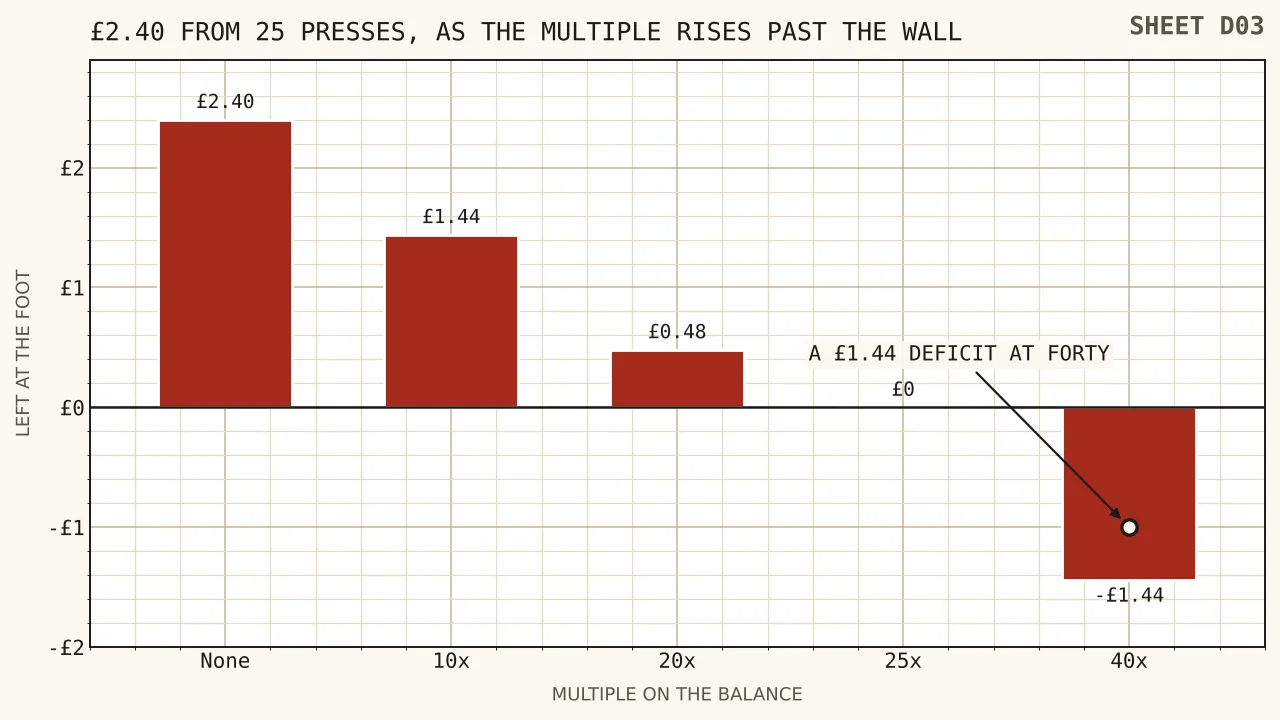
Scale the balance by one minus the multiple times the edge, and the figures fall out. Tenfold leaves three fifths of £2.40, which is £1.44. Twentyfold leaves one fifth, £0.48. Twenty-five times leaves the nought discussed earlier. Fortyfold leaves a deficit of £1.44, meaning the balance is expected to dry up with staking still outstanding and the reader funding the rest.
| Multiple | Staking owed | Presses at 10p | Lawful minimum time | Left at the foot |
|---|---|---|---|---|
| Nothing asked | none | none | none | £2.40 |
| Tenfold | £24.00 | 240 | 10 minutes | £1.44 |
| Twentyfold | £48.00 | 480 | 20 minutes | £0.48 |
| Twenty-five times | £60.00 | 600 | 25 minutes | nothing left |
| Fortyfold | £96.00 | 960 | 40 minutes | a deficit of £1.44 |
Two of those rows cannot be offered by a British licence holder. Bonus funds may not carry a play-through above ten times, a bound that arrived on 19 January 2026 in the third limb of code provision 5.1.1, where the practice it replaced had reached sixty times. The first two rows therefore describe this market and the last two describe an offer the bound does not reach.
The time column is where a small count becomes a large commitment. The presses take a minute. Tenfold on their proceeds takes 240 further presses and ten minutes. Fortyfold takes 960 presses and forty minutes. An award a minute long sits beside a condition up to forty times its length, and that ratio appears on no advertisement.
Two edges of the ten-times bound are unsettled, and unsettled is how this sheet reports them. Nothing published says whether a free press counts as bonus funds, in either direction, and nothing addresses a requirement worked out on a deposit added to a bonus. The published words go this far: a requirement against a bonus balance stops at ten times, and ten times £2.40 is £24.00.
8
What the gate buys, set against its absence
The gate is the subject of this page, so the comparison belongs in the same shape. Here is what registering with a British licence holder obliges that holder to do, and what stands in its place where there is no Great Britain licence at all. The right-hand column is worded rather than numbered, because in most rows the honest entry is a described absence.
| The subject | Required of a British licence holder | Stated in Curaçao’s own policy, version 1.0 |
|---|---|---|
| Identity at sign-up | Collected and checked ahead of all play, bonus presses and free-to-play games alike | An operator satisfied the player is 18 or over before any deposit or wager, with the document check itself deferred to later milestones |
| Wagering multiple | Tenfold on bonus funds, and nothing above it | No figure of any kind, on this or any other multiple |
| Stake on one press | Five pounds on an online slot, two for a customer beneath 25 | No stake figure appears |
| Pace of the game | Cycles two and a half seconds apart, turbo out, slam stop out, autoplay out | Nothing on cycle length, nothing on turbo, nothing on autoplay |
| Shutting an account | One national register, joined once, covering every licensed cashier | Each operator separately, terms from a year to a lifetime, irrevocable once the player confirms |
| Bonus terms | Terms that are clear, transparent and fair, kept easily accessible to anybody the incentive reaches | Transparent communication, plus a bar on aggressive promotion of the excessive kind |
The self-exclusion row is the sharpest of the six and the arithmetic in it runs the other way from the rest. Curaçao’s policy requires a long-term option of one year, with three years, five years, ten years and a lifetime also available, and once confirmed an exclusion there cannot be lifted by the player before it expires. The British scheme offers six months as its shortest term. So the offshore minimum is twice the British minimum and the offshore maximum has no end at all. The difference that matters is not the length. It is that one exclusion is entered once and reaches every licensed operator, while the other has to be entered again at every offshore cashier a person can still reach.
The bonus terms row is worth a second look as well. The British requirement is that the terms of an incentive be clear, transparent and fair, and that they be easily accessible to anybody the incentive is offered to. That duty is what makes a spin value or a withdrawal floor findable in the first place. Where the duty is absent, so is the arithmetic, and a reader holding twenty-five presses with no stated unit price cannot calculate anything at all.
Registration has a mirror image worth knowing on a page about signing up. Its terms, last revised on 20 May 2026, put four options at sign-up: half a year, a full year, five years, and the same five years set to renew. Ending one early is impossible, and the terms say so in capital letters. Neither does it lapse of its own accord when a term runs out: a person who does nothing at all stays excluded for up to seven years more. Switching one off means reaching the scheme’s contact centre, and then waiting out a cooling-off spell of a day or more, with the exclusion live for the whole of it.
Questions
- At 10p a press, how much is a 25 spin sign-up offer worth?
- Two pounds fifty of stake, which is twenty-five presses at 10p, with an expected £2.40 of it returning on a 96 per cent game. Every condition on the page then works downwards from that figure.
- Why does the number 25 turn up as both the count and the multiple?
- Coincidence, and a useful one. The count is a marketing choice. The multiple is fixed by the house edge: fourpence in the pound stays behind at 96 per cent, and a pound holds twenty-five fourpences. Set a twenty-five times requirement against the £2.40 these presses return and the two cancel out, at £60.00 of staking for nothing at the foot.
- Does the spin value change the answer much?
- It changes everything, and it is the figure most often left unstated. Hold the count at twenty-five and the expected return runs from £0.48 at 2p a press to £24.00 at a pound a press. With no published rule fixing the worth of a free spin, the unit price is the first figure to go looking for.
- Must I prove who I am before the presses can be used?
- At a British licence holder, yes, and before the play rather than after it. The holder has to collect and check identity information first, and the floor it works to names three things: a birth date, a name and a postal address. Three grounds are given, which are the age, the identity, and whether the person has already excluded themselves. Presses funded by a bonus fall inside the duty, so do free bets, and so do the free-to-play games a licensee hosts.
- How long do 25 free spins take to get through?
- Sixty-two and a half seconds on a licensed slot, where a fresh game cycle waits two and a half seconds for its turn. That is why an expiry on the presses themselves rarely costs a reader anything, while an expiry on the wagering frequently does.
- Will a £10 minimum withdrawal stop me being paid?
- On the average it will. Clearing a ten pound floor from an expected £2.40 takes 4.17 times the mean outcome, and a five pound floor takes 2.08 times. Ten pounds is a figure built around a hundred presses or more: 105 presses at 10p is roughly what would average it.
- Does a maximum win cap matter on a count this small?
- Rarely. A ceiling begins to bind past the count whose expectation reaches it, and at 9.6p a press that is 53 presses for a five pound ceiling and 105 for a ten pound one. At twenty-five presses a five pound ceiling stands at over double the expected outcome, so it trims the top of the distribution and leaves the mean alone.
- How much wagering can a licensed site put on what the presses win?
- Ten times the bonus funds at most. That bound arrived on 19 January 2026 in the third limb of code provision 5.1.1, replacing practice that had reached sixty times. On a £2.40 balance ten times is £24.00 of staking, which is 240 presses and ten minutes at the lawful floor speed.
- What is different about the same offer from a site with no British licence?
- The right-hand column of the last table on this sheet. With no Great Britain licence there is no tenfold bound on the wagering, no stake cap on a press, no minimum game cycle, and no requirement to join a national self-exclusion scheme. Self-exclusion there runs operator by operator, from one year up to a lifetime, and cannot be lifted early once confirmed, so a reader who wants one exclusion covering everything has to stay inside the licensed market to get it.