Sheet D04 Revision 1 Counted 16 October 2026
50 free spins no deposit no wager: £4.80 expected, and what the no-wager clause is worth
Fifty presses at 10p is £5.00 of funded stake, and a 96 per cent game returns £4.80 of it on average. Strip the play-through out and that £4.80 survives whole, which is the only time on this market the first figure and the last figure agree. Priced against a tenfold requirement, the two words “no wager” are worth £1.92, or twenty further presses.
The count 50 presses One spin 10p at face Comes to £4.80, whole
What a count of this size comes to
Every destination on this board is bought advertising. The site takes a fee if a reader goes on to register, and no figure printed below moves because of it.
The Spin Count
Gauge No 01
Betportal
Lowest multiple here
Priced at this site's own 10p a spin
What is counted
What is asked
No Great Britain licence
Licensed in Anjouan, Comoros, run by BetPortal Gaming Ltd, with Excite Ultra Media Ltd, reference ALSI-202601040-FI2.
Terms read 16 October 2026
Open the offer at Betportal, opens in a new tabThe Spin Count
Gauge No 02
WinBeast
Largest count here
Priced at this site's own 10p a spin
What is counted
What is asked
No Great Britain licence
Licensed in Curaçao, operator not named on the site.
Terms read 16 October 2026
Open the offer at WinBeast, opens in a new tabThe Spin Count
Gauge No 03
EliteSpin
Longest spin window
Priced at this site's own 10p a spin
What is counted
What is asked
No Great Britain licence
Licensed in Costa Rica, run by PrimeTier Limited.
Terms read 16 October 2026
Open the offer at EliteSpin, opens in a new tabThe Spin Count
Gauge No 04
Crown Jewelz
Multiple unpublished
No foot figure struck
What is counted
What is asked
No Great Britain licence
Licensed in Curaçao, number not verified, operator not named on the site.
Terms read 16 October 2026
Open the offer at Crown Jewelz, opens in a new tabThe figure in the third register is this site's own arithmetic and nothing an operator has published: the count at face, less the share a spin gives back at 96 per cent return to player, less what playing the wagering through costs at the same return. It describes the offer, not one reader's afternoon. Where the conditions price above the count the counter prints nothing rather than a negative sum, and where a figure the sum needs is unpublished it prints the condition in the operator's words instead.
A count has no unit of its own, so one is supplied. Where an operator publishes what a spin of its own is worth, that figure stands in the second register and is labelled as theirs. Where it does not, the second register carries this site's own 10p a spin and says so, and the foot figure moves in proportion: at half the price, half the money. The figure after it, what the count comes to for each spin, is the one that compares a large count against a small one.
Three words stand in the amount column where no figure can. Noted is a published condition that takes value away without leaving the sum a figure to take. Unpriced is a condition whose figure nobody has published, or a credit that is not a sum until a deposit of your own sets it. Own money is money of yours, which is never part of a foot figure.
Not one of the operators printed above holds a Great Britain licence, so the duties that licence carries do not reach them. Every online gambling company licensed in Great Britain has to be part of Gamstop Online, and a reader who has shut themselves out through the scheme is therefore not shut out here. The ceiling of ten times the bonus funds on a wagering requirement, in force since 19 January 2026, is a condition of that licence and binds the companies that hold one. Where a dispute goes instead is a matter for the authority named on the counter, and the Gambling Commission describes what a reader faces without a British licence as a lack of recourse if things go wrong. Nobody under 18 may hold an account at any of them.
Every term printed on a counter is the operator's own, and each counter carries the day it was read. The oldest of those readings is 16 October 2026. What binds a reader is the operator's own full terms, and not a line printed here.
1
Fifty presses, no multiple, £4.80
Start where the arithmetic starts. Fifty multiplied by ten pence is £5.00. Ninety-six per cent of five pounds is £4.80. With no play-through fastened to the winnings, nothing further is deducted, so £4.80 is both the expected value of the presses and the expected value of the offer.
That is a rare thing on this market and worth dwelling on for a sentence. Everywhere else in this section the headline figure and the final figure are different numbers, because a condition stands between them. Here they are the same number, and the whole of the page below is about the conditions that can still get between them from the side.
The third figure nobody prints is the duration. Two and a half seconds is a licensed slot’s minimum gap between game cycles, which puts two minutes and five seconds beneath fifty presses taken at top lawful speed. The offer is two minutes of play and an expected four pounds eighty.
| What is being counted | Figure |
|---|---|
| Presses awarded | 50 |
| Unit price, this site’s assumption | 10p |
| Stake the operator funds | £5.00 |
| Expected return at 96 per cent | £4.80 |
| Deducted for play-through | nothing |
| Expected at the foot | £4.80 |
| Shortest lawful run | 2 minutes 5 seconds |
2
What “no wager” is worth, counted in presses
A clause that removes a requirement has a price, and the price can be stated in the same unit as the offer. Converting it is the most useful trick on this sheet.
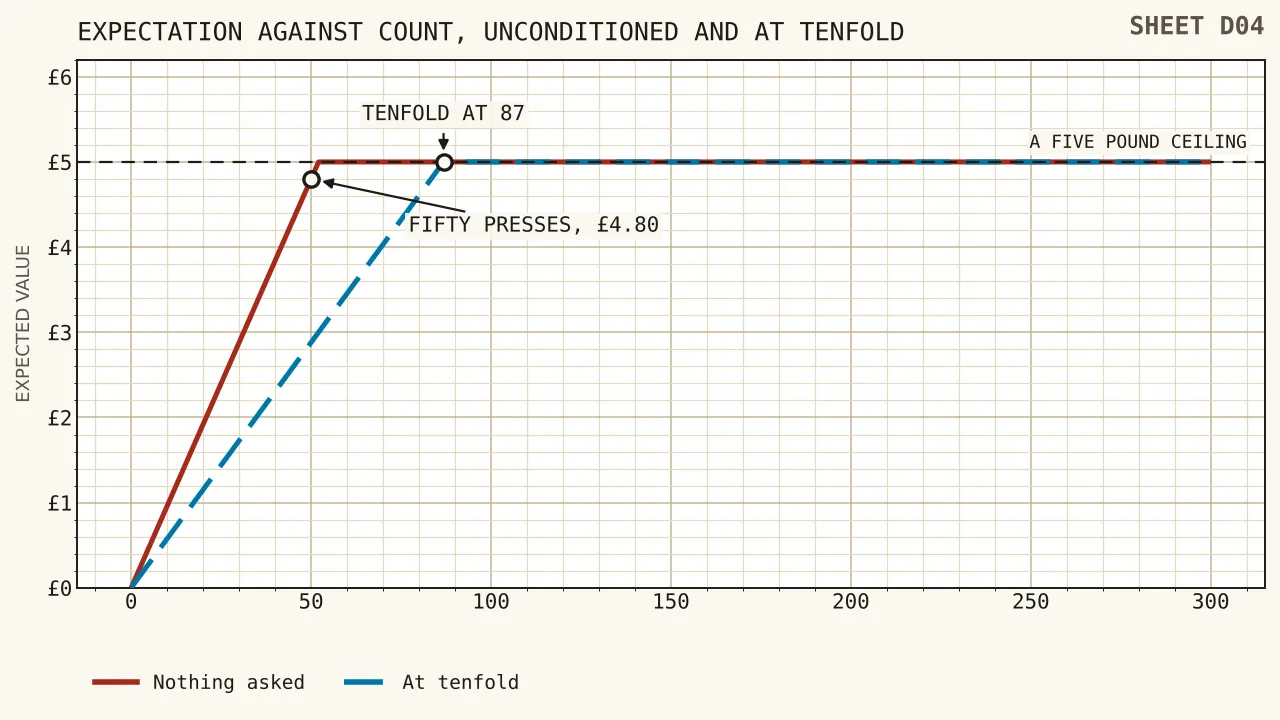
One turn of a wagering multiple shaves 4 per cent from the balance being cleared, since 4 per cent is what the house keeps out of a 96 per cent game. Tenfold therefore keeps three fifths of a balance, twentyfold keeps one fifth, and twenty-five times keeps none of it. Apply those to £4.80 and the arithmetic of the clause appears: against a tenfold requirement the clause saves £1.92, against twentyfold it saves £3.84, against twenty-five times it saves the entire £4.80, and against fortyfold it saves £6.72, since beyond the twenty-fifth turn the reader would have been funding the shortfall themselves.
Now divide those savings by 9.6p, which is what one press contributes. The clause is worth 20 presses against tenfold, 40 against twentyfold, 50 against twenty-five times, and 70 against fortyfold. Fifty presses with nothing asked of them is the same expected value as seventy presses carrying a fortyfold requirement, and a reader comparing two headlines now has one axis to compare them on.
Run the same equivalence the other way and the result is sharper still. Ask what count under a given multiple matches a no-wager fifty, and the answer is fifty divided by the fraction the multiple leaves behind.
| If the rival offer asks | Share of the balance it leaves | Count needed to match | Staking that count would owe |
|---|---|---|---|
| Nothing at all | all of it | 50 presses | none |
| Tenfold | three fifths | about 83 presses | £80.00 |
| Fifteenfold | two fifths | 125 presses | £180.00 |
| Twentyfold | one fifth | 250 presses | £480.00 |
| Twenty-two times | three twenty-fifths | about 417 presses | £881.28 |
| Twenty-four times | one twenty-fifth | 1,250 presses | £2,880.00 |
| Twenty-five times | none of it | no count whatever | not reachable |
The last row is the one to carry away. At twenty-five times, no headline count is large enough to equal fifty unconditional presses, because the expected value of the conditioned offer is nought however big the count gets. Two hundred presses, a thousand presses, ten thousand: multiplied by nought they come to nought. A reader who understands that one row can read any bonus page in this market in about fifteen seconds.
No wager on fifty presses equals 83 presses at tenfold and 250 at twentyfold
3
The word “free” has a rule standing behind it
Two words in the headline are doing advertising work, and both of them are regulated, which is the reason this site keeps two phrases out of its own prose entirely.
On the first word the advice is narrow and published: do not call an offer free if qualifying for it means the customer staking money of their own. The companion phrase, the one welding the idea of hazard to the word free, is likewise to be avoided unless the customer genuinely stands to lose nothing of theirs. Hence neither expression occurs on this site at all, and hence the figures above come in pounds instead of adjectives.
A no-deposit, no-wager offer is the one shape on this market that comes closest to earning the first word, because the reader puts in nothing and owes nothing afterwards. The honest qualification is that earning the word does not retire the other conditions. Under rule 8.17 of the advertising code, every significant condition that applies belongs in the material itself, put clearly and put prominently, wherever an omission would be liable to mislead. Drop a ceiling, or drop a payout floor, and a significant condition has gone missing whatever the rest of the material says.
Proportionality sits beside that, and it is the rule bearing most on small counts. A reward is meant to be proportionate to the hours and the money a player has put in already. Promotions ought not to accelerate as the spending climbs. And they ought not to steer anybody into gambling substantial amounts at some regular interval. For something able to pass muster the regulator offers one illustration, which is a single free bet following fifty pounds of staking. A condition travels with the illustration: at that level, handing over a free bet should be nothing out of the ordinary for the gambling in question. Detach the condition and it stops being the regulator’s illustration.
Nothing in the advertising rules sets the value of a press, so the word free tells a reader about the absence of a cost and nothing about the presence of a benefit. Fifty presses with no wagering is worth £4.80 and fifty presses with no wagering at 2p a press is worth £0.96. Both are equally free, and one is worth five times the other.
4
A ceiling that lands next to the count
With the multiple gone, the ceiling becomes the condition most likely to decide this offer, and on a count of fifty it lands almost exactly where the arithmetic does.
Expectation accumulates at 9.6p a press, so dividing a ceiling by 9.6p yields the count where that ceiling takes hold. Five pounds gives 53 presses. Fifty presses sit three presses below that, which means a five pound ceiling on this count is on the point of becoming the whole offer: the expectation is £4.80 and the ceiling is £5.00, so the headroom between them is twenty pence.
Above and below that crossover the ceiling behaves in two different ways and the difference is worth stating plainly. Below it, the ceiling removes the upper tail of the distribution: the average is untouched, and what goes is the chance of an unusual session. Above it, the ceiling replaces the expectation outright, because a capped balance cannot be expected to beat its own cap.
| Ceiling printed | Starts to bind beyond | Headroom on fifty presses |
|---|---|---|
| £2 maximum | 21 presses | binding already |
| £5 maximum | 53 presses | £0.20 |
| £10 maximum | 105 presses | £5.20 |
| £20 maximum | 209 presses | £15.20 |
| £50 maximum | 521 presses | £45.20 |
The two pound row shows what a tight ceiling does to a no-wager offer. An expectation of £4.80 under a two pound ceiling cannot exceed two pounds, so the ceiling has taken at least £2.80 before any other condition has been read. The no-wager clause was worth £1.92 against a tenfold requirement. A two pound ceiling costs more than the clause saved, which is the trade this part of the market makes when it drops a multiple.
One caution about those figures. No primary source sets a standard maximum-win cap for bonus winnings, so the five rows above are round numbers chosen to make the division readable, not a description of anybody’s published terms. What is published concerns the other balance. Capping the withdrawals out of a deposit balance is prohibited by a term of the licence. That protects money a reader paid in, and on an offer wanting no deposit there is no such money standing anywhere.
5
A floor, and the 2.08 times it asks for
A smallest-withdrawal figure is the other condition that survives the removal of a multiple, and it is the one most often printed somewhere other than the bonus terms.
The sum is a division. An expected £4.80 against a ten pound floor needs 2.08 times the mean outcome before a penny can move. Against a twenty pound floor it needs 4.17 times. Against a five pound floor it needs 1.04 times, which is near enough to the average that a reasonable share of sessions will clear it.
| Smallest withdrawal | Multiple of the mean needed | Distance from the mean | Count that would average it |
|---|---|---|---|
| £5.00 | 1.04 times | 20p short | 53 presses |
| £10.00 | 2.08 times | £5.20 short | 105 presses |
| £15.00 | 3.13 times | £10.20 short | 157 presses |
| £20.00 | 4.17 times | £15.20 short | 209 presses |
Put the floor and the ceiling side by side on this count and the window they leave is narrow. A ten pound floor and a five pound ceiling in the same terms would make payment arithmetically impossible, since nothing above five pounds can be won and nothing below ten pounds can be taken out. That combination is not something this sheet has observed anywhere; it is a demonstration that two separately unremarkable figures can close a door between them, and it is the reason both belong in the same reading rather than in separate glances.
The useful habit is to read the two numbers as a pair and ask whether the interval between them contains the expectation. On fifty presses the expectation is £4.80. A five pound floor with a fifty pound ceiling contains it with room. A ten pound floor with a twenty pound ceiling does not contain it at all.
6
The clock, the game, and the unit price
Three conditions remain, and each of them attacks a different part of the sum.
The clock is the mildest. Two minutes and five seconds is what fifty presses occupy at the lawful floor speed. A day holds 691 times that much time, and a week holds close to five thousand times it. Where a no-wager offer carries no requirement to clear, a window on the presses is about convenience rather than value. The exception is an offer whose window is measured in minutes from the moment of credit, and that is a condition a reader can only find by looking for it.
The game restriction is more serious than it looks, because it moves the only percentage in the sum. Every figure on this page assumes 96 per cent. A game returning 94 per cent turns the expected £4.80 into £4.70. A game at 92 per cent turns it into £4.60. The effect on an unconditioned count is small, because there is no multiple to amplify it, and that is itself a point in favour of a no-wager offer: without a play-through, a weaker game costs the reader pennies rather than pounds.
Where a return figure is findable at all is a question with a published answer, and it is narrower than readers expect. Information letting a customer judge their prospects must be within reach before they commit to gamble, and four alternatives discharge that duty: an account of the mechanics with how winners and prizes are settled, a house edge or margin, a return percentage, or the chance of the winning events occurring. Because they are alternatives, a licensee can satisfy the rule without ever printing a return percentage, and a reader who cannot find one is not necessarily looking at a breach.
The unit price is the third, and it is the largest. Fifty presses at 2p is £0.96 of expectation. At 5p it is £2.40. At 10p it is £4.80. At 20p it is £9.60. At 25p it is £12.00. Eleven pounds and more separates the cheapest of those from the dearest, under one identical headline. No published rule fixes the figure, which makes it the first thing worth hunting for and the last thing any headline volunteers.
7
Fifty presses against a fifty pound deposit
One comparison puts the whole page in proportion, and it needs no conditions at all to make the point.
Fifty unconditional presses at 10p carry an expected £4.80. A reader who instead deposited £5.00 of their own money and played it through the same machine once would also expect £4.80 back. The no-deposit, no-wager offer is therefore worth, in expectation, exactly one pass of a five pound deposit through a 96 per cent slot. That is the honest size of the thing: not nothing, and not a windfall.
The difference between the two, and it is the whole value of the offer, is who funded the £5.00. On the deposit the reader is down twenty pence on average and has risked five pounds of their own. On the no-deposit count the reader is up four pounds eighty on average and has risked nothing of their own, which is the one circumstance in this trade where the arithmetic points the reader’s way.
That conclusion comes with a boundary and the boundary is the point of the rest of the site. It holds only while the offer stays unconditional. Put a tenfold requirement on the winnings and the expected figure drops to £2.88. Put twenty-five times on them and it reaches nought. Put a two pound ceiling over the top and no multiple is needed to halve it. The words “no wager” are worth the £1.92 computed earlier, and they are worth that much only while the other three conditions stay reasonable.
The same £4.80 by either route, and one route charges the reader £5.00 for it
8
If the cashier held a British licence
Out at the offshore end of this market an offer holds no Great Britain licence, and a conditional sentence is the cleanest instrument for pricing that gap. Suppose the cashier behind one of them did hold a British licence. Every sentence in the next paragraph would then be true of it, and not one of them is true without the licence.
If it held one, it could not put a play-through above tenfold on bonus funds, a bound in force since 19 January 2026, where the practice it replaced ran to sixty times. If it held one, it could not weld a casino incentive to a bingo incentive and clear both through a single shared requirement. If it held one, those fifty presses could not be gambled until three items had each been collected and checked: the birth date, the address, the name. If it held one, it could not take a credit card, nor accept one arriving through a money service business. If it held one, no turbo button could be sold, the cycles could not crowd closer than two and a half seconds, a return failing to beat the stake could not be celebrated, and nothing could be dressed up as a near miss in place of the loss it replaces. If it held one, it could not take more than five pounds of stake on a single slot cycle, or more than two from a customer under twenty-five. If it held one, it could not refuse to enter the national online self-exclusion scheme. If it held one, a withdrawal once asked for would have no cancel button beside it, and the deposit balance would carry no ceiling on what left it.
Two things from the published offshore rulebook belong here, because an honest comparison runs both ways. Deposit limits are the first. On that subject Curaçao’s responsible gaming policy is the stricter document in one respect: a cut takes effect there at once, and a rise waits a week, against the single day Great Britain asks for. Daily, weekly and monthly are the periods it puts on offer.
The second is sharper and it concerns bonuses directly. A cooling-off period has to be reachable at one click, with neither an email nor an approval wanted, effective immediately and selectable by product. Four lengths are prescribed, the longest of them three months and the shortest a day, with one month and seven days between. An operator may not then discourage the player who wants one, and three methods of discouragement get named: putting the decision in question, offering reassurance so as to delay it, and dangling a bonus or a promotion as a reason to carry on. A spins offer put in front of somebody heading towards a cooling-off period is the precise thing that clause forbids, which is worth knowing on a page about spins.
What does not change with the licence is the tax position, and it runs the reader’s way for once. Gaming duty follows the player rather than the operator’s paperwork: an operator anywhere must register and pay British duty on remote gaming played by somebody who usually lives here. Nothing about an absent licence saves the reader a penny of it. Three things do go missing with the licence: the complaints clock, the approved adjudicator at the far end of it, and the one national register that closes every licensed account at a stroke.
Questions
- Priced to the press, what does a 50 spin no-wager offer come to?
- £4.80, at 10p a press and a 96 per cent return. Fifty presses commit £5.00 of funded stake, the machine is expected to hand back 96 per cent of it, and with no play-through attached nothing further comes off. The opening figure and the closing figure are the same, which happens nowhere else in this section.
- How much is the no-wager clause worth by itself?
- Against a tenfold requirement it saves £1.92, which is twenty further presses at 10p. Against twentyfold it saves £3.84, or forty presses. Against twenty-five times it saves the whole £4.80, because at that multiple a balance is expected to disappear entirely.
- What count with wagering would match 50 spins without it?
- About 83 presses at tenfold, 125 at fifteenfold, 250 at twentyfold and 1,250 at twenty-four times. At twenty-five times no count matches it at all, because the expected value of the conditioned offer is nought and no headline multiplied by nought comes to anything.
- Is it fair to call an offer like this free?
- Closer than most. The published advice runs against calling an offer free if qualifying for it means the customer staking money of their own, and a no-deposit, no-wager offer asks for neither a deposit nor a turnover. The qualification is that the word retires none of the other conditions. Every significant condition that applies still belongs in the material, clearly put and prominently put, wherever an omission would be liable to mislead.
- Does a maximum win cap matter when there is no wagering?
- More than before, because it is then the condition most likely to decide the offer. Divide the ceiling by 9.6p for the count where it takes hold: five pounds takes hold past 53 presses, and fifty presses stop three short. A two pound ceiling is already binding at this count and costs at least £2.80, which is more than the no-wager clause saved against a tenfold requirement.
- Will a minimum withdrawal figure stop me collecting £4.80?
- A ten pound floor asks for 2.08 times the mean outcome and a twenty pound floor for 4.17 times. A five pound floor asks for 1.04 times, which an ordinary session will sometimes reach. Read the floor and the ceiling as a pair and ask whether the gap between them contains the £4.80.
- How does this compare with depositing five pounds of my own?
- In expectation the two are identical. Five pounds through a 96 per cent slot returns an expected £4.80 either way. The difference is who funded the stake: on the deposit the reader is twenty pence down on average having risked five pounds, and on the unconditional count the reader is four pounds eighty up having risked none.
- What is missing when the offer comes from outside the British licence?
- With no Great Britain licence behind it, no tenfold bound governs the wagering, no identity check must come before bonus play, no cap limits the stake on a press, no floor sets the length of a game cycle, and no rule puts the cashier into the national self-exclusion scheme. On deposit limits the Curaçao policy is stricter in one respect, holding an increase for seven days where Great Britain holds it for twenty-four hours, and it also forbids an operator from dangling a bonus in front of a player who is heading for a cooling-off period.