Sheet D05 Revision 1 Counted 16 October 2026
Free daily spins: ten a day for a month is 96p a visit
An instalment schedule changes nothing about the arithmetic and everything about the commitment. Ten presses a day across thirty days is 300 presses, £30.00 of funded stake and an expected £28.80, which is 96p for each of thirty visits. Miss five of those days and £4.80 of it is gone. This sheet prices the attendance, the clocks and the rules that govern a drip.
The count 10 a day, 30 days One spin 10p Comes to £28.80 across 30 visits
What a drip of this size comes to
Every destination on this board is bought advertising. The site takes a fee if a reader goes on to register, and no figure printed below moves because of it.
The Spin Count
Gauge No 01
Betportal
Lowest multiple here
Priced at this site's own 10p a spin
What is counted
What is asked
No Great Britain licence
Licensed in Anjouan, Comoros, run by BetPortal Gaming Ltd, with Excite Ultra Media Ltd, reference ALSI-202601040-FI2.
Terms read 16 October 2026
Open the offer at Betportal, opens in a new tabThe Spin Count
Gauge No 02
WinBeast
Largest count here
Priced at this site's own 10p a spin
What is counted
What is asked
No Great Britain licence
Licensed in Curaçao, operator not named on the site.
Terms read 16 October 2026
Open the offer at WinBeast, opens in a new tabThe Spin Count
Gauge No 03
EliteSpin
Longest spin window
Priced at this site's own 10p a spin
What is counted
What is asked
No Great Britain licence
Licensed in Costa Rica, run by PrimeTier Limited.
Terms read 16 October 2026
Open the offer at EliteSpin, opens in a new tabThe Spin Count
Gauge No 04
Crown Jewelz
Multiple unpublished
No foot figure struck
What is counted
What is asked
No Great Britain licence
Licensed in Curaçao, number not verified, operator not named on the site.
Terms read 16 October 2026
Open the offer at Crown Jewelz, opens in a new tabThe figure in the third register is this site's own arithmetic and nothing an operator has published: the count at face, less the share a spin gives back at 96 per cent return to player, less what playing the wagering through costs at the same return. It describes the offer, not one reader's afternoon. Where the conditions price above the count the counter prints nothing rather than a negative sum, and where a figure the sum needs is unpublished it prints the condition in the operator's words instead.
A count has no unit of its own, so one is supplied. Where an operator publishes what a spin of its own is worth, that figure stands in the second register and is labelled as theirs. Where it does not, the second register carries this site's own 10p a spin and says so, and the foot figure moves in proportion: at half the price, half the money. The figure after it, what the count comes to for each spin, is the one that compares a large count against a small one.
Three words stand in the amount column where no figure can. Noted is a published condition that takes value away without leaving the sum a figure to take. Unpriced is a condition whose figure nobody has published, or a credit that is not a sum until a deposit of your own sets it. Own money is money of yours, which is never part of a foot figure.
Not one of the operators printed above holds a Great Britain licence, so the duties that licence carries do not reach them. Every online gambling company licensed in Great Britain has to be part of Gamstop Online, and a reader who has shut themselves out through the scheme is therefore not shut out here. The ceiling of ten times the bonus funds on a wagering requirement, in force since 19 January 2026, is a condition of that licence and binds the companies that hold one. Where a dispute goes instead is a matter for the authority named on the counter, and the Gambling Commission describes what a reader faces without a British licence as a lack of recourse if things go wrong. Nobody under 18 may hold an account at any of them.
Every term printed on a counter is the operator's own, and each counter carries the day it was read. The oldest of those readings is 16 October 2026. What binds a reader is the operator's own full terms, and not a line printed here.
1
The same sum, handed over in instalments
Begin by establishing what a schedule does not do, because almost every page about daily spins gets this part wrong in one direction or the other. A drip does not reduce the expected value of a count and it does not increase it. Three hundred presses are three hundred presses whether they arrive at once or ten at a time for a month.
So the opening sum is the ordinary one. Three hundred presses at ten pence is £30.00 of staking funded by the operator. Of that, £28.80 is the expected return on a 96 per cent game and £1.20 stays with the house. Those two figures hold however the presses are parcelled out.
What a schedule changes is the number of occasions a reader has to turn up, and the number of separate deadlines capable of expiring. Each of those is countable, and the counting is what this sheet does. The headline on a daily offer is a count of presses. The thing it is actually selling is a count of visits.
| What is being counted | Figure |
|---|---|
| Presses a day | 10 |
| Days in the schedule | 30 |
| Presses in total | 300 |
| Stake funded, at 10p a press | £30.00 |
| Expected return at 96 per cent | £28.80 |
| Expected per visit | £0.96 |
| Shortest lawful play per visit | 25 seconds |
The 10p unit price and the 96 per cent return are this site’s declared assumptions, not figures taken off a rule. Nothing published fixes what a free press is worth. Where a daily offer states its own unit value, that figure displaces the 10p and every sum on the page moves in proportion, which on a 300-press schedule means a swing of pounds rather than pence.
2
The schedule, priced per visit
A visit is the unit a daily offer trades in, so price one. Ten presses at 10p carry an expected 96p. Five presses carry 48p. Twenty presses carry £1.92. Twenty-five carry £2.40. Each of those is the expected return from one appearance, before any condition is applied to the proceeds.
Set the common schedules out and the shape of the trade becomes visible. The column that matters is not the total. It is the pairing of the per-visit figure with the number of visits, because that pairing is what a reader is being asked to agree to.
| The schedule | Visits asked for | Presses in all | Expected per visit | Expected in all |
|---|---|---|---|---|
| 5 a day for a week | 7 | 35 | £0.48 | £3.36 |
| 10 a day for a week | 7 | 70 | £0.96 | £6.72 |
| 20 a day for a week | 7 | 140 | £1.92 | £13.44 |
| 5 a day for a month | 30 | 150 | £0.48 | £14.40 |
| 10 a day for a month | 30 | 300 | £0.96 | £28.80 |
| 25 a day for four days | 4 | 100 | £2.40 | £9.60 |
| 10 a week for a year | 52 | 520 | £0.96 | £49.92 |
Two rows in that table are the same offer described two ways, and comparing them is the quickest lesson on the page. A hundred presses arriving twenty-five a day over four days has an expected £9.60. A hundred presses arriving ten a day over ten days has the identical £9.60. The second asks for six more appearances to deliver it, which is six more occasions on which a reader opens a gambling account for ninety-six pence.
One figure moves all of those totals and it is the figure a daily offer is least likely to state. Hold the schedule at ten presses a day for thirty days and shift the unit price, and the expected return across the month runs from under six pounds to nearly sixty.
| Price of one press | Expected per visit | Expected across the month |
|---|---|---|
| 2p a press | £0.19 | £5.76 |
| 5p a press | £0.48 | £14.40 |
| 10p a press | £0.96 | £28.80 |
| 20p a press | £1.92 | £57.60 |
Between the dearest row and the cheapest lies fifty-two pounds, with a headline that would be worded identically in each of those cases. A reader able to find the unit price in the terms has learned more in thirty seconds than the rest of the advertisement will tell them.
The year-long row is the one worth staring at. Fifty-two visits for an expected £49.92 is a pound a visit across twelve months, and the presses themselves occupy twenty-five seconds apiece at the lawful floor speed. Over the year that is twenty-one minutes and forty seconds of actual pressing, distributed across fifty-two separate sessions. The spins are not the commitment. The calendar is.
520 presses, 52 visits, 21 minutes 40 seconds of pressing, £49.92 expected
3
The attendance discount
Here is the arithmetic a daily offer depends on and never prints. Each tranche typically has to be used on the day it lands, so a missed day is not deferred. It is deleted, along with its contribution to the total.
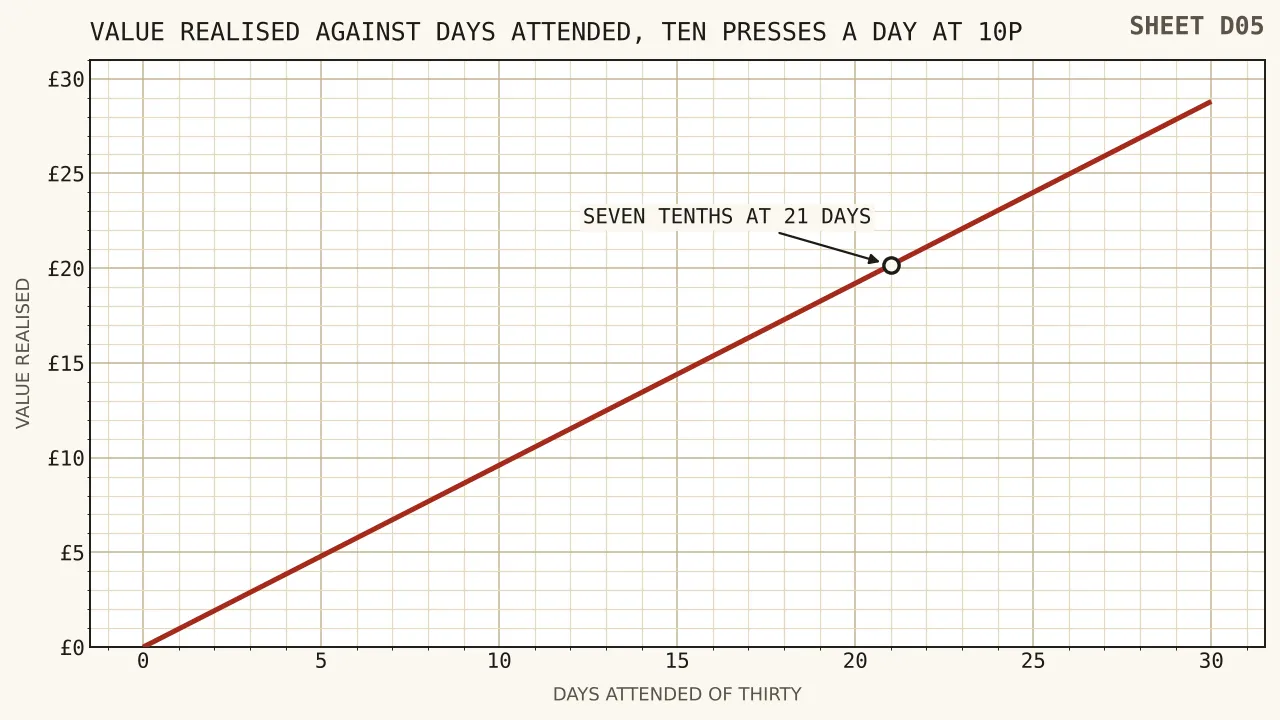
That makes the realised value of a drip the expected value multiplied by the share of days attended. On a thirty-day schedule of ten presses, every day attended is worth 96p and every day missed costs the same 96p. The arithmetic is linear, which is what makes it so easy to underestimate.
| Days actually attended | Presses collected | Expected value realised | Lost to missed days | Share of the headline |
|---|---|---|---|---|
| All thirty | 300 | £28.80 | nothing | the whole of it |
| Twenty-seven | 270 | £25.92 | £2.88 | nine tenths |
| Twenty-four | 240 | £23.04 | £5.76 | four fifths |
| Twenty-one | 210 | £20.16 | £8.64 | seven tenths |
| Fifteen | 150 | £14.40 | £14.40 | half |
| Seven | 70 | £6.72 | £22.08 | under a quarter |
Readers should price themselves honestly against that table. Attending a gambling account every single day for a month is a strong commitment, and anybody who attends twenty-one days out of thirty, which is a good rate by most standards, has collected seven tenths of a headline and will see the full number quoted back at them in every advertisement.
A payout floor behaves oddly on a drip, and the oddness earns a paragraph because it cuts both ways. Where each tranche has to be cashed out on its own, a day’s expected 96p can never reach a ten pound minimum withdrawal: clearing that floor from one visit would take 10.42 times the mean. Where the balance instead accumulates across the schedule, the month’s expected £28.80 clears a ten pound floor comfortably, and on the average clears it for the first time somewhere around day eleven.
So the sentence worth hunting for in a daily offer is not the one about the count. It is the one about whether the proceeds pool. A pooling drip of ten presses a day reaches a ten pound floor inside a fortnight. A non-pooling one never reaches it at all, whatever the headline says about the presses available across the month.
The same arithmetic applied to a weekly schedule is gentler, which is the honest point in favour of weekly drips. Ten presses a week for a year asks for fifty-two appearances spread across fifty-two weeks rather than thirty across thirty days, and a missed week costs the same 96p as a missed day. Attend forty of the fifty-two and £38.40 of the expected £49.92 has been collected.
4
Two clocks, and the one that matters
A drip runs two timers at once and they do entirely different jobs. One governs each tranche. The other governs the schedule. A reader who reads only the second has read the wrong one.
The tranche timer is usually a day, and a day is far more time than the presses need. Twenty-five seconds of play is ten cycles, each held to the two and a half second floor that applies on a licensed slot. A day holds 3,456 times that much time. So the tranche timer does not constrain the play. It constrains the reader’s diary, and that is a different kind of constraint.
The schedule timer is where a reader can lose real money without noticing. Where the whole offer expires on a fixed date rather than running a set number of days from the sign-up, a reader joining late collects fewer tranches than the headline promised. A thirty-day drip joined on day twelve of a calendar month delivers eighteen tranches and £17.28 of expectation, not thirty tranches and £28.80. Nothing in the advertisement is false and £11.52 has gone.
A third timer appears where the proceeds carry a requirement, and that one is the harshest of the three. A tenfold requirement on a single day’s 96p is £9.60 of staking, which is 96 further presses and four minutes. Thirty days of that is £288.00 of staking over the month, which is 2,880 presses and two hours. A reader who signed up for twenty-five seconds a day may find they have signed up for four minutes a day.
One advertising rule bears on all three timers at once. Any limit on the time a reader has to claim the offer, or to use it, ranks among the significant conditions, and those belong in the material itself, clearly and prominently put, wherever their absence would mislead. One published ruling bears that out. A decision dated 17 July 2024 dealt with a ten pound free bet whose claim route was a reply to a text message, sent before an hour the advertisement never gave. The advertisement had left the hour out. Leaving it out was treated as likely to mislead.
5
The rule that stops the value moving mid-schedule
One limb of the code provision governing incentives was written for offers of exactly this shape, and it is the most useful sourced fact on this page.
An incentive’s value may not be altered where the qualifying activity has been completed inside less than the whole of the offer period. In the context of a drip, that is a rule about front-loading and back-loading: the deal a reader signs up to on day one cannot be quietly repriced because they finished the qualifying part early. The provision bites whenever any customer or potential customer is offered an incentive, a reward or an arrangement giving them money, goods, services or some other advantage, and its second limb requires clear, transparent and fair terms, made easily accessible to everybody the offer is put to.
Two companion limbs apply to a daily schedule as much as to a lump sum. One of them holds a play-through on bonus funds to ten times. 19 January 2026 is the date it began, and sixty times is where the practice it displaced had got to. The other keeps a single incentive inside one product type, and four of those get named: lottery, bingo, casino, betting. A daily calendar of slot presses sits inside the casino type on its own. A calendar alternating slot presses with bingo tickets does not.
Apply the ten-times bound to the per-visit figure and the arithmetic stays small, which is the quiet advantage of a drip for anybody who dislikes requirements. Tenfold on one day’s 96p is £9.60 of staking and leaves an expected 58p from that day. Tenfold on the whole £28.80 at the end of a month is £288.00 of staking and leaves £17.28. The multiple is identical in both cases. Whether it is applied daily or cumulatively decides how much staking a reader has to do in one sitting, and that detail is rarely in the headline.
| How the requirement lands | Balance it attaches to | Staking per occasion | Presses per occasion | Expected at the foot |
|---|---|---|---|---|
| Nothing asked at all | £28.80 | none | none | £28.80 |
| Tenfold, day by day | £0.96 a day | £9.60 | 96 | £17.28 |
| Tenfold, once at the end | £28.80 | £288.00 | 2,880 | £17.28 |
| Twenty-five times at the end | £28.80 | £720.00 | 7,200 | nothing left |
| Fortyfold at the end | £28.80 | £1,152.00 | 11,520 | a deficit of £17.28 |
The two tenfold rows reaching the same £17.28 is worth one more sentence, because it is a genuine piece of arithmetic rather than a coincidence. A proportional scaling does not care how the balance is divided up, so thirty small requirements and one large one cost the same in expectation. What differs is the chance of completing them. Ninety-six presses in a day is four minutes. Eleven and a half thousand presses inside a window is eight hours of pressing, and the last two rows of that table describe offers no reader should assume they will finish.
6
The messages that carry the drip
A daily offer is delivered by notification, and notifications are regulated separately from the offer they carry. This is the part of a drip that most readers have never seen written down.
Direct marketing for online gambling has to be opted into by product type and by channel. The requirement took effect on 1 May 2025, and the date carries a trap worth naming: the regulator moved it from an earlier date in January of the same year, and its release records the change in terms, so 1 May 2025 is the only date to attach to this rule. A reader who opted in to casino email has not thereby opted in to casino text messages, nor to betting email.
The licence conditions behind that are two code provisions. One requires compliance with the advertising codes. The other takes consent for direct electronic marketing as its subject. Absent a consumer’s informed and specific consent, such marketing may not be sent at all, unless the law expressly permits the contact. Taken with the opt-in rule, that is the published answer to the question of why a daily spins reminder can arrive one way and not another.
A separate duty that landed on 17 January 2025 changes what a reader sees while the schedule runs. Net spend and time spent gambling both have to be shown to the customer as they happen. On a drip of ten presses a day, the first day reads £0.00 for net spend and twenty-five seconds for time. By day nineteen it is the figure telling a reader how much of the month has gone into the exercise. The same package of changes prohibited operator-led functionality for running several products together.
Three more dates belong on a page about habit, and these are dates a reader can use. March 2020 made the national online self-exclusion scheme a licence condition, binding on any operator that takes business from residents here. From the month after that, those same operators were running their whole customer base against the register at least once a day, so a registration bites on a daily offer inside twenty-four hours. Its own published figures carry the date 16 July 2026. Registrations rose by 16 per cent over that year’s first six months. The monthly record went to May 2026, which brought 12,236 sign-ups.
A daily reminder is the most effective part of a daily offer, which is why the marketing rules above are worth more to a reader than the count of presses. Turning off one channel for one product is a lever the licensed market has to give a customer. An opt-in by product and by channel appears nowhere in the offshore rulebook read for this sheet. The Curaçao policy does bar marketing to anybody inside an active cooling-off period or self-exclusion, and it does impose a training duty on affiliates, on marketing partners and on influencers.
7
What a year of a drip adds up to
Extend the schedule and the figures stop being pocket change, which is the strongest argument for pricing them.
Ten presses a week for a year is 520 presses, £52.00 of funded stake and an expected £49.92. Ten a day for a year is 3,650 presses, £365.00 of stake and an expected £350.40. Twenty a day for a year is 7,300 presses, £730.00 and £700.80. At the lawful floor speed the last of those is five hours and four minutes of pressing, spread across 365 appearances.
| The schedule | Presses in the year | Stake funded | Expected return | Pressing time at the floor speed |
|---|---|---|---|---|
| 10 a week | 520 | £52.00 | £49.92 | 21 minutes 40 seconds |
| 5 a day | 1,825 | £182.50 | £175.20 | 1 hour 16 minutes |
| 10 a day | 3,650 | £365.00 | £350.40 | 2 hours 32 minutes |
| 20 a day | 7,300 | £730.00 | £700.80 | 5 hours 4 minutes |
Two cautions on those four rows, and the first is about the ceiling. Where a maximum win applies to the offer as a whole rather than to each tranche, the annual figures collapse. Expectation arrives at 9.6p a press. Divide any ceiling by that and the quotient is the count past which the ceiling decides the answer: roughly 105 presses at ten pounds, 521 at fifty, 1,042 at a hundred. A ten pound annual ceiling on a schedule of ten a day caps an expected £350.40 at £10.00, which removes at least £340.40. A reader comparing a daily offer with a lump-sum one should look for whether the ceiling is per day, per week or per lifetime, because the word between the figure and the pound sign does most of the work.
The second caution is about the attendance arithmetic compounding over a year. Attend 300 days out of 365 on a schedule of ten a day, which is a high rate, and the realised figure is £288.00 instead of £350.40. Attend 200 days and it is £192.00. The headline never moves and the realised figure moves every time.
8
Coming back is the product
This is the section a page about daily spins has to write, and it is the reason the licensed market has a rule about it.
Three pushes are barred from a licensed product: towards chasing a loss, towards a larger stake, and towards carrying on after the customer has signalled a wish to stop. The guidance beneath that requirement reaches further in two directions bearing on a drip. Funds carried into a product, it says, are not to be topped up save where the customer chooses that on every single occasion. Somebody who has elected to leave is not to be drawn back in either, and a free game is the example given of the drawing back.
A daily spins calendar is, in its mechanism, an invitation to return. Where the customer has stopped, a licensed site’s invitation has to stop as well. That is not an argument against daily offers and this sheet does not make one. It is the reason the licence position of an offer matters more on this page than the count does: the same mechanism, outside the licence, carries no such stopping rule.
The figures a reader can use here are the self-exclusion ones. A registration with the national online scheme cannot be ended before its minimum period runs out, and the scheme’s own terms say so in capital letters. It does not lapse by itself either: a person who does nothing at the end of a period stays excluded for up to seven further years. Switching one off means contacting the scheme, and then a cooling-off period of a day or more, the exclusion running all the way through it. Sign-up offers four lengths. The shortest runs half a year. Then come a year and five years, with the five-year term also available set to renew itself. 20 May 2026 is the date those terms were last revised.
One point of detail about that scheme belongs on a page about habit, because getting it wrong would leave a reader half covered. Two separate schemes handle the matter, one for accounts online and one for premises. The shop scheme was formerly the multi-operator arrangement founded in 2016, it became part of the same group in July 2023, and it blocks access to betting shops rather than to accounts. Registering with one does not register a person with the other, and a page that implied otherwise would be giving a reader a false sense of the cover they have.
June 2017 is when the online scheme was established, by the trade association for remote gambling, and it came about at the request of the regulator together with the government department covering media and sport. What a reader joins is therefore nine years old as this sheet is written. The published count stood at 614,738 people, in figures dated 16 July 2026, and the five-year maximum had been the choice of more than half of them.
The scheme also states its own boundary, and the boundary is the reason this site keeps saying where an offer is licensed. Its reach stops at the operators which take part. Services provided by an organisation that does not take part lie beyond anything it can do. So a daily offer from a non-participating cashier reaches a reader the scheme has no machinery to shield, and no page here will assist anybody in getting to one.
Two support figures, for use rather than for decoration. The National Gambling Helpline is GamCare’s. 0808 8020 133 is the number. Calling it costs nothing. Opening hours cover the whole of every day, all year, and a caller can use the telephone, a live chat or WhatsApp. The free British route to blocking software comes from GamCare as well, rather than from the company that writes the software. TalkBanStop is its name, and it brings three things together: the helpline for the talking, the software for the blocking, the national scheme for the stopping. According to GamCare the software carries no charge for anybody ringing the helpline, or using its treatment and support services. That page takes the form of a news article and carries 12 April 2021 as its date. It never states how long the free access runs, so no duration appears here.
9
A drip with no rules behind it
The licensed market’s rules about schedules, messages and exits all arrived on dates, so the cleanest way to show what an offer holding no Great Britain licence is missing is to run the calendar.
14 April 2020: paying for gambling by credit card ended here, and the route through a money service business ended with it. March 2020: taking British business came to require membership of the national online self-exclusion scheme. April 2020: checks against that register became a daily exercise across an operator’s whole customer base. 17 January 2025: showing net spend and time as they accrue became compulsory, and operator-led play across several products at once was prohibited. 1 May 2025: direct marketing moved to opt-in by product and by channel. 9 April 2025: a five pound ceiling arrived on the stake for one online slot cycle. 21 May 2025: the ceiling for customers under twenty-five came down to two pounds. 19 January 2026: ten times became the most a play-through may ask of bonus funds, and one incentive stopped being allowed to mix two product types.
No cashier without a Great Britain licence is touched by a single one of those dates. The published alternative is thinner than a reader might hope and thicker than a careless page would admit. The offshore policy read for this sheet, issued by Curaçao’s authority at version 1.0 on 21 February 2025, does impose requirements. Behaviour tracking is one of them. Tools for a player’s own self-assessment are another. Then come deposit limits, cooling-off facilities a click away, and training for staff, for affiliates, for marketing partners and for influencers on social media. Marketing aimed at the self-excluded, at problem gamblers and at the financially vulnerable is barred, as is marketing sent during an active cooling-off period.
The arithmetic is what it does not contain. No ceiling on a multiple. No cap on a stake. No interval prescribed between game cycles. Not a word about autoplay. Nothing bars a celebration where the return has come in at or under the stake. Two sentences cover bonuses. Terms are to be communicated transparently. Aggressive bonus promotion is not to encourage excessive gambling. Set that against the eight dates in the paragraph above and the difference is not regulation against no regulation. It is a short policy against a long one, with the long one carrying every number.
Two further differences are worth naming because they cut in opposite directions. On deposit limits Curaçao is the stricter document in one respect: an increase waits seven days there against twenty-four hours here. On self-exclusion it is weaker by a wide margin. An exclusion gets arranged operator by operator, and for the other sites still within reach the policy’s remedy is to encourage a separate exclusion at each of them. One national register against a list a person has to work through by hand is the whole of the difference, and for a reader who signed up to a daily habit it is the difference that matters.
Tax runs the reader’s way regardless, and it is worth one sentence so that nobody mistakes an absent licence for an advantage. Gaming duty follows where the player usually lives rather than where the licence was issued, so an operator anywhere taking British play is inside the scope of British duty. So the missing licence saves a reader nothing, while taking away the complaints clock, the adjudicator approved to sit at the end of it, and the one register that closes every licensed account together.
Questions
- Across a month, what are free daily spins worth?
- Ten presses a day for thirty days is 300 presses, which at 10p is £30.00 of funded stake and an expected £28.80 on a 96 per cent game. Per visit the figure is 96p, and twenty-five seconds is how long the presses take where a licensed slot runs them at top lawful speed.
- Does paying the spins out daily reduce what they are worth?
- Not in itself. Three hundred presses have the same expected value whether they arrive at once or ten at a time. What a schedule adds is a count of visits and a separate deadline per tranche, and those are what turn a headline into a smaller realised figure.
- What does missing a day cost?
- Ninety-six pence a day, where ten presses land daily for a month. A tranche normally has to be used on the day it arrives, so a missed day is deleted rather than put off. Five missed days cost £4.80, and attending twenty-one of the thirty days delivers seven tenths of the headline, or £20.16.
- Is a daily schedule better or worse than the same count paid at once?
- Worse for a reader who will not attend, and no different for one who will. Twenty-five a day over four days, or ten a day over ten: a hundred presses carry an expected £9.60 either way. The second asks for six more appearances to hand over the same money.
- Can a site change the deal part way through a schedule?
- The incentive’s value, no, not where the qualifying activity has been finished inside less than the whole offer period. The code provision on incentives forbids that in terms. The same provision requires clear, transparent and fair terms, kept easily accessible to everybody the offer is put to.
- How does wagering work on a drip, daily or at the end?
- Either, and the expected cost is identical. Tenfold on one day’s 96p is £9.60 of staking, 96 presses and four minutes. Tenfold on the month’s £28.80 is £288.00, 2,880 presses and two hours. Both leave an expected £17.28, because a proportional scaling does not care how the balance is divided. What differs is the chance of finishing.
- Why do I get a text about the spins but not an email, or the other way round?
- Because direct marketing for online gambling is opted into by product type and by channel separately, a requirement that took effect on 1 May 2025. Consent is governed by a licence condition too: direct electronic marketing may not go to a consumer who has given no informed and specific consent for it, unless the law expressly permits the contact.
- What does a year of a daily offer come to?
- Ten a day for a year is 3,650 presses, £365.00 of funded stake and an expected £350.40, which is two hours and thirty-two minutes of pressing across 365 appearances. Attend 300 of those days rather than all of them and the realised figure is £288.00.
- Does a maximum win cap hurt a daily offer more than a one-off?
- It can, and the wording decides it. Dividing a ceiling by 9.6p gives the count past which it binds: roughly 105 presses at ten pounds, roughly 1,042 at a hundred. A ten pound ceiling applied to a whole year of ten a day caps an expected £350.40 at £10.00. Whether the ceiling is per day, per week or per lifetime is therefore worth more than the count.
- On a site with no British licence, what is different about a daily offer?
- None of the dated rules on this sheet reaches an offer carrying no Great Britain licence. The ten-times bound does not apply to its play-through. No cap limits the stake on one press. No floor sets the interval between game cycles. The reminders need no opt-in by product and by channel. Net spend and time need not be displayed as they accrue. No rule drags such a cashier into the national self-exclusion scheme. Behaviour tracking is asked for by the Curaçao policy read for this sheet, along with cooling-off facilities one click away and silence from the marketing throughout a self-exclusion. An exclusion out there gets arranged with one operator at a time, though, instead of once for the whole market.