Sheet D16 Revision 1 Counted 16 October 2026
100 free spins no deposit: the count where every threshold goes marginal
A hundred rounds at 10p is £10.00 of funded staking and an expected £9.60. That 40p shortfall is the whole reason this count is awkward: terms are written in round tens, the mean lands just under one, and a reader needs 1.04 times the average to reach a ten pound line. Every figure below is worked from those two numbers.
Rounds given 100 One round 10p Mean £9.60, 40p under the line
What a count of this size comes to
Every destination on this board is bought advertising. The site takes a fee if a reader goes on to register, and no figure printed below moves because of it.
The Spin Count
Gauge No 01
Betportal
Lowest multiple here
Priced at this site's own 10p a spin
What is counted
What is asked
No Great Britain licence
Licensed in Anjouan, Comoros, run by BetPortal Gaming Ltd, with Excite Ultra Media Ltd, reference ALSI-202601040-FI2.
Terms read 16 October 2026
Open the offer at Betportal, opens in a new tabThe Spin Count
Gauge No 02
WinBeast
Largest count here
Priced at this site's own 10p a spin
What is counted
What is asked
No Great Britain licence
Licensed in Curaçao, operator not named on the site.
Terms read 16 October 2026
Open the offer at WinBeast, opens in a new tabThe Spin Count
Gauge No 03
EliteSpin
Longest spin window
Priced at this site's own 10p a spin
What is counted
What is asked
No Great Britain licence
Licensed in Costa Rica, run by PrimeTier Limited.
Terms read 16 October 2026
Open the offer at EliteSpin, opens in a new tabThe Spin Count
Gauge No 04
Crown Jewelz
Multiple unpublished
No foot figure struck
What is counted
What is asked
No Great Britain licence
Licensed in Curaçao, number not verified, operator not named on the site.
Terms read 16 October 2026
Open the offer at Crown Jewelz, opens in a new tabThe figure in the third register is this site's own arithmetic and nothing an operator has published: the count at face, less the share a spin gives back at 96 per cent return to player, less what playing the wagering through costs at the same return. It describes the offer, not one reader's afternoon. Where the conditions price above the count the counter prints nothing rather than a negative sum, and where a figure the sum needs is unpublished it prints the condition in the operator's words instead.
A count has no unit of its own, so one is supplied. Where an operator publishes what a spin of its own is worth, that figure stands in the second register and is labelled as theirs. Where it does not, the second register carries this site's own 10p a spin and says so, and the foot figure moves in proportion: at half the price, half the money. The figure after it, what the count comes to for each spin, is the one that compares a large count against a small one.
Three words stand in the amount column where no figure can. Noted is a published condition that takes value away without leaving the sum a figure to take. Unpriced is a condition whose figure nobody has published, or a credit that is not a sum until a deposit of your own sets it. Own money is money of yours, which is never part of a foot figure.
Not one of the operators printed above holds a Great Britain licence, so the duties that licence carries do not reach them. Every online gambling company licensed in Great Britain has to be part of Gamstop Online, and a reader who has shut themselves out through the scheme is therefore not shut out here. The ceiling of ten times the bonus funds on a wagering requirement, in force since 19 January 2026, is a condition of that licence and binds the companies that hold one. Where a dispute goes instead is a matter for the authority named on the counter, and the Gambling Commission describes what a reader faces without a British licence as a lack of recourse if things go wrong. Nobody under 18 may hold an account at any of them.
Every term printed on a counter is the operator's own, and each counter carries the day it was read. The oldest of those readings is 16 October 2026. What binds a reader is the operator's own full terms, and not a line printed here.
1
Why a hundred is the pivot count
Of all the tallies advertised with nothing to pay, a hundred is the one where the arithmetic is most nearly a round number and most consistently just misses. Price a round at the 10p this site works to and a hundred of them carry £10.00 of staking. Keep 4p in the pound for the house, which is what a 96 per cent return means, and the expected proceeds are £9.60.
Hold those two figures side by side. The face value is a round ten. The expectation is forty pence short of it. Terms, meanwhile, are drafted in round tens: a ten pound smallest payout, a ten pound cap, a ten pound deposit to unlock something else. So a hundred rounds is forever landing a little under whichever ten pound line the small print has chosen, and the gap is exactly the house edge on £10.00 of turnover.
The mean is a long-run figure and should be read as one. Across many repetitions of a hundred rounds the average settles at £9.60. Inside any single hundred the distribution is lumpy, because slot payouts are concentrated in rare large outcomes. A median result below £9.60 is entirely consistent with a mean of £9.60, and anybody promising otherwise is selling something.
A word on where the two assumptions come from, since both carry every number on this page. Neither the price of a round nor the return is set by any rule that could be found. Three things are absent from every published source reached: what a free round is worth, who gets to fix that, and whether anybody must say. Whoever funds the award decides the pence, as a commercial matter. This sheet therefore declares 10p and 96 per cent, uses them openly, and shows the working so that a reader with different figures can redo the sums in one step.
The published duty on game information is narrower than the gap it leaves. Information bearing on the chance of winning has to be easily available ahead of a commitment to gamble, and requirement 3C lists four things that will do, with an “or” between them. The margin, otherwise the house edge, is one. The return percentage is another. The odds of the winning events is a third. Fourth comes an account of the mechanics, with the settling of a winner and the handing out of prizes. Any one discharges it, so a licensed site may publish a margin and never print a return figure at all.
2
Two variables, and which one matters
Two numbers can move the answer: the price of a round and the return of the game. Readers argue about the second and overlook the first, which inverts the order of importance by a factor of roughly twelve.
Run the return first. Hold the tally at 100 and the price at 10p, and vary only what the game gives back.
| Return of the game | Expected from 100 rounds | Against 96 per cent |
|---|---|---|
| 92 per cent | £9.20 | 40p worse |
| 94 per cent | £9.40 | 20p worse |
| 96 per cent | £9.60 | the house assumption |
| 97 per cent | £9.70 | 10p better |
| 98 per cent | £9.80 | 20p better |
Six percentage points of return, which is a wide band by any standard, moves the answer by 60p. Now hold the return at 96 per cent and vary the price of a round instead.
| Price of a round | Staking funded | Expected |
|---|---|---|
| 2p | £2.00 | £1.92 |
| 5p | £5.00 | £4.80 |
| 10p | £10.00 | £9.60 |
| 20p | £20.00 | £19.20 |
| 25p | £25.00 | £24.00 |
The price band moves the answer from £1.92 to £24.00, a spread of more than twelve to one on an unchanged headline. So the ranking of what to check is not a matter of taste: find the price of a round, then the conditions, and treat the return as a rounding adjustment unless the award is tied to one named game with a figure of its own.
A 6-point band of return moves 60p. A price band moves £22.08.
3
Forty pence under a ten pound line
A smallest-payout condition is the first thing to measure against £9.60, and at a hundred rounds the measurement is uncomfortably close. A ten pound line asks for 1.04 times the mean. In cash terms the shortfall is 40p, which an ordinary session will sometimes cover and will sometimes not.
That marginal position is worth dwelling on, because it is the opposite of the clear-cut cases either side. At twenty rounds a ten pound line asks 5.21 times the mean and the award is unpayable on the average. At two hundred rounds the same line is cleared with £9.20 to spare. A hundred rounds sits on the fence, so the condition decides the outcome roughly as often as the reels do.
| Line printed in the terms | Multiple of the mean | Cash gap |
|---|---|---|
| £5.00 | 0.52 | £4.60 of headroom |
| £9.60 | 1.00 | level |
| £10.00 | 1.04 | 40p short |
| £15.00 | 1.56 | £5.40 short |
| £25.00 | 2.60 | £15.40 short |
Readers are pointed at this very pairing by the regulator’s consumer material, whose illustration is a spend threshold sitting between a player and the payment of a bonus. Its own wording there carries a grammatical slip, so the instruction is paraphrased rather than quoted.
One rule in the neighbourhood protects money the reader paid in and not money the award produced. Prohibited is any term limiting the amount a consumer may withdraw from money they paid in themselves, and the banned drafting the regulator prints sets a daily maximum of £50 and a weekly one of £500. With nothing deposited there is no deposit balance to protect, so on this page the prohibition is dormant and the payout line stands.
4
Where a cap meets the hundredth round
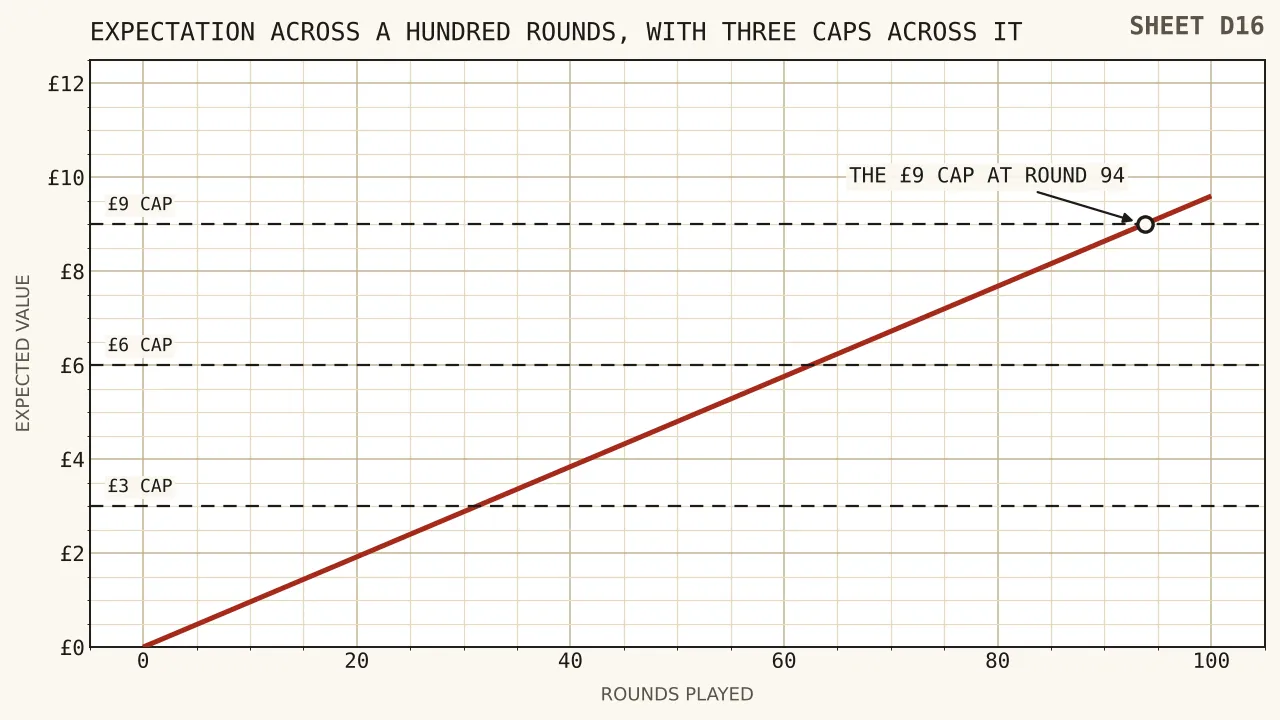
A ceiling on the winnings does not discount an award. It overwrites it. Once the terms fix a maximum that can leave the account, the expectation of everything that came before is bounded by that maximum.
The expectation grows by 9.6p a round at these prices, so any cap divided by 9.6 names the round where the average meets it. The table reads as a schedule of when the rest of the award stops counting.
| Cap on the proceeds | Mean arrives at round | Rounds left doing nothing |
|---|---|---|
| £3.00 | 32 | 68 |
| £6.00 | 63 | 37 |
| £9.00 | 94 | 6 |
| £9.60 | 100 | none |
| £12.00 | 125, past the award | none |
So a cap of £9.60 or more leaves this award untouched on the average, while a cap at £3.00 turns 68 of the hundred rounds into decoration. The right-hand column is the honest way to read a maximum-win term: it counts how much of the headline has been switched off.
No usual figure for a win cap on bonus proceeds is published anywhere reachable, so the caps above are round sums picked around this award’s own mean. Take the division and run it against whatever number appears in a particular set of terms.
5
The multiple, and what it leaves
Rounds given away carry no requirement themselves. Their proceeds can. Once those proceeds land in a bonus balance, the requirement works as it does on a deposit match, with turnover first and withdrawal second.
The sum is short. Multiply £9.60 by the multiple for the turnover owed. Take 4 per cent of that turnover for its expected cost. Subtract the second from the first and what remains is the balance scaled by one less four hundredths of the multiple.
| Multiple | Turnover owed | Rounds at 10p | Expected cost | Left standing |
|---|---|---|---|---|
| None | nil | nil | nil | £9.60 |
| Three times | £28.80 | 288 | £1.15 | £8.45 |
| Six times | £57.60 | 576 | £2.30 | £7.30 |
| Ten times | £96.00 | 960 | £3.84 | £5.76 |
| Eighteen times | £172.80 | 1,728 | £6.91 | £2.69 |
| Twenty-five times | £240.00 | 2,400 rounds | £9.60 | nil |
Twenty-five is the end of the road and the reason is arithmetical rather than rhetorical. Four hundredths divides into one twenty-five times, so a multiple of that size is expected to eat the balance before the clearance finishes. Beyond it the figure in the last column is negative, which means the balance is expected to run out mid-clearance and the remaining turnover is funded by the reader.
Only the rows up to ten times belong to this market. Above ten times the bonus funds, a requirement is not available to a British licensee: the code provision governing incentives has imposed that ceiling since 19 January 2026. The scope is wide: all licences including the ancillary remote ones, with gaming machine technical and software licences left out, so every remote casino licence falls inside. What it replaced was practice the regulator records as reaching sixty times, which on this balance would be £576.00 of turnover and an expectation of minus £13.44.
One companion rule shapes how an award can be built. One incentive is confined to one product type, of which the provision lists four. A hundred rounds on slots plus a cash match is one type, since slots are casino. A hundred rounds plus a bingo book is two, and may not be cleared through one shared requirement.
6
Four minutes ten, and forty minutes after
A licensed slot has a legislated pace, so a tally has a duration that no banner prints. Requirement 14D sets 2.5 seconds as the minimum spacing between game cycles, which is why 100 rounds cannot occupy under 250 seconds. A hundred rounds therefore occupies 250 seconds at the floor, which is four minutes and ten seconds of uninterrupted pressing.
Clearing what the rounds win takes considerably longer, and this is where a clock in the terms becomes a condition rather than a courtesy. A tenfold multiple on £9.60 sets the turnover at £96.00. At 10p that is 960 further rounds, and 960 cycles of 2.5 seconds is forty minutes to the second. Eighteen times would be 1,728 rounds and 72 minutes. A 24-hour window accommodates either. A thirty-minute window accommodates neither, and no feature exists on a licensed product to speed either up.
Three design rules hold that pace in place, and together they explain why a licensed clearance cannot be rushed. The system must take a separate commitment from the customer for every cycle, which is what the autoplay prohibition amounts to. Requirement 14E bars anything that cuts the wait for a result, and three examples are named in its guidance: slam stop, quick spin, turbo. Functionality for playing more than one game at once may not be offered, so a second window is not a route to half the elapsed time.
Worth adding for completeness, because readers conflate the two pace rules: the five-second minimum applies to casino games that are not slots, excluding peer-to-peer poker, and it took effect on 17 January 2025 according to the regulator’s own page listing updates effective that day. The standard itself carries no commencement date, and the 2.5-second rule for slots is not dated by that page at all.
250 seconds to use the award. 2,400 seconds to clear tenfold on what it wins.
7
A hundred split into tranches
A hundred divides neatly, which is why it is the tally most often dripped out across days. Splitting changes nothing about the expectation: the same £9.60 arrives whether the rounds come in one block or twenty at a time. What a split changes is the number of visits and the number of expiries.
| Shape of the drip | Visits required | Expectation per visit | Deleted by one missed day |
|---|---|---|---|
| All 100 together | 1 | £9.60 | £9.60 |
| 50 across 2 days | 2 | £4.80 | £4.80 |
| 20 across 5 days | 5 | £1.92 | £1.92 |
| 10 across 10 days | 10 | £0.96 | £0.96 |
The last column is the real content of a drip. Where a tranche expires the day it arrives, three absences across the ten days remove £2.88, and attending seven of the ten collects 70 per cent of the headline. Nothing about that is concealed; it is simply never put as a subtraction.
Attendance has a time cost as well. Ten rounds is 25 seconds at the floor pace, so a ten-day drip asks for ten separate visits of under half a minute. The award is small, the visits are short, and the commitment is spread across a fortnight of diary entries.
One licensed-market rule cuts across the pattern. Three prohibitions sit in requirement 14A: no encouragement to chase a loss, no pressure towards a larger stake, and no keeping a customer going once they have said they wish to stop. Its guidance adds that a customer who has gone is not to be drawn back, with a free game named as the draw. A daily tranche is precisely that sort of invitation, so on a licensed site it has to stop when the customer does.
8
What the reels are not allowed to do
A hundred rounds is a sample, and a reader is entitled to know what the sample is drawn from. The technical standards answer that in detail, and this is the part of the licence a free-spins page usually leaves out.
Requirement 7A calls for results that are acceptably random and rules out a compensated game, which is to say a system adapting its probabilities to what has already happened. What the prohibition catches is spelled out in the guidance: interventions, whether automatic or by hand, that alter the probabilities. Distribution of the results has to follow the theoretical probabilities, or the expected ones. Requirement 7B adds that the numbers are taken in the sequence they arrived, and that none is thrown out to produce adaptive behaviour.
Near misses are addressed directly, and this is the sharpest design rule on the sheet. Requirement 7C prohibits designs and features of a sort likely to leave a customer wrong about the chances of a given result. Two are named. One is a simulated device running probabilities other than the real article’s. The other is the swapping of a losing event for a near-miss losing event. Its guidance is blunter still. False near-miss displays are out, and no loss may be dressed up as a different one.
Two further requirements protect the sample while it is being drawn. Requirement 7D stops a game’s rules, its payouts and its outcome probabilities being altered while play is under way, and a change has to be drawn to the attention of the customer. One unacceptable clause is named outright: a rule reserving the right to change the game rules whenever the operator likes. And the result of the game and the customer’s gamble must be clearly and accurately displayed, for long enough to be read.
One more, because it bears on how a hundred rounds feels rather than on what it pays. Requirement 14F stops the machine celebrating where a return fails to beat the total staked, so the sounds and the visual effects of a win are unavailable for such a result. Three alternatives are suggested instead: a short sound when the credit arrives, a brief display of the lines that paid, and the total awarded shown as a figure. On a licensed slot, in other words, a 5p return on a 10p round is not allowed to look like a win.
9
A hundred rounds on an unlicensed machine
Awards at this tally are pushed hardest from outside the British system, and an offer printed there holds no Great Britain licence. Every rule in part eight is a condition of that licence, so none of it governs the reels a reader meets on a site without one. That is the specific loss on this page, and it is more concrete than a general warning.
The offshore rulebook was read rather than assumed. Read the offshore document, which is a responsible gaming policy from the Curaçao authority, first version, dated 21 February 2025. Randomness goes unmentioned in it. So does the near miss. There is no minimum interval between cycles, nothing about turbo or autoplay, and no restriction at all on how a small return may be presented. Its bonus provisions run to two sentences: communicate terms transparently and clearly, and avoid promotion aggressive enough to encourage excessive gambling.
A recognised title proves nothing about the licence, and that much is in writing from the regulator. That notice, which carries 20 January 2025, records casino games from licensed suppliers appearing where no licence exists. The same notice lists what such a website can mean for a player. Controls may be inadequate on two fronts, money laundering and social responsibility. Fraud, data privacy trouble and unfair practice are all named. So is the deliberate pursuit of people who have already excluded themselves.
That is not theoretical. Evolution Malta Holding Limited is the worked example. Six websites holding no licence, all of them reachable by consumers here, were found running its games. Large volumes of visits were recorded across the thirteen months from December 2023. And the agreed sum, dated 23 July 2026, was £4.75m. The findings included a failure to keep its games out of the British market through unlicensed operators. So the question for a reader who recognises a game on an unlicensed site is not whether the game is real, but whose rules the machine is running under.
| On the reels | British licence | No such licence |
|---|---|---|
| Adaptive probabilities | not permitted | unaddressed |
| Near-miss substituted for a loss | prohibited by name | unaddressed |
| Rules changed mid-play | not allowed, and a clause permitting it is unacceptable | unaddressed |
| Pace of a cycle | 2.5 seconds at the least | no figure anywhere |
| Turbo and autoplay | both out | no rule |
| Celebrating a sub-stake return | barred | no rule |
| Requirement on what the rounds win | ten times at most | no published ceiling |
Two things on the other side of the ledger, since a page that flattens the comparison is useless in both directions. Four pause lengths are required by the Curaçao policy, those being a day, a week, a month and three months, each reachable in one click without an email or a sign-off from the operator. Discouraging their use is forbidden, and the three discouragements named are querying the decision, offering reassurance to put it off, and offering a promotion to keep the play going. It also makes the operator answerable for its affiliates, enforced through binding contracts, audits and penalties.
Self-exclusion is where the loss cuts deepest, and the British scheme marks its own boundary. Participating operators are what a registration covers. Where an organisation has stayed outside, the scheme says it cannot help. Out there the exclusion is taken out one operator at a time, covering whatever domains that operator holds, and the policy encourages the player to go through it again at the next site. A year is the shortest term offered there; six months is the shortest here. Nothing on this page helps anybody past an exclusion, and the free helpline below is answered at any hour.
Duty tracks the player and ignores the licence. Registration for British gaming duty is owed wherever an operator sits, once it offers remote gambling to a person ordinarily resident in the United Kingdom, and from 1 April 2026 remote gaming is charged at 40 per cent of profits. A missing licence costs the reader every protection in the table above and saves them nothing at all.
Questions
- What is a hundred free spins actually worth in money?
- Ten pounds of funded staking produces an expected £9.60, on the pair of assumptions declared throughout this site: a round priced at 10p, and 96 pence returned in the pound. The missing 40p is the house edge across the hundred rounds, and it is also the reason the mean lands just under every ten pound line in the small print.
- Which matters more, the price of a spin or the game’s return?
- The price, by a factor of about twelve. Moving the return across a six-point band from 92 to 98 per cent changes the answer by 60p. Moving the price from 2p to 25p changes it from £1.92 to £24.00. Read the price out of the terms first and treat the return as a small adjustment.
- Can I withdraw what a hundred free spins win?
- It is marginal, which is what makes this tally awkward. A ten pound smallest-payout line asks for 1.04 times the £9.60 mean, so the shortfall is 40p and an ordinary session will sometimes cover it. A fifteen pound line asks 1.56 times, and a twenty-five pound line asks 2.60 times.
- When does a maximum win cap start costing me rounds?
- Divide the cap by 9.6p, which is what one round adds to the expectation. A three pound cap is reached by the mean at round 32, leaving 68 rounds contributing nothing. A nine pound cap is reached at round 94. A cap of £9.60 or more is not reached before the award ends, so it leaves the expectation alone.
- What does wagering do to the winnings from a hundred spins?
- A tenfold multiple means £96.00 of turnover: 960 rounds at 10p, forty minutes at the lawful pace, and £5.76 expected to survive. Eighteen times leaves £2.69. At twenty-five times nothing is left, that being the reciprocal of a 4 per cent edge.
- How long do a hundred free spins take?
- 250 seconds, or four minutes and ten seconds, at the quickest a licensed slot may run. 2.5 seconds have to elapse from the start of one cycle before another may open, every cycle takes a separate commitment from the customer, and the three accelerators are unavailable, so the floor holds.
- Is a slot allowed to show me a near miss?
- Not as a substitute for a loss. Requirement 7C prohibits a design or feature apt to mislead over the likelihood of a result, and names two: a simulated device running probabilities that are not the real article’s, and a near-miss event substituted for an ordinary loss. The guidance adds that one losing outcome may not be swapped for another.
- Does an instalment schedule reduce what the spins are worth?
- Not the expectation. Ten rounds a day for ten days averages the same £9.60 as a hundred rounds at once. What it adds is ten visits and ten expiry dates: on that schedule each missed day deletes 96p, so three missed days cost £2.88 and seven days of attendance collects 70 per cent of the headline.
- What changes when the hundred rounds come from an unlicensed cashier?
- The rules the machine runs under. Randomness requirements, the ban on adaptive probabilities, the near-miss prohibition, the bar on changing rules mid-play, the 2.5-second pace floor, the autoplay and turbo prohibitions, the bar on celebrating a sub-stake return and the ten-times ceiling on a requirement are all conditions of a licence, and the offshore policy read for this sheet contains none of them.
- If the game is one I know, is the site licensed?
- No. In a notice to the industry carrying 20 January 2025, the regulator records titles from licensed suppliers surfacing on sites with no licence at all. Six unlicensed websites within British reach were then found carrying one supplier’s games, and the settlement that followed, dated 23 July 2026, came to £4.75m. A familiar title says nothing about the licence behind the cashier.