Sheet R01 Revision 1 Counted 16 October 2026
Online casino UK: a credit is worth what the room it is spent in pays back
Take 320 spins at 10p. Face value £32.00, average return £30.72 on a 96 per cent reel, and that figure survives only while the credit stays in the room paying 96 pence. Move the same credit to a table counting five pence in the pound and the largest multiple it can carry drops from 25 to 1.25. The destination decides, not the headline.
The count 320 spins One spin 10p Comes to £30.72 in the reel room
What a count of this size comes to
Every destination on this board is bought advertising. The site takes a fee if a reader goes on to register, and no figure printed below moves because of it.
The Spin Count
Gauge No 01
Betportal
Lowest multiple here
Priced at this site's own 10p a spin
What is counted
What is asked
No Great Britain licence
Licensed in Anjouan, Comoros, run by BetPortal Gaming Ltd, with Excite Ultra Media Ltd, reference ALSI-202601040-FI2.
Terms read 16 October 2026
Open the offer at Betportal, opens in a new tabThe Spin Count
Gauge No 02
WinBeast
Largest count here
Priced at this site's own 10p a spin
What is counted
What is asked
No Great Britain licence
Licensed in Curaçao, operator not named on the site.
Terms read 16 October 2026
Open the offer at WinBeast, opens in a new tabThe Spin Count
Gauge No 03
EliteSpin
Longest spin window
Priced at this site's own 10p a spin
What is counted
What is asked
No Great Britain licence
Licensed in Costa Rica, run by PrimeTier Limited.
Terms read 16 October 2026
Open the offer at EliteSpin, opens in a new tabThe Spin Count
Gauge No 04
Crown Jewelz
Multiple unpublished
No foot figure struck
What is counted
What is asked
No Great Britain licence
Licensed in Curaçao, number not verified, operator not named on the site.
Terms read 16 October 2026
Open the offer at Crown Jewelz, opens in a new tabThe figure in the third register is this site's own arithmetic and nothing an operator has published: the count at face, less the share a spin gives back at 96 per cent return to player, less what playing the wagering through costs at the same return. It describes the offer, not one reader's afternoon. Where the conditions price above the count the counter prints nothing rather than a negative sum, and where a figure the sum needs is unpublished it prints the condition in the operator's words instead.
A count has no unit of its own, so one is supplied. Where an operator publishes what a spin of its own is worth, that figure stands in the second register and is labelled as theirs. Where it does not, the second register carries this site's own 10p a spin and says so, and the foot figure moves in proportion: at half the price, half the money. The figure after it, what the count comes to for each spin, is the one that compares a large count against a small one.
Three words stand in the amount column where no figure can. Noted is a published condition that takes value away without leaving the sum a figure to take. Unpriced is a condition whose figure nobody has published, or a credit that is not a sum until a deposit of your own sets it. Own money is money of yours, which is never part of a foot figure.
Not one of the operators printed above holds a Great Britain licence, so the duties that licence carries do not reach them. Every online gambling company licensed in Great Britain has to be part of Gamstop Online, and a reader who has shut themselves out through the scheme is therefore not shut out here. The ceiling of ten times the bonus funds on a wagering requirement, in force since 19 January 2026, is a condition of that licence and binds the companies that hold one. Where a dispute goes instead is a matter for the authority named on the counter, and the Gambling Commission describes what a reader faces without a British licence as a lack of recourse if things go wrong. Nobody under 18 may hold an account at any of them.
Every term printed on a counter is the operator's own, and each counter carries the day it was read. The oldest of those readings is 16 October 2026. What binds a reader is the operator's own full terms, and not a line printed here.
1
The count arrives attached to a room
Every award of spins names a destination. Sometimes the destination is one title. Sometimes it is a shelf of titles. Sometimes it is the whole reel room and nothing past its door. That attachment is not decoration: it fixes the return the credit will meet, and the return fixes everything downstream of it.
Work the headline first. A tally of 320 presses, each funded at 10p, is £32.00 of stake somebody else has put up. Give that stake to a machine handing back 96 pence per pound and the long-run average returning is £30.72. Give the identical stake to one handing back 92 pence and the average is £29.44. The gap of £1.28 appears in no headline anywhere.
So far the room has cost small change. It begins costing real money the instant a turnover condition is bolted on, because the condition is paid for out of that same return. Each pass of a balance through a 96 per cent reel leaves four pence of every pound behind. Twenty-five passes leave nothing standing. That reciprocal, 25, is the one figure worth carrying into any set of bonus terms.
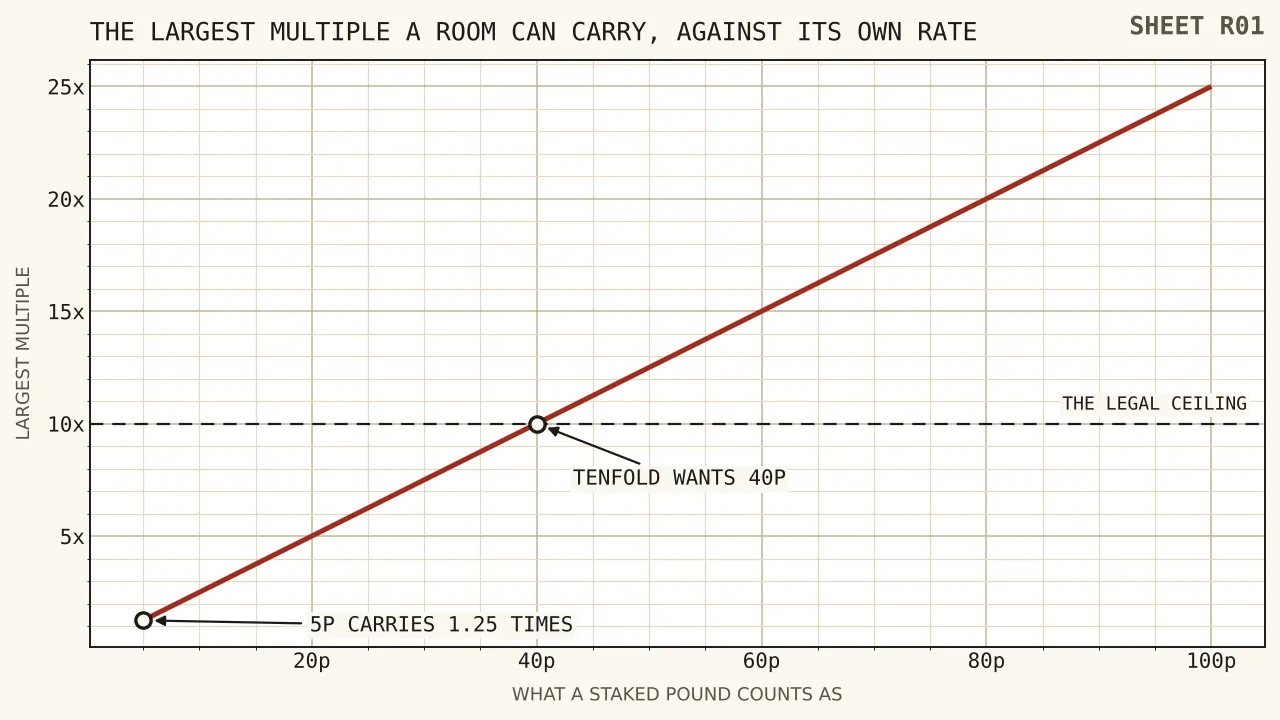
And 25 is the ceiling for the best room in the building. It assumes the credit is turning over somewhere a staked pound counts as a whole pound towards the requirement. Rooms counting a staked pound as five pence towards it exist, are advertised, and break no rule. In one of those the ceiling is not 25. It is 1.25.
So this sheet is about a division rather than a multiplication. The question is never how many presses were handed over. It is how much of each staked pound the destination hands back towards the requirement, since the requirement is denominated in contribution while the reader pays in stake.
A tally of 320 gets pushed hardest from cashiers that hold no Great Britain licence, which bears on the reader’s arithmetic and not merely on a lawyer’s. Fifteen separate duties fall away with that licence. Each duty is worth a figure against this page’s £30.72, and part nine prices them one at a time rather than summarising them as an absence of regulation.
Three quantities run through every part below. B is the credit before conditions, here £30.72. W is the turnover multiple the terms name. The letter g is the room’s contribution rate written as a fraction of a pound: 1 for a reel counting in full, 0.05 for a table counting at five pence. Across this site g is held at 1. This is the section where that assumption is taken apart deliberately, and every sentence that moves g says what moved it and to what.
2
Two numbers set the clearing point
The return and the multiple are the whole machine. Set the return at 96 pence and four pence is the edge, so one pass over a pound is expected to take 4p off it. Ten passes take 40p and leave 60p. Twenty take 80p and leave 20p. Twenty-five take the lot. Forty take £1.60, which is 60p more than the pound held, and the overshoot is funded from money the reader brought along.
Scaled onto 320 presses those four rows read as follows. Tenfold on £30.72 leaves £18.43. Twentyfold leaves £6.14. Twenty-five leaves nothing. Fortyfold leaves a shortfall of £18.43, and the staking producing it runs to £1,228.80, or 12,288 presses at this page’s price.
Move the return and the clearing point moves in a way that catches people out. A thinner return does not merely shave the balance, it drags the whole crossing nearer. Where the edge doubles to eight pence, twelve and a half passes exhaust the credit instead of twenty-five. Where it thins to three pence, the crossing sits out at thirty-three and a third. One divided by the edge is the clearing multiple, and nothing else is.
| Room pays back | House edge | Crossing multiple | £30.72 at tenfold | £30.72 at fortyfold |
|---|---|---|---|---|
| 90 pence per pound | 10.00% | 10.00x | nothing | short by £92.16 |
| 92 pence per pound | 8.00% | 12.50x | £6.14 | short by £67.58 |
| 94 pence per pound | 6.00% | 16.67x | £12.29 | short by £43.01 |
| 95 pence per pound | 5.00% | 20.00x | £15.36 | short by £30.72 |
| 96 pence per pound | 4.00% | 25.00x | £18.43 | short by £18.43 |
| 97 pence per pound | 3.00% | 33.33x | £21.50 | short by £6.14 |
Two cautions ride on that table. Its left column is a band, drawn to show the slope rather than to report any particular reel’s setting. And a reader hunting for the real number may not find it, because the duty to put the chances of winning within reach before a customer commits is discharged by any single item on a list of four. Those items, reordered here so the useful one comes last: an account of the workings, of how winners get settled and prizes handed out; the margin, which is the house edge under another name; the probability of the winning events; and the return percentage. The first three give a reader nothing that divides into £32.00 of stake. Only the fourth does, and the fourth is optional.
One divided by the edge is the clearing multiple, and no headline shifts it
3
What a pound staked actually contributes
Now the second mechanism, which does far more damage than the first and draws a fraction of the attention. A turnover requirement settles in contribution, not in stake. A room contributing in full retires a pound of requirement per pound staked. A room contributing thirty pence retires thirty pence per pound staked, so the pound must be found three and a third times over.
The division is unforgiving. Staking owed is required contribution divided by the contribution rate. Take £30.72 at tenfold: £307.20 of contribution is due. Counting in full, that is £307.20 staked across 3,072 presses. At thirty pence it becomes £1,024.00 and 10,240 presses. At ten pence, £3,072.00 and 30,720 presses. At five pence, £6,144.00 and 61,440 presses.
Then feed the cost of that staking back into the sum, because every pound of it meets the room’s edge on the way through. Turnover of £6,144.00 at 96 pence per pound is expected to cost £245.76. The credit was £30.72. A tenfold requirement, which reads as the gentlest multiple the regulated market permits, costs eight times the credit once it is served in a room contributing at five pence.
Thirty pence is not a figure invented here. A respondent’s worked illustration on the regulator’s consultation response describes a bonus of a hundred pounds at tenfold turnover, and in it each pound wagered contributes thirty pence against the requirement. Weighting was raised in that consultation and left alone when the multiple was capped. The arithmetic above belongs to this site; the contribution rate belongs to whoever supplied it.
One further figure comes off the same page. Where a pound wagered counts thirty pence, a hundred pounds of due contribution needs roughly £333.33 put through to reach. There is the whole problem in a line: a printed multiple is a floor under the turnover and never a statement of it.
No regulator publishes a live schedule of contribution rates, and none is supplied here. The structural point is enough, and it is sourced. In Great Britain the multiple carries a legal ceiling while the rate carries none, so the rate is where an offer’s true length now lives. A reader who has found the multiple has found roughly half the term, and on £30.72 the half they have not found is worth up to £215.04.
4
The condition, derived in four lines
Put the two mechanisms together and one inequality drops out. Expected residue is the credit times one minus the multiple times the edge over the contribution rate.
For the residue to stay above nothing, multiple times edge has to come to less than the contribution rate. At 96 pence per pound the edge is one twenty-fifth, so the test collapses into something portable: g has to beat W over 25.
Reverse it and it is handier still. Twenty-five times the contribution rate gives the largest multiple that room can carry before it starts eating the credit. Counting in full carries 25. Forty per cent carries 10. Twenty per cent carries 5. Ten per cent carries 2.5. Five per cent carries 1.25.
| Staked pound counts as | Largest clearable multiple | Staking owed at tenfold | Presses at 10p | £30.72 left at tenfold |
|---|---|---|---|---|
| 100 pence | 25.00x | £307.20 | 3,072 | £18.43 |
| 50 pence | 12.50x | £614.40 | 6,144 | £6.14 |
| 40 pence | 10.00x | £768.00 | 7,680 | nothing |
| 30 pence | 7.50x | £1,024.00 | 10,240 | short by £10.24 |
| 20 pence | 5.00x | £1,536.00 | 15,360 | short by £30.72 |
| 10 pence | 2.50x | £3,072.00 | 30,720 | short by £92.16 |
| 5 pence | 1.25x | £6,144.00 | 61,440 | short by £215.04 |
The bottom row repays a moment. A requirement of 1.25 times is lower than anything advertised anywhere, and 1.25 times £30.72 is £38.40 of contribution, which at five pence a pound is £768.00 put through to stand still. A room counting five pence per pound cannot clear even that without the credit going under, and every real offer asks several times more.
Read the column of shortfalls as a single quantity and the point lands harder still: between the top row and the bottom row of that table sits £245.76 of swing on one credit of £30.72, and not a penny of the swing is visible in the headline. Which is why a room restriction in the small print restricts nothing about where the fun happens. It is the term deciding whether the offer carries a positive expectation at all, and it is routinely set out in one clause under a headline count that has no bearing on it.
5
Room by room through a licensed house
A British online casino is several products sharing one cashier, and the rules reach them unevenly. Taking the rooms singly shows where 320 presses can earn their £30.72 and where they cannot.
The reel room is where spin credits belong, because a press is the unit they are denominated in. It is also the most heavily engineered room in the building. Between one cycle and the next a reel must leave two and a half seconds, which stretches this page’s 320 presses to 13 minutes 20 seconds at the floor. Nothing may compress that: turbo, quick spin and slam stop are each barred, autoplay is out, and a fresh commitment is needed per cycle. A cash ceiling sits on one cycle too, at £5.00 for a customer of twenty-five or more and £2.00 below that age, which at 10p a press is 50 presses and 20 presses respectively.
The table room is where the contribution rate collapses. Roulette and blackjack are not reel-based, so that cash ceiling misses them entirely and so does the two and a half second floor. One floor does catch them. Five seconds has to pass between cycles on a casino game outside the reel definition, with peer-to-peer poker carved out, and that requirement bit from 17 January 2025. Five seconds a cycle against five pence a pound is the slowest route to retiring a requirement that a licensed building contains.
The live room is the table room with a studio bolted on and the same arithmetic underneath. A dealt game’s return comes out of its own rules rather than a configuration file, which is a real advantage, and the contribution rate attached to it in the bonus terms takes that advantage straight back. Five seconds applies there as well.
The bingo room is the odd one out, since nothing obliges it to print a return. Where bingo is concerned, describing how the prizes get allocated discharges the duty to put the chances of winning within reach. A reader can therefore run every calculation on this page for every other room and find the input missing for this one, which is itself a result.
Scratch and instant games tend to sit beside the reels in a contribution schedule and nowhere near them in pace. Video poker, three-card poker and the other table-derived games tend to sit with the tables. None of that is published as a sector rule, so the only honest schedule to read is the one attached to the offer in front of you.
| Room | Shortest cycle | 3,072 cycles take |
|---|---|---|
| Reels | 2.5 seconds | 2 h 8 m |
| Casino, not reels | 5 seconds | 4 h 16 m |
| Poker between players | no floor stated | not fixed by the standard |
6
One operator’s published schedule, dated
With no sector table in existence, the next best thing is one licensee’s own schedule, read on a stated day and reported as that licensee’s wording rather than as a market norm. Clause 6.6 of the standing terms of SuprPlay Limited, the Malta-registered holder of Commission account 48695, was open on 15 October 2026 and read as follows.
Its rates, reordered here from worst to best so the arithmetic lines up: five per cent on all live casino tables; five on all roulette; five on all video poker; five on blackjack, baccarat and punto banco; five on three-card poker, Oasis poker and red dog; forty on other table games; a hundred on scratch games; a hundred on video, classic and jackpot slots.
Price that schedule against this page’s credit. Every five per cent line carries a multiple of 1.25 and no more. The forty per cent line carries exactly 10, which is the regulated ceiling, so a tenfold requirement served on other table games lands precisely on nothing. The hundred per cent lines carry 25. Six of the eight rows cannot support a single realistic requirement, and they are the rooms a casual reader pictures when they picture a casino.
The same terms, read the same day, put a first-deposit requirement at a minimum of thirty times the bonus and the qualifying deposit added together rather than thirty times the bonus by itself. That base matters more than the multiple does. Computed on bonus plus deposit, a requirement is larger at the same printed number, and whether a base of that shape sits inside the regulated ceiling is a question nobody has answered in print, either way, so this page follows the chain of published wording and halts where the wording halts.
Two other licensees’ welcome terms, also read on 15 October 2026, take the alternative route: tenfold turnover on free-spin winnings with the words “only Slots count” appended. That expresses the restriction as a scope rather than as a percentage, and arithmetically it is the kinder of the two, because a room counting nothing at all cannot be wandered into by accident while a room counting five pence can.
£6,144.00 put through to retire £307.20 of requirement at five pence a pound
7
Ceilings and clocks differ by room
A room restriction travels with two companions, both room-specific, both convertible into cash. First the ceiling on a single stake. A statutory instrument sets the most one individual may put on a single game cycle, writing £2.00 against anybody short of twenty-five and £5.00 against everybody from that age upwards. Its making date was 25 February 2025. Commencement ran separately and in two steps, the higher figure from 9 April 2025 and the lower from 21 May 2025, with six transitional weeks in between holding a flat five pounds for all ages. Both figures are reel-only, and the regulator’s guidance leaves roulette and blackjack out of them.
Price the ceiling instead of restating it. At £5.00 a cycle the £307.20 owed at tenfold could in principle be retired in 62 cycles rather than 3,072, taking 2 minutes 35 seconds at the reel floor instead of 2 hours 8 minutes. At £2.00 a cycle it is 154 cycles and 6 minutes 25 seconds. So the ceiling does not restrain the arithmetic at all. It restrains how fast a reader may walk into it, and across the hallway in the table room there is no such restraint.
Second, the clock. A requirement with a deadline is two conditions wearing one number, and the deadline is what makes a contribution rate lethal rather than merely expensive. Those 61,440 presses owed in a five pence room cannot pass a reel faster than 2.5 seconds each, which is 42 hours 40 minutes of deliberate button work. Served at a table at five seconds a cycle the same turnover runs 85 hours 20 minutes. Against a seven-day window that is twelve hours a day for a week. Against a twenty-four hour window it is arithmetically impossible.
| Contribution rate | Staking owed | Presses at 10p | At 2.5 seconds | At 5 seconds |
|---|---|---|---|---|
| 100 pence | £307.20 | 3,072 | 2 h 8 m | 4 h 16 m |
| 40 pence | £768.00 | 7,680 | 5 h 20 m | 10 h 40 m |
| 30 pence | £1,024.00 | 10,240 | 7 h 7 m | 14 h 13 m |
| 10 pence | £3,072.00 | 30,720 | 21 h 20 m | 42 h 40 m |
| 5 pence | £6,144.00 | 61,440 | 42 h 40 m | 85 h 20 m |
Hiding a deadline of that kind has a price on the public record, three times over. A stated hour governed a ten pound free bet, which had to be claimed by text; the advertisement omitted the hour, and the ruling carries 17 July 2024. One payment method was excluded, and small print among the full terms is where that sat; insufficient prominence was the finding, under the date 31 July 2024. A five pound voucher would not work on 14 March because a race meeting fell there, the voucher said nothing about it, and 27 August 2025 carries that one. Only the third of the three is written up in the language of a breach.
8
Why one credit cannot straddle two rooms
Since 19 January 2026 one incentive from a British licensee has been allowed just a single product type inside it. The rule names four, and reordered they stand: casino, bingo, lottery, betting. The consequence for a room-restricted count is specific and useful.
Reels are a casino product, so cash plus a tray of spins stays inside one type and may share one requirement. Bingo is a type of its own, so cash plus a book of tickets straddles two and cannot be cleared through one linked condition. Nothing but the rule’s four-item list produces that, and it is offered as a reading of those items.
Three carve-outs cut against the obvious reading, and the regulator supplies all three. Two products of one type inside a single incentive stay lawful, illustrated by a scratchcard beside a raffle. Marketing consent given separately for two products lets a single email carry a casino offer and a betting one at the same time. And a credit the customer may put wherever they like, illustrated by ten pounds usable across casino and betting, falls outside the ban altogether.
That third carve-out matters most here, because it describes the offer with the best arithmetic available anywhere. A credit the reader may direct is a credit they can aim at the highest contribution rate in the building. On the schedule in part six the difference between aiming well and aiming badly is the difference between carrying 25 and carrying 1.25, which on £30.72 at tenfold is the difference between £18.43 and a shortfall of £215.04.
The ceiling on the multiple arrived on the same date from the same code provision, with scope reaching every operating licence bar the two technical ones. What it displaced is on the record: turnover requirements running as high as sixty times were in use when the regulator consulted. Sixty times on this page’s credit is £1,843.20 of staking in a room counting in full, and £36,864.00 in a room counting at five pence.
9
The same count with the rulebook removed
Every figure above was produced inside a rulebook. Outside it the figures change, and the honest way to show that is to run the duties one at a time with a price against each, rather than to reach for a word like unregulated. The table below does exactly that: left column the duty, middle column what it holds down, right column what its absence is worth on 320 presses at 10p.
| Duty on a British licence holder | What it holds down | Its absence, priced here |
|---|---|---|
| Turnover ceiling | Tenfold on bonus funds, from 19 January 2026 | £18.43 becomes a shortfall of £18.43 at fortyfold |
| One product per incentive | Casino, bingo, lottery and betting kept apart | One requirement may span two rooms at 5 pence each |
| Cash cap on a reel cycle | Five pounds a cycle, two below the age of twenty-five | No limit on a single press, so 320 presses have no floor on their duration |
| Reel pace floor | 2.5 seconds between cycles | 13 m 20 s of protected pace removed from this count |
| Pace floor off the reels | 5 seconds, from 17 January 2025 | 26 m 40 s removed from the same count at a table |
| Speed-up features barred | Turbo, quick spin and slam stop | 61,440 presses become compressible, so a 42 h 40 m requirement stops being a brake |
| Autoplay barred | A commitment per cycle | 12,288 presses at fortyfold need no further decisions |
| No fanfare below the stake | Fanfare withheld unless the return exceeds what was staked | A 30p return on a 10p press can be given the full fanfare |
| No near-miss substitution | A losing outcome may not be dressed as an almost | The 4 pence edge stays the same and reads smaller |
| Identity before any press | Name, address and birth date, bonus and demo play included | £32.00 of stake may be handed to an unverified account |
| Credit card refused | Including through a money service business | £1,228.80 of turnover may be funded on borrowing |
| Financial limit by default | Prompted at registration, cut at once, raised after a day | No ceiling stands between the reader and the £1,228.80 |
| Withdrawal stands, balance uncapped | No undo button, no cap on a deposit balance | £18.43 of residue may be capped or recalled |
| Complaint clock and adjudicator | Eight weeks, then one of eight approved bodies | No clock and no adjudicator over the same £18.43 |
| National self-exclusion | Membership of the scheme, 614,738 registered at 16 July 2026 | An excluded reader is reachable, and the count is the bait |
Against that ledger stands the rulebook much of this market actually sits under. Its title is the responsible gaming policy of the Curaçao authority, its version number is 1.0 and its date is 21 February 2025. Count the rows it has no equivalent of. A ceiling on a multiple: none. A cash limit on a stake: none. A floor under a game cycle: none. A bar on autoplay: none. A bar on fanfare where the return fails to beat what was staked: none. Bonuses get two sentences there and the pair is the whole treatment, one asking for transparent communication with clear conditions and the other forbidding aggressive promotion that would push excessive play.
Two rows run the other way, and leaving them out would be as unreliable as calling that market lawless. Cutting a deposit limit bites immediately under both rulebooks. Raising one waits a week in Curaçao, where the British floor is a single day. On complaints the two regimes very nearly match: six months to bring one and eight weeks for the operator to finish it, and the operator pays for compulsory dispute resolution rather than the player, though the parameters of it are the operator’s own to write.
Tax is the row that does not move at all. The remote gaming rate stands at 40 per cent. It replaced 21 per cent, which had held for seven years, and the change took effect from 1 April 2026. Residence, not authorisation, is what the charge attaches to, so a cashier without a British licence sits inside that duty’s scope on exactly the terms of one holding it. The missing licence therefore saves a reader nothing in tax while removing fifteen rows of the ledger above.
One published enforcement outcome bears on the small print directly, and £170,000 is what it cost. Among one licensee’s rules governing fresh casino promotions, a clause kept back the discretion to shut an account down or confiscate what it had won. Fair and open dealing was the condition the regulator found breached. Wording of that shape lacks transparency and is capable of unfair outcomes for consumers, it recorded. Beyond the money, an audit was required from a third party at arm’s length, covering controls against laundering alongside those on safer gambling. Taichi Tech Limited is the licensee and Fafabet the trading name. 3 July 2025 carries the decision.
Questions
- What does the room a count must be spent in actually change?
- Two things, and both multiply. It fixes the return, which puts the clearing multiple at one over the edge: 25 at 96 pence per pound, 12.5 at 92 pence, 33.33 at 97 pence. And it fixes the contribution rate, which sets the staking owed. At five pence a pound, £307.20 of due contribution needs £6,144.00 put through, or 61,440 presses at 10p.
- How do I work out whether a requirement can be cleared at all?
- Multiply the room’s contribution rate by twenty-five and set the answer beside the multiple in the terms. Counting a staked pound in full carries 25. Forty per cent carries 10. Twenty per cent carries 5. Five per cent carries 1.25. Above that line the credit is expected to run out before the requirement does, and the reader funds the overshoot.
- Why does twenty-five keep coming up?
- Because twenty-five fours make a hundred. Where a room returns 96 pence per pound the edge is four pence, so each pass of a balance through it is expected to remove a twenty-fifth, and twenty-five passes remove all of it. The figure is the reciprocal of the edge and it shifts whenever the room shifts, which is exactly why the room outranks the headline.
- Is 320 spins at 10p worth £32.00?
- That is face value, not worth. On a 96 per cent reel the average coming back is £30.72, and the figure holds only while the credit stays in a room paying 96 pence. A turnover requirement then subtracts: tenfold leaves £18.43, twentyfold leaves £6.14, twenty-five leaves nothing, fortyfold leaves a shortfall of £18.43.
- Must a licensed British casino publish a return percentage for each game?
- No, and the misreading is common. What must be within reach before a customer commits is information letting them judge their chances, and any single item from the list discharges it. Reordered, the four run: a narrative of the workings, taking in the settling of winners and the handing out of prizes; the margin, under its other name of house edge; the chance of a winning event landing; the return percentage. A room may print the margin and never the percentage.
- Why can a bingo room avoid giving a return figure?
- Because the guidance under that duty treats a description of how prizes get allocated as sufficient where bingo is concerned, and the same goes for some lottery and other games. Every calculation on this page needs a return to produce a clearing multiple, so for that one room the input is absent, and inventing a figure to fill the hole would be worse than leaving it open.
- How long does the staking take once weighting is in it?
- Reels must leave 2.5 seconds between cycles. Elsewhere in the casino, peer-to-peer poker aside, the gap is five seconds, in force from 17 January 2025. So 61,440 presses owed in a five pence room run 42 hours 40 minutes on the reels, or 85 hours 20 minutes at a table. Neither figure can be compressed: quick spin, slam stop and automatic repetition are each off the menu where a licence applies.
- Does a cash ceiling of £5.00 or £2.00 on one cycle reach a roulette wheel?
- They do not. Both figures are reel-only, and the regulator’s guidance puts other casino games, roulette and blackjack among them, outside the limits. Its instrument carries a making date of 25 February 2025, and commencement arrived twice over: a cycle ceiling of £5.00 from 9 April 2025, then £2.00 from 21 May 2025 for a customer below twenty-five.
- Can one offer cover slots and bingo together?
- Not inside a single incentive whose terms are linked and shared, which has been the position since 19 January 2026. Four product types are named and only one of them may appear per incentive. Reels count as casino, so cash plus spins stays inside a single type. Cash plus bingo tickets straddles two. Where the customer picks the product themselves, the credit falls wholly outside that ban.
- What is lost when the room sits outside the British register?
- Fifteen rows of the ledger in part nine, which is why each is priced separately. Remove the register and the ledger unpins. With no Great Britain licence behind the cashier, nothing holds the multiple to tenfold, nothing holds a reel cycle to 2.5 seconds, nothing caps one press at £5.00 or £2.00, identity need not be checked before bonus play, a deposit balance may be capped, a complaint has no eight-week clock and no approved adjudicator behind it, and the house need not join the national self-exclusion scheme. One line of the ledger refuses to move: remote gaming duty reaches that operator anyway, at 40 per cent, the charge following where a player usually lives. So the gap costs a reader every route of recourse and saves them nothing in tax.