Sheet R08 Revision 1 Counted 16 October 2026
Free slots with no deposit: two instruments, and only one of them pays
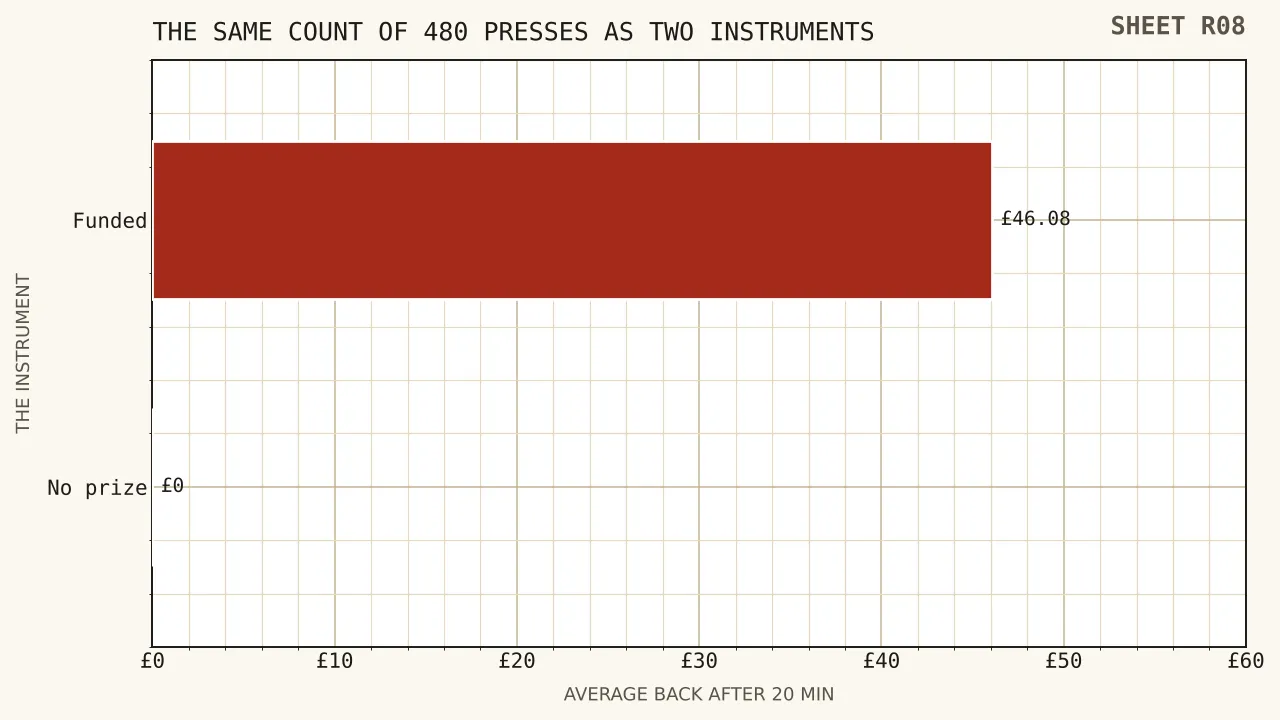
A no-prize version of a reel returns £0.00 in cash, whatever its configured percentage, because no prize is involved at all. A funded tray of 480 presses at 10p returns £46.08 on a 96 per cent reel. The whole difference between the two phrases is £46.08, and this page prices it.
The count 480 presses One press 10p Comes to £46.08 funded, £0.00 in demo
What a count of this size comes to
Every destination on this board is bought advertising. The site takes a fee if a reader goes on to register, and no figure printed below moves because of it.
The Spin Count
Gauge No 01
Betportal
Lowest multiple here
Priced at this site's own 10p a spin
What is counted
What is asked
No Great Britain licence
Licensed in Anjouan, Comoros, run by BetPortal Gaming Ltd, with Excite Ultra Media Ltd, reference ALSI-202601040-FI2.
Terms read 16 October 2026
Open the offer at Betportal, opens in a new tabThe Spin Count
Gauge No 02
WinBeast
Largest count here
Priced at this site's own 10p a spin
What is counted
What is asked
No Great Britain licence
Licensed in Curaçao, operator not named on the site.
Terms read 16 October 2026
Open the offer at WinBeast, opens in a new tabThe Spin Count
Gauge No 03
EliteSpin
Longest spin window
Priced at this site's own 10p a spin
What is counted
What is asked
No Great Britain licence
Licensed in Costa Rica, run by PrimeTier Limited.
Terms read 16 October 2026
Open the offer at EliteSpin, opens in a new tabThe Spin Count
Gauge No 04
Crown Jewelz
Multiple unpublished
No foot figure struck
What is counted
What is asked
No Great Britain licence
Licensed in Curaçao, number not verified, operator not named on the site.
Terms read 16 October 2026
Open the offer at Crown Jewelz, opens in a new tabThe figure in the third register is this site's own arithmetic and nothing an operator has published: the count at face, less the share a spin gives back at 96 per cent return to player, less what playing the wagering through costs at the same return. It describes the offer, not one reader's afternoon. Where the conditions price above the count the counter prints nothing rather than a negative sum, and where a figure the sum needs is unpublished it prints the condition in the operator's words instead.
A count has no unit of its own, so one is supplied. Where an operator publishes what a spin of its own is worth, that figure stands in the second register and is labelled as theirs. Where it does not, the second register carries this site's own 10p a spin and says so, and the foot figure moves in proportion: at half the price, half the money. The figure after it, what the count comes to for each spin, is the one that compares a large count against a small one.
Three words stand in the amount column where no figure can. Noted is a published condition that takes value away without leaving the sum a figure to take. Unpriced is a condition whose figure nobody has published, or a credit that is not a sum until a deposit of your own sets it. Own money is money of yours, which is never part of a foot figure.
Not one of the operators printed above holds a Great Britain licence, so the duties that licence carries do not reach them. Every online gambling company licensed in Great Britain has to be part of Gamstop Online, and a reader who has shut themselves out through the scheme is therefore not shut out here. The ceiling of ten times the bonus funds on a wagering requirement, in force since 19 January 2026, is a condition of that licence and binds the companies that hold one. Where a dispute goes instead is a matter for the authority named on the counter, and the Gambling Commission describes what a reader faces without a British licence as a lack of recourse if things go wrong. Nobody under 18 may hold an account at any of them.
Every term printed on a counter is the operator's own, and each counter carries the day it was read. The oldest of those readings is 16 October 2026. What binds a reader is the operator's own full terms, and not a line printed here.
1
Two instruments wearing one phrase
The phrase covers two products that have nothing arithmetically in common. One is a no-stake version of a reel: the button works, the reels turn, the balance on screen is a counter and nothing in it can be withdrawn. The other is a funded tray of presses at a real stake, whose proceeds are real money subject to whatever conditions the terms attach.
Pricing the first takes one line. No prize is involved, so the expected cash return is £0.00. That holds at a configured return of 92 pence per pound, at 96, at 99, and at any figure at all, because the multiplier that would turn a percentage into money is zero. A reader comparing two no-prize versions on their percentages is comparing two zeros.
Pricing the second takes two. Fund 480 presses at 10p apiece and £48.00 of stake results; a reel paying 96 pence per pound hands £46.08 of it back on average. Everything printed under the headline then subtracts from the £46.08, and parts three and seven do those subtractions.
So the useful question is never which free reel pays best. It is which of the two instruments a reader has been handed, and the test is a single word in the terms: whether anything on the screen can leave the account.
One point of overlap is worth stating because it surprises people. A no-prize game falls outside gambling technically, in the regulator’s own description, there being no prize involved, and it adds that access to such games by children strikes it as serving no legitimate purpose. The second half of that sentence is why an age check sits in front of a product worth £0.00, and part five works through it.
The loudest versions of both instruments sit outside the British licence, where the age check in front of the demo is among the duties that go. Part eight sets a figure beside every line of that ledger.
Three assumptions are declared and used throughout. One press costs 10p where a press is funded. A reel hands back 96 pence per pound, leaving four pence of edge. A requirement’s expected cost is the multiple times the edge times the credit. Nothing on this page states a configured return for a named title, because no reachable primary source publishes one.
2
A no-prize press is worth nothing, exactly
This is the shortest sum on the site and the one most worth doing, because a no-prize version is advertised with the same language as a funded tray and the two differ by the whole amount.
Average cash from a tray is count times stake times return times the proportion of winnings that can be withdrawn. A funded tray sets that last term to one, so 480 presses at 10p against a 96 per cent reel comes to £46.08. For a no-prize version the last term is zero, so the answer is £0.00 and the first three terms do not matter.
| Count | Funded, at 96 pence | No-prize version | Difference | Floor time at 2.5 seconds |
|---|---|---|---|---|
| 48 presses | £4.61 | £0.00 | £4.61 | 2 m 0 s |
| 120 presses | £11.52 | £0.00 | £11.52 | 5 m 0 s |
| 240 presses | £23.04 | £0.00 | £23.04 | 10 m 0 s |
| 480 presses | £46.08 | £0.00 | £46.08 | 20 m 0 s |
| 960 presses | £92.16 | £0.00 | £92.16 | 40 m 0 s |
| 4,800 presses | £460.80 | £0.00 | £460.80 | 3 h 20 m |
Two readings come off that. The third column is a column of zeros however far down the table a reader goes, so a larger no-prize count is not a larger offer: a thousand of them and ten of them are the same quantity. And the fifth column is the only thing a no-prize count does cost, which is time, and the time rises in exact proportion to the headline.
Which gives a reader a clean way to read a no-prize headline. Two and a half seconds times the count gives what is actually on offer. For 480 presses that is 20 minutes; for 4,800 it is 3 hours 20 minutes. The cash column stays at £0.00 throughout, and any sentence suggesting otherwise is describing a different product.
£0.00 at every count, and 20 minutes for 480 of them
3
480 funded presses, priced to the penny
Now the instrument that does pay. A tray of 480 at 10p is £48.00 of stake somebody else has funded, and on the house figure it averages £46.08. A requirement then takes its share, and the share is the multiple times four pence in every pound.
| Requirement | Turnover owed | Presses at 10p | Floor time | Left standing |
|---|---|---|---|---|
| None at all | nothing | 480 for the tray | 20 m 0 s | £46.08 |
| Fivefold | £230.40 | 2,304 | 1 h 36 m | £36.86 |
| Tenfold | £460.80 | 4,608 | 3 h 12 m | £27.65 |
| Twentyfold | £921.60 | 9,216 | 6 h 24 m | £9.22 |
| Twenty-five times | £1,152.00 | 11,520 | 8 h 0 m | nothing |
| Fortyfold | £1,843.20 | 18,432 | 12 h 48 m | short by £27.65 |
Three things in that table are worth isolating. The fifth row lands on nothing because twenty-five fours make a hundred, which is the whole of why twenty-five is the number this site keeps returning to. The sixth row is negative, and the shortfall is funded by the reader rather than absorbed by the credit. And nothing in the fourth column is estimated: 2.5 seconds is owed from a game’s start before the next may be commenced, which makes it a published floor.
Ten times is as heavy as bonus funds may be asked to turn over under a British licence, and 19 January 2026 made that so, which puts the third row at the regulated worst case and leaves the last two describing cashiers off the register. Sixty times was in use among licensees when the regulator consulted, and on this tray sixty times is £2,764.80 of turnover, 27,648 presses and 19 hours 12 minutes.
Two edges of that ceiling are unsettled and neither is papered over here. Bonus funds is the expression the wording bites on. Nothing is on the record either way about a press given free being such a fund, nor about a requirement reckoned over a deposit as well as over a bonus. This far, and no further, the published wording reaches. Proceeds of a press landing in a bonus balance carry a requirement that halts at ten times, which comes to £460.80 of turnover on £46.08.
4
What the word free is allowed to mean
The advertising regulator has published advice on this exact word, and it supplies the test a reader can apply themselves.
Its position runs thus. Free is a word to keep off an offer whose qualification stakes money belonging to the customer. Advice against that other phrase, the one pairing risk with its absence, follows as well, and the exception given is a case where losing funds of the customer’s own is genuinely impossible. Neither phrase appears anywhere on this site for that reason, which is an advertising rule and not a preference.
Price the test on this page. A no-prize version clears the test easily. Not a penny of the reader’s goes in, and nothing comes out either. A no-deposit funded tray meets it too, since no money has gone in. A tray requiring a qualifying deposit does not meet it on the regulator’s wording, because the deposit is the customer’s own money and it is at stake. Part seven costs that case.
Clear and prominent communication is owed for four kinds of condition, wherever omitting one would mislead, and three of them usually ride on a no-deposit tray. First comes eligibility, which covers a bar by location, a bar by age, and a restriction to new customers only. Second comes a requirement of wagering, or of deposit. Third, limits of time, whether on the claiming or on the using. Fourth, and last, bet types or odds minimums.
Placement is published as well. Online, the full terms should usually sit a single click away from the advertisement, and burying the link to them in a footer or in small print is out. A grammatical slip in the original is why that sentence appears here paraphrased and not quoted.
And the regulator’s own consequence is blunt enough to quote. Significant terms want prominent display within the advertisement itself, plus a position near whatever headline offer appears on the relevant pages for landing and for signing up; where significant conditions lack prominence enough, the advertisement is to be seen as misleading.
5
An age check before a no-stake game
A product worth £0.00 still sits behind an identity gate on a licensed site, and the reasoning is published.
Three things the regulator gives as reasons for an identity check: confirming identity, establishing age, and establishing self-exclusion status. A licence condition sits behind it. Information is obtained and verified under that condition so as to establish a customer’s identity, before any gambling by them, and the condition names three items as included while not restricting itself to them: name, address, date of birth.
The announcement of those rules went further in two directions that matter here. The age-check requirement applies to gambling with a free bet or a bonus as well as with a customer’s own money. And the versions of a licensee’s gambling games that take no stake are themselves behind an age check, which has to happen before a customer reaches them.
On the commencement date, care is owed. 7 February 2019 is the date on the article carrying the announcement, and 7 May is when it puts the new rules in force. It does not state the year. Only one reading is available from its own date, which is 7 May 2019, and that is what this site uses; a quotation of the source should mark the year as inference rather than as text.
One more figure from the same announcement puts the change in scale. A window of 72 hours for completing an age check had previously been available to operators. Price that against this page’s funded tray: 480 presses at the 2.5 second floor occupy 20 minutes, so a 72 hour window was 216 times longer than the whole tray takes to use.
And the regulator’s own framing of the free-to-play extension explains the gate on a £0.00 product. Technically outside gambling is where such games fall, no prize existing, and it states that no legitimate purpose occurs to it in children reaching them. The gate is therefore about who is at the screen rather than about what is in the balance.
One consumer-side protection belongs beside that. Nor may identity be sprung at the exit. Asking earlier being reasonably open to the licensee, no request to withdraw may trigger a fresh demand for information as the condition of its being paid. What the condition leaves intact is a licensee’s freedom to seek whatever some separate legal duty obliges it to collect at that point.
6
Which product rules reach a no-prize version
This is the part where an honest page stops short. The technical standards governing pace, autoplay, randomness and presentation are written for gambling, and the regulator’s own description of a no-prize game is that it is not technically gambling because no prize is involved.
So the position taken here is narrow. Each standard says what it covers and no more. Slots carry the 2.5 second pace floor. Casino games outside the reel definition carry the five second one, peer-to-peer poker excepted. Gaming, bingo included, carries the autoplay requirement. Gaming with bingo, lotteries and betting on virtual events carries the randomness standard. None of those scope lines says anything about a version that cannot pay a prize. This page therefore does not assert that any of them reaches a no-prize reel, and it does not assert that none does.
What follows for a reader is practical. Every figure in the fifth column of part two assumes the 2.5 second floor applies to the no-prize version as well, and that assumption is this page’s own rather than a sourced claim. Where it does not hold, a no-prize tray can run faster than 20 minutes, and the only quantity a no-prize tray ever had was its duration.
One duty does reach the no-prize version by name, and it is the one in part five: age verification before access. That is the single published point of contact between a product worth £0.00 and the British rulebook.
Two further things can be said without stretching anything. A no-prize version cannot carry a wagering requirement, because there is nothing to wager and nothing to withdraw, so the entire apparatus of multiples and contribution rates is inapplicable to it. And a no-prize version cannot carry a withdrawal floor, a maximum win or an expiry with a cash consequence, for the same reason. Every subtraction this site prices is a subtraction from a figure, and the figure here is zero.
7
The qualifying deposit, costed out
The third version of the phrase is a tray that arrives with a deposit attached, and the deposit is where a reader’s own money enters. Costing it needs one further figure: how many times the deposit itself has to be turned over.
Take a qualifying deposit of £10.00. Turning it over once on a 96 pence reel is expected to cost 40p. Five times costs £2.00. Ten times, £4.00. Twenty-five times, £10.00, which is the whole deposit. Forty times, £16.00. Sixty times, £24.00.
| Deposit turned over | Turnover | Expected cost | Tray plus deposit, net | Presses at 10p |
|---|---|---|---|---|
| Once | £10.00 | £0.40 | £45.68 | 100 |
| Five times | £50.00 | £2.00 | £44.08 | 500 |
| Ten times | £100.00 | £4.00 | £42.08 | 1,000 |
| Twenty-five times | £250.00 | £10.00 | £36.08 | 2,500 |
| Forty times | £400.00 | £16.00 | £30.08 | 4,000 |
| Sixty times | £600.00 | £24.00 | £22.08 | 6,000 |
The fourth column is the honest comparison, because it puts the tray and the deposit in one number. Even at sixty times on the deposit the combination stays positive, at £22.08, which is the useful finding: on a tray this size the deposit requirement is a real cost and not usually a fatal one.
Two further rows belong beside that table because the figures move with the price of a press rather than with the deposit. Staking at 10p a press, a £10.00 deposit turned over forty times comes to 4,000 presses, or 2 hours 47 minutes against a floor of 2.5 seconds each. Ten times over comes to 1,000 presses, 41 minutes and 40 seconds. Add the tray’s own tenfold requirement, which is 4,608 presses, and the combined obligation at those two deposit multiples is 8,608 presses and 5 hours 59 minutes, or 5,608 presses and 3 hours 54 minutes.
Reverse it to find where it would become fatal. The deposit requirement eats the whole £46.08 where its expected cost reaches that figure, and at four pence in the pound on a £10.00 deposit that needs a multiple of 115.2 times. No such multiple is advertised anywhere, which is why a qualifying deposit is a smaller problem than the requirement on the tray itself.
Change the deposit and the arithmetic scales. A £20.00 deposit at forty times costs £32.00 and leaves £14.08. A £50.00 deposit at forty times costs £80.00 and turns the whole package negative by £33.92. So the quantity that decides it is the deposit multiplied by the multiple, and a reader should compute that product before anything else in the terms.
One point of law closes this part. Whether a requirement computed on a deposit as well as a bonus falls inside the ten times ceiling has never been published either way, so the sixty times row above describes a cashier beyond the register and the chain of published wording stops where it stops.
8
Both instruments with nothing filed
Off the register both products change, and the no-prize version changes in a way that is specific to this page: the one duty that reached it is the duty that goes.
| The licence imposes | Its worth here, in cash |
|---|---|
| Age verified before a no-prize game | The gate in front of a £0.00 product disappears |
| Name, address and birth date before any press | £48.00 of stake may go on an unchecked account |
| No identity demand sprung at the exit | £27.65 of residue may be held against late paperwork |
| A ten times ceiling on the multiple | £27.65 standing becomes short by £27.65 at fortyfold |
| A 2.5 second gap between cycles | 20 minutes stops flooring the tray |
| Neither turbo nor repetition that runs itself | Those 18,432 presses turn compressible |
| One cycle held under a cash figure | A 50-press cycle limit, 20 for the young, goes |
| Credit cards turned away | Borrowing may fund £1,843.20 of turnover |
| A limit prompted as the default | Those 18,432 presses meet no ceiling first |
| A deposit balance left uncapped | A qualifying £10.00 turns conditional |
| A withdrawal that cannot be cancelled | £27.65 may be offered back to the reels |
| Eight weeks, then a name off the approved list | No route whatever for a disputed £27.65 |
| Membership of the national scheme | 480 presses can reach a registered reader |
The first row is the one peculiar to this subject. Inside the licence, a product of no cash value whatever sits behind an age check, and the reason the regulator states is that children reaching such games strikes it as having no legitimate purpose. Off the register that check is nobody’s obligation, and the product it would have gated is precisely the one a reader can be shown without any money changing hands.
One Curaçao document on responsible gaming covers much of that market: version 1.0, carrying the date 21 February 2025. Identity before play is where it is weaker, and the weakness is in the timing rather than the principle. Satisfaction that a player has reached 18 is what unlocks depositing and wagering under it. At registration, a date of birth confirmed is what the check against a minor runs on. Three additional steps are named for use where they can be used: open sources drawn on for verification; a box ticked by the player to declare themselves over 18; and a payment method confirmed. Later milestones are where full identity checking attaches. Under its policies on anti-money-laundering and on knowing the customer, a minimum of one government-issued identity document is set, brought forward only where any doubt whatever arises over a player’s age ahead of those milestones.
Beside it, the British position. Three items verified before gambling of any kind: name, then address, then date of birth. Bonus play falls inside the duty and so do the no-prize versions. The difference is not whether a check happens. It is whether it happens before the first press or at a milestone further down the line.
Two lines of that policy run the other way. Under it a deposit limit falls at once and rises only after a week, against a British floor of 24 hours on any rise. Complaints run 26 weeks on the player’s side and four weeks for the answer, with four further weeks available on written extension, adjudication being obligatory and paid by the operator.
One line does not move at all. Remote gaming duty of 40 per cent arrives in identical terms at a licensed cashier and an unlicensed one, the charge following a player’s usual country of residence. For the seven years prior the figure stood at 21 per cent, with 1 April 2026 as the changeover.
Questions
- What is a free slot with no deposit actually worth?
- Two products wear that phrase, and the answer differs by the whole amount. A no-prize version returns £0.00 in cash at any count and any configured percentage, because no prize is involved. A funded tray of 480 presses at 10p returns £46.08 on a 96 per cent reel. The test is whether anything on the screen can leave the account.
- Does a demo slot’s return percentage matter?
- Not to the cash answer. Average cash is count times stake times return times the proportion of winnings that can be withdrawn, and for a no-prize version that last term is zero, so the first three stop mattering. A reader comparing two no-prize versions on their percentages is comparing two zeros.
- So what does a no-prize count give me?
- Time, in exact proportion to the headline. Hold each cycle to two and a half seconds and 48 presses comes to 2 minutes, 480 to 20 minutes, 4,800 to 3 hours 20 minutes. The cash column stays at £0.00 all the way down. Note that the pace floor is written against slots and a no-prize version is described by the regulator as not technically gambling, so applying it here is this page’s own assumption rather than a sourced claim.
- Why do I have to prove my age for a game with no prizes?
- Because the rule says so expressly. Because the rule says so in terms. No-stake versions of a licensee’s gambling games are reachable only once an age check has run, and the regulator frames such games as technically outside gambling, a prize being absent, while finding no legitimate purpose in children getting at them. The identity condition wants three items obtained and verified ahead of any gambling: name, address, date of birth.
- When did the free-to-play age check start?
- Its announcement carries the date 7 February 2019 and puts the new rules in force on 7 May, with no year given. Its own date leaves one reading available, 7 May 2019, so that is the figure used here, offered as inference and not as text from the source. A window of 72 hours, previously available to operators for completing an age check, is also recorded in the same announcement.
- Can an offer be called free if I have to deposit first?
- Advice from the advertising regulator keeps the word free off an offer where qualifying puts money belonging to the customer at stake, and it advises against that other phrase, the one pairing risk with its absence, unless funds of the customer’s own genuinely cannot be lost. That is why neither phrase appears on this site, and the reason is an advertising rule rather than taste.
- How much does a qualifying deposit cost me?
- Four pence in the pound, times the multiple, times the deposit. A £10.00 deposit turned over once costs 40p, ten times costs £4.00, forty times costs £16.00 and sixty times costs £24.00. Even at sixty times the tray and deposit together stay positive at £22.08, because eating the whole £46.08 would need a multiple of 115.2 times.
- What does a requirement on the tray itself cost?
- Far more than the deposit does. Work it on £46.08. Five times leaves £36.86 behind. Ten times leaves £27.65. Twenty times leaves £9.22. Twenty-five leaves nothing whatever. Forty leaves a shortfall of £27.65. The turnover at fortyfold is £1,843.20, which is 18,432 presses and 12 hours 48 minutes at the floor speed.
- What is the ceiling on a British licensed requirement?
- Ten times the bonus funds, the position since 19 January 2026. On this tray that is £460.80 of turnover, 4,608 presses and 3 hours 12 minutes. Sixty times was in use among licensees when the regulator consulted, which on the same tray would be £2,764.80, 27,648 presses and 19 hours 12 minutes.
- What changes when neither product sits on the register?
- Every row of part eight’s table, thirteen of them, the first being peculiar to this subject. No Great Britain licence covers that cashier, so the age check standing in front of a £0.00 product is owed by nobody. Beside that one: an unchecked account may stake the £48.00; ten times stops being a ceiling; 20 minutes stops being a floor; and behind a disputed £27.65 there is neither an eight-week clock nor an approved adjudicator.