Sheet D02 Revision 1 Counted 16 October 2026
Casino no deposit bonus: a credit in pounds, converted into spins
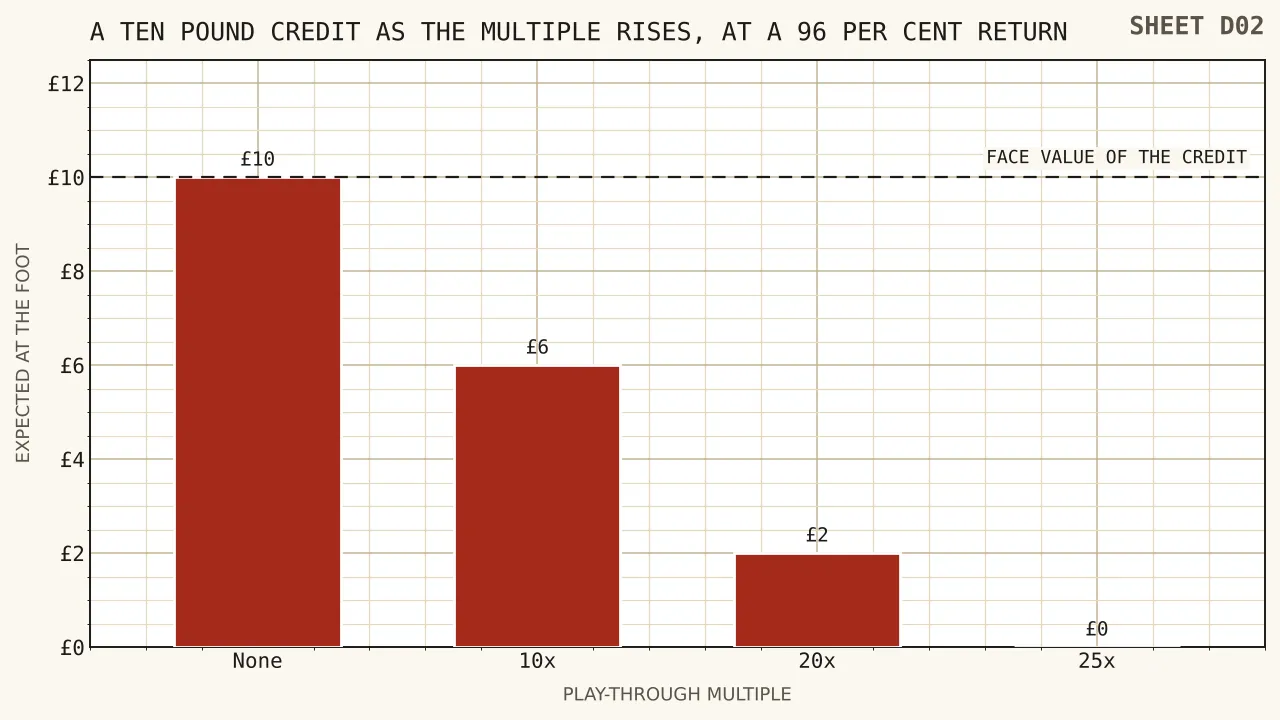
A no-deposit bonus arrives as money rather than as a tally, and money behaves differently: a credit can carry a turnover requirement where a tally of spins cannot. Ten pounds of bonus is 100 spins at 10p, worth £9.60 if nothing is asked of it and £6.00 once a tenfold requirement has been paid for. At twenty-five times the whole credit is gone. This sheet prices every rung on that ladder.
The credit £10 bonus One spin 10p Comes to £6.00 at tenfold
What a credit of this size comes to
Every destination on this board is bought advertising. The site takes a fee if a reader goes on to register, and no figure printed below moves because of it.
The Spin Count
Gauge No 01
Betportal
Lowest multiple here
Priced at this site's own 10p a spin
What is counted
What is asked
No Great Britain licence
Licensed in Anjouan, Comoros, run by BetPortal Gaming Ltd, with Excite Ultra Media Ltd, reference ALSI-202601040-FI2.
Terms read 16 October 2026
Open the offer at Betportal, opens in a new tabThe Spin Count
Gauge No 02
WinBeast
Largest count here
Priced at this site's own 10p a spin
What is counted
What is asked
No Great Britain licence
Licensed in Curaçao, operator not named on the site.
Terms read 16 October 2026
Open the offer at WinBeast, opens in a new tabThe Spin Count
Gauge No 03
EliteSpin
Longest spin window
Priced at this site's own 10p a spin
What is counted
What is asked
No Great Britain licence
Licensed in Costa Rica, run by PrimeTier Limited.
Terms read 16 October 2026
Open the offer at EliteSpin, opens in a new tabThe Spin Count
Gauge No 04
Crown Jewelz
Multiple unpublished
No foot figure struck
What is counted
What is asked
No Great Britain licence
Licensed in Curaçao, number not verified, operator not named on the site.
Terms read 16 October 2026
Open the offer at Crown Jewelz, opens in a new tabThe figure in the third register is this site's own arithmetic and nothing an operator has published: the count at face, less the share a spin gives back at 96 per cent return to player, less what playing the wagering through costs at the same return. It describes the offer, not one reader's afternoon. Where the conditions price above the count the counter prints nothing rather than a negative sum, and where a figure the sum needs is unpublished it prints the condition in the operator's words instead.
A count has no unit of its own, so one is supplied. Where an operator publishes what a spin of its own is worth, that figure stands in the second register and is labelled as theirs. Where it does not, the second register carries this site's own 10p a spin and says so, and the foot figure moves in proportion: at half the price, half the money. The figure after it, what the count comes to for each spin, is the one that compares a large count against a small one.
Three words stand in the amount column where no figure can. Noted is a published condition that takes value away without leaving the sum a figure to take. Unpriced is a condition whose figure nobody has published, or a credit that is not a sum until a deposit of your own sets it. Own money is money of yours, which is never part of a foot figure.
Not one of the operators printed above holds a Great Britain licence, so the duties that licence carries do not reach them. Every online gambling company licensed in Great Britain has to be part of Gamstop Online, and a reader who has shut themselves out through the scheme is therefore not shut out here. The ceiling of ten times the bonus funds on a wagering requirement, in force since 19 January 2026, is a condition of that licence and binds the companies that hold one. Where a dispute goes instead is a matter for the authority named on the counter, and the Gambling Commission describes what a reader faces without a British licence as a lack of recourse if things go wrong. Nobody under 18 may hold an account at any of them.
Every term printed on a counter is the operator's own, and each counter carries the day it was read. The oldest of those readings is 16 October 2026. What binds a reader is the operator's own full terms, and not a line printed here.
1
Money behaves differently from a tally
Two offers sit side by side at the door of a casino and they are not the same animal. One hands over a set of spins. The other hands over a sum in pounds and calls it a bonus. The first is a quantity of presses already paid for, and nothing can be asked of it beyond using it. The second is a balance, and a balance can have conditions fastened to it.
Convert first, then judge. At the 10p this site works to, a five pound credit is 50 spins, a ten pound credit is 100, a twenty-five pound credit is 250, and a hundred pound credit is 1,000. That conversion is the only honest way to set a cash headline against a spins headline, because it puts both on the same axis. A reader choosing between 100 free spins and ten pounds of bonus is choosing between two descriptions of the same stake, and the difference between them lives entirely in the small print.
Then apply the return. On a 96 per cent game the ten pound credit is expected to give back £9.60 across its 100 spins, the twenty-five pound credit £24.00 across 250, and the hundred pound credit £96.00 across 1,000. Those figures are the start of the sum rather than the end of it, which is where a cash bonus parts company from a count.
| Credit advertised | Spins at 10p | Expected at 96% |
|---|---|---|
| £5 bonus | 50 | £4.80 |
| £10 bonus | 100 | £9.60 |
| £20 bonus | 200 | £19.20 |
| £25 bonus | 250 | £24.00 |
| £30 bonus | 300 | £28.80 |
| £50 bonus | 500 | £48.00 |
| £100 bonus | 1,000 | £96.00 |
Nothing on this page needs a deposit to be made, which has one consequence worth holding on to from the first paragraph. Where no money has been paid in, there is no deposit balance. Several of the protections a reader might expect to rely on are written about a deposit balance, and on a no-deposit offer they have nothing to attach themselves to. Section five of this sheet works through which ones.
2
The turnover a credit can be asked to carry
A turnover requirement is a demand that wagers totalling some value be placed before funds become withdrawable. The multiple is the whole of it: a requirement is not a fee and not a deduction, it is a volume of staking, and the cost of producing that volume is what actually comes off the credit.
Work out the cost rather than the volume and the arithmetic becomes simple. On a 96 per cent game, fourpence is what a staked pound is expected to cost its owner. So a requirement of ten times ten pounds is a hundred pounds of staking at an expected cost of £4.00. Set that against the £9.60 the spins are expected to return and £5.60 is what survives. Run the shorter route to the same answer: a tenfold requirement keeps 60 per cent of a balance, and 60 per cent of ten pounds is £6.00.
The two routes differ by 40p because they measure slightly different things. The first starts from the expected return on the spins and deducts the cost of the turnover. The second applies the standard formula to the credit as a balance. This sheet quotes the second where a credit is involved, because a bonus balance is what the terms are written about, and the first where a count of spins is involved, because there the spins are the thing being handed over. Both are the site’s own working and neither is a figure read off a rule.
How high the multiple may go depends on where the cashier is licensed. Since 19 January 2026 a British licence holder may not attach a play-through above ten times to bonus funds: code provision 5.1.1 carries the limit, and the consultation paper behind it recorded some licensees running at up to sixty times beforehand. Its scope spares only the gaming machine technical and the software licences, which puts every licensed remote casino in the country inside it.
The same provision does a second job that bears on a casino credit. One incentive may not mix more than one of the product types it names, which are betting, casino, bingo and lottery. A casino credit and a set of slot spins stay on one side of that line, because slots are a casino product. A casino credit welded to a book of bingo tickets crosses it. Three carve-outs sit awkwardly against what a reader would assume. A credit spendable on whatever product the customer chooses escapes the ban altogether. A single email may carry a betting offer beside a casino one, where the customer has opted in on both products. Two products drawn from one type are allowed, and a raffle alongside a lottery scratchcard is the illustration given.
3
The ladder of credits against the ladder of multiples
One table settles the shape of this market. Credits run down the side, multiples across the top, and each cell is what the credit is expected to be worth once the staking has been paid for. Each cell is the credit, scaled by one minus the multiple times the 4 per cent edge.
| Credit | No requirement | Tenfold | Twentyfold | Twenty-five times | Fortyfold |
|---|---|---|---|---|---|
| £5 | £5.00 | £3.00 | £1.00 | nothing | £3.00 short |
| £10 | £10.00 | £6.00 | £2.00 | nothing | £6.00 short |
| £20 | £20.00 | £12.00 | £4.00 | nothing | £12.00 short |
| £25 | £25.00 | £15.00 | £5.00 | nothing | £15.00 short |
| £30 | £30.00 | £18.00 | £6.00 | nothing | £18.00 short |
| £50 | £50.00 | £30.00 | £10.00 | nothing | £30.00 short |
| £100 | £100.00 | £60.00 | £20.00 | nothing | £60.00 short |
Four things fall out of that grid. The first is that the proportion never changes. Tenfold always keeps three fifths, twentyfold always keeps one fifth, twenty-five always keeps nothing and fortyfold always leaves a shortfall of three fifths. A bigger headline is a bigger version of the same proportion, never a better deal per pound.
The second is that the right-hand column is a liability rather than an asset. A fortyfold requirement on fifty pounds of bonus demands two thousand pounds of staking, which costs an expected £80.00 against a fifty pound balance. The balance is expected to be spent before the condition is met, and anything still owed after that comes out of the reader’s own funds.
The third is the time. A hundred pounds of staking is a thousand presses at 10p. Two and a half seconds is the floor between cycles on a licensed slot, which puts forty-one minutes and forty seconds under a thousand presses. Two thousand pounds of staking is twenty thousand presses, which is thirteen hours and fifty-two minutes of button work at that same floor speed.
The fourth is the column that is missing. The grid takes no account of a game counting below its face. Where respondents on the regulator’s consultation page quoted a contribution rate of 30 per cent, a hundred pounds of required credit needs about £333.33 of real staking, so the clock and the press count above both triple while the multiple in the terms stays put.
£2,000 of staking, 20,000 presses, 13 hours 52 minutes, against a £50 credit
4
The maximum bet, and the clock it builds
A turnover requirement names a volume and says nothing about the rate. A maximum bet clause fixes the rate, and that is how a seven-day window and a modest multiple can combine into something nobody could finish.
Take the shape such clauses usually have, stated here as arithmetic on a kind of term and not as a report of anybody’s published offer: the largest permitted stake while wagering is a tenth of the credit, with a floor of 10p and a cash ceiling of five pounds, whichever of the two comes out lower. On a ten pound credit the tenth is £1.00, which is below the five pound ceiling, so one pound is the cap. On a hundred pound credit the tenth is £10.00, the five pound ceiling is lower, so five pounds is the cap.
Now count the bets. A tenfold requirement on ten pounds is a hundred pounds of staking, which at a one pound cap is at least a hundred bets and at 10p a spin is a thousand presses. A tenfold requirement on a hundred pounds is a thousand pounds of staking, which at a five pound cap is at least two hundred bets and at 10p is ten thousand presses. The bigger credit asks for ten times the staking and allows only five times the stake, so the number of presses rises faster than the headline does.
| Credit at tenfold | Staking due | Cap on one bet | Per day over 7 days | Presses a day at 10p |
|---|---|---|---|---|
| £5 | £50.00 | 50p | £7.15 | 72 |
| £10 | £100.00 | £1.00 | £14.29 | 143 |
| £25 | £250.00 | £2.50 | £35.72 | 358 |
| £50 | £500.00 | £5.00 | £71.43 | 715 |
| £100 | £1,000.00 | £5.00 | £142.86 | 1,429 |
Read the last column as minutes. At the lawful floor speed of two and a half seconds a cycle, 143 presses is six minutes a day and 1,429 presses is fifty-nine minutes and thirty seconds a day, every day for a week. A reader who has signed up for ten pounds of bonus has agreed to six minutes a day. A reader who has signed up for a hundred has agreed to an hour.
A cap on the bet does one useful thing, which is worth saying because this sheet is not an argument that every clause is hostile. A low cap slows the staking down, and slowing the staking down reduces the chance that a run of bad presses empties the balance before the requirement is met. The expected cost does not change. The spread of outcomes narrows.
5
Which balance the money is standing in
A casino account holds at least two pots and the rules treat them differently. One is the deposit balance, which holds money the customer paid in and winnings they have cleared. The other is the bonus balance, which holds credit the operator issued and whatever that credit has won while still inside its conditions.
On the deposit balance the position is unambiguous. A term capping what a consumer takes out of it may not be imposed. It may not be used. It may not be enforced, and it may not be relied upon. One specimen the regulator prints as prohibited sets a daily figure of fifty pounds against a weekly one of five hundred. Its guidance adds three things. Withdrawal from that balance, winnings included, is an entitlement available at any time. The maximum must carry no restriction. Reasonableness is the test for any limit placed on a withdrawal’s size or frequency. The page carrying that rule shows no publication date at all, so this sheet takes the rule from it and claims no freshness.
On the bonus balance the position is different, and the difference is the single most important thing on this page. Three absences line up. For a maximum-win cap on bonus winnings there is no standard figure in any primary source that could be reached. No rule forbids one. And nothing turns bonus winnings into bonus funds automatically. A ceiling on what a credit may win and an unrestricted right to withdraw a deposit balance can both be true in one set of terms, because they describe different pots.
Here is where a no-deposit offer differs from every other offer in the building. A reader who has paid in nothing has no deposit balance at all. The prohibition on capping withdrawals from that balance is real, enforceable and, for the duration of a no-deposit bonus, attached to an empty pot. Every pound in play sits in the bonus balance, where a ceiling is permitted. That is not a loophole anybody hid: it is the structure of the offer, and it is the reason this section of the site prices ceilings as seriously as it prices multiples.
One further clause shape belongs here. Where terms require a player holding an active bonus to cancel the whole bonus balance before withdrawing, including anything the bonus has won, the reader faces a choice rather than a deduction: finish the requirement, or abandon the credit and whatever it has made. Priced on a ten pound credit at tenfold with £60.00 of staking already done, abandoning means giving up the expected £6.00 and keeping nothing for the forty pounds of turnover still to go.
6
The window, priced per day
Expiry is the condition readers discount most and should discount least, because a window converts a volume of staking into a rate of attendance, and a rate of attendance is something a person either can or cannot manage.
Divide and see. A hundred pounds of staking inside seven days is £14.29 a day. Inside three days it is £33.34 a day. Inside twenty-four hours it is the whole hundred in one sitting, which at 10p a spin is a thousand presses and at the lawful floor speed is forty-one minutes and forty seconds without a pause. None of those three windows changes the expected cost of the staking by a penny. All three change the probability that the staking gets done at all, and an unfinished requirement forfeits the credit.
That is the asymmetry worth carrying away. The arithmetic of a requirement assumes it is completed. A window attacks the assumption rather than the figure, and a figure computed on an assumption that fails is worth nothing. A twenty-four hour window on a hundred pounds of turnover is not a small print detail: for most readers it is the whole offer.
Deadlines of that kind rank as significant conditions in advertising terms. The regulator’s list runs to four categories, and a no-deposit credit can trip each of them: minimum odds or bet types; limits on the time available for claiming or using the offer; the deposit and wagering requirements; and eligibility, meaning new customers only, an age bar or a location bar. One click should separate an online advertisement from its full terms, and no footer and no line of small print is an acceptable home for the link that does it.
Three rulings put a price on getting that wrong. One concerned a ten pound free bet whose claim deadline, a reply to a text by a stated hour, went unmentioned; the date on it is 17 July 2024. One concerned an excluded payment method sitting among the full terms, which the regulator found insufficiently prominent; that date is 31 July 2024. One concerned a five pound voucher that could not be used on 14 March because of a race meeting; that date is 27 August 2025, and of the three it is the only one the regulator’s page describes in the language of a breach.
7
Twenty-five times, and why it is a wall
Every figure in this sheet bends around one number, and the number is not in any rulebook. The number is the house edge turned upside down. Four pence in the pound stays with the house at 96 per cent, and a pound is twenty-five fourpences, so twenty-five turns of a balance are expected to eat it precisely.
Below the wall a credit keeps a fraction of itself, and the fraction is easy to carry in the head: subtract four per cent for each turn. Five times keeps 80 per cent. Ten times keeps 60. Fifteen times keeps 40. Twenty times keeps 20. Twenty-four times keeps 4 per cent, which on a ten pound credit is forty pence. At twenty-five the figure is zero whatever the headline said.
Above the wall the sum is negative, and a negative expected value on a bonus has a concrete meaning rather than a rhetorical one. It means the credit is expected to be exhausted while staking is still owed, and that the remaining staking will be funded by the player from their own money. A thirty-times requirement on twenty pounds of bonus is not a worse version of a good thing. It is an arrangement under which the reader is expected to put in £4.00 of their own.
| Multiple | Share of the credit kept | Staking due | Expected at the foot |
|---|---|---|---|
| Five times | 80 per cent | £50.00 | £8.00 |
| Ten times | 60 per cent | £100.00 | £6.00 |
| Fifteen times | 40 per cent | £150.00 | £4.00 |
| Twenty times | 20 per cent | £200.00 | £2.00 |
| Twenty-four times | 4 per cent | £240.00 | £0.40 |
| Twenty-five times | none | £250.00 | nothing |
| Thirty times | a deficit of 20 per cent | £300.00 | £2.00 of the reader’s own |
The practical use of the wall is as a test applied before reading anything else. Divide one hundred by the house edge expressed in whole numbers and the answer is the multiple at which the offer is worth nothing. At 96 per cent the answer is twenty-five. At 95 per cent it is twenty. On a 97 per cent game it is thirty-three and a third. The lower the return on the game a credit must be cleared on, the sooner the wall arrives, which is why a game restriction and a multiple have to be read together rather than one after the other.
8
The check that comes before the credit
A no-deposit bonus is usually described as arriving on registration, and registration on a British licensed site is a heavier thing than the phrase suggests. No gambling may happen until the holder has obtained and checked information fixing who the customer is. Three items set the condition’s floor: one is a birth date, one an address, one a name. A floor is not a list, so more may be asked for.
Three reasons are given for the check, and they are worth separating. One is age. One is whether the person has self-excluded. One is confirming identity as such. The duty reaches past money. Verification must come before gambling on a bonus. It must come before gambling on a free bet. It must also come before a customer can open the licensee’s free-to-play games, and the regulator’s reasoning there is that an absent prize keeps those games outside gambling while leaving no legitimate reason for a child to reach them. Before any deposit, a licensee must also tell the customer which documents or information may be wanted, when, and how to provide them.
Every offer in this section sits on that floor. A credit which requires an account, and an account which requires verified identity, is a credit nobody can collect anonymously on a licensed site. Where a reader meets an offer promising otherwise, the thing being advertised is the absence of the check and not a better bonus.
The check also has a closing rule that matters when the credit has turned into winnings. A withdrawal request must not be used as the trigger for demanding information the licensee could reasonably have asked for earlier, and money laundering information in particular should be sought promptly rather than at the point somebody wants to be paid. The exception is narrow: information needed at that moment to satisfy another legal duty. That consumer guide carries a publication date of 23 September 2020 and an update of 13 April 2022, which is why the live wording on identity is taken from the licence condition here and not from the guide.
One more duty lands at the same moment. A financial limit must be prompted for inside the registration process, or else at the first payment in. Setting a limit must be the default choice on offer. Declining one must take an act by the customer. A free text box takes the figure, with an equivalent where the gambling is by telephone. At account level is where limits bind, as a minimum. One type must be offered with at least the prominence of the others: the gross deposit limit, which caps what goes in across a stated period, and a facility failing that definition may not be called a deposit limit at all. Three periods have to appear among the durations: one month, seven days, and the twenty-four hour option beneath them. The regulator’s own worked example is usable arithmetic: set a daily ten pounds and a weekly hundred together, and the system must permit ten a day and seventy across the week, because the tightest limit governs.
Two directions, two speeds. A reduction the customer asks for lands at once, unless systems or a technical failure stand in the way. An increase waits on three things in sequence. The customer asks. Twenty-four hours or more of cooling-off pass. The customer then acts again to confirm. The asymmetry is the point: a limit can be tightened in a moment and loosened only after a night.
9
What the licence answers for, and what nobody answers for
Set the question as a series of questions, because that is how a reader meets a no-deposit credit in practice. Who stops the multiple at ten? Code provision 5.1.1, since 19 January 2026, and only where the cashier holds a British licence. Who stops a casino credit being bundled with bingo tickets under one shared requirement? The same provision. Who stops the credit being handed out before an identity check? Condition 17.1.1. Who makes the site prompt for a deposit limit and hold an increase overnight? The technical standard on financial limits.
Who stops a credit card funding the deposit that follows? A licence condition answers that one; 14 April 2020 is when it took effect, and a credit card arriving via a money service business falls inside it. Who stops the account offering to cancel a withdrawal request once it has been made? The technical standard on product design, which applies to all gambling and adds that the process of getting paid should be made as frictionless as possible. Who holds the slot a credit is cleared on to one cycle in two and a half seconds? Who keeps a turbo button off it? Who forbids a fanfare where the return has failed to beat the stake? Who stops two games running together? Who bars a near miss from standing in for the plain loss? The same standard, requirement by requirement. Who caps a single slot press at five pounds, or two pounds for a customer under twenty-five? A statutory instrument answers the stake question, and 25 February 2025 is the day it was made. Its own commencement clause gives a formula of six weeks rather than a calendar date, so the two dates, 9 April 2025 and 21 May 2025, come from the regulator’s guidance instead. Both caps reach online slots and nothing else.
Now put that list of questions where the British licence does not run, and a single answer does for every line of it: nobody. That is not an insult aimed at a jurisdiction. It is what the published rulebooks say when they are laid beside each other. Curaçao’s authority put out its responsible gaming policy at version 1.0, dated 21 February 2025, and what it does impose runs as follows. Age verification. Accessible information. Self-assessment tools. Behaviour tracking. Cooling-off and self-exclusion facilities. Deposit limits. Training for staff, affiliates, marketing partners and social media influencers. General principles on marketing and advertising. Absent from that list: a cap on a wagering multiple, a stake limit, a minimum game cycle, a bar on autoplay, any restriction on celebrating a sub-stake return. On bonuses it manages two sentences, asking for transparent terms and forbidding aggressive promotion that encourages excessive gambling.
Two points run the other way and belong on an honest page. Affiliates are reached directly by that policy, which calls for binding contracts, compliance audits and penalties for non-compliance; the British regulator’s advertising page does not mention affiliates at all, and touches third parties only on keeping advertisements away from copyright-infringing sites. Its complaints framework is real as well. Six months is a player’s window to complain there. An operator gets four weeks to respond, and one extension of four more on written notice, which totals the same eight weeks as the British outer limit. What differs is who sets the terms of dispute resolution. Approval of the adjudicators is the regulator’s job here, and no licensee may appoint one from outside that approved set. On that side the operator may fix the parameters, the binding effect of an outcome on the player among them.
The regulator’s own limit is worth quoting on any page that promises recourse, because it bounds what a complaint can achieve even inside the licence. It describes itself as not an ombudsman, says it lacks the powers to resolve gambling complaints or recover a customer’s money, cannot resolve disputes about withdrawals or technical faults in a game, and has no access to customer accounts. The route is the operator first, then an approved adjudicator. Outside the licence there is no operator anybody can compel and no adjudicator anybody approved.
Two sourced facts close the gap between all that and a reader’s experience. A recognisable game is no proof of a licence. Software from licensed suppliers has been showing up on unlicensed sites, which is what an industry warning notice recorded. Two failure modes get named from what it has seen: a payout blocked, and a withdrawal limit set at a height nobody reaches. Those two are the ceiling and the floor priced on this page, and out there no complaints route stands behind either.
Tenfold here, no ceiling there, and twenty-five times is where a credit reaches nothing
Questions
- Is a no-deposit bonus in pounds better than a count of free spins?
- They are the same stake described two ways, so the small print decides it. At 10p a spin, ten pounds of credit is 100 spins and twenty-five pounds is 250. The difference is that a credit is a balance and can carry a turnover requirement, while a count of spins has already been paid for and cannot.
- What does a £10 no deposit bonus actually come to?
- £10.00 if nothing is asked of it, £6.00 under a tenfold requirement, £2.00 under a twentyfold one, and nothing at all at twenty-five times. Each figure is the credit scaled by one minus the multiple times the 4 per cent edge, which is this site’s own working and not a published rule.
- How much turnover does a tenfold requirement mean in practice?
- Ten times the credit. On ten pounds the staking is £100.00, which at 10p is 1,000 spins, and the fastest they may lawfully be run is forty-one minutes and forty seconds. On a hundred pounds it is £1,000.00, ten thousand spins, and nearly seven hours of button work.
- Can a British licensed casino ask for more than ten times?
- Not on bonus funds. A play-through above ten times has been barred by code provision 5.1.1 since 19 January 2026, and the only licences outside its scope are the gaming machine technical one and the software one. Some licensees were running up to sixty times before it beforehand, a figure the consultation paper behind the limit put on record.
- Why does a maximum bet clause matter if the multiple is low?
- Because a multiple fixes the volume of staking and a maximum bet fixes the rate. Where the cap is a tenth of the credit, floored at 10p and ceilinged at five pounds, a tenfold requirement on ten pounds needs at least a hundred bets, and on a hundred pounds at least two hundred. Spread over seven days that is six minutes a day in the first case and nearly an hour a day in the second.
- Does the ban on capping withdrawals protect a no-deposit bonus?
- Not while the money is still bonus credit. That prohibition addresses the deposit balance, and nothing has been paid into one, so no such balance exists for it to govern. Every pound in play sits in the bonus balance, where no published rule forbids a ceiling on winnings.
- What happens if I withdraw before the requirement is finished?
- Where the terms require an active bonus to be cancelled first, the choice is to finish the turnover or to give up the credit and whatever it has won. On ten pounds at tenfold with sixty pounds of staking already placed, abandoning means letting go of an expected £6.00 and getting nothing for the turnover already done.
- Why is twenty-five times described as a wall rather than a bad deal?
- Because the figure is the house edge inverted. A single turn is expected to take 4 per cent of the balance, and twenty-five of them therefore take all of it, so the expected value lands on nothing at all. Past that point the credit is expected to run out with staking still owed, and the remainder comes from the player. On a 95 per cent game the wall arrives at twenty times instead.
- Must I prove my identity before a no-deposit bonus can be used?
- On a British licensed site, yes. Information establishing identity has to be obtained and checked before a customer gambles, and the floor is three items: a date of birth, a name, an address. Play funded by a bonus is covered, play on a free bet is covered, and so are the free-to-play versions of a licensee’s games. A withdrawal request may not be the first moment paperwork is demanded, where asking earlier would have been reasonable.
- What is missing from a no-deposit credit at an offshore cashier?
- An offer of that shape carries no Great Britain licence. Nothing then halts the multiple at tenfold. Nothing turns away a credit card. No minimum game cycle applies, and turbo and autoplay go unmentioned. The five pound slot stake limit and the two pound one for under-25s do not reach it. Nothing obliges it to join the national self-exclusion scheme. The eight-week complaints clock ending at an adjudicator the regulator has approved does not exist out there. What the Curaçao policy read for this sheet does carry is a six-month complaints window and free dispute resolution, so the honest statement is that recourse is weaker and differently arranged rather than missing.