Sheet R03 Revision 1 Counted 16 October 2026
Live casino UK: the best edge in the building, weighted to nothing
A tray of 130 presses at 10p is worth £12.48 on a 96 per cent reel. A 37-pocket wheel paying 35 to 1 keeps less than that reel does, 2.70 pence in the pound against four. Then the bonus terms count a staked pound at five pence there, and clearing a tenfold requirement at that table costs £67.46 to settle a £12.48 credit.
The count 130 presses One press 10p Comes to £12.48, and nothing at the table
What a count of this size comes to
Every destination on this board is bought advertising. The site takes a fee if a reader goes on to register, and no figure printed below moves because of it.
The Spin Count
Gauge No 01
Betportal
Lowest multiple here
Priced at this site's own 10p a spin
What is counted
What is asked
No Great Britain licence
Licensed in Anjouan, Comoros, run by BetPortal Gaming Ltd, with Excite Ultra Media Ltd, reference ALSI-202601040-FI2.
Terms read 16 October 2026
Open the offer at Betportal, opens in a new tabThe Spin Count
Gauge No 02
WinBeast
Largest count here
Priced at this site's own 10p a spin
What is counted
What is asked
No Great Britain licence
Licensed in Curaçao, operator not named on the site.
Terms read 16 October 2026
Open the offer at WinBeast, opens in a new tabThe Spin Count
Gauge No 03
EliteSpin
Longest spin window
Priced at this site's own 10p a spin
What is counted
What is asked
No Great Britain licence
Licensed in Costa Rica, run by PrimeTier Limited.
Terms read 16 October 2026
Open the offer at EliteSpin, opens in a new tabThe Spin Count
Gauge No 04
Crown Jewelz
Multiple unpublished
No foot figure struck
What is counted
What is asked
No Great Britain licence
Licensed in Curaçao, number not verified, operator not named on the site.
Terms read 16 October 2026
Open the offer at Crown Jewelz, opens in a new tabThe figure in the third register is this site's own arithmetic and nothing an operator has published: the count at face, less the share a spin gives back at 96 per cent return to player, less what playing the wagering through costs at the same return. It describes the offer, not one reader's afternoon. Where the conditions price above the count the counter prints nothing rather than a negative sum, and where a figure the sum needs is unpublished it prints the condition in the operator's words instead.
A count has no unit of its own, so one is supplied. Where an operator publishes what a spin of its own is worth, that figure stands in the second register and is labelled as theirs. Where it does not, the second register carries this site's own 10p a spin and says so, and the foot figure moves in proportion: at half the price, half the money. The figure after it, what the count comes to for each spin, is the one that compares a large count against a small one.
Three words stand in the amount column where no figure can. Noted is a published condition that takes value away without leaving the sum a figure to take. Unpriced is a condition whose figure nobody has published, or a credit that is not a sum until a deposit of your own sets it. Own money is money of yours, which is never part of a foot figure.
Not one of the operators printed above holds a Great Britain licence, so the duties that licence carries do not reach them. Every online gambling company licensed in Great Britain has to be part of Gamstop Online, and a reader who has shut themselves out through the scheme is therefore not shut out here. The ceiling of ten times the bonus funds on a wagering requirement, in force since 19 January 2026, is a condition of that licence and binds the companies that hold one. Where a dispute goes instead is a matter for the authority named on the counter, and the Gambling Commission describes what a reader faces without a British licence as a lack of recourse if things go wrong. Nobody under 18 may hold an account at any of them.
Every term printed on a counter is the operator's own, and each counter carries the day it was read. The oldest of those readings is 16 October 2026. What binds a reader is the operator's own full terms, and not a line printed here.
1
A press is a reel instrument
Start with a fact about units that gets skipped. A free spin is denominated in reel cycles. It is a funded press of a reel’s start control, and it has no meaning at a table where the unit is a bet on a layout. So the first thing a count of 130 presses does when it meets a live room is fail to convert.
In practice an offer handles that in one of two ways. Either the presses are confined to the reels and the live room is simply out of scope, or the presses are spent on the reels and whatever they win is then carried into a turnover requirement which the live room is permitted to serve, usually at a punishing rate. The second route is where the arithmetic on this page lives.
Price the tray first. 130 presses at 10p is £13.00 of stake. Give that to a reel handing back 96 pence per pound and £12.48 is the long-run average returning. That is the credit. Everything after this is about where the credit is then obliged to go.
A live room looks like the right destination, and on one measure it is. A dealt game’s return is not a figure somebody chose in a configuration file. Two things about the game produce it: how many outcomes the apparatus can reach, and what the house pays on each of them. On a wheel of 37 pockets paying 35 to 1 for a single number, that arithmetic gives 36 back for every 37 staked, which is 97.30 pence in the pound and an edge of 2.70. A 96 per cent reel keeps 4p. The table keeps less.
And on the measure that actually decides the credit, the table is the worst room in the building, because the contribution rate attached to it in bonus terms is routinely a twentieth. The better edge is then swamped by a factor of twenty, and the rest of this sheet is that collision worked out in pounds, in rounds and in hours.
What sells a live room hardest is a cashier carrying no Great Britain licence whatsoever. £12.48 is the figure at stake, and fifteen duties come off with that licence. Part nine takes them in turn and converts each into minutes at a five-second table, because a seat is measured in time as much as in money.
Arithmetic from the rules of the apparatus, labelled as this site’s own working and not as any published figure. A single-number bet on a 37-pocket wheel wins once in 37 and returns 36 times the stake, so the expected return is 36 over 37, or 97.2973 pence in the pound. An even-money bet on the same wheel wins 18 times in 37 and returns twice the stake, which gives 36 over 37 again. Add a second zero and the wheel has 38 pockets, the same prices apply, and the return becomes 36 over 38, or 94.7368 pence. Nothing here is a claim about what any studio runs.
2
The wheel’s return is arithmetic, not a setting
This matters arithmetically, and trust has nothing to do with it. A reel’s return is a property of a build, and a reader may not be able to find it. Any single item from the list will discharge the duty to put a customer’s prospects inside reach, since an “or” sits between them. Publish the margin and the duty is done. Publish how likely the winning events are and it is done. Publish an account of the workings, with the settling of winners and the allocating of prizes inside it, and it is done. The percentage need never appear.
At a wheel the reader does not need the percentage published, because the rules of the game contain it. Count the pockets, read the price list, divide. That is the single genuine advantage a dealt game has over a reel for anybody doing arithmetic, and this page is going to spend the rest of its length showing how completely the weighting takes it back.
Two cautions before the figures. The first: this reasoning works for a wheel because a wheel’s outcome space is visible and its prices are fixed. It does not work for every dealt game. Where the return depends on how a player chooses to act, on the number of decks, or on which of several house rules a studio has adopted, the figure is not derivable from the table alone, and no figure for such a game appears anywhere on this page.
The second: the live room is not a slot, so none of the reel-specific rules apply to it. Reel-based casino games played online are what the cash ceiling on a game cycle is written against, and the regulator’s guidance stops it travelling further. The two and a half second gap belongs to slots. A five-second gap between cycles is what the live room gets instead. Its scope is casino gaming outside the reel definition, minus peer-to-peer poker, and 17 January 2025 is when it began to bite.
So the honest comparison for a reader holding £12.48 of reel credit is three numbers wide: the edge they will meet, the rate at which their staking will count, and the seconds each round will take. The table wins on the first, loses heavily on the second, and loses on the third as well.
36 over 37 is 97.2973 pence in the pound, and nobody had to publish it
3
One pocket moves the whole answer
Before weighting enters, look at what the apparatus alone does. One extra pocket on a wheel is a small physical change and a large arithmetical one.
On 37 pockets the house keeps 2.7027 pence per pound. On 38 it keeps 5.2632 pence, which is 1.95 times as much. Put that against £13.00 of stake and the difference is £0.33, which sounds trivial until a turnover requirement multiplies it. Put it against the £124.80 of turnover that a tenfold requirement on £12.48 produces, and the difference is £3.20, or a quarter of the whole credit.
The crossing multiple makes the same point more sharply. It is one divided by the edge, and at full contribution a 37-pocket wheel crosses to nothing at 37 times while a 38-pocket wheel crosses at 19. A 96 per cent reel crosses at 25, which puts the two wheels on either side of it. So the same requirement can be generous at one table, break-even at the reels and hopeless at the next table along, with nothing in the offer’s text to tell them apart.
| Apparatus | Return per pound | House keeps | Crossing at full count | Cost of £124.80 turned over |
|---|---|---|---|---|
| Wheel of 37 pockets | 97.2973p | 2.7027p | 37.00x | £3.37 |
| Reel at 96 per cent | 96.0000p | 4.0000p | 25.00x | £4.99 |
| Wheel of 38 pockets | 94.7368p | 5.2632p | 19.00x | £6.57 |
Read the last column as the price of the requirement rather than as a property of the game. At full contribution a tenfold requirement on this page’s credit costs £3.37 at the better wheel, £4.99 at the reel and £6.57 at the worse wheel, which leaves £9.11, £7.49 and £5.91 standing in that order.
Those are the only figures on this page where the table comes out ahead, and they rest on a contribution rate of a hundred pence in the pound that bonus terms very rarely give a dealt game.
4
Five pence in the pound at the table
Now the term that undoes all of it. A turnover requirement is settled in contribution rather than in stake, and the rate for a dealt table is routinely a fraction. No regulator publishes a schedule of those rates, and none is invented here. A schedule belonging to one licensee, opened on a day this page states, is what can be shown.
Account 48695 on the Commission’s register belongs to SuprPlay Limited, registered in Malta, and clause 6.6 of its standing terms could be read on 15 October 2026. Its line for all live casino tables is 5 per cent. Four further lines carry the same figure: all roulette; all video poker; blackjack, baccarat and punto banco; and the red dog, Oasis poker and three-card poker group. Other table games are 40 per cent. Scratch games and slots of every kind are 100.
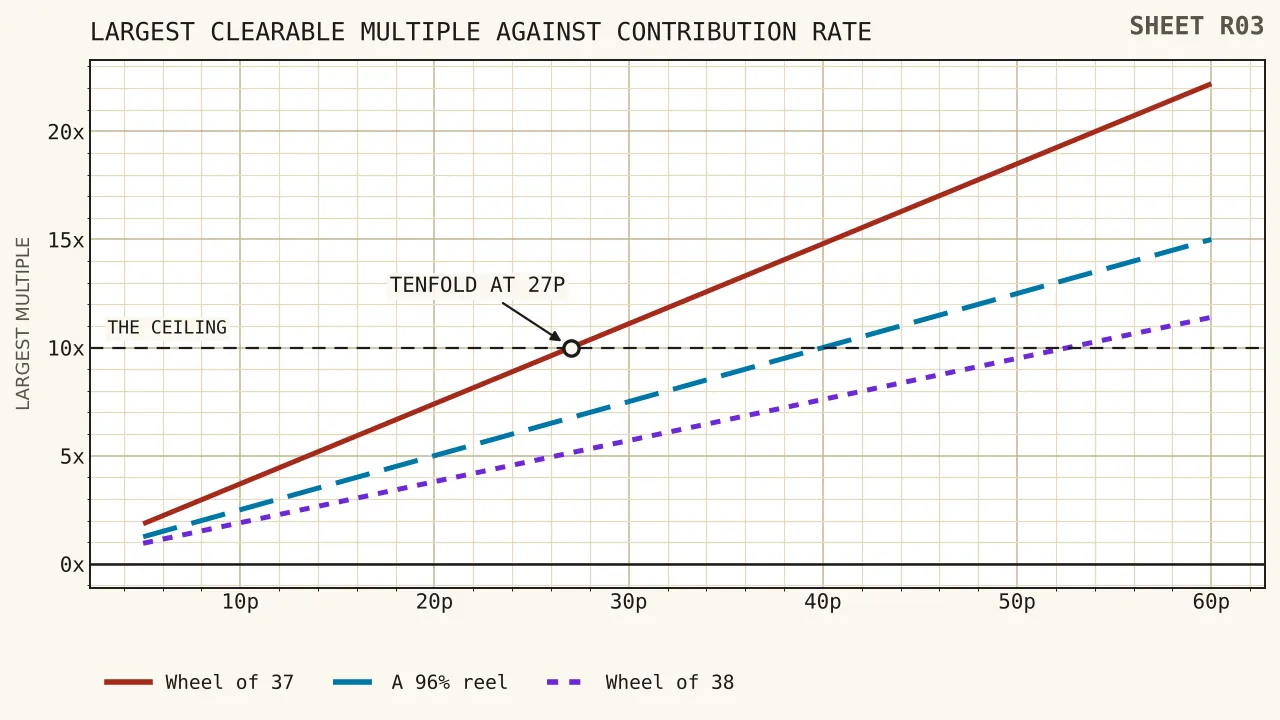
Hold that 5 per cent and redo the crossing arithmetic. The largest multiple a room can carry is the contribution rate divided by the edge. At a 37-pocket wheel counting five pence, that is 0.05 over 0.027027, which is 1.85. At a 38-pocket wheel counting five pence it is 0.05 over 0.052632, which is 0.95. A requirement of one times would exceed the second of those.
| Seat counts a staked pound at | Wheel of 37 | Wheel of 38 | Reel at 96 per cent |
|---|---|---|---|
| 100 pence | 37.00x | 19.00x | 25.00x |
| 40 pence | 14.80x | 7.60x | 10.00x |
| 20 pence | 7.40x | 3.80x | 5.00x |
| 10 pence | 3.70x | 1.90x | 2.50x |
| 5 pence | 1.85x | 0.95x | 1.25x |
The bottom row is the whole page in four figures. Ten times is the heaviest requirement a British licensee may put on bonus funds, and at five pence in the pound no dealt table can carry a fifth of that. The regulated ceiling and the usual contribution rate are not merely in tension. They are a factor of five to ten apart.
One licensee’s schedule is not the market, and this page says so plainly. What the schedule does establish is that the five pence figure is real, published, dated and attached to every live line in one operator’s terms, which is a firmer footing than any sector estimate could have.
5
£67.46 to clear £12.48
Here is the sum the headline hides, done once at each rate. A tenfold requirement on a credit of £12.48 calls for £124.80 of contribution. Contribution is not stake, so divide by the rate to get the staking.
At a hundred pence in the pound the staking is £124.80. At forty pence it is £312.00. At twenty pence, £624.00. At ten pence, £1,248.00. At five pence, £2,496.00. That last figure is 200 times the credit it is clearing, and it is the figure a reader signs up to when a dealt table is the only room open to them.
Then price the staking against the apparatus. £2,496.00 turned over on a 37-pocket wheel is expected to cost £67.46, because the house keeps 2.7027 pence of every pound. On a 38-pocket wheel the same turnover costs £131.37. The credit was £12.48, so the residue is a shortfall of £54.98 at the better wheel and £118.89 at the worse one. Money the reader brought along is what funds either shortfall.
| Contribution rate | Staking owed | Cost at 37 pockets | Cost at 38 pockets | Residue at 37 pockets |
|---|---|---|---|---|
| 100 pence | £124.80 | £3.37 | £6.57 | £9.11 |
| 40 pence | £312.00 | £8.43 | £16.42 | £4.05 |
| 20 pence | £624.00 | £16.86 | £32.84 | short by £4.38 |
| 10 pence | £1,248.00 | £33.73 | £65.68 | short by £21.25 |
| 5 pence | £2,496.00 | £67.46 | £131.37 | short by £54.98 |
Three readings come off that table and each is worth a line. First: the fourth column is always roughly double the third, which is the extra pocket doing its work consistently at every rate. Second: the crossover from residue to shortfall happens between forty pence and twenty pence at the better wheel, so a reader needs a rate above a quarter before a tenfold requirement is survivable at a seat. Third: the ratio between the top and bottom rows of the second column is twenty to one, which is the contribution rate alone, unhelped by anything the apparatus does.
One more division belongs here, because it answers the question a reader actually asks. How large would the contribution rate have to be for a tenfold requirement to leave the credit intact? Divide ten by the crossing multiple at full count. Ten over 37 at the better wheel gives 27.03 pence in the pound. Ten over 25 at a 96 per cent reel gives 40 pence. At a 38-pocket wheel it is ten over 19, or 52.63 pence, which is above any weighting a dealt game is given anywhere. Of the three, then, only the better wheel could survive a tenfold requirement on a rate under two fifths, and it would still need five times the rate one licensee’s schedule gives it.
And the same division run on the house assumption for this site, forty times, gives the figures a reader meeting an offshore requirement needs. Forty over 37 is 108.11 pence in the pound. Forty over 25 is 160 pence. Forty over 19 is 210.53 pence. All three exceed a hundred pence, which is the most any room can count, so a fortyfold requirement cannot be cleared on expectation at any seat or any reel, whatever its weighting. That is the arithmetical reason the tenfold ceiling exists, stated without reference to anybody’s intentions.
That is why the headline on a live-room offer carries so little information. The count sets the credit, the apparatus sets the edge, and the contribution rate sets a multiplier on the staking that is larger than either.
6
Five seconds a round, and what that costs in hours
A seat is measured in time. The gap a licensed casino game outside the reel definition must leave between one cycle and the next is five seconds, peer-to-peer poker excepted, and 17 January 2025 is when that figure took effect. Convert the staking above into rounds and the clock becomes the sharpest condition on the page.
Suppose the reader bets a pound a round. £2,496.00 of staking is 2,496 rounds, which at five seconds apiece is 3 hours 28 minutes of unbroken play, nothing paused and nothing considered. Suppose instead they bet at the same 10p the presses were priced at. Now it is 24,960 rounds and 34 hours 40 minutes.
Set those against a deadline and the requirement either stands or falls on arithmetic alone. A seven-day window accommodates 3 hours 28 minutes easily and accommodates 34 hours 40 minutes only at five hours a day for a week. A twenty-four hour window accommodates the first and cannot accommodate the second at all.
| Bet per round | Rounds owed | At five seconds | Hours a day over a week |
|---|---|---|---|
| £0.10 | 24,960 | 34 h 40 m | 4 h 57 m |
| £0.50 | 4,992 | 6 h 56 m | 59 m |
| £1.00 | 2,496 | 3 h 28 m | 30 m |
| £5.00 | 499 | 42 m | 6 m |
The table contains a trap worth naming. Reading down it, the obvious conclusion is to bet larger and finish sooner, and that conclusion is correct about the clock and silent about the money. Every row owes the identical £2,496.00 of turnover and therefore the identical £67.46 of expected cost at a 37-pocket wheel. Betting five pounds a round does not reduce the price of the requirement by a penny. It compresses the same price into 42 minutes, and it raises the spread around the mean enormously, which is to say it makes both the good and the bad outcomes arrive faster.
One further duty belongs here, with a date. Two figures have had to be shown in real time by a licensed operator since 17 January 2025: time spent gambling, and net spend. A reader grinding 24,960 rounds is who that was written for, and neither figure is owed by a cashier outside the register.
2,496 rounds at £1, or 24,960 at 10p, for the same £67.46 of expected cost
7
No ceiling on a stake at this table
The five pound row above is lawful at a live table in a way it would not be at a reel, and the asymmetry is worth setting out because readers import the reel rule by mistake.
One game cycle carries a cap, set by statutory instrument, on the total an individual may stake into it. Two figures sit in it: £2.00 where the individual has not reached twenty-five, and £5.00 from that age upwards. 25 February 2025 is the date of its making. Commencement arrived in two steps. 9 April 2025 brought in the higher figure. 21 May 2025 brought in the lower. Six transitional weeks lay between them, during which five pounds applied flat across every age.
Those figures reach online slots and stop there. Three features make up the instrument’s definition: played online, reel-based, a casino game. The middle of those three then gets a definition of its own, covering a game where moving or changing images, or text, get displayed by means of reels represented visually or by some other means, the resulting arrangement settling whether a prize, an opportunity or an advantage is won. Online slots only is how the regulator’s guidance puts the scope of the limits, and roulette and blackjack get named as games outside their reach.
So a round at a wheel may carry any stake the cashier permits, and the arithmetic of this page is unaffected in expectation and transformed in spread. At 10p a round the 24,960 rounds owed produce a tightly clustered outcome around a £67.46 loss. At £50.00 a round the same turnover is 50 rounds, the expected cost is still £67.46, and the distribution of what actually happens is no longer a distribution a reader should be relying on.
Price the asymmetry one more way. On a reel, 1,248 presses at the £5.00 ceiling would be £6,240.00 of stake, so the ceiling is not what stops a determined reader; the 2.5 second gap, the absence of autoplay and the absence of turbo are what stop them. At a live table the stake ceiling is absent and the five-second gap is the only brake in the room.
8
One game at a time, and a running total
Two further duties shape a licensed live room, and both are about how many things may happen at once.
The first is in the product design standard and covers casino games with peer-to-peer poker excluded: a gambling system must not offer functionality facilitating play at more than one game simultaneously. The guidance behind it reaches split-screen and multi-screen arrangements and the combining of games in ways that let simultaneous play happen. A wall of four wheels on one screen is the thing being described.
The second arrived on 17 January 2025 and comes at it from the other direction: operator-led functionality for playing multiple products at the same time is banned, and the release announcing it gave roulette and blackjack tables as its example.
Price the pair against the staking in part five. Four seats at once would take 2,496 rounds of £1.00 down from 3 hours 28 minutes to 52 minutes of elapsed time, with the five-second gap intact at each seat. The expected cost would remain £67.46. So what the duty protects is not the money but the pace, and what it costs an operator is the compression of a 3 hour 28 minute obligation into under an hour.
A reader can test any room against that in a second. If the interface will show more than one dealt game live and accept a bet at each, something is wrong with the licence position of the room, and the arithmetic above is the reason it would be offered: a requirement that takes 34 hours 40 minutes at 10p a round is unsellable, and the same requirement across four seats is merely tedious.
One quieter duty belongs with these. Shortening the wait before a result appears is something a licensed system may not permit a customer to do. Three features are named as impermissible in the guidance: slam stop, quick spin, turbo. It is written for reels and it matters at a table too, because the live room’s only brake is time.
9
The same seat with no register behind it
Everything above is a licensed seat. Take the register away and the duties come off one at a time. Converting each into the currency of this page, which is minutes at a five-second table and pounds against a £12.48 credit, is the only way to show what the removal is actually worth.
| Carried by a British licence | Gone without one | Worth, on this page’s figures |
|---|---|---|
| Ceiling of ten times on bonus funds | The multiple may run to any figure | £7.49 of residue turns into a £7.49 shortfall at fortyfold |
| Five seconds between cycles | Rounds may follow each other at will | 3 h 28 m of protected pace removed from 2,496 rounds |
| One dealt game at a time | Seats may be stacked on one screen | A 3 h 28 m obligation compresses to 52 m across four seats |
| No shortening of a result | A round may be hurried to its answer | The only brake on £2,496.00 of staking is removed |
| Net spend and time shown live | Neither figure need appear | £67.46 of expected cost accrues unlabelled |
| One product type per incentive | Reels and tables may share one condition | A reel credit may be sent to a five pence seat by its own terms |
| Identity before any play | No name, address or birth date needed first | £13.00 of stake laid by an unverified account |
| Credit card refused | Borrowing may fund the seat | £2,496.00 of turnover available on credit |
| Financial limit as the default | No prompt, no cooling-off on an increase | Nothing stands in front of 24,960 rounds |
| Withdrawal stands once asked | A cancel button may be offered | £9.11 of residue may be returned to the table |
| Deposit balance uncapped | A term may limit what leaves | The reader’s own stake becomes conditional |
| Outcomes acceptably random | No prohibition on a compensated game | 36 over 37 stops being a reliable input |
| No near miss substituted | A loss may be dressed as an almost | 2.7027 pence of edge reads smaller than it is |
| Eight weeks and an adjudicator | No clock, no approved name at the end | A disputed £9.11 has no route |
| National self-exclusion scheme | Membership is nobody’s obligation | An excluded reader is reachable, with the count as bait |
Set the Curaçao rulebook against that ledger, because much of this market sits under it. Version 1.0 of its responsible gaming policy carries 21 February 2025. Searched for a ceiling over a wagering multiple it returns nothing. Searched for a cash limit on a stake, nothing. For a floor under a game cycle, nothing. For a bar on automatic repetition, nothing. For a bar on celebrating a return that has not beaten the stake, nothing. Two sentences cover bonuses in that document. One wants them communicated transparently, with conditions made clear. The other forbids aggressive promotion of the sort that would drive excessive play.
Two lines of that rulebook are the stricter ones and leaving them out would be dishonest. A reduction to a deposit limit takes effect immediately, while a rise is held for seven days, where the British holding period is at least a day. Complaints are where the two regimes nearly coincide. 26 weeks for a player to bring one, four weeks in which to answer, four more on a written extension, and an obligatory adjudication the operator pays for.
A word on what cannot be said here. The randomness requirement is the one row of the ledger that makes the arithmetic of parts two and three usable at all, since 36 over 37 is a statement about a fair wheel. Where that requirement is absent, this page can say only that the figure loses its guarantee. Beyond that it is silent about any particular unlicensed room, there being no primary source within reach that publishes such a thing, and a figure made up to plug the gap would be worse than an open gap.
One published outcome shows the regulator pricing the overlap between licensed suppliers and unlicensed sites. Games supplied by Evolution Malta Holding Limited turned up on six unlicensed websites that consumers in Great Britain could reach. £4.75m is what it agreed to pay, and 23 July 2026 carries the agreement. Large volumes of visits are what the release records across the months from December 2023 through to November 2024. Three findings: customer due diligence; the assessment of risk around terrorist financing and money laundering; and whatever controls ought to have held its games back from a British market served by unlicensed operators. The practical lesson for a reader at a live table is narrow and useful: a familiar studio logo above a wheel is not evidence of a licence underneath it.
Questions
- Can I spend free spins at a live table?
- Usually not, because a press is a reel instrument: it is a funded press of a reel’s start control and it does not convert into a bet on a layout. The live room enters the arithmetic the other way round, when whatever the presses win carries a turnover requirement that the live room is allowed to serve. That credit is £12.48 here: 130 presses, 10p each, a reel giving back 96 pence per pound.
- Why can a wheel’s return be worked out when a reel’s cannot?
- Because the rules of the apparatus contain it. Count the pockets, read the prices, divide. A single number on a wheel of 37 wins once in 37 and pays back 36 times the stake, which gives 97.2973 pence in the pound. A reel’s return belongs to a build instead, and the disclosure duty there can be met with the margin, with how likely the winning events are, or with an account of the workings, none of which is a percentage.
- How much does one extra pocket cost me?
- The house keeps 2.7027 pence per pound on 37 pockets and 5.2632 pence on 38, so the second wheel is 1.95 times as expensive. On £13.00 of stake the difference is £0.33. On the £124.80 of turnover a tenfold requirement produces it is £3.20. The crossing multiple falls from 37 times to 19 times, which puts a 96 per cent reel between the two wheels.
- What does five pence in the pound do to a tenfold requirement?
- It multiplies the staking by twenty. £124.80 of contribution becomes £2,496.00 of staking, which is 200 times the £12.48 credit it is clearing. On a 37-pocket wheel that turnover is expected to cost £67.46, leaving a shortfall of £54.98. On a 38-pocket wheel it costs £131.37 and the shortfall is £118.89.
- What is the largest requirement a live seat can actually clear?
- Divide the contribution rate by the house edge. At five pence in the pound a 37-pocket wheel carries 1.85 times and a 38-pocket wheel carries 0.95. Ten times is the heaviest a British licensee may put on bonus funds, so at the usual live rate no dealt table carries a fifth of the lawful maximum.
- Does the five pound stake cap apply at a live table?
- No. Both cash figures belong to online slots. Three features make up the instrument’s definition of those: a casino game, reel-based, played online. Among the games the regulator’s guidance keeps outside the limits, roulette and blackjack are named. The instrument’s making date was 25 February 2025, with £5.00 commencing 9 April 2025 and £2.00, for anybody under twenty-five, on 21 May 2025.
- How long does a live requirement take in real time?
- Five seconds is the shortest gap a licensed casino game outside the reel definition may leave between cycles, in force from 17 January 2025. So £2,496.00 of staking is 2,496 rounds and 3 hours 28 minutes at £1.00 a round, or 24,960 rounds and 34 hours 40 minutes at 10p. Betting larger shortens the clock and leaves the expected cost of £67.46 exactly where it was.
- Should I bet bigger to finish the wagering faster?
- The clock improves and the money does not. Every stake size in part six owes the same £2,496.00 of turnover and therefore the same £67.46 of expected cost at a 37-pocket wheel. What rises with the stake is the spread around that figure, which means the good and the bad outcomes both arrive sooner. Nothing on this page is advice to do either.
- Why can a licensed room only show me one dealt game at a time?
- Two duties say so. The product design standard bars a gambling system from offering functionality that facilitates play at more than one game simultaneously, covering split-screen and multi-screen arrangements, for casino games with peer-to-peer poker excluded. The second arrived on 17 January 2025 as a ban on operator-led functionality for simultaneous play across products, illustrated in the release by tables of blackjack and roulette. Four seats would cut a 3 hour 28 minute obligation to 52 minutes without touching the £67.46.
- What is lost at a seat with no British licence behind it?
- Every row of part nine’s ledger, all fifteen, priced in pounds and in minutes. A seat with no Great Britain licence behind it loses the tenfold ceiling over the multiple, rounds need not leave five seconds between them, seats may be stacked, a result may be hurried, net spend need not be shown live, identity need not be checked before £13.00 is staked, a credit card may fund £2,496.00 of turnover, and a disputed £9.11 has no clock and no approved adjudicator behind it. The randomness duty is the one that matters most to the arithmetic here, because 36 over 37 is a statement about a fair wheel.