Sheet D19 Revision 1 Counted 16 October 2026
5 free spins no deposit: forty-eight pence, and the paperwork it costs
Five pulls at 10p is 50p of staking, and the average handed back by a game returning 96 per cent is £0.48. That is the smallest sum this site prices. The arithmetic takes one line, so most of this sheet is about the other side of the trade: what a reader hands over to collect 48p, and which rules govern whoever is collecting it.
Pulls given 5 One pull 10p Mean 48p
What a count of this size comes to
Every destination on this board is bought advertising. The site takes a fee if a reader goes on to register, and no figure printed below moves because of it.
The Spin Count
Gauge No 01
Betportal
Lowest multiple here
Priced at this site's own 10p a spin
What is counted
What is asked
No Great Britain licence
Licensed in Anjouan, Comoros, run by BetPortal Gaming Ltd, with Excite Ultra Media Ltd, reference ALSI-202601040-FI2.
Terms read 16 October 2026
Open the offer at Betportal, opens in a new tabThe Spin Count
Gauge No 02
WinBeast
Largest count here
Priced at this site's own 10p a spin
What is counted
What is asked
No Great Britain licence
Licensed in Curaçao, operator not named on the site.
Terms read 16 October 2026
Open the offer at WinBeast, opens in a new tabThe Spin Count
Gauge No 03
EliteSpin
Longest spin window
Priced at this site's own 10p a spin
What is counted
What is asked
No Great Britain licence
Licensed in Costa Rica, run by PrimeTier Limited.
Terms read 16 October 2026
Open the offer at EliteSpin, opens in a new tabThe Spin Count
Gauge No 04
Crown Jewelz
Multiple unpublished
No foot figure struck
What is counted
What is asked
No Great Britain licence
Licensed in Curaçao, number not verified, operator not named on the site.
Terms read 16 October 2026
Open the offer at Crown Jewelz, opens in a new tabThe figure in the third register is this site's own arithmetic and nothing an operator has published: the count at face, less the share a spin gives back at 96 per cent return to player, less what playing the wagering through costs at the same return. It describes the offer, not one reader's afternoon. Where the conditions price above the count the counter prints nothing rather than a negative sum, and where a figure the sum needs is unpublished it prints the condition in the operator's words instead.
A count has no unit of its own, so one is supplied. Where an operator publishes what a spin of its own is worth, that figure stands in the second register and is labelled as theirs. Where it does not, the second register carries this site's own 10p a spin and says so, and the foot figure moves in proportion: at half the price, half the money. The figure after it, what the count comes to for each spin, is the one that compares a large count against a small one.
Three words stand in the amount column where no figure can. Noted is a published condition that takes value away without leaving the sum a figure to take. Unpriced is a condition whose figure nobody has published, or a credit that is not a sum until a deposit of your own sets it. Own money is money of yours, which is never part of a foot figure.
Not one of the operators printed above holds a Great Britain licence, so the duties that licence carries do not reach them. Every online gambling company licensed in Great Britain has to be part of Gamstop Online, and a reader who has shut themselves out through the scheme is therefore not shut out here. The ceiling of ten times the bonus funds on a wagering requirement, in force since 19 January 2026, is a condition of that licence and binds the companies that hold one. Where a dispute goes instead is a matter for the authority named on the counter, and the Gambling Commission describes what a reader faces without a British licence as a lack of recourse if things go wrong. Nobody under 18 may hold an account at any of them.
Every term printed on a counter is the operator's own, and each counter carries the day it was read. The oldest of those readings is 16 October 2026. What binds a reader is the operator's own full terms, and not a line printed here.
1
Five pulls, and one line of arithmetic
Five is the smallest tally advertised often enough to need a page. The sum is 5 times 10p times 0.96, and the answer is £0.48. Face value is 50p. The 2p difference is the house edge on 50p of turnover, which is as small as the edge ever gets in absolute terms and exactly as large as always in proportional ones.
A mean of 48p has an unusual property worth stating: on five pulls, the median outcome is almost certainly nil. Slot payouts concentrate in rare large results, so a five-pull sample will most often return nothing at all, with the 48p average carried by the small chance of a feature. A reader should take 48p as what five pulls are worth across thousands of repetitions, and nothing as the likeliest single outcome.
That makes five pulls the clearest case on the site of a tally whose arithmetic is trivial and whose terms are everything. There is no realistic wagering requirement to model, because a 48p balance times ten is £4.80 of turnover, which is 48 further pulls. There is no realistic ceiling, because almost any printed ceiling sits above 48p. What is left is the paperwork, the time, and the question of who is standing behind the award.
| Quantity | Figure |
|---|---|
| Staking funded | £0.50 |
| Expected back at 96 per cent | £0.48 |
| House edge over the five | £0.02 |
| Per pull, in expectation | 9.6p |
| Shortest lawful run | 12.5 seconds |
| Tenfold turnover on the mean | £4.80, or 48 pulls |
Both assumptions behind that table are declared and neither is a rule. A pull costs 10p here; a game returns 96 pence in the pound here. Three things are missing from every source reachable: what a free pull is worth, who sets the figure, and whether it has to be disclosed. So the figure is stated rather than implied, and a reader with a 20p award doubles every money row.
2
The pence, which are the whole offer
On a tally of five, the price of a pull is not one factor among several. It is the offer. Five pulls can be worth 10p or £4.80 depending on a figure that rarely appears in the headline, and the ratio between the extremes is fifty to one.
| One pull costs | Staking | Expected |
|---|---|---|
| 2p | £0.10 | £0.10 |
| 5p | £0.25 | £0.24 |
| 10p | £0.50 | £0.48 |
| 20p | £1.00 | £0.96 |
| 50p | £2.50 | £2.40 |
| £1 | £5.00 | £4.80 |
| £5, the slot stake ceiling | £25.00 | £24.00 |
The bottom row is a legal boundary rather than a market observation. On a British licence the total staked in one slot game cycle has a ceiling of £5, falling to £2 for an individual who has not reached 25. Those limits were carried by regulations made on 25 February 2025, while the commencement dates are the regulator’s: the larger figure from 9 April 2025, the smaller from 21 May that year. So the largest five-pull award a licensed slot can lawfully deliver is £24.00 of expectation for a reader over 25, and £9.60 for one under it.
Two cautions on those limits. They apply to online slots only and not to other casino games, which the regulator states in terms. The instrument prints no calendar date at all. Six weeks from the day of making is how it expresses commencement, and a further transitional six weeks put the same five pound ceiling on everybody. So the two dates belong to the guidance and should be attributed there.
Five pulls: 10p at the bottom of the band, £24.00 at the regulated top
3
Every threshold is out of reach
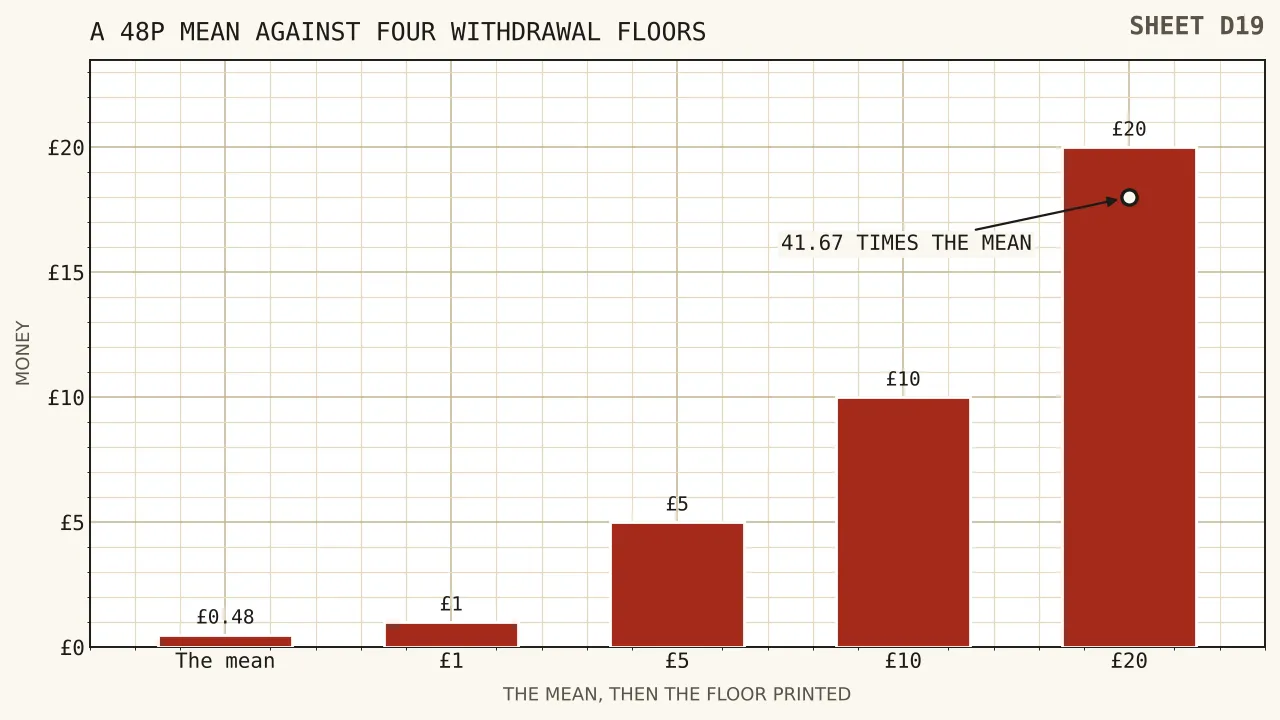
A smallest-payout rule decides a five-pull award before the reels turn. The mean is 48p, so the multiple of the average a reader needs is the threshold divided by 0.48, and the answers are large.
| Threshold | Times the mean required | Pulls that would reach it on the mean |
|---|---|---|
| £1.00 | 2.08 | 11 |
| £5.00 | 10.42 | 53 |
| £10.00 | 20.83 | 105 |
| £20.00 | 41.67 | 209 |
The right-hand column is the useful one. It converts a threshold into the tally that would reach it without luck, and every figure in it is larger than five by at least a factor of two. A five-pull award under a ten pound withdrawal threshold is twenty-one times short on the average, and a reader needs a result in the top fraction of the distribution for any money to move at all.
That is not a hidden term and it is not unlawful. It is two numbers in one document whose product is a promotion that pays nothing in the ordinary case. Players are told, in the consumer guidance, to watch for restrictions on an introductory offer, the example being a spending threshold that has to be met before the bonus arrives. A grammatical slip runs through that sentence in the original, so paraphrase serves better than quotation.
A ceiling on the winnings behaves differently at this tally and is usually irrelevant. The expectation grows 9.6p a pull, reaching 48p at the fifth and stopping there. Any ceiling above 48p leaves the expectation untouched. Only a ceiling of 48p or less has any effect, and a cap pitched that low is seen less often than one pitched high.
4
What 48p costs in paperwork
The honest way to price a five-pull award is as a trade. One side is 48p of expectation. The other side is an account, a set of identity details, and a marketing relationship, and on a British licence each of those has a published rule attached.
Identity comes first and it comes before any play. Before a customer gambles, the licensee has to get hold of the information that establishes who they are, and verify it. Three items are fixed as the floor: a name, the address they live at, the date they were born. It says the information is not restricted to them. Bonus-funded play falls inside that duty, as does play on a free bet, and so do the versions of a licensee’s games where nothing is at stake, since access to any of them sits behind the age check. The customer also learns, ahead of any deposit, what may be wanted by way of documents, the point at which it might be wanted, and the means of providing it.
What may be requested is not fixed. Three examples appear on the regulator’s consumer page, those being household bills, driving licences and passports, and it states that the choice of document is not one it specifies. A payout held up for want of sufficient identity information puts the operator, on that page’s own wording, into possible breach of the identity condition. Two dates sit on it, a publication in September 2020 on the twenty-third and a last update in April 2022 on the thirteenth, which makes it older than the condition it describes.
Marketing is the second half of the trade and has its own rule with its own date. Marketing direct to a customer, where online gambling is the subject, needs an opt-in gathered for each channel and for each type of product separately. 1 May 2025 is when that began to bind. That date moved once during implementation, and the regulator’s release puts the change on the record, the requirement having been shifted off 17 January 2025 and onto the May date. The January date should never be attached to this rule. A separate code provision on direct electronic marketing wants consent that is both informed and specific before any consumer is contacted by that route, unless the law expressly permits it.
Set against 48p, those rules are the real content of a five-pull offer. A reader is handing over three verified identifiers and a contactable address in exchange for an expected 48p, and the only thing that makes the exchange a regulated one rather than a private arrangement is the licence on the other side of it.
5
Twelve and a half seconds
Twelve and a half seconds is what five pulls occupy at the lawful floor, 2.5 seconds being the least that may separate the start of one game cycle from the start of the next. Twelve and a half seconds is the shortest honest estimate of how long the award lasts.
Three rules hold that figure down, and on a tally this small they are the difference between an award and a reflex. Each cycle requires the start control to be released and depressed again, or an equivalent action, so nothing advances while a button is held. Every cycle takes its own commitment from the customer, which is what the prohibition on automatic play amounts to when written as a duty. And features that cut the time until a result appears are not permitted at all.
One more design rule matters more at five pulls than at five hundred. Celebration is barred where a return comes in no higher than the total stake, so 4p back on a 10p pull cannot arrive dressed as a win in sound and vision. On a five-pull award, where most results are losses and small returns, that rule is most of what separates an accurate display from a misleading one.
The near-miss prohibition sits alongside it. Also prohibited is any design or feature that might reasonably be expected to mislead about how likely a result is, and two are named. A real device may not be simulated at probabilities it does not have. Nor may a near-miss losing event be swapped in where an ordinary one belongs. Across five pulls a reader has a sample far too small to detect either, which is precisely why the rule exists rather than being left to the market.
12.5 seconds of play, three identifiers, one marketing consent, 48p of expectation
6
Who commits an offence, and who does not
Small awards are the usual bait on sites without British authorisation, so a reader should know where the law puts the liability. It sits with whoever provides the facilities.
Under section 33(1) a person commits an offence by providing facilities for gambling unless an exception applies, and the first exception listed is holding an operating licence that authorises the activity and carrying it on within the terms and conditions of that licence. Section 33(4) carries the penalty: imprisonment for up to 51 weeks, a fine at standard scale level 5, or both at once, and those 51 weeks read as six months north of the border.
No parallel offence for the customer appears anywhere in the Act. The provider is addressed from one end of the section to the other, which lets a page state that the statutory liability belongs to the operator. What a page may not then do is call an unlicensed site safe. The thing forfeited out there is protection, and the rest of this sheet counts it up.
Reach is dealt with twice over. Section 36(1) makes it immaterial whether the facilities are provided from inside the United Kingdom or from outside. Section 36(3) then catches remote gambling in two situations: one piece of the remote gambling equipment standing in Great Britain, or none of it standing here while the facilities get used here. Section 36(3A) attaches a knowledge test to that second situation, and it bites on a person who knows, or who ought to know, of use here that is either happening already or likely. Those subsections arrived by substitution under the 2014 Act on licensing and advertising, effective for specified purposes from 1 November 2014, and equipment on British soil had been the only route in before them.
Advertising carries an offence of its own at section 330(1), committed by a person who advertises unlawful gambling. Unlawful, for that purpose, covers gambling which could not take place as advertised without an offence under the Act unless some licence, notice, permit, registration or exception were in place, and it is not. Three limits are published alongside. A reasonable belief in the lawfulness of the gambling is a defence for conduct within two of the limbs of section 327(1). For a third limb, knowledge of unlawfulness, actual or constructive, is needed. And carrying a communication as a transmission business, with no control over its content, is not by itself the offence. Section 330(8) makes every day of a display its own offence. Commencement fell on 1 September 2007, and the published text is current to changes in force on or before 14 October 2026.
7
What the regulator says about the other side
A 48p award is cheap to give away, which is why it is often given away by sites that have nothing else to offer. The regulator publishes its own account of what such a site means, and it is worth reading in its own words rather than in a summary.
Acting illegally is how its consumer page describes any gambling business trading without a Gambling Commission licence, and two consequences are named there. One is action by the regulator against the operator. The other is the withdrawal of payment facilities by the major payment systems organisations, with MasterCard the example given. Four checks are put to a player on the same page. Is a British licence held? Is the licensed status displayed? Does the click through to the register work? And do the licence details, activities and domain names among them, agree with what the register says?
A blog post dated 21 October 2025 goes further, quoting its Director of Enforcement and Intelligence. Three absences are listed for unlicensed sites: payment systems that are secure, tools for gambling responsibly, and checks on age. Three things consumers face in consequence are listed too: unfair gaming practices, loss of money, and nowhere to turn when matters go wrong. Two withdrawal failure modes appear in the same post: a payout simply blocked, and a withdrawal limit pitched at a level nobody reaches. Serious data protection concerns are recorded as well, with identity theft and fraud as the risks named.
Two sentences in it guard against overstatement in either direction. On scale, the regulator accepts that the revenue involved makes full dismantling of the ecosystem unlikely. On effect, traffic across the 160 websites it had targeted for enforcement is reported down by 32 per cent. Global in scale, driven digitally and increasingly sophisticated is how the post describes that market, and it attaches no revenue figure.
The register is the check that costs a reader nothing. The regulator publishes registers of licensed businesses, individuals, regulatory actions and premises, each searchable and downloadable, along with public statements and freedom of information requests. The register page shows neither a date nor instructions for reading it, so a page built on register data has to publish the date it looked, rather than implying an interpretation the regulator never gave.
8
Forty-eight pence, two rulebooks
Awards of five pulls are given away hardest beyond Britain, by a cashier that has no Great Britain licence behind it. The arithmetic does not move: 48p is 48p under any flag. What moves is every rule in parts four, five and six, because each of them attaches to the licence and not to the website.
| On a five-pull award | British licence | No British licence |
|---|---|---|
| Identity before the first pull | three identifiers verified first | a declared age at the gate, documents at a later milestone |
| Marketing after sign-up | opt-in by product and by channel since 1 May 2025 | no published equivalent |
| Stake in one slot cycle | £5 at most, falling to £2 below 25 | no published limit |
| Pace of a cycle | 2.5 seconds minimum spacing | no figure in the rulebook |
| A 4p return on a 10p pull | may not be celebrated as a win | unaddressed |
| Near-miss display | prohibited by name | unaddressed |
| Statutory offence | not in issue, the licence authorises the activity | on the provider under section 33, not on the customer |
That last column comes out of the offshore document rather than out of assumption. Take the policy on responsible gaming that the Curaçao authority issues, numbered version 1.0 and dated to 21 February 2025. A stake limit is not in it. Neither is a minimum interval between cycles. Automatic play goes unmentioned, so does turbo, and nothing restricts how a small return may be dressed up. What it does make mandatory runs to eight items: age verified; information kept within reach; players able to self-assess; behaviour tracked; cooling-off and exclusion left in the hands of the player; limits on deposits; training that has to reach marketing partners, influencers, affiliates and staff; and general principles covering marketing.
On age it is weaker in a specific way that matters to a tiny award aimed at new accounts. Neither depositing nor wagering is to be possible there until the operator has satisfied itself about a player being 18 or more. At registration the work is done by a confirmed date of birth, and three supports are named for use where practicable: an open-source check, a box the player ticks, and the payment method confirmed. A document check waits for a later milestone, fixed by the authority’s policies on customer knowledge and on money laundering, and is pulled forward only where doubt about a player’s age arrives before it.
Two of its provisions run the other way. A deposit limit comes down immediately out there, and goes up only after seven days, against one day as the British floor. Affiliates, too, are put on the operator, to be held in line by contracts that bind, audits of compliance and penalties for failing them, and the British advertising guidance written for operators goes no distance at all into that.
The loss that cannot be priced is the national self-exclusion scheme, membership of which is a condition of a British licence. The scheme publishes the boundary itself: participating operators are its reach, and an organisation outside it is beyond any help the scheme can give. Out there an exclusion goes in at a single operator, across whatever domains that operator holds, and repeating the exercise elsewhere is what the policy encourages. No sentence on this page is of use to anybody trying to get round an exclusion, and the free helpline printed below answers at any hour. For 48p of expectation, that is the trade set out in full.
Questions
- What are 5 free spins worth?
- £0.48 on average, from 50p of staking, at 10p a pull and a 96 per cent return. Both figures are declared assumptions rather than published rules. Across five pulls the likeliest single result is nothing, since slot returns bunch into rare large outcomes, which makes 48p an average over many repetitions rather than a forecast.
- Is a five-spin award ever worth more than that?
- Only if the pull is priced higher. At 20p the same five pulls average 96p, at £1 they average £4.80, and at the £5 slot stake ceiling they average £24.00. A customer under 25 is capped at £2 a slot cycle on a British licence, which puts the same five pulls at £9.60.
- Can I withdraw 48p?
- Almost never. Dividing a threshold by 0.48 gives the multiple of the average needed: 2.08 times for a one pound threshold, 10.42 times for five pounds, and 20.83 times for ten. The right way to read those figures is that a ten pound threshold would be met on the mean by 105 pulls, and the award is five.
- What am I actually giving up to collect it?
- An account, three verified identifiers and a contactable address. A British licensee obtains and verifies three identifiers, the name, the postal address and the date of birth, and does all of it before any gambling. Play funded by a bonus is covered, so is play on a free bet, and so are the versions of its own games that carry no prize. In advance, the customer also hears which documents might be wanted and by what route to send them.
- Will I be marketed to afterwards?
- Only with consent, on a British licence. An opt-in is needed for direct marketing of online gambling, taken by channel and by product type, binding from 1 May 2025 and not from the January date that stood earlier in the timetable. A separate code provision requires informed and specific consent before a consumer is contacted by direct electronic marketing at all.
- How long do five free spins take?
- 12.5 seconds, that being the fastest a licensed slot is allowed to deliver five cycles when 2.5 seconds separate each from the last. Each cycle needs the control let go of and depressed afresh, a commitment is taken every single time, and no feature may cut short the wait for a result.
- Does playing at an unlicensed site make me a criminal?
- The offence belongs to the provider. Section 33 makes the provision of gambling facilities an offence unless an operating licence authorises the activity and its conditions are kept, and section 33(4) allows 51 weeks of imprisonment, a level 5 fine on the standard scale, or both together. Taking part as a customer is not an offence anywhere in the Act. Protection is what a reader forfeits on an unlicensed site, not liberty.
- Does an offshore site have to care that I am in Britain?
- Location of the facilities is immaterial under the Act. Remote gambling is caught where some of the equipment stands in Great Britain, and caught again where none of it does but the facilities are used here. Knowledge governs the second route, which applies to a person aware, or properly expected to be aware, of use in Great Britain, whether actual or likely. Effect came for specified purposes on 1 November 2014.
- What does the regulator say about sites without a licence?
- That trading without a Gambling Commission licence is illegal; that action against the operator is open to it; and that the major payment systems organisations may pull a business’s payment facilities. Its enforcement blog adds a shortage of age verification, of responsible gambling tools and of secure payment systems, and lists a blocked payout and an unreachable withdrawal limit among the failures it has seen.