Sheet W16 Revision 1 Counted 16 October 2026
Crypto casino no deposit bonus: no payment in, and the charge waits at the exit
Priced at 10p each, fifty spins put £5.00 through a reel set, and a 96 per cent return brings £4.80 of it back on average. Put a ten-times condition on that and £2.88 is what the arithmetic leaves. A flat transfer charge of £1.20 on the way out is 41.7 per cent of it, which is the largest share any rail takes anywhere on this site.
The count 50 spins One spin 10p Comes to £2.88, then £1.68 after the exit
What a no-deposit count comes to at the exit
Every destination on this board is bought advertising. The site takes a fee if a reader goes on to register, and no figure printed below moves because of it.
The Spin Count
Gauge No 01
Betportal
Lowest multiple here
Priced at this site's own 10p a spin
What is counted
What is asked
No Great Britain licence
Licensed in Anjouan, Comoros, run by BetPortal Gaming Ltd, with Excite Ultra Media Ltd, reference ALSI-202601040-FI2.
Terms read 16 October 2026
Open the offer at Betportal, opens in a new tabThe Spin Count
Gauge No 02
WinBeast
Largest count here
Priced at this site's own 10p a spin
What is counted
What is asked
No Great Britain licence
Licensed in Curaçao, operator not named on the site.
Terms read 16 October 2026
Open the offer at WinBeast, opens in a new tabThe Spin Count
Gauge No 03
EliteSpin
Longest spin window
Priced at this site's own 10p a spin
What is counted
What is asked
No Great Britain licence
Licensed in Costa Rica, run by PrimeTier Limited.
Terms read 16 October 2026
Open the offer at EliteSpin, opens in a new tabThe Spin Count
Gauge No 04
Crown Jewelz
Multiple unpublished
No foot figure struck
What is counted
What is asked
No Great Britain licence
Licensed in Curaçao, number not verified, operator not named on the site.
Terms read 16 October 2026
Open the offer at Crown Jewelz, opens in a new tabThe figure in the third register is this site's own arithmetic and nothing an operator has published: the count at face, less the share a spin gives back at 96 per cent return to player, less what playing the wagering through costs at the same return. It describes the offer, not one reader's afternoon. Where the conditions price above the count the counter prints nothing rather than a negative sum, and where a figure the sum needs is unpublished it prints the condition in the operator's words instead.
A count has no unit of its own, so one is supplied. Where an operator publishes what a spin of its own is worth, that figure stands in the second register and is labelled as theirs. Where it does not, the second register carries this site's own 10p a spin and says so, and the foot figure moves in proportion: at half the price, half the money. The figure after it, what the count comes to for each spin, is the one that compares a large count against a small one.
Three words stand in the amount column where no figure can. Noted is a published condition that takes value away without leaving the sum a figure to take. Unpriced is a condition whose figure nobody has published, or a credit that is not a sum until a deposit of your own sets it. Own money is money of yours, which is never part of a foot figure.
Not one of the operators printed above holds a Great Britain licence, so the duties that licence carries do not reach them. Every online gambling company licensed in Great Britain has to be part of Gamstop Online, and a reader who has shut themselves out through the scheme is therefore not shut out here. The ceiling of ten times the bonus funds on a wagering requirement, in force since 19 January 2026, is a condition of that licence and binds the companies that hold one. Where a dispute goes instead is a matter for the authority named on the counter, and the Gambling Commission describes what a reader faces without a British licence as a lack of recourse if things go wrong. Nobody under 18 may hold an account at any of them.
Every term printed on a counter is the operator's own, and each counter carries the day it was read. The oldest of those readings is 16 October 2026. What binds a reader is the operator's own full terms, and not a line printed here.
1
Nothing in, and a charge at the far end
Every other sheet in this section begins with a payment and takes something off it. This one has no payment to take anything off, because a count handed over before any money moves is a count that arrives for nothing. The journey is therefore one-legged, and the charge waits at the end of it.
That changes the arithmetic in a way worth stating up front. A toll on a deposit is a percentage of a sum the reader chose. A toll at the exit is a percentage of whatever the count happened to produce, and a no-deposit count produces very little by design. The denominator is small, the numerator is fixed, and the resulting share is the biggest on this site.
Work it through once here and in detail later. Take fifty spins. Priced at 10p each they put £5.00 through a reel set, and where that set returns 96 per cent the average coming back is £4.80. Apply a condition of ten times and expectation leaves £2.88. Take a flat £1.20 off to move the money out, and £1.68 is what reaches the reader.
So the rail has taken 41.7 per cent of the expected proceeds without ever appearing in the headline. Nothing in the offer was misdescribed. A charge that would be trivial against a deposit is enormous against a balance built out of nothing, and arithmetic is the only thing that reveals it.
An offer of this shape stands behind no Great Britain licence, and what that absence does to the £2.88 occupies the rest of this sheet. One figure summarises it: ten times is the ceiling a licensed desk may put on a staking condition, and where that ceiling does not reach, the same £4.80 at a condition of twenty-five times is worth exactly nothing.
The £1.20 exit charge used here is a working figure for a transfer, chosen because it divides cleanly, and no network publishes a figure this site could cite. Three house assumptions sit underneath the rest: ten pence as the price of a spin, a return of 96 per cent over the long haul, and no weighting reducing what a staked pound contributes. No regulator publishes any of the three, and part six sets out what else nobody publishes about a spin.
2
What fifty spins are worth before any charge
A count stays a bare number until the worth of one of them is supplied, and that holds twice over where no money changed hands. Fifty spins is a number. Fifty of them priced at 10p is £5.00 going through the reels, and £5.00 through reels returning 96 per cent brings £4.80 back on average.
What happens next is decided by the condition attached, and the arithmetic has one crossing point. Each trip of a pound through a reel set costs 4p, so twenty-five trips use the pound up. A condition of twenty-five times therefore leaves nothing at all, whatever the count was, and any condition above twenty-five leaves less than nothing.
| Condition on the winnings | Staking it requires | Expected cost of that staking | What is left of £4.80 | In spins at 10p |
|---|---|---|---|---|
| None at all | nothing | nothing | £4.80 | 48 |
| Five times | £24.00 | 96p | £3.84 | 38.4 |
| Ten times | £48.00 | £1.92 | £2.88 | 28.8 |
| Twenty times | £96.00 | £3.84 | 96p | 9.6 |
| Twenty-five times | £120.00 | £4.80 | nothing | 0 |
| Thirty times | £144.00 | £5.76 | 96p against the reader | below nought |
| Forty times | £192.00 | £7.68 | £2.88 against the reader | below nought |
Three rows there deserve naming. Ten times is the ceiling a licensed desk may apply to a staking condition; the date it took effect is 19 January 2026; what it leaves is £2.88. Twenty-five is where the arithmetic crosses nothing. Forty, a figure found where the ceiling does not apply, means a reader who clears the condition has worked through £192.00 of staking in order to be £2.88 worse off than if they had stopped.
The time involved is measurable too, because a licensed reel game holds 2.5 seconds open before the following cycle may start. Fifty spins occupies 2 minutes 5 seconds. The £48.00 of staking a ten-times condition requires is 480 cycles of 10p and 20 minutes. At forty times it is 1,920 cycles and 1 hour 20 minutes, for a result £2.88 below where it started.
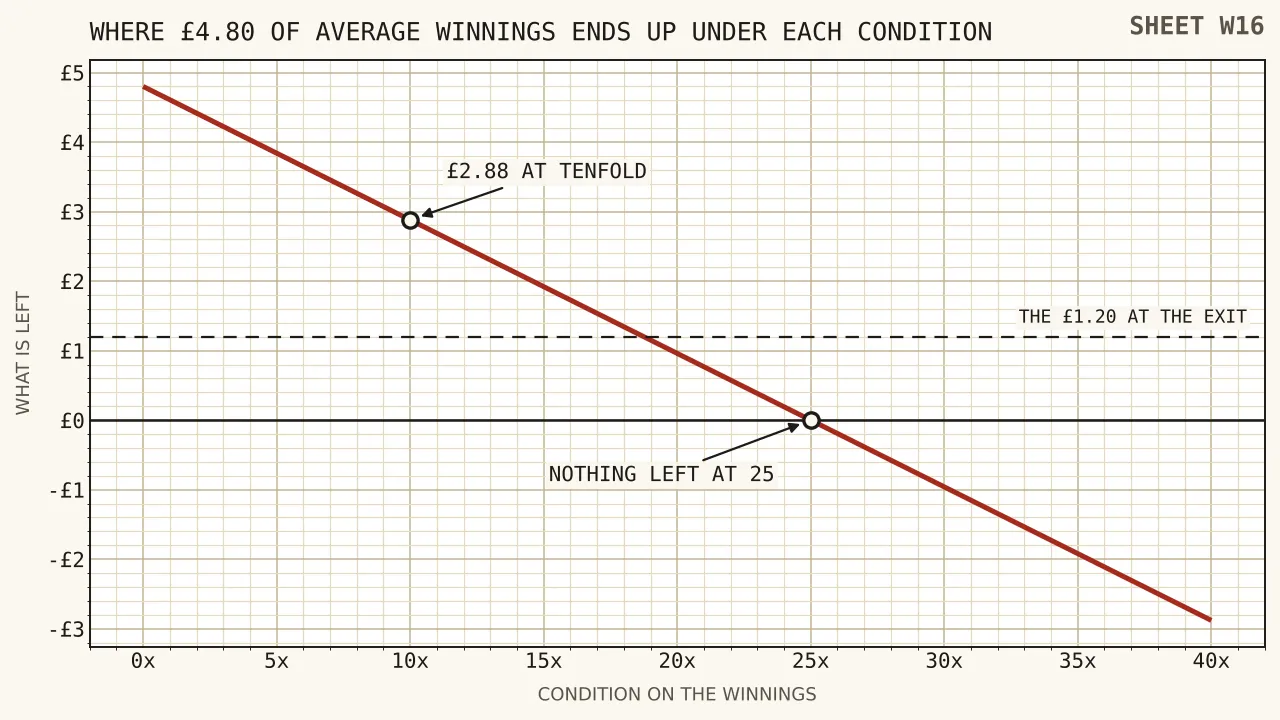
£2.88 at ten times, nothing at twenty-five, £2.88 the wrong way at forty
3
The charge that can exceed the balance
Now put the transfer charge beside those figures. A flat £1.20 does not know or care what it is being taken from, which is the defining property of a fixed charge and the reason it behaves so badly at this end of the scale.
| The count | Minutes at the floor | Face value at 10p | Average winnings | Left at ten times | The charge as a share of that | Reaches the reader |
|---|---|---|---|---|---|---|
| 20 spins | 50 s | £2.00 | £1.92 | £1.15 | 104 per cent | nothing |
| 50 spins | 2 m 5 s | £5.00 | £4.80 | £2.88 | 41.7 per cent | £1.68 |
| 100 spins | 4 m 10 s | £10.00 | £9.60 | £5.76 | 20.8 per cent | £4.56 |
| 150 spins | 6 m 15 s | £15.00 | £14.40 | £8.64 | 13.9 per cent | £7.44 |
The top row is why this page exists. On a twenty-spin count, a £1.20 charge is larger than the whole expected balance, so the exit costs more than the thing being taken out and the arithmetic has nowhere to go. That is not a hypothetical shape of charge; it is the ordinary shape of a transfer fee meeting the ordinary size of a no-deposit count.
Read the sixth column downwards and a fixed charge does what a fixed charge always does. Nothing about the £1.20 changes between the rows. The share it takes falls from 104 per cent to 13.9 per cent purely because the balance underneath it grows. A reader comparing two offers of 20 and 150 spins is comparing a charge of 104 per cent with one of 13.9 per cent, and neither figure is printed anywhere.
One further interaction makes the top rows worse. Where a condition is attached and the balance has to be staked before it can leave, a small balance meets the charge only if it survives the staking, so the charge and the condition compound. At twenty-five times the balance reaches nought before the charge is ever levied, and the charge is then not 104 per cent of anything. It is simply never reached.
104 per cent, which is a £1.20 charge against a £1.15 balance
4
A floor under a withdrawal, against £2.88
A second term bites harder than the charge, and it is a floor rather than a fee. Where a stated sum is the smallest a cashier will send out, a no-deposit balance has to be multiplied before it can leave at all, and the multiplier is arithmetic rather than opinion.
| Smallest withdrawal accepted | Multiple of £2.88 needed | Multiple of £4.80 needed | Spins at 10p it stands for |
|---|---|---|---|
| £5.00 | 1.74 times | 1.04 times | 50 |
| £10.00 | 3.47 times | 2.08 times | 100 |
| £20.00 | 6.94 times | 4.17 times | 200 |
| £50.00 | 17.4 times | 10.4 times | 500 |
| £100.00 | 34.7 times | 20.8 times | 1,000 |
Expectation runs the wrong way for every row of that table. A reel set gives back 96 pence in the pound over a long run, so multiplying a balance by 6.94 is not something a reader can work towards; it has to come out of variance, and variance is the one thing arithmetic cannot promise. A floor of £20.00 against an expected £2.88 is a door that mostly does not open.
At a licensed desk the position over money the reader themselves paid in is different, and worth stating precisely for the contrast. Nothing may be imposed, relied on or enforced by way of a term that caps a consumer’s withdrawals out of deposited money, and the published illustration of that fault allows £500 in a week together with £50 in a day. Restricting a withdrawal’s size is permitted, and so is restricting the number of them, provided the restriction is reasonable.
The honest qualification is that none of that is about a bonus. Deposited money is the subject of that rule, and a count handed over for nothing never puts a penny into a deposit balance, the reader having deposited none. A floor placed under a withdrawal of bonus proceeds is therefore a separate term on a separate subject, which those words leave untouched.
Taken together, the charge and the floor describe the shape of the whole product. A count handed over for nothing produces an expected £2.88 under the most favourable condition a licence permits. A flat charge takes 41.7 per cent of that, and a floor of £20.00 asks for seven times it before the money is allowed to move.
5
The clause with a £170,000 penalty behind it
One term attached to offers of this kind has an enforcement outcome published behind it, which makes it the sharpest item on this sheet. A penalty of £170,000 carries the date 3 July 2025. What drew it was the bonus wording for an operator’s new casino promotions, which reserved a discretion: accounts closed, or winnings taken away, at the operator’s own choosing.
The licensing condition on dealing fairly and openly is what the regulator found breached here. A discretion of that kind, exercisable with no clear justification, was said to lack transparency and to be capable of producing unfair outcomes for consumers. The case required something further: an independent third-party audit reaching the safer gambling controls and the anti-money-laundering ones alike, to give assurance that compliance would hold.
Price that clause against this page’s figures and it is not a percentage of anything. It is the whole £2.88, and the whole £1.68 that would have reached the reader, and the 20 minutes of cycles the condition took to clear. Set against a £1.20 transfer charge, a clause of that shape is 240 per cent of the biggest cost this page has otherwise found.
| What takes the money | On a 50-spin count | As a share of £2.88 |
|---|---|---|
| A ten-times condition on the winnings | £1.92 of expected cost | it is what produces the £2.88 |
| A flat transfer charge at the exit | £1.20 | 41.7 per cent |
| A condition of twenty-five times instead of ten | £2.88 | 100 per cent |
| A discretionary forfeiture clause | £2.88, and the 20 minutes | 100 per cent |
| A £20.00 floor under a withdrawal | the whole balance, mostly | 100 per cent, in effect |
What may not be said about that clause is as important as what may. The regulator fined an operator for including it. Nothing published says such a term is void, so a page cannot tell a reader the clause would fail if it were relied on. What a reader can be told is that the regulator has put a figure on a licensee for drafting one, and has named the condition breached.
A second point follows for a reader of offers that sit outside the British licence. The fine landed because a licence condition applied. Where no such condition applies, the same drafting attracts no penalty, and the clause does the whole of its work with nobody to complain to about it.
6
What nobody publishes about a free spin
Three things a page on this subject would like to state are not available to state, and recording the gap beats filling it.
The first is the value of a spin. No regulator publishes the method by which a spin’s cash value gets fixed, nor who does the fixing, nor what a licensee has to disclose of it. The number of pence a spin is worth is a commercial decision and no rule sets it, which is why the 10p on this site is labelled as an assumption on every page that uses it.
The second is whether a spin given away is itself to be treated as bonus funds once the ten-times ceiling is applied. Bonus funds are what that ceiling is written about. A narrower statement is safe: once a spin’s winnings land in a customer’s bonus balance, any condition attached to them is capped at ten times. Whether the ceiling reaches spins as such has not been published, and no sentence here will claim it either way.
The third is any distribution of conditions, caps or spin values across the offshore market. Nothing citable publishes one. The contrast available is structural rather than numerical: Great Britain has the ten-times ceiling, and the offshore policy read for this site carries nothing equivalent.
Two rules do bear on what a reader is entitled to know. Information letting a customer judge their chances has to be easy to come by before they commit to gamble, and the items capable of satisfying it are joined by the word or. Probability of winning events will do. So will margin, or house edge. So will a return to player percentage. So will an account of how a game works, how winners get picked and how prizes are handed out. A licensed desk is therefore under no obligation to print a return percentage, a point routinely got wrong. Separately, clear and transparent and fair is what an incentive’s terms must be, with easy access to them for whoever the incentive was offered to.
One advertising rule belongs here because it is about the word in the key itself. Advice published by the advertising regulator says that where qualifying means a customer putting up money of their own, the word free ought not to be used of the offer. A count that genuinely asks for no payment is therefore one of the few offers to which the word properly applies, which is also why the charges in parts three and four deserve the attention this sheet gives them.
7
What an unregulated rail actually gives up
A payment rail outside the ordinary banking system is sometimes presented as a feature. On the arithmetic of this page it is not one, and the honest way to put the matter is to list what a British player hands over, duty by duty, rather than to assert that nothing is left.
| Duty on a British licensee | What it is worth on these figures |
|---|---|
| A staking condition capped at ten times | the difference between £2.88 and nothing |
| One product type only inside one incentive | spins and a match stay one type; tickets and a match do not |
| Identity settled before any play | three particulars, bonus play included |
| Stake ceilings inside one reel-game cycle | £5, or £2 for anyone under 25 |
| A gap between game cycles | two and a half seconds, which is what puts 2 m 5 s on the clock |
| No automatic play, no shortened reveal | the 20 minutes cannot be compressed |
| A cancelled withdrawal not offered back | the £1.68 cannot be clawed into play |
| A complaint answered inside eight weeks | then an adjudicator from the approved list |
| Membership of the national exclusion scheme | one registration, every licensed operator |
For a reader who has already put a protection in place, the bottom row is the one that counts. Operators taking part are what the scheme covers, its terms stating that an organisation outside it puts its gambling beyond the scheme’s reach. An offer arrived at by an unregulated rail is outside by construction, which is a plain statement of where the scheme stops rather than a route around it.
What the regulator has published about desks of that kind is specific. Controls short of the mark on money laundering, and equally short on social responsibility. Fraud, unfair practice and questions over the privacy of data left sitting with the customer. Age checks often missing, secure payment systems missing, and the instruments a player uses to keep a grip on things missing too. Payouts stopped dead. Withdrawal ceilings pitched where nobody will ever get to them, which is part four with a divisor chosen so the division cannot finish.
Two things reach a reader regardless. One April 2026 is the date duty on remote gaming profits reached 40 per cent, and whether it bites turns on the customer’s own country rather than the operator’s, so a desk with no licence here sits inside that charge while sitting outside every row of the table above. As for the statutory offence, it is committed by whoever provides the facilities and not by the person having a bet, which is a point about liberty and not about protection.
8
The unit’s own price, which is not a charge
A balance held in a network’s own unit carries one more quantity, and it is not a cost. Between the moment £2.88 is credited and the moment it is converted, the pound value of the unit moves, and it moves in both directions.
That is a variance rather than a toll, since which way it will go cannot be known beforehand. What is sayable is how big it stands next to the other figures here. A 10 per cent move on £2.88 is 29p, which is roughly a quarter of the transfer charge. A 41.7 per cent move would be the whole transfer charge. A 100 per cent fall would be the balance.
| Move while the balance is held | On £2.88 that is | Measured against the £1.20 charge | In spins at 10p |
|---|---|---|---|
| 5 per cent | 14p | an eighth of it | 1.4 |
| 10 per cent | 29p | a quarter of it | 2.9 |
| 25 per cent | 72p | three fifths of it | 7.2 |
| 41.7 per cent | £1.20 | all of it | 12 |
| 100 per cent, downwards | £2.88 | 2.4 times it | 28.8 |
No forecast of that column appears on this site, and nothing here amounts to an opinion on it. Proportion is the whole point, and at this scale the proportion is uncomfortable: a balance of £2.88 can lose the equivalent of a whole transfer charge to a move of a size that happens often, which makes the charge and the variance comparable in a way they never are on a larger payment.
One practical consequence follows. The longer a small balance sits in the unit, the more of that exposure it carries, and a floor under a withdrawal forces it to sit there. A £20.00 floor on an expected £2.88 does not merely delay the exit; it keeps the balance exposed to the price of the unit for as long as the wait lasts.
9
Two minutes of checking, and what it settles
Whether any row of part seven’s table binds a particular cashier is answerable in about two minutes, and the method does not require trusting anybody’s page.
First, the licence statement, generally at the foot of a site, which carries an account number. Second, that number handed to the public register, which comes back either with an entry or with a blank. Third, the domains on the entry, set beside the web address on screen. A blank settles it. So does an entry whose domains leave out the site you are reading.
Published on that register are premises, regulatory actions, personal licences and licensed businesses. Players are told in so many words to check that a site’s claims line up with what is held there, domain names and licensed activities among them. How a status should be read is explained nowhere on it, which is why a page leaning on it has to date its reading.
Recognising the games settles nothing at all. Suppliers holding licences have had their titles found at sites holding none, and one such matter settled at £4.75m, the decision dated 23 July 2026, six sites beyond the licence having run the games. A familiar reel set is not evidence, and neither is a payment logo.
Readers looking for protection instead of an offer have three routes, and no fee attaches to any of them. The national online scheme, registered with once, closes accounts throughout the British licensed market, half a year being its briefest term. Gambling sites and apps can be blocked on a household’s devices by software, and the charity behind the helpline publishes a way of obtaining it at no cost. The helpline’s own number, 0808 8020 133, is answered at every hour.
No part of this sheet is written to help anyone back into somewhere they have excluded themselves from, nor to get round a gambling block set on a bank account. A block a reader asked for belongs in the same family as an exclusion, and on the figures of this page it is worth considerably more than £2.88.
10
Added up at the far end
Below, the ordering answers to a rule this site works everywhere: thinner odds on the money finding its way back mean a lower place. There is no mark out of anything, no verdict, and no rail or logo lifts an entry by so much as a position.
Five figures carry the page. A fifty-spin count priced at 10p puts £5.00 through the reels and averages £4.80 back. A ten-times condition leaves £2.88, and a twenty-five-times condition leaves nothing. A flat £1.20 at the exit takes 41.7 per cent of the £2.88, and on a twenty-spin count it takes 104 per cent, which is more than the balance. A floor of £20.00 asks for 6.94 times the expected balance before the money may move. And the clause that carries a published penalty of £170,000 takes the lot.
Which means reading the offer backwards from the way it is advertised. The forfeiture clause first, then the condition, then the floor under a withdrawal, then the exit charge. The count in the headline comes last, because a count is the one figure in the whole offer that costs the operator nothing to print.
Questions
- What is a fifty-spin count actually worth?
- At 10p a spin it is £5.00 of staking, and a 96 per cent return brings £4.80 of that back on average. A ten-times condition on those winnings requires £48.00 of staking, costing £1.92 in expectation, so £2.88 is what the arithmetic leaves before any charge.
- Why does the exit charge matter so much here?
- Because nothing went in, so there is no deposit for the charge to be a small percentage of. A flat £1.20 against the £2.88 a fifty-spin count leaves is 41.7 per cent, which is the largest share any rail takes anywhere on this site.
- Can the charge really be bigger than the balance?
- Yes, at the small end. A twenty-spin count averages £1.92 of winnings and leaves £1.15 after a ten-times condition, so a £1.20 charge is 104 per cent of it. The exit then costs more than the thing being taken out, and the arithmetic has nowhere left to go.
- Where does a condition stop being survivable?
- At twenty-five times, because each trip of a pound through a reel set costs 4p and twenty-five trips use the pound up. A twenty-five-times condition leaves nothing whatever the count was. Forty times leaves £2.88 against the reader, after £192.00 of staking and 1 hour 20 minutes of cycles.
- What ceiling does a licence put on a condition?
- Ten times the bonus funds, a ceiling which took effect on 19 January 2026. On a fifty-spin count that is £48.00 of staking and £2.88 left. Where no British licence applies, the ceiling does not apply either, which is where the twenty-five and forty-times figures come from.
- What does a minimum withdrawal do to this?
- It asks for a multiple. Against an expected £2.88, a £20.00 floor wants 6.94 times the balance, a £50.00 floor wants 17.4 times and a £100.00 floor wants 34.7 times. Expectation runs the other way at 96 pence in the pound, so the whole of any such multiplication has to come out of variance.
- Is a cap on bonus winnings against the rules?
- Not by the rule on deposit balances, whose subject is money the customer paid in. A count handed over for nothing puts no penny into a deposit balance, so a floor or a ceiling on bonus proceeds is a separate term on a separate subject, which those words leave untouched.
- Can a casino just take the winnings away?
- A clause of that shape carries a published penalty of £170,000, dated 3 July 2025, where the wording left it to an operator’s discretion whether accounts were closed or winnings taken away. The licensing condition on dealing fairly and openly is what the regulator found breached. Nothing published says the term is void, so the honest statement is that the regulator fined a licensee for drafting one.
- Is the value of a free spin set by any rule?
- No. Nothing published sets out the method by which a spin’s cash value gets fixed, nor who does the fixing, nor what has to be disclosed of it. The number of pence a spin is worth is a commercial decision, which is why the 10p used across this site is labelled as an assumption wherever it appears.
- Does the ten-times ceiling cover free spins themselves?
- That has not been published, and no sentence here will claim it either way. Bonus funds are what the ceiling is written about. A narrower statement is safe: once a spin’s winnings land in a bonus balance, any condition attached to them is capped at ten times.
- Should the unit’s own price be treated as a charge?
- No, it is a variance, having no sign in advance. At this scale its size is worth knowing. A 10 per cent move on £2.88 is 29p, about a quarter of the transfer charge, and a 41.7 per cent move is the whole of it. A floor under a withdrawal keeps the balance exposed to it for longer.
- What does an unregulated rail cost me in protections?
- The ten-times ceiling goes, taking the difference between £2.88 and nothing with it. One product type to an incentive. Three particulars verified ahead of any play whatever, bonus play included. Both statutory ceilings on what a reel-game cycle may take. Then the gap of 2.5 seconds, absent which the 20 minutes could not be computed. No automatic play, and no shortened reveal. A withdrawal that cannot be handed back for play. A reply inside eight weeks, with an adjudicator off the approved list beyond that. And the national scheme, reaching the operators inside it while saying plainly that the others are past its reach. Duty at 40 per cent stays, since it follows the customer and not the desk.