Sheet W07 Revision 1 Counted 16 October 2026
Credit card casino: priced as borrowing, because the rail is shut
Borrowing on a card stopped being a way to pay for gambling on 14 April 2020. That makes this the one page in the section where the toll is total: at a licensed cashier the rail does not exist. What can be priced is the borrowing itself. £200.00 carried for a year at 2 per cent a month costs £48.00, against the £120.00 a doubled £200.00 is worth at ten turnovers.
Borrowed £200.00 Cost of a spin 10p Comes to 2,000 spins and a running charge
What borrowed staking comes to
Every destination on this board is bought advertising. The site takes a fee if a reader goes on to register, and no figure printed below moves because of it.
The Spin Count
Gauge No 01
Betportal
Lowest multiple here
Priced at this site's own 10p a spin
What is counted
What is asked
No Great Britain licence
Licensed in Anjouan, Comoros, run by BetPortal Gaming Ltd, with Excite Ultra Media Ltd, reference ALSI-202601040-FI2.
Terms read 16 October 2026
Open the offer at Betportal, opens in a new tabThe Spin Count
Gauge No 02
WinBeast
Largest count here
Priced at this site's own 10p a spin
What is counted
What is asked
No Great Britain licence
Licensed in Curaçao, operator not named on the site.
Terms read 16 October 2026
Open the offer at WinBeast, opens in a new tabThe Spin Count
Gauge No 03
EliteSpin
Longest spin window
Priced at this site's own 10p a spin
What is counted
What is asked
No Great Britain licence
Licensed in Costa Rica, run by PrimeTier Limited.
Terms read 16 October 2026
Open the offer at EliteSpin, opens in a new tabThe Spin Count
Gauge No 04
Crown Jewelz
Multiple unpublished
No foot figure struck
What is counted
What is asked
No Great Britain licence
Licensed in Curaçao, number not verified, operator not named on the site.
Terms read 16 October 2026
Open the offer at Crown Jewelz, opens in a new tabThe figure in the third register is this site's own arithmetic and nothing an operator has published: the count at face, less the share a spin gives back at 96 per cent return to player, less what playing the wagering through costs at the same return. It describes the offer, not one reader's afternoon. Where the conditions price above the count the counter prints nothing rather than a negative sum, and where a figure the sum needs is unpublished it prints the condition in the operator's words instead.
A count has no unit of its own, so one is supplied. Where an operator publishes what a spin of its own is worth, that figure stands in the second register and is labelled as theirs. Where it does not, the second register carries this site's own 10p a spin and says so, and the foot figure moves in proportion: at half the price, half the money. The figure after it, what the count comes to for each spin, is the one that compares a large count against a small one.
Three words stand in the amount column where no figure can. Noted is a published condition that takes value away without leaving the sum a figure to take. Unpriced is a condition whose figure nobody has published, or a credit that is not a sum until a deposit of your own sets it. Own money is money of yours, which is never part of a foot figure.
Not one of the operators printed above holds a Great Britain licence, so the duties that licence carries do not reach them. Every online gambling company licensed in Great Britain has to be part of Gamstop Online, and a reader who has shut themselves out through the scheme is therefore not shut out here. The ceiling of ten times the bonus funds on a wagering requirement, in force since 19 January 2026, is a condition of that licence and binds the companies that hold one. Where a dispute goes instead is a matter for the authority named on the counter, and the Gambling Commission describes what a reader faces without a British licence as a lack of recourse if things go wrong. Nobody under 18 may hold an account at any of them.
Every term printed on a counter is the operator's own, and each counter carries the day it was read. The oldest of those readings is 16 October 2026. What binds a reader is the operator's own full terms, and not a line printed here.
1
Two thousand spins, and a clock
Two thousand spins is what £200.00 buys at 10p apiece. Only that first line works the way the rest of this section works, because a toll prices every other way in and no toll prices this one. A toll takes a share of the payment once. Borrowing takes a share every month until the balance is cleared.
The second thing that separates this rail from the rest is that a licensed cashier will not accept it. Card credit and gambling payment were separated on 14 April 2020 and have stayed separate. So a reader asking which licensed cashiers take a credit card is asking a question with one answer, and it is none of them.
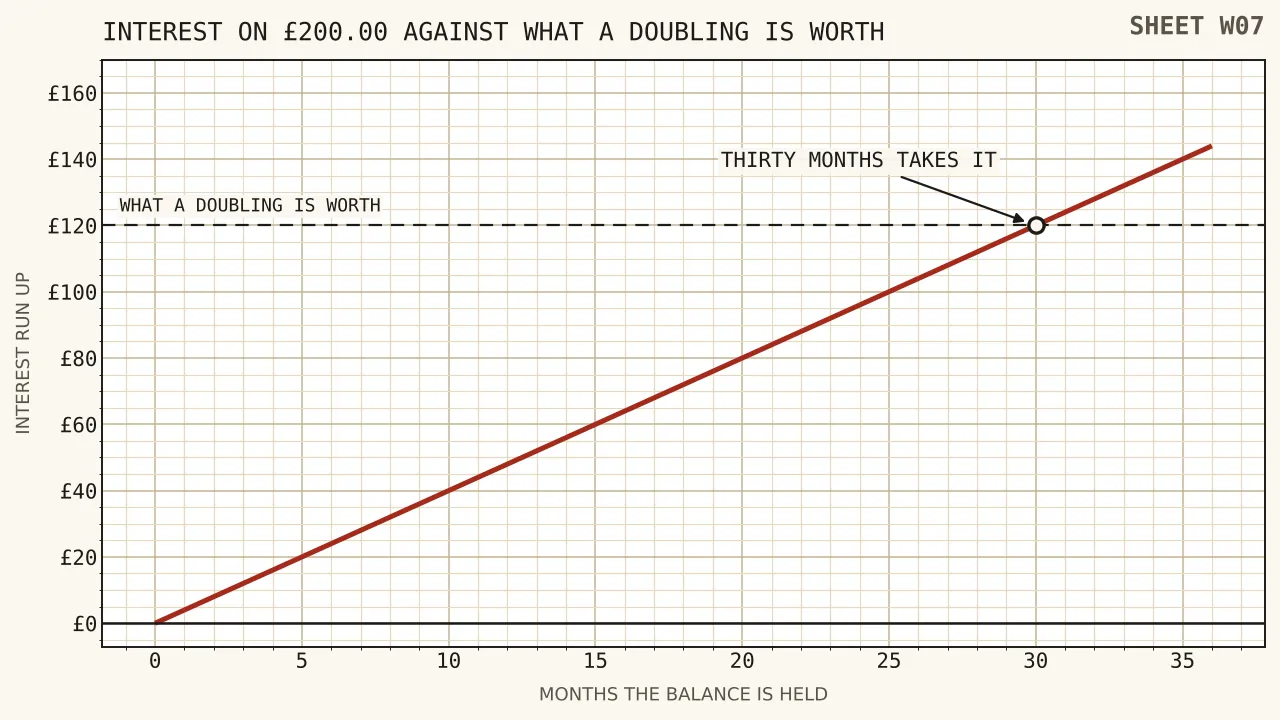
What remains to be priced, then, is the borrowing. Take £200.00 and a rate of 2 per cent a month, which is round rather than published, and the charge is £4.00 a month. Against that sits the value of a doubling: £200.00 of credit at a licensed ceiling of ten turnovers means £2,000.00 of staking, £80.00 of expected cost, and £120.00 left. Thirty months of interest would consume the whole £120.00.
Four working figures. 10p buys one spin. Staking returns 96 per cent across a long run. Staking of a pound counts as a pound against a demand. And interest runs at 2 per cent a month, a round number used for arithmetic rather than a rate anybody quotes. Not one of the four is published, and none of this is advice about credit.
2
The only rail the rulebook names
Across the whole of the British material on gambling payments, exactly one method is addressed by name, and this is it. Nothing permits or prohibits a wallet, a voucher, a bank transfer or a unit of any network. The card that lends is the single exception.
| Element | Substance |
|---|---|
| The rule | A licensee takes no payment for gambling by credit card |
| The extension | Caught even where a money service business carries the payment onward |
| The date | 14 April 2020 |
| Who it binds | Remote licences without exception, ancillary remote betting and lottery included |
| Bound as well | Non-remote betting licences: general, pool, intermediary |
| Left out | Three business categories: machine technical, software, host |
Two things follow from that table and both are useful. The first is that the extension exists because a direct refusal would otherwise be trivial to route around, so the rule reaches the detour as well as the road. The second is that the list of bound licences is long enough to cover any cashier a reader is likely to meet, and the exclusions are all business-to-business categories.
A reader who finds a cashier accepting card credit for gambling has therefore learned something specific rather than something vague. They have not learned that the cashier is generous with payment methods. They have learned which side of 14 April 2020 it is operating on.
3
The charge that keeps running
Every other charge in this section is paid once. Interest is paid for as long as the balance exists, which means its total is not a property of the payment but of the time. Here is £200.00 held at three rates over five durations, set against the £120.00 a doubling is worth.
| Held for | At 1.5 per cent a month | At 2 per cent a month | At 2.5 per cent a month | Share of £120.00 at the middle rate |
|---|---|---|---|---|
| 1 month | £3.00 | £4.00 | £5.00 | 3.3 per cent |
| 3 months | £9.00 | £12.00 | £15.00 | 10 per cent |
| 6 months | £18.00 | £24.00 | £30.00 | 20 per cent |
| 12 months | £36.00 | £48.00 | £60.00 | 40 per cent |
| 30 months | £90.00 | £120.00 | £150.00 | 100 per cent |
The last row is the one to sit with. At the middle rate, two and a half years of carrying £200.00 costs exactly what the promotion was worth in expectation. Everything the reader hoped to gain has been handed to the lender, and the reader still owes the £200.00.
The arithmetic also runs the other way, and honesty requires saying so. One month of interest at the middle rate is £4.00, which is 3.3 per cent of the £120.00. A reader who borrows and repays quickly has paid a small charge. The difficulty is that a wagering demand has a clock of its own: 20,000 cycles at 10p make up £2,000.00 of staking, and a 2.5 second floor under each of them puts 13 hours 53 minutes under the lot.
One further asymmetry deserves a line of its own. A toll is deducted from the money going in, so a reader can see it before they stake anything; the arithmetic is settled at the moment of payment. Interest is deducted from the reader afterwards, on a schedule set by somebody else, and the total is not knowable at the moment of payment because it depends on a repayment date that has not happened yet. That is why this page gives a table of durations rather than a figure. The honest answer to what borrowing costs is a function, not a number.
30 months of interest on £200.00 equals the whole £120.00
4
Interest expressed as a toll
Elsewhere in this section a rail is priced by what it keeps, and the keeping is converted into turnovers: 1 per cent retained takes one quarter turnover away from a crossing that starts at 25. Interest can be put in the same currency by asking what share of the payment it takes.
| Interest paid | As a share of £200.00 | Crossing it implies | Spins of 2,000 it costs |
|---|---|---|---|
| £4.00 | 2 per cent | 24.5 turnovers | 40 spins |
| £12.00 | 6 per cent | 23.5 turnovers | 120 spins |
| £24.00 | 12 per cent | 22 turnovers | 240 spins |
| £48.00 | 24 per cent | 19 turnovers | 480 spins |
| £120.00 | 60 per cent | 10 turnovers | 1,200 spins |
Compare that with the charged rails elsewhere in this section, where a typical toll runs from nothing to about 2.5 per cent and costs at most a quarter of a turnover. A year of borrowing is a 24 per cent toll. No payment rail anywhere in this section comes within a factor of ten of that.
The bottom row restates the point of the whole page. At 60 per cent the implied crossing is 10, which is the licensed ceiling itself, so a reader who borrows for two and a half years has cancelled the ceiling’s entire benefit without any term in the promotion changing.
5
Twenty thousand cycles, and the stake that shortens them
A doubled £200.00 carries £2,000.00 of staking at the licensed ceiling. Counted in cycles that figure depends wholly on the stake; counted in expected cost it does not depend on the stake in the least. Four hundred pieces or twenty thousand, the expectation is £80.00 either way.
| Staked each cycle | Cycles required | Floor on the clock | Expected cost |
|---|---|---|---|
| 10p | 20,000 cycles | 13 h 53 m | £80.00 |
| 25p | 8,000 cycles | 5 h 33 m | £80.00 |
| 50p | 4,000 cycles | 2 h 46 m | £80.00 |
| £2 | 1,000 cycles | 41 m 40 s | £80.00 |
| £5 | 400 cycles | 16 m 40 s | £80.00 |
The two ceilings in the last two rows are statutory and they are the reason this table stops where it does. No more than £5 may be taken by one cycle of a reel game from a player who has reached 25, and no more than £2 where they have not. So the shortest lawful route through £2,000.00 of staking is 400 cycles for one reader and 1,000 cycles for another, purely as a function of age.
Borrowing interacts with that in a way worth naming. Interest runs on the calendar rather than on the cycles, so a reader who clears the staking in 16 minutes and repays the balance that week has paid almost nothing in interest. A reader who takes 13 hours and 53 minutes across a month, at 10p a cycle, is a month into the borrowing before the obligation is even discharged.
£80.00 is the expected cost of £2,000.00 at every stake size
6
Two clocks that do not line up
A promotion has a clock and so does a card. They are set by different people for different purposes, and the gap between them is where a reader gets caught. The promotion wants the staking done quickly. The card bills monthly and charges from the day the money is drawn.
| Time the terms allow | Cycles a day at 10p | Minutes a day at the floor | Whether a statement has arrived |
|---|---|---|---|
| 24 hours | 20,000 cycles | 833 m | no |
| 7 days | 2,857 cycles | 119 m | no |
| 14 days | 1,429 cycles | 60 m | probably not |
| 30 days | 667 cycles | 28 m | about now |
| 60 days | 334 cycles | 14 m | twice over |
Read the top row as arithmetic rather than as a suggestion. 833 minutes is thirteen hours and fifty-three minutes, which does not fit inside a day that also contains sleep, so a 24-hour clock on a £2,000.00 obligation at 10p a cycle is not a term a reader can satisfy at the floor. The only lawful way to satisfy it is a larger stake, and the largest lawful stake is £5.
The last column is the part belonging to this page alone. Elsewhere in the section a reader knows the cost before the first spin. Here the cost is still growing once the spins are over, and the first written notice of it arrives after the promotion has been settled one way or the other.
7
A block is a protection
Card issuers and banks offer a setting that refuses gambling payments, and many apply one by default on credit. It is worth being plain about what that is. What it amounts to is a protection, either chosen by the account holder or handed to them, and it sits in the same family as a registration with the national self-exclusion scheme: one decision, made in advance, so that the same decision need not be made later on a bad evening.
This site does not discuss getting past such a setting, and it does not discuss getting past a self-exclusion either. There is nothing on these pages about which rails are likelier to clear where a block is in place, because the question has no honest version. A reader who has a block and wants it gone can raise that with the institution that set it, which is the only route this site has anything to say about.
| Protection | Who it binds | What it does not reach |
|---|---|---|
| A gambling setting on a card or account | The institution holding the account | Payments made on some other rail |
| The national self-exclusion scheme | Operators taking part in it | Anybody who takes no part |
That second row is the scheme setting out its own limits, and no sentence on a page like this one is more useful. What it can do is exclude a person from the gambling services that participating operators offer. What it says it cannot do is keep that person away from services belonging to organisations which take no part in it. Membership is compulsory for every operator licensed here, so the scheme’s reach is pinned to the licence and not to any particular website.
The mechanics are worth tabulating, because every row of them is a figure or a rule rather than an opinion, and a reader deciding whether to register benefits from seeing the whole shape at once.
| Element | Position |
|---|---|
| Periods offered | Six months. One year. Five years. Five years renewing itself |
| Ending early | Not possible, and the scheme says so in capitals |
| Expiry | Does not happen on its own |
| Extending | A further period may be chosen |
| Lifting one | Contact with the scheme, then a wait |
| Length of that wait | 24 hours at the least, exclusion live throughout |
| Auto renewal | Switchable off during a five-year period’s closing six months, and not before |
The last row is the one people miss. Where the five-year option with renewal has been chosen, the window for turning the renewal off is the final six months of the period, which is 10 per cent of it. Outside that window the renewal stands.
8
What a licence fixes
Everything above assumes a cashier that answers to somebody. The table below is what a Great Britain licence fixes, with the figure or date attached to each item, so that a reader can see which of them is a principle and which is a number.
| Item | Substance | Figure or date |
|---|---|---|
| The wagering ceiling | Ten turnovers is as far as a licensed demand goes | 19 January 2026 |
| Stake on one cycle | Reel games only, and lower below the age of 25 | £5, and £2 |
| Between cycles | Reel games, start to start | 2.5 seconds |
| Identity | Verification precedes play at a licensed cashier, and free-to-play versions of games are inside that rule | no date on the condition |
| Card credit | Refused, detours included | 14 April 2020 |
| The deposit balance | No ceiling on taking it out; the specimen that fails allows a day of £50 | no date on the guide |
| Complaints | Acknowledged promptly, answered in full, then escalated to an approved adjudicator | 3 working days, then 8 weeks |
Two rows of that table bear directly on borrowing. The identity row means a licensed cashier knows who the account holder is before any play, which is the precondition for the card refusal to be enforceable at all. The ceiling row means the £120.00 in the third table of this page is a floor on the value of a doubling rather than a hopeful estimate.
Not one row of that table is owed to a reader who goes there, because an operator able to carry this rail holds no Great Britain licence. The rail they accept is the rail the rule names, and the reason they can accept it is the reason nothing else in the table applies either.
9
The check, and what the record shows
Take the number from the footer, look it up on the register, and read the listed domains against the address bar. A licence number that returns no entry is not a licence, and an entry that omits your domain is not yours.
Money is how the licensed side publishes its record, and a reader can inspect that rather than taking it on trust. On the enforcement listing, £10m stands against an operator in October 2025. December 2025 carries £2m against another. The 2026 entries include £900,000 and £609,104, and suspensions appear alongside the penalties. A supplier’s own titles on six unlicensed sites cost that supplier £4.75m in July 2026.
A caution about those figures, because it matters for accuracy. The dates on that listing are not the same field as the date shown on an operator’s own entry in the register: a penalty of £650,000 sits against 20 November 2025 where the listing records it, and against 30 October 2025 on the operator’s own page. Neither is wrong, and a page naming an operator should use the date on that operator’s entry.
A rate of 40 per cent has applied to remote gaming profits since the start of April 2026. It follows the player rather than the operator, so a cashier abroad taking a British reader’s borrowed £200.00 is inside the charge while standing outside every row of the previous table.
10
Priced, not ranked
The order below is set by the odds of recovery and by nothing else, with no score attached to any entry. A cashier that accepts a payment method the rules refuse does not rise for being accommodating.
Here is the trade, set out as a ledger rather than a warning.
| What goes | What that is worth here |
|---|---|
| Ten as the ceiling on a demand | The difference between {£120.00} kept and {£120.00} owed |
| The two stake figures on a cycle | £5, and £2 below the age of 25 |
| The floor between cycles | The 13 hours 53 minutes becomes unmeasurable |
| Identity settled first | The card refusal becomes unenforceable |
| The refusal of card credit | Interest enters the arithmetic |
| A prompt to set a limit | No ceiling fixed in advance |
| The paid-in balance protected | A withdrawal ceiling becomes permissible |
| Three days, then eight weeks | No clock on a complaint at all |
| An approved adjudicator | Nobody independent at the end of it |
| The reach of the self-exclusion scheme | A registration that stops at the licence |
Ten rows, and the first of them is worth £240.00 of swing on a £200.00 payment. Set that beside the £4.00 a month this page has been pricing and the proportions are settled. Borrowing is the expensive part of the arithmetic, and the absence of a licence is the expensive part of everything else.
Questions
- Will a licensed casino take a credit card?
- It will not. Card credit and gambling payment were separated on 14 April 2020 and have stayed separate since. Drafting catches the obvious detour too, since a money service business carrying such a payment to the licensee is refused on the very same ground.
- Which licences does the refusal bind?
- Remote licences are all bound, and that includes the ancillary remote pair, one for betting and one for lottery. Three non-remote betting licences are bound too: the general one, the pool one, the intermediary one. What sits outside is machine technical, software and host, and those are business categories rather than cashiers.
- What does borrowing £200.00 actually cost?
- At 2 per cent a month, £4.00 a month: £12.00 over three months, £24.00 over six, £48.00 over a year. The rate is round illustrative arithmetic rather than anybody’s published figure, and the shape of the answer does not depend on it.
- How does that compare with the offer?
- A doubled £200.00 at the licensed ceiling of ten turnovers is £2,000.00 of staking, £80.00 of expected cost and £120.00 left. A year of interest at the middle rate is £48.00, which is 40 per cent of it. Thirty months takes all of it.
- What is interest as a toll?
- Divide it by the payment. £4.00 on £200.00 is 2 per cent, which costs half a turnover off a crossing of 25. £48.00 is 24 per cent and a crossing of 19. The charged rails elsewhere in this section run from nothing to about 2.5 per cent.
- How long does the wagering take?
- 20,000 cycles at 10p, which is what £2,000.00 of staking comes to. Each of them waits 2.5 seconds for the one before, so 13 hours 53 minutes is the quickest the lot can be done, and a licensed cashier may sell nothing that shortens it.
- My bank blocks gambling payments. What does this page say about that?
- That a block protects, and protects in the way a registration with the national self-exclusion scheme protects, and that getting past either of them is something this site will not discuss. Where a reader wants a block lifted, the institution that applied it is the only route worth asking about.
- What does the self-exclusion scheme reach?
- Gambling services offered by participating operators, and every operator licensed in Great Britain is obliged to belong. Keeping a person away from services that belong to organisations outside the scheme is what it states it cannot do, and that is a limit on the protection rather than a loophole to be used.
- How long does a registration last?
- Four lengths are on offer. Six months is the shortest. Then a year. Then five years. Then five years renewing itself. Ending one early is not possible. Expiry does not happen by itself either. Lifting a registration means contacting the scheme and then waiting at least 24 hours, the exclusion staying live for the whole of that wait.
- Is the licensed side actually enforced?
- In published money. Published enforcement reaches £10m against one operator, dated October 2025. Another has £2m against December 2025. The 2026 entries run to £900,000 and £609,104, and suspensions sit alongside. Dates there differ from the dates on an operator’s own register entry, so a page naming an operator uses the entry.
- What still applies to an unlicensed cashier?
- Duty. A rate of 40 per cent has applied to remote gaming profits since the start of April 2026, and it follows where the player ordinarily lives rather than where the operator sits. So the tax reaches the cashier while none of the protections does.