Sheet R13 Revision 1 Counted 16 October 2026
Bitcoin slots: a second variance, and it is larger than the first
840 presses at 10p is £84.00 of stake, £80.64 back at 96 pence per pound, and £3.36 kept by the room. Price the same tray in a unit that moves against sterling and a 4 per cent move is worth exactly that £3.36. A ten per cent move is worth 2.5 times the entire house edge.
The count 840 presses One press 10p Comes to £80.64 in sterling terms
What a count of this size comes to
Every destination on this board is bought advertising. The site takes a fee if a reader goes on to register, and no figure printed below moves because of it.
The Spin Count
Gauge No 01
Betportal
Lowest multiple here
Priced at this site's own 10p a spin
What is counted
What is asked
No Great Britain licence
Licensed in Anjouan, Comoros, run by BetPortal Gaming Ltd, with Excite Ultra Media Ltd, reference ALSI-202601040-FI2.
Terms read 16 October 2026
Open the offer at Betportal, opens in a new tabThe Spin Count
Gauge No 02
WinBeast
Largest count here
Priced at this site's own 10p a spin
What is counted
What is asked
No Great Britain licence
Licensed in Curaçao, operator not named on the site.
Terms read 16 October 2026
Open the offer at WinBeast, opens in a new tabThe Spin Count
Gauge No 03
EliteSpin
Longest spin window
Priced at this site's own 10p a spin
What is counted
What is asked
No Great Britain licence
Licensed in Costa Rica, run by PrimeTier Limited.
Terms read 16 October 2026
Open the offer at EliteSpin, opens in a new tabThe Spin Count
Gauge No 04
Crown Jewelz
Multiple unpublished
No foot figure struck
What is counted
What is asked
No Great Britain licence
Licensed in Curaçao, number not verified, operator not named on the site.
Terms read 16 October 2026
Open the offer at Crown Jewelz, opens in a new tabThe figure in the third register is this site's own arithmetic and nothing an operator has published: the count at face, less the share a spin gives back at 96 per cent return to player, less what playing the wagering through costs at the same return. It describes the offer, not one reader's afternoon. Where the conditions price above the count the counter prints nothing rather than a negative sum, and where a figure the sum needs is unpublished it prints the condition in the operator's words instead.
A count has no unit of its own, so one is supplied. Where an operator publishes what a spin of its own is worth, that figure stands in the second register and is labelled as theirs. Where it does not, the second register carries this site's own 10p a spin and says so, and the foot figure moves in proportion: at half the price, half the money. The figure after it, what the count comes to for each spin, is the one that compares a large count against a small one.
Three words stand in the amount column where no figure can. Noted is a published condition that takes value away without leaving the sum a figure to take. Unpriced is a condition whose figure nobody has published, or a credit that is not a sum until a deposit of your own sets it. Own money is money of yours, which is never part of a foot figure.
Not one of the operators printed above holds a Great Britain licence, so the duties that licence carries do not reach them. Every online gambling company licensed in Great Britain has to be part of Gamstop Online, and a reader who has shut themselves out through the scheme is therefore not shut out here. The ceiling of ten times the bonus funds on a wagering requirement, in force since 19 January 2026, is a condition of that licence and binds the companies that hold one. Where a dispute goes instead is a matter for the authority named on the counter, and the Gambling Commission describes what a reader faces without a British licence as a lack of recourse if things go wrong. Nobody under 18 may hold an account at any of them.
Every term printed on a counter is the operator's own, and each counter carries the day it was read. The oldest of those readings is 16 October 2026. What binds a reader is the operator's own full terms, and not a line printed here.
1
Two variances, stacked
Every other page in this section has one source of uncertainty: the reel. A tray priced in a unit that floats against sterling has two, and the second is the larger of them by a wide margin.
Fix the sterling arithmetic first, because it is the part that behaves. 840 presses funded at 10p is £84.00 of stake. A reel returning 96 pence per pound gives back £80.64 on average, so the room keeps £3.36. All the house takes from the tray is that £3.36, a quantity that is bounded, knowable and in principle publishable.
Now add the unit. Where a tray is denominated in something that moves, its sterling value at the moment of award and its sterling value at the moment of withdrawal are different numbers, and the difference is unbounded in either direction. A 4 per cent adverse move on £84.00 is £3.36, which is precisely the house’s entire take. A 10 per cent move is £8.40, which is 2.5 times it. A 20 per cent move is £16.80, five times it.
So on a tray of this size the question of which reel, which return and even which multiple is second-order. The unit is first-order, and nothing in any offer’s terms addresses it.
One thing this page will not do is forecast a unit. No reachable primary source publishes anything about a crypto-denominated gambling balance, which means the figures here are conditional throughout: they say what a move of a given size is worth, not what move will happen. That is the only honest shape for the arithmetic.
Out there no Great Britain licence applies at all, so price those 840 presses again with the ledger stripped out. Eleven duties travel with that licence, and part eight puts a figure on each of them.
Three declared figures and one open variable. A press costs 10p in sterling terms. 96 pence per pound comes back from the reel, four pence staying as edge. A condition’s expected cost is the multiple times that edge times the credit. The open variable is the move in the unit between award and withdrawal, written throughout as a percentage of the sterling face value and never forecast.
2
840 presses, priced in sterling first
The sterling column of this page is ordinary, and setting it out properly is what makes the currency column legible afterwards.
| As printed | Turnover due | Presses, 10p each | Floor time | Left over |
|---|---|---|---|---|
| None on the winnings | nothing | 840 for the tray | 35 min flat | £80.64 |
| Five times | £403.20 | 4,032 | 2 hr 48 min | £64.51 |
| Ten times | £806.40 | 8,064 | 5 hr 36 min | £48.38 |
| Twenty times | £1,612.80 | 16,128 | 11 hr 12 min | £16.13 |
| Twenty-five times | £2,016.00 | 20,160 | 14 hr exactly | nothing |
| Forty times | £3,225.60 | 32,256 | 22 hr 24 min | short by £48.38 |
Each extra unit of multiple costs £3.23 off the residue column, that being £80.64 scaled by four per cent. The fifth row arrives at nothing because a pound holds twenty-five lots of four pence. Only one column rests on a published figure, the fourth, 2.5 seconds being owed after a game’s start before the following cycle may be commenced.
Then the usual second mechanism. Where a staked pound counts as less than a pound towards the condition, divide to get the staking. The £806.40 owed at ten times is £806.40 of staking on the reels, £2,016.00 at forty pence in the pound, £4,032.00 at twenty pence and £16,128.00 at five pence. In presses those are 8,064, 20,160, 40,320 and 161,280.
That last figure is 112 hours at the lawful floor speed, which is four and two thirds days of continuous pressing. Multiply a room’s rate by twenty-five for the heaviest multiple it bears: 1.25 in a five pence room, which puts the condition above eight times past bearing.
Hold the fifth column of that table in mind for part three, because every figure in it is about to be compared with a currency move rather than with another multiple.
£3.36 of house edge on 840 presses, against £8.40 for a ten per cent move
3
Four per cent is the whole edge
Here is the arithmetic this page exists for. The house’s take on the tray is the stake times the edge, which is £84.00 times four pence in the pound, or £3.36. A move in the unit is the stake times the move. Set the two expressions equal and they meet at a move of 4 per cent.
So the breakeven comparison is exact and memorable: a 4 per cent move in the unit between award and withdrawal is worth the same as the entire house edge on 840 presses. Anything beyond 4 per cent dominates the reel.
| Move in the unit | Worth in sterling | As a multiple of the £3.36 edge | Equivalent in presses | Equivalent condition |
|---|---|---|---|---|
| 1 per cent | £0.84 | 0.25 | 8 presses | 2.5 times |
| 2 per cent | £1.68 | 0.50 | 17 presses | 5 times |
| 4 per cent | £3.36 | 1.00 | 34 presses | 10 times |
| 10 per cent | £8.40 | 2.50 | 84 presses | 25 times |
| 20 per cent | £16.80 | 5.00 | 168 presses | 50 times |
| 50 per cent | £42.00 | 12.50 | 420 presses | 125 times |
The last two columns are the useful ones. A 10 per cent adverse move costs a reader the equivalent of 84 presses of this tray, which is a tenth of the whole headline, and it costs the same as a twenty-five times wagering condition, which is the multiple at which a credit reaches nothing.
Run it the other way and the comparison gets sharper still. A move of 2 per cent is worth the same as a fivefold condition. A move of 4 per cent matches the regulated ceiling of ten times. A move of 20 per cent matches a fiftyfold condition, which no licensed cashier may set and which would be remarkable even beyond the register.
Which is the finding. On a tray of 840 priced in a floating unit, the currency exposure routinely exceeds the worst wagering condition a cashier is likely to print, and it appears in no set of terms because it is not a term. It is a consequence of the denomination.
Two qualifications keep that honest. A favourable move helps a reader by the same arithmetic, so the exposure is two-sided rather than a hidden charge. And the comparison is between a mean and a spread: the £3.36 is an expected cost while the currency figure is a possible outcome, so the two are not the same kind of quantity. Part seven handles that properly.
4
A condition held open while the unit moves
A wagering condition and a floating unit interact, and the mechanism is time. Balances stay in an account while a condition runs, and a balance that stays is exposed for exactly as long.
Take the fourth column of part two. An unconditioned tray is exposed for 35 minutes at the floor speed. A tenfold condition holds the balance for 5 hours 36 minutes of pressing. A twentyfold condition holds it for 11 hours 12 minutes. A fortyfold condition holds it for 22 hours 24 minutes. In each case the exposure window is the pressing time plus whatever intervals a reader takes between sessions, which is usually the larger part.
| Condition | Balance at the start | Pressing time | A 10 per cent move on the start balance | A 10 per cent move on the residue |
|---|---|---|---|---|
| None | £80.64 | 35 min flat | £8.06 | £8.06 |
| Five times | £80.64 | 2 hr 48 min | £8.06 | £6.45 |
| Ten times | £80.64 | 5 hr 36 min | £8.06 | £4.84 |
| Twenty times | £80.64 | 11 hr 12 min | £8.06 | £1.61 |
| Twenty-five times | £80.64 | 14 hr exactly | £8.06 | nothing |
The fourth column is flat, which is the point. Whatever the condition, the balance begins at £80.64 and a 10 per cent move at the outset is worth £8.06. The fifth column falls, because by the end of a heavy condition there is less left for a move to act on.
So a long condition shrinks the currency exposure and lengthens it at the same time. There is no sense in which this is a benefit: the reason the exposure shrinks is that the condition has already taken the money. At twenty-five times the currency risk reaches nothing for the same reason the residue does.
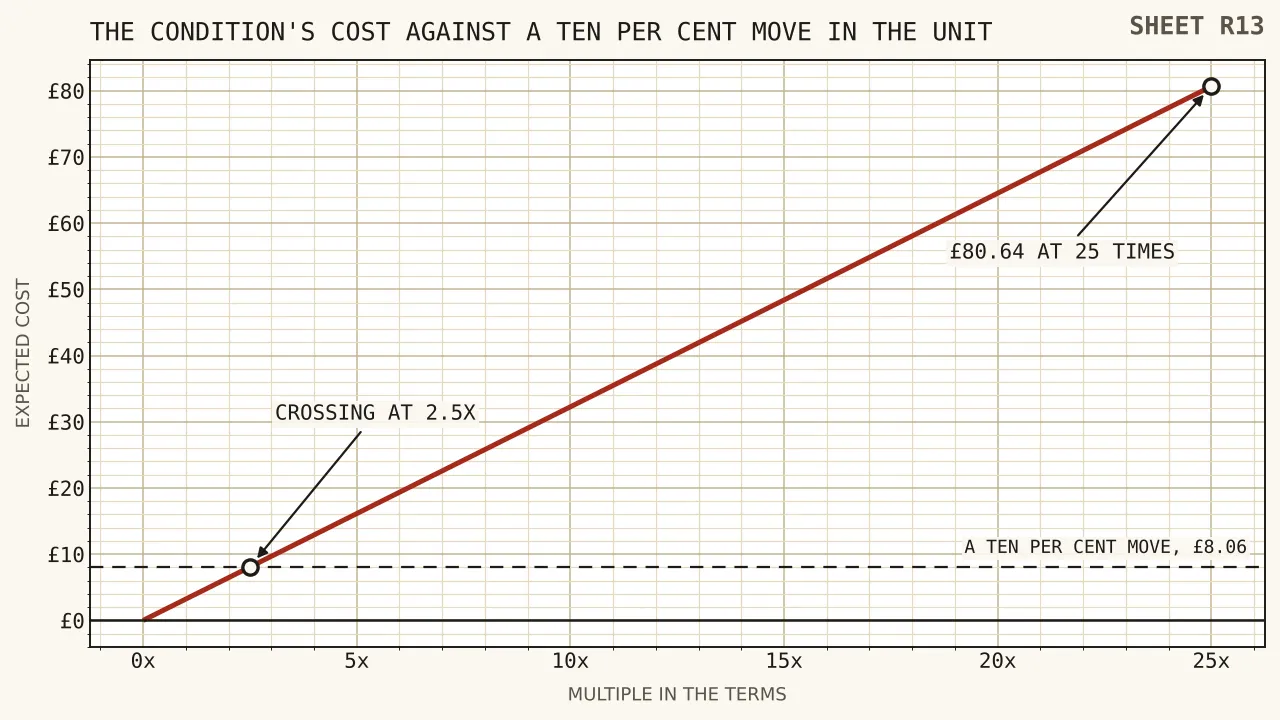
One figure puts the interaction in order of magnitude. Over the 5 hours 36 minutes a tenfold condition demands, the expected cost of the condition is £32.26, and a 10 per cent move on the balance is worth £8.06 at the start falling to £4.84 at the end. The condition is the larger quantity over that window. Over the 35 minutes of a bare tray, the condition costs nothing and the move is worth £8.06, so the ranking reverses.
Which gives the rule. A long condition makes the reel the dominant risk. A short one or none at all makes the unit the dominant risk. The crossover on this tray is a condition of about two and a half times, where the condition’s expected cost of £8.06 matches a 10 per cent move.
5
What the card rule says, and what it does not
One payment rule bears on this subject, and the honest account of it is a statement of scope rather than a conclusion.
Payment for gambling by credit card is not accepted by a British licensee, and the condition reaches a card routed via a money service business as well. Its commencement is 14 April 2020. Every kind of remote licence falls inside the scope, ancillary remote lottery and ancillary remote betting among them, together with the non-remote betting intermediary, pool betting and general betting licences, and it leaves out the gaming machine technical, host and gambling software kinds.
What that rule does not do is address a deposit made in anything other than a card payment. No reachable primary source says whether a balance funded in a floating unit falls inside or outside it, and no primary source reachable for this site addresses crypto-denominated deposits at all. So this page records what the condition covers and stops there, rather than inferring a position in either direction.
Two things can be said without stretching. The first is arithmetical: borrowing to fund the £3,225.60 of turnover a fortyfold condition demands would add a cost of credit on top of the £48.38 shortfall the condition is already expected to produce, and the card rule exists to stop exactly that compounding.
The second is about what the licence buys elsewhere in the cashier. Withdrawals once requested have to stand, no option to cancel being offered, and two additions sit in the guidance: depositing with those same funds should not be put back on the table, and friction on the route out should be reduced so far as the operator is able. Nor may any term cap a consumer’s withdrawals from a deposit balance of their own. On this tray those two duties protect £48.38 of residue at ten times.
And one duty is specific to a long condition. Reductions to a financial limit bite immediately, barring a technical failure, and an increase sits for 24 hours at the least and then wants a second positive act from the customer. Over 5 hours 36 minutes of pressing that asymmetry is the only mechanism a reader has for stopping, and it is nobody’s obligation off the register.
6
Thirty-five minutes, then five hours thirty-six
Time on this page does double duty: it measures the pressing and it measures the exposure. Both come off the same published floor.
Within 2.5 seconds of a preceding game no cycle may be commenced, which puts 840 presses at 35 minutes as a minimum. The conditions then run 2 hours 48 minutes at five times, 5 hours 36 minutes at ten, 11 hours 12 minutes at twenty, 14 hours at twenty-five and 22 hours 24 minutes at forty.
None of that compresses on a licensed reel. No customer may be handed a way of shortening a result’s wait, with three features impermissible by name, and repetition may not run itself, a commitment coming due at each cycle. Those duties are what make the fourth column of part two a floor rather than an estimate, and they are among the eleven in part eight.
Convert the heaviest row into days and the obligation stops being abstract. 22 hours 24 minutes at the floor speed is 32,256 presses. Spread over a week that is 3 hours 12 minutes a day. Spread over a twenty-four hour window it is 93 per cent of the day. Spread over a two-hour window it is arithmetically impossible, and a reader can establish that before claiming rather than after.
Put the exposure window beside it. A balance that has to survive 22 hours 24 minutes of pressing will in practice sit in the account for days, and across days a floating unit can move by a great deal more than the 4 per cent that matches the whole house edge. The pressing time is therefore a lower bound on the exposure window and not an estimate of it.
One scale figure closes the part. At 24 presses a minute, the 32,256 presses owed at forty times are 1,344 minutes of deliberate button work. Divided into the £48.38 shortfall the condition is expected to produce, that is a loss of 3.6p for every minute spent, which is the clearest single statement of what a fortyfold condition is.
7
Adding the two spreads together
Part three compared a mean with a possible outcome, which is not a fair comparison. Doing it properly means putting both uncertainties in the same units, and the result is a sharper version of the same conclusion.
Take the reel first. On the simplest paytable, with one prize paying a fixed multiple and the mean held at 96 pence per pound, the spread per press in units of stake is the square root of 0.96 times the multiple less 0.9216. Where the prize pays 100 times the stake that is 9.75. Across 840 independent presses the spread of the total grows with the square root of the count, so it is 9.75 times the square root of 840, which is 282.6 units of stake, or £28.26 at 10p a press.
Now the unit. A move of m per cent applies to the whole balance at once rather than press by press, so it does not shrink with the square root of anything. On £84.00, a 10 per cent move is £8.40 and a 35 per cent move is £29.40.
| Source of spread | On 840 presses | On 84 presses | On 8,400 presses | Grows with |
|---|---|---|---|---|
| The reel, prize of 100 times | £28.26 | £8.94 | £89.37 | the square root of the count |
| The reel’s expected cost | £3.36 | £0.34 | £33.60 | the count |
| A 10 per cent move in the unit | £8.40 | £0.84 | £84.00 | the count |
| A 35 per cent move in the unit | £29.40 | £2.94 | £294.00 | the count |
The last column is where the structure shows. The reel’s spread grows with the square root of the count while everything else grows with the count itself, so the reel’s spread matters most on a small tray and least on a large one. On 84 presses the reel’s spread of £8.94 dwarfs a 10 per cent move worth 84p. On 8,400 presses a 10 per cent move is worth £84.00 against a reel spread of £89.37, so the two are comparable. On 84,000 presses the move would be worth £840.00 against a reel spread of £282.60.
That crossover is the honest form of the finding in part three. A currency exposure does not diversify away with volume and a reel’s randomness does. So the larger the tray, the more completely the unit dominates, and at 840 presses the two are already within a factor of three and a half of each other.
Two caveats are owed. Those spread figures use the simplest possible paytable and the square-root rule for independent presses, so they establish an order of magnitude rather than a precise number, and they are this site’s own working. And nothing here is a forecast: the percentages in the table are stated sizes of move, not predictions that any such move will occur.
8
840 presses, nothing on the register
Eleven lines follow. Each is something a British licence requires, with a figure from this page standing against it.
| Imposed by a licence | Worth here, in cash or time |
|---|---|
| Conditions halted at ten times | £48.38 survives, rather than a £48.38 shortfall at forty |
| A staked pound credited in full on reels | 8,064 presses owed, not 161,280 at five pence |
| Cycles kept 2.5 seconds apart | 35 m under the tray, 5 h 36 m under the condition |
| A result that cannot be hurried | 32,256 presses at forty times stay 22 h 24 m |
| A commitment at every cycle | 8,064 separate decisions rather than one |
| No credit card at the cashier | £3,225.60 of turnover cannot be borrowed |
| A limit cut at once, raised after a day | The only brake across 5 h 36 m of pressing |
| Withdrawals standing once requested | No path back to the reels for £48.38 of residue |
| A deposit balance nobody may cap | Whatever went in stays the reader’s to take out |
| Results that must be acceptably random | The £3.36 of edge stays a fixed quantity |
| An eight-week clock ending in adjudication | Somewhere exists for a disputed £48.38 |
The tenth row is the one this page leans on hardest. Four pence of edge in each pound is what produces every figure in parts two, three, four and seven, and such an edge is a reliable input only where a compensated game is barred and randomness required. Off the register the arithmetic stays computable and stops being checkable, which on a tray exposed to a second variance is a worse position than it sounds.
What much of that market answers to is one Curaçao responsible gaming policy, numbered 1.0 and dated 21 February 2025. Searched for a wagering multiple’s ceiling it yields nothing; for the cash limit over a stake, nothing; for any minimum length imposed on a game cycle, nothing. Bonuses get two sentences of treatment in it. Transparent communication with the conditions clear is what one wants. Aggressive promotion of a kind that would encourage excessive gambling is what the other bars.
Two of its lines run the other way. Deposit limits drop at once out there and climb only once seven days have passed, while 24 hours is the British floor on a climb. And complaints get 26 weeks of player time and four weeks of operator time, with four more on a written extension, adjudication being obligatory and the operator paying for it.
Nothing moves the remaining line. Where a player ordinarily lives is what remote gaming duty of 40 per cent attaches to, which brings it to a licensed cashier and an unlicensed one in identical terms; 21 per cent held across the seven years ending 1 April 2026.
Questions
- What are 840 free spins at 10p worth?
- £84.00 of stake at face and £80.64 back on a reel returning 96 pence per pound, with £3.36 staying with the room. Conditions then subtract: ten times leaves £48.38, twenty times leaves £16.13, twenty-five times leaves nothing and forty times leaves a shortfall of £48.38.
- How much does a move in the unit cost compared with the house edge?
- A 4 per cent move matches the whole of it exactly, because £84.00 at four pence in the pound is £3.36 and 4 per cent of £84.00 is the same figure. A 10 per cent move is £8.40, or 2.5 times the edge. A 20 per cent move is £16.80, five times it. A 50 per cent move is £42.00, twelve and a half times it.
- What wagering condition is a currency move equivalent to?
- Divide the move by four pence in the pound. A 2 per cent move matches a fivefold condition, a 4 per cent move matches tenfold, a 10 per cent move matches twenty-five times, which is the multiple at which a credit reaches nothing, and a 20 per cent move matches fiftyfold. In presses of this tray those moves are worth 17, 34, 84 and 168 presses respectively.
- Does a long wagering condition increase my currency exposure?
- It lengthens the window and shrinks the balance, which are opposite effects. The balance starts at £80.64 whatever the condition, so a 10 per cent move at the outset is worth £8.06 in every case. By the end of a tenfold condition the residue is £48.38 and the same move is worth £4.84. The reason the exposure falls is that the condition has already taken the money.
- Which is the bigger risk, the reel or the unit?
- It depends on the condition and the count. On this tray the crossover is a condition of about two and a half times, where the condition’s expected cost of £8.06 matches a 10 per cent move. On count, the reel’s spread grows with the square root while a currency move grows with the count itself, so a bigger tray is dominated more completely by the unit: at 84 presses the reel’s spread is £8.94 against 84p for a 10 per cent move, and at 8,400 presses it is £89.37 against £84.00.
- Does the credit card ban cover a deposit in a floating unit?
- Nothing reachable says either way, and this page will not infer one. What the condition does state: credit cards are not taken as payment for gambling by a British licensee, a card reaching the cashier through a money service business included, and commencement fell on 14 April 2020. Its scope covers every remote licence and the non-remote betting licences, excluding gambling software, host and gaming machine technical licences.
- How long do 840 presses and their condition take?
- 35 minutes goes on the tray. Within 2.5 seconds of a preceding game, no cycle may begin. The conditions run 2 hours 48 minutes at five times, 5 hours 36 minutes at ten, 11 hours 12 minutes at twenty, 14 hours at twenty-five and 22 hours 24 minutes at forty. Compression is unavailable: three features are impermissible by name and every cycle brings its own commitment due.
- What does a fortyfold condition cost per minute?
- 3.6p of loss for every minute spent. The 32,256 presses owed are 1,344 minutes at 24 presses a minute, and the expected shortfall is £48.38, which divides out at 3.6p a minute. On an unconditioned tray the same arithmetic runs the other way: £80.64 of credit over 35 minutes is £2.30 a minute.
- Does game weighting still apply here?
- Exactly as elsewhere. The £806.40 owed at ten times is £806.40 of staking on the reels, £2,016.00 at forty pence in the pound, £4,032.00 at twenty pence and £16,128.00 at five pence, which is 161,280 presses and 112 hours. A room’s rate multiplied twenty-five-fold gives the heaviest multiple it bears, putting a five pence room at 1.25.
- What is lost with nothing on the British register?
- Eleven lines, costed in part eight, the tenth of them mattering most here. No Great Britain licence stands behind it, so acceptable randomness is required of nobody and compensated games are barred by nothing, leaving the four pence edge every figure here rests on computable and unverifiable. Beside that: ten times halts nothing, the 8,064 presses owed may become 161,280 where a room credits five pence, a withdrawal may be handed back to the reels, and a disputed £48.38 runs to no eight-week route. Remote gaming carries 40 per cent of duty to that cashier even so, with a player’s ordinary residence setting the charge.