Sheet P06 Revision 1 Counted 16 October 2026
100% deposit bonus: a coefficient of one, priced out
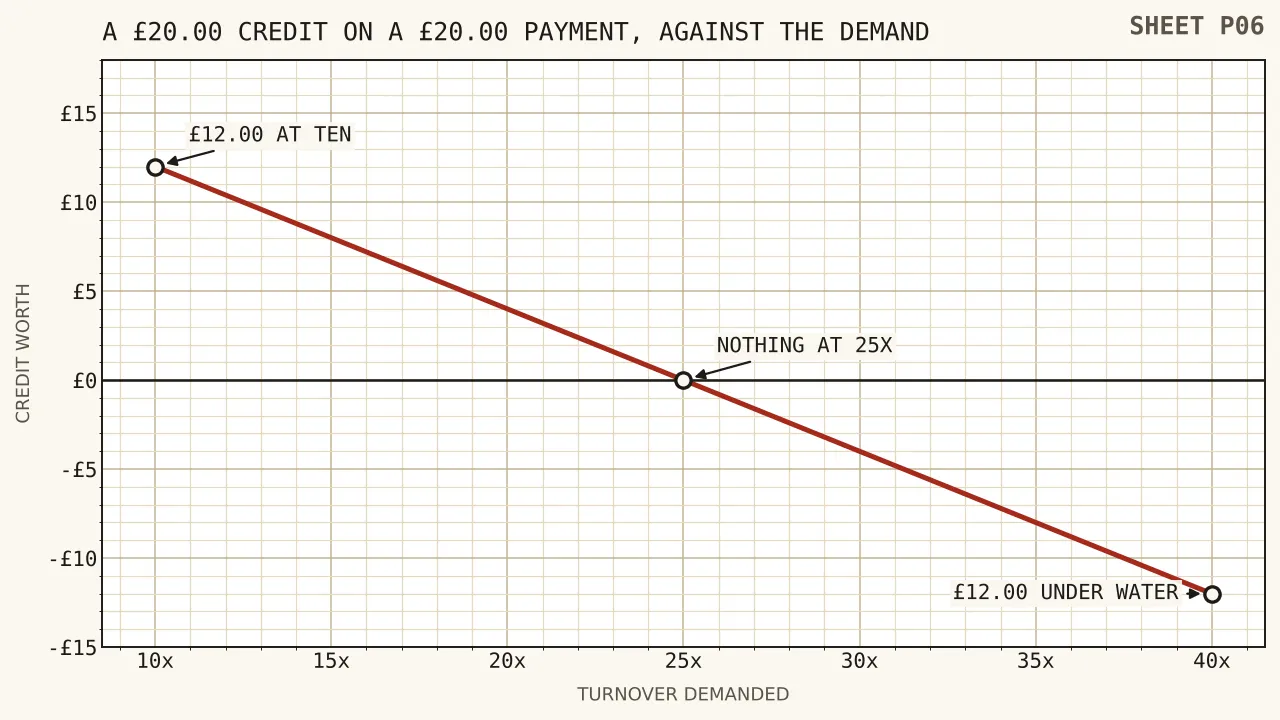
A doubled balance is the plainest offer in this section: one pound of credit for one pound paid in. Put £20.00 across and £20.00 comes back as bonus funds, which at 10 turnovers leaves £12.00 and at 25 leaves nothing. Every other headline in this corner of the market is this sum multiplied, so it is worth doing once and keeping.
Paid in £20.00 One spin 10p Comes to £12.00 kept at 10 turnovers
What a doubled balance comes to
Every destination on this board is bought advertising. The site takes a fee if a reader goes on to register, and no figure printed below moves because of it.
The Spin Count
Gauge No 01
Betportal
Lowest multiple here
Priced at this site's own 10p a spin
What is counted
What is asked
No Great Britain licence
Licensed in Anjouan, Comoros, run by BetPortal Gaming Ltd, with Excite Ultra Media Ltd, reference ALSI-202601040-FI2.
Terms read 16 October 2026
Open the offer at Betportal, opens in a new tabThe Spin Count
Gauge No 02
WinBeast
Largest count here
Priced at this site's own 10p a spin
What is counted
What is asked
No Great Britain licence
Licensed in Curaçao, operator not named on the site.
Terms read 16 October 2026
Open the offer at WinBeast, opens in a new tabThe Spin Count
Gauge No 03
EliteSpin
Longest spin window
Priced at this site's own 10p a spin
What is counted
What is asked
No Great Britain licence
Licensed in Costa Rica, run by PrimeTier Limited.
Terms read 16 October 2026
Open the offer at EliteSpin, opens in a new tabThe Spin Count
Gauge No 04
Crown Jewelz
Multiple unpublished
No foot figure struck
What is counted
What is asked
No Great Britain licence
Licensed in Curaçao, number not verified, operator not named on the site.
Terms read 16 October 2026
Open the offer at Crown Jewelz, opens in a new tabThe figure in the third register is this site's own arithmetic and nothing an operator has published: the count at face, less the share a spin gives back at 96 per cent return to player, less what playing the wagering through costs at the same return. It describes the offer, not one reader's afternoon. Where the conditions price above the count the counter prints nothing rather than a negative sum, and where a figure the sum needs is unpublished it prints the condition in the operator's words instead.
A count has no unit of its own, so one is supplied. Where an operator publishes what a spin of its own is worth, that figure stands in the second register and is labelled as theirs. Where it does not, the second register carries this site's own 10p a spin and says so, and the foot figure moves in proportion: at half the price, half the money. The figure after it, what the count comes to for each spin, is the one that compares a large count against a small one.
Three words stand in the amount column where no figure can. Noted is a published condition that takes value away without leaving the sum a figure to take. Unpriced is a condition whose figure nobody has published, or a credit that is not a sum until a deposit of your own sets it. Own money is money of yours, which is never part of a foot figure.
Not one of the operators printed above holds a Great Britain licence, so the duties that licence carries do not reach them. Every online gambling company licensed in Great Britain has to be part of Gamstop Online, and a reader who has shut themselves out through the scheme is therefore not shut out here. The ceiling of ten times the bonus funds on a wagering requirement, in force since 19 January 2026, is a condition of that licence and binds the companies that hold one. Where a dispute goes instead is a matter for the authority named on the counter, and the Gambling Commission describes what a reader faces without a British licence as a lack of recourse if things go wrong. Nobody under 18 may hold an account at any of them.
Every term printed on a counter is the operator's own, and each counter carries the day it was read. The oldest of those readings is 16 October 2026. What binds a reader is the operator's own full terms, and not a line printed here.
1
One pound for one pound
A doubling is a multiplier of one, which makes it the cleanest arithmetic in this section and the right place to learn the sum. Pay £20.00 and the cashier adds £20.00 of bonus funds. The balance on the screen reads £40.00, and only half of that is the reader’s to withdraw, because the other half arrives with a condition attached.
So two figures have to be tracked separately from the first second. The payment is money the reader owns. The credit is money the reader has to earn by turning it over. Any page that adds them together and calls the total a bonus has already lost the thread.
The unit here is one pound paid in. At a coefficient of one, each pound paid in buys exactly one pound of credit, so the pence returned for each pound in and the pence returned for each pound of credit are the same number. That coincidence is what makes this page the base case for the rest of the section: at 200 per cent the two columns separate by a factor of two, and at 400 per cent by a factor of four.
Three declared assumptions carry it. A spin costs 10p. A slot returns 96p in the pound over the long run, which leaves an edge of 4p. Weighting is at full count, meaning a pound staked moves a requirement by a pound. No source fixes what one free spin is worth, so the 10p on this sheet is declared rather than discovered.
Every pound figure below scales. A £40.00 payment at this coefficient doubles them, a £10.00 payment halves them, and a £5.00 payment quarters them. What never moves is the multiple at which the sign flips, because that figure comes from the edge and not from the size of the payment.
2
What 10 turnovers leaves
Ten turnovers of a £20.00 credit is £200.00 of staking. A 96p game is expected to keep 4p of every pound, so £200.00 through it is expected to cost £8.00. Take that from the credit and £12.00 stands at the foot. In spins, £200.00 at 10p is 2,000 of them.
Fifteen turnovers is £300.00 of staking, an expected cost of £12.00 and £8.00 left. Twenty turnovers is £400.00, a cost of £16.00 and £4.00 left. Twenty-five turnovers is £500.00, a cost of £20.00, and the credit is gone exactly. Nothing about that last line is a coincidence: 25 fours make 100.
| Turnovers demanded | Staking owed | Spins owed at 10p | Expected cost | Credit surviving |
|---|---|---|---|---|
| 10 turnovers | £200.00 | 2,000 spins | £8.00 | £12.00 |
| 15 turnovers | £300.00 | 3,000 spins | £12.00 | £8.00 |
| 20 turnovers | £400.00 | 4,000 spins | £16.00 | £4.00 |
| 25 turnovers | £500.00 | 5,000 spins | £20.00 | nothing |
| 35 turnovers | £700.00 | 7,000 spins | £28.00 | short by £8.00 |
| 40 turnovers | £800.00 | 8,000 spins | £32.00 | short by £12.00 |
Per pound paid in, those rows read 60p, 40p, 20p, nothing, a shortfall of 40p and a shortfall of 60p. A reader who remembers one line from this page should remember the first and the fourth: 10 turnovers keeps three fifths of a doubling, and 25 turnovers keeps none of it.
2,000 spins at 10p to clear £200.00 of staking
3
Where 25 comes from
The crossing is not a convention and it is not borrowed from any rulebook. It falls out of the return. An edge of 4 per cent is expected to take 4p from each pound that passes through the game, so after 25 passes the expected take is 100p of every pound that started. Whatever balance was being cleared has been consumed.
Which gives a one-line test for any offer in this section. Multiply the turnover demand by the edge. Under 100 per cent, the credit survives in proportion to what is left. At exactly 100 per cent, it finishes at nought. Over 100 per cent, the reader’s own payment pays for the remainder of the staking.
| Return the game pays | Expected take over 10 turnovers | Crossing multiple |
|---|---|---|
| 98p in the pound | 20 per cent of the credit | 50 |
| 96p in the pound | 40 per cent of the credit | 25 |
| 94p in the pound | 60 per cent of the credit | 16.7 |
| 90p in the pound | the whole credit | 10 |
The bottom row is the one that catches people. On a game paying 90p in the pound, a 10 turnover demand is already at the crossing, so a doubled balance with a 10 times condition can be worth nothing at all depending on which game it has to be cleared on. A licensee may publish a house edge, a return percentage, a probability or a plain description, because an “or” joins those four, which means the figure a reader needs is sometimes printed as something else.
4
When the payment is in the base
A doubling is the worst case for one particular term, and it is worth knowing which one. Where the turnover demand attaches to the payment as well as the credit, the base becomes £40.00 rather than £20.00, so twice the money gets cleared at one multiple and half of it was never the reader’s to keep.
That £40.00 base at 10 turnovers means staking of £400.00, an average cost of £16.00, so £4.00 of the credit is left where £12.00 would have been. Twelve and a half turnovers of that base is £500.00 of staking, expected to cost £20.00, and the credit is gone. So the crossing halves, from 25 to 12.5, purely because of which balance the multiple is written against.
| Turnovers | Credit alone as the base | Payment and credit as the base |
|---|---|---|
| 5 turnovers | £16.00 left | £12.00 left |
| 10 turnovers | £12.00 left | £4.00 left |
| 12.5 turnovers | £10.00 left | nothing |
| 20 turnovers | £4.00 left | short by £12.00 |
| 25 turnovers | nothing | short by £20.00 |
The halving is specific to a coefficient of one. At 200 per cent the base grows by half rather than doubling, so the crossing lands at 16.7. At 300 per cent it is 18.75, and at 400 per cent it is 20. The arithmetic is 25 multiplied by the percentage over one plus the percentage, and the lesson is that a combined base punishes the smallest headline hardest.
Whether the regulated ceiling of 10 reaches a combined base has not been published in either direction. Bonus funds are the subject of the ceiling’s wording, and no published example deals with a payment folded into the base. A page can state the arithmetic of such a term, as this one has, and cannot state its regulatory status.
5
The ceiling on the credit
A doubling is advertised with a maximum, and the maximum is where the coefficient of one stops being one. Under the cap each pound paid in buys a pound of credit. Over it, the credit sits still while the payment grows, so the effective match rate is the cap divided by the payment.
Take a cap of £50.00. A £20.00 payment earns £20.00, a true doubling. A £50.00 payment earns £50.00, still true. A £100.00 payment earns £50.00, so the match in truth is 50 per cent, and a £200.00 payment brings that figure to 25. Per pound paid in at 10 turnovers, those last three are worth 60p, then 30p, then 15p.
| Paid in | Credit it earns | The match in truth | Kept per pound in at 10 |
|---|---|---|---|
| £20.00 | £20.00 | a full doubling | 60p a pound |
| £50.00 | £50.00 | still a full doubling | 60p a pound |
| £75.00 | £50.00 | 67 per cent of the payment | 40p a pound |
| £100.00 | £50.00 | half the payment | 30p a pound |
| £200.00 | £50.00 | a quarter of the payment | 15p a pound |
A ceiling can sit on the winnings rather than on the credit, and the pair get muddled routinely. Capping what a bonus balance converts replaces the expectation instead of scaling it: hold the exit at £30.00 and that is the ceiling on the whole exercise, whatever credit stood behind it. A cap on bonus winnings and an uncapped deposit balance can both be true at once, because they govern different balances.
Nothing may limit what leaves a deposit balance, and the illustration of the forbidden kind sets £50 against a day and £500 against a week. No standard figure for a cap on bonus winnings is published anywhere this site can cite, so £30.00 is a round number picked to keep the sum readable, not a report of anybody’s terms.
6
The British ceiling, and the time it buys
Bonus funds and 10 turnovers is the British pairing, settled on 19 January 2026, and it keeps a licensed credit on the right side of nought. Against a £20.00 credit the ceiling means £200.00 of staking at worst, so £12.00 is the least a licensed doubling can be expected to leave at full weight.
Up to 60 times was the habit the ceiling corrected, on the regulator’s own figure, which is 240p of expected cost against each pound of credit. Run that against this page’s payment: 60 turnovers of £20.00 is £1,200.00 of staking, an expected cost of £48.00, and a shortfall of £28.00 against a credit of £20.00. The reader would have been better off never claiming.
The ceiling also buys time, which nobody advertises. The pace on a licensed slot is one cycle every 2.5 seconds at best, which turns 10,000 spins into 6 hours 56 minutes and 40 seconds. At the ceiling, 2,000 spins is 83 minutes and 20 seconds. At 60 turnovers it would have been 12,000 spins and over eight hours of pressing a button on purpose.
| What is counted | At the ceiling of 10 | At 60 turnovers |
|---|---|---|
| Staking owed | £200.00 | £1,200.00 |
| Spins at 10p | 2,000 | 12,000 |
| Shortest lawful run | 1 h 23 m 20 s | 8 h 20 m |
| Expected cost | £8.00 | £48.00 |
| Standing at the foot | £12.00 | short by £28.00 |
Automatic play is out, and so are the features that shorten a result, which is why a floor pace is also the real pace. A reader pricing a doubling should treat the hours in that table as part of the cost, because they are the part that cannot be bought back at any percentage.
£1,200.00 of staking at 60 turnovers, against a £20.00 credit
7
Weighting, and the stake while it runs
A game counting below its face lifts the staking and leaves the advertised multiple alone, which is how a demand inside the ceiling of 10 still sends more than 10 times the credit through the reels.
A contribution rate of 30p in the pound was quoted by respondents during the consultation, and the point went on the record without a rule following it. The requirement at 10 turnovers is £200.00 of contribution. Delivering it at that rate takes £666.67 of staking, which is 6,667 spins at 10p and an expected cost of £26.67. Against £20.00 of credit that is a shortfall of £6.67, while the published multiple still reads 10.
| The weight | Staking needed | Spins needed | Cost of it | Left of the credit |
|---|---|---|---|---|
| 100p in the pound | £200.00 | 2,000 spins | £8.00 | £12.00 |
| 50p in the pound | £400.00 | 4,000 spins | £16.00 | £4.00 |
| 30p in the pound | £666.67 | 6,667 spins | £26.67 | short by £6.67 |
| 20p in the pound | £1,000.00 | 10,000 spins | £40.00 | short by £20.00 |
Those rows are arithmetic done on this sheet. The 30p belongs to the respondents who supplied it, and no current table of game contributions is published by any source citable here, so a grid of percentages presented as fact would be an invention. Treat the multiple and the weight as one term, because that is what they are.
A stake ceiling while a requirement runs changes the clock and not the cost. Where terms hold a spin to a tenth of the credit, £2.00 is the ceiling on a spin here, and £200.00 of staking becomes 100 spins in place of 2,000. The expected cost is £8.00 either way. One slot cycle is capped at £5, or £2 for a customer under 25, and both figures are slots-only.
8
What the advertisement has to carry
A doubling is sold in six words and conditioned in six hundred, which is why the advertising rules matter as much as the licensing ones. Promotional material carries its applicable significant conditions clearly and prominently where an omission would mislead, and in a gambling promotion four kinds of thing qualify.
Eligibility, the deposit and wagering demands, the time limits and the bet types make four kinds of significant condition. Price each against this page’s £20.00 payment and the reason they are significant becomes arithmetic rather than principle. Eligibility decides whether the £20.00 buys a credit at all. The wagering demand decides whether the credit is worth £12.00 or nothing. A time limit decides whether 2,000 spins can physically be made, since 1 hour 23 minutes and 20 seconds of button work has to fit inside the window. And the eligible games fix the weighting, which can turn £12.00 into £6.67 short.
The regulator puts the consequence of hiding one in a single line: significant terms belong inside the advertisement prominently, and beside the headline on the pages where a reader lands and signs up, with a burial making the whole thing misleading. One click from the advertisement is where full terms belong, not down in a footer.
Three published rulings put dates on it. A deadline left out of an advertisement was treated as a significant condition on 17 July 2024. An excluded payment method buried in the full terms was judged insufficiently prominent on 31 July 2024. A £5 voucher that was no use on 14 March, with the advertisement silent about it, breached the code on 27 August 2025. Only the third of those is written up as a breach on the regulator’s own page.
One advertising rule bears on the word in the headline rather than the small print. Calling an offer free is out where qualification needs the customer’s own stake, and a doubling wants £20.00 before it does anything. So the honest reading of a doubled balance is a purchase: £20.00 buys £12.00 of expectation at the regulated ceiling, and buys nothing at 25 turnovers.
£20.00 paid in buys £12.00 of expectation at the ceiling of 10
9
The doubling without the licence
A doubled balance from a cashier outside the British licence is the same coefficient with none of the rules around it. Each duty below is set against its worth on this page’s own figures, so the loss reads in pounds instead of adjectives.
| What a licence requires | What it is worth here |
|---|---|
| A turnover demand of 10 at most | £200.00 of staking at worst, so £12.00 survives |
| One product type in one incentive | spins clear with a casino credit; bingo tickets do not |
| £5 a slot cycle, £2 under the age of 25 | £200.00 of staking is 40 cycles at the ceiling |
| 2.5 seconds between slot cycles | 2,000 spins cannot pass in under 1 h 23 m 20 s |
| Identity settled before any play | the £20.00 credit cannot reach an unverified account |
| A credit card turned away | borrowed money cannot fund the £20.00 |
| A limit offered at the first payment | a £10 day puts the £20.00 payment two days off |
| No cap on the deposit balance | the £20.00 paid in stays withdrawable |
| A complaint shut inside 8 weeks | then an adjudicator from a list of eight |
| A seat in the national self-exclusion scheme | one registration, every licensed cashier |
No stake cap, no minimum pace and no turnover ceiling appear in that offshore policy, and bonuses get two lines in it. That policy is Curaçao’s responsible gaming document, version 1.0, dated the 21st of February 2025, the one offshore rulebook readable end to end from here. What that absence means for a doubling is exact: nothing out there stops a 40 turnover demand, and 40 turnovers of £20.00 is a shortfall of £12.00.
Three further things a reader gives up are worth naming separately. Payouts blocked, and withdrawal limits set too high to reach: those are failure modes the regulator records beyond the register. A game from a licensed studio says nothing about the cashier running it. And the approved list of adjudicators holds eight names, and their coverage differs, one of them not reaching remote casino at all, which is still eight more routes than an unlicensed cashier offers.
Tax is the one line that does not change at the border. British gaming duty follows the player’s ordinary residence, so an offshore cashier owes it too, at 40 per cent of profits. Leaving the register saves the reader nothing on that front and costs them every row in the table above.
Questions
- What does a 100% deposit bonus actually come to?
- On a £20.00 payment: £12.00 at 10 turnovers, £4.00 at 20, nought at 25, then a shortfall of £12.00 by 40. Per pound paid in that is 60p, 20p, nothing, and 60p of the reader’s own money. Two declared assumptions sit under those figures: a 10p spin, and 96p in the pound coming back.
- Why is 25 the multiple that matters?
- Because 25 trips through an edge of 4 per cent are expected to consume all of what is being cleared. Multiply the turnover demand by the edge to get the share of the credit the staking eats: 40 per cent at 10 turnovers, 80 per cent at 20, the lot at 25. On a game paying 90p in the pound the crossing moves down to 10.
- How many spins does the wagering take?
- Ten turnovers of a £20.00 credit comes to £200.00 of staking, or 2,000 spins at 10p. A licensed slot cannot restart a cycle inside 2.5 seconds, so that is 1 hour 23 minutes and 20 seconds of deliberate pressing. At 60 turnovers it would be 12,000 spins and more than eight hours.
- What changes if the deposit has to be wagered too?
- The crossing halves, from 25 turnovers to 12.5, because the base becomes £40.00 while the credit stays at £20.00. Ten turnovers of that base is £400.00 of staking, expected to cost £16.00, leaving £4.00 instead of £12.00. The halving is worst at this coefficient: at 400 per cent the crossing on a combined base is 20.
- Is a bigger percentage better than a doubling?
- It is a bigger credit with a proportionally bigger obligation, and the multiple still decides the sign. At 10 turnovers a doubling of £20.00 keeps £12.00 and a quadrupling of the same payment keeps £48.00, but at 40 turnovers the first is £12.00 under water and the second is £48.00 under. A larger headline is a heavier wager on the multiple staying small.
- Can paying in more reduce what I get?
- Per pound paid in, yes, as soon as the credit hits its ceiling. Under a £50.00 cap a £50.00 payment is still a true doubling, a £100.00 payment is a match of 50 per cent, and a £200.00 payment is a match of 25 per cent. Value per pound in falls from 60p to 30p to 15p across those three at 10 turnovers.
- How much turnover can a licensed cashier demand?
- Ten turnovers of the bonus funds. The ceiling was settled on 19 January 2026 and reaches all but the gaming machine technical and software licences. Against a £20.00 credit that is £200.00 of staking at worst and £12.00 surviving. The regulator put the practice it replaced at up to 60 times.
- Does game weighting change the answer?
- It raises the staking and leaves the headline alone. At 10 turnovers the contribution required is £200.00. At the 30p rate respondents put to the regulator, delivering it takes £666.67 of staking, or 6,667 spins, at an expected cost of £26.67, which turns £12.00 surviving into £6.67 short. No current contribution table is published anywhere citable.
- What does the same offer cost outside the British licence?
- The turnover ceiling, the product rule, the £5 and £2 slot stake caps, the 2.5 second cycle, identity before play, the refusal of a credit card, the limit prompt, an uncapped deposit balance, an 8-week complaint with an approved adjudicator behind it, and the national self-exclusion scheme. The offshore policy read for this site sets no turnover ceiling, so a 40 turnover demand is possible there, and 40 turnovers of £20.00 is a shortfall of £12.00.