Sheet V06 Revision 1 Counted 16 October 2026
A £5 deposit casino: fifty spins, two minutes and five seconds, twenty pence of expected cost
Five pounds at 10p a spin is fifty spins. A 96 per cent configuration expects £4.80 back and 20p of cost, and the fifty presses take 2 minutes and 5 seconds at the lawful pace. Five pounds is also the smallest deposit at which a percentage match has anything much to work on, so this sheet prices what a headline percentage really multiplies, and what the regulated ceiling does to it.
Spins for five pounds 50 One spin 10p Expected £4.80
What a count of this size comes to
Every destination on this board is bought advertising. The site takes a fee if a reader goes on to register, and no figure printed below moves because of it.
The Spin Count
Gauge No 01
Betportal
Lowest multiple here
Priced at this site's own 10p a spin
What is counted
What is asked
No Great Britain licence
Licensed in Anjouan, Comoros, run by BetPortal Gaming Ltd, with Excite Ultra Media Ltd, reference ALSI-202601040-FI2.
Terms read 16 October 2026
Open the offer at Betportal, opens in a new tabThe Spin Count
Gauge No 02
WinBeast
Largest count here
Priced at this site's own 10p a spin
What is counted
What is asked
No Great Britain licence
Licensed in Curaçao, operator not named on the site.
Terms read 16 October 2026
Open the offer at WinBeast, opens in a new tabThe Spin Count
Gauge No 03
EliteSpin
Longest spin window
Priced at this site's own 10p a spin
What is counted
What is asked
No Great Britain licence
Licensed in Costa Rica, run by PrimeTier Limited.
Terms read 16 October 2026
Open the offer at EliteSpin, opens in a new tabThe Spin Count
Gauge No 04
Crown Jewelz
Multiple unpublished
No foot figure struck
What is counted
What is asked
No Great Britain licence
Licensed in Curaçao, number not verified, operator not named on the site.
Terms read 16 October 2026
Open the offer at Crown Jewelz, opens in a new tabThe figure in the third register is this site's own arithmetic and nothing an operator has published: the count at face, less the share a spin gives back at 96 per cent return to player, less what playing the wagering through costs at the same return. It describes the offer, not one reader's afternoon. Where the conditions price above the count the counter prints nothing rather than a negative sum, and where a figure the sum needs is unpublished it prints the condition in the operator's words instead.
A count has no unit of its own, so one is supplied. Where an operator publishes what a spin of its own is worth, that figure stands in the second register and is labelled as theirs. Where it does not, the second register carries this site's own 10p a spin and says so, and the foot figure moves in proportion: at half the price, half the money. The figure after it, what the count comes to for each spin, is the one that compares a large count against a small one.
Three words stand in the amount column where no figure can. Noted is a published condition that takes value away without leaving the sum a figure to take. Unpriced is a condition whose figure nobody has published, or a credit that is not a sum until a deposit of your own sets it. Own money is money of yours, which is never part of a foot figure.
Not one of the operators printed above holds a Great Britain licence, so the duties that licence carries do not reach them. Every online gambling company licensed in Great Britain has to be part of Gamstop Online, and a reader who has shut themselves out through the scheme is therefore not shut out here. The ceiling of ten times the bonus funds on a wagering requirement, in force since 19 January 2026, is a condition of that licence and binds the companies that hold one. Where a dispute goes instead is a matter for the authority named on the counter, and the Gambling Commission describes what a reader faces without a British licence as a lack of recourse if things go wrong. Nobody under 18 may hold an account at any of them.
Every term printed on a counter is the operator's own, and each counter carries the day it was read. The oldest of those readings is 16 October 2026. What binds a reader is the operator's own full terms, and not a line printed here.
1
Fifty spins, and what they come to
Five pounds divided by a 10p press is fifty presses. Each press carries 9.6p of expectation at a 96 per cent configuration, so fifty of them come to £4.80, and the 20p between the deposit and that figure is the expected cost of the whole visit. At the pace a licensed slot has to keep, with 2.5 seconds from one cycle’s start before the following one may open, those fifty presses fill 125 seconds. Two minutes and five seconds.
The 20p is four per cent of the deposit and it stays at four per cent of the deposit whatever the cashier charges for a press. Put the price at a penny and five pounds becomes 500 presses over 20 minutes and 50 seconds, and the expected cost is still 20p. Put it at a pound and five pounds becomes five presses over 12.5 seconds, and the expected cost is still 20p. A fixed deposit hands the price lever to the clock and keeps the money out of its reach.
That is worth stating at the outset because a five pound page attracts two different readers. One wants the longest session five pounds can lawfully buy, and for that reader the answer is the cheapest press available. The other wants to know what five pounds costs, and for that reader the answer is fixed at 20p before any term, bonus or condition is read. Everything else on this sheet is about the conditions, which only ever subtract.
Fifty presses, 125 seconds, and 20p of expected cost at any price
2
What a percentage match actually multiplies
At five pounds a percentage match stops being decorative. A hundred per cent on five pounds is five pounds of bonus, and the headline percentages run upward from there, so this is the deposit at which a reader first has to understand what the percentage touches and what it does not.
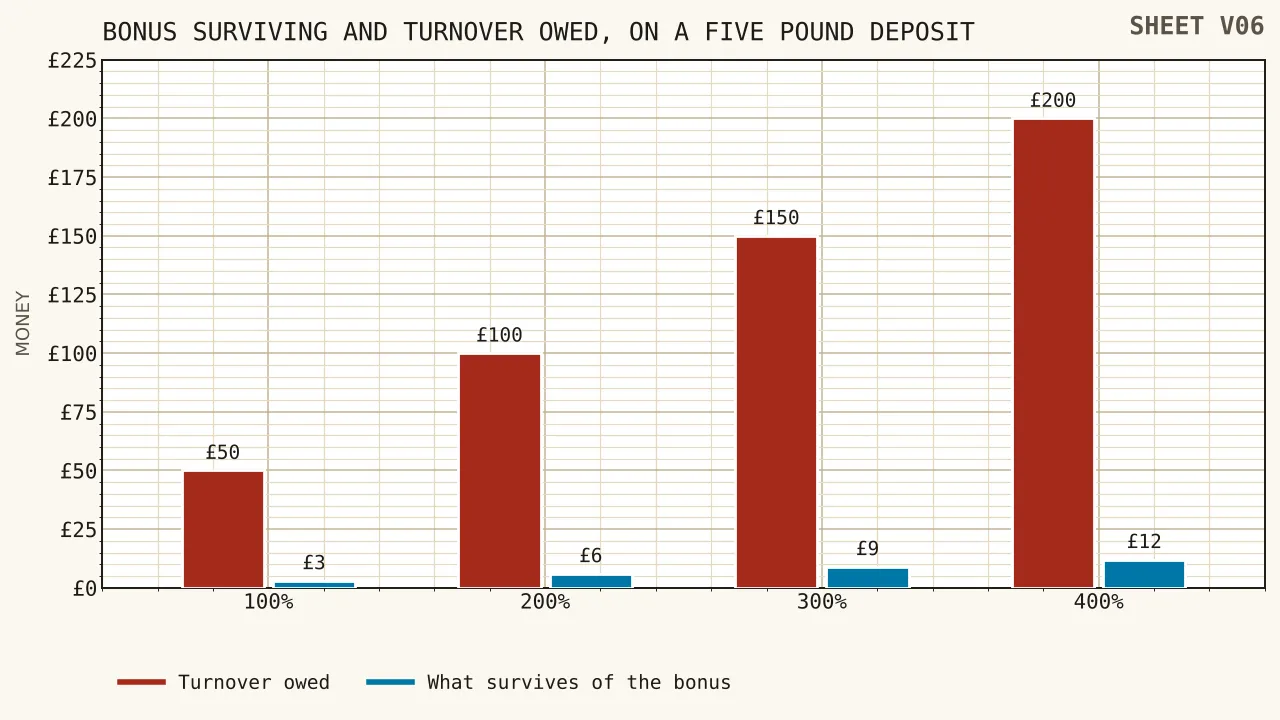
Here is the mechanism, and it is simpler than the marketing. The regulated ceiling caps the multiple while the percentage goes untouched, so a bigger percentage does not raise the turnover owed for each pound of bonus. It raises the bonus, and with it the total turnover, in exactly the same proportion. The ratio of turnover to bonus stays at ten to one in every row below, and the larger headline is therefore a larger obligation rather than a better deal.
| Headline on five pounds | Bonus | Turnover at the ceiling | Presses at 10p | Of the bonus left |
|---|---|---|---|---|
| 100 per cent | £5.00 | £50.00 | 500 | £3.00 |
| 200 per cent | £10.00 | £100.00 | 1,000 | £6.00 |
| 300 per cent | £15.00 | £150.00 | 1,500 | £9.00 |
| 400 per cent | £20.00 | £200.00 | 2,000 | £12.00 |
That table yields three points. The first is that the ten in the third column is the regulated figure and everything else is the site’s own arithmetic, which is the right way to label it. The second is that the final column comes to sixty per cent of the second right across the rows, since the expected cost of clearing is four per cent of the turnover while the turnover is ten times the bonus, so forty per cent of any bonus goes on the clearance and sixty survives, at every scale. The third is the clock, which the table leaves out and which deserves its own line.
Five hundred presses at 2.5 seconds is 1,250 seconds, 20 minutes and 50 seconds. A thousand is 41 minutes and 40 seconds. Fifteen hundred comes to 1 hour 2 minutes 30 seconds. Two thousand comes to 1 hour 23 minutes 20 seconds. So the 400 per cent headline on a five pound deposit is, read honestly, a commitment to an hour and twenty-three minutes of unbroken pressing in exchange for £12.00 of expected survival. A reader may want that. A reader should at least be shown it.
One number in the table moves if a site counts a game at less than its full stake. Let a game count at 30 per cent and each pound of required turnover needs £3.33 actually staked, so the 100 per cent row’s £50.00 becomes £166.67 through the till, 1,667 presses, an expected cost of £6.67, and a five pound bonus that finishes £1.67 down rather than £3.00 up. The printed multiple did not change. Nothing was concealed. The arithmetic simply tripled.
Ten to one in every row, and sixty per cent of any bonus surviving
3
The ceiling, and the question it leaves open
The figure doing the work in the table above is a code provision rather than a convention. A British licensee may not require staking above ten times the funds, a ceiling binding from 19 January 2026 in place of the sixty times the record carries for the period before. Its scope runs to operating licences in general, setting aside gaming machine technical licences and gambling software licences, which affects who is bound rather than how the sum is done.
From sixty to ten is a sixfold reduction and it is worth pricing on a five pound deposit, because the comparison is the clearest demonstration on this sheet of what a code provision is worth in money. A five pound bonus at sixty times is £300.00 of turnover, 3,000 presses, 7,500 seconds, and an expected cost of £12.00 against a bonus of five pounds. That is a bonus with a negative expectation of seven pounds. The same bonus at ten times costs £2.00 and leaves £3.00. The provision turned a loss of £7.00 into a gain of £3.00, a swing of £10.00 on a five pound bonus.
Twenty-five is the multiple at which a bonus breaks even, four per cent being exactly a twenty-fifth. Below it the expected cost of clearing is smaller than the bonus. Above it the cost is larger. Ten sits comfortably below twenty-five and sixty sat well above it, which is the whole story of that change expressed as arithmetic rather than as policy.
One question the provision does not settle, and this sheet will not pretend otherwise. Whether a condition that puts the deposit through the same play-through as the bonus falls inside the cap is not something any reachable source answers. What can be said is the consequence, and it is large at five pounds. If a 100 per cent match requires both the five pounds of bonus and the five pounds of deposit to be staked ten times, the turnover is £100.00 rather than £50.00, the presses double to 1,000, the expected cost doubles to £4.00, and the surviving part of a five pound bonus falls from £3.00 to £1.00. Sixty per cent of survival became twenty. A reader who cannot tell which reading a term uses should price the worse one and plan on it.
Sixty times cost £12.00 on a £5 bonus; ten times costs £2.00
4
Five pounds in, five pounds a press
There is a coincidence of figures at this deposit which is worth a part of its own, because it shows how little the size of a deposit tells anybody about the speed at which it can go.
A statutory instrument dated 25 February 2025 holds the stake on an online slot to £5.00 from 25 upward and to £2.00 between 18 and 24, its two guidance notes carrying 9 April and 21 May 2025. Slots alone are reached, which leaves a table game, or a round with a live dealer, answering to no figure of that kind.
Read that against a five pound deposit. For a reader aged 25 or over, the entire deposit is one lawful press. One press at £5.00 carries an expected cost of 20p, identical to the fifty presses at 10p, and occupies 2.5 seconds instead of 125. Same money, same expected cost, a fiftyfold difference in how long the deposit exists. Between 18 and 24 the ceiling is £2.00, so five pounds is two full presses with a pound left over, which is 5 seconds of clock and the same 20p.
| Price of a press | Presses | Clock at the floor | Expected cost |
|---|---|---|---|
| 1p | 500 | 20 min 50 s | 20p |
| 10p, this sheet | 50 | 2 min 5 s | 20p |
| £2.00, the cap at 18 to 24 | 2 and change | 5 s | 20p |
| £5.00, the cap at 25 and over | 1 | 2.5 s | 20p |
The top row and the bottom row are 500 presses apart and nothing else about them differs. That is the argument for reading the price of a press before reading anything else on a cashier page, and it is the argument this whole section of the site is built on.
One rule keeps those presses separate. Every game cycle calls for its own commitment, the start control released and depressed anew before the next opens, and a button or key or screen held down may not open any. So fifty presses means fifty decisions, and one press at five pounds means one.
One lawful press can be the whole deposit, at the same 20p of cost
5
What may not be capped on the way out
A five pound deposit rarely produces a withdrawal worth arguing about, which is exactly why the rule here is best learned at five pounds, before the sums get big enough to matter.
A licensee must not impose, use, enforce or seek to rely on any term in a consumer contract or consumer notice which has the object or effect of imposing any maximum limit on the sum a consumer takes out of their deposit balance. The regulator supplies its own example of a term that is prohibited, and the example is a sentence a reader will recognise: you may withdraw up to £50.00 per day and up to £500.00 per week.
Measure that example against this sheet. Fifty pounds is ten of these deposits. Five hundred pounds is a hundred of them. So a term of that kind would never bite on a five pound deposit or on the £4.80 it expects to return, and that is the point of learning it here: a withdrawal cap is written for winnings, and a reader who only ever deposits five pounds will never discover whether their site has one until the day it matters.
The same page states the entitlement in three further sentences. Players are entitled to withdraw money from their deposit balance, winnings included, at any time. The largest amount of money a player can withdraw at any time may carry no restriction. And any limit touching the size or the number of withdrawals must be reasonable. One precision to go with them: that page carries no publication date and no date of last update, so it can be cited for the rule and must not be given a freshness date it does not claim.
A separate technical requirement closes the other door. The option of cancelling a withdrawal request must not be given to a consumer, with the guidance adding that funds already requested should not come back as something to deposit, and that the route out should be kept as free of friction as possible. On this sheet that is worth 19p: cancel a withdrawal of £4.80 and stake it again at 10p and the next 48 presses carry that much expected cost, which is most of a second visit’s worth of edge for nothing gained.
A prohibited cap of £50 a day is ten of these deposits
6
Terms that must be fair and terms that must be clear
Everything priced above lives inside a term, which makes the condition governing terms the quiet foundation of the sheet. It has four limbs and they are worth separating, because readers tend to collapse them into one vague expectation of fairness.
The first limb: the terms under which gambling is offered, together with the consumer notices attached to them, may not be unfair in the way the Consumer Rights Act 2015 means by the word, and compliance with them is the licensee’s duty. The second: contract terms and consumer notices have to be transparent in the sense that Act gives the word, and the contract terms have to reach customers in a way that is easily accessible. The third: a change to the terms has to satisfy the same fairness and transparency requirements of that Act, and notice of a material change has to reach customers ahead of the moment it takes effect. The fourth sits alongside them and governs practice rather than wording.
Two details about that condition belong on a page of this kind. Its application is to all operating licences, gaming machine technical licences and gambling software licences aside, and its page states no effective date, which is a thing to notice rather than a gap to fill with a guess.
Priced on five pounds, the second and third limbs are where the money is. A term setting the multiple at ten rather than at some other figure is worth the £10.00 swing calculated in part three, and a term that is available in an easily accessible way is the only reason a reader can find the multiple at all. A material change told in advance is worth the difference between the arithmetic a reader planned on and the arithmetic they end up inside.
Four limbs, no effective date stated, and a £10.00 swing inside one of them
7
Five pounds at an unlicensed cashier
A five pound bonus bought offshore carries no Great Britain licence. Set against the six parts above, here is what that removes.
The ten-times ceiling goes, which on a five pound bonus is the difference between £2.00 of clearing cost and whatever multiple a term chooses, with sixty times costing £12.00 and any multiple above twenty-five turning the bonus negative. The slot stake caps of £5.00 and £2.00 go, so the one-press arithmetic in part four has no upper limit. The prohibition on a maximum withdrawal term goes, along with the regulator’s example of the sentence that is not allowed. The entitlement to withdraw at any time goes. The bar on putting a cancel button in front of a withdrawal goes. The fairness and transparency limbs go, and with them the duty to tell a customer of a material change before it bites. The 2.5-second pace floor goes, so fifty presses need not take 125 seconds.
What does not go is the arithmetic, and one obligation. Five pounds staked at a 96 per cent configuration still expects £4.80 back and 20p of cost, with the configuration itself now an unknown rather than a regulated figure, so 20p is a floor rather than an estimate. And British gaming duty takes in any operator that serves a person ordinarily resident here, a British licence or none, so the charge reaches across the border while nothing in the list above does.
The national scheme for self-exclusion covers each online gambling business licensed in Great Britain and reaches no unlicensed one, which the scheme states itself. Nothing here gives anybody a route around a self-exclusion, around software that blocks, or around a bank that has refused, and where one of those is in place the panel below holds the only useful line on the sheet.
Seven rules that halt at the border, and one charge that crosses it
8
Five pounds in one column
Five pounds at 10p is fifty presses, £4.80 of expectation, 20p of expected cost and 2 minutes 5 seconds. The 20p holds at every lawful price; what moves is the press count and the clock.
A 100 per cent match is five pounds of bonus, £50.00 of turnover at the ceiling, 500 presses, 20 minutes 50 seconds, an expected cost of £2.00, and £3.00 of the bonus surviving it. Every higher headline keeps that ratio of ten to one and that survival share of sixty per cent, so the percentage scales the obligation and the reward together and never the balance between them. A 30 per cent game weighting turns the same row into £166.67 of staking, 1,667 presses, and a bonus that finishes £1.67 down.
Sixty times on five pounds of bonus would cost £12.00, which is a swing of £10.00 against the ten-times figure in force since 19 January 2026. Twenty-five times is the break-even multiple. Where a requirement takes in the deposit beside the bonus, the turnover doubles and the surviving share drops from sixty per cent to twenty.
For the smaller end, a one pound deposit is a fifth of every figure here and a three pound minimum sits between the two. In the other direction, the high roller sheet sets the lawful ceiling against the clock, the comparison sheet puts the unit beside the published market figures, the new sites sheet reads the register, and the mobile sheet covers the duties fixed to a small screen. The section itself is what a spin is worth, and the nearest tally to fifty presses is priced on the five pound no deposit sheet.
Twenty pence to five pounds, whatever the price of a press
Questions
- How many spins is a five pound deposit?
- Fifty at 10p, and 500 at a penny. Either way a 96 per cent configuration expects £4.80 back and 20p of cost, since four per cent of the five pounds is what the cost comes to, not four per cent of a press. The fifty presses take 2 minutes 5 seconds at the lawful floor and the 500 take 20 minutes 50 seconds.
- Does a 400 per cent match beat a 100 per cent one?
- It gives more bonus and owes more turnover, in the same proportion. On five pounds the first is £20.00 of bonus against £200.00 of turnover and the second £5.00 against £50.00, a ratio of ten to one in both cases, because the regulated cap bites on the multiple and leaves the percentage untouched. Sixty per cent of either bonus survives the clearing, which is £12.00 and £3.00.
- What is the ceiling on what a five pound bonus must stake?
- Ten times the funds, which is £50.00 of turnover, 500 presses at 10p, 20 minutes 50 seconds and £2.00 of expected cost. That ceiling took effect on 19 January 2026, sixty times being the figure the record carries for before, and its scope leaves out licences for gaming machine technical work and for gambling software.
- How much was the old sixty-times figure worth?
- On a five pound bonus it meant £300.00 of turnover, 3,000 presses, 7,500 seconds and £12.00 of expected cost, so the bonus carried a negative expectation of seven pounds. At ten times the same bonus costs £2.00 and leaves £3.00, a swing of £10.00. Twenty-five times is break-even, since four per cent is exactly a twenty-fifth.
- Can a term require the deposit to be played through too?
- Whether such a condition falls inside the cap is not settled by any reachable source, so this sheet asserts neither reading. The consequence is priceable: on a 100 per cent match, staking both the bonus and the deposit ten times is £100.00 of turnover rather than £50.00, 1,000 presses, £4.00 of cost, and a surviving share that falls from sixty per cent of the bonus to twenty.
- Could a five pound deposit be one spin?
- On a licensed slot, yes, from 25 upward, because an instrument dated 25 February 2025 holds the stake there to £5.00, with £2.00 the ceiling between 18 and 24. One press at the higher ceiling carries the same 20p of expected cost as fifty presses at 10p and lasts 2.5 seconds instead of 125. The caps reach slots alone.
- Can a site cap what I withdraw?
- Not by a maximum. A licensee must not impose, use, enforce or seek to rely on any term in a consumer contract or consumer notice that would have the object or effect of capping the sum a consumer takes out of their deposit balance, and the regulator’s own example of a prohibited term reads: you may withdraw up to £50.00 per day and up to £500.00 per week. Withdrawal from a deposit balance, winnings included, is an entitlement at any time, and any cap on the number of withdrawals, or on what each one carries, must be reasonable.
- What has to be true of the terms themselves?
- Four things. Gambling terms and the consumer notices with them may not be unfair in the way the Consumer Rights Act 2015 means, and a licensee is bound to keep to its own terms. Contract terms and consumer notices must be transparent within the meaning of that Act, with the terms made available in an easily accessible way. A change must meet the same fairness and transparency requirements, and material changes must be told to customers before they take effect. The condition reaches all operating licences bar gaming machine technical and gambling software ones, and its page states no effective date.
- Why does cancelling a withdrawal cost money?
- Because a consumer must not be given the option to do it, and the arithmetic shows why the rule exists. Cancel a withdrawal of £4.80 and stake it at 10p and the following 48 presses carry 19p of expected cost, which is almost as much as the original deposit cost in the first place. The guidance adds that requested funds should not be offered back as a deposit and that the route out should be kept as free of friction as possible.
- Are offers at a five pound cashier licensed in Great Britain?
- They are not. No licence from Great Britain covers them, so the ten-times ceiling, the £5.00 and £2.00 slot caps, the bar on a maximum withdrawal term, the entitlement to withdraw at any time, the bar on a cancel button, the fairness and transparency limbs and the 2.5-second pace floor are all absent. British gaming duty still reaches an operator serving a person ordinarily resident here. Nor does the national scheme for self-exclusion, and nothing on this page gives anybody a route around a self-exclusion, around software that blocks, or around a bank that has refused.