Sheet V02 Revision 1 Counted 16 October 2026
New casino sites: what a launch offer is worth, and what new actually means
A launch award of 240 spins at 10p is £24.00 of staking and an expected £23.04. That figure is comparable across every site a reader is looking at, new or old, because it is built from two numbers rather than from a banner. This sheet prices the offer, then sets out what the public register can and cannot tell a reader about a site that opened last month.
Launch tally 240 spins One spin 10p Expected £23.04
What a count of this size comes to
Every destination on this board is bought advertising. The site takes a fee if a reader goes on to register, and no figure printed below moves because of it.
The Spin Count
Gauge No 01
Betportal
Lowest multiple here
Priced at this site's own 10p a spin
What is counted
What is asked
No Great Britain licence
Licensed in Anjouan, Comoros, run by BetPortal Gaming Ltd, with Excite Ultra Media Ltd, reference ALSI-202601040-FI2.
Terms read 16 October 2026
Open the offer at Betportal, opens in a new tabThe Spin Count
Gauge No 02
WinBeast
Largest count here
Priced at this site's own 10p a spin
What is counted
What is asked
No Great Britain licence
Licensed in Curaçao, operator not named on the site.
Terms read 16 October 2026
Open the offer at WinBeast, opens in a new tabThe Spin Count
Gauge No 03
EliteSpin
Longest spin window
Priced at this site's own 10p a spin
What is counted
What is asked
No Great Britain licence
Licensed in Costa Rica, run by PrimeTier Limited.
Terms read 16 October 2026
Open the offer at EliteSpin, opens in a new tabThe Spin Count
Gauge No 04
Crown Jewelz
Multiple unpublished
No foot figure struck
What is counted
What is asked
No Great Britain licence
Licensed in Curaçao, number not verified, operator not named on the site.
Terms read 16 October 2026
Open the offer at Crown Jewelz, opens in a new tabThe figure in the third register is this site's own arithmetic and nothing an operator has published: the count at face, less the share a spin gives back at 96 per cent return to player, less what playing the wagering through costs at the same return. It describes the offer, not one reader's afternoon. Where the conditions price above the count the counter prints nothing rather than a negative sum, and where a figure the sum needs is unpublished it prints the condition in the operator's words instead.
A count has no unit of its own, so one is supplied. Where an operator publishes what a spin of its own is worth, that figure stands in the second register and is labelled as theirs. Where it does not, the second register carries this site's own 10p a spin and says so, and the foot figure moves in proportion: at half the price, half the money. The figure after it, what the count comes to for each spin, is the one that compares a large count against a small one.
Three words stand in the amount column where no figure can. Noted is a published condition that takes value away without leaving the sum a figure to take. Unpriced is a condition whose figure nobody has published, or a credit that is not a sum until a deposit of your own sets it. Own money is money of yours, which is never part of a foot figure.
Not one of the operators printed above holds a Great Britain licence, so the duties that licence carries do not reach them. Every online gambling company licensed in Great Britain has to be part of Gamstop Online, and a reader who has shut themselves out through the scheme is therefore not shut out here. The ceiling of ten times the bonus funds on a wagering requirement, in force since 19 January 2026, is a condition of that licence and binds the companies that hold one. Where a dispute goes instead is a matter for the authority named on the counter, and the Gambling Commission describes what a reader faces without a British licence as a lack of recourse if things go wrong. Nobody under 18 may hold an account at any of them.
Every term printed on a counter is the operator's own, and each counter carries the day it was read. The oldest of those readings is 16 October 2026. What binds a reader is the operator's own full terms, and not a line printed here.
1
A launch offer, priced before anything else
A site that opened recently has one thing to sell that an established one does not, which is novelty, and novelty has no cash value. So the first move with any launch offer is the same as with any other: convert the tally into money and compare it with the tally next to it.
Take 240 spins, a size that suits a launch because it looks generous and costs little. At the 10p this site works to, 240 spins carry £24.00 of staking. Send that through a game returning 96 pence in the pound and the expectation is £23.04, with 96p kept by the house.
Two arithmetical habits make the rest of this sheet portable, and both take one line. To turn any tally into money at the price this site uses, multiply by 9.6p: a launch award of 240 comes to £23.04, one of 300 to £28.80, one of 500 to £48.00. To turn any tally into time at the lawful floor, multiply by 2.5 seconds and divide by 60: 240 spins is ten minutes, 300 is twelve and a half, and 500 is twenty minutes and fifty seconds. A reader with those two multiplications can price a launch offer from the banner alone, and then spend the saved effort on the terms instead.
One further conversion is worth making before any comparison, because it prices the thing a reader actually supplies. Ten minutes of pressing for an expected £23.04 is £2.30 a minute at 10p a spin, 23p a minute at a penny, and £5.76 a minute at 25p. Those rates are the only honest way to compare a launch award against the time it asks for, and none of them appears in a banner.
Those three figures travel with the reader to the next site on the list, which a headline count does not.| One spin priced at | Staking funded | Expected back | Minutes at the floor pace |
|---|---|---|---|
| 2p | £4.80 | £4.61 | 10 |
| 5p | £12.00 | £11.52 | 10 |
| 10p | £24.00 | £23.04 | 10 |
| 20p | £48.00 | £46.08 | 10 |
| 25p | £60.00 | £57.60 | 10 |
The right-hand column is identical all the way down, and that is the useful oddity. Time follows the tally and ignores the stake. With 2.5 seconds owed between cycles on a licensed slot, 240 of them occupy 600 seconds, or ten minutes, whatever each one costs. So 240 spins is ten minutes of pressing whatever happens, while the money moves across that price band by twelve and a half times.
Both of the figures underneath this are declared rather than discovered. No published source fixes the worth of a free spin, names whoever settles it, or requires it to be printed. A licensed site need not publish a return percentage either, four alternatives being enough to satisfy the information duty, with an “or” between them. So the method is to state the assumptions, show the working, and let a reader substitute their own.
A launch award is the one place on this site where a reader should be most careful with the word new. A new brand is not a new licence, a new licence is not a new company, and none of the three is a new platform. Parts two to five are about telling those apart from published material, because the difference decides who the reader is actually contracting with.
2
New means a licence with a start date
The British regulator publishes a public register, and that register is where the word new can be given a date. Four registers are published: businesses, individuals, premises, and the actions taken by the regulator. The businesses register, the personal licences register and the premises register can each be searched and downloaded. Published alongside them are public statements, regulatory actions and responses to freedom of information requests.
What that gives a reader about a new site is a set of dates rather than an opinion. A licence has a start date for each activity it authorises, so a site whose remote casino licence begins in the current year is new in the only sense the register recognises. A brand that has moved from one licence holder to another will show a start date on the new account and an end date on the old one, and the sequence of those two dates is the migration.
Two figures put the register’s size in perspective, and both come from the annual statistics covering April 2025 to March 2026. The figures at 31 March 2026 were 2,154 operators holding licences, and 3,097 activities licensed between them. Those are counts of operators and activities rather than of websites, and a single licence can carry a long list of domains, which is why a count of brands cannot be read off them.
One caution belongs with every use of the register, and it is the regulator’s own silence rather than a criticism. The register page carries no date and no guidance on how to read it. It says nothing about how to interpret domain names listed against a licensee, and nothing about the meaning of an active or an inactive status. So a page built on register data publishes the date of its own check, and stops short of implying an interpretation the regulator has never given.
2,154 operators, 3,097 licensed activities, and no count of websites anywhere
3
Four checks, and what each one proves
The regulator publishes a short list of things a player should check before gambling anywhere, and on a new site each item does a different job. Taken in order: a Gambling Commission licence held by the business; a licensed status shown on the website; a working route through to the public register, where the licence can be seen; and agreement between the register and the licence details, activities and website domain names included.
The fourth is the one that matters most at a launch, and the reason is structural. A new site has a new domain, and a domain only appears against a licence once somebody has put it there. Where the site displays a licence number but the domain does not appear on that account’s list, a reader is looking at a mismatch between the claim and the record, and the register is the authority on which is which.
| The check | What it proves | What it does not |
|---|---|---|
| A licence is held | somebody is licensed | that it is the site in front of you |
| A licensed status is displayed | the site makes the claim | that the claim is current |
| The click reaches the register | the account number resolves | which domains sit on it |
| Activities and domains match | this website is covered | who owns the brand |
The arithmetic reason to run each check on a new site is in part one of this sheet. A 240-spin launch offer is worth about £23.04, and claiming it costs an account plus three verified identifiers. A reader who spends two minutes on four checks is spending two minutes to find out who holds the other side of a twenty-three pound transaction, which is a better ratio than most things on the internet.
One further published duty makes the checks meaningful. Identity has to be settled before a customer gambles at all, the floor being three items, a name, an address to post to and a birth date, and the duty reaches play paid for out of a bonus, and reaches the prize-free versions of the licensee’s own games as well. A site that lets a reader spin before any of that has happened is not following the rule, whatever its footer says.
4
What the register will not tell you
A page about new sites should be as clear about the gaps as about the figures, because the gaps are where a reader gets misled. Four things cannot be read off the published record, and this sheet will not supply any of them.
There is no count of licensed remote casino operators. Remote casino, betting and bingo are reported together as one sector, whose gross gambling yield for the year ending March 2026 came to £8.3 billion, a rise of 6.9 per cent. No casino-only operator count can be read off a combined sector figure, so the only operator counts available are the 2,154 operators and 3,097 activities in part two.
There is no count of websites, new or otherwise. Domains appear against licences, a single licence can carry a very large number of them, and the register publishes no guidance on reading that list. A sentence beginning with a number of new casino sites is a sentence somebody has made up.
There is no statement of who owns a brand. The register names the licensee, and the licensee is the company a reader contracts with, which is not necessarily the company whose name is on the website. Where the two differ, part five explains the mechanism.
And there is no as-at date on the download page. The register is live data, the download page states no date, and the result is that two readers checking in the same week can honestly report different things. The only defensible practice is to record the date of the check, which is what the sheets on this site do.
One figure for scale, because a page about new sites invites a reader to imagine a crowded market. Across the whole of Great Britain the gross gambling yield for April 2025 to March 2026 was £17.5 billion, a 4.4 per cent increase on the year before, and £13.2 billion of that excludes all reported lotteries. Inside the online sector, £5.7 billion came from casino games, of which slots alone accounted for £4.8 billion.
Two more published figures help a reader size the market a new site is entering, and both carry their period. For April 2025 to March 2026 the regulator reports 25.7 million accounts active as the final reporting quarter closed. Licensed gambling premises numbered 8,081, down 2.0 per cent, and betting shops 5,617, down 3.6 per cent. Those premises counts are land-based and say nothing about websites, which is the point: the published record counts operators, activities, accounts and premises, and never counts sites.
Those are the published sizes. The number of sites competing for them is not published at all.5
A domain can be licensed to somebody else
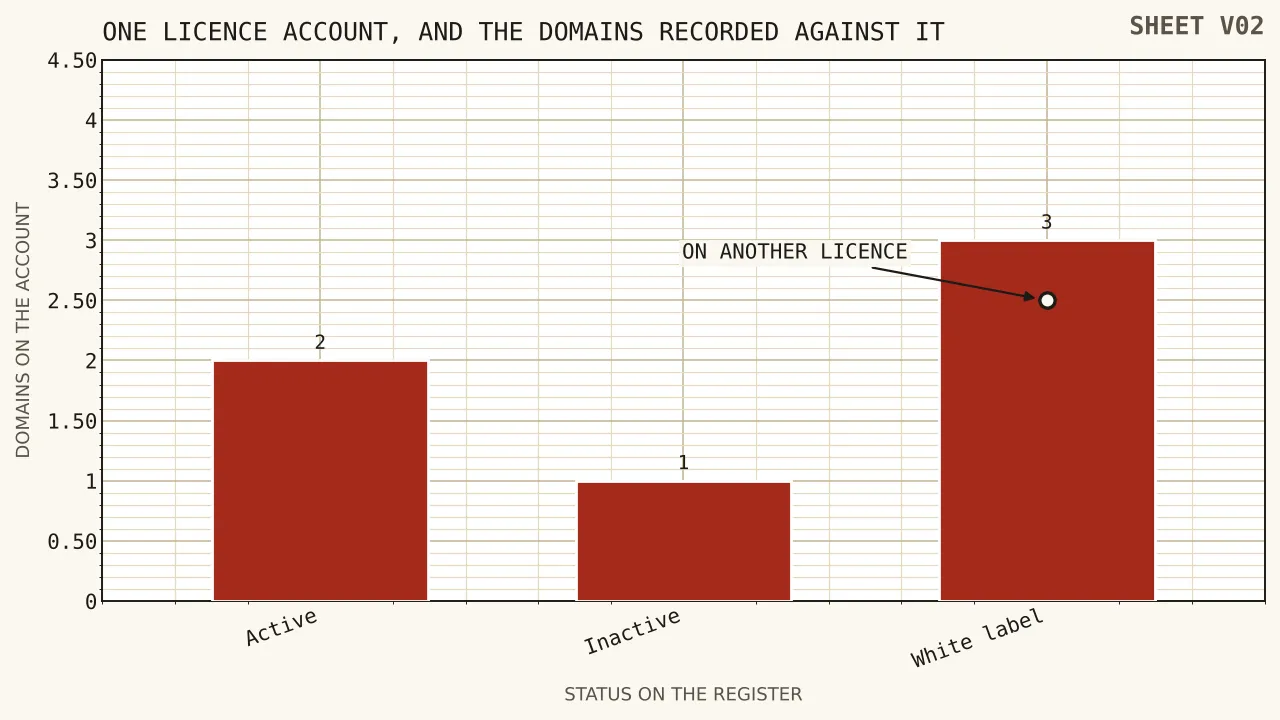
The register records three statuses for a domain, and a reader looking at a new site needs all three. The three are Active, Inactive and White Label. The third is the one that surprises people, and it is the ordinary way a new consumer brand reaches the market.
White Label marks a domain as licensed, and it means the website is running on an operating licence belonging to another company, so the brand on the front and the licensee on the register are two businesses. None of that is a defect or a loophole. Licence conditions bind the licensee, the licensee answers for the site, and the reader’s contract is with the licensee and not with the brand.
What it changes is the question a reader should ask. On a new site with a white label arrangement, the brand may be weeks old while the licence behind it is years old, or the reverse. The honest sentence names the holder of the licence, gives the account number, and says the site runs on that company’s licence, which is how the review sheets here are written.
It also changes what a reader can infer from the look of a site. A platform shared across many brands means the games, the cashier and the terms may be identical from one new brand to the next, and the only thing that is genuinely new is the front page. Pricing the offer rather than the branding is the defence against that, and the whole of this site is built on it.
Two practical notes follow. First, where a domain appears on one account as Inactive and on another as Active or White Label, the active record is the live one and the sequence of dates shows the move. Second, an account number resolving on the register is not the same as the domain appearing on it, which is why the fourth check in part three is the one that settles whether the licence covers the website.
6
January 2026, and the line it draws
One date matters more than any other to a reader comparing new sites with old ones. On 19 January 2026 a ceiling of ten times the bonus funds came into force on wagering requirements attached to incentives, under the social responsibility code provision that governs them. A site licensed in Great Britain after that date has never been permitted to print a requirement above ten times.
The practical consequence is a comparison a reader can make without reading any terms. Where an offer asks for fifteen, twenty or forty times, it is not an offer from this market. What the ceiling replaced stands on the regulator’s record at sixty times, and it is the one market multiple here attributed to the regulator instead of to this site.
Put the ceiling against the launch tally in part one. The proceeds of 240 spins have an expectation of £23.04. A tenfold requirement on that balance is £230.40 of turnover, which is 2,304 further spins at 10p and 96 minutes at the lawful minimum pace. Three fifths of the balance survives, or £13.82, two fifths being what ten times a 4 per cent edge removes.
| Requirement printed | Turnover owed | Spins at 10p | Minutes at floor pace | Expected to survive |
|---|---|---|---|---|
| Nothing on the proceeds | nil | nil | nil | £23.04 |
| Five times | £115.20 | 1,152 | 48 | £18.43 |
| Ten times, the ceiling | £230.40 | 2,304 | 96 | £13.82 |
| Twenty times | £460.80 | 4,608 | 192 | £4.61 |
| Forty times | £921.60 | 9,216 | 384 | a deficit of £13.82 |
A British licence supplies only the top three rows. The last two describe offers printed elsewhere, and the final row is the clearest demonstration on this page of what a large multiple does: at forty times the balance is expected to be exhausted before the requirement is met, and the staking after that point comes out of the reader’s own money.
A second rule took effect on that same date and shapes how a launch package may be put together. Across the four types the provision names, those being lottery, bingo, casino and betting, a single incentive may reach only one. Slots count as casino, so a launch package of spins with a cash match sits inside one type, while spins with a book of bingo tickets reaches into two and cannot run through one shared requirement.
7
Comparing two launch offers in one unit
The practical value of a spin price is that it makes unlike offers comparable, and launch offers are deliberately unlike. Spins at one site, a match at the next, a mixture at the third. All three can be reduced to an expectation in pounds, and the arithmetic takes three lines each.
For a tally of spins, multiply the tally by the spin price by the return. For a cash bonus, multiply the bonus by one less the multiple times the house edge. For a deposit match, apply the second of those to the bonus alone. The deposit stays the reader’s own money throughout and forms no part of what the offer hands over.
| How it is advertised | Headline | Worked expectation | Turnover owed | Minutes at the floor |
|---|---|---|---|---|
| Spins, nothing asked | 240 spins | £23.04 | nil | 10 |
| Spins with a tenfold requirement | 240 spins | £13.82 | £230.40 | 106 |
| A £20 cash bonus at ten times | £20 bonus | £12.00 | £200.00 | 83 |
| A 100 per cent match on £20 | £20 matched | £12.00 | £200.00 | 83 |
Two conclusions come off that table and both are useful at a launch. The first row is worth £23.04 and the second is worth £13.82, which is what a requirement costs even when the tally is identical. And the third and fourth rows are the same offer dressed differently: a cash bonus of twenty pounds and a hundred per cent match on a twenty pound deposit produce the same bonus, the same turnover and the same expectation, with the difference being that the match asks the reader to put £20.00 of their own money through the same cashier first.
One more thing the cap does not do, since a launch is where the largest percentages appear. The ceiling governs a multiple and not a percentage, so a larger match leaves the turnover per pound of bonus exactly where it was. It raises the bonus, and the turnover rises in the same proportion. On a £10.00 deposit, a 100 per cent match gives £10.00 of bonus and at most £100.00 of play-through; 200 per cent gives £20.00 and £200.00; 300 per cent gives £30.00 and £300.00; 400 per cent gives £40.00 and £400.00. Ten to one holds throughout, which makes the bigger headline the bigger obligation and nothing else. Ten is the regulated figure; everything else in that sentence is arithmetic done here.
8
A new site and a new complaint
A site with no history is a site with no complaints record, which cuts both ways, so the useful thing to know is what the process looks like if a reader needs it. On a British licence the clocks are published and they do not depend on the age of the site.
The whole process, internal escalation included, has to finish within eight weeks of first receipt. The right to complain stays open for six months at the least, counted from the date of the incident. Acknowledgement should come as soon as reasonably possible, inside three working days at the outside, falling to a single day at an operator open at all hours.
After that the case goes to an independent dispute resolution body, and the regulator approves the bodies a licensee may use. Eight sit on the published list, and their sector coverage is not uniform. Five carry remote across every sector. Two appear against all sectors in the table, though one of that pair names betting alone in its own entry. And one is listed for non-remote settings only, which leaves remote casino off it entirely. That page carries a May 2021 publication date and a revision in January 2025.
What the regulator will not do is worth knowing before a reader writes to it. Four statements cover it. The word it uses about itself is that it is no ombudsman. Settling a gambling complaint lies outside its powers, and so, on its own statement, does getting a consumer’s money back. A dispute over a transaction is outside what it can resolve, and so is a stuck withdrawal or a faulty game. And customer accounts are not visible to it. Its instruction to a player is that the business hears the complaint first.
Against a launch award worth £23.04, those timings are the honest frame for a decision. Eight weeks of correspondence over twenty-three pounds is a poor use of anybody’s time, and the process exists anyway, because the same eight weeks apply to a dispute over £2,304.00. The number that should decide whether a reader joins a new site is the one in part one, and the number that should decide whether they pursue a complaint is whatever is in dispute.
9
New offshore, and a regulator in mid-reform
Many of the sites advertised as new to a British reader are new offshore sites, and those hold no Great Britain licence. None of parts two to six applies to them: there is no British register entry to check, no ten-times ceiling on the launch offer, and no account number to reconcile against a domain.
What there is instead, in the jurisdiction most often named, is a regulator in the middle of a reform. The Curaçao Gaming Authority gives its own origins as a foundation, incorporated in April 1999 on the nineteenth, set up as the regulator for that whole industry, in Curaçao and from it, and brought about by a second Mutual Evaluation Report, which the Caribbean Financial Action Task Force issued in 1998. Its online gaming page describes it as the regulator for the online gaming industry.
Its governing law is an ordinance on games of chance, which the authority’s online gaming page says came into effect on 24 December 2024, calling it a pivotal reform of the sector, with the process behind it starting in November 2023. Its functions, as listed, run to licensing and supervising online gaming, licensing and supervising land-based casinos, granting, amending, revoking and suspending numbers lottery licences, taking notifications for charitable goods lotteries, bingo and bon ku ne, and supervising anti-money-laundering and counter-terrorist-financing compliance across the industry.
Three cautions belong with that, and all three are the authority’s own material rather than this site’s commentary. Its own site contradicts itself on the date: the About Us page states that the ordinance was enacted on 24 December 2025 and, in another section, gives entry into force as 24 December 2024, while the online gaming page gives 24 December 2024. Two of those three statements support the 2024 date, which is the one to use, and a page relying on it should say that a 2025 date also appears. When this sheet was put together, a statement on the authority’s own site said the online gaming portal was offline. And no count of licensees could be taken from it with a date attached, so nothing on this site states how many operators hold a licence there.
A second jurisdiction appears often enough on new sites to need a line. Anjouan licences come from a body that publishes on a commercial domain, with no government address behind it. It calls itself a gaming authority, with an internet gaming regulatory authority as its subtitle, and claims the role of designated regulator for licensing and supervising internet gaming operations, working beneath an offshore financial authority that it says was set up under the island’s own laws, Anjouan being part of the Comoros. Nowhere on it is an ordinance, an Act or a regulation named. Maintaining a public register is something it claims, and it offers a verification tool for a licence as well. Two further pages are listed as well. One covers a complaint process for players, the other names authorised dispute providers, and neither could be read, the first having returned an error when it was fetched.
The position for a reader looking at a new offshore site is therefore lopsided, and the offer has nothing to do with it. On the British side there is a register with dates, a published list of approved dispute bodies, and a ceiling on what a launch offer may demand. On the other side there is a rulebook that can be read, a complaints framework running six months for the player and eight weeks for the answer, and an authority whose own portal was offline when checked.
The loss that no launch offer compensates is the national self-exclusion scheme. Membership rides on the British licence, so a new British site belongs from its opening day, and the scheme states that its exclusions reach the gambling services of participating operators while an organisation outside it is past the help it can give. A new offshore site is outside the scheme by construction. No sentence here assists anybody in working round an exclusion of their own, and the helpline below costs nothing and answers at any hour.
One figure stays the same whichever side a new site sits on. Wherever it sits, an operator comes within British gaming duty as soon as it takes remote gambling from a person ordinarily living in the United Kingdom, and 40 per cent of operator profits has been the charge on remote gaming since 1 April 2026. What a reader may rely on is what a new licence changes. Who bears the duty is unchanged by it.
Questions
- What is a launch offer of 240 free spins worth?
- £23.04 on average, worked at 10p for one spin against a return of 96 per cent on £24.00 of staking. The same tally is worth £4.61 at 2p a spin and £57.60 at 25p, so the price of a spin decides the offer and the tally decides only the time, which is ten minutes either way.
- How can I tell whether a casino site is genuinely new?
- By the licence dates on the public register, which records a start date for each activity a licence authorises. A brand that has moved between licence holders shows a start date on one account and an end date on the other. The register publishes no as-at date, so any check has to be reported with the date it was made.
- How many new casino sites are there?
- Nobody publishes that figure, and this site will not invent one. What the register gives, as at 31 March 2026, is 2,154 operators and a total of 3,097 licensed activities, which counts neither brands nor websites. Remote casino, betting and bingo are also reported as one sector, so no casino-only operator count can be read off the statistics either.
- What should I check before signing up to a new site?
- Four things, kept in the regulator’s own order. A Gambling Commission licence held by the business. A licensed status shown on the site. A working click through to the public register. And agreement between the register and the licence details, activities and domain names included. The fourth is the one that matters at a launch, because a new domain only appears on an account once somebody has added it.
- Why does a new brand sometimes name a different company?
- Because the register records some domains as White Label, which means the website runs on another company’s operating licence. Such a domain is a licensed one, the conditions bind whoever holds the licence, and the reader contracts with that holder rather than with the brand. The honest description names the licence holder and its account number.
- Are new sites allowed to ask for forty times wagering?
- Not on a British licence. A ceiling of ten times the bonus funds has applied to requirements attached to incentives since 19 January 2026, so a site licensed here after that date has never been able to print more than ten times. The regulator records requirements of up to sixty times as the practice the ceiling replaced.
- What does a tenfold requirement do to a 240-spin launch award?
- It takes £23.04 down to £13.82, ten lots of a 4 per cent edge amounting to 40 per cent of the balance. Turnover owed comes to £230.40: 2,304 further spins at 10p, and 96 minutes once each cycle takes its 2.5 seconds.
Game weighting is the figure that turns the minutes in that table into hours, and a launch offer is where it hides. Apply a contribution rate of 30 per cent, the figure respondents put to the consultation. Buying the £230.40 of progress in the tenfold row then takes roughly £768.00 of staking. At 10p that is 7,680 spins and 320 minutes at the floor pace, for the same expected £13.82 at the end. The money does not move and the time more than triples, which is why a contribution table is worth finding before a tally is.
- Is a 200 per cent match better than a 100 per cent one?
- It is larger, and the obligation is larger in the same proportion. On a £10.00 deposit a 100 per cent match gives £10.00 of bonus and at most £100.00 of play-through, while 200 per cent gives £20.00 and £200.00. The ratio of ten to one is fixed by the ceiling, so the percentage changes the size and not the terms.
- What happens if something goes wrong at a site with no track record?
- The published clocks apply whatever the age of the site. Acknowledgement is owed as soon as reasonably possible, and inside three working days at the latest, cut to one day at an operator trading at all hours, with the full process closing inside eight weeks. Six months at least is the window for bringing a complaint, counted from the incident, and the case afterwards goes to one of the eight approved dispute bodies.
- Will the Gambling Commission settle it for me?
- No. It states that it is no ombudsman. Resolving a gambling complaint is not among its powers, nor is getting a consumer’s money back. Complaints about a gambling transaction, a withdrawal that has stuck or a game that has failed, are outside what it can resolve. And it has no sight of a customer account. It tells players to complain to the business first.
- What is different about a new offshore site?
- Nothing exists to reconcile against a British register entry, no ceiling governs what the launch offer may demand, and the national scheme for self-exclusion does not reach it. In the jurisdiction named most often, the ordinance is given as effective from 24 December 2024 on the authority’s online gaming page, a conflicting 2025 date sits on its About Us page, and its own portal for online gaming was stated offline when this sheet was compiled.