Sheet P13 Revision 1 Counted 16 October 2026
Slots sign up bonus: the only product with statutory stake figures
Pay £50.00, take £50.00 of credit, and a licensed cashier may ask for £500.00 through the reels and no more. That staking is expected to cost £20.00, so the credit is worth £30.00. Slots are also the one product carrying stake figures set by statute, £5 a cycle and £2 for anyone under 25, and those figures change how long £500.00 takes without changing what it costs.
Payment £50.00 A cycle priced at 10p Comes to £30.00 when the demand is ten
What a slots credit comes to
Every destination on this board is bought advertising. The site takes a fee if a reader goes on to register, and no figure printed below moves because of it.
The Spin Count
Gauge No 01
Betportal
Lowest multiple here
Priced at this site's own 10p a spin
What is counted
What is asked
No Great Britain licence
Licensed in Anjouan, Comoros, run by BetPortal Gaming Ltd, with Excite Ultra Media Ltd, reference ALSI-202601040-FI2.
Terms read 16 October 2026
Open the offer at Betportal, opens in a new tabThe Spin Count
Gauge No 02
WinBeast
Largest count here
Priced at this site's own 10p a spin
What is counted
What is asked
No Great Britain licence
Licensed in Curaçao, operator not named on the site.
Terms read 16 October 2026
Open the offer at WinBeast, opens in a new tabThe Spin Count
Gauge No 03
EliteSpin
Longest spin window
Priced at this site's own 10p a spin
What is counted
What is asked
No Great Britain licence
Licensed in Costa Rica, run by PrimeTier Limited.
Terms read 16 October 2026
Open the offer at EliteSpin, opens in a new tabThe Spin Count
Gauge No 04
Crown Jewelz
Multiple unpublished
No foot figure struck
What is counted
What is asked
No Great Britain licence
Licensed in Curaçao, number not verified, operator not named on the site.
Terms read 16 October 2026
Open the offer at Crown Jewelz, opens in a new tabThe figure in the third register is this site's own arithmetic and nothing an operator has published: the count at face, less the share a spin gives back at 96 per cent return to player, less what playing the wagering through costs at the same return. It describes the offer, not one reader's afternoon. Where the conditions price above the count the counter prints nothing rather than a negative sum, and where a figure the sum needs is unpublished it prints the condition in the operator's words instead.
A count has no unit of its own, so one is supplied. Where an operator publishes what a spin of its own is worth, that figure stands in the second register and is labelled as theirs. Where it does not, the second register carries this site's own 10p a spin and says so, and the foot figure moves in proportion: at half the price, half the money. The figure after it, what the count comes to for each spin, is the one that compares a large count against a small one.
Three words stand in the amount column where no figure can. Noted is a published condition that takes value away without leaving the sum a figure to take. Unpriced is a condition whose figure nobody has published, or a credit that is not a sum until a deposit of your own sets it. Own money is money of yours, which is never part of a foot figure.
Not one of the operators printed above holds a Great Britain licence, so the duties that licence carries do not reach them. Every online gambling company licensed in Great Britain has to be part of Gamstop Online, and a reader who has shut themselves out through the scheme is therefore not shut out here. The ceiling of ten times the bonus funds on a wagering requirement, in force since 19 January 2026, is a condition of that licence and binds the companies that hold one. Where a dispute goes instead is a matter for the authority named on the counter, and the Gambling Commission describes what a reader faces without a British licence as a lack of recourse if things go wrong. Nobody under 18 may hold an account at any of them.
Every term printed on a counter is the operator's own, and each counter carries the day it was read. The oldest of those readings is 16 October 2026. What binds a reader is the operator's own full terms, and not a line printed here.
1
Fifty pounds in, five hundred through
Start with the shape of the thing. A payment of £50.00 meets a match of the same size, the balance reads £100.00, and half of it carries a condition. Ten turnovers of the credit is the most a licensed cashier may ask, so the obligation is £500.00 of staking on reel games.
At a 4 per cent edge, £500.00 of staking is expected to cost £20.00. Subtract that from the £50.00 of credit and £30.00 is the expected end of the exercise. Per pound paid in, the offer is worth 60p. Those are the three numbers the rest of this page moves around.
The declared working figures, as everywhere on this site: a cycle of a reel game priced at 10p, a long-run return of 96 per cent on money put through, and a pound of staking counting as a pound against the demand unless a term cuts it. None of the three is published by anybody. The first two belong to the game and the third belongs to the offer.
What makes a slots sign-up offer different from the others in this section is not the arithmetic. It is that slots are the only product with stake figures written into a statutory instrument, and those figures change the shape of the £500.00 without touching the £20.00.
Why the £20.00 does not move. Expected cost is the edge multiplied by the money that passes through the game. £500.00 at 4 per cent is £20.00 whether it arrives as 5,000 cycles of 10p or 100 cycles of £5. The stake size decides how long the obligation takes and how violently the balance swings. It does not decide the price.
2
The two figures written into statute
25 February 2025 is the date on the regulations. What they do is put a ceiling on a single game cycle. For an individual of 25 or over the ceiling is £5. For one who has not reached 25 it is £2. The condition rides on every remote casino operating licence, and a licence granted before the regulations were made carries it as well.
Commencement arrived in two stages. For six weeks the higher figure stood alone and applied at every age; only once those weeks had run did the lower figure begin for players of 18 to 24. The instrument names no calendar date at all, putting the commencement in the form of a period instead, so the dates have to be taken from the Commission’s guidance. The first of them is 9 April 2025. The second is 21 May 2025.
| Term | Substance of the definition |
|---|---|
| An online slots game | Played online, reel-based, and a casino game |
| A reel-based game | Images or text that move or change, displayed through reels or by some other means |
| Why the arrangement matters | The prize turns on it, or whatever other opportunity stands in a prize’s place |
| Outside the definition | Casino games built on something other than reels, roulette and blackjack among them |
The guidance is explicit on that last row: the figures reach online slots and stop there. A reader at a roulette table is outside them, which is worth knowing before a bonus is taken on a mixed account, because a slots-only offer and a slots-only stake ceiling do not always arrive together.
| Player | Ceiling on one cycle | Date the guidance gives | Cycles £500.00 of staking represents |
|---|---|---|---|
| Aged 25 or over | £5 | 9 April 2025 | 100 cycles |
| Aged 18 to 24 | £2 | 21 May 2025 | 250 cycles |
| At this page’s working price | 10p | not a statutory figure | 5,000 cycles |
So a slots sign-up offer is the one place in this section where a reader can put a legal ceiling on a single cycle. On a £500.00 obligation, a player over 25 staking at the ceiling clears it in 100 cycles. A player under 25 needs 250. A player at 10p needs 5,000, which is fifty times the first figure for the same £20.00 of expected cost.
The ratio between the two statutory figures is 2.5, and it carries straight into the cycle counts. A player under 25 needs two and a half times as many cycles as a player over 25 to put the same £500.00 through, which is 250 against 100, and two and a half times as long to do it. Between the two commencement dates there was a six-week stretch when the £5 ceiling applied to every age, so an 18-year-old and a 45-year-old faced the same figure for that period and then did not.
£500.00 of staking is 100 cycles at £5 and 5,000 cycles at 10p
3
Same cost, different clock
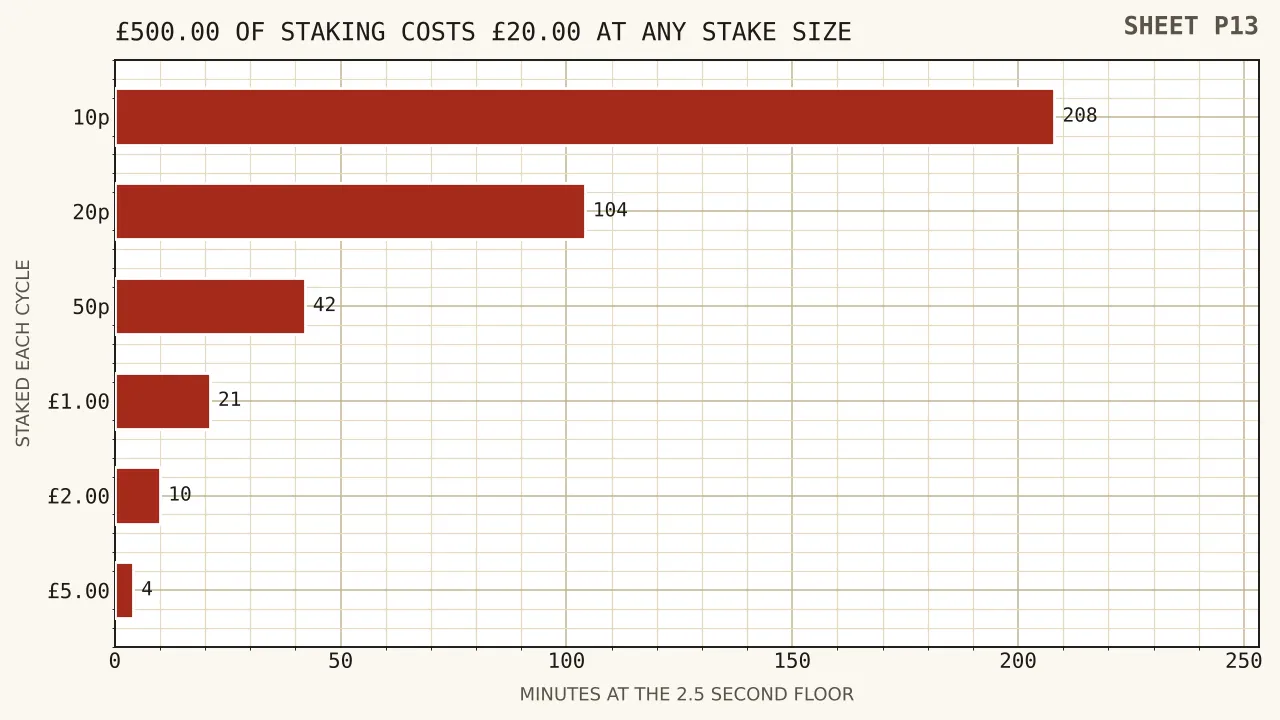
Time is the quantity the stake size actually governs. Where a licence applies, 2.5 seconds must pass before a further cycle of a reel game may begin, and 24 cycles a minute is what that permits at the outside. Multiply the cycle counts above by 2.5 seconds and the obligation acquires an hours figure.
| Staked each cycle | Cycles it takes | Least time possible | Cost expected | What the £50.00 leaves |
|---|---|---|---|---|
| 10p | 5,000 cycles | 3 h 28 m 20 s | £20.00 of cost | £30.00 |
| 20p | 2,500 cycles | 1 h 44 m 10 s | £20.00 of cost | £30.00 |
| 50p | 1,000 cycles | 41 m 40 s | £20.00 of cost | £30.00 |
| £1 | 500 cycles | 20 m 50 s | £20.00 of cost | £30.00 |
| £2 | 250 cycles | 10 m 25 s | £20.00 of cost | £30.00 |
| £5 | 100 cycles | 4 m 10 s | £20.00 of cost | £30.00 |
Four of the five columns move and one does not. That invariance is the most useful single fact about clearing a reel requirement, and it cuts both ways. Staking larger does not make the condition cheaper. Staking smaller does not make it dearer. It makes it longer, and a longer session is its own kind of cost.
What does change with the stake is the spread of outcomes around the £30.00. One hundred cycles of £5 produce a handful of large results and a wide range of possible endings. Five thousand cycles of 10p produce something much closer to the mean. A reader who wants the £30.00 figure to mean anything in practice wants the larger count, and the larger count costs three and a half hours.
One cycle at the £5 ceiling carries the staking of fifty cycles at 10p. That is why the time floor and the stake ceiling are worth reading as a pair rather than separately. The floor is written per cycle, so it slows the cycles and not the money: at 10p a player can move 2.40p of expected cost a minute, and at £5 the same floor permits £4.80 of expected cost a minute, which is two hundred times as much. The ceiling on the stake is what stops the floor from being a formality.
4
The headline cannot move the ratio
Ten limits the multiple applied to the bonus, and says nothing about the percentage used to work the bonus out in the first place. A bigger percentage therefore buys a bigger credit and a bigger obligation in the same proportion, and the ratio between them stays at ten to one in every case.
| Headline | Credit received | Staking demanded | Expected cost of it | Expected end |
|---|---|---|---|---|
| 100 per cent | £50.00 | £500.00 | £20.00 | £30.00 kept |
| 200 per cent | £100.00 | £1,000.00 | £40.00 | £60.00 kept |
| 300 per cent | £150.00 | £1,500.00 | £60.00 | £90.00 kept |
| 400 per cent | £200.00 | £2,000.00 | £80.00 | £120.00 kept |
Every row keeps three fifths of the credit, because every row faces the same ten turnovers and the same 4 per cent. The expected end is 0.6 times the credit throughout. A reader comparing a 100 per cent offer with a 400 per cent one is comparing the size of the credit and nothing else, so long as each stays inside the ceiling.
Outside the ceiling the comparison breaks. Take the 400 per cent row at a forty times demand: £200.00 of credit, £8,000.00 of staking, £320.00 of expected cost, and £120.00 of shortfall where the licensed version kept £120.00. At 10p a cycle that is 80,000 cycles, which is 55 hours and 33 minutes at the floor.
The crossing is always the same place. Each pound through a reel game is expected to shed 4p, so the 25th pass has shed the whole pound. Any credit at any percentage is worth nothing in expectation at twenty-five turnovers, and is negative beyond it. Ten and twenty-five are the two numbers to carry away from this section.
80,000 cycles and 55 hours where a forty times demand meets £200.00
5
Eligible reels, and the pound that counts as 30p
A slots sign-up offer narrows the games before it narrows anything else, and that is mostly honest: a slots bonus on slots keeps the whole pound counting as a pound. The arithmetic trouble starts where the terms carve out titles inside the product, usually the ones with progressive pools, or count certain reels at a fraction.
Weighting inflates the staking by the reciprocal of the fraction. At 50p in the pound, £500.00 of requirement needs £1,000.00 of staking and costs £40.00 rather than £20.00, leaving £10.00 of the credit. At 30p in the pound it needs £1,666.67, costs £66.67, and the credit is £16.67 under water before the session ends.
| Counted per pound staked | Staking actually needed | Expected cost | Expected end | Cycles at 10p |
|---|---|---|---|---|
| 100p | £500.00 of staking | £20.00 | £30.00 kept | 5,000 cycles |
| 75p | £666.67 of staking | £26.67 | £23.33 kept | 6,667 cycles |
| 50p | £1,000.00 of staking | £40.00 | £10.00 kept | 10,000 cycles |
| 30p | £1,666.67 of staking | £66.67 | £16.67 of shortfall | 16,667 cycles |
| 20p | £2,500.00 of staking | £100.00 | £50.00 of shortfall | 25,000 cycles |
The crossing for a weighted line is 25 multiplied by the fraction. At 50p in the pound it falls to 12.5 turnovers, which is above the ceiling of ten but not by much. At 40p it falls to ten exactly, and a weighted slots bonus at a licensed cashier can therefore be worth nothing in expectation while every term in it is permitted.
That is the single most useful consequence of the ten-times ceiling being a ceiling on the multiple alone. It protects a reader against a large demand. It does not protect them against a small weighting, and the two are arithmetically interchangeable: a pound that counts as 40p under a ten-times demand is a twenty-five times demand wearing a different name.
A mixed incentive is a separate problem. From 19 January 2026, a single incentive holds one product type only, and the types number four: betting, casino, bingo, lottery. Reel games belong to casino, so a match with spins attached stays within a single type and is untouched by the rule. Tickets for bingo beside the same match would reach across two types.
6
What a licensed reel game may not do
The £20.00 of expected cost assumes the reels behave as their mathematics says. Under a Great Britain licence that assumption has requirements behind it, and a slots bonus is the place where they all apply at once.
| Reference | What it stops |
|---|---|
| RTS 7A | A compensated game, and any hand placed on the probabilities |
| RTS 7B | Random numbers set aside because of adaptive behaviour |
| RTS 7C | A near miss shown falsely, and a loss dressed as another loss |
| RTS 7D | Rules or payouts altered mid-play, and a term reserving the right to alter them |
| RTS 14C | Any arrangement letting several games run side by side |
| RTS 14E | Buying a quicker route to the result |
| RTS 14F | A fanfare where the return has not beaten the stake |
Two of those seven bear directly on clearing a requirement at speed. Nothing may be sold that brings a result forward, and nothing may make four reel sets playable side by side. So the 3 hours 28 minutes in the second table is a floor that cannot be bought down, and the only lawful way to shorten it is to stake more per cycle.
Then there is the duty to inform, which a reader uses before taking the offer at all. Easy reach, ahead of any commitment, is where a game has to put whatever a customer could reasonably need for weighing up their chances. Four candidates qualify, standing as alternatives to one another: an account of the game together with its prizes; a margin; a percentage of return; or the likelihood of an event that wins. One suffices. A reel game is therefore not obliged to show a percentage, although a percentage is the candidate most often picked.
Autoplay is the last of the group. The requirement is that a commitment be made cycle by cycle, one at a time; its scope runs across gaming, bingo included, and the single thing carved out of it is the posting of blinds for a player in poker between players. Five thousand cycles is therefore five thousand separate commitments, which is a fact about a wagering requirement that no table can convey.
7
The cap, the clock and the money paid in
A conversion cap limits what the credit may become. It is permitted, and on this offer it works against the upside rather than the mean. Set at £30.00 it matches the expected end exactly and removes everything above it. Set at £100.00 it leaves the arithmetic of this page untouched and still removes the outcomes a reader is hoping for.
A clock is the term most likely to defeat a reader on a slots offer, because of the floor under the cycles. Seven days to clear £500.00 at 10p means 5,000 cycles inside a week, which is 29 minutes and 46 seconds a day. Twenty-four hours to clear the same £500.00 means 3 hours 28 minutes in one sitting, and a reader who stakes larger to beat the clock is accepting a wider spread for the same £20.00 of cost.
| Time allowed | Cycles a day it implies | Minutes a day at the floor |
|---|---|---|
| 24 hours | 5,000 cycles | 208 m 20 s |
| 3 days | 1,667 cycles | 69 m 27 s |
| 7 days | 715 cycles | 29 m 46 s |
| 14 days | 358 cycles | 14 m 55 s |
| 30 days | 167 cycles | 6 m 57 s |
The payment itself is protected in a way the credit is not. Rationing withdrawals from money the reader paid in is an unfair term, and the drafting held up as impermissible puts £50 on a day and £500 on a week. So the opening figure of the register above this text is the reader’s own, and no term may meter it back out to them.
A limit at the desk is the term that interacts with a clock most usefully, and at a licensed cashier the reader can set one. Where a £50.00 payment has been made and a limit of £10.00 a day is then put up, no further payment can be made to chase the requirement, and the £500.00 has to be cleared out of the balance that already exists. That is the arithmetic case for setting a limit before taking an offer rather than after.
Two further protections sit on the way in. Identity is settled before an account gambles, which at a licensed cashier means before the first cycle rather than before the first withdrawal. And a credit card has been no way to pay for gambling since 14 April 2020, the refusal extending to a money transfer business enlisted to carry such a payment onward. Staking on borrowed money adds interest to an exercise worth 60p in the pound at its best.
8
Why the caps are the tell
The stake figures give a reader something no other term does: a number they can test in the game itself in about ten seconds. Open a reel game, try to set a stake of £10 on one cycle, and see whether the game permits it. A cashier licensed in Great Britain will not, because the condition attaches to its licence and to every reel game it offers.
That test is better than reading a footer, because it cannot be copy-pasted. A licence statement can be written by anyone. A stake selector that offers £10 on a reel game is telling a reader, in the product itself, that the operating licence condition is not in force there.
The same test has two cousins. A reel game that runs a hundred cycles unattended is outside the autoplay prohibition. A reel game with a button that cuts a result short is outside the prohibition on shortening the wait. Any of the three tells a reader where they are standing without opening a register at all, though the register remains the only check that settles the question.
The register check, in order. The footer gives a licence number. The public register turns that number into an entry. The entry lists the domains the licence covers, and the address bar has to appear among them, spelled identically. A statement without a matching entry is decoration.
Software is no help here either. Titles appear at cashiers of every kind. One supplier parted with £4.75m once six unlicensed sites, all of them within a reader’s reach from here, were found running its own games. A reel set you recognise says nothing about who holds the £50.00.
9
What a count outside the licence is missing
Offers built this way hold no Great Britain licence. For a slots offer in particular that absence is unusually concrete, because the things lost are things with figures attached rather than things with principles attached.
Lost: the £5 ceiling on a cycle, and the £2 ceiling for a player under 25. Lost: ten as the limit on the multiple, which is what keeps £500.00 from becoming £2,000.00. Lost: the floor of 2.5 seconds, and with it the 3 hours 28 minutes that made the obligation measurable. Lost: the autoplay prohibition, the ban on shortening a result, and the ban on simultaneous play. Lost: identity before the first cycle. Lost: cards refused at the desk. Lost: a deposit limit offered there. Lost: a paid-in balance that cannot be fenced. Lost: a final answer owed inside eight weeks, and an adjudicator at no cost once it is given. Lost: whatever reach Gamstop would otherwise have had.
What is not lost is the duty. A rate of 40 per cent applies to remote gaming profits from 1 April 2026, and it is the player who determines its reach rather than the operator: a business of any location is inside the scope once it offers remote gambling to someone whose ordinary home is here. An unlicensed cashier taking a British reader’s £50.00 is inside that scope and outside every figure in the paragraph above.
Set those two paragraphs beside each other and the trade is plain. A reader gives up ten specific protections, several of them numeric, and gains a larger headline percentage whose value is fixed at 0.6 times the credit only while the demand stays at ten.
10
Priced, not ranked
A single rule sets the order, the same one used on every page here. Entries fall as the odds against a reader recovering their own money lengthen. Scores are not given, nothing is named best, and generosity in a headline lifts nothing.
For a slots sign-up offer the reader needs four answers before the headline means anything. What is the multiple. What fraction of a pound counts. What is the conversion cap. How long is the clock. With those answers, £50.00 of credit prices itself anywhere between £30.00 and a loss, and the arithmetic on this page will do the rest.
The one thing worth repeating is the invariance. £500.00 through the reels costs £20.00 at 10p a cycle and £20.00 at £5 a cycle. Changing the stake changes the clock and the spread, never the price. A reader who understands that sentence cannot be sold a faster way to clear a requirement, because there is no cheaper way to clear one.
Questions
- A slots sign up bonus on £50.00: what is it worth?
- £30.00 in expectation where the demand is ten turnovers. The credit is £50.00, the staking demanded is £500.00, and at a 4 per cent edge that staking is expected to cost £20.00. Per pound paid in the offer comes to 60p.
- What are the stake limits on online slots?
- £5 on one game cycle, dropping to £2 for a player who has not reached 25. The regulations behind them carry the date 25 February 2025, and the condition rides on every remote casino operating licence. For calendar dates the Commission’s guidance is the source: 9 April 2025 for the first figure, then 21 May 2025 for the second. The same guidance confines both to online slots, so a roulette or blackjack table is outside them.
- Does staking more clear a requirement more cheaply?
- No. Expected cost is the edge multiplied by the money that passes through, so £500.00 costs £20.00 at any stake size. What changes is the time and the spread: 5,000 cycles of 10p takes 3 hours 28 minutes at the floor, while 100 cycles of £5 takes 4 minutes 10 seconds and ends almost anywhere.
- How long does £500.00 of wagering take?
- 3 hours 28 minutes and 20 seconds at 10p a cycle, because a licensed reel game keeps 2.5 seconds between one start and the next, giving 24 cycles a minute. At 50p it is 41 minutes 40 seconds, and at the £5 ceiling it is 4 minutes 10 seconds.
- Does a bigger percentage improve the offer?
- It enlarges both sides equally. On a £50.00 payment, 100 per cent gives £50.00 of credit and £500.00 of staking; 400 per cent gives £200.00 and £2,000.00. Ten pounds of staking for every pound of credit, in each case, with the expected end sitting at 0.6 of the credit, so £30.00 grows into £120.00 and the proportion never shifts.
- What does weighting do to a slots bonus?
- It raises the staking without raising the requirement. At 50p in the pound, £500.00 of requirement needs £1,000.00 of staking, costs £40.00 and leaves £10.00. At 40p the crossing falls to ten turnovers exactly, so a weighted offer at a licensed cashier can be worth nothing while every term in it is permitted.
- How much turnover may a licensed cashier ask for?
- Bonus funds turned over ten times, under a ceiling dating from 19 January 2026. Against £50.00 of credit it fixes the obligation at £500.00; a forty times condition would mean £2,000.00, 20,000 cycles at 10p, and £30.00 of shortfall instead of £30.00 kept.
- Is there a quick way to tell whether a cashier is licensed here?
- Try to set a stake of £10 on one cycle of a reel game. A cashier holding a Great Britain licence will not allow it, because the stake condition attaches to the licence. Two cousins of the test: a reel game that runs unattended, or a button that cuts a result short, also sit outside the British requirements. The register remains the check that settles it.
- Is a cap on what I take out allowed?
- On the credit, yes: capping what bonus funds may convert to is not prohibited, and it bites on the upside rather than on the mean. On your own payment, no. Metering that back out is an unfair term, and the drafting held up as impermissible puts £50 on a day and £500 on a week.
- Can free spins be attached to a slots match?
- Yes. A reel game belongs to the casino type, so a match carrying spins remains within one type and the mixed-incentive rule dated 19 January 2026 is never engaged. Put bingo tickets beside that match and two of the named types are in play, which one incentive may not do.
- At a cashier outside the British licence, what goes?
- Both cycle ceilings, £5 and £2. Ten as the limit on a multiple. The 2.5 second floor. The autoplay prohibition, together with the bans on shortening a result and on running games side by side. Identity ahead of the first cycle. Cards refused. A limit available at the desk. A paid-in balance beyond fencing. A final answer owed inside eight weeks, with an adjudicator afterwards at no cost. And Gamstop’s reach. The 40 per cent duty is the one thing that stays, following the player.