Sheet P02 Revision 1 Counted 16 October 2026
300% deposit bonus: three pounds of credit, and the bill for it
A tripling hands over £3.00 of credit for each £1.00 paid in, and hands over three times the turnover with it. Pay £15.00, take £45.00 of credit, and at 10 turnovers £27.00 survives. At 30 turnovers the same credit is £9.00 under water. The percentage sets the size of the bet. The multiple sets which way it points.
Paid in £15.00 Credit at 300 per cent £45.00 Comes to £27.00 after 10 turnovers
What a tripled balance comes to
Every destination on this board is bought advertising. The site takes a fee if a reader goes on to register, and no figure printed below moves because of it.
The Spin Count
Gauge No 01
Betportal
Lowest multiple here
Priced at this site's own 10p a spin
What is counted
What is asked
No Great Britain licence
Licensed in Anjouan, Comoros, run by BetPortal Gaming Ltd, with Excite Ultra Media Ltd, reference ALSI-202601040-FI2.
Terms read 16 October 2026
Open the offer at Betportal, opens in a new tabThe Spin Count
Gauge No 02
WinBeast
Largest count here
Priced at this site's own 10p a spin
What is counted
What is asked
No Great Britain licence
Licensed in Curaçao, operator not named on the site.
Terms read 16 October 2026
Open the offer at WinBeast, opens in a new tabThe Spin Count
Gauge No 03
EliteSpin
Longest spin window
Priced at this site's own 10p a spin
What is counted
What is asked
No Great Britain licence
Licensed in Costa Rica, run by PrimeTier Limited.
Terms read 16 October 2026
Open the offer at EliteSpin, opens in a new tabThe Spin Count
Gauge No 04
Crown Jewelz
Multiple unpublished
No foot figure struck
What is counted
What is asked
No Great Britain licence
Licensed in Curaçao, number not verified, operator not named on the site.
Terms read 16 October 2026
Open the offer at Crown Jewelz, opens in a new tabThe figure in the third register is this site's own arithmetic and nothing an operator has published: the count at face, less the share a spin gives back at 96 per cent return to player, less what playing the wagering through costs at the same return. It describes the offer, not one reader's afternoon. Where the conditions price above the count the counter prints nothing rather than a negative sum, and where a figure the sum needs is unpublished it prints the condition in the operator's words instead.
A count has no unit of its own, so one is supplied. Where an operator publishes what a spin of its own is worth, that figure stands in the second register and is labelled as theirs. Where it does not, the second register carries this site's own 10p a spin and says so, and the foot figure moves in proportion: at half the price, half the money. The figure after it, what the count comes to for each spin, is the one that compares a large count against a small one.
Three words stand in the amount column where no figure can. Noted is a published condition that takes value away without leaving the sum a figure to take. Unpriced is a condition whose figure nobody has published, or a credit that is not a sum until a deposit of your own sets it. Own money is money of yours, which is never part of a foot figure.
Not one of the operators printed above holds a Great Britain licence, so the duties that licence carries do not reach them. Every online gambling company licensed in Great Britain has to be part of Gamstop Online, and a reader who has shut themselves out through the scheme is therefore not shut out here. The ceiling of ten times the bonus funds on a wagering requirement, in force since 19 January 2026, is a condition of that licence and binds the companies that hold one. Where a dispute goes instead is a matter for the authority named on the counter, and the Gambling Commission describes what a reader faces without a British licence as a lack of recourse if things go wrong. Nobody under 18 may hold an account at any of them.
Every term printed on a counter is the operator's own, and each counter carries the day it was read. The oldest of those readings is 16 October 2026. What binds a reader is the operator's own full terms, and not a line printed here.
1
Three pounds for one
A tripling multiplies the reader’s payment by three and multiplies the obligation by three in the same stroke. Those two facts travel together and the advertisement carries only the first of them. Pay £15.00 and £45.00 of bonus funds appears. The screen then reads £60.00, of which £15.00 belongs to the reader and £45.00 has a condition written against it.
Price it per pound in and the headline stops being a boast. Three pounds of credit arrive for each pound handed across. At 10 turnovers of those three pounds, £1.80 survives for each pound paid in. At 25 turnovers nothing survives. At 30, each pound paid in is 60p down. The arithmetic is one subtraction long and it runs the same way at every size of payment.
Three figures are declared rather than discovered, because no source fixes any of them. A spin costs 10p. A slot hands back 96p of each pound over the long run, which leaves 4p as the edge. Game weighting is at full count unless a sentence says otherwise, so one pound through the reels moves a requirement by one pound.
The reason a tripling needs its own page is the size of the obligation it carries. At 10 turnovers a £45.00 credit owes £450.00 of staking, which at 10p is 4,500 spins. A doubling of the same payment would owe £300.00 and 3,000 spins. The credit grew by half and so did the work.
A tripling is the first headline in this part of the market where the credit routinely exceeds the payment by enough to put the whole balance under a condition. On a £15.00 payment, three quarters of the £60.00 showing is conditional money. A reader who reads the big figure as a bankroll has misread three quarters of it.
2
The bill, in spins and hours
An obligation published as a multiple gets delivered as button work, so a tripling is best read in two further units: spins, and the time those spins take at the pace a licence allows.
A slot cycle cannot restart inside 2.5 seconds, so a count of 600 spins occupies 25 minutes before anybody pauses to think. Scale that up. The 4,500 spins behind a 10 turnover demand on £45.00 of credit take 3 hours 7 minutes and 30 seconds at the floor pace. A 30 turnover demand on the same credit is 13,500 spins, which is 9 hours 22 minutes and 30 seconds.
| Turnovers asked | Staking it owes | Spins to deliver it | Floor on the time | What survives |
|---|---|---|---|---|
| 10 turnovers | £450.00 owed | 4,500 spins | 3 h 7 m 30 s | £27.00 |
| 15 turnovers | £675.00 owed | 6,750 spins | 4 h 41 m 15 s | £18.00 |
| 20 turnovers | £900.00 owed | 9,000 spins | 6 h 15 m | £9.00 |
| 25 turnovers | £1,125.00 owed | 11,250 spins | 7 h 48 m 45 s | nothing |
| 30 turnovers | £1,350.00 owed | 13,500 spins | 9 h 22 m 30 s | short by £9.00 |
Nothing automatic, no turbo and no slam stop: that floor pace is therefore the working pace. Nothing on a licensed slot runs that staking down while the reader does something else, which makes the fourth column a real cost rather than a curiosity.
The same obligation at a larger stake collapses the clock and leaves the money alone. Stake caps of £5 and £2 attach to slots alone, which leaves a roulette table outside them. Put £1,350.00 through at £5 a cycle and it is 270 cycles, or 11 minutes 15 seconds. The expected cost stays at £54.00, because the edge takes its 4 per cent from the turnover and never from the clock.
A floor under withdrawals works against a tripling from the other direction, and it is easy to miss while reading a big headline. Where terms set a smallest payout of £20.00, the £27.00 expected to survive 10 turnovers clears it with £7.00 to spare. The £9.00 expected to survive 20 turnovers does not clear it at all, so the average outcome at that multiple is a balance the reader cannot move. Beating the average becomes the only route to being paid, and a 2.2 times multiple of the mean is what a £20.00 floor would ask for there.
13,500 spins at 10p, nine hours and twenty-two minutes of pressing
3
Where the sign changes
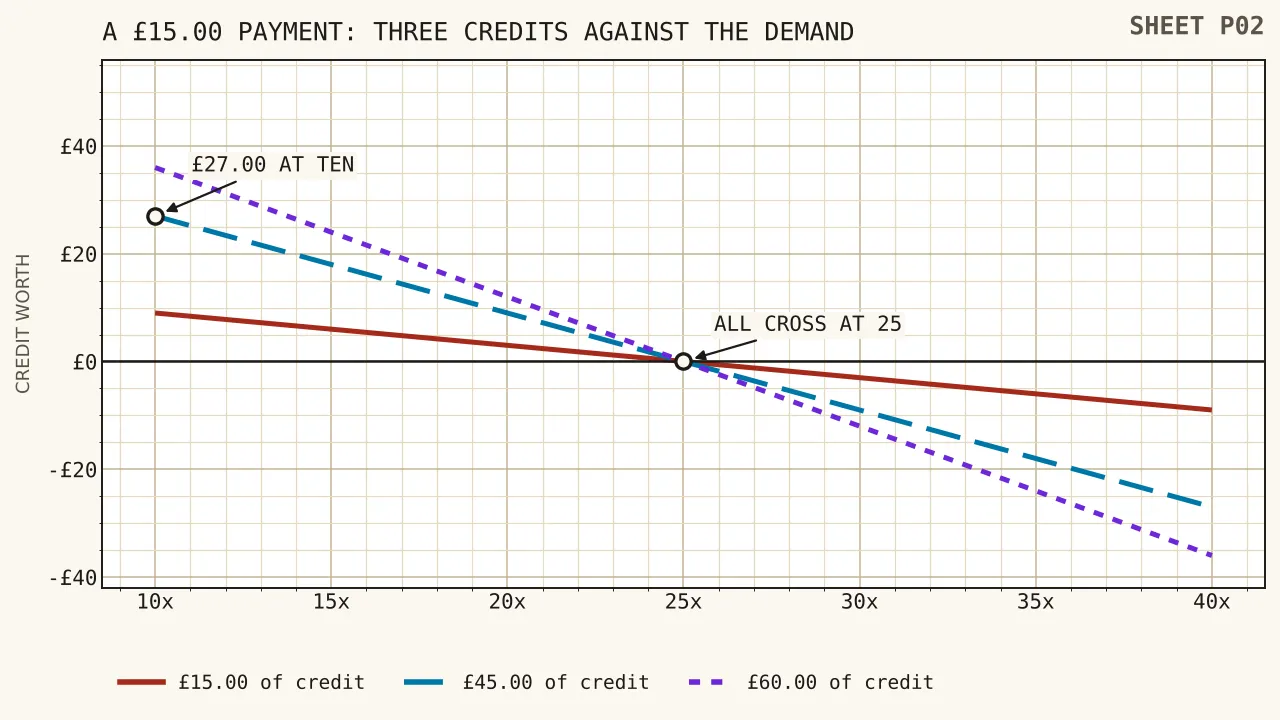
Twenty-five decides a tripling, and the 300 in the headline plays no part in it. It comes from the edge: 4p in the pound, taken 25 times over, is 100p. A credit cleared 25 times is a credit the staking has eaten.
So the headline moves the magnitude and the multiple moves the sign. Hold the payment at £15.00 and run the pair of them against each other. At 10 turnovers a tripling keeps £27.00 where a doubling keeps £18.00. At 40 turnovers the tripling is £27.00 down where the doubling is £18.00 down. The bigger headline is the bigger number in both directions.
| Headline | Credit | Kept at 10 turnovers | At 25 turnovers | At 40 turnovers |
|---|---|---|---|---|
| 100 per cent | £15.00 of credit | £9.00 kept | nothing | short by £9.00 |
| 200 per cent | £30.00 of credit | £18.00 kept | nothing | short by £18.00 |
| 300 per cent | £45.00 of credit | £27.00 kept | nothing | short by £27.00 |
| 400 per cent | £60.00 of credit | £36.00 kept | nothing | short by £36.00 |
Put the four headlines on one payment and a second reading appears. The gap between a doubling and a tripling at 10 turnovers is £9.00 on a £15.00 payment, and the gap between a tripling and a quadrupling is £9.00 as well. Each extra hundred points of headline is worth 60p for each pound paid in at that multiple, and costs 60p for each pound paid in at 40. The ladder is linear in both directions, so there is no size at which a bigger headline becomes a different kind of offer.
Every row crosses in the same column, which is the most useful line on this page. A reader comparing a tripling at 30 turnovers with a doubling at 20 is not comparing 300 against 200. They are comparing a negative number against a positive one.
4
The ceiling that caps the three
A tripling is advertised with a maximum credit, and the maximum arrives sooner than it does on a smaller headline, because the coefficient eats the allowance three times as fast. A cap of £45.00 on a tripling is reached by a payment of £15.00. The same cap on a doubling would take £22.50 to reach, and on a 100 per cent offer, £45.00.
Beyond that point the match falls away while the payment keeps climbing. Pay £30.00 against a £45.00 cap and the credit is still £45.00, so the match in truth is 150 per cent. Pay £60.00 and it is 75 per cent. Pay £150.00 and it is 30 per cent, with the advertisement still saying 300.
| Paid in | Credit earned | What the match really is | Per pound in at 10 |
|---|---|---|---|
| £5.00 | £15.00 of credit | a full tripling | 180p a pound |
| £15.00 | £45.00 of credit | still a full tripling | 180p a pound |
| £30.00 | £45.00 of credit | half the advertised rate | 90p a pound |
| £60.00 | £45.00 of credit | a quarter of it | 45p a pound |
| £150.00 | £45.00 of credit | a tenth of it | 18p a pound |
The reading is blunt. On a capped tripling, the payment that maximises value per pound in is the smallest one that reaches the cap, and every pound above it buys credit at a worse rate than the pound before. A reader who pays in £150.00 to collect the largest advertised credit has bought £45.00 of conditional money with £150.00 of their own.
Two ceilings can coexist without contradiction: one on converting bonus winnings, and none whatever on the deposit balance. So a tripling can sit inside terms that allow the reader to withdraw the whole £15.00 they paid in at any moment, and still hold the winnings from the £45.00 under a conversion ceiling.
5
Ten, and the 60 it replaced
Since 19 January 2026 a turnover demand on bonus funds cannot pass 10 at a licensed cashier, which puts £400.00 of staking behind a £40.00 credit and not a penny more. For the tripling on this page the same ceiling means £450.00 of staking at worst, and £27.00 of the credit surviving.
The regulator’s own figure for what came before it is 60 times, an expected cost of 240p against each pound of credit. Run it here and the tripling turns nasty: 60 turnovers of £45.00 is £2,700.00 of staking, an expected cost of £108.00, and a shortfall of £63.00 against a payment of £15.00. The reader would lose four times their payment on the average.
One figure from that consultation has to be attributed with care. One respondent put three quarters of its own offers inside a band of one to 10 turnovers already. That is an operator describing its own book, not a measurement of the market, and it must not be promoted into one.
The companion rule of the same date bites on the shape of the package rather than its size. An incentive covers one product type out of four: casino, betting, bingo, lottery. A tripling with free spins attached stays inside the casino type, slots being casino games. A tripling with bingo tickets attached spans two types and cannot be cleared through one shared requirement.
| The measure | Held to 10 | Let out to 60 |
|---|---|---|
| Staking the credit owes | £450.00 owed | £2,700.00 owed |
| Spins to deliver it | 4,500 spins | 27,000 spins |
| Floor on the time | 3 h 7 m 30 s | 18 h 45 m |
| Expected cost of it | £18.00 | £108.00 |
| Set against £15.00 paid in | £27.00 kept | short by £63.00 |
6
The base, and whose money is in it
A term that puts the demand on the payment as well as the credit costs a tripling less than it costs a doubling, which is the one place where a big headline helps. The base here is £60.00 rather than £45.00, a rise of a third, where a doubling’s base would have risen by half.
Ten turnovers of £60.00 is £600.00 of staking, expected to cost £24.00, leaving £21.00 of the £45.00 credit. For a combined base the crossing here is 18.75 turnovers, which is 25 scaled by three quarters, the headline over one plus the headline. A doubling gets 12.5 and a quadrupling gets 20.
| What the demand attaches to | Turnovers that empty the credit | Standing after 10 turnovers |
|---|---|---|
| The £45.00 credit on its own | 25 turnovers | £27.00 kept |
| Credit and the £15.00 payment together | 18.75 turnovers | £21.00 kept |
| Credit alone, on a game counting 30p in the pound | 7.5 turnovers as demanded | short by £15.00 |
Nothing published addresses a payment folded into the base, the ceiling’s wording speaking of bonus funds, which leaves such a term unplaced in both directions. The arithmetic is not: a reader can work out the crossing from the headline in one division and should do it before claiming.
Whether a spin given away beside the credit is itself bonus funds is unpublished in both directions, so how far the ceiling reaches over spins is unknown. Where the winnings from such spins land as bonus funds, a demand against those funds stops at 10. The published chain reaches that point and no further.
7
The print that decides it
A tripling is sold in three characters and conditioned in several hundred words, so the advertising rules carry real weight here. Significance attaches to four kinds of thing here: eligibility, the deposit and the wagering, the time allowed, and the bets or games that count. Leave one out where the omission misleads and the code has been broken.
Price each of them against this page. Eligibility settles whether £15.00 buys anything whatever. The wagering demand settles whether £45.00 of credit is worth £27.00 or nought. Whether 4,500 spins are physically possible is what a time limit decides, since 3 hours 7 minutes and 30 seconds of pressing has to fit in the window. The eligible games fix the weighting, and a game counting 30p in the pound turns £450.00 of required contribution into £1,500.00 of actual staking.
One ruling of 31 July 2024 found an excluded payment method insufficiently prominent where it sat among the full terms. On a deposit offer that cuts twice, since the rail a reader pays with can disqualify the payment from the match.
One enforcement outcome sits directly on bonus terms. A discretionary clause over closing accounts and keeping winnings drew a £170,000 penalty, decided on 3 July 2025. Priced in this page’s units, that fine is 1.7 million spins of stake at 10p, or 3,778 tripled credits of the size worked here. The clause was not struck down, since a penalty is what got published, and a reader meeting such wording now knows what it cost somebody.
Complaint clocks belong in the price of any offer this size, because a tripling is the kind of package a dispute tends to attach to. Three working days for an acknowledgement, 24 hours where the cashier never closes, and 8 weeks for the whole of it, escalation included. A customer has at least 6 months from the incident to start one. Seven days of silence after a reasonable request for information can stop the clock, which then restarts where it halted. The closing letter has to say the process is finished and point at an adjudicator.
What the regulator will not do belongs beside that. It says so itself: no ombudsman, no power over a withdrawal dispute, no sight of a customer’s account. The route to money back runs through the cashier and then an approved adjudicator, which is precisely the route a cashier without a licence does not have to provide.
Four kinds of game information satisfy the duty and an “or” joins them, so the 96p assumed here may appear nowhere on the game a tripling has to be cleared on. What appears instead may be a house edge of 4 per cent, which is the same fact in other clothes.
8
A tripling off the register
Headlines of this size cluster at cashiers outside the British licence, and pricing that loss means taking the duties one at a time. Each line below names something a licence holder has to do, then what the doing is worth against a £15.00 payment and a £45.00 credit.
| What a licence holder must do | What it is worth here |
|---|---|
| Stop a turnover demand at 10 | £450.00 of staking at worst, so £27.00 of the credit lives |
| Keep one incentive to one product type | spins clear with the credit; tickets would need their own |
| Hold a slot cycle to £5, or £2 under 25 | £450.00 of staking is 90 cycles at the ceiling |
| Leave 2.5 seconds between slot cycles | 4,500 spins cannot be done inside 3 h 7 m 30 s |
| Check identity before any play at all | the £45.00 cannot land on an unverified account |
| Refuse a credit card, money transfer route included | the £15.00 cannot be borrowed on a card here |
| Offer a limit at registration or first payment | a £10 day puts the £15.00 payment two days out |
| Leave the deposit balance uncapped | the £15.00 stays withdrawable whatever the credit does |
| Finish a complaint within 8 weeks | an approved adjudicator waits behind it, eight to pick from |
| Sign up to the national self-exclusion scheme | a single registration spans the licensed market |
The one offshore rulebook readable from here is Curaçao’s responsible gaming policy, which carries a February 2025 date and a version number of 1.0. That policy sets no turnover ceiling, no stake cap and no floor under the pace of a cycle. Two lines are all it gives to bonuses. For a tripling that absence is the whole story: 40 turnovers of £45.00 is £1,800.00 of staking, an expected cost of £72.00, and a shortfall of £27.00 against the payment.
Two further things belong in the price. An unlicensed site may run thin anti-money-laundering controls and leave a customer without recourse, which the regulator has said in terms. And exclusion out there is arranged with one cashier at a time, where one registration with Gamstop Online reaches every British licensed online company, because the licence sets the scope of it.
Remote gaming duty reads 40 per cent of operator profit, a figure dated 1 April 2026, wherever the cashier happens to sit. So a tripling from beyond the register costs the reader every row of the table above and saves them nothing in tax.
Questions
- What is a 300% deposit bonus worth per pound paid in?
- At 10 turnovers, £1.80 for each pound paid in. At 20 turnovers, 60p. At 25, nothing. At 30, each pound paid in is 60p down. Those figures assume a 10p spin, a game returning 96p in the pound and full weighting, and all three assumptions are declared here rather than taken from a rule.
- How much staking does a £45.00 credit owe?
- At 10 turnovers, £450.00, which is 4,500 spins at 10p and 3 hours 7 minutes and 30 seconds at the pace a licensed slot allows. At 30 turnovers it is £1,350.00, 13,500 spins and over nine hours. The expected cost of the staking is 4 per cent of it either way.
- Does the headline percentage move the break-even multiple?
- No. The crossing comes from the edge, not the headline: 4p in the pound taken 25 times is 100p, so a credit cleared 25 times has been consumed whatever its size. On a £15.00 payment, 100, 200, 300 and 400 per cent all cross at 25 and differ only in how far they fall afterwards.
- Why does paying in more stop helping?
- Because the credit is capped and the coefficient eats the cap three times as fast. Against a £45.00 ceiling, a £15.00 payment is a full tripling, a £30.00 payment is worth 150 per cent in truth, and a £150.00 payment is worth 30 per cent. Per pound paid in at 10 turnovers, value drops from 180p to 90p to 18p.
- What is the maximum wagering a British licensed cashier may ask?
- Ten turnovers of the bonus funds, in force since 19 January 2026, across every licence bar the gaming machine technical and software ones. Against the £45.00 credit on this page that caps the staking at £450.00 and leaves £27.00. The regulator put earlier practice at up to 60 times, which here would mean £2,700.00 of staking and a shortfall of £63.00.
- What happens if the deposit is wagered as well?
- The base becomes £60.00 and the crossing falls to 18.75 turnovers. Ten turnovers of that base is £600.00 of staking, expected to cost £24.00, which leaves £21.00 instead of £27.00. A tripling suffers less from such a term than a doubling does, because the payment is a smaller share of the base.
- Can free spins ride along with a tripling?
- Under a British licence they can, because slots are a casino product and an incentive may cover one product type only. Bingo tickets alongside the same credit would span two types. Whether a spin itself counts as bonus funds for the ceiling is unpublished in both directions, so its reach over spins stays unknown.
- What does game weighting do to the obligation?
- It lifts the staking while the advertised multiple sits still. Ten turnovers of £45.00 is £450.00 of required contribution, and a game counting 30p in the pound needs £1,500.00 of staking to deliver that, at an expected cost of £60.00. That 30p came from respondents during the consultation. No up-to-date grid of game contributions exists in any citable source.
- What is lost taking a tripling from a cashier that is not licensed here?
- Ten turnovers as a ceiling. The one-product rule. Stake caps of £5 and £2 on a slot cycle. The 2.5 second gap. Identity checked up front. A credit card refused. The limit prompt. A deposit balance nobody may cap. Eight weeks to a decision, with an approved adjudicator after it. And the national scheme for self-exclusion. The offshore policy read for this site fixes no turnover ceiling, so 40 turnovers of £45.00 is possible there, and that is a shortfall of £27.00.