Sheet P05 Revision 1 Counted 16 October 2026
Deposit £5, 100 free spins, no wagering: the 40p that decides it
Five pounds buys a hundred spins. At 10p each they carry £10.00 of stake the cashier funded, and £9.60 of expectation. With nothing owed on the winnings that figure stands. Then one line in the banking terms can undo it: a smallest withdrawal of £10.00 leaves the average outcome 40p short of being payable.
Paid in £5.00 One spin 10p Comes to £9.60 expected, nothing owed
What a count of this size comes to
Every destination on this board is bought advertising. The site takes a fee if a reader goes on to register, and no figure printed below moves because of it.
The Spin Count
Gauge No 01
Betportal
Lowest multiple here
Priced at this site's own 10p a spin
What is counted
What is asked
No Great Britain licence
Licensed in Anjouan, Comoros, run by BetPortal Gaming Ltd, with Excite Ultra Media Ltd, reference ALSI-202601040-FI2.
Terms read 16 October 2026
Open the offer at Betportal, opens in a new tabThe Spin Count
Gauge No 02
WinBeast
Largest count here
Priced at this site's own 10p a spin
What is counted
What is asked
No Great Britain licence
Licensed in Curaçao, operator not named on the site.
Terms read 16 October 2026
Open the offer at WinBeast, opens in a new tabThe Spin Count
Gauge No 03
EliteSpin
Longest spin window
Priced at this site's own 10p a spin
What is counted
What is asked
No Great Britain licence
Licensed in Costa Rica, run by PrimeTier Limited.
Terms read 16 October 2026
Open the offer at EliteSpin, opens in a new tabThe Spin Count
Gauge No 04
Crown Jewelz
Multiple unpublished
No foot figure struck
What is counted
What is asked
No Great Britain licence
Licensed in Curaçao, number not verified, operator not named on the site.
Terms read 16 October 2026
Open the offer at Crown Jewelz, opens in a new tabThe figure in the third register is this site's own arithmetic and nothing an operator has published: the count at face, less the share a spin gives back at 96 per cent return to player, less what playing the wagering through costs at the same return. It describes the offer, not one reader's afternoon. Where the conditions price above the count the counter prints nothing rather than a negative sum, and where a figure the sum needs is unpublished it prints the condition in the operator's words instead.
A count has no unit of its own, so one is supplied. Where an operator publishes what a spin of its own is worth, that figure stands in the second register and is labelled as theirs. Where it does not, the second register carries this site's own 10p a spin and says so, and the foot figure moves in proportion: at half the price, half the money. The figure after it, what the count comes to for each spin, is the one that compares a large count against a small one.
Three words stand in the amount column where no figure can. Noted is a published condition that takes value away without leaving the sum a figure to take. Unpriced is a condition whose figure nobody has published, or a credit that is not a sum until a deposit of your own sets it. Own money is money of yours, which is never part of a foot figure.
Not one of the operators printed above holds a Great Britain licence, so the duties that licence carries do not reach them. Every online gambling company licensed in Great Britain has to be part of Gamstop Online, and a reader who has shut themselves out through the scheme is therefore not shut out here. The ceiling of ten times the bonus funds on a wagering requirement, in force since 19 January 2026, is a condition of that licence and binds the companies that hold one. Where a dispute goes instead is a matter for the authority named on the counter, and the Gambling Commission describes what a reader faces without a British licence as a lack of recourse if things go wrong. Nobody under 18 may hold an account at any of them.
Every term printed on a counter is the operator's own, and each counter carries the day it was read. The oldest of those readings is 16 October 2026. What binds a reader is the operator's own full terms, and not a line printed here.
1
Five pounds in, £9.60 out
The arithmetic is two multiplications. At 10p a spin a hundred of them hold £10.00 of stake, funded by the cashier. At the return this sheet works to, £9.60 of it is expected back. Set that against the £5.00 the offer asks for and the count is expected to be worth 1.92 times the payment.
Per pound handed across, the figures are 20 spins and £1.92. The reason they look generous beside a percentage match is structural rather than commercial: a count is paid for before it arrives, so there is nothing to turn over in order to release it and no multiple to apply to the expectation.
Two numbers hold that up, and this site declares both rather than claiming a source for them. A spin is priced at 10p. The long-run figure for what comes back out of a slot is taken as 96 per cent. No published material fixes the cash worth of a free spin, names anybody as responsible for fixing it, or requires it to be disclosed, so a reader whose terms print a different value should scale each line below in proportion.
The phrase doing the work is the third one in the headline. Priced: a ten times demand on the winnings would cut £9.60 to £5.76, a twenty times demand to £1.92, and a twenty-five times demand to nothing. So the words are worth up to the whole expectation, which is why they belong in the terms and not merely in the advertisement.
Paying the £5.00 in does not spend it. It sits in a deposit balance, and at a licensed cashier nothing may cap what leaves that balance, so a reader who collects the spins and stops has committed the money rather than parted with it. The trade this page prices is £5.00 of certain money against £9.60 of expectation.
2
The 40p that decides it
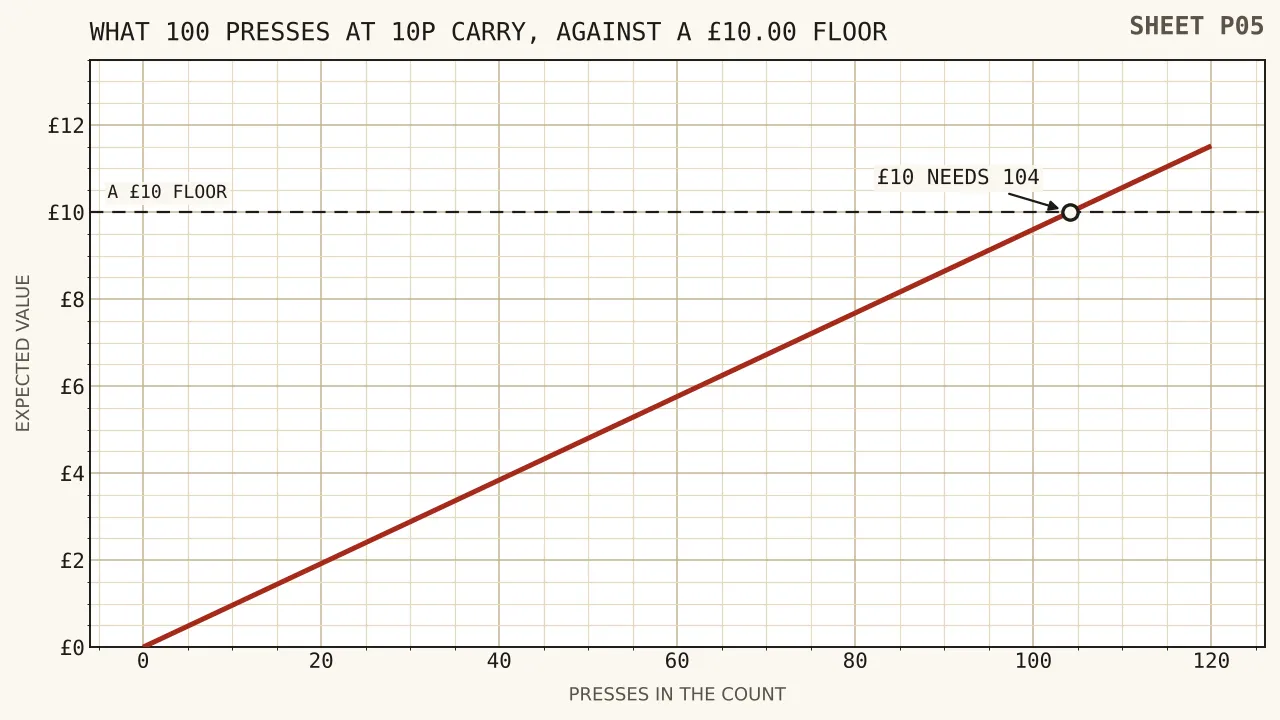
Once the wagering is gone, the condition that settles this offer is whatever the banking terms set as a smallest payout. Below that figure a balance stops being money the reader can reach. The question is therefore narrow: does £9.60 of expectation clear it?
Against £10.00 it does not, by 40p. Expressed as a multiple, the reader needs 1.04 times the mean, which an ordinary run will sometimes deliver and will often miss. Against £5.00 the expectation clears with £4.60 to spare. Against £20.00 it needs 2.08 times the mean, and against £50.00 it needs 5.21 times, which is a different kind of outcome altogether.
| Smallest withdrawal | Multiple of £9.60 required | Gap on the average |
|---|---|---|
| £5.00 | under the mean already | none, £4.60 clear |
| £10.00 | 1.04 times | 40p |
| £15.00 | 1.56 times | £5.40 |
| £20.00 | 2.08 times | £10.40 |
| £50.00 | 5.21 times | £40.40 |
Run the same figure backwards and the floor turns into a count. With 9.6p of expectation to a spin, £10.00 takes 104.2 spins to clear on the average, £15.00 takes 156.3, and £20.00 takes 208.3. A hundred spins is four spins under the first of those, which is the narrowest miss in this section and the reason the page is built round it.
Nothing about that pairing is unlawful or concealed. Two figures sitting in different parts of the terms, one in the promotion and one in the banking section, multiply together into an offer whose average outcome cannot be paid. What is published on the reader’s side is a test of reasonableness over any cap on a withdrawal’s size or frequency, and a right to draw on a deposit balance whenever they like.
3
What the fiver itself is
The payment deserves pricing in the same unit as the count, because a reader is holding two stakes rather than one. £5.00 at 10p a spin is 50 spins of the reader’s own money. Put those through the same 96 per cent game and the expected cost is 20p.
So the whole exercise, taken to its end, is 150 spins: 50 funded by the reader and 100 funded by the cashier. The expected cost of the first 50 is 20p and the expected gain across all 150 is £9.60 minus that 20p, which is £9.40 on the arithmetic alone, before any floor is applied.
| Whose money | Spins it buys | Expected movement |
|---|---|---|
| The reader’s £5.00 | 50 spins | a cost of 20p |
| The funded count | 100 spins | a return of £9.60 |
| Both together | 150 spins | £9.40 on the arithmetic |
There is a licence rule that makes the payment look small in a second way. One slot cycle may carry a stake of £5 once the customer has turned 25, and £2 before that. So the whole of this page’s payment is one lawful cycle for an older customer and two and a half cycles for a younger one, which puts the £5.00 entry price in proportion: it is the smallest sum the cashier can usefully ask for and still require a verified account.
Both stake figures belong to slots alone. A roulette wheel is outside them, and so is a blackjack table. The dates are published separately from the instrument that made them: the £5 limit from 9 April 2025 and the £2 limit for under-25s from 21 May 2025, with the regulations themselves made on 25 February 2025 and setting commencement as an interval rather than a day.
One more comparison belongs in this section, because it is the one that explains why cashiers hand counts out at all. The expected cost to the house of funding a hundred spins is 4 per cent of the £10.00 it wrote, which is 40p. The payment it asked for is £5.00. A reader paying twelve and a half times the expected cost of the gift is the arithmetic of the whole section, and it is not hidden anywhere: it is simply never printed.
150 spins in all, 50 of them bought with the payment
4
Four minutes and ten seconds
A count has a running time and the licence fixes its floor. The fastest a licensed slot may be worked is 24 cycles a minute, so a hundred spins occupies 4 minutes and 10 seconds, and the 150 spins of the previous section occupy 6 minutes and 15 seconds.
Three prohibitions keep that pace where it is, and together they are why the floor is also the realistic figure. There is no permission for automatic play in online gaming. Nothing on offer may shorten the interval before a result lands. Two games at once is not functionality a licensed system provides, so splitting a count across two windows is out.
| The count | Shortest run it can have | Expectation at 96 per cent |
|---|---|---|
| 25 spins | 1 m 2 s of pressing | £2.40 |
| 50 spins | 2 m 5 s of it | £4.80 expected |
| 100 spins | 4 m 10 s all told | £9.60 expected |
| 150 spins | 6 m 15 s of pressing | £14.40 |
Four minutes against a 24-hour claim window is no constraint at all, which is the useful finding: on an offer with no wagering demand, a clock is the mildest of the conditions a reader can meet. The figure matters only where a count is dripped out in instalments, because each tranche brings a window of its own and a missed tranche is gone.
Where a clock runs against the winnings instead, there is nothing for it to measure on this page. A window exists to be beaten by staking, and staking is what no demand means. That is worth saying because a 72-hour expiry printed beside a no-wagering count is a condition with no work to do, while the same expiry printed beside a ten times demand would mean £96.00 of staking, 960 spins and 40 minutes of pressing inside three days.
Twenty spins a day across five days carries the same £9.60, delivered in five sittings of 50 seconds. One missed day removes £1.92 of that, which is the expectation attached to one fifth of the count and the same figure as a pound of the payment.
5
What survives the phrase
Three conditions outlive the removal of a wagering demand. The floor is the first and has its own section above. The second is the clock, which has just been priced. The third is the game the spins have to be used on, and readers check it least often of the three.
A spin carries its stake multiplied by the return, so the eligible game moves the answer directly. A hundred spins come to £9.80 where the game returns 98 per cent, £9.60 at 96 per cent, £9.40 at 94 and £9.00 at 90. The spread across that range is 80p, which is a sixth of the payment and more than the 40p gap on a £10.00 floor.
| Return on the eligible game | One spin carries | The hundred comes to |
|---|---|---|
| 98 per cent | 9.8p | £9.80 |
| 96 per cent | 9.6p | £9.60 |
| 94 per cent | 9.4p | £9.40 |
| 90 per cent | 9p | £9.00 |
Finding out which row applies is not always possible from the promotion. Four ways exist to satisfy the duty to put something about a customer’s chances in front of them before they commit, and the four are alternatives, so a margin or a probability may appear where a reader expected a percentage. The information panel inside the game is where whichever of the four was chosen will be.
A fourth thing sits outside those three and still moves the answer: the balance the winnings land in. Cash in a withdrawable balance makes the £9.60 final. Bonus funds with no demand attached make the figure the same while putting it in a balance the offer’s own terms govern, including any ceiling on conversion. No published rule settles which of the two a free spin produces.
6
The rate against the alternatives
A reader choosing between offers of this kind is choosing between rates, and the rate is the count divided by the payment. Expressing it as a multiple of the payment makes the comparison immediate, because that is the figure the reader actually cares about.
| The pairing | Spins to the pound | Expected total | Times the payment |
|---|---|---|---|
| £5.00 for 100 spins | 20 spins | £9.60 | 1.92 times |
| £5.00 for 200 spins | 40 spins | £19.20 | 3.84 times |
| £10.00 for 100 spins | 10 spins | £9.60 | 0.96 times |
| £10.00 for 200 spins | 20 spins | £19.20 | 1.92 times |
| £10.00 for 300 spins | 30 spins | £28.80 | 2.88 times |
| £20.00 for 300 spins | 15 spins | £28.80 | 1.44 times |
Two things fall out of that. The third row is the only one under 1, which means a hundred spins on £10.00 is expected to return less than the payment that unlocked it. And the first and fourth rows are identical as rates, which shows the count on its own saying nothing: 100 spins and 200 spins can be the same offer at different payments.
A third reading is about the direction of the market rather than any one offer. The pairings that look most generous per pound in are the ones with the smallest payments, which is what a reader should expect: the cashier is buying a verified account with a payment method attached, and the price it pays for one is roughly constant whatever the payment. At £5.00 in, a count worth £9.60 is the price of the account. At £20.00 in, a count worth £28.80 is the same purchase at a worse rate for the reader.
The comparison has a limit worth stating. A higher rate with a condition attached can be worth less than a lower rate with none. Forty spins to the pound with 25 turnovers demanded of the winnings is expected to come to nothing, where this page’s 20 spins to the pound and no demand is expected to come to £9.60. Rate first, then conditions, then the floor.
7
What the licence is worth on a fiver
Every figure above assumes the cashier does what a British licence requires. Listing those requirements against this page’s own numbers shows what the licence is actually worth here, which is more than the count and less than a promise about any single session.
| Required of the holder | Its worth on these figures |
|---|---|
| An account verified before it may spin | the hundred spins cannot be collected anonymously |
| A pace no faster than 24 cycles a minute | 4 m 10 s is the floor and also the real figure |
| Results acceptably random, no game that compensates | the 9.6p a spin carries is the figure it claims |
| A cycle staked at £5 at most, or £2 under the age of 25 | the payment is one lawful cycle, or two and a half |
| Ten turnovers as the cap, if a demand ever appears | £5.76 as the worst case rather than nothing |
| Reasonableness required of any withdrawal limit | a floor cannot be pitched arbitrarily above £9.60 |
| Nothing capping the deposit balance | the £5.00 stays within reach all the way |
| No demand for papers at the exit that belonged at the door | the payout cannot be held for papers askable earlier |
A reader can check three rows of that table inside a minute, and cannot check the rest. The stake ceiling shows up in the game itself, since the maximum bet button will not pass £5. The pace shows up on the second spin. And the verified account shows up at registration, because an unverified account at a licensed cashier cannot spin at all. The technical standards on randomness are the ones a reader has to take on the strength of the licence, which is exactly the job a licence is there to do.
Most of the value on a count with no wagering sits in two of those rows. The technical one, because the whole worth of the offer rests on the spins being what the advertisement says they are. And the withdrawal one, because a floor pitched high enough turns £9.60 of expectation into nothing without touching the count.
The identity row deserves a second look too. Information a licensed cashier could reasonably have collected earlier cannot be made a condition of the payout, and what it gathers against money laundering is to be sought promptly instead of hoarded until a reader asks to be paid. On a balance of £9.60 that rule is the difference between a small payment and a long exchange of documents.
8
The same fiver, beyond the register
A no-wagering phrase on a £5.00 payment is advertised on both sides of the register, in the same words, by cashiers whose obligations are completely different. Outside the British licence, every row in the table above becomes optional.
The offshore document readable in full from here is a responsible gaming policy, version 1.0, carrying a date in February 2025. Turnover demands go unbounded in it, stakes go unbounded, and the pace of a cycle has no floor, and it says nothing about randomness, about compensated games or about what a screen may do when a spin returns less than it cost. For a count whose value rests entirely on the spins, that last silence is the expensive one.
Two things it does require are worth stating, because a page that treats the offshore side as a void is as unreliable as one that treats it as equivalent. One click has to reach a cooling-off period there, with no email required and no permission to seek. And a bonus dangled to keep a player going through one is barred there in terms.
Of the losses, self-exclusion is the one with least argument in it. The boundary of that scheme is the British licence, so one registration closes the licensed market and reaches nothing past it, which the scheme publishes as its own limit. Past it an exclusion gets arranged cashier by cashier, with a year as the shortest term on offer, against the six months the British scheme opens at.
One further difference is worth pricing because it bears on a small balance. A payout that goes wrong on the licensed side has a dated route behind it: six months in which to complain, eight weeks for the answer, and afterwards one of the eight approved adjudicators, five of which reach remote casino. A £9.60 balance is too small to litigate and exactly the size that route exists for. Nothing equivalent is published beyond the register, and the regulator here disclaims any power over a withdrawal dispute in any case.
Tax follows the player rather than the cashier. Duty attaches wherever the operator sits once remote gambling reaches somebody who usually lives here, and the remote gaming rate is 40 per cent of profit. So the £5.00 gains no tax advantage past the register while losing the eight rows above. Nothing on this page will help anybody past a bank’s gambling block or any other protection of that family, and the omission is deliberate.
Questions
- What is a hundred free spins on £5 worth?
- Stake of £10.00 funded, with £9.60 expected back on the two declared figures: 10p to a spin, 96 per cent coming out. As a multiple of the payment that is 1.92, or £1.92 to each pound in. Nothing owed on the winnings means no multiple gets applied, which leaves £9.60 as the answer.
- Will the winnings clear a minimum withdrawal?
- A £10.00 floor is missed by 40p on the average, needing 1.04 times the mean. A £5.00 floor clears with £4.60 spare. At £20.00 the floor asks 2.08 times the mean, and at £50.00 it asks 5.21 times. Each spin carries 9.6p, so clearing £10.00 on the average takes 104.2 spins against the 100 on offer.
- What would a wagering demand have taken?
- £3.84 at ten turnovers, which leaves £5.76. £7.68 at twenty, which leaves £1.92. The whole £9.60 at twenty-five turnovers, that many passes through an edge of 4 per cent being expected to swallow whatever is cleared. The phrase has to appear in the terms for any of that to be avoided.
- How does the £5 payment itself price out?
- As 50 spins of the reader’s own stake, with an expected cost of 20p at the same return. Taken together with the funded count that is 150 spins in one session, and £9.40 of expected gain across the pair of them before any floor is applied.
- What is the shortest the count can take?
- Four minutes and ten seconds, the licensed ceiling being 24 cycles a minute. Automatic play has no permission in online gaming, nothing sold may shorten a result, and two games together is not on offer, all of which makes that figure a floor rather than an estimate.
- Does the eligible game change the answer?
- Directly. A spin carries its stake multiplied by the return, so the hundred comes to £9.80 at 98 per cent, £9.60 at 96, £9.40 at 94 and £9.00 at 90. The spread is 80p, which is wider than the 40p gap on a £10.00 floor, and the duty to disclose anything about the chances can be met four different ways.
- How does 20 spins to the pound compare?
- It sits second among the pairings here. At forty spins to the pound each pound in returns £3.84, at twenty it returns £1.92, and a hundred spins on £10.00 returns 96p, which is under the payment itself. A higher rate carrying a 25 times demand is still worth less than a lower rate with no demand at all.
- What does a £5 payment buy in stake terms?
- One lawful slot cycle for a customer of 25 or over, since the stake ceiling on a cycle is £5, and two and a half cycles for anybody younger, where the ceiling is £2. Both figures are slots rules: the £5 from 9 April 2025 and the £2 from 21 May 2025, under regulations made on 25 February 2025.
- What goes missing at a cashier that is not licensed here?
- The verified account before play, the pace ceiling, the technical standards on randomness, the stake caps, the ten-turnover cap that would bound a demand if one appeared, the reasonableness test on withdrawal limits, the protection around a deposit balance, and the rule against demanding papers at the exit. In the offshore policy read for this site there is no turnover ceiling, nothing capping a stake, and no floor under the pace. The operator is inside British duty regardless, at 40 per cent of its remote gaming profit.