Sheet W08 Revision 1 Counted 16 October 2026
Paysafecard casino: a voucher, a flat charge and no way back
A £20.00 voucher carrying a £1.50 charge is a toll of 7.5 per cent, which buys 185 spins at 10p where £20.00 should buy 200. The crossing where a credit is expected to be worth nothing moves with it, from 25 turnovers down to 23.125. And because a voucher runs one way only, the money has to leave by some other rail, so the return journey is priced separately.
Voucher bought £20.00 A spin at 10p Comes to 185 spins once the charge is paid
What a voucher comes to in spins
Every destination on this board is bought advertising. The site takes a fee if a reader goes on to register, and no figure printed below moves because of it.
The Spin Count
Gauge No 01
Betportal
Lowest multiple here
Priced at this site's own 10p a spin
What is counted
What is asked
No Great Britain licence
Licensed in Anjouan, Comoros, run by BetPortal Gaming Ltd, with Excite Ultra Media Ltd, reference ALSI-202601040-FI2.
Terms read 16 October 2026
Open the offer at Betportal, opens in a new tabThe Spin Count
Gauge No 02
WinBeast
Largest count here
Priced at this site's own 10p a spin
What is counted
What is asked
No Great Britain licence
Licensed in Curaçao, operator not named on the site.
Terms read 16 October 2026
Open the offer at WinBeast, opens in a new tabThe Spin Count
Gauge No 03
EliteSpin
Longest spin window
Priced at this site's own 10p a spin
What is counted
What is asked
No Great Britain licence
Licensed in Costa Rica, run by PrimeTier Limited.
Terms read 16 October 2026
Open the offer at EliteSpin, opens in a new tabThe Spin Count
Gauge No 04
Crown Jewelz
Multiple unpublished
No foot figure struck
What is counted
What is asked
No Great Britain licence
Licensed in Curaçao, number not verified, operator not named on the site.
Terms read 16 October 2026
Open the offer at Crown Jewelz, opens in a new tabThe figure in the third register is this site's own arithmetic and nothing an operator has published: the count at face, less the share a spin gives back at 96 per cent return to player, less what playing the wagering through costs at the same return. It describes the offer, not one reader's afternoon. Where the conditions price above the count the counter prints nothing rather than a negative sum, and where a figure the sum needs is unpublished it prints the condition in the operator's words instead.
A count has no unit of its own, so one is supplied. Where an operator publishes what a spin of its own is worth, that figure stands in the second register and is labelled as theirs. Where it does not, the second register carries this site's own 10p a spin and says so, and the foot figure moves in proportion: at half the price, half the money. The figure after it, what the count comes to for each spin, is the one that compares a large count against a small one.
Three words stand in the amount column where no figure can. Noted is a published condition that takes value away without leaving the sum a figure to take. Unpriced is a condition whose figure nobody has published, or a credit that is not a sum until a deposit of your own sets it. Own money is money of yours, which is never part of a foot figure.
Not one of the operators printed above holds a Great Britain licence, so the duties that licence carries do not reach them. Every online gambling company licensed in Great Britain has to be part of Gamstop Online, and a reader who has shut themselves out through the scheme is therefore not shut out here. The ceiling of ten times the bonus funds on a wagering requirement, in force since 19 January 2026, is a condition of that licence and binds the companies that hold one. Where a dispute goes instead is a matter for the authority named on the counter, and the Gambling Commission describes what a reader faces without a British licence as a lack of recourse if things go wrong. Nobody under 18 may hold an account at any of them.
Every term printed on a counter is the operator's own, and each counter carries the day it was read. The oldest of those readings is 16 October 2026. What binds a reader is the operator's own full terms, and not a line printed here.
1
Fifteen spins for the privilege
Two hundred spins is what £20.00 should buy at 10p apiece. A charge of £1.50 on the voucher reduces that to 185. Fifteen spins have gone on the act of arriving, and they are gone before any result has been shown, which is what every page in this section means by the cost of getting to the desk.
As a share of the sum, £1.50 on £20.00 is 7.5 per cent. That is the largest toll priced anywhere in this section, and it is not because the charge is large. It is because the voucher is small. A charge of fixed size is a percentage that rises as the sum falls, and vouchers are sold in small sums.
Turn 7.5 per cent into the currency this section uses. A staked pound is expected to shed four pence on a reel set, so the pound itself has gone after twenty-five passes, and 25 is therefore the demand at which a credit is expected to be worth nothing. Each 1 per cent a rail retains takes a quarter turnover off that figure, so 7.5 per cent takes 1.875 turnovers and leaves a crossing of 23.125.
Three working figures hold throughout: 10p for one spin, 96 pence coming back on the pound over the long run, and every pound staked counting as a whole pound against a demand. The £1.50 charge is this page’s own round number for the arithmetic. Nothing in that list is published by anybody, and the charge on any particular voucher is a commercial matter for whoever sells it.
2
A rail that runs one way
The feature that separates a voucher from every other way in is that it has no way out. A card can be refunded, a wallet can be paid into, a bank account can receive. A voucher is a code that was bought with cash or with a card and spent once. Money does not travel back up it.
So a reader paying by voucher has chosen two rails, not one, and only thought about the first. The second rail is whichever one the cashier pays people on, and it brings a charge of its own, a clock of its own, and verification of its own. The round trip is the sum of two different things rather than twice one thing.
| Exit rail | Toll on the way out | Round trip as a share of £20.00 | Crossing it leaves |
|---|---|---|---|
| A bank transfer at no charge | nothing | 7.5 per cent | 23.125 |
| A card refund at no charge | nothing | 7.5 per cent | 23.125 |
| A wallet taking 1 per cent | 20p | 8.5 per cent | 22.875 |
| A rail taking £1.00 flat | £1.00 | 12.5 per cent | 21.875 |
The cheapest case in that table is a 7.5 per cent round trip, which is the voucher charge standing alone, and the dearest is 12.5 per cent. Compare that with a rail charging 1 per cent each way, where the round trip is 2 per cent and the crossing stays at 24.5. The voucher is between four and six times dearer than that, measured in turnovers.
One further consequence belongs here. A cashier may say it returns money by the method used to pay, and on this rail that is impossible, so some other arrangement has to be made. At a licensed desk the obligation to pay does not go away because the rail is one-directional: money in the deposit balance may be taken out, and a ceiling over it is prohibited. What the reader should expect is a bank-account question put at the exit, on a rail where the entrance never asked one.
12.5 per cent is the round trip where the exit takes £1.00
3
Denominations, and the sum you wanted
Vouchers are sold in fixed amounts, which means the sum a reader pays is chosen from a list rather than typed into a box. That has an arithmetic consequence nobody mentions: where the amount wanted is not on the list, the reader either pays more than intended or buys two vouchers and pays the charge twice.
| Route | Charges paid | Money that arrives | Toll as a share of what was spent |
|---|---|---|---|
| A £50.00 voucher, £15.00 unspent | £1.50 | £48.50 at the desk | 3 per cent |
| A £25.00 and a £10.00 voucher | £3.00 | £32.00 at the desk | 8.57 per cent |
| A £20.00 and a £20.00 voucher | £3.00 | £37.00 at the desk | 7.5 per cent |
The middle row is the honest answer to the question and the worst of the three. Two charges on £35.00 is £3.00, which is 8.57 per cent, and a crossing of 22.86. The first row looks cheaper as a percentage only because £15.00 of the reader’s money is sitting on a voucher that has not been spent.
That stranded balance is worth pricing on its own, because it is the quietest cost on the rail. £15.00 unspent is 150 spins at 10p that were paid for and not played. Unless the remainder is used later it is not a charge of 3 per cent at all: it is a charge of £1.50 plus a loan of £15.00 to nobody in particular.
Small remainders are the common case and they are the same arithmetic in miniature. A balance of £1.20 left on a voucher is twelve spins. A balance of 40p is four. Across a handful of vouchers a reader can leave behind more than the charge that started the page.
4
One charge, six denominations
Hold the charge at £1.50 and run it across the sums vouchers are normally sold in. The pattern is the one every flat charge produces, and it is steeper here than anywhere else in this section because the sums are smaller.
| Voucher | Charge as a share | Spins at 10p | Spins the charge took | Crossing it leaves |
|---|---|---|---|---|
| £10.00 | 15 per cent | 85 spins | 15 spins | 21.25 turnovers |
| £20.00 | 7.5 per cent | 185 spins | 15 spins | 23.125 turnovers |
| £25.00 | 6 per cent | 235 spins | 15 spins | 23.5 turnovers |
| £30.00 | 5 per cent | 285 spins | 15 spins | 23.75 turnovers |
| £50.00 | 3 per cent | 485 spins | 15 spins | 24.25 turnovers |
| £100.00 | 1.5 per cent | 985 spins | 15 spins | 24.625 turnovers |
Fifteen spins is the constant and the fourth column never moves. On the top row those fifteen spins are 15 per cent of everything the reader bought. On the bottom row they are 1.5 per cent. The charge did not change; the denominator did, by a factor of ten.
The crossing column gives the same information in the unit that matters for a promotion. A £10.00 voucher leaves 21.25 turnovers of headroom before a credit is expected to be worthless, and a £100.00 voucher leaves 24.625. Against the licensed ceiling of ten turnovers both are comfortable. Against a forty times condition both are irrelevant, because the condition has already passed the crossing by a distance.
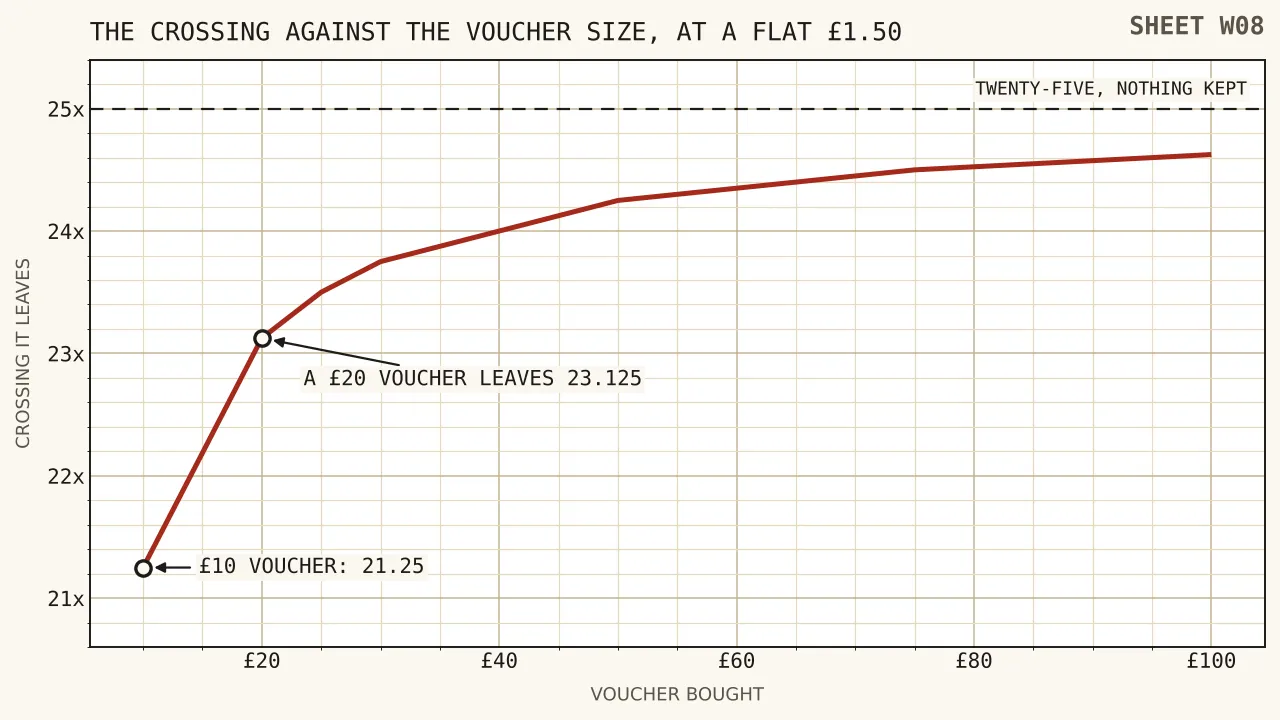
15 spins is the whole charge at every denomination
5
What the voucher does not solve
A voucher is sometimes described as a way of paying without handing over details, and at a licensed cashier that description does not survive contact with the rules. A licensed cashier will not let anybody gamble until it has obtained and verified the customer’s name, their address and their date of birth, and that bar stands in front of the free-to-play versions of its games as well. The rail used to pay changes nothing about any of it.
| What the rule reaches | What a licensee will not do | Where its date stands |
|---|---|---|
| The deposit balance | Will not write a ceiling over what the player draws out of it | the guide prints no date |
| Paying by credit card | Will not take a gambling payment on one, including a payment reaching it through a money service business | in force 14 April 2020 |
| The multiple on a credit | Will not ask play-through above ten times the bonus funds | in force 19 January 2026 |
| A financial limit | Will not carry a customer past registration without putting the facility in front of them | the standard prints no date |
| Questions at the exit | Will not save for the withdrawal what it could reasonably have sought at sign-up | the condition prints no date |
| Identity | Will not let anybody gamble, the free-to-play games included, until the customer’s details have been obtained and verified | the condition prints no date |
Two rows there bear on this rail in particular. The identity row means a voucher does not buy anonymity at a licensed desk, because the account rather than the payment is what gets verified. The card credit row means a voucher bought with a credit card and spent at a licensed cashier is the arrangement the refusal was drafted to reach, since it catches a payment that arrives through a business whose trade is moving money.
The questions-at-the-exit row earns a sentence of its own, being the row a reader is likeliest to reach for. A withdrawal request will not license the cashier to demand what it could sensibly have sought at the outset. On a one-way rail the exit will involve questions about a bank account, and the rule is what stops those questions being used as a brake.
Put the two together and the position is clear enough. A voucher narrows what the cashier learns at the moment of payment. It does not narrow what the cashier is obliged to establish before play, and at a licensed desk the obligation does not bend to the rail.
One further licensed duty prices unusually well on this rail, because a voucher arrives in fixed lumps. Light-touch financial checks attach to an online customer once a net deposit passes a monthly threshold. Two figures have been set for that threshold. The first was £500, in force from 30 August 2024. The second took over on 28 February 2025 at £150, which is 30 per cent of the figure it replaced. Each £20.00 voucher puts £18.50 into the account, so eight of them reach £148.00 and the ninth carries the total to £166.50, which is where the lower threshold is crossed. Nine charges of £1.50 is £13.50 by that point, or 135 spins. Reaching the higher figure takes twenty-eight vouchers, £518.00 arriving, £42.00 of charges, and 420 spins gone on the act of arriving. A second and heavier set of assessments has not gone live anywhere, and runs as a pilot with consumers unaffected while it does. Nor does either exercise reach a credit file, which the regulator puts in terms.
6
Eighteen minutes, then three hours
The spins a voucher buys can be timed, because a licensed reel game will not begin a further cycle until 2.5 seconds have passed, which allows 24 cycles in a minute at the outside. 185 spins therefore occupy 7 minutes and 43 seconds.
That 10p spin is this sheet’s working figure and not a ceiling. Two statutory ceilings sit above it: a stake on any single game cycle stops at £5.00, and at £2.00 where the player is under 25. The £5.00 figure commenced on 9 April 2025. The £2.00 figure followed six weeks later, on 21 May 2025. Both reach online slots and nothing besides, so roulette and blackjack sit outside them. Run the same £18.50 at the top of each. At £5.00 a cycle it is 3 full cycles with £3.50 over, which is 7.5 seconds at the floor. At £2.00 it is 9 cycles with 50p over, or 22.5 seconds. At 10p it is 185 cycles and 7 minutes 43 seconds. The sum bought is identical in all three; what moves is how long the reader is at the desk, by a factor near sixty.
A promotion attached to the payment occupies very much longer. Suppose the £18.50 that arrives is matched at 100 per cent: £18.50 of credit, £185.00 of staking at the licensed ceiling, £7.40 of expected cost and £11.10 left. In cycles that is 1,850, and at the floor it is 1 hour 17 minutes.
| What is being staked | In pounds | In cycles of 10p | Time it cannot beat |
|---|---|---|---|
| The spins the voucher buys | £18.50 | 185 cycles | 7 m 43 s |
| 5 turnovers of a £18.50 credit | £92.50 | 925 cycles | 38 m 33 s |
| 10 turnovers of it | £185.00 | 1,850 cycles | 1 h 17 m |
| 25 turnovers of it | £462.50 | 4,625 cycles | 3 h 13 m |
| 40 turnovers of it | £740.00 | 7,400 cycles | 5 h 8 m |
| 60 turnovers of it | £1,110.00 | 11,100 cycles | 7 h 42 m |
The row at 25 turnovers is where the credit is expected to be worth nothing, and it costs 3 hours 13 minutes to get there. The row at 40 is worth £7.40 against the reader and costs 5 hours 8 minutes. Rows of that sort are the arithmetic argument for reading the multiple before anything else on a payment page.
The bottom row carries the regulator’s own figure for what some licensees were asking before a ceiling arrived, reported as up to 60 times. Sixty turnovers of £18.50 is £1,110.00 of staking, 11,100 cycles, and 7 hours 42 minutes at the floor. Four pence in the pound on that staking is £44.40 of expected cost against £18.50 of credit, so the credit finishes £25.90 against the reader. Ten keeps £11.10 and sixty owes £25.90, which puts £37.00 between the two ends of the column.
None of those floors can be bought down. A separate commitment is owed on every cycle, and a licensed system will not sell a shortcut to the result: the guidance names features of that sort among the things it does not permit. Side-by-side play across several games is barred as well.
7
The register, in three lines
Spin counts put up outside the British system hold no Great Britain licence. Establishing that for a single cashier takes about two minutes, and the three lines of the check are tabulated in this section.
| Line | What to do | What fails it |
|---|---|---|
| First | Take the licence number out of the footer | No number, or a number shown only as a picture |
| Second | Put that number to the public register | A number that brings back nothing |
| Third | Match the domains listed there to the address bar | An entry that does not list the domain you are on |
That check has no software substitute. A settlement of £4.75m followed six unlicensed sites being found with one supplier’s games on them, and the findings included a money laundering risk assessment that fell short and controls that failed to keep its games out of this market. A game a reader recognises says nothing about who is holding the voucher’s money.
Remote gaming profits have carried a rate of 40 per cent from 1 April 2026. What stood before it was 21 per cent, in place since 1 April 2019. Duty does not care about the licence; it cares which country the player calls home. An overseas cashier that takes £18.50 from a British reader is therefore inside the charge, while none of the duties tabulated earlier on this sheet falls on it.
Convert the rate into this sheet’s unit and it comes out small. 185 cycles of 10p is £18.50 through the reel set, of which 96 per cent is expected back, so the room keeps 74p and the duty on that is 29.6p. Take the same credit round a tenfold demand instead and £185.00 of staking leaves £7.40 with the room, on which the duty is £2.96. The charge on the voucher, at £1.50, is five times the duty the first of those two figures raises.
8
Priced, not ranked
One test and no other places an offer out here: the odds against getting your own money back out again. Nothing is scored. Nothing is called best. A payment logo in a cashier’s footer moves none of it.
The summary of the rail is four figures. £1.50 on £20.00 is 7.5 per cent. That is 15 spins out of 200. It leaves a crossing of 23.125. And because nothing travels back up the rail, the exit is a separate rail with a separate charge.
One row in the ledger below needs its source said out loud. The penalty came to £170,000, and 3 July 2025 is its decision date. What drew it was a line in the bonus rules a cashier applied to new casino promotions, which left to that cashier’s discretion both whether an account stayed open and whether winnings were paid out at all. The condition held to have been breached is the fair and open one, and the stated objection was an absence of transparency carrying a risk of unfair results for the customer. Set £170,000 beside the £1.50 this sheet has spent four tables pricing and the ratio runs past 113,000 to one, which is one way of saying that the terms rather than the charge are where the money sits. What the published outcome shows is a penalty and not a clause struck down, so that is as far as this sheet takes it.
| What a licensed desk is held to | What it is worth once nobody is held to it |
|---|---|
| Play-through is held to ten times the bonus funds | £37.00 of swing on one voucher: £11.10 kept at ten, £25.90 owed at sixty |
| One incentive holds a single product type, nothing else | A voucher-funded match and its spins are one product; nothing from another may ride on the same terms |
| A net deposit over £150 in a month brings a check | Nine vouchers reach that line, by which point £13.50 of charges is spent |
| A withdrawal request is not handed back for cancelling | £18.50 on its way out is not re-offered as £18.50 to stake |
| Nothing caps what the player draws from a deposit balance | The exit on a one-way rail becomes whatever the cashier writes into it |
| A stake on one cycle stops at £5, or £2 under 25 | 185 cycles of 10p in place of 3 cycles, or of 9 |
| 2.5 seconds pass before the next cycle may start | 7 minutes 43 seconds ceases to be a floor anybody has to respect |
| Six months stand open in which to complain | No window, and no clock by which an answer falls due |
| Terms are fair and transparent, with £170,000 behind the point | A discretionary forfeiture clause with nothing standing over it |
| Every British licensee belongs to Gamstop Online | A registration whose reach ends where the licence ends |
Ten clauses, and the first is worth £37.00 of swing on a voucher that carried £20.00. The charge four tables of this sheet went to pricing is £1.50. That ratio, close to twenty-five to one, is the whole argument for reading the multiple before reading the payment page.
Questions
- What does a voucher charge cost in spins?
- Fifteen spins, where the charge is £1.50 and a spin is 10p. A £20.00 voucher buys 185 instead of 200. Those fifteen spins are the same at every denomination, so a £10.00 voucher loses 15 per cent and a £100.00 voucher loses 1.5 per cent.
- How far does that move the break-even demand?
- Down to 23.125, from 25. A quarter of a turnover is what each 1 per cent retained by a rail costs, so 7.5 per cent costs 1.875. On a £10.00 voucher the toll is 15 per cent and the crossing falls to 21.25.
- Can money be paid back onto a voucher?
- No. It is a one-way rail: the code was bought and spent, and nothing travels back up it. The exit is therefore a second rail, bringing with it a charge, a clock and a set of questions that all belong to that rail, which is why the round trip is priced here as two different things.
- What if the amount I want is not sold as a voucher?
- Either overshoot or buy two. Reaching £35.00 with a £25.00 and a £10.00 voucher costs £3.00 of charges, which is 8.57 per cent and a crossing of 22.86. Buying £50.00 and leaving £15.00 unspent looks like 3 per cent but strands 150 spins you have already paid for.
- Does a voucher keep me anonymous at the casino?
- Not at a licensed one. Date of birth, address and name are all obtained and verified before a licensed cashier will let anybody gamble, and the free-to-play versions of its games sit inside that rule too, because what gets verified is the account and not the payment. A voucher narrows what the cashier learns at the moment of payment and nothing else.
- Can I buy the voucher with a credit card?
- Not where the payment is for gambling at a licensed cashier. Since 14 April 2020 a licensee will not accept gambling payment on a credit card, and the refusal is drafted to reach money arriving through a business whose trade is moving money.
- Will I be asked for bank details at the exit?
- Probably, because the money cannot go back the way it came. What a licensed cashier may not do is use that moment to ask for what it could sensibly have asked at the start, and money in the deposit balance comes out without a ceiling written over it.
- How long does the wagering take?
- A doubled £18.50 at the licensed ceiling is £185.00 of staking, which is 1,850 cycles at 10p and 1 hour 17 minutes at the floor of 2.5 seconds. A forty times condition is £740.00, 7,400 cycles and 5 hours 8 minutes.
- What is the licensed limit on a wagering demand?
- The licensed ceiling sits at ten turnovers of the credit, with effect from 19 January 2026. On £18.50 of credit that is £185.00 of staking, £7.40 of expected cost and £11.10 left. At forty turnovers the same credit is £7.40 against the reader.
- What does the absence of a licence remove?
- Ten clauses, on this sheet’s reckoning. Play-through held to ten times the bonus funds, which is £37.00 of swing on one voucher. A single product type to one incentive. A check once a net deposit passes £150 inside a month. A withdrawal request that is not handed back for cancelling. No cap written over a deposit balance on the way out. A stake stopped at £5 on a cycle, or £2 under 25. A floor of 2.5 seconds between cycles. Six months in which to bring a complaint. Terms that are fair and transparent. And membership of Gamstop Online, whose reach ends where the licence ends.