Sheet D06 Revision 1 Counted 16 October 2026
Bingo no deposit bonus: ten pounds of credit is 100 tickets at 10p
A bingo credit turns into tickets the way a casino credit turns into presses, and £10.00 at a 10p ticket is a hundred of them. The third figure is where bingo departs from slots. A room’s expected return is one minus the share the operator keeps, that share is published nowhere, and the whole of a bingo offer’s value hangs on it. So this sheet prices the count exactly and runs the margin as a range.
The credit £10 bonus One ticket 10p Comes to 100 tickets, margin unknown
What a credit of this size comes to
Every destination on this board is bought advertising. The site takes a fee if a reader goes on to register, and no figure printed below moves because of it.
The Spin Count
Gauge No 01
Betportal
Lowest multiple here
Priced at this site's own 10p a spin
What is counted
What is asked
No Great Britain licence
Licensed in Anjouan, Comoros, run by BetPortal Gaming Ltd, with Excite Ultra Media Ltd, reference ALSI-202601040-FI2.
Terms read 16 October 2026
Open the offer at Betportal, opens in a new tabThe Spin Count
Gauge No 02
WinBeast
Largest count here
Priced at this site's own 10p a spin
What is counted
What is asked
No Great Britain licence
Licensed in Curaçao, operator not named on the site.
Terms read 16 October 2026
Open the offer at WinBeast, opens in a new tabThe Spin Count
Gauge No 03
EliteSpin
Longest spin window
Priced at this site's own 10p a spin
What is counted
What is asked
No Great Britain licence
Licensed in Costa Rica, run by PrimeTier Limited.
Terms read 16 October 2026
Open the offer at EliteSpin, opens in a new tabThe Spin Count
Gauge No 04
Crown Jewelz
Multiple unpublished
No foot figure struck
What is counted
What is asked
No Great Britain licence
Licensed in Curaçao, number not verified, operator not named on the site.
Terms read 16 October 2026
Open the offer at Crown Jewelz, opens in a new tabThe figure in the third register is this site's own arithmetic and nothing an operator has published: the count at face, less the share a spin gives back at 96 per cent return to player, less what playing the wagering through costs at the same return. It describes the offer, not one reader's afternoon. Where the conditions price above the count the counter prints nothing rather than a negative sum, and where a figure the sum needs is unpublished it prints the condition in the operator's words instead.
A count has no unit of its own, so one is supplied. Where an operator publishes what a spin of its own is worth, that figure stands in the second register and is labelled as theirs. Where it does not, the second register carries this site's own 10p a spin and says so, and the foot figure moves in proportion: at half the price, half the money. The figure after it, what the count comes to for each spin, is the one that compares a large count against a small one.
Three words stand in the amount column where no figure can. Noted is a published condition that takes value away without leaving the sum a figure to take. Unpriced is a condition whose figure nobody has published, or a credit that is not a sum until a deposit of your own sets it. Own money is money of yours, which is never part of a foot figure.
Not one of the operators printed above holds a Great Britain licence, so the duties that licence carries do not reach them. Every online gambling company licensed in Great Britain has to be part of Gamstop Online, and a reader who has shut themselves out through the scheme is therefore not shut out here. The ceiling of ten times the bonus funds on a wagering requirement, in force since 19 January 2026, is a condition of that licence and binds the companies that hold one. Where a dispute goes instead is a matter for the authority named on the counter, and the Gambling Commission describes what a reader faces without a British licence as a lack of recourse if things go wrong. Nobody under 18 may hold an account at any of them.
Every term printed on a counter is the operator's own, and each counter carries the day it was read. The oldest of those readings is 16 October 2026. What binds a reader is the operator's own full terms, and not a line printed here.
1
A ticket is not a press, and the unit has to be declared
Every sheet on this site turns a headline into two figures, a count and the price of one, then into a third. On a bingo offer the first two behave as they do anywhere else. The third is the difficulty, and it is better met head on than covered over with a percentage borrowed from a slot.
The conversion first, because that part is sound. A bingo no-deposit bonus arrives either as bonus funds spendable on tickets or as a number of tickets outright. At a 10p ticket, five pounds of credit is 50 entries, ten pounds is 100, twenty pounds is 200 and fifty pounds is 500. Halve the ticket price and those counts double. Put the ticket at 25p and they fall to two fifths. The ticket price does for a bingo offer what the spin price does for a spins offer: it is the unit without which the count says nothing.
A 10p ticket is what this sheet works to, for consistency rather than from observation. The rest of the site prices one press at 10p, so holding a ticket at the same figure lets a reader compare a bingo headline with a casino headline without two conversions in their head. Neither figure is fixed by anything published. Where an offer states its own ticket price, that figure displaces this one and every total below moves with it.
| Credit advertised | Entries at 10p | Entries at 5p | Entries at 25p |
|---|---|---|---|
| £5 of bonus | 50 | 100 | 20 |
| £10 of bonus | 100 | 200 | 40 |
| £20 of bonus | 200 | 400 | 80 |
| £30 of bonus | 300 | 600 | 120 |
| £50 of bonus | 500 | 1,000 | 200 |
One difference between the products shows up in that table and deserves naming at the outset. A press on a slot is a unit of stake against a machine. An entry into a bingo game is a share of a pool that other entries have also paid into. The count of entries a credit buys is exact. What an entry is expected to return depends on a number nobody publishes, and the next two sections are about that number.
2
The disclosure duty stops short of a percentage
On a slot the expected return is a property of the game which a licensee may choose to print. In a bingo room it is neither of those things, and the reason sits inside the disclosure rule itself.
The duty is that information bearing on a customer’s chance of winning be within easy reach before they commit to gamble. Four items sit under an “or”, which means a single one of them answers the duty in full. The chance of a winning event arising is one of them. One is a percentage return. One is a margin, or a house edge. The fourth is an account of the mechanics, covering the settling of winners and the sharing of prizes. The guidance then adds a concession aimed squarely at this product. Bingo is named in a concession, along with certain lottery and other games: for those, an account of the prize allocation suffices by itself.
Put those together and the position is plain. A licensed bingo room can satisfy its obligations in full by explaining how a prize gets divided up, with no percentage of any kind appearing anywhere. No page on this site may say that a licensed site has to publish a return figure, and none may invent one for a bingo room.
A boundary on the arithmetic follows, and a boundary is not the same thing as vagueness. The countable part of a bingo offer is countable to the penny. A ten pound credit at a 10p ticket buys a hundred entries, and a hundred entries is what the reader holds. The part that cannot be counted is the expected return on them, which turns on the prize pool, on how many entries went into the game and on the operator’s own retained share, and not one of those three is published anywhere this sheet could reach.
100 entries exactly, and a return percentage no published source has to state
3
The margin is the missing number, so run it as a range
Here is the useful move, and it is arithmetic rather than sourcing. The unknown in a bingo offer is not a mystery with many parts. It collapses into a single figure, and once that is seen the whole offer can be priced as a range instead of being abandoned as unknowable.
Take a game that sells a number of entries at a price each. The stakes paid in are the price multiplied by the number of entries. The prizes paid out are that total less whatever share the operator retains. A player holding some of those entries has, by symmetry, an expected share of the prizes equal to their share of the entries. Multiply it through and the player’s expected return per entry is the entry price multiplied by one less the operator’s retained share.
That expression has exactly the shape of a slot’s arithmetic. Price times return, where the return is one minus the margin. Everything unpublished about a bingo room sits in that one term, and this site’s own working can therefore proceed by holding the margin as a variable and showing what each value of it does.
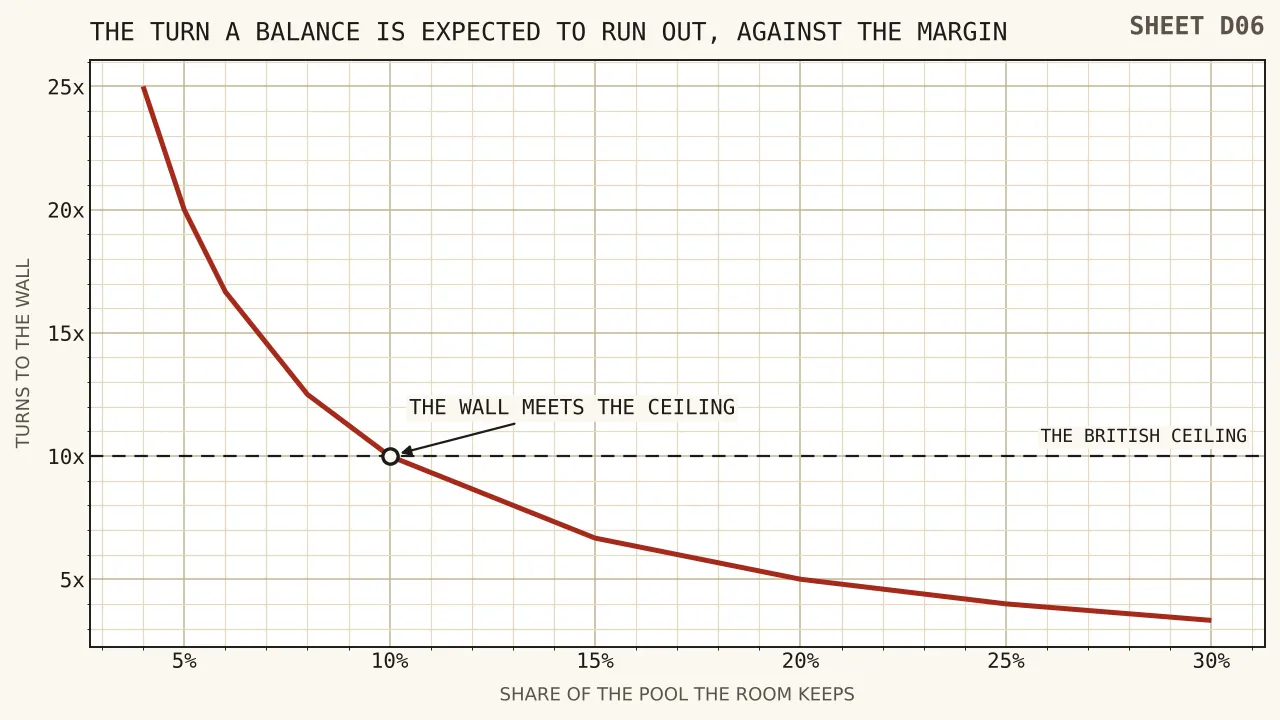
| If the room retains | Expected back on £10 of entries | Multiple at which a balance reaches nothing | What tenfold leaves of £10 |
|---|---|---|---|
| 4 per cent | £9.60 | 25 times | £6.00 |
| 10 per cent | £9.00 | 10 times | nothing at all |
| 15 per cent | £8.50 | 6.67 times | a deficit of £5.00 |
| 20 per cent | £8.00 | 5 times | a deficit of £10.00 |
| 25 per cent | £7.50 | 4 times | a deficit of £15.00 |
| 30 per cent | £7.00 | 3.33 times | a deficit of £20.00 |
The third column carries the finding here, and it rewards a slow reading. One divided by the margin gives the turn on which a balance is expected to run out. Four pence in the pound is a 96 per cent slot’s margin, which puts that wall at twenty-five turns. In a room retaining a tenth, the wall stands at ten turns. In a room retaining a fifth, it stands at five.
So the regulated ceiling and the arithmetic wall need not coincide at all. A British licensee may ask for ten turns of the bonus funds and may not ask for eleven. Where the clearing happens on a 96 per cent slot, ten times leaves three fifths of a credit intact. Where it happens in a room keeping a tenth of the pool, the same ten times is the wall itself, and the expected value of the exercise is nought. Where the room keeps a fifth, ten times is double the wall, and the credit is expected to be gone with half the staking still outstanding.
One more piece of arithmetic belongs beside the margin, because it is the choice a reader actually makes in a bingo room. A hundred entries can be spent as six entries across sixteen games, or as one entry across a hundred, and the expected return is the same in both cases: the entry price multiplied by one less the retained share, a hundred times over. What changes is the spread of outcomes. Many entries in few games buys a larger share of fewer pools. Few entries in many games buys a small share of many. The mean sits still and the variance moves.
That matters for a condition rather than for the mean. Where a payout floor stands at ten pounds, a reader needs one outcome above ten pounds rather than an average above it, and concentrating entries into fewer games raises the chance of producing one. Where a ceiling stands at ten pounds, the concentration works against the reader, because the ceiling clips precisely the large single result that concentration is designed to produce. Read the floor and the ceiling together, then decide how to spread the entries, in that order and not the other way about. A reader who spreads first and reads afterwards has made the decision before seeing the two figures that decide it.
Two statements about that table, both necessary. The margins in it are not a report and no primary source publishes a margin for any bingo room: they are a range chosen to make the relationship visible. As for the relationship, that is arithmetic worked here and not a rule anybody issued. What it shows is that the single question worth asking of a bingo bonus with a bingo-only requirement is what the room keeps, and that the answer is almost never on the page.
4
Where the sum can be completed in full
A bingo bonus is frequently sent somewhere other than the bingo room to be turned over, and wherever that somewhere is a slot the arithmetic becomes exact again, because this site states a 96 per cent return and the cost of staking is then multiplication.
The working is the one the whole site uses. On a 96 per cent game a staked pound carries an expected cost of fourpence. Ten times a ten pound credit therefore asks £100.00 of staking, costs an expected £4.00 of it, and leaves £6.00. Twentyfold asks £200.00 and leaves £2.00. Twenty-five times asks £250.00 and leaves nothing, because a pound holds twenty-five fourpences. Beyond that the arithmetic turns negative, which means the credit is expected to run dry with staking still owed and the reader finding the remainder.
| Bingo credit | Entries it buys at 10p | Staking owed at tenfold | Survives tenfold | Survives twentyfold |
|---|---|---|---|---|
| £5 | 50 | £50.00 | £3.00 | £1.00 |
| £10 | 100 | £100.00 | £6.00 | £2.00 |
| £20 | 200 | £200.00 | £12.00 | £4.00 |
| £30 | 300 | £300.00 | £18.00 | £6.00 |
| £50 | 500 | £500.00 | £30.00 | £10.00 |
Count the presses as well as the pounds, because the presses are the time. A thousand presses is what a hundred pounds of staking buys at 10p each. Hold the cycles two and a half seconds apart, as a licensed slot must, and the fastest lawful passage runs forty-one minutes and forty seconds. Five hundred pounds of staking is five thousand presses and three hours and forty-seven minutes. A fifty pound bingo credit cleared at tenfold on a slot is therefore most of an evening.
One further complication raises both figures without touching the multiple. Where a game counts below its face towards a requirement, a staked pound contributes less than a pound of credit. Take the 30 per cent rate respondents quoted to the regulator in consultation: a hundred pounds of required credit then needs around £333.33 of staking, or 3,333 presses, which is over two hours. No current contribution table is published by any primary source, so this sheet states no figure for how bingo itself counts towards a requirement.
5
One incentive, one product type
The rule written most directly for a bingo offer took effect on 19 January 2026, and it has changed what a package may lawfully contain.
More than one type of gambling product may not be included inside a single incentive, and the rule lists four types: lottery, bingo, casino, betting. Bingo is one of them and casino is another. Hand a reader bingo entries and slot presses under one shared set of terms and the line has been crossed. Hand them entries alone, or presses alone, and it has not. Its stated aim is a narrow one: to stop two products sharing one incentive where their terms are linked together.
Assumptions get upended by three carve-outs, and every one of them tells here. One type may supply two products, and the illustration pairs a raffle with a lottery scratchcard. Separate betting and casino offers may ride in one email where the customer opted in on both products. A credit the customer spends on whatever product they fancy escapes the ban entirely, and the illustration there is ten pounds that works across betting and casino.
That last carve-out describes a great many bingo offers, so it is the one to understand. Ten pounds the reader may spend in the bingo room or on the slots, as they prefer, is one credit rather than a mixed incentive. Ten pounds which must go five into the bingo room and five onto the slots, with a single requirement spanning both, is the arrangement the ban was written about.
The question to put to any bingo bonus follows from that. Is this one credit I may spend where I choose, or two awards bolted together. The first is simple to price. The second produces the terms nobody can follow, and now cannot lawfully be offered here under shared conditions. Only two licences stand outside the ban, one covering gaming machine technical work and one covering gambling software. The ceiling discussed next carries that same scope.
6
The ceiling, and what it is worth in a bingo room
Readers tend to assume that bingo sits outside the rules written for casino bonuses. On the wagering ceiling that assumption is wrong, and the scope line is the reason.
Ancillary remote licences are reached along with the rest, and only two sit outside: gaming machine technical, and software. A remote bingo licence is not one of those two. From 19 January 2026, therefore, no British licensee may ask customers to play bonus funds through more than ten times, in a bingo room or in a slot lobby alike. For the practice this ceiling displaced, the regulator recorded a figure of sixty times.
Set the ceiling against the credits already tabulated and a short list of figures follows. Ten pounds at ten times is £100.00 of staking. Twenty pounds is £200.00. Fifty pounds is £500.00. Cleared on a 96 per cent slot those cost an expected £4.00, £8.00 and £20.00, so three fifths of each credit survives.
Cleared in a bingo room the same three requirements cost whatever the room’s retained share makes them cost, and section three is the answer to that: at a tenth retained, ten times is precisely the wall. The ceiling is a real protection and it is a protection expressed as a multiple rather than as an outcome. A multiple means different things in rooms with different margins, which is why this sheet prices the margin rather than trusting the multiple.
The ceiling has two unsettled edges, reported here as unsettled. It bites on bonus funds, and whether a free entry counts as one has never been published either way. A requirement computed on a deposit added to a bonus is unaddressed too. The published wording reaches this far: against a bonus balance, a requirement halts at ten times.
One companion duty belongs beside the ceiling because it is what makes any of this findable. An incentive’s terms must be fair, must be transparent, must be clear, and must sit within easy reach of whoever the thing is offered to. Altering the value is barred too, in the case where qualifying activity finished before the offer period was out, and a package cannot therefore be repriced partway along.
7
Which rules reach a bingo room, and which stop at the slot
This is what makes a bingo page different from a casino page, and it takes care, because several of the best-known British protections are written about online slots and reach nothing else.
The stake caps are the clearest instance. One game cycle’s stake is held to five pounds by a statutory instrument dated 25 February 2025, and to two pounds for anybody beneath twenty-five. 9 April 2025 and 21 May 2025 are the dates, supplied by the regulator’s guidance, which also states that online slots are the whole of the limits’ reach and other casino games lie outside them. Reels do the defining work in the instrument. Images that move or change, shown by means of visual reel representations or otherwise, and an arrangement of them that settles whether a prize has been won. A bingo game is not that, so neither cap touches an entry.
Game speed divides the same way. A slot keeps its cycles two and a half seconds apart. Casino games that are not slots keep five, peer-to-peer poker excepted, and that one is dated 17 January 2025, a date taken from the regulator’s updates page because no part of the standard itself carries a commencement date. Bingo is named in neither figure.
What does reach a bingo room is substantial, and a list serves a reader better than an impression. The autoplay prohibition reaches gaming, and bingo gets named inside that, so each game cycle needs committing to one at a time. At peer-to-peer poker, automatically posted blinds make the one carve-out. The standard on random outcomes covers gaming including bingo, bringing with it the bar on substituting a near miss for a losing event and the requirement that outcomes be acceptably random with no compensated game behind them. The financial limit standard covers all gambling bar subscription lotteries. All gambling falls under the bar on offering a customer the cancellation of a withdrawal request. The incentive provision, as the last two sections set out, covers all licences.
| The rule | In a bingo room | On an online slot |
|---|---|---|
| Tenfold ceiling on bonus play-through | Applies, as it does to all licences bar two | Applies |
| One product type to an incentive | Applies, and bingo is one of those types | Applies |
| Five pound stake cap, two under 25 | Does not apply, the cap being written for reel-based games | Applies, from 9 April and 21 May 2025 |
| Minimum interval between game cycles | Does not apply, as neither the 2.5 nor the 5 second figure names bingo | Applies, at two and a half seconds |
| Autoplay prohibition | Applies, across gaming including bingo | Applies |
| Near miss bar and random outcomes | Applies, across gaming including bingo | Applies |
| Financial limit prompts and cooling-off | Applies, across all gambling bar subscription lotteries | Applies |
| No option to cancel a withdrawal | Applies, across all gambling | Applies |
| A return percentage must be printed | Does not apply, a prize allocation account being enough | Does not apply, four alternatives being available |
The final row explains the whole sheet. Neither product is obliged to print a percentage, and for bingo the alternative the guidance accepts is the easier one: say how the prizes get shared out. For a game whose pool genuinely varies with the entries sold that is a sensible rule, and it is also the reason the third figure on a bingo offer has to be handled as a range.
8
A floor, a ceiling, and a prize that arrives in lumps
The five conditions that subtract from a spins count subtract from a bingo credit too, and two of them behave differently here because of the shape a prize takes.
A payout floor works identically everywhere: a balance under the stated minimum cannot be moved, and the question is how far above the average a reader has to finish. On the slot side that question has an exact answer. Ten pounds of credit cleared at tenfold leaves an expected £6.00, so a ten pound floor asks for 1.67 times the expected outcome. On the bingo side the same question has an answer per margin: at a 4 per cent retained share a hundred entries are expected to return £9.60, which clears a ten pound floor at 1.04 times the mean, and at a 30 per cent share they return £7.00, which needs 1.43 times.
A ceiling behaves differently in a bingo room, and this is the one place where a bingo offer can be easier to read than a casino one. A slot’s return arrives as many small results and a few rare large ones, so a cap removes a tail nobody can see in advance. A bingo game pays a stated prize to whoever completes the pattern, and the prize for a room is often posted before the game starts. Pitch a ceiling below the posted prize and a reader can see it coming, which is more than most conditions on most offers allow.
Two things this sheet declines to state. It will not give a standard maximum-win figure on bonus winnings, because no primary source publishes one. And it will not give a distribution of prizes, ceilings or ticket prices across the market, because everything located on that subject during this build sat on a trade publication, a law firm note or an affiliate page, and none of those may be cited here.
The rule that does bite absolutely concerns the other balance. Putting a cap on the withdrawals from a deposit balance is out. Imposing such a term is barred, as is using one, as is enforcing one, as is leaning on one. A specimen the regulator prints as banned pairs fifty pounds in the day with five hundred in the week. Taking money out of that balance, winnings and all, is available at any hour. The maximum is subject to no restriction. Limits on a withdrawal’s size or frequency have to be reasonable ones. On a no-deposit bingo bonus all of that is real and attached to an empty pot, because nothing has been paid in for it to govern.
9
Outside the licence, the product boundary disappears
Run the comparison product by product, since that is the axis this page is built on. An offer at that end of the market carries no Great Britain licence, and the earliest casualties are the rules that separate bingo from slots and one incentive from two.
On the bingo side: nothing confines an incentive to a single product type, so entries and presses may be welded together under one shared requirement. Nothing holds the play-through to ten times. No duty makes the terms clear, or transparent, or fair, or reachable by the person being offered them. Nothing stops the value being altered where the qualifying activity finished early.
Now the slot side, where a bingo credit so often gets sent for clearing. No cap meets the stake on a press. No floor meets the interval between cycles. Autoplay is unmentioned. So is turbo. So is slam stop. So is the running of two games together, and so is a celebration where the return failed to beat the stake. None of them appears in the Curaçao responsible gaming policy, version 1.0 of 21 February 2025, which was read end to end so that the sentence could be written.
On the account side: bonus play needs no prior identity check, the policy asking instead that an operator be satisfied the player has turned eighteen before a deposit or a wager, and leaving the document check to milestones further along. A credit card is not barred. Nothing prohibits a ceiling over the money leaving a deposit balance. Nor does anything drag the cashier into the national online self-exclusion scheme, which is run by The National Online Self Exclusion Scheme Limited, of Harrogate, registered number 10504973, and which every online gambling company licensed here has to belong to.
On recourse the gap is narrower than a careless page would claim, and the detail is instructive. A complaints framework is published: six months for the player to complain, four weeks for the operator to answer, one extension of four more weeks on written notice, and dispute resolution that is compulsory and free to the player. Complaint numbers also go to the regulator twice yearly, on 15 January and on 15 June, with January 2026 the first due date. The categories reported run from the total, through the settled complaints upheld and the settled complaints rejected, to those pending, those broken down by category, those referred to dispute resolution, and those where the player has turned to law. Nowhere this sheet could reach is there a published aggregate of those reports, so no complaint volume for the jurisdiction appears here.
Two more facts about that regulator belong on a page leaning on its rulebook. Its governing ordinance took effect on 24 December 2024. The authority’s own about page gives 2025 for the same event, so the earlier date is the reading two of the three statements support. At the time its site was read for this sheet, the authority stated that the online gaming portal it runs was offline.
Tax goes the reader’s way whatever the licence position, and the sentence earns its place so that nobody mistakes a missing licence for a saving. The charge attaches to where the player ordinarily resides and not to whichever jurisdiction issued a licence, so any operator taking British play, wherever it sits, is inside British gaming duty. Nothing is saved there. What goes instead is the eight-week clock on a complaint, the adjudicator approved to hear it afterwards, and the register that shuts every licensed account in one action.
Questions
- How many bingo tickets does a £10 no deposit bonus buy?
- A hundred, at the 10p ticket this sheet works to. Two hundred where a ticket is 5p, forty where it is 25p. The count is exact once the ticket price is known, and the ticket price is the figure a headline is least likely to carry.
- What is a bingo no deposit bonus expected to return?
- It depends on one number, which is the share of the pool the room keeps. A player’s expected return per entry is the entry price multiplied by one less that share, so a hundred entries at 10p return an expected £9.60 where the room keeps 4 per cent and £7.00 where it keeps 30 per cent. No primary source publishes the share for any room, so this sheet runs it as a range rather than stating a figure.
- Why will this site not just quote a bingo return percentage?
- Because a licensed bingo room does not have to publish one. The disclosure duty offers four alternatives joined by an “or”, and the guidance adds that for bingo a description of how the prizes are allocated will be sufficient. A percentage invented for the look of the thing would be the easiest false figure on the page to write and the hardest to defend.
- Can a bonus hand me bingo tickets and free spins together?
- Not under one shared set of terms, on a British licence, since 19 January 2026. Of the four product types the rule names, no more than one may go inside a single incentive, and bingo and casino are two of them. A credit the customer may lay out on whichever product suits them is untouched by the ban.
- Does the ten-times wagering ceiling reach bingo?
- It does. All licences are covered, the ancillary remote ones too, and the only exclusions are the gaming machine technical licence and the software licence, which leaves a remote bingo licence inside. Ten pounds of credit at ten times is £100.00 of staking, costing an expected £4.00 on a 96 per cent slot and leaving £6.00.
- Is a ten times requirement generous in a bingo room?
- That depends entirely on the margin, which is the point of this sheet. Invert the retained share for the turn on which a balance is expected to run out: twenty-five at a 4 per cent share, ten at a tenth, five at a fifth. So the regulated ceiling can sit well below the wall, exactly on it, or well above it, depending on a figure the terms do not state.
- Is a bingo entry caught by the £5 and £2 stake limits?
- No. Those limits are written for online slots, which the instrument defines by reference to reels, and the regulator’s guidance states that they do not reach other casino games. For the five pound figure its date is 9 April 2025; for the two pound figure, 21 May 2025.
- Is there a minimum gap between bingo games, as there is on slots?
- None written about bingo. Cycles on a slot stay two and a half seconds apart. A different figure, five seconds, governs casino games outside the slots category, and poker played between customers is excluded from it. On the regulator’s updates page the date attached to it reads 17 January 2025. Across gaming, though, autoplay is prohibited with bingo named in terms, so every game cycle needs its own commitment.
- Which British protections does a bingo account actually get?
- More than most readers assume. The tenfold ceiling, the one-product rule, the autoplay prohibition, the near-miss bar, the financial limit machinery and the bar on cancelling a withdrawal request all reach a bingo room. What stops at the slot is the stake cap and the minimum interval between game cycles.
- What changes if the bingo site holds no British licence?
- With no Great Britain licence in the picture, an incentive is confined to no single product type, a play-through is held to no ten times, an identity check need not precede bonus play, and the cashier joins no national self-exclusion scheme. Curaçao does publish a six-month complaints window, an eight-week operator timeline and free dispute resolution, and it requires complaint numbers to be reported twice a year, but no aggregate of those reports has been published, so no volume figure can be cited.