Sheet R12 Revision 1 Counted 16 October 2026
Big Bass slots: a count of 60 meets the floor before it meets the multiple
60 presses at 10p is £6.00 of stake and £5.76 back at 96 pence per pound. On a tray that small the smallest payable sum decides the answer before any wagering condition gets near it: a £10.00 floor asks for 1.74 times the average, and 174 presses would be needed to clear it behind a tenfold condition.
The count 60 presses One press 10p Comes to £5.52 to £5.82
What a count of this size comes to
Every destination on this board is bought advertising. The site takes a fee if a reader goes on to register, and no figure printed below moves because of it.
The Spin Count
Gauge No 01
Betportal
Lowest multiple here
Priced at this site's own 10p a spin
What is counted
What is asked
No Great Britain licence
Licensed in Anjouan, Comoros, run by BetPortal Gaming Ltd, with Excite Ultra Media Ltd, reference ALSI-202601040-FI2.
Terms read 16 October 2026
Open the offer at Betportal, opens in a new tabThe Spin Count
Gauge No 02
WinBeast
Largest count here
Priced at this site's own 10p a spin
What is counted
What is asked
No Great Britain licence
Licensed in Curaçao, operator not named on the site.
Terms read 16 October 2026
Open the offer at WinBeast, opens in a new tabThe Spin Count
Gauge No 03
EliteSpin
Longest spin window
Priced at this site's own 10p a spin
What is counted
What is asked
No Great Britain licence
Licensed in Costa Rica, run by PrimeTier Limited.
Terms read 16 October 2026
Open the offer at EliteSpin, opens in a new tabThe Spin Count
Gauge No 04
Crown Jewelz
Multiple unpublished
No foot figure struck
What is counted
What is asked
No Great Britain licence
Licensed in Curaçao, number not verified, operator not named on the site.
Terms read 16 October 2026
Open the offer at Crown Jewelz, opens in a new tabThe figure in the third register is this site's own arithmetic and nothing an operator has published: the count at face, less the share a spin gives back at 96 per cent return to player, less what playing the wagering through costs at the same return. It describes the offer, not one reader's afternoon. Where the conditions price above the count the counter prints nothing rather than a negative sum, and where a figure the sum needs is unpublished it prints the condition in the operator's words instead.
A count has no unit of its own, so one is supplied. Where an operator publishes what a spin of its own is worth, that figure stands in the second register and is labelled as theirs. Where it does not, the second register carries this site's own 10p a spin and says so, and the foot figure moves in proportion: at half the price, half the money. The figure after it, what the count comes to for each spin, is the one that compares a large count against a small one.
Three words stand in the amount column where no figure can. Noted is a published condition that takes value away without leaving the sum a figure to take. Unpriced is a condition whose figure nobody has published, or a credit that is not a sum until a deposit of your own sets it. Own money is money of yours, which is never part of a foot figure.
Not one of the operators printed above holds a Great Britain licence, so the duties that licence carries do not reach them. Every online gambling company licensed in Great Britain has to be part of Gamstop Online, and a reader who has shut themselves out through the scheme is therefore not shut out here. The ceiling of ten times the bonus funds on a wagering requirement, in force since 19 January 2026, is a condition of that licence and binds the companies that hold one. Where a dispute goes instead is a matter for the authority named on the counter, and the Gambling Commission describes what a reader faces without a British licence as a lack of recourse if things go wrong. Nobody under 18 may hold an account at any of them.
Every term printed on a counter is the operator's own, and each counter carries the day it was read. The oldest of those readings is 16 October 2026. What binds a reader is the operator's own full terms, and not a line printed here.
1
A small tray has a different enemy
On a large tray the wagering multiple is what takes the money. On a tray of 60 the multiple is often beside the point, because the smallest payable sum has already decided the outcome before any requirement is reached.
Begin with the figure nobody disputes. 60 presses funded at 10p is £6.00 of stake. Send it through a reel returning 96 pence in each pound and the average home is £5.76, trailing the face value by 24p.
Now set a smallest payable sum of £10.00 beside that £5.76. The reader needs 1.74 times the average to be paid anything whatever, and the requirement has not yet been applied. Set a floor of £20.00 beside it and the figure is 3.47 times. Set £5.00 and the floor is cleared on the mean with 76p to spare.
Which produces the practical rule for a small tray. Locate the smallest payable sum before anything else. Divide it by count times press price times return. An answer above one means the offer’s average outcome cannot be paid out at all. Everything else in the terms is a second-order effect.
A named game family changes nothing about that arithmetic, and this page will not pretend otherwise. Configured returns for titles are published by no primary source within reach, which is why part two runs a band of 92 to 97 pence per pound and part six gives crossing values rather than an estimate.
Those cashiers hold no Great Britain licence, they advertise a count of 60 hardest, and twelve duties leave with the licence. Part eight sets a figure from this page against each of them.
Three quantities and one band. A press costs 10p. Multiply credit by edge by multiple and the requirement’s expected cost appears. A floor is cleared on the mean where the credit reaches it. 92 to 97 pence is a band used for demonstration, and stated as such; 96 standing alone anywhere is the assumption this site declares as its house figure.
2
60 presses across a band of returns
Two multiplications give the tray and the band gives its width. On £6.00 of stake the whole band is worth 30p, which is three presses.
| Returns per pound | Tray averages | Behind ten times | Behind twenty times | Behind forty times |
|---|---|---|---|---|
| 92 pence | £5.52 | £1.10 | short by £3.31 | short by £12.14 |
| 94 pence | £5.64 | £2.26 | short by £1.13 | short by £7.90 |
| 96 pence | £5.76 | £3.46 | £1.15 | short by £3.46 |
| 97 pence | £5.82 | £4.07 | £2.33 | short by £1.16 |
Three readings. The tray column spans 30p from top to bottom, so on bare presses the unknown return is worth three presses. The third column spans £2.97, so behind a tenfold condition it is worth ten times as much. Negative throughout is the fifth column, 97.5 pence per pound being what a fortyfold condition wants while the band tops out at 97.
Two of those columns also show where the floor comes in. Behind a tenfold condition the residues are £1.10, £2.26, £3.46 and £4.07. None of them clears a £5.00 floor. Every one of them is below the £5.76 the bare tray would have returned, and the one thing they are all below is any floor a cashier is likely to print.
Two further rows belong beside that, because a reader may be holding a smaller or larger tray than 60 and the arithmetic scales exactly. Halve the count to 30 and every figure halves: £3.00 of stake, £2.88 of credit, £1.73 behind a tenfold condition. Double it to 120 and every figure doubles: £12.00 of stake, £11.52 of credit, £6.91 behind the same condition.
So the condition and the floor work together on a small tray in a way that neither does alone. The condition shrinks the credit from £5.76 towards £3.46, and the floor then refuses to pay out anything under its own figure. A pair of clauses that each look survivable produces an offer with an expected payment of nothing.
30p of band on the tray, £2.97 of band behind a tenfold condition
3
The floor, as a multiple of the average
A floor is best read as a multiple of the mean, because that is the quantity a reader has to beat. Divide the floor by the credit and the answer is how many times the average outcome has to be exceeded.
| Smallest payable sum | Times the mean needed | Gap on the mean | Against £3.46 at ten times | Against £1.15 at twenty times |
|---|---|---|---|---|
| £5.00 | 0.87 times | clear by £0.76 | short by £1.54 | short by £3.85 |
| £10.00 | 1.74 times | short by £4.24 | short by £6.54 | short by £8.85 |
| £20.00 | 3.47 times | short by £14.24 | short by £16.54 | short by £18.85 |
| £50.00 | 8.68 times | short by £44.24 | short by £44.24 | short by £46.54 |
The first row is the only one a bare tray of 60 clears on the mean, and it stops clearing as soon as any condition is attached. The other three are unreachable on the average whatever the condition does.
Two things follow for a reader holding a small count. First, the floor is the figure to find before the multiple, because it can make the multiple irrelevant. Second, where the floor cannot be cleared on the mean the reader’s whole prospect lives in the upper tail of the distribution, and the shape of that tail depends on the paytable rather than on the return.
Put a number on the second point. Let the single win pay 250 times the stake, its probability tuned so the mean comes out at 96 pence per pound. That win is needed once in 260.42 presses, so a tray of 60 expects 0.23 of them and ends with nothing 79.4 per cent of the time. When it does land, at 10p a press, it pays £25.00, which clears a £20.00 floor comfortably.
So on that paytable a tray of 60 behind a £20.00 floor pays nothing about four times in five and pays well the fifth time, while its average is £5.76. Such is the arithmetic of a small tray on a title of high variance, worked by this site on a model kept deliberately simple and describing no real paytable.
4
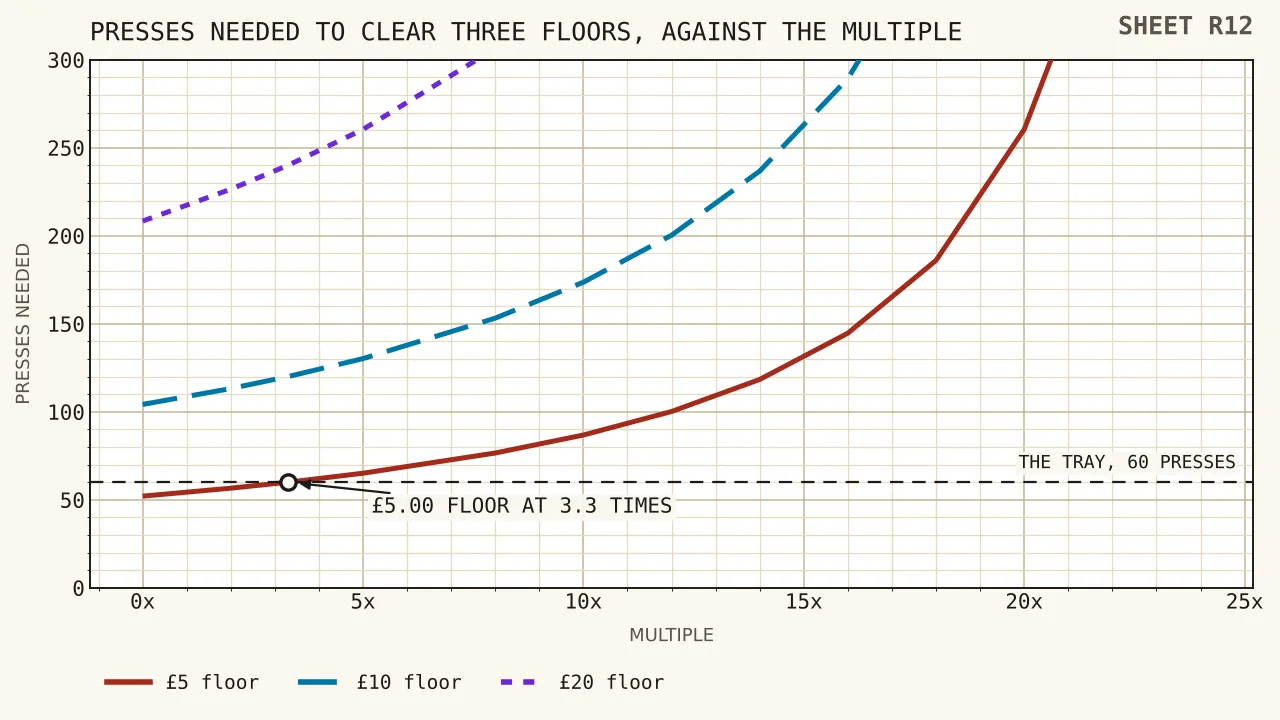
The count a floor actually needs
Reverse the arithmetic and a floor turns into a count, which is the single most useful conversion on a page about small trays.
The presses needed are the floor divided by the product of the press price, the return and one minus the multiple times the edge. At 10p and 96 pence with no condition that denominator is 0.096, so a £5.00 floor needs 52 presses, a £10.00 floor needs 104 and a £20.00 floor needs 208.
Add a tenfold condition and the denominator falls to 0.0576. Now £5.00 needs 87 presses, £10.00 needs 174 and £20.00 needs 347. Add a twentyfold condition and the denominator falls to 0.0192: £5.00 needs 260 presses, £10.00 needs 521 and £20.00 needs 1,042.
| Condition attached | For a £5.00 floor | For a £10.00 floor | For a £20.00 floor | Multiplier on 60 |
|---|---|---|---|---|
| Nothing on the winnings | 52 | 104 | 208 | 0.9 to 3.5 |
| Ten times | 87 | 174 | 347 | 1.5 to 5.8 |
| Twenty times | 260 | 521 | 1,042 | 4.3 to 17.4 |
| Twenty-five times | no count clears it | no count clears it | no count clears it | unbounded |
The bottom row is the twenty-five that runs through this whole site, appearing in a new costume. Twenty-five times puts the denominator at nothing, since the credit is expected to be eaten precisely, and then no count clears any floor on the mean. Beyond twenty-five the denominator turns negative and the question stops making sense.
The last column is the comparison a reader wants. Against this page’s headline of 60, a £10.00 floor behind a tenfold condition needs 2.9 times the count advertised. A £20.00 floor behind a twentyfold condition needs 17.4 times it.
Which is why a headline count and a smallest payable sum should be read as one quantity rather than two. The count is a numerator and the floor is a target, and neither means anything without the other.
5
Three shapes of named-game offer, costed
Offers that name a game family come in a few recognisable shapes, and the arithmetic separates them cleanly. Three wordings were readable on 15 October 2026 across different licensees’ pages. Terms move weekly, so nothing here claims any of them is current; the shapes are what last.
Shape one: a tray of 100 presses at a spin value of £0.10, on a named title, with no wagering stated against the winnings and a qualifying deposit of £10.00. On the house figure the tray is worth £9.60, and if the qualifying deposit has to be turned over once that costs 40p, leaving £9.20.
Shape two: a tray of 151 presses at a spin value of £0.10, on a named title, with ten times against the free spin winnings and slots the only room that counts, plus a maximum bonus of £25.00 and a qualifying deposit of £10.00. The tray is worth £14.50, the tenfold condition costs £5.80, and £8.70 survives before the deposit is costed.
Shape three: 20 presses on a named title in return for depositing and wagering £20.00, with the qualifying wagering to be completed inside seven days and no wagering on the winnings. At this page’s assumed press price the tray is worth £1.92, the £20.00 of qualifying turnover costs 80p, and the net is £1.12.
| Shape | Tray worth | Condition costs | Qualifying costs | Net |
|---|---|---|---|---|
| 100 presses, nothing on winnings | £9.60 | nothing | £0.40 | £9.20 |
| 151 presses, ten times on winnings | £14.50 | £5.80 | £0.40 | £8.30 |
| 20 presses, £20.00 staked to qualify | £1.92 | nothing | £0.80 | £1.12 |
| 60 presses, ten times on winnings | £5.76 | £2.30 | not stated | £3.46 |
Two things fall out. The headline counts run 100, 151, 20 and 60, and the net values run £9.20, £8.30, £1.12 and £3.46, so the ordering by headline and the ordering by net are not the same. The 151-press offer has the largest count and the second-largest net, because its condition costs £5.80.
And the third row is the clearest demonstration on the site of what a qualifying requirement does to a small tray. 20 presses is worth £1.92, the qualifying turnover costs 80p, and the net £1.12 is 42 per cent less than the tray looked. No wagering condition was applied to the winnings at all.
One caution on the maximum bonus in shape two. A cap of £25.00 on the bonus is not a cap on the tray, and the two get confused. On the figures above the tray is worth £14.50, well inside £25.00, so the cap binds on nothing and the tenfold condition does all the work.
6
Crossing values for a named title
With no configured return published for any title, a threshold is the one usable output. Break-even wants the edge sitting at one over the multiple, so the return required is one minus that same reciprocal.
| As printed in the terms | Return required |
|---|---|
| Four times | 75.00 pence |
| Ten times | 90.00 pence |
| Fourteen times | 92.86 pence |
| Twenty times | 95.00 pence |
| Twenty-five times over | 96.00 pence exactly |
| Forty times | 97.50 pence |
Under the band’s floor of 92 pence sit three rows; inside or above it sit the other three. Track down a published figure for whichever title is in hand and one step settles it. Over the threshold, something survives the condition. Under it, the credit is expected to go, with some of the reader’s own money after it.
Where the room also weights the game, scale the condition first. Put the multiple over the rate and read the table at whatever that gives. Forty pence in the pound turns a tenfold condition into the equivalent of twenty-five times, wanting 96 pence. At five pence it behaves like two hundred times and needs 99.5, which no reel reaches.
Under a British licence, ten times is as heavy a condition as bonus funds carry, effective from 19 January 2026. Read off the table, that ceiling wants 90 pence returned, a figure sitting beneath the band. So inside the licence almost any build survives the lawful maximum, and the arithmetic rather than anybody’s generosity is the reason.
One figure for scale. The regulator’s own record of what the ceiling displaced puts some requirements at sixty times, needing 98.33 pence to break even. Against this tray, sixty times comes to £345.60 of turnover across 3,456 presses, finishing £8.06 under water on a credit of £5.76.
7
Two and a half minutes, and then 24
Time is the only quantity here taken from a published floor rather than from arithmetic. Within 2.5 seconds of the preceding game no cycle may be commenced, putting a floor of 2 minutes 30 seconds under a tray of 60.
The condition is the longer job by an order of magnitude. £57.60 of turnover at ten times is 576 presses and 24 minutes. At twenty times it is 1,152 presses and 48 minutes. At twenty-five times, 1,440 presses and 1 hour. At forty times, 2,304 presses and 1 hour 36 minutes.
So the ratio of condition to tray is 9.6 to one at ten times and 38.4 to one at forty, which is the multiple scaled by the return. A reader is being offered 2 minutes 30 seconds of the thing advertised and asked for 24 minutes of something else.
None of it compresses on a licensed reel. No customer gets an option to cut the wait for a result, and the impermissible features are named as three: slam stop, turbo, quick spin. Unattended repetition is impossible as well. Every cycle brings its own commitment due, and starting one always wants that control going up and then down, or its equivalent.
One clock from a real wording belongs here. Shape three in part five required its qualifying wagering to be completed inside seven days of the deposit. £20.00 of turnover at 10p a press is 200 presses and 8 minutes 20 seconds, so seven days is 1,210 times what the obligation needs. That is a deadline binding on nothing, and it is worth noticing because a deadline on a small obligation is often the mildest clause in a set of terms while a deadline on a large one is the fiercest.
One more conversion makes the whole page comparable across counts. Everything here scales linearly with the headline, so a reader can carry a single ratio instead of a table. On the house figure, each press is worth 9.6p of credit and 0.4p of edge. A condition of W therefore removes 0.4p times W per press, and the residue per press is 9.6p less that figure: 5.76p where the condition is ten times, 1.92p where it is twenty, nil at twenty-five, and a loss of 5.76p at forty.
Multiply those by any count and the answer follows without arithmetic. A tray of 60 at ten times is 60 lots of 5.76p, which is £3.46. A tray of 300 at the same condition is £17.28. A tray of 1,000 is £57.60. The floor from part three does not scale with the count at all, which is precisely why a small tray meets it first and a large one does not.
Put the two together for the general rule on this page. A floor of F is cleared on the mean where the count exceeds F divided by the residue per press. At ten times that divisor is 5.76p, so £10.00 wants 174 presses and £20.00 wants 347, exactly as part four had it. At twenty times the divisor is 1.92p and the same two floors want 521 and 1,042 presses.
Price the fierce case for contrast. A fortyfold condition on this tray is 1 hour 36 minutes of pressing. Set inside a window of twenty-four hours that is 6.7 per cent of a day, so it is reachable. Inside a two-hour window it is 80 per cent of the window, which is not.
8
Sixty presses, nothing on the register
Every line below is something a British licence requires, and a figure from this page stands beside it. Twelve lines, and the first two are the ones that decide a small tray.
| A licence requires | Costed on 60 |
|---|---|
| A condition halting at ten times | £3.46 survives, rather than a £3.46 shortfall at forty times |
| A deposit balance nobody may cap | A qualifying £10.00 or £20.00 stays the reader’s to withdraw |
| A withdrawal that cannot be cancelled | £3.46 of residue is not offered back to the reels |
| Reels crediting a staked pound in full | 11,520 presses avoided, 576 owed instead |
| Cycles kept 2.5 seconds apart | 2 m 30 s under the tray, 24 m under the condition |
| No turbo, slam stop or quick spin | 576 presses cannot be compressed |
| A commitment at every cycle | 576 separate decisions rather than one |
| A cash lid over one cycle | A cycle takes 50 presses, or 20 for the young |
| Results acceptably random | The 0.4p of edge per press stays fixed |
| A loss never shown as an almost | 60 outcomes read as what they are |
| Identity verified before press one | £6.00 of stake needs an account somebody checked |
| Eight weeks, with adjudication at the end | A disputed £3.46 has a destination |
The second row is the one that matters most to a small tray, and it is the row most often misunderstood. A term capping withdrawals from a consumer’s own deposit balance is beyond what any term may do, and a specimen of the barred wording comes from the regulator itself: fifty a day alongside five hundred a week. That protects the £10.00 or £20.00 a reader put in to qualify. Bonus winnings with a maximum win over them are a separate balance, untouched by that rule, which lets one document hold both figures without self-contradiction.
And the twelfth row carries the arithmetic of a small dispute. Nobody litigates £3.46, which leaves an eight-week process terminating at a regulator-approved adjudicator as the only machinery ever likely to examine it. What it will not do is set out by the regulator in four statements. Ombudsman is a title it disclaims. Settling a gambling complaint, and getting a consumer’s money returned, are powers it lacks. A withdrawal that has stalled, and a game that has faulted, are not cases it will take. Accounts belonging to customers are shut to it.
Two further figures close the ledger. One document governs much of that market, a Curaçao responsible gaming policy numbered 1.0 under the date 21 February 2025, and no ceiling over a wagering multiple appears inside it. And 40 per cent of duty on remote gaming attaches to residence, not to an operator’s paperwork, so twelve lines go and no tax is saved.
Questions
- What are 60 free spins at 10p worth?
- Face value is £6.00 of stake, with £5.52 to £5.82 coming back over a band running 92 to 97 pence per pound. At the house figure of 96 pence it is £5.76, which falls to £3.46 behind a tenfold condition and £1.15 behind a twentyfold one.
- Why does the smallest payable sum matter more than the wagering on a small count?
- Because it can make the wagering irrelevant. Divide the floor by the credit to see what the reader has to beat: a £5.00 floor is 0.87 times the mean and is cleared, a £10.00 floor is 1.74 times, a £20.00 floor is 3.47 times and a £50.00 floor is 8.68 times. All but the smallest are unreachable on the average before any condition is applied.
- What count would it take to clear a ten pound floor?
- 104 with nothing attached, 174 behind a tenfold condition and 521 behind a twentyfold one, at 10p a press and 96 pence returned per pound. A £20.00 floor needs 208, 347 and 1,042 respectively. No count clears any floor on the mean at twenty-five times, that condition being expected to eat the credit precisely.
- Does a named game family change the arithmetic?
- Not at all. Stake comes from count times press price, credit comes from the return, and a configured return for any title is published by no primary source within reach. Honest output is therefore the band set out in part two and the thresholds in part six, since a figure recalled from memory would invent a fact about an existing product.
- What return does a condition need in order to break even?
- Take one, subtract the multiple’s reciprocal. That gives 75.00 pence per pound for four times, ten times needs 90.00, fourteen times needs 92.86, twenty times needs 95.00, twenty-five times needs 96.00 and forty times needs 97.50. Weighting means scaling the multiple by the reciprocal of the rate before the table is read.
- How do offers naming a game family compare on arithmetic?
- Three wordings readable on 15 October 2026 cost out at £9.20 net for 100 presses with nothing on the winnings, £8.30 net for 151 presses behind ten times, and £1.12 net for 20 presses in return for depositing and wagering £20.00. So the ordering by headline count and the ordering by net value are not the same. Terms change weekly and nothing here claims any of those offers is current.
- Is a maximum bonus the same as a cap on my winnings?
- No, and the two get confused. On the figures in part five a tray of 151 presses at a spin value of £0.10 is worth £14.50, which is well inside a maximum bonus of £25.00, so that cap binds on nothing. The tenfold condition does all the work, costing £5.80.
- How long does a tray of 60 take, and how long does its condition take?
- 2 minutes 30 seconds goes on the tray itself, 2.5 seconds flooring each cycle. The condition is 576 presses and 24 minutes at ten times, 1,152 presses and 48 minutes at twenty, 1,440 presses and an hour at twenty-five, and 2,304 presses and 1 hour 36 minutes at forty. Nothing compresses any of it, since turbo, quick spin and slam stop are impermissible and each cycle needs its own commitment.
- May a licensed cashier limit my withdrawals?
- Not from a deposit balance. Nothing in any term may cap withdrawals from one, and a specimen of the barred wording gets printed by the regulator, setting five hundred weekly beside fifty daily. That protects a qualifying £10.00 or £20.00. Winnings from a bonus with a maximum over them belong to another balance and escape the rule.
- What does a tray of 60 lose off the British register?
- Twelve lines, costed in part eight. That cashier holds no Great Britain licence. So nothing halts a condition at ten times; a deposit balance becomes cappable; a requested withdrawal may be offered back to the reels; the 576 presses owed on reels may become 11,520 in a room crediting five pence; 2 minutes 30 seconds stops flooring the tray; and a disputed £3.46 runs to no eight-week route and nobody approved to adjudicate. Duty of 40 per cent on remote gaming arrives at that cashier anyway, tracking a player’s ordinary residence.