Sheet R11 Revision 1 Counted 16 October 2026
Mobile slots: the screen shrinks and not one figure moves
88 presses at 10p is £8.80 of stake and £8.45 back at 96 pence per pound. A phone changes the number of taps and nothing else: the edge, the pace floor, the stake ceiling and the multiple are all indifferent to the device. 845 taps is what a tenfold requirement costs, and 35 minutes 12 seconds is the least it can take.
The count 88 presses One press 10p Comes to £8.45 before conditions
What a count of this size comes to
Every destination on this board is bought advertising. The site takes a fee if a reader goes on to register, and no figure printed below moves because of it.
The Spin Count
Gauge No 01
Betportal
Lowest multiple here
Priced at this site's own 10p a spin
What is counted
What is asked
No Great Britain licence
Licensed in Anjouan, Comoros, run by BetPortal Gaming Ltd, with Excite Ultra Media Ltd, reference ALSI-202601040-FI2.
Terms read 16 October 2026
Open the offer at Betportal, opens in a new tabThe Spin Count
Gauge No 02
WinBeast
Largest count here
Priced at this site's own 10p a spin
What is counted
What is asked
No Great Britain licence
Licensed in Curaçao, operator not named on the site.
Terms read 16 October 2026
Open the offer at WinBeast, opens in a new tabThe Spin Count
Gauge No 03
EliteSpin
Longest spin window
Priced at this site's own 10p a spin
What is counted
What is asked
No Great Britain licence
Licensed in Costa Rica, run by PrimeTier Limited.
Terms read 16 October 2026
Open the offer at EliteSpin, opens in a new tabThe Spin Count
Gauge No 04
Crown Jewelz
Multiple unpublished
No foot figure struck
What is counted
What is asked
No Great Britain licence
Licensed in Curaçao, number not verified, operator not named on the site.
Terms read 16 October 2026
Open the offer at Crown Jewelz, opens in a new tabThe figure in the third register is this site's own arithmetic and nothing an operator has published: the count at face, less the share a spin gives back at 96 per cent return to player, less what playing the wagering through costs at the same return. It describes the offer, not one reader's afternoon. Where the conditions price above the count the counter prints nothing rather than a negative sum, and where a figure the sum needs is unpublished it prints the condition in the operator's words instead.
A count has no unit of its own, so one is supplied. Where an operator publishes what a spin of its own is worth, that figure stands in the second register and is labelled as theirs. Where it does not, the second register carries this site's own 10p a spin and says so, and the foot figure moves in proportion: at half the price, half the money. The figure after it, what the count comes to for each spin, is the one that compares a large count against a small one.
Three words stand in the amount column where no figure can. Noted is a published condition that takes value away without leaving the sum a figure to take. Unpriced is a condition whose figure nobody has published, or a credit that is not a sum until a deposit of your own sets it. Own money is money of yours, which is never part of a foot figure.
Not one of the operators printed above holds a Great Britain licence, so the duties that licence carries do not reach them. Every online gambling company licensed in Great Britain has to be part of Gamstop Online, and a reader who has shut themselves out through the scheme is therefore not shut out here. The ceiling of ten times the bonus funds on a wagering requirement, in force since 19 January 2026, is a condition of that licence and binds the companies that hold one. Where a dispute goes instead is a matter for the authority named on the counter, and the Gambling Commission describes what a reader faces without a British licence as a lack of recourse if things go wrong. Nobody under 18 may hold an account at any of them.
Every term printed on a counter is the operator's own, and each counter carries the day it was read. The oldest of those readings is 16 October 2026. What binds a reader is the operator's own full terms, and not a line printed here.
1
The device is not in the formula
Write out the sum a count of presses turns into and the phone is absent from every term. Count, times the price of a single press, times whatever the room gives back: that is expected value. Scale that figure by one less the multiple times edge over rate, and expected residue after a condition drops out. Four quantities, none of them a screen size.
So the arithmetic on this page is the reel room’s arithmetic, and the whole of what a phone changes is the input method. 88 presses funded at 10p is £8.80 of stake. Put that through a reel paying 96 pence back per pound and £8.45 averages home, £0.35 staying behind.
Three things a reader might expect the device to change, and does not. Slots, not desktops, are what the pace floor addresses, so a phone reel owes its 2.5 seconds exactly as any other does, counted from the start of one game. The cash ceiling on a single game cycle is written about an online reel-based casino game, which a phone reel is. And the ceiling on a requirement is written about bonus funds, which do not know what they are being spent on.
One thing is genuinely device-shaped, and part four takes it: a duty about how many clicks stand between a customer and the facility for setting their own financial limit. On a phone, clicks are taps and taps are the scarce resource, which makes that duty the one place where the hardware and the rulebook meet.
A tray of 88 pushed this hard means no Great Britain licence, and the cost shows up in taps as readily as in pence. Part eight prices eleven duties against this page’s figures.
Four figures, declared once. A press costs 10p. The reel returns 96 pence per pound, so four pence is the edge. The contribution rate is a hundred pence in the pound, which is what the reel room gives. No cycle may be commenced within 2.5 seconds of the game preceding it, and that figure is the one published quantity here; everything else is arithmetic.
2
88 presses and what a condition costs them
Scale the credit by one less four per cent of the multiple and the subtraction is done. The arithmetic is linear in the multiple, losing 34p of residue for each extra unit, because 34p is four per cent of £8.45.
| Multiple | Turnover owed | Taps at 10p | Least time, 2.5 s a tap | Residue |
|---|---|---|---|---|
| None on the winnings | nothing | 88 for the tray | 3 m 40 s | £8.45 |
| Five times | £42.24 | 423 | 17 m 36 s | £6.76 |
| Ten times | £84.48 | 845 | 35 m 12 s | £5.07 |
| Fifteen times | £126.72 | 1,268 | 52 m 48 s | £3.38 |
| Twenty times | £168.96 | 1,690 | 1 h 10 m | £1.69 |
| Twenty-five times | £211.20 | 2,112 | 1 h 28 m | nothing |
| Forty times | £337.92 | 3,379 | 2 h 21 m | short by £5.07 |
Three things read off that table. The residue column falls by 34p a step of five, exactly. Row six arrives at nothing, a pound holding twenty-five lots of four pence. And the fourth column is the only one taken from a published figure rather than from arithmetic.
Now move the contribution rate, which is the other half of every page in this section. The £84.48 owed at ten times is £84.48 of staking in the reel room, £211.20 where a staked pound counts forty pence, £422.40 at twenty pence and £1,689.60 at five pence. In taps those are 845, 2,112, 4,224 and 16,896.
The last of those is worth sitting with on a phone page. 16,896 taps at the 2.5 second floor is 11 hours 44 minutes of thumb work for a credit of £8.45, and the expected cost of producing it is £67.58. A reader would be eight times the credit out of pocket.
Twenty-five times a room’s rate gives the heaviest multiple it bears, which runs 25, 10, 5 and 1.25 across rates of a hundred pence, forty, twenty and five. A phone makes no difference to any of those numbers, and nor does anything else about the hardware.
845 taps at ten times, 16,896 taps if the room counts five pence
3
A count is a number of taps
On a phone the count stops being abstract, because each press is one physical act and the acts cannot be delegated. That gives a second unit to price the offer in, and it is a unit nobody advertises.
Nothing may be handed to a customer for shortening the wait on a result, and three features are impermissible by name: slam stop, quick spin, turbo. Self-running repetition is barred too, the aim stated being clarity on auto-play’s unavailability to online gaming, and a commitment comes due cycle by cycle. A cycle’s beginning must always demand that the start control go up and then down, or the equivalent, and holding anything down may not begin the following one.
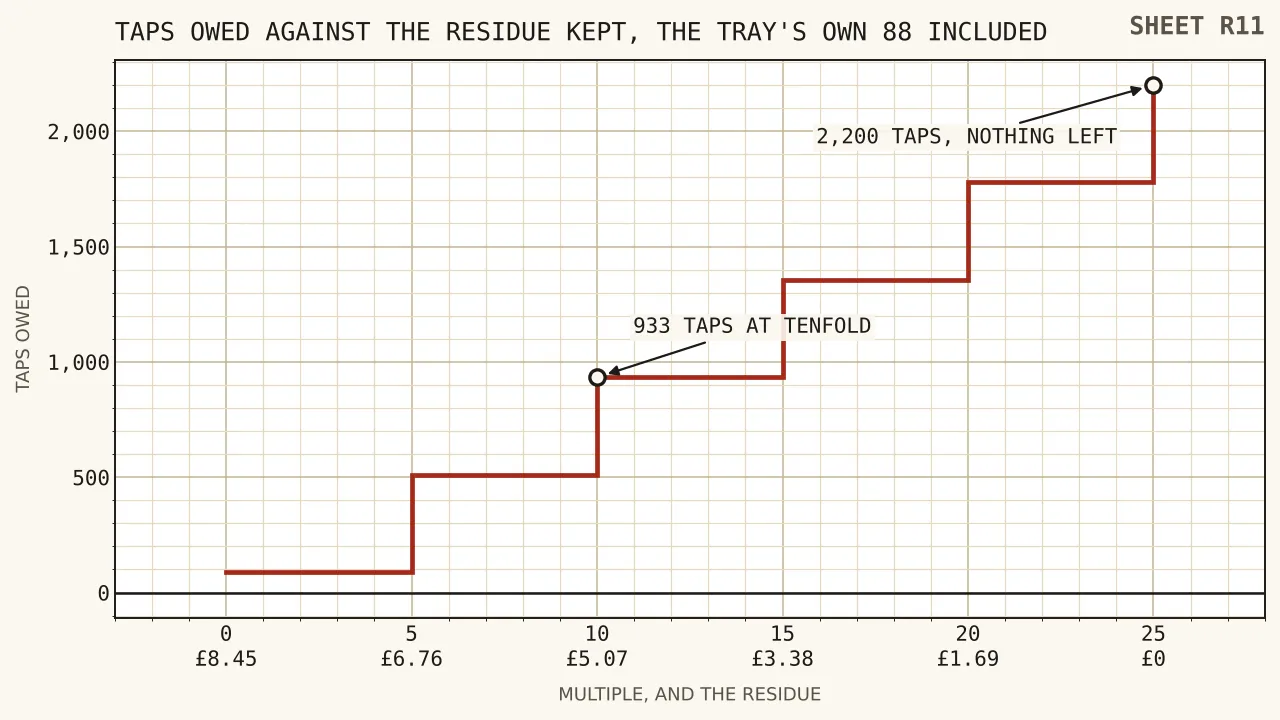
Read those together and the tap count becomes a hard floor rather than a style of play. 88 presses is 88 taps. The 845 taps owed at ten times cannot be reduced to one tap and a wait. The 3,379 owed at forty times cannot either.
| Condition | Taps owed | Residue | Taps per penny kept | Pence per 100 taps |
|---|---|---|---|---|
| Nothing on the winnings | 88 | £8.45 | 0.10 | 960.2p |
| Five times | 511 | £6.76 | 0.76 | 132.3p |
| Ten times | 933 | £5.07 | 1.84 | 54.3p |
| Twenty times | 1,778 | £1.69 | 10.52 | 9.5p |
| Twenty-five times | 2,200 | nothing | no finite figure | nothing |
The tap counts in that table add the tray’s own 88 to the turnover’s, since both have to be made. The fourth column is the honest price of an offer expressed in effort: a tenth of a tap buys a penny where nothing is required, and 10.52 taps buy a penny at twenty times.
And the fifth column is the same fact the other way up. A hundred taps are worth £9.60 of residue on an unconditioned tray and 9.5p of residue behind a twentyfold condition, which is a hundredfold difference in what the same physical effort earns.
One qualification. Those figures assume a reader completes the requirement, which on a small credit is frequently not what happens, and they assume the 2.5 second floor is the binding constraint rather than how fast a thumb moves. Each assumption is stated so that a reader may put their own figure in its place.
4
The one duty written about clicks
Here is the only place in the rulebook where the shape of a screen is the subject. The facilities letting a customer set their own financial limits must be provided through a direct link on the homepage, and must be clearly visible and accessible there. Deposit pages and screens owe the same visibility and accessibility, or else a link that carries it. Minimising the pages and clicks a customer crosses en route is the system’s job.
Price that against the tap counts in part three. Suppose the facility sits three taps from the homepage. The 845 taps owed at ten times are 282 times that distance. The 3,379 owed at forty times are 1,126 times it. So the duty is asking for a journey of three taps to sit alongside an obligation of several thousand, and the ratio is the argument for the duty.
The rest of the limit regime has figures worth setting beside those taps. Six further elements of the regime price out as follows, each in the unit this page runs in.
| What the standard asks | Set against 88 presses |
|---|---|
| Availability from registration onward | Before tap one, not after tap 845 |
| A prompt at registration, or at the first payment in | One prompt against 845 taps of obligation |
| Limit-setting presented as the default | Declining it costs a positive act and a confirmation |
| Durations including 24 hours, 7 days, 1 month | A daily cap of £10.00 is 100 taps a day |
| A cut applied at once, barring technical failure | 845 taps of obligation can be stopped immediately |
| A rise held 24 hours, then a second act | A day’s gap before the cap can rise above 100 taps |
Two shape requirements go with those.
The limit must be a free text box, or the telephone equivalent, and the account is the minimum level it has to apply at. Deposit limits of the gross kind are among those that must be offered, their definition turning on a cap over what gets paid into an account within a stated duration, and anything falling outside it may not go by that name. Prominence at least equal to that of other limit types is owed to them.
One worked example comes from the regulator and is directly usable. Set a hundred pounds as a weekly deposit limit and ten pounds as a daily one, and the most the system may allow becomes seventy pounds a week with ten a day, the most restrictive of the two always governing. At this page’s press price, ten pounds a day is 100 taps a day and seventy pounds a week is 700 taps a week, which is less than the 845 a tenfold requirement demands.
That last comparison is the page in one line. A limit a reader sets at ten pounds a day cannot fund a tenfold requirement on this tray inside a week, and the requirement and the limit are usually agreed on the same screen.
5
A stake ceiling at thumb scale
Two cash ceilings govern a reel cycle. £5.00 applies from twenty-five upwards and £2.00 to anybody younger. In taps at 10p those are twenty presses and fifty presses folded into a single act.
Which produces the clearest arithmetic on the page. At the higher ceiling the £84.48 owed at ten times takes 17 cycles instead of 845, and 42.5 seconds instead of 35 minutes 12 seconds. At the lower ceiling it takes 43 cycles and 1 minute 48 seconds. So the ceiling does not restrain how much a reader may put through a phone. It restrains how fast, and the factor is fifty.
Three scope points keep that honest. Both figures belong to online slots, built in the instrument from three features: a casino game, played online, reel-based. The guidance keeps them away from other casino games and names roulette and blackjack among those. And a formula rather than a date governs commencement in the instrument, six weeks running from its making, which was 25 February 2025. Two calendar dates come from the regulator rather than the instrument, 9 April 2025 starting the higher figure and 21 May 2025 the lower, six transitional weeks between them running five pounds flat for every age.
| Stake per cycle | Cycles for £84.48 | Least time | Expected cost | Residue |
|---|---|---|---|---|
| £0.10 | 845 | 35 m 12 s | £3.38 | £5.07 |
| £2.00 | 43 | 1 m 48 s | £3.38 | £5.07 |
| £5.00 | 17 | 42.5 s | £3.38 | £5.07 |
Two columns of that table are identical down the page, and that is the finding. Staking larger per cycle compresses the clock by a factor of fifty and leaves the expected cost of the requirement at £3.38 and the residue at £5.07. What it does change is the spread: 17 cycles produce a far wider range of outcomes around £5.07 than 845 do, so the larger stake buys speed and sells certainty.
Nothing on this page recommends either. The arithmetic is here so the trade is visible rather than implied.
6
Four disclosures on a four-inch screen
Any of four items satisfies the duty putting a customer’s prospects inside reach ahead of a commitment, an “or” sitting among them, and a small screen shortens the list by nothing.
In order of their use to a calculator: first the percentage returned, dividing straight into £8.80; then the margin, a subtraction away from the same place; then a winning event’s probability, which wants the payout schedule beside it; and last a narrative of how the game works, how winners get settled and how prizes get handed out, which produces no figure at all.
So a phone reel may lawfully present the fourth of those and nothing else. A percentage, where one appears, is wanted by the guidance as the theoretical average figure. Writing that a licensed room must print a percentage misreads the structure of the standard.
Two further duties in the same standard are what make a figure usable once found. Reachability is owed for the rules themselves, along with accuracy and sufficiency to explain all of them, and all reasonable steps towards making them understandable. And as a game proceeds, enough must be displayed for a customer to understand the state it is in.
That last duty is the one a small screen puts under pressure, and the arithmetic of this page is why it matters. A reader working through 845 taps has 845 occasions to misread a balance, and the state of the account is the only thing standing between them and the twenty-fifth multiple at which the credit reaches nothing.
One figure from the live standards belongs here too. From 17 January 2025 onwards a licensed operator has owed a customer two live disclosures, one of them the net spend and the other the time spent gambling. On this page’s figures a reader at ten times is being shown a £84.48 turnover and a 35 minute 12 second clock while the residue falls from £8.45 towards £5.07.
7
The session, measured against a journey
A phone tray gets used in gaps, so the useful unit is a block of time rather than an evening. Convert the obligations into blocks and the offer prices itself.
88 presses is 3 minutes 40 seconds at the floor. The 845 taps owed at ten times are 35 minutes 12 seconds. The 1,690 owed at twenty times are 1 hour 10 minutes. The 3,379 owed at forty times are 2 hours 21 minutes.
| Obligation | Taps | Ten-minute blocks | Blocks a day over a week | Residue per block |
|---|---|---|---|---|
| The tray alone | 88 | 0.4 | under one | £23.05 |
| Ten times | 845 | 3.5 | 0.5 | £1.44 |
| Twenty times | 1,690 | 7.0 | 1.0 | £0.24 |
| Forty times | 3,379 | 14.1 | 2.0 | a loss of £0.36 |
| Ten times at five pence | 16,896 | 70.4 | 10.1 | a loss of £0.84 |
The last column is the figure worth carrying away. An unconditioned tray of 88 returns £23.05 per ten minutes of pressing. The same tray behind a tenfold condition returns £1.44 per ten minutes. Behind twentyfold it returns 24p. Behind fortyfold it loses 36p per ten minutes, and in a room counting five pence it loses 84p.
Put beside a commute that affords two ten-minute blocks a day, the fourth row of that table is a week of commutes to finish £5.07 down, and the fifth row is five weeks of them.
Two more conversions make the blocks comparable with something a reader already measures. At 24 presses a minute, a tray of 88 is 3.7 minutes of pressing and the turnover at ten times is 35.2 minutes, so the obligation is 9.6 times the length of the thing that produced it. At twenty times it is 19.2 times as long, and at forty times 38.4 times. That ratio is nothing but the multiple over the rate, which is why the condition drives it and the count does not. Change the count to 880 presses and the ratio holds at 9.6 while every absolute figure multiplies by ten: £88.00 of stake, £84.48 of credit, 8,448 taps owed at ten times and 5 hours 52 minutes of pressing.
And the per-tap value falls on exactly the same schedule. Residue divided by total taps gives 9.6p a tap on an unconditioned tray, 0.54p a tap at ten times, 0.10p at twenty times and nothing at twenty-five. A reader who presses at the lawful floor earns 9.6p a tap for 3 minutes 40 seconds, or half a penny a tap for 38 minutes 52 seconds, and the two are the same offer with one clause added.
One product duty sits directly on top of that arithmetic. A gambling product may not actively encourage a customer to chase a loss, to raise a stake, to increase the amount they had decided on, or to keep going after indicating they wish to stop. Two additions sit in the guidance. Topping up funds taken into a product should happen only where the customer elects it each time. And drawing back in a person who elected to leave is out, with a free game named as the means of doing it.
8
The same phone, nothing on the register
The hardware is identical off the register and eleven duties are not. Each line below carries a figure from this page, in taps where taps are the better unit.
| What a licence pins down | Reckoned on this tray |
|---|---|
| A multiple stopped at ten times | 845 taps owed, rather than 3,379 at forty times |
| A staked pound counted in full | 16,896 taps avoided, 845 owed instead |
| A gap of 2.5 seconds per cycle | 3 m 40 s floors the tray, 35 m 12 s the turnover |
| No slam stop, quick spin or turbo | Every one of 845 taps is a separate act |
| Repetition that cannot run itself | 845 commitments, not one |
| A cash lid on one cycle | 50 taps folded into a cycle, or 20 under twenty-five |
| A limit facility a few taps away | Three taps against 845, a ratio of 282 to one |
| A limit prompted as the default | A £10.00 daily cap is 100 taps a day |
| Net spend and time shown live | £84.48 and 35 m 12 s both visible as they accrue |
| Identity checked before the first tap | £8.80 of stake needs a verified account |
| A route out, eight weeks then adjudication | Somewhere for a disputed £5.07 to go |
Two of those rows are specific to a phone. Screen geometry is the subject of exactly one duty in the rulebook, which is the limit facility sitting a few taps off, and the row above it is what turns 845 taps into 16,896. Both are absent off the register, and the second is worth £64.20 of expected cost on a credit of £8.45.
What much of that market runs under is a Curaçao policy on responsible gaming, numbered 1.0, carrying 21 February 2025. It is stricter on one of the rows above and silent on most of the others. Stricter on one: cutting a deposit limit bites at once out there and raising one waits a week, where the British floor on a rise is a day. Silent on four: a multiple’s ceiling, a stake’s cash lid, a cycle’s minimum length, and any bar on repetition running itself.
And the tax line does not move. Remote gaming duty of 40 per cent follows a player’s usual country of residence rather than an operator’s licence, replacing 21 per cent which had stood for seven years, with 1 April 2026 the date of the change.
Questions
- Are mobile slots different from desktop slots?
- Not in the arithmetic. Count by press price by return gives expected value; scaling that by one less multiple times edge over rate gives expected residue. No term in either formula is a screen size. 88 presses at 10p is £8.80 of stake and £8.45 back at 96 pence per pound, on any device.
- What does a tenfold requirement cost on a tray of 88?
- £84.48 of turnover. In taps at 10p that is 845, and at 2.5 seconds a cycle it is 35 minutes 12 seconds. The expected cost is £3.38 and the residue is £5.07. Twenty times leaves £1.69; twenty-five leaves nothing whatever.
- Does the stake cap apply on a phone?
- Yes. Online slots, not desktops, is what it addresses, and the instrument assembles that term from three features: reel-based, played online, a casino game. In taps at 10p, £5.00 is fifty presses folded into one act and £2.00 is twenty. The guidance keeps both figures away from other casino games and names roulette and blackjack among those.
- Is there any rule about how a mobile site is laid out?
- One. One. A direct link on the homepage, clearly visible and accessible there, is how the facilities for setting a customer’s own financial limits have to be reachable. Deposit screens, and deposit pages, owe that same visibility and accessibility, or else carry a link that does. And minimising whatever pages or clicks lie on that route falls to the system.
- How does a deposit limit interact with a wagering requirement?
- Arithmetically, and often badly. One worked example from the regulator puts a weekly limit of a hundred pounds beside a daily one of ten, observes that the most restrictive governs, and arrives at ten pounds daily with seventy weekly as the most the system may allow. Those come to 100 taps daily and 700 weekly at this page’s press price, both under the 845 taps demanded by a tenfold requirement here.
- Can I speed a mobile slot up?
- No. A result’s wait may not be shortened at a customer’s option, three named features falling outside what is permitted: turbo, quick spin, slam stop. Self-running repetition is barred as well, a commitment coming due at each cycle, and a cycle’s beginning always demanding the start control up and then down, or an equivalent. So 845 taps stays 845 separate acts.
- Should I bet more per spin to finish the wagering faster?
- Faster, yes; cheaper, no. The £84.48 owed at ten times takes 845 cycles at 10p, 43 at £2.00 and 17 at £5.00, which compresses the clock from 35 minutes 12 seconds to 42.5 seconds. The expected cost stays £3.38 and the residue stays £5.07 in all three cases. What rises is the spread around that residue, and nothing here recommends either course.
- What is a tray of 88 worth per ten minutes of tapping?
- £23.05 with no condition attached, £1.44 behind a tenfold condition, 24p behind twentyfold, and a loss of 36p behind fortyfold. In a room counting a staked pound at five pence, a tenfold condition loses 84p per ten minutes and runs to 70.4 blocks of ten minutes in all.
- Must a mobile slot show me its return percentage?
- No. Four items satisfy the disclosure duty with an “or” between them, and only one of them is a percentage. Useful to a calculator in this order: the percentage returned, then the margin, then a winning event’s probability, then a narrative of how the game works, how winners get settled, how prizes get handed out. A room may publish the last of those alone.
- What does a phone reel lose with nothing on the register?
- Eleven lines, costed in part eight, and two of them are peculiar to a phone. That cashier holds no Great Britain licence, which leaves the limit facility at no particular distance and a staked pound at no particular rate. That second absence is what turns 845 taps into 16,896, at a cost of £64.20 against a credit of £8.45. Alongside those, no multiple stops at ten times, £8.80 may be staked from an unverified account, and a disputed £5.07 has no eight-week route. At 40 per cent the remote gaming duty arrives at that cashier anyway, tracking wherever the player ordinarily lives.