Section W Revision 1 Counted 16 October 2026
The way in: a toll of 99p is ten presses that never happen
A payment of £18.00 buys 180 presses at 10p. Put a flat 99p charge on the way in and 9.9 of those presses have gone before the first one is counted; put 2.5 per cent on it instead and the loss is 4.5 presses. Sixteen pages price every rail in the same unit, and state where the two shapes of charge cross.
The count 180 presses One spin 10p Comes to 170.1 presses
Which rails reach a cashier at this end of the market
Every destination on this board is bought advertising. The site takes a fee if a reader goes on to register, and no figure printed below moves because of it.
The Spin Count
Gauge No 01
Betportal
Lowest multiple here
Priced at this site's own 10p a spin
What is counted
What is asked
No Great Britain licence
Licensed in Anjouan, Comoros, run by BetPortal Gaming Ltd, with Excite Ultra Media Ltd, reference ALSI-202601040-FI2.
Terms read 16 October 2026
Open the offer at Betportal, opens in a new tabThe Spin Count
Gauge No 02
WinBeast
Largest count here
Priced at this site's own 10p a spin
What is counted
What is asked
No Great Britain licence
Licensed in Curaçao, operator not named on the site.
Terms read 16 October 2026
Open the offer at WinBeast, opens in a new tabThe Spin Count
Gauge No 03
EliteSpin
Longest spin window
Priced at this site's own 10p a spin
What is counted
What is asked
No Great Britain licence
Licensed in Costa Rica, run by PrimeTier Limited.
Terms read 16 October 2026
Open the offer at EliteSpin, opens in a new tabThe Spin Count
Gauge No 04
Crown Jewelz
Multiple unpublished
No foot figure struck
What is counted
What is asked
No Great Britain licence
Licensed in Curaçao, number not verified, operator not named on the site.
Terms read 16 October 2026
Open the offer at Crown Jewelz, opens in a new tabThe figure in the third register is this site's own arithmetic and nothing an operator has published: the count at face, less the share a spin gives back at 96 per cent return to player, less what playing the wagering through costs at the same return. It describes the offer, not one reader's afternoon. Where the conditions price above the count the counter prints nothing rather than a negative sum, and where a figure the sum needs is unpublished it prints the condition in the operator's words instead.
A count has no unit of its own, so one is supplied. Where an operator publishes what a spin of its own is worth, that figure stands in the second register and is labelled as theirs. Where it does not, the second register carries this site's own 10p a spin and says so, and the foot figure moves in proportion: at half the price, half the money. The figure after it, what the count comes to for each spin, is the one that compares a large count against a small one.
Three words stand in the amount column where no figure can. Noted is a published condition that takes value away without leaving the sum a figure to take. Unpriced is a condition whose figure nobody has published, or a credit that is not a sum until a deposit of your own sets it. Own money is money of yours, which is never part of a foot figure.
Not one of the operators printed above holds a Great Britain licence, so the duties that licence carries do not reach them. Every online gambling company licensed in Great Britain has to be part of Gamstop Online, and a reader who has shut themselves out through the scheme is therefore not shut out here. The ceiling of ten times the bonus funds on a wagering requirement, in force since 19 January 2026, is a condition of that licence and binds the companies that hold one. Where a dispute goes instead is a matter for the authority named on the counter, and the Gambling Commission describes what a reader faces without a British licence as a lack of recourse if things go wrong. Nobody under 18 may hold an account at any of them.
Every term printed on a counter is the operator's own, and each counter carries the day it was read. The oldest of those readings is 16 October 2026. What binds a reader is the operator's own full terms, and not a line printed here.
1
The question every rail has to answer
Sixteen pages sit under this heading, each about one way of moving money into a cashier, and all sixteen ask the same thing. What does this route remove before the first press is counted? The answer has to be given in presses, because presses are the thing the reader is buying and percentages are the thing the rail is quoting.
A charge of two and a half per cent sounds negligible. On a payment of £18.00, which at 10p a press is 180 presses of stake, two and a half per cent is 45p, and 45p is four and a half presses. Four and a half presses out of a hundred and eighty, put that way, is a figure a reader can weigh against the thing being offered. Two and a half per cent is not.
Two further rules govern this section. A toll is never the only cost of a rail: speed at the exit, a ceiling on what can be sent, a currency conversion and the chance of the route being withdrawn all belong in the account. And a rail is not a reason to choose a cashier. The arithmetic of the package still decides that, and a rail that saves 50p on a package worth nothing at the foot has saved nothing worth having.
One line in this section is not negotiable. A gambling block on a bank card, a blocker installed on a phone, and the national self-exclusion scheme itself are all protections, and none of the sixteen pages here contains anything about getting past one. Where a page explains how a rail works it stops at the point where the explanation would become a way round a block, and says so.
2
A toll restated in presses
Take the same £18.00 payment through four shapes of charge and read the loss in presses rather than in money. A flat 99p takes 9.9 presses. A flat 50p takes five. Two and a half per cent takes four and a half. A charge of 1 per cent takes 1.8. The three cells at the top of this sheet carry the first of those: 180 presses bought, 170.1 of them surviving the way in.
The decimal is deliberate. A press is not divisible at the cashier, so 9.9 presses means the reader is ten presses short in practice and holds 10p of change they cannot spend one press at a time. Small, and worth noticing, because this is the only place on the site where rounding goes against the reader twice.
Now put the toll next to the expected cost of the play it buys. A hundred and eighty presses at 10p is £18.00 of turnover, and a machine that keeps 4p of each pound is expected to take 72p of it. So a 99p toll on the way in is larger than the entire expected cost of using the money once it has arrived. That comparison is the sharpest thing in this section: the rail can cost more than the game.
It gets worse where a charge sits at both ends. A 99p toll in and a 99p toll out on the same £18.00 is £1.98, or 19.8 presses, which is eleven per cent of the stake pool consumed by moving money rather than by playing with it. A reader who makes four small payments a month instead of one has paid that toll four times.
99p in and 99p out on £18.00 is 19.8 presses, against 72p of expected cost on the play
3
Where a flat charge and a percentage cross
The two shapes of charge in this market are a fixed sum and a proportion, and which of the two is cheaper turns wholly on how large the payment is. Below the crossing point the proportion wins; above it the fixed sum wins. The crossing point is the fixed sum divided by the proportion, and it is the one piece of arithmetic in this section a reader can do at the cashier.
| Fixed charge | Proportion | They cross at | In presses at 10p | Cheaper on £10.00 |
|---|---|---|---|---|
| 20p | 0.8 per cent | £25.00 | 250 | the proportion, by 12p |
| 45p | 1.5 per cent | £30.00 | 300 | the proportion, by 30p |
| 70p | 2.0 per cent | £35.00 | 350 | the proportion, by 50p |
| 99p | 2.5 per cent | £39.60 | 396 | the proportion, by 74p |
| £1.20 | 3.0 per cent | £40.00 | 400 | the proportion, by 90p |
Every crossing point in that table sits well above £18.00, which is the practical conclusion for this market. Payments in Britain cluster well below the crossing points above, so for most readers a proportional charge is the cheaper of the two shapes, and a flat charge is a penalty on small payments specifically. At £10.00 the 99p pair costs 99p against 25p, a factor of about four.
Run the comparison the other way and the flat charge comes into its own. A payment of £200.00 carries £5.00 at two and a half per cent and still only 99p flat, which is 50 presses against 9.9. Nothing in this is about which rail is better. It is about which shape of charge suits the size of payment the reader actually makes, and the figure to find is the crossing point.
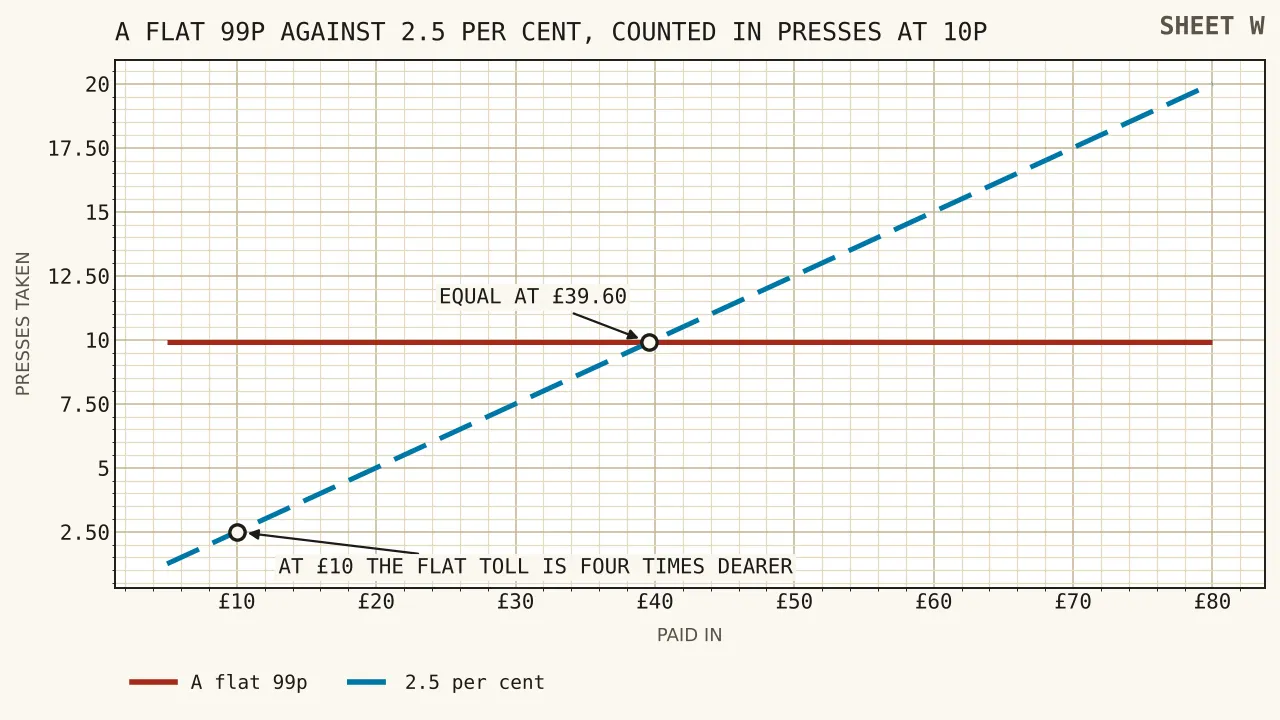
4
One rail is shut by rule
Of all the routes in this section, one cannot be used at a British cashier at all, and what closes it is a rule, not a commercial decision. The date is 14 April 2020, the instrument is a licence condition, and what it forbids is taking a credit card in payment for gambling. Sending the card payment by way of a money service business evades nothing.
The scope repays reading. Every remote licence falls inside it, the ancillary remote betting and ancillary remote lottery licences included, and three non-remote licences do as well, those being pool betting, betting intermediary and general betting. Three licence types sit outside: host, gambling software, gaming machine technical.
The arithmetic of why this matters is simple enough to state in one sentence. Borrowing to stake means the expected cost of the play and the cost of the borrowing both fall on the same money, so on £18.00 of turnover the expected 72p from the machine is joined by whatever the credit costs, and the two are additive. That is the honest reason the rail is closed here, and it is also why the page on this subject is written about the cost of borrowing rather than about where the rail can still be found.
5
The free rail still has a price
Several rails in this section charge the reader nothing at all, and the temptation is to stop the analysis there. The price of a free rail is time at the exit, and time at the exit has a cost that is not interest.
Interest on a held balance is negligible at this scale: £18.00 sitting for five days is worth fractions of a penny to anybody. The real cost of a wait is the opportunity it creates to put the money back through the machine, and that one is easy to price. An £18.00 balance put back through the machine at 10p a press buys 180 presses, with an expected 72p of cost attached, so a wait that ends in a reversal is worth minus 72p rather than nothing.
British rule shuts that door, and shuts it in terms. A withdrawal once requested may not be offered back to the customer for cancellation, money inside such a request is not to be made depositable again, and the guidance tells operators to strip friction out of the paying-out process rather than add it. So on a licensed site the wait is just a wait. Elsewhere it is an invitation, and the invitation carries a price of 72p for every £18.00 held.
6
The route: cards and wallets
Eight pages cover the rails most readers already hold. They divide by the shape of the charge rather than by the brand on the front.
A debit card on the Visa network asks what a charge that grows with the payment does to a tally that does not, and a debit card on the Mastercard network asks a different question: what happens to a balance sitting at a cashier when the rail underneath it is withdrawn, which is a risk a card carries and a voucher does not. Paying by credit card asks what the shut rail would cost if it were open, priced as borrowing.
A PayPal balance asks what a rail with no toll on it actually costs, and finds the answer in a clause rather than a fee. Apple Pay and Google Pay ask the same question from two directions: when the rail is free, the only priced figure left is the reader’s own ceiling, and both pages are about what that ceiling should be set at and how quickly it can be lowered.
A MuchBetter wallet asks how many separate legs a payment has and which of them is quoted, because a journey with four charging points advertised as one is the commonest way a toll hides. Skrill, Neteller and Trustly together asks what a collar on a percentage charge does, meaning a proportion with a floor and a ceiling bolted to it, which behaves like a flat charge at the bottom of the range and like a proportion in the middle.
7
The route: a voucher and a phone bill
Two pages deal with rails that run one way only, and that asymmetry is their whole subject. A prepaid voucher asks what a flat charge and a fixed denomination do together, since a voucher cannot be part-spent at the cashier and cannot usually carry a withdrawal back the other way, which means a second rail has to be found for the exit before the first one is used.
Paying against a phone bill asks what the steepest toll in this market costs in presses, and why a charge expressed as a share of the payment is at its most expensive exactly where the payments are smallest. That page also carries the plainest version of the warning in this section, because a bar placed with a mobile provider protects a reader exactly as a bank’s gambling block does, and nothing here helps anybody around either.
8
The route: the coin rails
Five pages cover payment in a cryptocurrency, and they are grouped because they share a charge structure nothing else in this section has. The toll is a network fee that does not scale with the payment, plus a spread on the conversion that does, plus a second conversion at the exit. A rail with three charging points, two of which move independently of the amount sent, cannot be priced with a single percentage.
Paying a cashier in coin is the page to read first, since it sets out the three charging points and asks what a British licence has to say about any of them. Bitcoin as the rail asks what the phrase in the search box can and cannot be answered with, which is a question about evidence rather than about coins.
Ethereum as the rail asks what a fee indifferent to how much is being sent does to a small payment, and a dollar-pegged token as the rail asks what is left of the case for coin once the volatility has been engineered out, which turns out to be a question about the flat fee alone. A coin cashier with nothing to pay in is the odd one out: no payment means no toll on the way in, so the whole charge waits at the exit, and that page prices it there.
9
The route: getting it back out
One page in this section is about the direction nobody advertises. Cashiers that pay out quickly asks what a wait costs when no fee is attached to it, and answers in the two currencies this page has been using throughout: the presses a reversal would buy, and the clause that decides whether a reversal is possible at all.
It belongs with the rails rather than in a section of its own because the exit is usually the same rail as the entrance, running backwards, and inherits its charge and its ceiling. A reader who has chosen a route for its toll on the way in has also chosen the route and the toll on the way out, often without being told so.
10
The exit a rail leads to, off the register
A rail is only as good as the exit it reaches, and that is where the comparison with the offshore end of this market bites hardest. The cashier on the far side of that rail holds no Great Britain licence; the four rules set out in this section therefore do not reach it, and every one of them is about getting money back rather than putting it in.
The first is the rule readers meet most often and recognise least. Identity has to be established and checked before a British licensee lets anybody gamble, and the same condition then bolts the obvious trapdoor shut: nothing the licensee was in a position to request at the outset may be demanded for the first time because a withdrawal has been requested. Documents at the door, in other words, and not at the exit. An exception survives for whatever some other legal duty compels a licensee to gather at that moment. The regulator’s guidance for players, dated 23 September 2020 with a revision in April 2022, says the same thing in shorter words and warns that a payout held up over missing identity information can leave the operator in breach.
Second comes the standard forbidding a cashier to dangle a cancellation in front of a withdrawal already asked for, which section five priced at 72p for every £18.00 held. Third comes the bar on any ceiling over the money a customer draws back out of a deposit balance, that being the money they paid in by whichever rail this section covers. Fourth comes the clock on a complaint: three working days to acknowledge one, cut to twenty-four hours at a site that trades at all hours, eight weeks for the whole of it, and then an approved adjudicator. The approved list runs to eight bodies, five of them carrying every remote sector.
Set that against the one figure that does cross the water. Remote gaming duty keys off the customer’s country of ordinary residence, not off the issuer of any licence, and it bills the operator rather than the player. Its rate ran at 21 per cent from 2019 until 1 April 2026, when 40 per cent replaced it. An offshore cashier taking British payments is inside the charge whichever rail the payment arrived on. The absence of a British licence subtracts the four protections above and adds nothing to the reader’s side of the ledger.
Eight weeks to an approved adjudicator here, against whatever the terms happen to say out there
Questions
- How do I compare two payment charges quickly?
- Convert both into presses. A payment of £18.00 at 10p a press is 180 presses of stake, so a flat 99p charge costs 9.9 presses and a 2.5 per cent charge costs 4.5. Presses are what the reader is buying, and a percentage is what the rail is quoting.
- Is a flat charge or a percentage cheaper?
- It depends on the size of the payment, and the dividing line is the flat sum divided by the proportion. A 99p charge set against 2.5 per cent crosses at £39.60, or 396 presses of stake. Below that the percentage is cheaper and above it the flat sum is, and British payments cluster well below the crossing points usual in this market.
- Can a toll really cost more than the gambling?
- On a small payment, yes. A hundred and eighty presses at 10p is £18.00 of turnover, and a machine keeping 4p of each pound is expected to take 72p of it. A flat 99p on the way in is larger than that, and a 99p charge at each end comes to £1.98, or 19.8 presses, against 72p of expected cost on the play itself.
- Why can I not pay with a credit card at a British site?
- Because a licence condition has barred it since 14 April 2020. Slotting a money service business into the middle of the payment evades nothing. Every remote licence is inside the scope, the ancillary remote betting and ancillary remote lottery licences included, plus three non-remote licences: pool betting, betting intermediary and general betting.
- What does a free payment rail actually cost?
- Time at the exit, and the price of that time is not interest. A wait creates the opportunity to put the money back through the machine, and an £18.00 balance pushed through again at 10p a press buys 180 presses with an expected 72p of cost attached. On a licensed site that door is shut, because on a licensed site a requested withdrawal stays requested.
- Can documents be demanded at the point of withdrawal?
- Not for anything it was in a position to request at the outset. Identity has to be established and checked before a British licensee lets anybody gamble, and the same condition stops a withdrawal request from becoming the occasion for a fresh demand. An exception survives for whatever another legal duty compels the licensee to gather at that moment.
- Which rail should I choose?
- None of these pages answers that, because a rail is not a reason to pick a cashier. Work out the crossing point for the charges in front of you, convert the toll into presses, then weigh it against what the package itself is worth at the foot. Saving 50p on the way in to something worth nothing at the foot has saved nothing worth having.
- What does a rail lose when the cashier is not on the British register?
- Four things, and every one of them concerns the exit rather than the entrance: documents required at the door instead of at the withdrawal, the standard against dangling a cancellation at a withdrawal already asked for, the prohibition on any ceiling over what is drawn from a deposit balance, and the duty to close a complaint out within eight weeks, an approved adjudicator waiting behind that. Remote gaming duty crosses regardless, keyed to the customer’s residence, and 40 per cent replaced 21 per cent on 1 April 2026.