Sheet R10 Revision 1 Counted 16 October 2026
Top 10 best online slots: four orderings, and they disagree
110 presses at 10p is £11.00 of stake and £10.56 back at 96 pence per pound. The word best picks out no single quantity: four defensible orderings exist, and on four worked reels they produce four different answers. The same reel finishes first on two of them and last on another.
The count 110 presses One press 10p Comes to £10.56 before conditions
What a count of this size comes to
Every destination on this board is bought advertising. The site takes a fee if a reader goes on to register, and no figure printed below moves because of it.
The Spin Count
Gauge No 01
Betportal
Lowest multiple here
Priced at this site's own 10p a spin
What is counted
What is asked
No Great Britain licence
Licensed in Anjouan, Comoros, run by BetPortal Gaming Ltd, with Excite Ultra Media Ltd, reference ALSI-202601040-FI2.
Terms read 16 October 2026
Open the offer at Betportal, opens in a new tabThe Spin Count
Gauge No 02
WinBeast
Largest count here
Priced at this site's own 10p a spin
What is counted
What is asked
No Great Britain licence
Licensed in Curaçao, operator not named on the site.
Terms read 16 October 2026
Open the offer at WinBeast, opens in a new tabThe Spin Count
Gauge No 03
EliteSpin
Longest spin window
Priced at this site's own 10p a spin
What is counted
What is asked
No Great Britain licence
Licensed in Costa Rica, run by PrimeTier Limited.
Terms read 16 October 2026
Open the offer at EliteSpin, opens in a new tabThe Spin Count
Gauge No 04
Crown Jewelz
Multiple unpublished
No foot figure struck
What is counted
What is asked
No Great Britain licence
Licensed in Curaçao, number not verified, operator not named on the site.
Terms read 16 October 2026
Open the offer at Crown Jewelz, opens in a new tabThe figure in the third register is this site's own arithmetic and nothing an operator has published: the count at face, less the share a spin gives back at 96 per cent return to player, less what playing the wagering through costs at the same return. It describes the offer, not one reader's afternoon. Where the conditions price above the count the counter prints nothing rather than a negative sum, and where a figure the sum needs is unpublished it prints the condition in the operator's words instead.
A count has no unit of its own, so one is supplied. Where an operator publishes what a spin of its own is worth, that figure stands in the second register and is labelled as theirs. Where it does not, the second register carries this site's own 10p a spin and says so, and the foot figure moves in proportion: at half the price, half the money. The figure after it, what the count comes to for each spin, is the one that compares a large count against a small one.
Three words stand in the amount column where no figure can. Noted is a published condition that takes value away without leaving the sum a figure to take. Unpriced is a condition whose figure nobody has published, or a credit that is not a sum until a deposit of your own sets it. Own money is money of yours, which is never part of a foot figure.
Not one of the operators printed above holds a Great Britain licence, so the duties that licence carries do not reach them. Every online gambling company licensed in Great Britain has to be part of Gamstop Online, and a reader who has shut themselves out through the scheme is therefore not shut out here. The ceiling of ten times the bonus funds on a wagering requirement, in force since 19 January 2026, is a condition of that licence and binds the companies that hold one. Where a dispute goes instead is a matter for the authority named on the counter, and the Gambling Commission describes what a reader faces without a British licence as a lack of recourse if things go wrong. Nobody under 18 may hold an account at any of them.
Every term printed on a counter is the operator's own, and each counter carries the day it was read. The oldest of those readings is 16 October 2026. What binds a reader is the operator's own full terms, and not a line printed here.
1
Best is not a quantity
A list of ten needs an ordering and an ordering needs one number. The trouble with this subject is that four numbers have an equal claim, they are not proxies for one another, and on real specifications they rank the same reels in different sequences.
Settle the tray first, because that part is not in dispute. 110 presses funded at 10p is £11.00 of stake. At 96 pence returned per pound the average coming home is £10.56, and the house keeps £0.44. Those three figures hold whatever ordering a reader prefers.
The four candidates are these. What comes back per pound, which is the return. Second, the heaviest requirement a reel bears before the credit sinks, found by putting rate over edge. The chance that 110 presses finish with nothing at all, which comes from the paytable’s shape. And fourth, what a requirement will demand in staking, being credit by multiple over rate.
Each of those is a real number with a real consequence for a reader. None of them is derivable from the others. And part seven shows four worked reels on which the orderings come out as A, D, B, C; A, B, C, D; C, B, D, A; and C, B, A, D.
Which is why this page carries no numerical score and no stars. A figure invented to make a list sortable is the easiest false statement to write and the hardest to defend, and nothing published anywhere would support one. What a reader can have instead is the four numbers, each with its own arithmetic, and a note on which of them answers their actual question.
A count of 110 pushed at this volume is almost certainly outside the British licence. Thirteen duties come off with that licence, and part nine prices each against the £10.56.
The four reels in part two are specifications, not products. Each is a set of numbers chosen to make the orderings visible: a return, a top win as a multiple of the stake, and a contribution rate. No reachable primary source publishes a configured return or a paytable for any named title, so a page naming real titles and ordering them on figures of its own invention would be inventing facts about products that exist.
2
Four reels, fully specified
Here are the four, each described by three numbers and nothing else. The paytable model is the simplest available: one prize, paying a fixed multiple of the stake, with its probability set so the mean lands on the stated return.
| Reel | Returns per pound | Top win pays | Counts a staked pound at | Credit from 110 presses |
|---|---|---|---|---|
| Reel A | 97.0 pence | 1,000 times | 100 pence | £10.67 |
| Reel B | 96.0 pence | 50 times | 100 pence | £10.56 |
| Reel C | 94.5 pence | 10 times | 100 pence | £10.40 |
| Reel D | 96.5 pence | 250 times | 40 pence | £10.62 |
Four edges follow by subtraction: 3.00 pence, 4.00 pence, 5.50 pence and 3.50 pence per pound. On £11.00 of stake those are £0.33, £0.44, £0.61 and £0.39 that the room keeps.
Four trigger frequencies follow by division. Reel A needs its prize once in 1,030.93 presses. Reel B once in 52.08. Reel C once in 10.58. Reel D once in 259.07. The four frequencies are the whole explanation of why the reels feel so unlike each other at an identical count.
And the fifth column is the only part a reader can usually compute from an offer alone, since a count and a press price are normally printed while the other three numbers are not. The spread between the fattest and thinnest credit there is £0.27, which is two and a bit presses.
Hold that £0.27 in mind through the next four parts, because it is the entire prize for choosing correctly on the return alone, and the parts that follow produce differences many times larger.
3
Ordering by what comes back
The first ordering is the obvious one and the weakest. Rank by the return and the sequence runs A, then D, then B, then C.
What that ordering buys is the fifth column of part two: credits of £10.67, £10.62, £10.56 and £10.40. First place beats last place by £0.27 on a tray of 110, which is 2.5 per cent of the face value.
Put it per press and the differences shrink further. Reel A gives back 9.70p a press, Reel D 9.65p, Reel B 9.60p and Reel C 9.45p. The whole argument about which reel pays best is an argument about a quarter of a penny per press.
One more way to read it, which gives the ordering its only real claim. Divide the cost of using each reel by the time it takes. At 10p a press and the 2.5 second floor, a reader makes 24 presses a minute, so the room’s take runs at £2.40 times the edge per minute: 7.20p a minute on Reel A, 8.40p on D, 9.60p on B and 13.20p on C. Over the 4 minutes 35 seconds that 110 presses occupy, that is £0.33, £0.39, £0.44 and £0.61.
So on the return, and on the cost per minute it implies, Reel A wins. Keep that result, because two of the next three parts put it last.
A quarter of a penny a press separates the best return from the worst
4
Ordering by what a requirement can carry
The second ordering asks a different question: how heavy a requirement can this reel survive? Rate over edge gives the answer, and whether an offer carries a positive expectation at all is decided by that one figure.
Reel A carries 33.33 times. Reel B carries 25.00. Reel C carries 18.18. Reel D carries 11.43, because its forty pence contribution rate divides into its 3.50 pence edge rather than a hundred pence doing so.
So the sequence is A, B, C, D, and Reel D has moved from second place to last. Nothing about the reel changed. The question changed.
| Reel | Carries up to | After tenfold | After twentyfold | After fortyfold |
|---|---|---|---|---|
| Reel A | 33.33x | £7.47 | £4.27 | short by £2.13 |
| Reel B | 25.00x | £6.34 | £2.11 | short by £6.34 |
| Reel C | 18.18x | £4.68 | nothing left | short by £12.47 |
| Reel D | 11.43x | £1.33 | short by £7.96 | short by £26.54 |
Read the tenfold column against the return column from part three and the whole point of this page is visible. On the return, A beats D by £0.05 of credit. Behind a tenfold requirement, A beats D by £6.14. The contribution rate did that, and the contribution rate is the number least likely to appear anywhere a reader will see it.
A British licensee may load bonus funds no more heavily than ten times, which dates from 19 January 2026. So the third column is the regulated worst case and the last column describes a cashier beyond the register.
5
Ordering by the chance of an empty tray
The third ordering asks what a reader is actually likely to experience, which is a question about the distribution rather than the mean.
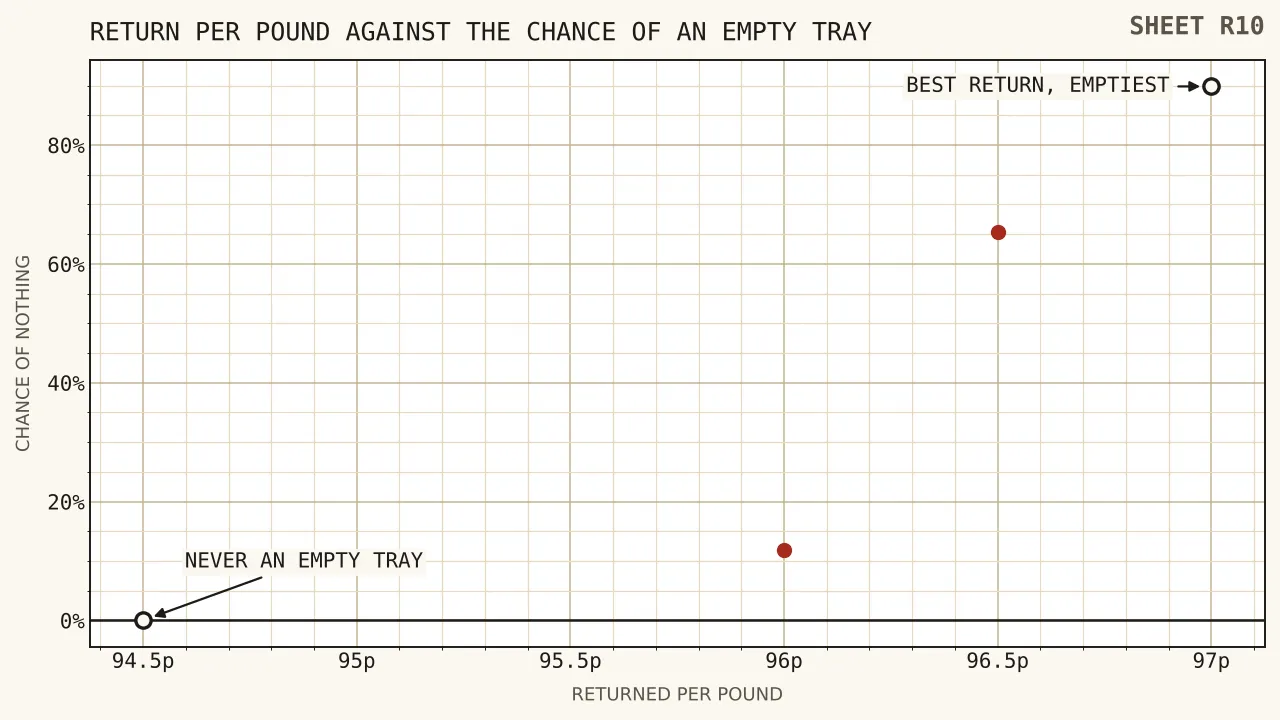
On the single-prize model, the probability of 110 presses producing nothing at all is the probability of missing the prize 110 times running. Reel A misses it 89.87 per cent of the time. Reel D misses it 65.35 per cent of the time. Reel B misses it 11.85 per cent of the time. Reel C effectively never does, its chance of an empty tray rounding to nothing at two decimal places.
That gives the sequence C, B, D, A, which is almost exactly the reverse of part three. The reel with the best return is the reel most likely to hand a reader nothing, and the reason is arithmetical rather than sinister: a thin edge paid out through a very large and very rare prize has to be rare in proportion.
| Reel | Prize needed once in | Expected hits in 110 | Chance of nothing | Prize at 10p a press |
|---|---|---|---|---|
| Reel A | 1,030.93 presses | 0.11 | 89.87% | £100.00 |
| Reel B | 52.08 presses | 2.11 | 11.85% | £5.00 |
| Reel C | 10.58 presses | 10.40 | under 0.01% | £1.00 |
| Reel D | 259.07 presses | 0.42 | 65.35% | £25.00 |
The fourth column and the fifth column are the same fact seen twice. Reel A’s prize is £100.00 at this page’s press price, and the price of a prize that size is a tray that usually ends at zero. Reel C’s prize is £1.00 and arrives ten times in a tray of 110.
Which ordering a reader should prefer depends on what they want from 110 presses, and this page will not choose for them. What it will do is point out that any list ordered on the return alone is implicitly ordering on the first column of part three while the reader is usually asking about the fourth column here.
6
Ordering by the staking owed
The fourth ordering is about effort. Contribution rather than stake is what settles a requirement, so what a reader puts through comes to credit by multiple over rate.
At tenfold: Reel C owes £103.95, Reel B owes £105.60, Reel A owes £106.70 and Reel D owes £265.38. The sequence is C, B, A, D.
Note what has happened to Reel A. It owes slightly more staking than B or C for the unremarkable reason that it produced a slightly larger credit, and a larger credit means a larger requirement. Being the best reel on the return makes a reader very marginally worse off on the fourth ordering.
In presses at 10p those four figures are 1,040, 1,056, 1,067 and 2,654. At the 2.5 second floor they are 43 minutes 20 seconds, 44 minutes, 44 minutes 28 seconds and 1 hour 50 minutes 35 seconds. Reel D’s contribution rate has added more than an hour to an obligation that is otherwise within four minutes of being identical across the other three.
And the cost of that staking is where the money goes. £265.38 turned over at a 3.50 pence edge costs £9.29, against a credit of £10.62, which is why Reel D’s residue at tenfold is £1.33. The same reel on a hundred pence contribution rate would owe £106.15, cost £3.72 and leave £6.90.
So the contribution rate alone is worth £5.57 on this tray, which is twenty times the £0.27 that the entire return ordering was worth in part three.
7
The four orderings, side by side
Put them together and the case against a single list is a table rather than an argument.
| The question asked | First | Second | Third | Fourth |
|---|---|---|---|---|
| What comes back per pound | A | D | B | C |
| How heavy a requirement it carries | A | B | C | D |
| How often the tray ends empty | C | B | D | A |
| How much staking is owed | C | B | A | D |
Four sequences, four different winners counted across the rows, and one reel in first place twice and last place once. Reel B is second on every row, which is the closest thing to a defensible pick available, and it is second because its three numbers are the least extreme rather than because it is good at anything.
That is the finding. A reel optimised for one ordering is worse on at least one other, and the trade-offs are not small: £0.27 separates the return ordering from top to bottom while £6.14 separates the tenfold residue ordering.
So the question a reader should ask is not which reel is best. It is which of the four columns they care about, and then whether the figure they need is published anywhere. Usually the count and the press price are, and the other three are not.
Somebody will now ask for the four to be combined into one, so here is why that cannot be done honestly. Combining requires weights, and weights require a reader’s own preference between money and spread. Give the return a weight of one and the chance of an empty tray a weight of one, measured in percentage points, and Reel C wins by a mile because 89.87 beats £0.27 on any scale that treats a point as a penny. Give the empty-tray chance a weight of a hundredth and Reel A wins. The answer is a property of the weights, not of the reels, and any single list has chosen weights without saying so.
One honest composite does exist, and it is narrow. Where a requirement is attached and a reader intends to clear it, expected residue in pounds answers the whole question, because it already contains the return, the contribution rate and the multiple. At tenfold those four figures are £7.47, £6.34, £4.68 and £1.33, which puts the sequence at A, B, C, D and makes the second ordering the right one for that reader. At twentyfold they are £4.27, £2.11, nothing, and a shortfall of £7.96, and the sequence is unchanged.
For a reader who will not clear a requirement, expected residue is the wrong figure entirely and the fourth column of part five is the right one, because the question has become how often 110 presses produce anything at all. Those two readers are looking at the same tray and need opposite lists, which is the clearest possible demonstration that the word in the heading describes a preference rather than a measurement.
Two thresholds help where the other figures are missing. A requirement of W breaks even at a return of one less the reciprocal of W, which is 90.00 pence at tenfold, 95.00 pence at twentyfold and 97.50 pence at fortyfold. And where the contribution rate is known, divide the multiple by it before using those thresholds: Reel D’s tenfold requirement at forty pence behaves like twenty-five times and needs 96.00 pence, which its 96.5 pence just clears.
8
A floor on the way out, and a small tray
A tray of 110 is small enough that a withdrawal floor can decide the answer on its own, regardless of which of the four orderings a reader used.
Take the credit at the house figure, £10.56. A smallest payable sum of £5.00 is cleared on the mean with room to spare, needing 0.47 times the average. A floor of £10.00 needs 0.95 times, which is cleared on the mean by 56p. A floor of £20.00 needs 1.89 times the average, so a reader has to almost double the mean to be paid anything whatever.
| Smallest payable sum | Multiple of the mean needed | Margin on the mean | Reel A, after tenfold | Reel D, after tenfold |
|---|---|---|---|---|
| £5.00 | 0.47 times | clear by £5.56 | clear, £7.47 | short, £1.33 |
| £10.00 | 0.95 times | clear by £0.56 | short, £7.47 | short, £1.33 |
| £20.00 | 1.89 times | short by £9.44 | short, £7.47 | short, £1.33 |
The last two columns are where a floor and a requirement collide. Behind a tenfold requirement, Reel A’s residue of £7.47 clears a £5.00 floor and fails a £10.00 one. Reel D’s residue of £1.33 fails all three. So a pair of figures that each look survivable separately can combine into an offer whose average outcome is unpayable by construction.
Reversing it gives the count a reader would need. Clearing a £10.00 floor on the mean, behind a tenfold requirement on a 96 pence reel, needs a credit of £16.67, which needs £17.36 of stake and 174 presses. A £20.00 floor needs 348 presses. Neither figure appears in a headline of 110.
One further arithmetic belongs beside those thresholds, because it converts a floor into a count. The presses needed to clear a floor of F, on a reel returning R per pound at a press price of P, behind a requirement of W at a contribution rate of g, are F divided by the product of P, R and one minus W times the edge over g. At the house figures and a tenfold requirement that denominator is 0.0576, so a £5.00 floor needs 87 presses, a £10.00 floor needs 174, and a £20.00 floor needs 348.
Run the same formula at twentyfold and the denominator falls to 0.0192, which triples every answer: 261 presses for £5.00, 521 for £10.00 and 1,042 for £20.00. At twenty-five times the denominator is nothing and no count whatever clears any floor on the mean, which is the same twenty-five appearing in a new guise.
One rule separates two things that get muddled here. Capping what a consumer takes from a deposit balance is beyond any term, and a specimen of the barred wording is printed by the regulator itself, in which a weekly five hundred stands beside a daily fifty. A floor on the smallest payable sum, and a maximum win attached to bonus winnings, are different animals on a different balance, which is how one document can carry a cap and an uncapped right at once without contradicting itself.
9
No score, no stars, and what the licence holds
No star count appears anywhere here, and no numerical score either, for the reason that produced four orderings in place of one. A sortable figure would have to be invented, inventing it would be the easiest false statement available, and no published source would support it.
What can be stated is what the licence holds in place, each line priced against this page’s £10.56.
| What a licence pins down | Costed on this tray |
|---|---|
| A requirement stopping at ten times | £6.34 standing on Reel B, against a £6.34 shortfall at fortyfold |
| Results that are acceptably random | Every figure in parts three to six becomes computable |
| Rules and payouts fixed during play | Reel C’s prize stays one in 10.58 for all 110 presses |
| Chances made available before the commitment | A single disclosure reaches the reader, though not always the percentage |
| A 2.5 second gap between cycles | 4 m 35 s floors the tray; 44 m floors the tenfold turnover |
| No turbo and no self-running repetition | 1,056 presses at tenfold cannot be hurried |
| A cash lid over a single cycle | A cycle holds 50 presses, or 20 for the young |
| Silence unless the stake is beaten | A 5p return on a 10p press is reported, not celebrated |
| Losses never dressed as an almost | Reel A’s 89.87 per cent of empty trays read as empty |
| Identity checked before the first press | £11.00 of stake needs an account somebody has verified |
| A cashier that refuses credit cards | Borrowing is shut out of £105.60 of turnover |
| A deposit balance nobody may cap | £6.34 of residue stays the reader’s to take |
| Eight weeks and then an adjudicator | A disputed £6.34 has a route that exists |
The second and third rows carry the weight on a page of this kind. A stated return and a stated paytable are what produce every probability in parts five and six, and a stated return is worthless where probabilities may be adjusted, or altered mid-session. The orderings remain computable off the register. They stop being checkable.
Two figures close the ledger. Remote gaming duty, at 40 per cent, attaches to wherever a player ordinarily lives, which brings it to a cashier with a British licence and to one lacking it alike. And a ceiling over a wagering multiple appears nowhere inside the document much of that market answers to, which is the Curaçao responsible gaming policy at 1.0, dated 21 February 2025.
Questions
- What are 110 free spins at 10p worth?
- £11.00 at face, and £10.56 averaged off a reel giving back 96 pence in each pound, the room retaining £0.44. Behind a tenfold requirement that becomes £6.34, behind twentyfold £2.11, and at twenty-five times it is nothing.
- Why will this page not rank ten slots?
- Because four defensible orderings exist and they disagree. On four worked specifications they come out as A, D, B, C by return; A, B, C, D by the heaviest requirement carried; C, B, D, A by the chance of an empty tray; and C, B, A, D by the staking owed. One reel finishes first twice and last once.
- How much is the best return actually worth?
- Across 110 presses it comes to £0.27 from the best of the four specifications to the worst, or 2.5 per cent of face, or a farthing-sized quarter of a penny each press. The contribution rate, by contrast, is worth £5.57 on the same tray, and the chance of an empty tray ranges from under 0.01 per cent to 89.87 per cent.
- Which number should I actually look at?
- Whichever answers the question being asked. For a bare tray with no conditions, the return. For a tray with a wagering requirement, the contribution rate divided by the edge, since that is the heaviest multiple the reel can carry. For what a single session is likely to feel like, the chance that the tray ends with nothing. For the amount of pressing owed, take credit by multiple over rate.
- Why does a high return often mean an empty tray?
- Arithmetic rather than anything sinister. A thin edge paid out through a very large and very rare prize has to be rare in proportion. On the single-prize model a reel returning 97 pence per pound through a prize of 1,000 times the stake needs that prize once in 1,030.93 presses, so 110 presses miss it 89.87 per cent of the time, while a reel returning 94.5 pence through a prize of 10 times needs it once in 10.58 and effectively never finishes empty.
- What is the heaviest requirement a British licensed site may set?
- Ten times the bonus funds, a position dating from 19 January 2026. Against the four specifications, a tenfold requirement leaves £7.47, £6.34, £4.68 and £1.33, the last of those being the reel whose contribution rate is forty pence in the pound rather than a hundred.
- Is there a quick test for whether a requirement clears?
- Put the contribution rate over the edge and set the answer beside whatever multiple is printed. The four specifications carry 33.33, 25.00, 18.18 and 11.43. Alternatively work from the return: a requirement of W breaks even at one less the reciprocal of W, so 90.00 pence at tenfold, 95.00 pence at twentyfold and 97.50 pence at fortyfold. Where weighting applies, scale the multiple up by the reciprocal of the rate before using either method.
- Can a withdrawal floor swallow a tray this size?
- Easily. Against a mean of £10.56, a £5.00 floor needs 0.47 times the average and a £10.00 floor needs 0.95 times, both cleared on the mean. A £20.00 floor needs 1.89 times. Behind a tenfold requirement the picture changes: a residue of £7.47 clears £5.00 and fails £10.00, and a residue of £1.33 fails all three.
- How many presses would clear a ten pound floor?
- Behind a tenfold requirement on a 96 pence reel, clearing £10.00 on the mean needs a credit of £16.67, which needs £17.36 of stake and 174 presses. A £20.00 floor needs 348. A headline of 110 is well under either figure.
- What does the register hold in place here?
- Thirteen lines, each priced in part nine, and two of them carry most of the weight on this subject. A room with no Great Britain licence owes nobody acceptable randomness, and nothing there keeps rules, payouts or probabilities still during play, which leaves every probability in parts five and six computable and unverifiable at once. Beside those: ten times ceases to cap the multiple, an unverified account may stake the £11.00, and no eight-week clock sits behind a disputed £6.34. That operator pays remote gaming duty at 40 per cent regardless, the charge being fixed by a player’s usual country of residence.