Sheet R06 Revision 1 Counted 16 October 2026
Pragmatic slots: a studio supplies the game, a room installs the build
190 presses at 10p is £19.00 of stake. One studio’s title can sit in three rooms on three builds, and the arithmetic follows the build rather than the badge: £17.48, £17.86 or £18.24 across a band of returns. Behind a tenfold requirement the same three become £3.50, £7.14 and £10.94.
The count 190 presses One press 10p Comes to £17.48 to £18.43
What a count of this size comes to
Every destination on this board is bought advertising. The site takes a fee if a reader goes on to register, and no figure printed below moves because of it.
The Spin Count
Gauge No 01
Betportal
Lowest multiple here
Priced at this site's own 10p a spin
What is counted
What is asked
No Great Britain licence
Licensed in Anjouan, Comoros, run by BetPortal Gaming Ltd, with Excite Ultra Media Ltd, reference ALSI-202601040-FI2.
Terms read 16 October 2026
Open the offer at Betportal, opens in a new tabThe Spin Count
Gauge No 02
WinBeast
Largest count here
Priced at this site's own 10p a spin
What is counted
What is asked
No Great Britain licence
Licensed in Curaçao, operator not named on the site.
Terms read 16 October 2026
Open the offer at WinBeast, opens in a new tabThe Spin Count
Gauge No 03
EliteSpin
Longest spin window
Priced at this site's own 10p a spin
What is counted
What is asked
No Great Britain licence
Licensed in Costa Rica, run by PrimeTier Limited.
Terms read 16 October 2026
Open the offer at EliteSpin, opens in a new tabThe Spin Count
Gauge No 04
Crown Jewelz
Multiple unpublished
No foot figure struck
What is counted
What is asked
No Great Britain licence
Licensed in Curaçao, number not verified, operator not named on the site.
Terms read 16 October 2026
Open the offer at Crown Jewelz, opens in a new tabThe figure in the third register is this site's own arithmetic and nothing an operator has published: the count at face, less the share a spin gives back at 96 per cent return to player, less what playing the wagering through costs at the same return. It describes the offer, not one reader's afternoon. Where the conditions price above the count the counter prints nothing rather than a negative sum, and where a figure the sum needs is unpublished it prints the condition in the operator's words instead.
A count has no unit of its own, so one is supplied. Where an operator publishes what a spin of its own is worth, that figure stands in the second register and is labelled as theirs. Where it does not, the second register carries this site's own 10p a spin and says so, and the foot figure moves in proportion: at half the price, half the money. The figure after it, what the count comes to for each spin, is the one that compares a large count against a small one.
Three words stand in the amount column where no figure can. Noted is a published condition that takes value away without leaving the sum a figure to take. Unpriced is a condition whose figure nobody has published, or a credit that is not a sum until a deposit of your own sets it. Own money is money of yours, which is never part of a foot figure.
Not one of the operators printed above holds a Great Britain licence, so the duties that licence carries do not reach them. Every online gambling company licensed in Great Britain has to be part of Gamstop Online, and a reader who has shut themselves out through the scheme is therefore not shut out here. The ceiling of ten times the bonus funds on a wagering requirement, in force since 19 January 2026, is a condition of that licence and binds the companies that hold one. Where a dispute goes instead is a matter for the authority named on the counter, and the Gambling Commission describes what a reader faces without a British licence as a lack of recourse if things go wrong. Nobody under 18 may hold an account at any of them.
Every term printed on a counter is the operator's own, and each counter carries the day it was read. The oldest of those readings is 16 October 2026. What binds a reader is the operator's own full terms, and not a line printed here.
1
A badge is not a build
A studio writes a game. A room installs it. Those are two different acts by two different businesses, and the figure a reader needs sits with the second of them.
Start with what is certain. 190 presses at 10p is £19.00 of funded stake. That figure is independent of the studio, the title and the room, because it is a count multiplied by a price and nothing else.
What the stake returns is not certain, and this page will not pretend otherwise. Nothing reachable publishes a configured return for any named title from any named studio. So the method here is a band and a crossing value: show what £19.00 of stake averages at each plausible return, and then give the return at which a given requirement breaks even.
At 92 pence returned per pound the tray averages £17.48. At 94 pence, £17.86. At 96 pence, £18.24. At 97 pence, £18.43. The whole band is £0.95 wide, which is nine and a half presses.
And a studio name does not pick a row in that table. What the badge tells a reader is who designed the mechanics, how the bonus rounds behave and what the paytable looks like. What it does not tell them is which build the room in front of them has installed, and the build is where the return lives.
Expect no Great Britain licence wherever these counts get pushed hardest, and expect the badge to be doing the reassuring. A studio’s logo above a reel is a statement about software and not about licensing, and part five gives the published enforcement outcome that proves the point rather than asserting it.
The band on this page runs 92 to 97 pence returned per pound and is a demonstration device, stated as one. A bare 96 anywhere below is the house assumption this site declares. No configured return for a title appears here. None is published by any primary source within reach, and supplying one from memory would invent a fact about a product that exists.
2
One title, three rooms, three answers
Run the same tray through three rooms and the spread shows up where it matters, which is behind the requirement rather than on the presses.
| Build returns | Tray averages | House keeps | Behind tenfold | Behind fortyfold |
|---|---|---|---|---|
| 92 pence | £17.48 | £1.52 | £3.50 | short by £38.46 |
| 94 pence | £17.86 | £1.14 | £7.14 | short by £25.00 |
| 96 pence | £18.24 | £0.76 | £10.94 | short by £10.94 |
| 97 pence | £18.43 | £0.57 | £12.90 | short by £3.69 |
Three readings. The tray column spans £0.95, so on bare presses the build hardly matters. The tenfold column spans £9.40, so behind a requirement the build matters nearly ten times as much. The fortyfold column is negative throughout, so at that multiple no build in the band leaves anything standing.
The amplification is not a quirk. Before the edge is subtracted a requirement multiplies it, so everything the reader does not know about that edge gets multiplied on the same scale. The multiple is therefore the size of the reader’s exposure to the missing figure, which is a cleaner way to think about a wagering condition than counting its zeros.
One further division makes the point in reverse. Divide the tray by the house take and the build’s quality appears as a ratio: at 92 pence the room keeps £1.52 of the £19.00, and at 97 pence it keeps £0.57. The better build is 2.67 times cheaper to use, and that ratio is invisible on any screen a reader will see.
£0.95 of spread on the presses, £9.40 of spread behind a tenfold requirement
3
Where the studio’s choices do bind
A studio does fix things, and three of them have arithmetic attached. None of them is the return.
The first is the shape of the paytable, which sets the spread. Take the simplest model: a game whose only win returns a fixed multiple, with the chance of that win set so the mean comes to 96 pence per pound. Where the win pays 10 times the stake it is needed once in 10.42 presses, so a tray of 190 expects 18.24 hits. Where it pays 250 times it is needed once in 260.42, so the same tray expects 0.73 hits and finishes with nothing 48.1 per cent of trays. The average sits at £18.24 whichever is chosen. Those frequencies are this site’s working on a model kept deliberately simple.
The second is the number of presses a feature consumes. Where a bonus round plays out across several screens without further stake, the rule against letting a customer shorten the wait for a result does not reach it, because that rule is disapplied for bonus or feature games in which no extra stake is wagered. So a feature can run faster than 2.5 seconds a screen while the base game cannot, and a tray of 190 base presses still has a floor of 7 minutes 55 seconds.
The third is whether the game is reel-based at all, which decides whether the cash ceiling on a single cycle reaches it. Online slots is what that ceiling is written for, and three features define the term: reel-based, a casino game, played online. The first of those three gets a further definition: a game in which images, or text, move or change, by means of reels represented visually or some other way, the arrangement landed on deciding whether a prize, an advantage or an opportunity has been won. A studio’s crash game or wheel product may fall outside that definition, and a reader should not assume a cash ceiling applies to everything with a spin button.
Those three put a number on something readers are usually offered as a mood. Take the spread first and run it across the band rather than at one return. Hold the paytable at a win of 250 times and let the return move: at 92 pence the win is needed once in 271.74 presses, at 96 pence once in 260.42, at 97 pence once in 257.73. Across 190 presses that is 0.70, 0.73 and 0.74 expected hits, and the chance of an empty tray runs 49.6, 48.1 and 47.7 per cent. So a better build buys a reader about two percentage points of hit chance and £0.95 of mean. The paytable shape is doing roughly twenty-five times as much work as the build.
Then take the feature. Where a bonus round pays out across, say, ten screens with no further stake, those ten screens are one game cycle for the purposes of the 2.5 second floor, because a cycle ends once everything staked or won has gone, or reached the player, with the start control available once more. A tray of 190 presses in which one press in forty opens a ten-screen feature is still 190 cycles and still 7 minutes 55 seconds at the floor, and it will feel several times longer.
So the studio decides how a tray feels and the room decides what it is worth. A list ordered by studio is a list ordered by the first of those.
4
The crossing value for a studio title
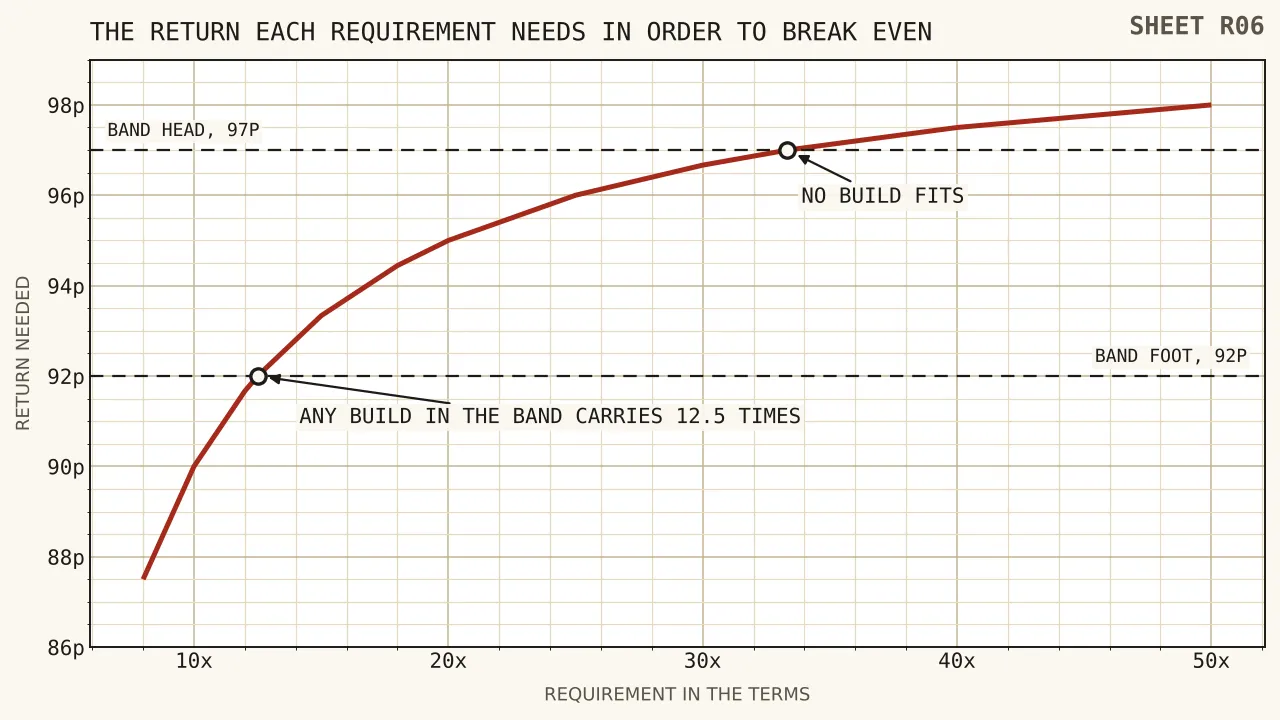
The useful output is a threshold rather than an estimate. Break-even arrives where the edge equals one over W, which makes the needed return one less the multiple’s reciprocal.
| Requirement in the terms | Needs a return of |
|---|---|
| Eightfold | 87.50 pence |
| Tenfold | 90.00 pence |
| Twelvefold | 91.67 pence |
| Eighteenfold | 94.44 pence |
| Twenty-fivefold | 96.00 pence |
| Thirty-fivefold | 97.14 pence |
| Fiftyfold | 98.00 pence |
A reader with a published figure for the build in front of them now has a one-step test. Above the threshold, the requirement leaves something. Below it, the requirement is expected to consume the credit and then some of the reader’s own money.
Where the room also weights the contribution, scale the requirement first. Take the multiple, divide by that rate, and read the table at whatever comes out. A tenfold requirement at half contribution reads as twentyfold and needs 95 pence. At a fifth it reads as fiftyfold and needs 98 pence. At a twentieth it reads as two hundredfold and needs 99.5 pence, which is outside any band this page would entertain.
Bonus funds under a British licence carry ten times as their heaviest requirement, the position since 19 January 2026. Set beside the table, that ceiling corresponds to a needed return of 90 pence per pound, which is beneath the bottom of the band in part two. So inside the British licence almost any build in the band survives the lawful maximum, and the arithmetic of the ceiling is the reason rather than any claim about generosity.
A figure exists on the record for what that ceiling displaced. Sixty times was in use among licensees at the time of the consultation, and 98.33 pence per pound is what sixty times needs to break even. On this page’s tray that requirement would be £1,094.40 of staking at the house figure, which is 10,944 presses.
5
A supplier’s logo proves nothing about a site
A reader who recognises a studio’s games tends to read that recognition as reassurance about the room. The regulator has published the reason that inference fails, and it is better than any argument this page could make.
A notice warning the industry, dated 20 January 2025, sets out what it had become aware of: casino games from licence-holding suppliers running on websites with no licence at all. Inadequate controls are what the same notice records such sites may carry, in social responsibility and in anti-money-laundering alike, and it lists three things customers are left open to: fraud, unfair practices, and issues of data privacy. Targeting of vulnerable customers by sites without licences is recorded in the same notice, and its example is somebody who has registered a self-exclusion with the national scheme.
And there is a priced case behind it. Six unlicensed websites, each one reachable from Great Britain, were found running games that Evolution Malta Holding Limited had supplied. £4.75m is the sum it agreed to pay, under the date 23 July 2026. Visits in large volumes are what its release records for the stretch running December 2023 to November 2024. Behind that sum sat three findings. One concerned due diligence on customers. One concerned how risk was assessed around terrorist financing and the laundering of money. One concerned the controls that should have held its games out of a British market reached through operators without licences.
The practical rule for a reader is one sentence long. A familiar game above the reels is evidence about software. Licensing is a different question, settled by the public register and by nothing visible on the page itself. The regulator sets a player four checks to run there. One: a licence held by the business. Two: a licensed status displayed on the site. Three: a click through that actually lands on the register. Four: licence details tallying with it, website domain names and activities included.
One caution attaches to the register as a source. Undated, and carrying no instructions for reading itself, it settles neither what an active or inactive status signifies nor how a domain listed against a licensee should be taken. Anybody using it owes a reader the date of the check, and must not pretend an interpretation has been published where none has.
6
The named-game clause in a welcome offer
Offers routinely tie a tray of presses to one title, and the clause doing it is where a studio name actually appears in a set of terms. Two licensees’ wording, read on 15 October 2026, shows the shape without this page claiming either offer is running today.
One put a spin value of £0.10 against a named title with a requirement of ten times the free spin winnings and the words “only Slots count” attached, alongside a minimum deposit of £10.00 and a maximum bet while wagering of ten per cent of the free spin winnings, with a floor of £0.10, or £5.00, whichever came out lower. The other named a different title, also at a spin value of £0.10, with the same ten times on free spin winnings and the same slots-only restriction.
Three things in those clauses are worth pricing. The spin value of £0.10 matches this page’s own assumption, which is why 10p is used here. A slots-only restriction states the contribution rate as a scope instead of a percentage, and that is the kinder of the two forms: nobody wanders into a room counting nothing, whereas a room counting five pence takes bets all day. And the maximum bet while wagering is a brake on the clock rather than on the money: capping a bet at ten per cent of the credit means a tenfold requirement needs at least a hundred bets to complete.
Work that last one on this page’s figures. A credit of £18.24 with a tenfold requirement owes £182.40. A bet ceiling of ten per cent of the credit is £1.82, so at least 101 bets are needed. Held to 2.5 seconds each, those 101 bets take 4 minutes 13 seconds, so they constrain nothing. At this page’s press price of 10p the same turnover is 1,824 presses and 1 hour 16 minutes, which is the real figure.
Offer terms change weekly, so nothing above should be read as a statement about what any operator is doing now. The arithmetic of such a clause is what survives, being the one part of any offer that stays fresh.
7
What 190 presses cost in minutes
Time is the price nobody quotes. Converting a tray and its requirement into minutes gives a reader the one figure that cannot be argued about, because it comes from a published floor rather than from an estimate.
Between a game starting and the next being commenced, 2.5 seconds is owed. A cycle’s beginning must also always require the start control to go up and then down, or an equivalent act. So 190 presses occupy at least 7 minutes 55 seconds.
| Requirement | Staking owed at 96 pence | Presses at 10p | Floor time | What is left |
|---|---|---|---|---|
| None | nothing | 190 for the tray | 7 m 55 s | £18.24 |
| Tenfold | £182.40 | 1,824 | 1 h 16 m | £10.94 |
| Twentyfold | £364.80 | 3,648 | 2 h 32 m | £3.65 |
| Twenty-fivefold | £456.00 | 4,560 | 3 h 10 m | nothing |
| Fortyfold | £729.60 | 7,296 | 5 h 4 m | short by £10.94 |
| Sixtyfold | £1,094.40 | 10,944 | 7 h 36 m | short by £25.54 |
Nothing compresses the fourth column on a licensed reel. Nobody may be handed a way of shortening the wait for a result. Three named features fall outside what is permitted: quick spin, slam stop and turbo. Self-running repetition is out as well. Clarity that auto-play is unavailable to gaming online is the standard’s aim, and a commitment per cycle is its requirement.
One clock interacts with that and is often missed. Where a requirement carries a deadline, the deadline and the floor time together decide whether the condition is reachable at all. Spread 5 hours of pressing across a seven-day window and it is 43 minutes daily. The same five hours inside a twenty-four hour window is a fifth of the day, and the arithmetic says so before anybody has to argue about it.
8
The same title with nothing filed
The identical game from the identical studio runs in rooms with nothing on the British register, and the band gets worse rather than merely staying unknown. Here is each duty with a figure from this page against it.
| The duty that lapses | Its worth on this tray |
|---|---|
| Requirement capped at ten times | £10.94 standing, instead of a £25.54 shortfall at sixtyfold |
| Results acceptably random, no compensated game | The 90 pence threshold becomes uncheckable |
| Rules and probabilities fixed in play | A figure true at press one need not hold at press 190 |
| Chances disclosed before the commitment | The band stays 92 to 97 pence with nothing to narrow it |
| 2.5 seconds between cycles | 7 m 55 s stops flooring the tray |
| No turbo, no automatic repetition | 10,944 presses at sixtyfold become compressible |
| Cash ceiling on one cycle | A limit of 50 presses a cycle, or 20, disappears |
| Identity verified before any press | £19.00 staked from an unchecked account |
| Credit card refused at the cashier | £729.60 of turnover fundable on borrowing |
| A deposit balance that may not be capped | The £10.94 of residue turns conditional |
| An eight-week clock, then an approved name | A disputed £10.94 goes nowhere |
| Membership of the national scheme | 190 presses can reach a registered reader |
Two rows of that table are specific to a studio page. The randomness requirement is what turns a published percentage into a figure a reader may lean on, and the bar on changing rules, payouts or probabilities during play is what makes it true for the whole tray rather than for the first press. Without both, the threshold in part four can still be computed and can no longer be checked.
Much of that market answers to the Curaçao authority’s policy on responsible gaming, numbered 1.0 and carrying 21 February 2025. Searched for a ceiling on a wagering multiple it yields nothing. Searched for a cash limit over a stake: nothing. For a game cycle’s minimum length: nothing. For anything barring repetition that runs itself: nothing. Two sentences in it address bonuses. Transparency in how they are communicated, with the terms made clear, is the first. A prohibition on aggressive promotion that would encourage excessive gambling is the second.
A pair of rows run the other way, and the comparison would be misreported without them. Under that policy a deposit limit comes down at once and goes up after seven days, the British floor for going up being 24 hours. On complaints the figures are 26 weeks of player time, 4 weeks of operator time, and 4 further weeks where a written extension gets taken, adjudication being compulsory and billed to the operator.
Tax does not move. Remote gaming duty catches an operator at 40 per cent whether or not a British licence is held, because the charge follows the country the player usually lives in. The previous rate held for seven years at 21 per cent, and the switch dates from 1 April 2026. So the absent licence buys a reader nothing and costs them the twelve rows above.
Questions
- What are 190 free spins at 10p worth on a studio title?
- Face value £19.00. The average back depends on the build the room installed, not on the studio, so the answer is a band: £17.48 at 92 pence returned per pound, £18.24 at 96 pence, £18.43 at 97 pence. The band is £0.95 wide on bare presses and £9.40 wide behind a tenfold requirement.
- Does a studio set the return on its own games?
- Not from the reader’s point of view, because the figure that applies is a property of the build installed in the room in front of them, and nothing reachable publishes that build title by title. What the studio does fix is the shape of the paytable, which sets the spread, how many presses a feature consumes, and whether the game is reel-based at all, which decides whether a cash ceiling on one cycle reaches it.
- What return does a wagering requirement need in order to break even?
- One minus the reciprocal of the multiple. Eightfold needs 87.50 pence per pound, tenfold needs 90.00, twelvefold needs 91.67, twenty-fivefold needs 96.00, thirty-fivefold needs 97.14 and fiftyfold needs 98.00. Where the room also weights the contribution, divide the multiple by the rate first and read the table at the answer.
- Can two games with the same return behave differently?
- Completely. Hold the mean at 96 pence, let the only win pay some fixed multiple, and the frequencies fall out. A win of 10 times the stake has to land once in 10.42 presses, giving 18.24 expected hits across 190. A win paying 250 times is needed once in 260.42, so across the same tray 0.73 hits are expected and 48.1 per cent of trays finish empty. The average is £18.24 either way. Those frequencies are this site’s working on a model kept deliberately simple.
- Does a studio logo I recognise tell me the room is licensed?
- No, and the regulator has published the reason. A warning notice went to the industry on 20 January 2025, recording casino games from licence-holding suppliers showing up on sites that held no licence. A priced case sits behind the notice as well. Six websites without licences, each reachable by consumers in Great Britain, were carrying games Evolution Malta Holding Limited had supplied, and the sum agreed was £4.75m under the date 23 July 2026.
- How should I check a site’s licence position?
- Through the public register. Four checks are set for a player there. A licence held by the business, first. A licensed status displayed on the site, second. Third, a click through that lands on the register itself. Fourth, licence details tallying with it, website domain names and activities included. One caution: that register page carries neither a date nor a note on how it should be read, so a reader is owed the date of whatever check was run against it.
- Why do offers name one particular slot?
- Because the named-game clause is where the room fixes the spin value, the requirement and the scope at once. Two licensees’ wording read on 15 October 2026 put a spin value of £0.10 against a named title with ten times on the free spin winnings and the words “only Slots count” attached. A slots-only restriction is the contribution rate expressed as a scope, and it is the kinder form of the two.
- How does a maximum bet clause change the sums?
- It constrains the clock rather than the money. On a credit of £18.24 a tenfold requirement owes £182.40, and a bet ceiling of ten per cent of the credit is £1.82, so at least 101 bets are needed. At the press price used here the same turnover is 1,824 presses and 1 hour 16 minutes, which is the figure that actually binds.
- How long do 190 presses and their wagering take?
- 7 minutes 55 seconds covers the tray, on a 2.5 second floor measured from each game’s start to the next commencement. The requirement is longer: 1,824 presses and 1 hour 16 minutes at tenfold, 4,560 presses and 3 hours 10 minutes at twenty-fivefold, 10,944 presses and 7 hours 36 minutes at sixtyfold. Licensed reels compress none of it. Quick spin, turbo and slam stop are impermissible by name, and a commitment is wanted at every cycle.
- What does the same title lose in a room with nothing on the register?
- Twelve rows of the table in part eight, two of them peculiar to this method. Price it again with no Great Britain licence in the frame. Acceptable randomness is then required of nothing, and rules, payouts and probabilities may shift during a game, which leaves the 90 pence threshold computable and unverifiable at once. Beside those: nothing holds a multiple at ten; an unchecked account may stake the £19.00; borrowing may fund the £729.60 of turnover; and over a disputed £10.94 there is no eight-week clock and nobody approved to adjudicate.