Sheet R04 Revision 1 Counted 16 October 2026
Online slots UK: 420 presses, and the only room that counts them in full
420 presses at 10p is £42.00 of stake and £40.32 back on a 96 per cent reel. Here, and almost nowhere else, a pound put through retires a full pound of requirement, which is why a tenfold condition leaves £24.19 standing in this room and a shortfall in most others. The reel room’s own price is paid in time: 17 minutes 30 seconds for the presses, 2 hours 48 minutes for the turnover.
The count 420 presses One press 10p Comes to £40.32 before conditions
What a count of this size comes to
Every destination on this board is bought advertising. The site takes a fee if a reader goes on to register, and no figure printed below moves because of it.
The Spin Count
Gauge No 01
Betportal
Lowest multiple here
Priced at this site's own 10p a spin
What is counted
What is asked
No Great Britain licence
Licensed in Anjouan, Comoros, run by BetPortal Gaming Ltd, with Excite Ultra Media Ltd, reference ALSI-202601040-FI2.
Terms read 16 October 2026
Open the offer at Betportal, opens in a new tabThe Spin Count
Gauge No 02
WinBeast
Largest count here
Priced at this site's own 10p a spin
What is counted
What is asked
No Great Britain licence
Licensed in Curaçao, operator not named on the site.
Terms read 16 October 2026
Open the offer at WinBeast, opens in a new tabThe Spin Count
Gauge No 03
EliteSpin
Longest spin window
Priced at this site's own 10p a spin
What is counted
What is asked
No Great Britain licence
Licensed in Costa Rica, run by PrimeTier Limited.
Terms read 16 October 2026
Open the offer at EliteSpin, opens in a new tabThe Spin Count
Gauge No 04
Crown Jewelz
Multiple unpublished
No foot figure struck
What is counted
What is asked
No Great Britain licence
Licensed in Curaçao, number not verified, operator not named on the site.
Terms read 16 October 2026
Open the offer at Crown Jewelz, opens in a new tabThe figure in the third register is this site's own arithmetic and nothing an operator has published: the count at face, less the share a spin gives back at 96 per cent return to player, less what playing the wagering through costs at the same return. It describes the offer, not one reader's afternoon. Where the conditions price above the count the counter prints nothing rather than a negative sum, and where a figure the sum needs is unpublished it prints the condition in the operator's words instead.
A count has no unit of its own, so one is supplied. Where an operator publishes what a spin of its own is worth, that figure stands in the second register and is labelled as theirs. Where it does not, the second register carries this site's own 10p a spin and says so, and the foot figure moves in proportion: at half the price, half the money. The figure after it, what the count comes to for each spin, is the one that compares a large count against a small one.
Three words stand in the amount column where no figure can. Noted is a published condition that takes value away without leaving the sum a figure to take. Unpriced is a condition whose figure nobody has published, or a credit that is not a sum until a deposit of your own sets it. Own money is money of yours, which is never part of a foot figure.
Not one of the operators printed above holds a Great Britain licence, so the duties that licence carries do not reach them. Every online gambling company licensed in Great Britain has to be part of Gamstop Online, and a reader who has shut themselves out through the scheme is therefore not shut out here. The ceiling of ten times the bonus funds on a wagering requirement, in force since 19 January 2026, is a condition of that licence and binds the companies that hold one. Where a dispute goes instead is a matter for the authority named on the counter, and the Gambling Commission describes what a reader faces without a British licence as a lack of recourse if things go wrong. Nobody under 18 may hold an account at any of them.
Every term printed on a counter is the operator's own, and each counter carries the day it was read. The oldest of those readings is 16 October 2026. What binds a reader is the operator's own full terms, and not a line printed here.
1
420 presses, priced to the penny
A spin is a funded press of a start control, so a count of spins is a count of presses and the money follows from the price of one. Fix that price at 10p and 420 presses is £42.00 of stake. Fix the reel at 96 pence back per pound and the average coming home is £40.32. Two multiplications, no interpretation.
Both inputs are declared rather than discovered, and the reason is worth a sentence. No reachable primary source states what a free spin is worth, who sets its worth, or whether anybody must disclose it. Whoever runs the cashier decides the pence, as a commercial matter. So this site states its assumption in the open instead of pretending a rule supplied one.
From there everything is subtraction, and the shape of the subtraction is what makes this room different from the rest of the building. Put a pound through a reel and a full pound of requirement is retired by it. Nowhere else in a casino does that reliably happen, and the consequence is that the reel room is both the cheapest place to clear a condition and the room every condition is therefore steered into.
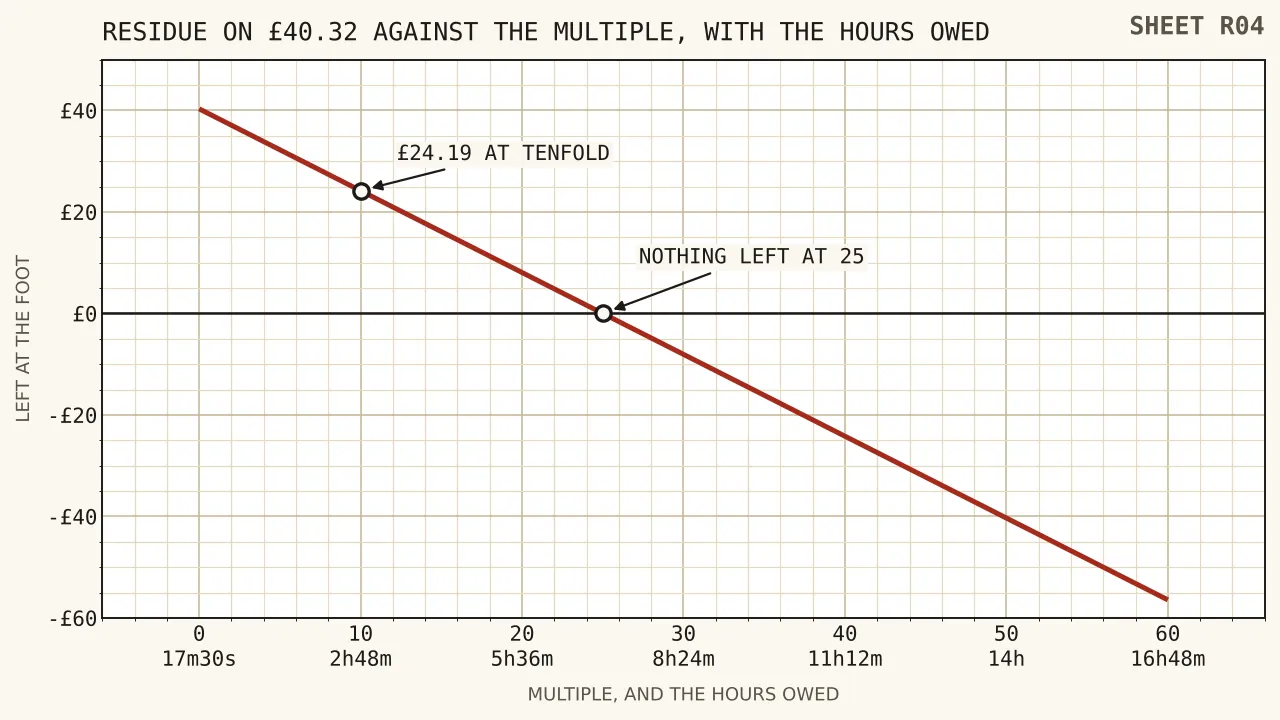
Here is the requirement as arithmetic. Expected residue comes to the credit multiplied by what is left after the multiple times the edge has been divided by the contribution rate and taken away from one. Set the rate at one and that division disappears. What remains is the credit, scaled by a factor of one minus the multiple’s four per cent. Tenfold keeps 60 per cent. Twentyfold keeps 20. Twenty-five keeps nothing, because 25 fours make a hundred. Fortyfold runs 60 per cent under water.
On £40.32 those four rows are £24.19, £8.06, nothing, and a shortfall of £24.19. The last of those is funded by the reader, because the credit is expected to be gone before the requirement is.
Reckon on no Great Britain licence wherever a count of this size is being pushed. That absence is not a mood, it is fifteen specific duties, and part nine converts each of them into presses so a reader can see what the register was buying.
Four figures do all the work on this page and each is stated once here. The price of one press: 10p. The reel’s return: 96 pence per pound, leaving a four pence edge. The contribution rate in this room: a hundred pence in the pound, written as g equal to 1. The clearing multiple: 25, which is one divided by the edge. Where a page in this section moves the contribution rate it says what moved it; here it is not moved, and that is the room’s single real advantage.
2
A hundred pence in the pound
The phrase game weighting sounds like an administrative detail and it is the largest number in most offers. A room that counts a staked pound at a fraction makes the requirement a multiple of itself, and the division is where offers quietly become unclearable.
One schedule was legible on 15 October 2026, at clause 6.6 in the standing terms of the licensee holding Commission account 48695. Eight lines, worst to best: 5 per cent on roulette; 5 on live tables; 5 on video poker; 5 across blackjack, baccarat and punto banco; 5 across a poker-derived group; 40 on other table games; 100 on scratch games; 100 on slots of the video, classic and jackpot kinds. That is one operator’s wording on a stated day, not a sector table, and no regulator publishes a sector table at all.
Price the difference on this page’s credit and the reel room’s advantage stops being abstract. A tenfold requirement on £40.32 is £403.20 of contribution. Here that is £403.20 of staking across 4,032 presses. At 40 pence in the pound it would be £1,008.00 and 10,080 presses. At 5 pence it would be £8,064.00 and 80,640 presses, costing £322.56 to produce against a credit of £40.32.
| Staked pound counts as | Staking owed | Presses, 10p apiece | Expected cost of it | What is left|
|---|---|---|---|---|
| 100 pence, a reel | £403.20 | 4,032 | £16.13 | £24.19 |
| 40 pence | £1,008.00 | 10,080 | £40.32 | nothing |
| 30 pence | £1,344.00 | 13,440 | £53.76 | short by £13.44 |
| 10 pence | £4,032.00 | 40,320 | £161.28 | short by £120.96 |
| 5 pence | £8,064.00 | 80,640 | £322.56 | short by £282.24 |
Thirty pence is not a rate invented here. A respondent put it into the regulator’s consultation response as an illustration: take £100 of bonus, apply turnover of ten times, and thirty pence per wagered pound is what the illustration says gets credited. Capping the multiple was the action taken; weighting came up in the same consultation and no action followed. Credit where it belongs: the table’s arithmetic is this site’s, the thirty pence is the respondent’s.
Which is the real reason a slots-only restriction in a set of bonus terms reads as a kindness. The restriction keeps the credit in the only room that counts in full, and the row above shows what that is worth: £24.19 against a shortfall of £282.24, a swing of £306.43 on the same credit and the same printed multiple.
3
The percentage a reader may never see
The 96 in every sum above is an assumption, and a reader trying to replace it with the real figure may find the search closed off. The duty is to make information about a customer’s chances reachable before they commit, and four items satisfy it with an “or” between them.
Ordered from least useful to most, for somebody holding a calculator: a narrative of the workings, the determining of winners and the allocating of prizes; then the margin, otherwise called the house edge; then how probable the winning events are; then the percentage returned to the player. Only the last divides straight into £42.00, and the guidance adds that where it is given it should be the average theoretical figure.
So a licensed reel may publish the margin and nothing else, and the reader must do the subtraction themselves. No loophole is involved: that is how the standard is built, and writing that a licensed room has to print a percentage misreads it.
Three other duties in the same standard are worth having, because they tell a reader what the figure means once they find it. Reachable, accurate, and sufficient to explain every one of them: that is what the rules themselves have to be. While the game runs, enough must be displayed for the customer to understand where it stands. Reachable before the commitment as well: the prizes and payouts a game might produce, or else whatever calculates or determines them.
Two further provisions protect the arithmetic itself. Game results have to be acceptably random, with a compensated game ruled out, and that pairing is what lets 96 per cent be used as an input rather than read as marketing. Random numbers, further, get used in the order they arrive rather than thrown away. Nor may a game in play have its payouts, its rules or its outcome probabilities altered, and the guidance picks out one clause by name as unacceptable, the one reserving a right to change the game rules at any time.
Four permitted disclosures, one of them a percentage, and the “or” between them is the whole story
4
Two and a half seconds, multiplied out
A reel has a floor on its own pace, and converting a count into time is the arithmetic nobody prints. Measured from a game’s start, 2.5 seconds is the minimum before a further cycle may be commenced. Added to the same requirement: beginning a cycle must always need the start control released and then depressed, or the equivalent action taken.
So 420 presses occupy at least 1,050 seconds, which is 17 minutes 30 seconds of deliberate pressing with nothing between one press and the next. That is the floor on the tray itself, and against any window of a day or longer it binds on nothing.
The turnover is where the clock bites. £403.20 of staking at tenfold is 4,032 presses and 2 hours 48 minutes. At twentyfold it is 8,064 presses and 5 hours 36 minutes. At fortyfold it is 16,128 presses and 11 hours 12 minutes. Put a fortyfold requirement behind a twenty-four hour window and a reader is being asked for nearly half a day of continuous button work.
| Multiple named | Staking owed | Presses, 10p each | Floor time, 2.5 s a cycle | Residue on £40.32|
|---|---|---|---|---|
| None on the winnings | nothing | none | 17 m 30 s for the tray | £40.32 |
| Fivefold | £201.60 | 2,016 | 1 h 24 m | £32.26 |
| Tenfold | £403.20 | 4,032 | 2 h 48 m | £24.19 |
| Twentyfold | £806.40 | 8,064 | 5 h 36 m | £8.06 |
| Twenty-five times | £1,008.00 | 10,080 | 7 h 0 m | nothing |
| Fortyfold | £1,612.80 | 16,128 | 11 h 12 m | short by £24.19 |
| Sixtyfold | £2,419.20 | 24,192 | 16 h 48 m | short by £56.45 |
Nothing may compress those hours on a licensed reel. Nor may the wait before a result arrives be shortened at a customer’s option, and the guidance names three such features as impermissible: turbo, slam stop, quick spin. Automatic repetition is out as well. Its aim, in the standard’s own words, is to make clear that auto-play is not something online gaming may offer. Its requirement is a commitment taken cycle by cycle. Its one carve-out covers blinds posted without a click at a table where players face each other.
The guidance under the pace rule defines a game cycle precisely enough to be useful. The player starting the game opens it. It closes once all the money staked or won has gone, or has been delivered or made available to them, with the start control free once more. A held screen, a held key and a held button are each barred from starting the next one.
5
The ceiling on one press, in presses
A cash limit sits on a single reel cycle, and the only honest way to read it is to convert it into the unit this page is written in. A cap fixes the total one individual may stake into a single game cycle. Under twenty-five the figure is £2.00. From twenty-five upwards it is £5.00. The instrument carrying those was made on 25 February 2025.
In presses at this page’s price, £5.00 is fifty of them stacked into one cycle and £2.00 is twenty. Which means the ceiling does not restrain the money a reader can put through a reel: it restrains how quickly they can put it through. At the higher ceiling, the £403.20 owed at tenfold needs 81 cycles and 3 minutes 23 seconds instead of 4,032 presses and 2 hours 48 minutes. At the lower ceiling it needs 202 cycles and 8 minutes 25 seconds.
Commencement arrived in two steps. The higher of the two arrived first, on 9 April 2025; the lower followed on 21 May 2025. Six transitional weeks lay between those dates, with a flat five pounds applying to every age inside them.
Scope is the part most often got wrong. Online slots is where both figures belong. Three features build that term in the instrument: reel-based, played online, and a casino game. The last of the three carries a definition of its own. It covers a game in which text, or images, move or change, displayed by means of reels shown visually or by anything else, and in which the arrangement arrived at decides whether an advantage, an opportunity or a prize has been won. Online slots only, says the regulator’s guidance of the limits’ reach, with blackjack and roulette named among the games left outside.
One more wrinkle. No calendar date for commencement appears in the instrument itself, which gives a formula instead: six weeks counted from the day it was made. Both calendar dates above come from the regulator and are the only published ones, so neither should be presented as text a reader would find in the instrument.
6
What the reel may not say about itself
Three presentation duties shape what 420 presses look like while they are being used, and each of them is a reason the arithmetic on this page is trustworthy on a licensed reel and untestable elsewhere.
Celebration is barred where the return has failed to exceed the stake gambled. Win-related sound, and win-related visuals, may not run against such a return. Three alternatives appear in the guidance: the total awarded displayed; the winning lines shown briefly; a short sound as the crediting happens. Price that against this page’s press: a 6p return on a 10p press is a 4p loss, and 420 presses is a sequence in which that happens often. A room permitted to celebrate it would be reporting losses as wins several times a minute.
Nor may a loss be presented as a thing that nearly happened. Prohibited: a design or feature carrying a reasonable expectation of misleading the customer as to how likely particular results are. Two instances get named. One puts a near-miss loss in the place of a loss. The other simulates a real device on probabilities the device does not run. Flatly put in the guidance: false display of a near-miss result is out, and one losing outcome standing in for a different one is out.
And the product may not push. Chasing losses, increasing a stake, raising the amount decided on, or continuing after the customer has indicated they want to stop: none of these may be actively encouraged. Three additions sit in the guidance. Money taken into a product should get topped up only where the customer chooses it on each occasion. Content should not encourage anybody to win back what they have lost. And a customer who has decided to exit should not be tempted in again, with a free game named as how that is done. A tray of 420 presses handed to somebody who has just stopped is precisely the thing described.
Two of those three protect the integrity of the figure. The third protects the reader from the figure being used as bait, and it is the only rule in this part that speaks directly to what this site writes about.
7
The requirement at every multiple
A British licensee has had a hard ceiling on the multiple since 19 January 2026: bonus funds may not be required to turn over more than ten times. The same provision names four types of gambling product, of which an incentive may contain one. Scope: every operating licence other than the gambling software and gaming machine technical kinds.
What the ceiling displaced is on the record in the regulator’s own figure: requirements running up to sixty times were in use when it consulted. On this page’s credit, sixty times is £2,419.20 of staking, 24,192 presses, 16 hours 48 minutes at the pace floor and a shortfall of £56.45, which is 140 per cent of the credit it was clearing.
One figure from that consultation needs careful attribution. A single operator responding said that 75 per cent of its own offers fell inside the band from one to ten times. That is one respondent about its own book, not a finding about the market, and it is reported here as what it is.
That ceiling has two unsettled edges, and neither gets papered over here. The wording bites on bonus funds. Nothing has ever been published, in either direction, on whether a press handed over free amounts to such a fund. Nor is there a published answer on a requirement worked out across a deposit as well as a bonus instead of across the bonus by itself. Follow the published wording exactly and this much is sayable: credit the proceeds of a press as bonus funds and any requirement over those funds halts at ten times. On £40.32 that stop is £403.20 of staking and 4,032 presses.
A standing term from one licensee shows how the base can change without the multiple changing. Read on 15 October 2026, the standing terms on account 48695 put a first-deposit requirement at thirty times as a minimum, computed across the bonus and the qualifying deposit together. A requirement computed on a sum is heavier than the same number computed on a part of that sum, and the printed multiple hides the difference entirely.
8
How big this room is, in published figures
A count of 420 is a small quantity inside a very large one, and the published statistics give the scale precisely enough to be worth the arithmetic.
Across Great Britain, the twelve months to March 2026 produced £17.5bn of gross gambling yield, up 4.4 per cent. Strip out every reported lottery and £13.2bn remains, a rise of 4.7 per cent. 17 September 2026 is the publication date on both. £8.3bn of that total came from the sector covering remote bingo, betting and casino, which rose 6.9 per cent.
Inside that sector the annual report gives the two figures this page needs: online casino games produced £5.7bn, and slots games produced £4.8bn.
Three ratios follow, and all three are this site’s own division. Slots are 84.2 per cent of online casino yield. Of the remote sector in total they are 57.8 per cent. And they are 27.4 per cent of gambling yield across Great Britain, lotteries included, which makes the reel room the single largest product in British gambling by that measure.
One more division, flagged as an illustration rather than a finding. Yield is what the house keeps. At the four pence edge this page works to, a yield of £4.8bn implies turnover of £120bn, because four pence in the pound retained on £120bn is £4.8bn. That is the site’s own arithmetic on the house assumption and not a published turnover figure. Divide £120bn by 10p and the answer is 1.2 trillion presses; hold each to the 2.5 second floor and the answer is roughly 95,000 years.
Two cautions on the statistics. That headline £17.5bn is labelled two ways by its own publisher. Total gross gambling yield is the news release’s phrase. The value of the gambling market in Great Britain is the statistics hub’s. Where precision matters, take the release. Three further counts sit in the same annual report. 25.7 million is the count of active accounts at the last reporting quarter’s close. Licensed operators at 31 March 2026: 2,154. Licensed activities on the same date: 3,097. An account is not a person, and the report publishes accounts, so no per-player figure can be read off it.
9
A reel with nothing filed behind it
Every figure above belongs to a licensed reel. The same 420 presses are advertised by cashiers with nothing filed on the register, and the right way to show the difference on a reel page is in presses, since presses are what the reader is counting.
| Held by a British licence | In presses, at 10p apiece | What goes without it|
|---|---|---|
| Ten times on bonus funds | 4,032 presses owed, not 16,128 | A multiple of any size, and 11 h 12 m at fortyfold |
| One product type per incentive | 4,032 presses stay on a reel | The same condition served at 5 pence, so 80,640 presses |
| 2.5 seconds between cycles | 17 m 30 s is the floor on 420 | No floor at all on the tray’s duration |
| No turbo, no slam stop | 2 h 48 m of pressing stays 2 h 48 m | The clock on 4,032 presses becomes compressible |
| Commitment per cycle | 16,128 decisions at fortyfold | One decision, then an automatic sequence |
| £5.00 and £2.00 on one cycle | 50 presses, or 20 under twenty-five | Any stake the cashier will accept in one cycle |
| Nothing celebrated at or under the stake | A 6p return on a 10p press stays a 4p loss | Losses presented with the apparatus of a win |
| No near miss in place of a loss | 420 outcomes read as what they are | A loss dressed as an almost |
| Acceptably random, no compensated game | 96 pence stays a usable input | The 4 pence edge loses its guarantee |
| No encouragement to chase or continue | 420 presses are not offered as a return ticket | A free tray may be used to entice somebody back |
| Identity verified before any press | £42.00 of stake needs a checked account | The whole tray staked on an unchecked one |
| No credit card at the cashier | £403.20 of turnover is funded from cash | Borrowing may fund it, money service route included |
| Financial limit offered by default | Something stands in front of 16,128 presses | Nothing prompted, and an increase waits for nothing |
| Withdrawal stands, deposit balance uncapped | £24.19 of residue is the reader’s to take | A cancel button, or a cap on the way out |
| Eight weeks, then an approved adjudicator | A disputed £24.19 has a route | Neither a clock nor an adjudicator for that sum |
| The national self-exclusion scheme | 420 presses cannot reach a registered reader | Membership nobody is obliged to hold |
Much of that market sits under one document: a responsible gaming policy from the authority in Curaçao, numbered 1.0 as a version and carrying the date 21 February 2025. Six rows of the table have nothing answering to them inside it. Search it for a multiple’s ceiling: nothing. For a stake’s cash limit: nothing. For a game cycle’s floor: nothing. For a bar on repeating automatically: nothing. For a bar on fanfare where the stake was not beaten: nothing. For a bar on hurrying a result: nothing. Bonuses get two sentences and no more. Transparent communication, with the conditions made clear, is what the first wants. Aggressive promotion that would drive excessive play is what the second forbids.
Two rows run the other way, and omitting them would misreport the comparison. Deposit limits move differently in the two places. Downwards it is immediate under both. Upwards it waits a week out there, where 24 hours is the British floor. And there is a complaints route out there: 26 weeks for a player to raise one, 4 for the answer, 4 more if a written extension is taken.
One row refuses to move, and it is the tax row. Remote gaming duty sits at 40 per cent today. 21 per cent is what it replaced, after seven years at that level, and 1 April 2026 is when the replacement took effect. What the charge attaches to is residence, not authorisation. So a cashier lacking a British licence falls inside its scope exactly as one holding it does, which means the gap above costs a reader sixteen rows and saves them nothing.
Questions
- What are 420 free spins at 10p worth?
- Face value £42.00, and £40.32 on average from a reel returning 96 pence per pound. Conditions then subtract: tenfold leaves £24.19, twentyfold leaves £8.06, twenty-five times leaves nothing, and fortyfold leaves a shortfall of £24.19 which the reader funds themselves.
- Why is the reel room the cheapest place to clear a requirement?
- Because a pound put through a reel retires a full pound of requirement. A requirement settles in contribution rather than stake, so a room counting at a fraction multiplies the staking by the reciprocal of that fraction. £403.20 of contribution is £403.20 of staking on a reel, £1,008.00 at forty pence in the pound and £8,064.00 at five pence.
- How long do 420 presses take?
- 17 minutes 30 seconds at the floor. Timed from a game’s start, the following cycle may not be commenced inside two and a half seconds. The turnover is the longer job: 4,032 presses and 2 hours 48 minutes at tenfold, 10,080 presses and 7 hours at twenty-five times, 16,128 presses and 11 hours 12 minutes at fortyfold.
- Can a licensed slot be sped up?
- No. No. Shortening the wait for a result is not something a customer may be given, and three features get named as impermissible in the guidance: quick spin, turbo, slam stop. Automatic repetition is barred too. The aim as stated is clarity on one point, that auto-play cannot be offered where gaming happens online, and a separate commitment per cycle is what the system has to obtain. Nothing may begin a fresh cycle by being held down, whether that is the screen, a key or a button.
- How many presses is the five pound stake cap?
- Fifty at this page’s price of 10p, and twenty where the reader is under twenty-five and the £2.00 figure applies. So the ceiling limits pace rather than total outlay: the £403.20 owed at tenfold needs 81 cycles and 3 minutes 23 seconds at the higher ceiling, against 4,032 presses and 2 hours 48 minutes at 10p.
- Must a licensed slot publish its return percentage?
- It must not be assumed so. Any single item discharges the duty, since an “or” separates them. Item one: the margin, or house edge. Item two: how likely the winning events are. Item three: an account covering how the game works, how its winners get determined and how its prizes get handed out. Item four: the return percentage. Nothing stops a reel publishing the margin and leaving it there, and when a percentage does appear the guidance wants it to be the theoretical average.
- What is the highest wagering multiple a British slot bonus may carry?
- Ten times, applied to the bonus funds, effective 19 January 2026. Two licence types sit outside the scope, those for gambling software and for gaming machine technical work; every other operating licence is inside it. The regulator’s own figure for what that displaced is sixty times, which on £40.32 would be £2,419.20 of staking, 24,192 presses and 16 hours 48 minutes at the pace floor.
- How large is the slots market in Great Britain?
- Four figures, nested. £4.8bn from slots games sits inside £5.7bn from online casino games, which sits inside £8.3bn for the remote sector, which sits inside £17.5bn of yield across Great Britain for the twelve months to March 2026. Publication date: 17 September 2026. By this site’s own division that makes slots 84.2 per cent of online casino yield and 27.4 per cent of the national total.
- Can a slot celebrate a win that is smaller than my stake?
- Not on a licensed reel. Where a return has not exceeded the total staked, the system may not celebrate it, and visuals or sound of the win-related kind are not permitted against it. A 6p return on a 10p press is a 4p loss, and across 420 presses that happens often enough for the rule to matter more than it sounds.
- What does a reel lose when nothing is filed on the register?
- Sixteen rows of the table in part nine, each counted in presses. Push a count that big and you are almost certainly outside the British licence. Then the 4,032 presses owed at tenfold become 16,128 at fortyfold, or 80,640 in a room counting five pence. 17 minutes 30 seconds ceases to floor the tray. 50 presses ceases to ceiling one cycle. Celebration of a loss becomes available, as does an almost in place of it. Nobody need check whose account the £42.00 is staked from. And over a disputed £24.19 there is neither a clock nor an approved adjudicator. Remote gaming duty still reaches that cashier at 40 per cent, since the charge follows the player’s residence.