Sheet P12 Revision 1 Counted 16 October 2026
Bingo sign up bonus: the one number the room will not print
A doubling on £35.00 gives £35.00 of credit and, at the British ceiling of ten turnovers, £350.00 of tickets to buy. What that costs depends on the room’s margin, and no rule obliges a bingo game to publish one. At 4p in the pound the credit is worth £21.00. At 10p in the pound it is worth nothing at all. The whole page is that one unknown.
Paid in £35.00 One ticket 5p Comes to £21.00 if the margin is 4p in the pound
What a bingo credit comes to
Every destination on this board is bought advertising. The site takes a fee if a reader goes on to register, and no figure printed below moves because of it.
The Spin Count
Gauge No 01
Betportal
Lowest multiple here
Priced at this site's own 10p a spin
What is counted
What is asked
No Great Britain licence
Licensed in Anjouan, Comoros, run by BetPortal Gaming Ltd, with Excite Ultra Media Ltd, reference ALSI-202601040-FI2.
Terms read 16 October 2026
Open the offer at Betportal, opens in a new tabThe Spin Count
Gauge No 02
WinBeast
Largest count here
Priced at this site's own 10p a spin
What is counted
What is asked
No Great Britain licence
Licensed in Curaçao, operator not named on the site.
Terms read 16 October 2026
Open the offer at WinBeast, opens in a new tabThe Spin Count
Gauge No 03
EliteSpin
Longest spin window
Priced at this site's own 10p a spin
What is counted
What is asked
No Great Britain licence
Licensed in Costa Rica, run by PrimeTier Limited.
Terms read 16 October 2026
Open the offer at EliteSpin, opens in a new tabThe Spin Count
Gauge No 04
Crown Jewelz
Multiple unpublished
No foot figure struck
What is counted
What is asked
No Great Britain licence
Licensed in Curaçao, number not verified, operator not named on the site.
Terms read 16 October 2026
Open the offer at Crown Jewelz, opens in a new tabThe figure in the third register is this site's own arithmetic and nothing an operator has published: the count at face, less the share a spin gives back at 96 per cent return to player, less what playing the wagering through costs at the same return. It describes the offer, not one reader's afternoon. Where the conditions price above the count the counter prints nothing rather than a negative sum, and where a figure the sum needs is unpublished it prints the condition in the operator's words instead.
A count has no unit of its own, so one is supplied. Where an operator publishes what a spin of its own is worth, that figure stands in the second register and is labelled as theirs. Where it does not, the second register carries this site's own 10p a spin and says so, and the foot figure moves in proportion: at half the price, half the money. The figure after it, what the count comes to for each spin, is the one that compares a large count against a small one.
Three words stand in the amount column where no figure can. Noted is a published condition that takes value away without leaving the sum a figure to take. Unpriced is a condition whose figure nobody has published, or a credit that is not a sum until a deposit of your own sets it. Own money is money of yours, which is never part of a foot figure.
Not one of the operators printed above holds a Great Britain licence, so the duties that licence carries do not reach them. Every online gambling company licensed in Great Britain has to be part of Gamstop Online, and a reader who has shut themselves out through the scheme is therefore not shut out here. The ceiling of ten times the bonus funds on a wagering requirement, in force since 19 January 2026, is a condition of that licence and binds the companies that hold one. Where a dispute goes instead is a matter for the authority named on the counter, and the Gambling Commission describes what a reader faces without a British licence as a lack of recourse if things go wrong. Nobody under 18 may hold an account at any of them.
Every term printed on a counter is the operator's own, and each counter carries the day it was read. The oldest of those readings is 16 October 2026. What binds a reader is the operator's own full terms, and not a line printed here.
1
Thirty-five pounds, and a margin nobody prints
Take the commonest shape this offer comes in: pay £35.00, receive £35.00 of bingo credit, and turn the credit over ten times before any of it may be taken out. The obligation is £350.00 of ticket purchases. Priced at 5p a ticket, which is where a bingo schedule usually starts, that is 7,000 tickets.
This page uses 5p rather than the 10p reel cycle the rest of the site works in, because a bingo ticket is not a spin and pricing it as one would misstate how many purchases the demand represents. Everything else stays as declared elsewhere: £1 of staking counts as £1 against the requirement unless a term reduces it.
Then the arithmetic stops, because the next step needs the room’s margin and no rule obliges a bingo game to publish one. On a reel game this site uses 96 per cent, a declared working figure. For bingo there is nothing equivalent to declare, so the honest thing is to carry the margin through as a letter and show what each value of it does.
The missing figure is not an oversight by the room. The information duty on a licensed game is satisfied, for bingo, by a description of how prizes are allocated. A margin, a house edge and a return percentage are all alternatives to that description rather than additions to it, which is set out in section four below.
2
The crossing moves with the margin
Write the expected end of a bonus as the credit less what the staking is expected to cost. The credit is £35.00. The staking is £350.00. The cost is the margin multiplied by the staking. At 4p in the pound that is £14.00 and the credit is worth £21.00. At 8p it is £28.00 and the credit is worth £7.00. At 10p the cost is the whole £35.00 and the exercise is worth nothing.
| Margin in the pound | Cost of £350.00 of tickets | Expected end | Turnovers that would reach nought |
|---|---|---|---|
| 2p | £7.00 of cost | £28.00 kept | 50 turnovers |
| 4p | £14.00 of cost | £21.00 kept | 25 turnovers |
| 5p | £17.50 of cost | £17.50 kept | 20 turnovers |
| 8p | £28.00 of cost | £7.00 kept | 12.5 turnovers |
| 10p | £35.00 of cost | nothing either way | 10 turnovers |
| 12p | £42.00 of cost | £7.00 of shortfall | 8.33 turnovers |
| 15p | £52.50 of cost | £17.50 of shortfall | 6.67 turnovers |
The last column is the useful one. Divide 1 by the margin and the answer is the number of turnovers at which a credit of any size is expected to have been consumed. A 4p margin puts that crossing at 25, which is where the reel arithmetic on the rest of this site puts it. A 10p margin puts it at 10, which is exactly the British ceiling, and a 15p margin puts it at 6.67, below any demand a licensed room is permitted to make.
So the same ten-times condition is generous, neutral or hopeless depending on a number the reader cannot look up. That is the central fact about a bingo sign-up offer, and it is a different fact from the one that governs a reel bonus, where a return percentage is at least capable of being published.
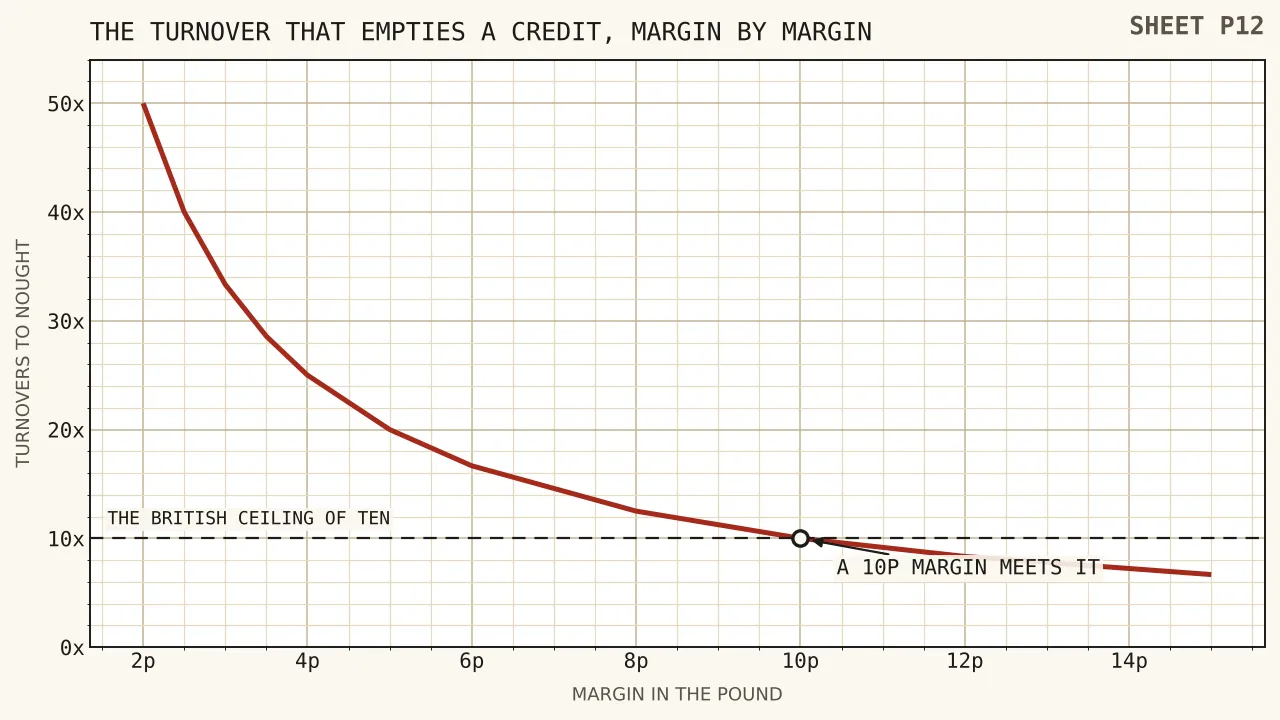
1 divided by the margin is the turnover count that consumes any credit
3
Seven thousand tickets, and no floor under them
The demand in purchases rather than pounds: £350.00 at 5p a ticket is 7,000 tickets. At 10p a ticket it is 3,500. At 25p a ticket it is 1,400, and at £1 a ticket it is 350. The pounds hold still while the count moves, and the count is what a reader has to settle before deciding whether a condition can be met at all.
| Price of one ticket | Tickets the demand represents | Tickets a pound of credit costs |
|---|---|---|
| 5p | 7,000 tickets | 200 tickets |
| 10p | 3,500 tickets | 100 tickets |
| 25p | 1,400 tickets | 40 tickets |
| £1 | 350 tickets | 10 tickets |
Time is where bingo parts company with the reel pages on this site. A 2.5 second minimum belongs to slots. A 5 second minimum belongs to casino games that are not slots, with poker between players left out of it. A bingo game answers to neither description, so neither figure reaches it, and no published floor exists from which to build an estimate of hours.
What does reach bingo is the autoplay prohibition, whose scope covers gaming and names bingo inside it. Under that requirement a customer has to commit to every game cycle one by one. Its guidance excepts only the blinds a peer-to-peer poker game posts for a player, which has no bearing on a bingo room. So the purchases cannot be set running unattended, even though nothing fixes how long a game takes.
The practical reading is that 7,000 tickets is a quantity the reader has to commit to in pieces, across however many games the room runs, with no sourced figure for how long that takes. Where a page gives you a confident number of hours for a bingo requirement, ask which published rule it came from.
4
What a bingo game must tell you before you buy
The information duty is where the missing margin comes from, and it repays a close reading. Ahead of money moving, a game puts within easy reach whatever a customer could reasonably need in order to judge how likely they are to win. Four candidates then follow, with the word or between them, so any single candidate discharges the whole duty and the other three may be absent.
| Candidate | Does it yield a number a reader can use |
|---|---|
| How the game runs, with winners and prizes settled | No |
| The margin, or the edge held by the house | Yes |
| A return percentage, average and theoretical | Yes |
| The chance of a winning event occurring | Partly |
Two of the four rows above hand a reader something to put in the second table of this page. Two do not. A room choosing the first row has satisfied the duty and told the reader nothing that can be multiplied by £350.00, which is the whole of the difficulty this page is built around.
| Product | What the guidance records as sufficient | Whether a reader can expect a percentage |
|---|---|---|
| Bingo | A description of how prizes are allocated | No, the description alone will do |
| Games between players | How the game works and how winners are determined | No, the description alone will do |
| A reel game | Any one of the listed items | Only if that is the item the licensee chooses |
Bingo is then dealt with by name. For it, and for some lottery and other games, an account of prize allocation is recorded as sufficient on its own. Where a percentage is given at all, it is the average and theoretical one that is called for, not some other measure. Those two sentences are the reason a reel game commonly shows a number and a bingo room commonly shows none.
Three further requirements govern the game itself, and they are more useful to a bingo player than the margin candidates are. The rules come first: easily reached before money moves, accurate, and complete enough to explain every one of them. Then a running display, so that while play continues enough is shown for the customer to follow where things stand. Then the prizes, meaning what may be won or how the sums are arrived at, reachable before the commitment is made. A reader may therefore ask for the prize structure, and the prize structure is the next best thing to a margin.
From a prize structure a margin can sometimes be worked out. If a room sells 400 tickets at 5p for a £20.00 pool and pays out £18.00 of prizes, the margin is 10p in the pound, and the table in section two says a ten-times demand on a bingo credit is then worth nothing in expectation. Rooms are not obliged to publish pool sizes and payouts in that form, but where they do, the sum takes a minute.
5
A match plus tickets crosses two products
One incentive, one product type: 19 January 2026 is the date that rule took hold. Four types are named in it. Betting is the first. Casino is the second. Bingo is the third and lottery the fourth. Attach a parcel of free spins to a match on a bingo payment and two types are in play at once, since a reel game belongs to casino while bingo stands alone.
Three carve-outs sit around it, and a reader would guess none of them. Take two products that share a type: one incentive may hold both of them, and a raffle sitting beside a lottery scratchcard is the published example. The second permits a betting offer and a casino offer in one email, where marketing for each has separately been opted into. The third takes any spend-it-where-you-like credit out of the ban, the illustration being £10.00 good at a betting desk or a casino one.
That third carve-out is the one that matters at a bingo cashier. An offer drafted as bingo tickets plus spins is caught. The same value drafted as a credit the reader may spend where they like is not. The aim is put narrowly by the regulator itself: what is caught is one incentive, with linked and shared terms, mixing products inside it.
Weighting is the other way the product mix changes the arithmetic. Where the terms count a pound of bingo tickets as less than a pound against the requirement, the obligation inflates by the reciprocal. At 30p in the pound, £350.00 of requirement needs £1,166.67 of ticket purchases, which at 5p a ticket is 23,333 tickets rather than 7,000.
| Counted per pound staked | Purchases the requirement needs | Tickets at 5p | Multiple of the unweighted figure |
|---|---|---|---|
| 100p in the pound | £350.00 of purchases | 7,000 tickets | 1 time |
| 50p in the pound | £700.00 of purchases | 14,000 tickets | 2 times |
| 30p in the pound | £1,166.67 of purchases | 23,333 tickets | 3.33 times |
| 20p in the pound | £1,750.00 of purchases | 35,000 tickets | 5 times |
| 10p in the pound | £3,500.00 of purchases | 70,000 tickets | 10 times |
Weighting and the ceiling pull in different directions, and the difference is worth stating plainly. Ten is a limit on the multiple of the bonus, which fixes the requirement at £350.00 and nothing more. Weighting does not raise the requirement; it raises what the reader must stake to satisfy it, and the cost of the staking rises with it.
23,333 tickets at 5p where bingo counts 30p in the pound
6
The ceiling, the cap and the paid-in balance
Ten turnovers is a term of the licence and not a feature of any game, which is why bingo credit sits under it like everything else. On £35.00 of credit the most a licensed room may demand is £350.00, and a fifty or sixty times condition on a bingo bonus is a sign the room is not licensed here, whatever its front page says.
A conversion cap on what the credit may become is not prohibited. Set at £25.00, a cap takes the £21.00 figure in the register above and leaves it where it is on the mean, while removing every outcome beyond £25.00. Set at £10.00 it binds at once: whatever the margin turns out to be, £10.00 is the ceiling on the whole exercise.
The deposit balance is treated differently. Capping what may come back out of the reader’s own money is an unfair term, and the specimen of impermissible drafting fences a day at £50, a week at £500. The £35.00 in the first cell of the register above is therefore the reader’s to take back, subject to the staking they choose to do with it.
| Term | Permitted at a licensed room | What it does to £35.00 |
|---|---|---|
| Ten turnovers of the credit | Yes, and that is the ceiling | £350.00 of purchases |
| Sixty turnovers of the credit | No | £2,100.00 of purchases |
| A cap on converting the credit | Yes | Caps the upside only |
| A cap on withdrawing the payment | No | Would fence the reader’s own £35.00 |
Two protections sit around the payment itself. Identity has to be settled before an account gambles at all, which at a licensed room means before the first ticket. And card borrowing has been shut out of gambling payments since 14 April 2020, the shut-out extending to a money transfer business used to route such a payment onward. Buying 7,000 tickets on borrowed money adds interest to a calculation whose sign is uncertain before the interest arrives.
7
How little is published about the room
It is worth seeing how thin the public record is on this product. £8.3 billion was the yield of the remote sector that lumps casino, betting and bingo together, in the year ending March 2026, a rise of 6.9 per cent. Casino games account for £5.7 billion of that, reel games for £4.8 billion. Bingo sits inside the total, with no separate line in anything this page can cite.
So the sector’s own statistics follow the same pattern as the information duty. Reel games are measured and published; bingo is reported inside a larger heading. A reader who wants to know what a bingo room keeps has to ask the room, and the room is under no obligation to answer with a percentage.
A few further published figures put the sign-up offer in proportion. £17.5 billion was the British total over the same year, 4.4 per cent up on the one before; strip out every reported lottery and £13.2 billion is what remains. The register carried 2,154 operators at the close of March 2026, running 3,097 licensed activities between them. Accounts in active use, as the last reporting quarter ended, numbered 25.7 million.
Against those totals, £21.00 of expectation on a £35.00 payment is a rounding error to the industry and a real sum to the reader. That asymmetry is the reason a sign-up offer exists at all, and it is not an argument against taking one. It is an argument for knowing which of the seven rows in the second table you are standing on.
8
The register, and the two-minute check
Everything above divides at one line. A room licensed in Great Britain answers for six things: the ceiling of ten, the information duty, the autoplay prohibition, identity ahead of play, cards refused at the cashier, and a paid-in balance nobody may fence. Where no Great Britain licence is held, not one of those six is owed to a reader.
The check, in three steps. Take the licence number out of the statement in the footer. Put it into the public register and open the entry it returns. Compare the domains listed on that entry with the one in the address bar, letter by letter. An entry that does not name the domain you are on is not a licence for the site you are on.
Familiar software is not a substitute for that check. Titles show up at every sort of cashier. £4.75m was the sum one supplier paid once its own games were traced to six unlicensed sites a reader here could reach. Knowing who built a bingo room tells a reader nothing about who is holding the £35.00.
Duty tracks the player and pays no attention to the licence. Since 1 April 2026 remote gaming profits have been charged at 40 per cent. The operator’s own location changes nothing; the test is whether gambling is offered to a person whose ordinary home is here. An unlicensed room taking a British reader’s £35.00 is inside the scope of that duty and outside every protection in the paragraph above.
9
Priced, not ranked
One published rule sets the order, applied identically across this site: the longer the odds against a reader seeing their own money again, the lower the entry goes. Nothing is scored, nothing is called best, and a larger bingo headline moves nothing upward.
What this page can tell a reader is the shape of the sum rather than its answer. £35.00 of credit at ten turnovers is £350.00 of tickets, and the credit is worth £21.00, £7.00 or nothing as the margin moves from 4p to 8p to 10p in the pound. Ask the room for its prize allocation, work out which column you are in, and the offer stops being a headline.
Taken from outside the British licence, the losses are specific rather than vague. Nothing holds the demand down to ten. Nothing obliges the room to set out how prizes are allocated before a ticket is sold. Nothing withholds an unattended autoplay. Nothing puts identity ahead of the first purchase. Nothing turns a credit card away. Nothing offers a limit at the desk. Nothing keeps the paid-in £35.00 clear of a withdrawal cap. Nothing starts a clock of eight weeks on a complaint, and nothing waits at the end of one. And nothing carries a Gamstop registration through to the room.
That list is why this page prices instead of recommending. The arithmetic is honest about its own gap: one number is missing, the room is not required to supply it, and the sign of the whole exercise depends on it.
Questions
- A bingo sign up bonus: what is it worth?
- It depends on a figure the room need not publish. On £35.00 paid in and £35.00 of credit at ten turnovers, the obligation is £350.00 of tickets. At a 4p margin the credit is worth £21.00, at 8p it is worth £7.00, and at 10p it is worth nothing in expectation.
- Why can you not give one figure for the return?
- Because no rule makes a bingo game publish a return percentage. The information duty is satisfied, for bingo, by a description of how prizes are allocated. A margin, a house edge and a return figure are alternatives to that description, so a licensed room may give the description alone.
- How many tickets is a £350.00 requirement?
- 7,000 at 5p each, 3,500 at 10p, 1,400 at 25p and 350 at £1. Each pound of the £35.00 credit costs 200 tickets at 5p. The pounds are fixed by the ten-times ceiling; the count is fixed by the ticket price in the schedule.
- Is there a minimum time between bingo games?
- Not one that can be cited. Slots have a 2.5 second minimum written for them. Casino games that are not slots have a 5 second one, poker between players aside. Neither description fits bingo, so no published floor applies, and that is why no hours figure appears against 7,000 tickets on this page.
- Can a bonus combine bingo tickets and free spins?
- Not as a single incentive at a licensed cashier. Since 19 January 2026 more than one product type within an incentive is prohibited, and the four types are betting, casino, bingo and lottery. A reel game is a casino product, so tickets plus spins crosses two. A credit the customer may spend on any product is outside the ban.
- What does weighting do to the requirement?
- It raises the staking rather than the requirement. Where bingo counts 30p in the pound, £350.00 of requirement needs £1,166.67 of purchases, which is 23,333 tickets at 5p instead of 7,000. At 10p in the pound it needs £3,500.00 of purchases and 70,000 tickets.
- How many turnovers may a licensed room demand?
- Ten of the bonus funds, under a ceiling that took hold on 19 January 2026. On £35.00 of credit it pins the requirement at £350.00. A sixty times condition would mean £2,100.00 of ticket purchases, and no room licensed here may impose it.
- Can the room cap what I take out?
- It may cap what the credit converts to; that is not prohibited. It may not cap withdrawals from the money you paid in, which is treated as an unfair term, and the specimen of drafting that fails holds a customer to £50 inside a day and £500 inside a week.
- Can I work the margin out myself?
- Sometimes, from the prize structure, which a licensed game must make available before you commit. If 400 tickets sell at 5p into a £20.00 pool and £18.00 of prizes come out, the margin is 10p in the pound. Put that in the second table and a ten-times demand is worth nothing in expectation.
- What is given up at a room outside the British licence?
- A demand that cannot pass ten. Prize allocation set out before a purchase. The prohibition on autoplay. Identity ahead of play. Cards turned away at the desk. A limit available there too. A paid-in balance that nobody may fence. Eight weeks to a final answer, with an adjudicator afterwards at no cost. The reach of the national self-exclusion scheme. What does not fall away is the 40 per cent duty, which attaches by where the player ordinarily lives.