Sheet D21 Revision 1 Counted 16 October 2026
10 free spins: one pound of staking, ninety-six pence back
Ten clicks at 10p is exactly £1.00 of staking, which makes this the easiest tally on the site to price: the expectation is £0.96 and the house edge is 4p. The arithmetic takes a line, so the rest of this sheet is about the advertising rules that govern how a one pound offer may be put in front of a reader.
Clicks given 10 One click 10p Mean 96p
What a count of this size comes to
Every destination on this board is bought advertising. The site takes a fee if a reader goes on to register, and no figure printed below moves because of it.
The Spin Count
Gauge No 01
Betportal
Lowest multiple here
Priced at this site's own 10p a spin
What is counted
What is asked
No Great Britain licence
Licensed in Anjouan, Comoros, run by BetPortal Gaming Ltd, with Excite Ultra Media Ltd, reference ALSI-202601040-FI2.
Terms read 16 October 2026
Open the offer at Betportal, opens in a new tabThe Spin Count
Gauge No 02
WinBeast
Largest count here
Priced at this site's own 10p a spin
What is counted
What is asked
No Great Britain licence
Licensed in Curaçao, operator not named on the site.
Terms read 16 October 2026
Open the offer at WinBeast, opens in a new tabThe Spin Count
Gauge No 03
EliteSpin
Longest spin window
Priced at this site's own 10p a spin
What is counted
What is asked
No Great Britain licence
Licensed in Costa Rica, run by PrimeTier Limited.
Terms read 16 October 2026
Open the offer at EliteSpin, opens in a new tabThe Spin Count
Gauge No 04
Crown Jewelz
Multiple unpublished
No foot figure struck
What is counted
What is asked
No Great Britain licence
Licensed in Curaçao, number not verified, operator not named on the site.
Terms read 16 October 2026
Open the offer at Crown Jewelz, opens in a new tabThe figure in the third register is this site's own arithmetic and nothing an operator has published: the count at face, less the share a spin gives back at 96 per cent return to player, less what playing the wagering through costs at the same return. It describes the offer, not one reader's afternoon. Where the conditions price above the count the counter prints nothing rather than a negative sum, and where a figure the sum needs is unpublished it prints the condition in the operator's words instead.
A count has no unit of its own, so one is supplied. Where an operator publishes what a spin of its own is worth, that figure stands in the second register and is labelled as theirs. Where it does not, the second register carries this site's own 10p a spin and says so, and the foot figure moves in proportion: at half the price, half the money. The figure after it, what the count comes to for each spin, is the one that compares a large count against a small one.
Three words stand in the amount column where no figure can. Noted is a published condition that takes value away without leaving the sum a figure to take. Unpriced is a condition whose figure nobody has published, or a credit that is not a sum until a deposit of your own sets it. Own money is money of yours, which is never part of a foot figure.
Not one of the operators printed above holds a Great Britain licence, so the duties that licence carries do not reach them. Every online gambling company licensed in Great Britain has to be part of Gamstop Online, and a reader who has shut themselves out through the scheme is therefore not shut out here. The ceiling of ten times the bonus funds on a wagering requirement, in force since 19 January 2026, is a condition of that licence and binds the companies that hold one. Where a dispute goes instead is a matter for the authority named on the counter, and the Gambling Commission describes what a reader faces without a British licence as a lack of recourse if things go wrong. Nobody under 18 may hold an account at any of them.
Every term printed on a counter is the operator's own, and each counter carries the day it was read. The oldest of those readings is 16 October 2026. What binds a reader is the operator's own full terms, and not a line printed here.
1
Ten clicks and a round pound
A tally of ten is the cleanest demonstration this site has of its own method, because the staking comes to a round pound and every figure after it is a percentage of something simple. Ten clicks times 10p is £1.00. At a return of 96 per cent, £0.96 comes back and 4p stays with the house.
Every number on the rest of this page can be read off those three. One click is worth 9.6p of expectation. Ten of them are worth 96p. A hundred would be worth £9.60, and a thousand £96.00, which is how a reader can use a ten-click page to price any tally they meet: divide by ten, multiply by the tally, and the answer is in pence.
On a sample of ten the mean is a weak guide to a single session, and the honest statement is that most ten-click awards return nothing. Slot payouts concentrate into infrequent large outcomes, so the modal result on ten clicks is zero and the 96p average is carried by the tail. That is not a defect in the game, it is what a 96 per cent return looks like when it is sampled ten times.
Both of the numbers underneath that come from this site rather than from a rulebook. No reachable source states the worth of a free click, nor who settles that figure, nor whether a reader has to be told it. The two assumptions are therefore declared and used openly, and the arithmetic is written so that another pair can be substituted in one step.
What is published about a game’s figures is narrower than readers expect. Before a commitment to gamble is made, information touching the prospects of a win has to be within reach, and any of four items will satisfy that, with an “or” dividing them. The margin counts, under that name or as the house edge. The percentage returned counts. The odds on the winning events count. So does an account of the mechanics, taking in the settlement of winners and the allocation of prizes. A margin figure discharges it on its own, so a licensed site need never print a return percentage.
2
The price, and the ceiling over it
At a tally of ten the price of a click is the entire offer, and it moves the answer by two orders of magnitude. The band below runs from a figure at the bottom of what a slot will accept to the largest stake a British licence permits in one game cycle.
| One click costs | Staking | Expected | Times the 10p case |
|---|---|---|---|
| 2p | £0.20 | £0.19 | 0.2 |
| 5p | £0.50 | £0.48 | 0.5 |
| 10p | £1.00 | £0.96 | 1.0 |
| 25p | £2.50 | £2.40 | 2.5 |
| £1 | £10.00 | £9.60 | 10 |
| £2, the ceiling under 25 | £20.00 | £19.20 | 20 |
| £5, the ceiling from 25 upwards | £50.00 | £48.00 | 50 |
The last two rows are statutory rather than observed. Regulations made on 25 February 2025 set two ceilings on the total stake in a game cycle: £2 for an individual below the age of 25, and £5 once they have passed it. Both commencement dates belong to the regulator’s guidance, the larger ceiling dated 9 April 2025 and the smaller one 21 May. No calendar date is printed in the instrument. Coming into force six weeks on from the making is how it puts the matter, with a transitional six weeks in which one flat five pound cap covered everybody.
Two definitions in those regulations are worth having, because they fix what the caps apply to. Online slots game, in the regulations, means a casino game which is reel-based and which is played online. A game is reel-based where moving or changing images or text appear, by means of representations of reels or otherwise, and the arrangement they settle into decides whether a prize, an opportunity or another advantage is won. Slots alone are covered, which the regulator states in terms: the limits reach no other casino game, roulette and blackjack included.
Ten clicks: 19p at the bottom of the band, £48.00 at the regulated top
3
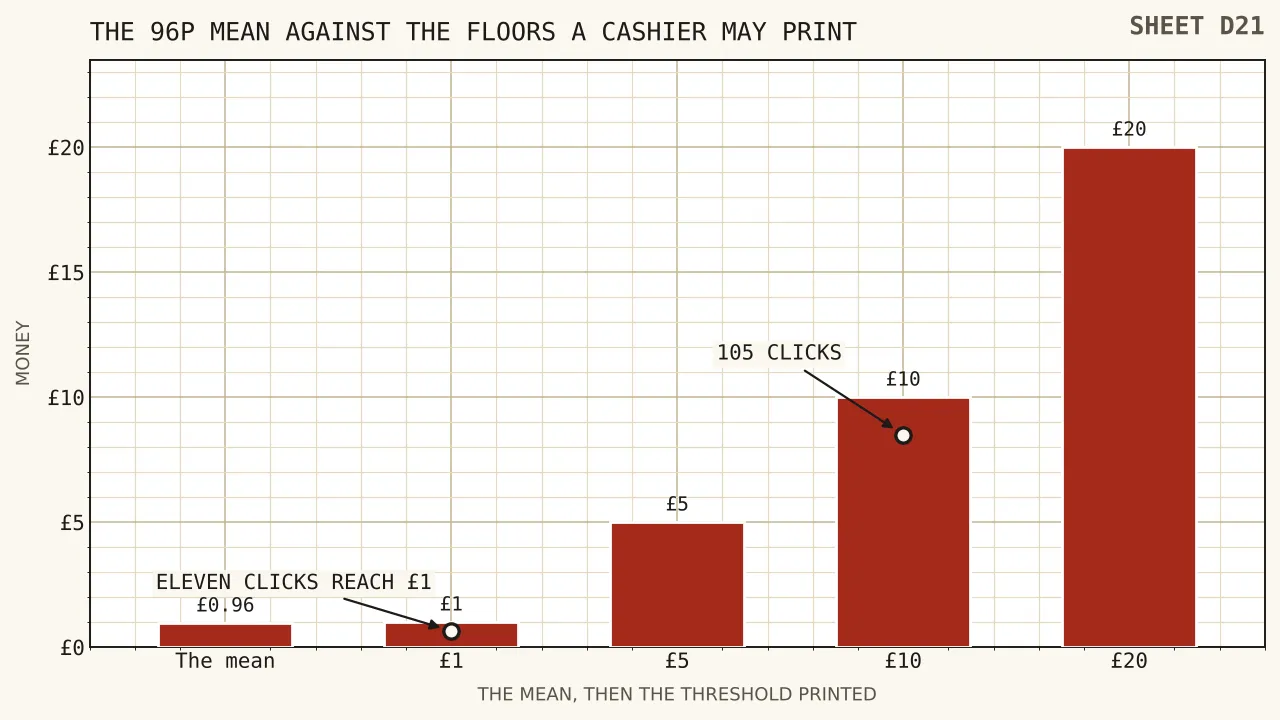
Ninety-six pence against a threshold
A smallest-payout rule settles a ten-click award before anything turns. With the mean at 96p, dividing a threshold by 0.96 gives what a reader has to achieve, and only the smallest threshold lies inside an ordinary result.
| Threshold | Times the mean | Clicks that reach it on the mean |
|---|---|---|
| £0.50 | 0.52 | 6 |
| £1.00 | 1.04 | 11 |
| £5.00 | 5.21 | 53 |
| £10.00 | 10.42 | 105 |
| £20.00 | 20.83 | 209 |
Each threshold is converted in the third column into the tally that would meet it on the average alone, which is the quickest test of whether an award and its terms belong together. A ten-click award sits one click short of a one pound threshold, ten times short of a five pound one, and twenty times short of a ten pound one. Where a set of terms pairs ten clicks with a ten pound minimum withdrawal, the arithmetic says the ordinary outcome is unpayable, and the reader needs a result far out in the tail for anything to move.
A win cap barely matters at this size, which is the mirror image. The mean reaches 96p and stops, so any ceiling above 96p never binds on the average and only a ceiling under it has an effect. Where the two conditions appear together, the threshold is the one to read first.
One rule in the same area protects a balance this page does not create. Separately prohibited is the term that caps what may be withdrawn from a deposit balance. With nothing paid in there is no deposit balance, so a threshold set on bonus proceeds stands on its own, and the prohibition has nothing to work on.
4
On registration, or on a deposit
Ten clicks arrive in two ways, and the two are not the same offer. Clicks arriving on registration put nothing of the reader’s at stake, so the 96p expectation is the whole transaction. Where they come attached to a payment, the payment is the price of the award and belongs in the sum.
Price the second case honestly. A reader who puts in £10.00 to receive ten clicks has bought 96p of expectation for a tenner, and the deposit is not a cost of the award: it is money that remains the reader’s and can be played or withdrawn on its own terms. What the deposit does is change the question from what the award is worth to what the whole transaction is worth, and that second question depends on what the reader does with the £10.00.
| How the clicks arrive | Reader’s outlay | Award expectation | What the arithmetic turns on |
|---|---|---|---|
| On registration | nothing | £0.96 | the threshold in the terms |
| On a £5 payment | £5.00 | £0.96 | what the £5 is played at |
| On a £10 payment | £10.00 | £0.96 | what the £10 is played at |
| On a £20 payment | £20.00 | £0.96 | what the £20 is played at |
Reading down the third column is the useful exercise: the award is worth 96p in every row, and the qualifying payment buys none of it. A reader comparing a no-deposit ten with a deposit-linked ten is comparing 96p against 96p, and the deposit requirement is a reason to prefer the first unless the reader wanted to deposit anyway.
One advertising rule bears directly on which of those two an offer may call free. On the advertising regulator’s own advice, describing an offer as free is out wherever qualifying costs the customer a stake of their own, and the phrase pairing risk with free is to be avoided unless genuinely nothing of theirs is exposed. A ten-click award on registration passes that test. A ten-click award requiring a payment does not pass it on the strength of the payment alone.
5
Twenty-five seconds, and what fills them
Ten clicks occupy 25 seconds at the lawful floor, with 2.5 seconds owed after each start before another cycle may open. Twenty-five seconds is the shortest honest description of how long the award lasts.
Three product rules fill those seconds and none of them can be waived. The control has to be released and depressed again for each cycle, so a held button produces nothing. The customer commits separately to every cycle, and that duty is the prohibition on automatic play stated the other way round. And no feature may reduce the time until the result is presented, which removes the accelerators by name.
Two display rules matter more at ten clicks than anywhere else on this site, because a reader has so few results to look at. Celebration is barred unless a return exceeds the total staked, so 6p off a 10p click arrives without the sound or the animation of a win. Nor may a near-miss losing outcome stand in for an ordinary losing one, designs and features likely to mislead over the chances of a result having been prohibited. Across ten clicks nobody could detect a breach of either rule, which is exactly why they are rules.
Displaying the result properly is a requirement in itself. Clearly and accurately, the system shows what the game did and what the customer gambled, and leaves it up long enough to be read. On a ten-click award that duty is the difference between a reader knowing what happened and a reader guessing.
6
Which codes govern a one pound advertisement
A one pound offer costs little to advertise widely, which makes the rules on advertising it the ones carrying this page. Four non-broadcast code sections apply, by the regulator’s own account: section 3 on misleading advertising, section 8 on promotional marketing, section 16 on gambling and section 17 on lotteries. On the broadcast side the equivalents are sections 3, 17, 18 and 22, the last covering premium-rate telephone services.
Section 16 of the non-broadcast code opens with a general duty: marketing communications for gambling must be socially responsible, with particular regard to the need to protect children, young persons and other vulnerable persons from harm. Three of its specific rules bear on a small headline offer.
Rule 16.3.4 bars three suggestions: that gambling answers a money worry, that it stands in for a job, or that it is a route to financial security. A one pound award is too small for that suggestion to be made in figures, which means it can only be made in tone, and the rule reaches tone.
Rule 16.3.12 bars marketing with strong appeal to children or to young persons, and bars a person or a character whose example anybody below 18 is likely to copy. Rule 16.3.14 is the under-25 rule: no-one who is, or seems to be, under 25 years old may be featured gambling or playing a significant role. A significant role is open to somebody between 18 and 24 in one situation only. The advertisement has to sit where a bet may be placed directly, and the example given is an operator’s own website. That person also has to appear as whatever the bet is about, and not inside a gambling setting. Everywhere else, and the regulator names social media, nobody under 25 may feature at all.
Two further duties come from the gambling regulator’s own advertising page. The base duty is that marketing communications must not mislead consumers. The prominence duty comes with its consequence attached. Significant terms are displayed prominently inside the advertisement, and placed near the headline offer wherever a reader lands or signs up. Prominence that falls short makes the advertisement misleading.
Two code provisions sit behind all of that on the licence itself. One of them requires that the advertising codes be complied with. The other covers direct electronic marketing, where consent that is both informed and specific has to come first, unless the law expressly allows the contact. That page is published 17 May 2021 and last updated 29 June 2026.
One absence is worth recording rather than filling. Affiliates go unaddressed on the gambling regulator’s advertising page, save inside its digital advertising section, which asks operators to take all reasonable steps to see that the third parties they contract with likewise keep off copyright-infringing websites. No page should claim there are published affiliate advertising rules beyond that.
7
Every subtraction, priced in pence
At 96p the conditions can be set out in one table with their effects in pence, which is not possible at larger tallies. Each row starts from the same 96p and applies one condition.
| Condition applied | What remains | Taken | Why |
|---|---|---|---|
| Nothing but the clicks | £0.96 | nil | the mean, undocked |
| A tenfold multiple on the proceeds | £0.58 | 38p | ten times a 4 per cent edge |
| A twentyfold multiple | £0.19 | 77p | twenty times the edge |
| A 50p win cap | £0.50 | 46p | the cap replaces the mean |
| A £1 withdrawal threshold | nothing on the mean | 96p | 1.04 times the mean needed |
| A £5 withdrawal threshold | nothing on the mean | 96p | 5.21 times the mean needed |
Three conclusions follow and all three transfer to larger tallies. A multiple scales the award down in proportion. Forty per cent goes at ten times, 80 per cent at twenty, and all of it at twenty-five, which is 1 divided by 0.04. A cap replaces the award where it sits below the mean and does nothing where it sits above. A threshold is the only condition that can take the whole award while leaving the balance intact, because the money exists and cannot be moved.
The ceiling on multiples belongs here as the limit on the second and third rows. Ten times the bonus funds is the most a British licensee may require, fixed by the code provision on incentives from 19 January 2026, and only two licence types, those for gaming machine technical work and for software, fall outside its scope. So the twentyfold row describes an offer from outside this market, and sixty times, which the regulator records as prior practice, would have left a deficit on a 96p balance.
8
The same ten clicks, advertised offshore
Small tallies are the cheapest stock in the offshore shop window, and nothing printed there has a Great Britain licence behind it. Part six is the part that disappears, and what replaces it is shorter but not empty, so this sheet sets the two side by side rather than asserting a void.
Seven practices are barred by the marketing restrictions in the Curaçao policy, whose first version carries 21 February 2025. Advertising that misleads, that is excessive or that is aggressive. Targeting people who have self-excluded, people with a gambling problem, or people who are financially vulnerable. Portraying gambling as a route to financial success. Misrepresenting skill against chance. Emotional manipulation. Content that appeals to children. And marketing sent while a cooling-off or an exclusion is running.
Read that list against section 16 and the overlap is real. Both regimes bar an appeal to children, both bar the suggestion that gambling solves money problems, and both bar marketing to somebody who has excluded themselves. Specificity is what is missing out there. No rule about the under-25s. No bar on a character a child might copy. No prominence duty attached to a landing page. And no published list naming the conditions that count as significant inside a promotion.
Where the offshore document is stronger is affiliates, and a page about a cheap, widely advertised award should say so. Responsibility for affiliate compliance with responsible gaming standards is placed on the operator, to be enforced by contracts that bind, by audits, and by penalties where an affiliate falls short. British advertising guidance for operators contains no equivalent.
| On a one pound offer | British licence | No British licence |
|---|---|---|
| Codes that apply | four non-broadcast sections, four broadcast ones | one policy, seven marketing bars |
| Under-25s in an advertisement | barred, with a narrow carve-out for 18 to 24 | no rule published |
| Significant terms | prominent, beside the headline, or the ad is misleading | transparent terms required, no list given |
| Affiliates | addressed only on copyright-infringing placement | operator answerable, with audits and penalties |
| Marketing to an excluded person | barred, and the register is national | barred, and the exclusion is per operator |
| Consent to electronic marketing | informed and specific, taken per product and per channel from 1 May 2025 | nothing published to match it |
That final row is the one a reader notices. On a British licence, an opt-in to direct marketing has to be taken by product type and by channel, a requirement in force from 1 May 2025 after the date moved from the January figure that stood earlier in the timetable. Offshore, what governs the marketing a reader receives after taking a 96p award is whatever the operator’s own policy says.
Self-exclusion is the loss that no advertising rule compensates. Membership of the national online scheme rides on the British licence, and the scheme itself says its exclusions reach participating operators and that it has no help to offer where an organisation stays out. Out there the exclusion goes in with a single operator, across the domains it holds, and repeating the exercise at the next site is what the policy encourages. No line on this page assists somebody who wants round an exclusion, and the helpline below costs nothing at any hour.
Questions
- What are 10 free spins worth?
- £0.96 on average, from exactly £1.00 of staking, at 10p a click and a 96 per cent return. One click is worth 9.6p of expectation, which makes this tally the easiest to scale: multiply 9.6p by whatever tally a reader is looking at and the answer is in pence.
- Will ten free spins usually pay anything?
- Most often they pay nothing, and the 96p is an average across many repetitions rather than a typical result. Slot returns concentrate into infrequent large outcomes, so the commonest result on a ten-click sample is zero, with the mean carried by the rare feature. That is what a 96 per cent return looks like when it is sampled ten times.
- How much can ten spins be worth at a higher stake?
- £9.60 at £1 a click, £19.20 at £2 and £48.00 at £5. Those last two figures are statutory. Regulations made on 25 February 2025 cap the total staked in a game cycle at £2 below the age of 25, and at £5 from 25 upwards.
- Can I withdraw 96p?
- Only where the terms allow a payout that small. Dividing a threshold by 0.96 gives what a reader needs: 1.04 times the mean for a one pound threshold, 5.21 times for five pounds and 10.42 times for ten. Put another way, a ten pound threshold would be reached on the mean by 105 clicks, and the award is ten.
- Do the stake limits apply to all casino games?
- No. They cover slots alone, as the regulator states in terms. Two definitions do that work. For a game to be an online slots game it has to be a casino game, to be reel-based, and to be played online. It is reel-based where images or text shift or alter, by representations of reels or by some other means, and where the resulting arrangement settles whether a prize or another advantage has been won.
- Is a deposit-linked ten the same offer as a free ten?
- The award is worth 96p either way, which is the point. A qualifying payment buys none of the expectation, so a reader comparing the two is comparing 96p with 96p plus a condition. Advice from the advertising regulator also bears on it, since the word free is unavailable wherever qualifying means staking money belonging to the customer.
- How long do ten free spins take?
- 25 seconds, which is the floor a licensed slot works to, with 2.5 seconds owed between consecutive cycles. Each cycle needs the control released and pressed again, each needs its own commitment from the customer, and no feature may reduce the time until the result appears.
- Which rules govern how a small offer is advertised?
- Four non-broadcast code sections apply, covering misleading advertising, promotional marketing, gambling and lotteries, with four broadcast equivalents. The gambling section requires marketing to be socially responsible, bars any suggestion that gambling solves financial problems, bars strong appeal to children, and bars anybody who is or seems under 25 from featuring gambling or playing a significant role.
- What does a tenfold requirement take off 96p?
- 38p, leaving 58p. Ten lots of 4 per cent make 40 per cent of the balance. Twenty times takes 77p and leaves 19p. Twenty-five times takes all of it, because twenty-five is one divided by 0.04, and no British licensee may ask above ten times the bonus funds in any case.
- What changes if the ten clicks come from an unlicensed site?
- The advertising rules in part six, chiefly. The offshore policy read for this sheet bars seven marketing practices, including targeting the self-excluded and portraying gambling as a route to financial success, but it carries no under-25 rule, no prominence requirement for significant terms and no list of what counts as significant. It does make the operator answerable for its affiliates, which British guidance does not.