Sheet O07 Revision 1 Counted 16 October 2026
Non-Gamstop PayPal casinos: what a wallet cannot buy, costed at 15p a press
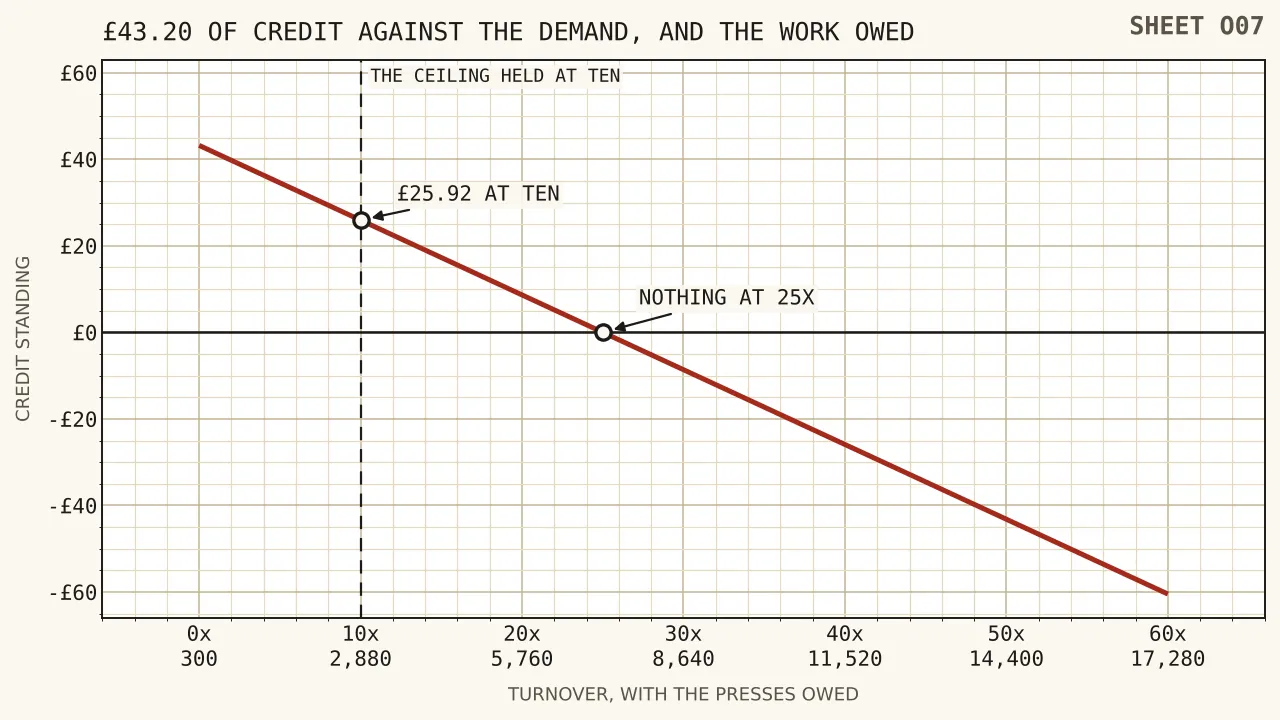
300 presses priced at 15p is £45.00 of stake, £43.20 of expected credit and 0.6p of house edge inside every single press. Ten turnovers leave £25.92 standing, twenty leave £8.64, twenty-five leave nothing whatever. A wallet moves that money. It does not regulate the cashier at the other end of it, and this sheet prices the difference.
Presses funded 300 Each one priced 15p, 0.6p of it edge Standing at ten £25.92
What a count of this size comes to
Every destination on this board is bought advertising. The site takes a fee if a reader goes on to register, and no figure printed below moves because of it.
The Spin Count
Gauge No 01
Betportal
Lowest multiple here
Priced at this site's own 10p a spin
What is counted
What is asked
No Great Britain licence
Licensed in Anjouan, Comoros, run by BetPortal Gaming Ltd, with Excite Ultra Media Ltd, reference ALSI-202601040-FI2.
Terms read 16 October 2026
Open the offer at Betportal, opens in a new tabThe Spin Count
Gauge No 02
WinBeast
Largest count here
Priced at this site's own 10p a spin
What is counted
What is asked
No Great Britain licence
Licensed in Curaçao, operator not named on the site.
Terms read 16 October 2026
Open the offer at WinBeast, opens in a new tabThe Spin Count
Gauge No 03
EliteSpin
Longest spin window
Priced at this site's own 10p a spin
What is counted
What is asked
No Great Britain licence
Licensed in Costa Rica, run by PrimeTier Limited.
Terms read 16 October 2026
Open the offer at EliteSpin, opens in a new tabThe Spin Count
Gauge No 04
Crown Jewelz
Multiple unpublished
No foot figure struck
What is counted
What is asked
No Great Britain licence
Licensed in Curaçao, number not verified, operator not named on the site.
Terms read 16 October 2026
Open the offer at Crown Jewelz, opens in a new tabThe figure in the third register is this site's own arithmetic and nothing an operator has published: the count at face, less the share a spin gives back at 96 per cent return to player, less what playing the wagering through costs at the same return. It describes the offer, not one reader's afternoon. Where the conditions price above the count the counter prints nothing rather than a negative sum, and where a figure the sum needs is unpublished it prints the condition in the operator's words instead.
A count has no unit of its own, so one is supplied. Where an operator publishes what a spin of its own is worth, that figure stands in the second register and is labelled as theirs. Where it does not, the second register carries this site's own 10p a spin and says so, and the foot figure moves in proportion: at half the price, half the money. The figure after it, what the count comes to for each spin, is the one that compares a large count against a small one.
Three words stand in the amount column where no figure can. Noted is a published condition that takes value away without leaving the sum a figure to take. Unpriced is a condition whose figure nobody has published, or a credit that is not a sum until a deposit of your own sets it. Own money is money of yours, which is never part of a foot figure.
Not one of the operators printed above holds a Great Britain licence, so the duties that licence carries do not reach them. Every online gambling company licensed in Great Britain has to be part of Gamstop Online, and a reader who has shut themselves out through the scheme is therefore not shut out here. The ceiling of ten times the bonus funds on a wagering requirement, in force since 19 January 2026, is a condition of that licence and binds the companies that hold one. Where a dispute goes instead is a matter for the authority named on the counter, and the Gambling Commission describes what a reader faces without a British licence as a lack of recourse if things go wrong. Nobody under 18 may hold an account at any of them.
Every term printed on a counter is the operator's own, and each counter carries the day it was read. The oldest of those readings is 16 October 2026. What binds a reader is the operator's own full terms, and not a line printed here.
1
0.6p of edge, 300 times over
Fifteen pence a press, 300 presses, and a reel handing back 96 pence in each staked pound. Those three figures settle the whole sheet. Stake at face: £45.00. Mean return: £43.20. Difference: £1.80, which is 0.6p of edge collected 300 times.
A turnover demand then bites at 0.6p per press per turnover. So the residue per press reads 8.64p where ten turnovers are asked, 2.88p where twenty are, nothing at twenty-five, and a 8.64p hole at forty. Across 300 presses: £25.92, then £8.64, then nothing, then £25.92 of the reader’s own money gone. Sixty turnovers dig the hole to £60.48, which is a third again more than the tray was worth before anybody pressed anything.
Twenty-five is where the line touches zero, and the press price has nothing to do with it. Four pence out of each pound is the edge; a hundred pence divides by four pence twenty-five times; so the twenty-fifth turnover consumes the last of the credit. That holds whether the press costs 15p or 15 pounds.
Worth saying plainly before part two: an offer of this shape holds no Great Britain licence. The ten-times ceiling is the one term a British licence nailed down, and with it gone the four figures above stop being a range and start being a question nobody has answered.
Now the specific thing this sheet exists to price. A reader searching for a wallet alongside the phrase in the heading is looking for a way to move £45.00 in and £25.92 out. Parts three to five set out what a British licence puts around the moving of that money, duty by duty, with a figure beside each. Part seven is the one to turn to where a registration is the thing that brought a reader to this heading.
This sheet names no wallet, no cashier and no domain, and it will not say which way of paying is likelier to work at a site holding no British licence. Nothing published settles that, and a sentence of the sort would be useful only to somebody trying to get round a protection. What can be priced honestly is the paperwork, and the paperwork is what parts three to six cost out.
2
A wallet is not a regulator
One confusion drives the search behind this heading, and clearing it up is worth more than any list of features.
The duties in this sheet attach to a licence held by the cashier. None of them attaches to the instrument used for paying. A wallet that behaves impeccably is a wallet; it carries no wagering ceiling, no stake cap, no pace floor, no complaints clock and no self-exclusion register, because none of those is a property of a payment method. Which means a recognisable way of paying tells a reader nothing at all about the 16 duties the rest of this section of the site prices.
The regulator has made that point in a neighbouring context, with a published finding behind it. An industry notice puts it on the record: casino games from licensed suppliers have appeared on websites holding no licence. A familiar title therefore certifies nothing whatever about the site running it. That is not theoretical. The sum was £4.75m, the date 23 July 2026, the licensee Evolution Malta Holding Limited, which agreed to pay once the regulator had traced its games onto six sites that held no licence and that British consumers could reach. Visits across those sites ran to large volumes from December 2023 through November 2024.
Scale that against the tray in part one. £4.75m is 183,256 lots of £25.92. Three findings sat behind it. Risks of terrorist financing, and of money laundering, were not identified and assessed by appropriate steps. Controls meant to hold those games out of Britain’s market, where an unlicensed operator is the route in, were not effective. And requirements for due diligence on customers went unmet. In the enforcement director’s published words, serious weaknesses in that assessment of risk were exposed by the case, and the failings were serious enough for suspension of the licence to be considered.
What this sheet does not do is run that reasoning across to any payment brand, because no primary source has done so. The published finding concerns games. A reader can take from it the general shape of the point, which is that recognisability is not evidence, and no more than that.
One further published fact belongs in the same paragraph, because it works the other way round. Among the consequences the regulator names for a business operating without its licence is that payment facilities may be withdrawn by major payment systems organisations, MasterCard being the example given. So a rail’s presence at a cashier is not permanent, which matters to anyone holding £25.92 on the far side of it.
3
Four rules owed at a licensed cashier desk
Four published duties govern money at a licensed cashier. Each one is a sentence in a rulebook and a figure on this tray, so the table carries both.
| What binds a British licensee | Its date, where one is published | What its absence is worth here |
|---|---|---|
| Gambling may not be paid for by credit card | In effect 14 April 2020 | £1,728.00 of fortyfold turnover cannot be borrowed |
| No option offered for calling a withdrawal back | The standard publishes none | £25.92 once requested cannot be fed back to the reels |
| No maximum over what leaves a deposit balance | No date whatever on that page | The reader’s own £45.00 is not rationed out weekly |
| Three identity items settled ahead of any play | The condition publishes no date | 2,880 presses of turnover run on a checked account |
Row one is worth taking slowly, because its scope is wider than it looks. Accepting payment for gambling by credit card is the thing the condition bars, and the bar extends to such a payment where a money service business carries it. Scope: every remote licence, the ancillary remote ones for betting and for lottery included; and on the non-remote side, betting intermediary licences, pool betting and general betting. Three sit outside: host licences, those for gaming machine technical, and those for gambling software. Note what the condition does not do: it names credit cards and that routing, and nothing else, so this sheet states the scope and stops there rather than extending it to instruments the wording does not reach.
Row two converts cleanly. Where a licensed system may not hold out a cancel button, a requested payout stays requested, and the guidance adds that funds under a live request should not be offered back as something to deposit, with the route out carrying as little friction as can be managed. On this tray that rule is worth the difference between £25.92 banked and £25.92 returned to a reel at 2.88p of residue per press.
Row three is the one readers assume everywhere. No licensee may impose a ceiling over what a deposit balance pays out, nor use one, nor enforce one, nor lean on one. A failing specimen is printed by the regulator itself, allowing a customer fifty pounds in any day against five hundred in any week. Reasonableness governs a limit, which may be pitched at how large one withdrawal is or at how many withdrawals there are, and money in that balance, winnings and all, leaves when the player says it leaves. One distinction belongs with it. A ceiling on what a bonus may produce is a different animal, untouched by the rule, whose subject is the deposit balance alone.
Row four is priced in part six, since 2,880 presses is what a tenfold demand costs on this tray. Three items are what the condition wants settled first, name and address and date of birth, and it is express that its list is not closed.
0.6p of edge a press, £25.92 standing at ten turnovers, 2,880 presses to earn it
4
Eight weeks, then one of eight adjudicators
A dispute about money out is the thing a reader of this heading is really insuring against, so the complaints machinery deserves a part of its own with its clocks converted into days.
Start with the operator’s side. Three working days, or 24 hours at a cashier that never closes: that is the window for acknowledging a complaint, with the wording adding that it should happen as soon as is reasonably possible. Eight weeks from receipt caps the whole of it, internal escalation included, and provision 6.1.1.2 of the social responsibility code is what the guidance puts behind that cap. Bringing a complaint stays open for six months at the very least, measured from the incident, and no term available to a licensee shuts that window earlier. Pausing is allowed. Seven days of no answer to a reasonable information request can make stopping the clock reasonable, and the reply when it comes restarts that clock where it halted instead of at zero. Three jobs fall to the closing letter: the decision explained, the operator’s own process declared at an end, and the route to an independent adjudicator set out.
Then the adjudicators, because a licensee may use only one the regulator has approved. Eight stand on the published list: IBAS. eCOGRA. ProMediate. Tattersalls Committee. ADR Group. Pegasus ADR Service. Blexr Limited. And a centre for effective dispute resolution, usually written as CEDR. One name has gone, the page’s update note recording Lindsays removed. Sector coverage differs between them and the difference matters to a casino player. Five of the eight are listed for remote in every sector: CEDR and eCOGRA, IBAS, Blexr Limited, ADR Group. ProMediate and Tattersalls Committee appear in the table for all sectors, though the latter’s own entry runs to betting only. Pegasus ADR Service appears instead against family entertainment centres, bingo that is not remote, adult gaming centres, and public houses along with members clubs, which leaves remote casino off its entry altogether. Publication of that page: 17 May 2021. Last revision: 15 January 2025. IBAS is described on it as adjudicating where a dispute stands between a licensed gambling operator and its customer.
Now the limit readers do not expect, stated by the regulator about itself. “We are not an ombudsman” is its own phrase. Three disclaimers follow. Resolving a gambling complaint, or recovering a consumer’s money, are powers it does not hold. Transactions fall outside it, with trouble over a withdrawal and a technical fault inside a game given as the two examples. And a customer’s account is not visible to it, so whatever happened in one is not something it can see. What it directs a player to do is put the matter first to the gambling business. Publication 11 December 2023, with 4 June 2024 as the last update.
Convert the lot into days against £25.92. Three working days to an acknowledgement, or one day where the cashier never closes. Fifty-six days to a final answer. One hundred and eighty-two days in which the complaint may be started. Then an approved adjudicator, chosen from a list of eight, five of which cover remote casino. That is the machinery a British licence buys, and the sum it is protecting here is £25.92, which is 58 pence of value for each of the 56 days.
One honest correction to a line this market attracts. It is wrong to say there is no complaints route beyond the British licence. Curaçao’s regulator publishes one, and on paper the shape tracks the British version. Lodging costs nothing, and the six months available for it run from the settlement of the bet, or else from the incident. Within a week, receipt is owed a confirmation in writing. Assessment and response arrive inside four weeks, a single four-week extension being available on prior written notice, which lands the outer limit on the same eight weeks. Complaints about responsible gaming are prioritised there. Best efforts aim at five business days, receipt is confirmed inside two, and delay is held to a fortnight, extendable by a second fortnight where a player answers slowly.
Where the two regimes genuinely part is not the timetable. It is who writes the terms of the adjudication. Britain’s regulator approves the entities, and nothing outside its approved list is available to a licensee. Under the Curaçao policy adjudication is compulsory and costs the player nothing, the operator bearing all of it. Yet the parameters are expressly contemplated as the operator’s to set: whether legal proceedings must wait on adjudication, whether the outcome is binding on a player, and whether escalation needs a claim to clear some minimum value. That last parameter is the one to hold against this tray. A minimum claim value set above £25.92 would put the whole of this offer’s best case below the threshold for being heard.
5
A payout limit nobody can reach
Two failure modes at the exit are on the regulator’s record, and the second is the sharpest piece of arithmetic in this section of the site.
Its blog post of 21 October 2025 names both: some sites are blocking payouts, and some are setting withdrawal limits so high they are unattainable. Data protection is flagged in the same place as a serious concern, identity theft being one named risk and fraud the other. Words attributed there to the regulator’s director for enforcement and intelligence describe sites without a licence as often short of three things: secure payment systems, then tools for responsible gambling, then verification of age. Consumers, the same passage runs, meet heightened exposure to unfair gaming practices, to losing money, and to having nowhere to turn when something goes wrong.
Take the second failure mode and price it. Where a payout limit cannot be reached, it performs the function of a win ceiling fixed at zero, and it performs it with no multiple printed in the terms at all. On this tray that converts £25.92 into £0.00. No figure in the offer changes. The headline count stays 300. The press price stays 15p. The expected credit stays £43.20. Only the exit moves, and the exit is where the whole of the value sat.
One sentence of published British rule sits against that: capping what leaves a deposit balance is not open to a licensee, and reasonableness governs a limit, pitched at the size of a withdrawal or at the count of withdrawals. The word reasonable is doing the work there, and off the register there is no word doing it at all.
Here is the same point as a table, with the floor expressed in presses so the scale is visible. Residue per press is 14.4p where nothing is demanded, 8.64p at a tenfold demand and 2.88p at twenty, so a payout floor divided by one of those gives the presses a reader needs before the mean reaches it.
| Demand on the credit | Residue, one press | Floor of £10.00 | Floor of £15.00 | Floor of £25.00 |
|---|---|---|---|---|
| None at all | 14.4p | 70 | 105 | 174 |
| Ten turnovers | 8.64p | 116 | 174 | 290 |
| Twenty turnovers | 2.88p | 348 | 521 | 869 |
| Twenty-five turnovers | nothing | unreachable | unreachable | unreachable |
Read the row for a tenfold demand against the count. 300 presses clears a floor of £10.00 with 184 presses to spare, clears £15.00 with 126 to spare, and clears £25.00 with 10 presses in hand. Ten presses is £1.50, so under two pounds of margin separates this tray from a balance that cannot legitimately leave. Move to twenty turnovers and every one of the three floors is out of range.
6
The multiple, and the hours it costs
One table holds the arithmetic of the offer. Each turnover demanded costs £1.73 of the credit and adds 288 presses to the obligation.
| Turnovers asked of the credit | Turnover owed | Presses at 15p | At the 2.5 s floor | Credit still standing |
|---|---|---|---|---|
| None | nothing | 300, the tray alone | 12 min 30 s | £43.20 |
| Five | £216.00 | 1,440 | 1 hr | £34.56 |
| Ten, the regulated ceiling | £432.00 | 2,880 | 2 hr | £25.92 |
| Twenty | £864.00 | 5,760 | 4 hr | £8.64 |
| Twenty-five | £1,080.00 | 7,200 | 5 hr | nothing |
| Forty | £1,728.00 | 11,520 | 8 hr | £25.92 adrift |
| Sixty | £2,592.00 | 17,280 | 12 hr | £60.48 adrift |
Ten turnovers is a regulated ceiling, commencing 19 January 2026, and the provision carrying it is code 5.1.1 at its third limb. Two licence types escape, gaming machine technical and gambling software, which leaves every remote casino licence in Great Britain bound by it. Sixty times, in the last row, is the figure the regulator reported in use by some licensees before that ceiling arrived.
The time column uses the shorter of the two British pace floors. Between a game’s start and the next cycle becoming startable, a reel owes 2.5 seconds, and the guidance is strict about what a cycle is. It opens when the player opens it. It closes once the start control is free again and every penny staked or won has gone or been made available to them. Pressure maintained on a key, on a screen, on a button, opens nothing. Casino games that are not reels carry five seconds instead, with peer-to-peer poker outside the rule, and that five-second figure has a date of 17 January 2025 taken from the regulator’s own page of updates. The standard itself publishes no commencement date for any of its lettered requirements, so this sheet attaches no date to the 2.5-second figure.
One effect of the time column is easy to miss. A pace floor does not reduce a loss by a penny. £17.28 is the expected cost of 2,880 presses whether they occupy two hours or four minutes. What the floor buys is the two hours, which is the interval inside which somebody can notice what is happening and stop. At the floor, this tray moves £3.60 of stake a minute and 14.4p of expected loss a minute. Double the pace and both of those double.
Then the mechanism that can make ten turnovers cost more than ten turnovers. Contribution settles a demand; stake does not. Thirty per cent is the weighting in a worked example supplied by a respondent and printed on the regulator’s page, under which thirty pence of each staked pound counts towards the requirement. At that rate the £432.00 in row three becomes £1,440.00 of staking, which is 9,600 presses and 6 hours 40 minutes at the floor. Weighting came through the ceiling untouched.
Two caps belong beside the table, because they bound what one press may cost and this page’s press costs 15p. A statutory instrument made 25 February 2025, numbered SI 2025 No. 215, puts five pounds on a game cycle for anyone 25 or over and two pounds for anyone younger, with the guidance supplying two commencement dates, 9 April 2025 for the larger ceiling and 21 May 2025 for the smaller, and stating plainly that online slots are all the limits reach. Measured here, those ceilings are 33 presses and 13 presses. Beyond the register nothing bounds a cycle at all.
7
Two blocks that belong to somebody else
Two things can stop a payment reaching a cashier, and neither belongs to the cashier. Both are protections, and this part is about what they are rather than about how they are circumvented.
The first is the national self-exclusion scheme, and its reach is a property of the licence. Participation is required of every company licensed here to gamble online, which is why a site beyond the scheme and a site beyond the licence name one population rather than two. Since April 2020 each licensee has had to compare its whole customer base against that register inside every 24 hours. Its own terms are candid about where the protection stops. Exclusion is what it delivers, and the operators it reaches are the ones participating in it. Preventing access where a service belongs to some organisation that does not participate is the thing it states it cannot do. Read as a measure rather than as a gap, that sentence does more work than anything else here: the licence is what buys the block, so no payment rail could supply it and none has claimed to.
Periods, since they are the figures a reader weighs. Four lengths are offered at registration. Six months. Twelve months. Sixty months. Then sixty months renewing of their own accord. Switching that renewal off can be done only across the closing half-year of such a term. Deactivation before the minimum period ends is not available, and the scheme’s own terms put that in capitals. Lapsing is not available either. Extension runs to six months, twelve months or sixty; deactivation is the alternative; and where a person does neither, as many as seven further years of exclusion follow. A contact centre handles deactivation, 24 hours of cooling off at the minimum, the exclusion live throughout. Operators are then told of that earlier exclusion for seven years, through which blocking is not required of them. The terms were last revised 20 May 2026.
Hold those periods against the tray. Six months is the shortest term on offer. £25.92 is the best this tray can be expected to produce. That is 14 pence a day across the shortest available registration, and the figure falls to nothing where the demand reaches twenty-five turnovers.
The second block belongs to a bank. A gambling block that a card issuer sets, or one inside a banking app, protects in precisely the sense the scheme does, and leaving it switched on is what this sheet suggests. No part of this page explains how either block is got around, and no part of it suggests a way of paying that might clear one. A reader who wants the arithmetic behind that decision has it in the table in part six: £25.92 at a tenfold demand, nothing whatever at twenty-five, and at forty that same £25.92 leaving the reader’s own pocket.
8
What £25.92 does not come with
Close the sheet by putting the two sides of the trade in the same paragraph, which is the only honest way to end a page like this.
On one side: £25.92, which is what 300 presses at 15p are expected to produce under the heaviest demand a British cashier could lawfully set. Reaching it takes 2,880 presses and two hours at the shorter pace floor. Nothing in the market published anywhere says a cashier beyond the register will ask for ten rather than forty, and at forty the same tray costs £25.92 instead of paying it.
On the other side sits what the money buys. Credit cards refused, dated 14 April 2020. A payout with no cancel button on it. A deposit balance nobody may cap. Three identity items settled ahead of press number one. Fifty-six days to a final answer on a complaint, with three working days to the acknowledgement, or one day where the cashier never shuts. One hundred and eighty-two days across which that complaint may be started. Then an adjudicator from the approved list, five of whose eight names cover remote casino. A 2.5-second gap between reel cycles. Five pounds on a cycle, two for anybody under 25. And a register of self-exclusions read daily by every licensee. Ten entries set against £25.92, which works out at £2.59 an entry.
The division is the argument. Small enough to be split across the protections being set aside and still produce a figure under three pounds: that is what the sum weighs, and the arithmetic makes the case with no adjectives in it.
Three things cost a reader in Great Britain nothing. The National Gambling Helpline is the first, on 0808 8020 133, staffed by GamCare at every hour on all 365 days, answering over WhatsApp, on live chat and by telephone, to anybody ringing about themselves and to anybody ringing about another person. Blocking software is the second: Gamban, reaching gambling apps and sites by the tens of thousands on all the major platforms. TalkBanStop is the third, GamCare’s pairing of that line with that software and with the self-exclusion scheme, under which the software is charged for at nothing to anybody who rings or takes up GamCare’s treatment and support. The article setting that pairing out carries 12 April 2021 as its date. No duration appears on it, so none is claimed here, and a seven-day trial is what the company’s own pages show, with no British free route among them.
Questions
- Does paying with a wallet make a casino safer?
- No, because the duties in this sheet attach to the cashier’s licence and not to the instrument used for paying. A wallet carries no wagering ceiling, no stake cap, no pace floor, no complaints clock and no self-exclusion register, since none of those is a property of a payment method. The regulator has made the neighbouring point with a finding behind it: games from suppliers that hold licences have been found running at sites that hold none, so a familiar title certifies nothing about the site around it.
- What is 300 presses at 15p worth?
- £45.00 of stake at face and £43.20 of expected credit, with 0.6p of house edge inside each press and £1.80 across the tray. Each turnover demanded then costs 0.6p a press, so the credit stands at £25.92 after ten turnovers, £8.64 after twenty, nothing after twenty-five, and £25.92 adrift after forty.
- Which payment method works at a site outside the scheme?
- This sheet will not answer that, and nothing published settles it. A sentence of the kind would be useful only to somebody trying to get round a protection, so what is costed here instead is the paperwork: four cashier duties in part three, the complaints machinery in part four, and the exit arithmetic in part five.
- Why are credit cards refused at a licensed cashier?
- Because accepting payment for gambling by credit card is what a licence condition bars, and a credit-card payment travelling through a money service business is caught as well. 14 April 2020 is the effective date. Scope covers every remote licence, the ancillary remote ones for betting and for lottery included, plus betting intermediary licences and pool betting and general betting where those are not remote; host licences sit outside it, as do gaming machine technical and gambling software. On this tray the condition keeps £1,728.00 of fortyfold turnover off borrowed money.
- May a cashier cap what leaves my balance?
- Not a deposit balance. Imposing a term that caps what such a balance pays out is barred, as are using one, enforcing one and leaning on one, and a failing specimen is printed by the regulator itself, allowing a customer fifty pounds in any day against five hundred in any week. Reasonableness is the test for a limit, pitched at a withdrawal’s size or at the count of withdrawals. A ceiling on what a bonus may produce is a separate animal the rule does not reach.
- How long may a complaint take, and who decides it?
- Three working days is the window for acknowledging it, or 24 hours at a cashier that never closes, with the wording adding that it should happen as soon as is reasonably possible. Fifty-six days caps the whole thing, internal escalation and all. A complaint may be started for six months at the very least, measured from the incident. Seven days of silence on a reasonable information request permits the clock to be halted, a reply restarting it where it stopped. An adjudicator the regulator approves decides at the end, drawn from a published list of eight on which five carry remote across all sectors.
- Can the regulator recover money for me?
- No, and its own phrase for itself is that it is no ombudsman. Three disclaimers follow. Resolving a gambling complaint is a power it does not hold, and recovering a consumer’s money is another. Transactions fall outside it, trouble over a withdrawal and a technical fault inside a game being the examples given. And a customer’s account is not visible to it, so whatever happened in one cannot be seen. What it directs a player to do is put the matter first to the gambling business. Publication 11 December 2023, with 4 June 2024 as the last update.
- Does any complaints route exist beyond the register?
- Saying there is none would be wrong. Curaçao’s regulator publishes one whose paper shape tracks the British version. Lodging costs nothing, and the six months available for it run from the settlement of a bet or else from the incident. Inside a week, receipt has to be confirmed in writing. A response arrives inside four weeks, with one four-week extension available on prior written notice, landing the outer limit on the same eight weeks. Divergence comes over who fixes the terms of the adjudication, since that policy contemplates the operator doing it, a minimum claim value for escalation being one of the parameters named. Pitched above £25.92, such a threshold would drop this whole offer’s best case below the level at which it could be heard.
- What happens when a payout limit cannot be reached?
- It performs the function of a win ceiling fixed at zero, with no multiple printed anywhere in the terms. Blocked payouts, and limits on withdrawal pitched high enough to be unreachable, are both on the record in the regulator’s blog post dated 21 October 2025. Applied here, £25.92 turns into £0.00 while every other figure stays exactly as advertised: 300 presses, 15p apiece, £43.20 of expected credit. Only the exit moved, and the exit held all of the value.
- Can a self-exclusion registration block an offshore cashier?
- No, and the scheme states as much itself. What it delivers is exclusion, reaching those operators that participate and their gambling services; what it says it cannot do is prevent access where the service belongs to an organisation standing outside. Participation arrives with the Great Britain licence that every licensed online company holds, and since April 2020 each licensee has compared its whole customer base against that register inside every 24 hours. The licence is what buys the block, so no payment rail could supply it.
- What does help cost, and how do I reach it?
- Nothing, and on 0808 8020 133. GamCare staffs that line as the National Gambling Helpline, at every hour on all 365 days, answering over WhatsApp, on live chat and by telephone, open to anybody ringing about themselves and to anybody ringing about another person. Blocking software, Gamban, reaches gambling apps and sites by the tens of thousands on all the major platforms, and TalkBanStop is GamCare’s name for pairing that line with that software and with the self-exclusion scheme. A gambling block from a bank or a card issuer protects in the same sense. Getting round any of the three is not something this sheet explains.