Section P Revision 1 Counted 16 October 2026
Counted against a payment: what £17 buys, in credit and in presses
Pay in £17 against a doubling and the credit is £34.00, which a tenfold play-through reduces to £20.40 at the foot. Pay in the same £17 at twenty presses to the pound and the face value is also £34.00, but the figure at the foot is £19.58. Thirteen pages work out why those two numbers differ by exactly four per cent.
The count 340 spins One spin 10p Comes to £19.58
What a package attached to a deposit is worth per pound paid
Every destination on this board is bought advertising. The site takes a fee if a reader goes on to register, and no figure printed below moves because of it.
The Spin Count
Gauge No 01
Betportal
Lowest multiple here
Priced at this site's own 10p a spin
What is counted
What is asked
No Great Britain licence
Licensed in Anjouan, Comoros, run by BetPortal Gaming Ltd, with Excite Ultra Media Ltd, reference ALSI-202601040-FI2.
Terms read 16 October 2026
Open the offer at Betportal, opens in a new tabThe Spin Count
Gauge No 02
WinBeast
Largest count here
Priced at this site's own 10p a spin
What is counted
What is asked
No Great Britain licence
Licensed in Curaçao, operator not named on the site.
Terms read 16 October 2026
Open the offer at WinBeast, opens in a new tabThe Spin Count
Gauge No 03
EliteSpin
Longest spin window
Priced at this site's own 10p a spin
What is counted
What is asked
No Great Britain licence
Licensed in Costa Rica, run by PrimeTier Limited.
Terms read 16 October 2026
Open the offer at EliteSpin, opens in a new tabThe Spin Count
Gauge No 04
Crown Jewelz
Multiple unpublished
No foot figure struck
What is counted
What is asked
No Great Britain licence
Licensed in Curaçao, number not verified, operator not named on the site.
Terms read 16 October 2026
Open the offer at Crown Jewelz, opens in a new tabThe figure in the third register is this site's own arithmetic and nothing an operator has published: the count at face, less the share a spin gives back at 96 per cent return to player, less what playing the wagering through costs at the same return. It describes the offer, not one reader's afternoon. Where the conditions price above the count the counter prints nothing rather than a negative sum, and where a figure the sum needs is unpublished it prints the condition in the operator's words instead.
A count has no unit of its own, so one is supplied. Where an operator publishes what a spin of its own is worth, that figure stands in the second register and is labelled as theirs. Where it does not, the second register carries this site's own 10p a spin and says so, and the foot figure moves in proportion: at half the price, half the money. The figure after it, what the count comes to for each spin, is the one that compares a large count against a small one.
Three words stand in the amount column where no figure can. Noted is a published condition that takes value away without leaving the sum a figure to take. Unpriced is a condition whose figure nobody has published, or a credit that is not a sum until a deposit of your own sets it. Own money is money of yours, which is never part of a foot figure.
Not one of the operators printed above holds a Great Britain licence, so the duties that licence carries do not reach them. Every online gambling company licensed in Great Britain has to be part of Gamstop Online, and a reader who has shut themselves out through the scheme is therefore not shut out here. The ceiling of ten times the bonus funds on a wagering requirement, in force since 19 January 2026, is a condition of that licence and binds the companies that hold one. Where a dispute goes instead is a matter for the authority named on the counter, and the Gambling Commission describes what a reader faces without a British licence as a lack of recourse if things go wrong. Nobody under 18 may hold an account at any of them.
Every term printed on a counter is the operator's own, and each counter carries the day it was read. The oldest of those readings is 16 October 2026. What binds a reader is the operator's own full terms, and not a line printed here.
1
The question under every page here
Thirteen pages sit under this heading and all thirteen answer one question: what does a pound paid in buy? Not what the headline says it buys. What it is expected to be worth after the condition riding on it has been discharged, priced to the penny and converted into presses.
Half this market quotes in percentages and half quotes in presses to the pound, which is why the two halves are almost never compared properly. A doubling and a rate of twenty presses for every pound look like different species of offer. On a £17 payment they produce an identical face value of £34.00, and the figures they leave at the foot differ by 82p. That gap is not a detail. It is the exchange rate between the two currencies this section deals in, and section five works it out.
The widest page here is the casino welcome bonus, which asks what the whole shape of a first-deposit package comes to rather than what one variant of it comes to. Read that one if the package in hand mixes a percentage and a tally, since most of them do.
Every figure below is this site’s arithmetic and not an operator’s claim. A press costs 10p. A machine gives back 96p of each pound put through it. Contribution counts at unity. The multiple is stated in each sum, and where it reads ten that is the British legal ceiling rather than a market observation. Where it reads forty it is the order of multiple a cashier writes when no regulator is reading.
2
Your own money is not part of the gift
One rule governs every sum in this section and it is constantly broken in advertising copy. The money the reader pays in is theirs. The bonus does not include it, the operator has not given it, and it never belongs in the balance a play-through is calculated against unless the terms expressly say so. A doubling on £17 is a gift of £17. It is not a gift of £34, even though £34 is the figure that appears on the screen.
The distinction has a legal edge as well as an arithmetic one. A British licensee is forbidden to put any limit on what a customer draws back from a deposit balance of their own, and the term the regulator holds out as one it will not allow confines a player to a fixed sum each day and a larger fixed sum each week. So the £17 paid in remains the reader’s, withdrawable whenever they choose. What the condition bites on is the £17 the operator added, plus whatever that £17 earns.
Keep those two pots separate and the arithmetic of a match becomes simple. One pot is capital returned on demand. The other is a gift carrying an obligation, and the obligation is measured in turnover rather than in time or in effort. The second pot is what the remainder of this page concerns.
3
Seventeen pounds at four percentages
Take a payment of £17, which is deliberately not a round figure, and run it through the four percentages this market advertises most. The play-through is set at ten, the British maximum.
| Match | Credit given | Expected cost | Turnover owed | Presses at 10p | Minutes owed | At the foot |
|---|---|---|---|---|---|---|
| 100 per cent | £17.00 | £6.80 | £170.00 | 1,700 | 71 | £10.20 |
| 200 per cent | £34.00 | £13.60 | £340.00 | 3,400 | 142 | £20.40 |
| 300 per cent | £51.00 | £20.40 | £510.00 | 5,100 | 213 | £30.60 |
| 400 per cent | £68.00 | £27.20 | £680.00 | 6,800 | 283 | £40.80 |
Each cost cell is 4 per cent of the turnover standing on the same line, every time, and the minutes column assumes a press every 2.5 seconds, the quickest cadence a licensed slot may lawfully run at.
Divide the last column by the £17 paid in and the percentages reappear as a rate of return on the payment: 60p of expected value for each pound deposited at 100 per cent, £1.20 at 200, £1.80 at 300, £2.40 at 400. That ladder is a straight line, which is the point of the next section.
4
Nothing improves when the percentage does
The headline percentage is the loudest number in this market and the least informative. Here is why. A play-through sets the turnover owed as a multiple of the credit, so the ratio between work and reward is fixed by the multiple and is untouched by the percentage. At ten times, every pound of credit carries ten pounds of turnover. That is true at 100 per cent and it is true at 400 per cent.
What a steeper percentage does is scale both sides of that ratio together. Four times the credit, four times the turnover, four times the clock, four times the figure at the foot. The 400 per cent row of the table above produces £40.80, which looks handsome until the 283 minutes beside it are read as well. A doubling produces a quarter of the money for a quarter of the work. Neither is a better deal than the other. They are the same deal at different sizes.
So a reader comparing two packages should ignore the percentages until the multiples have been put side by side, because the multiple is the only figure in the advertisement that changes the rate of exchange. A 100 per cent match at five times play-through keeps 80 per cent of its credit. A 400 per cent match at twenty times keeps 20 per cent. The second has four times the headline and a quarter of the efficiency, and in pence per pound deposited the two tie exactly at 80p, a dead heat reached from opposite directions.
Ten pounds of turnover for every pound of credit, at 100 per cent and at 400 per cent alike
5
A pound of presses is 96p of credit
Now the exchange rate between the two halves of this market. Both packages below start from the same £17 payment and arrive at the same face value of £34.00, and they do not finish in the same place.
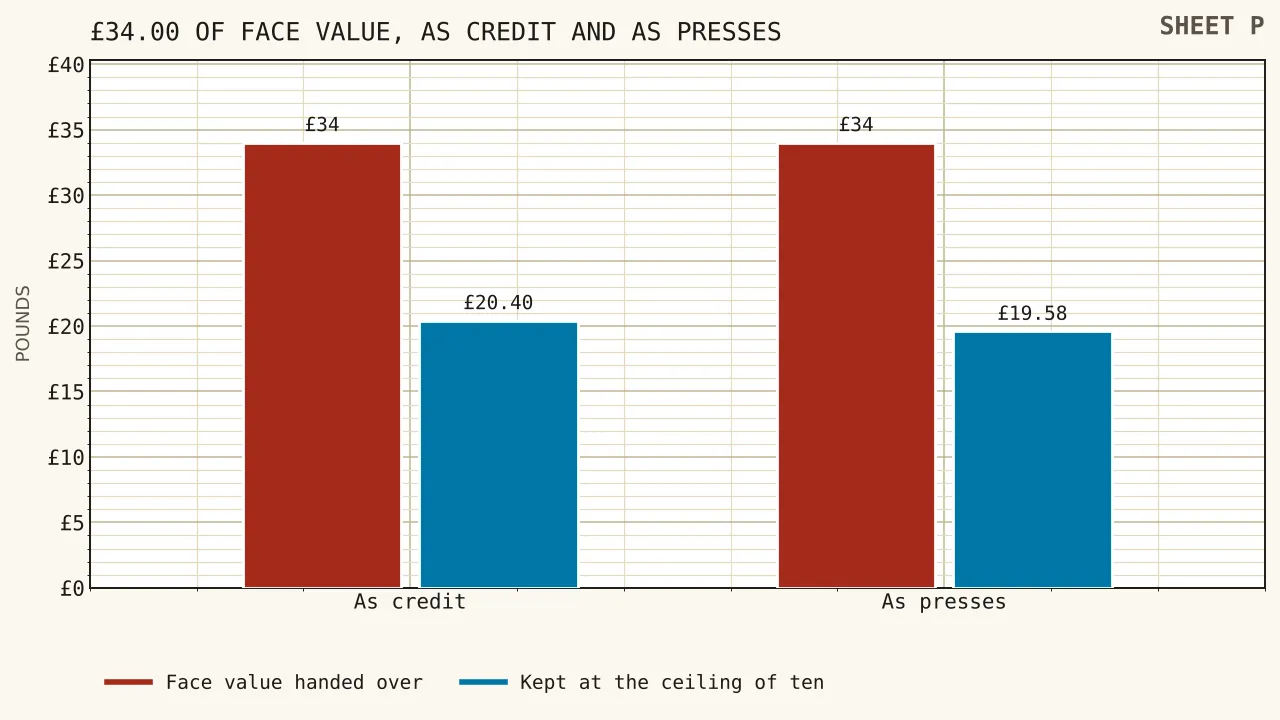
A doubling gives £34.00 of credit. Credit is cash in a balance, so the play-through goes straight on to it: ten times £34.00 is £340.00 of turnover, costing £13.60, which leaves £20.40.
Twenty presses to the pound gives 340 presses. Presses are not cash. They have to go through the reel first, and the reel keeps four pence in the pound on the way, so 340 presses at 10p produce an expected balance of £32.64 rather than £34.00. The play-through then attaches to that: ten times £32.64 is £326.40 of turnover, costing £13.06, which leaves £19.58.
The difference is 82p, and it is not a rounding artefact. It is exactly four per cent of £20.40, because the presses passed through the machine one extra time before the condition even started. A pound of spin face value is therefore worth 96p of bonus credit, flat, at every size and under every multiple. Anybody choosing between a percentage and a tally can apply that factor in their head: convert the tally to face value, knock four per cent off, and compare with the credit.
6
The route: a percentage of the payment
Four pages take a single percentage and work it out end to end. They are ordered by steepness, which is also the order in which the obligation grows.
The straight doubling answers what the simplest coefficient in this market actually produces, and it is the page to read before the others because every steeper figure is a multiple of its answer. The tripling of the balance asks what the extra pound of credit costs in turnover once it has been added.
Three pounds of credit for each pound paid asks whether a ceiling on the credit, which usually arrives with a percentage that steep, cancels out the percentage itself. And the steepest line this market prints asks the sharpest version of the question this whole group shares: how many hours of lawful pressing does a headline of that size actually commit the reader to?
7
The route: presses for a payment
Six pages quote in presses instead. The useful figure on each is the rate, meaning presses delivered for every pound paid in, because the rate is what survives when the headline is forgotten. Thirty to the pound and ten to the pound are both common, and they are a factor of three apart.
Ten presses for each pound paid sets the floor of the range and asks what the thinnest rate on offer is worth once the reel has taken its share. Forty presses for each pound paid sets the ceiling, and asks what has to be true elsewhere in the terms for a rate that steep to be affordable to the house.
Thirty presses for each pound paid asks which clause absorbs the difference between a generous rate and a plain one. A smaller payment with the play-through struck out asks what is left to go wrong when the heaviest condition has already gone, and the larger payment with the same clause asks whether the premium for that clause scales with the tally or stays flat.
A tally of 120 bought with real money asks the question none of the others has to: where the presses are spent, and why the destination can move the answer further than the rate does.
8
The route: two rooms, two units
Two pages are organised by the room rather than by the shape of the offer, because in those two rooms the unit itself changes. A sign-up package for the slots room is the only one in this section with statutory figures over the unit, since a single online slot game cycle has a legal ceiling in pounds, and that page asks what the ceiling does to the arithmetic of a sign-up.
A sign-up package for the bingo room asks the opposite question. There the unit is a bingo ticket, played against other customers rather than against a machine, the room has no obligation to publish a percentage return at all, and that page asks what can be converted honestly when the one figure the arithmetic needs is never printed.
9
Where the base is twice the bonus
One clause changes the whole picture and it is easy to read past. Some terms compute the requirement from the credit plus the payment rather than from the credit alone. On the £17 doubling that doubles the base: the turnover owed goes from £170.00 to £340.00, the expected cost from £6.80 to £13.60, and the gain over the money paid in falls from £10.20 to £3.40. Two thirds of the value of the package is removed by a clause that adds four words.
Whether a clause of that construction sits inside the British ten-times ceiling has not been published. Bonus funds are what the ceiling is drafted around, and nothing issued addresses a requirement computed on the payment too. The chain of published wording is therefore set out here with nothing appended: ten turns is the maximum on the credit, the base that ceiling applies to is bonus funds, and what happens once the base widens is not something anybody has written down.
What a reader can do instead is arithmetic. Multiply the stated multiple by the stated base, divide by the price of a press, and the obligation appears in presses. On the widened base above that is 3,400 presses, which at the 2.5-second floor under a game cycle is 8,500 seconds, or two hours and twenty-two minutes of uninterrupted pressing. The clause is not hidden. It is simply never converted.
10
A payment made outside the register
Strike the duties out one line at a time and the value of a payment made at the offshore end of this market can be read off what remains. The cashier at the other end of that payment holds no Great Britain licence, so the ledger starts there.
Strike out the credit-card prohibition, dated 14 April 2020, which shuts that rail at a British cashier whether the card is presented directly or pushed through an intermediary. Strike out the financial-limit machinery: the prompt that has to appear at registration or at the first payment, the rule that makes setting a limit the default rather than the option, the immediate effect of any reduction, and the 24-hour hold that must elapse before an increase can take effect. Strike out the vulnerability checks, set at first against a net deposit over £500 in a month from 30 August 2024, then at £150 in a month from 28 February 2025. Strike out the standard that will not let a cashier offer to undo a withdrawal request already made, which is the single clause most likely to turn a figure at the foot back into turnover.
What is left is the arithmetic of a free hand. On the £17 doubling, a fortyfold requirement rather than a tenfold one puts the turnover owed at £1,360.00, the expected cost at £54.40, and the balance £20.40 short rather than £20.40 up. The headline on the package is unchanged. The multiple is the only thing that moved, and nothing out there holds it down.
Readers often raise the next point in the opposite order, so it belongs here. Sign up once to the national scheme and the self-exclusion covers each company licensed to take British online business, with nothing whatever beyond them inside it, because the licence and not the website fixes that boundary. The scheme says as much itself. That is the edge of the cover a registered person has, and this site carries nothing about getting past it, past a blocker, or past a bank’s own gambling block.
£20.40 kept at the British ceiling against £20.40 lost at forty times, on the same £17
Questions
- Is my own deposit part of the bonus?
- No. A doubling on £17 is a gift of £17, not of £34, even though £34 is the figure shown on the screen. The money paid in stays the reader’s, and a British licensee may not put any limit on what a customer draws back out of their own deposit balance. The condition attaches to the credit the operator added and to what that credit earns.
- Does a steeper percentage make a package better value?
- Not at a given multiple. A play-through fixes the turnover at so many pounds for each pound of credit, and that ratio is untouched by the percentage. Four times the credit means four times the turnover, four times the clock and four times the figure at the foot. The multiple is the only number in the advertisement that changes the rate of exchange.
- What is £17 at a doubling worth after a tenfold play-through?
- The credit is £34.00, the turnover owed is £340.00, and four pence of every pound of that comes to an expected £13.60, which leaves £20.40. In presses the obligation is 3,400, and at the 2.5-second floor under a game cycle those presses occupy 8,500 seconds, or two hours and twenty-two minutes.
- Which is worth more, a pound of credit or a pound of spins?
- The credit, by four per cent, at every size. Presses have to pass through the reel before the condition starts, and the reel keeps four pence in the pound on the way. On a £17 payment, £34.00 of credit leaves £20.40 while 340 presses at 10p leave £19.58, a gap of 82p that is exactly four per cent of the larger figure.
- How do I compare a percentage offer with a spins offer?
- Convert the tally to face value by multiplying by the price of a press, take four per cent off the result, and set it beside the credit. That single factor of 0.96 is the whole exchange rate between the two currencies this part of the market quotes in, and it holds under any multiple.
- What happens when the wagering base includes the payment too?
- The base doubles on a straight match, and so does the cost. On £17 the turnover owed rises from £170.00 to £340.00, the expected cost from £6.80 to £13.60, and the gain over the money paid in falls from £10.20 to £3.40. Whether a clause of that construction sits inside the British ten-times ceiling has not been published, so no answer to that is offered here.
- What is the most a British licensed site can require?
- Ten turns of play-through on bonus funds, from 19 January 2026. Every table on this page uses that ten, and labels it as the legal maximum rather than as something observed in the market. Above it the arithmetic belongs to cashiers that no British rule reaches.
- What does a payment lose when the site is not on the British register?
- The credit-card prohibition in force since 14 April 2020, the financial-limit prompt and its default setting, the immediate reductions and the 24-hour hold on increases, the vulnerability checks whose threshold dropped from £500 to £150 of net deposit on 28 February 2025, and the standard barring a cancel button on a withdrawal already asked for. Participation in the national self-exclusion scheme disappears with the licence that carries it. On the £17 doubling, a fortyfold requirement leaves the balance £20.40 short instead of £20.40 up.