Sheet P10 Revision 1 Counted 16 October 2026
400% deposit bonus: the steepest line on the sheet
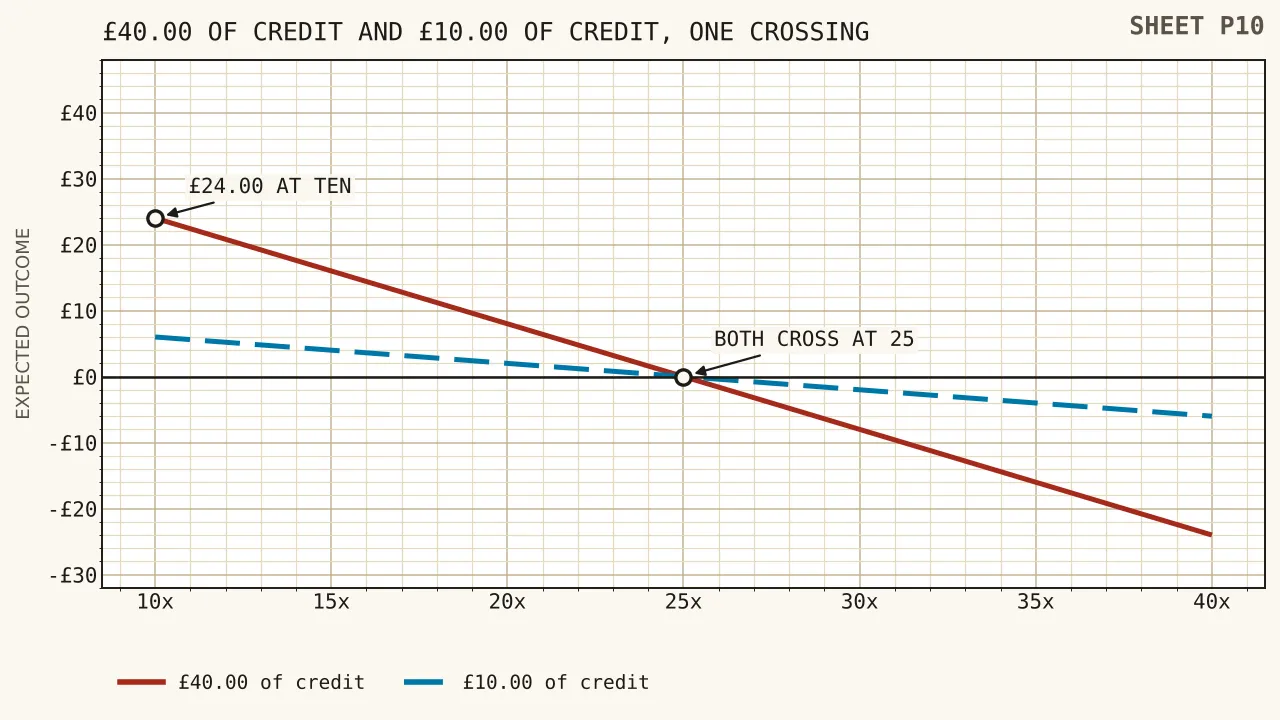
A quadrupling turns £10.00 into £40.00 of credit and £400.00 of obligation at a ten times demand. Keep the demand at ten and £24.00 is the expected end of it. Push it to forty and the same offer is £24.00 under water. No headline in this corner of the market rises faster, and none falls faster once the crossing is passed.
Paid in £10.00 One cycle 10p Comes to £24.00 where ten turnovers are asked
What a quadrupled credit comes to
Every destination on this board is bought advertising. The site takes a fee if a reader goes on to register, and no figure printed below moves because of it.
The Spin Count
Gauge No 01
Betportal
Lowest multiple here
Priced at this site's own 10p a spin
What is counted
What is asked
No Great Britain licence
Licensed in Anjouan, Comoros, run by BetPortal Gaming Ltd, with Excite Ultra Media Ltd, reference ALSI-202601040-FI2.
Terms read 16 October 2026
Open the offer at Betportal, opens in a new tabThe Spin Count
Gauge No 02
WinBeast
Largest count here
Priced at this site's own 10p a spin
What is counted
What is asked
No Great Britain licence
Licensed in Curaçao, operator not named on the site.
Terms read 16 October 2026
Open the offer at WinBeast, opens in a new tabThe Spin Count
Gauge No 03
EliteSpin
Longest spin window
Priced at this site's own 10p a spin
What is counted
What is asked
No Great Britain licence
Licensed in Costa Rica, run by PrimeTier Limited.
Terms read 16 October 2026
Open the offer at EliteSpin, opens in a new tabThe Spin Count
Gauge No 04
Crown Jewelz
Multiple unpublished
No foot figure struck
What is counted
What is asked
No Great Britain licence
Licensed in Curaçao, number not verified, operator not named on the site.
Terms read 16 October 2026
Open the offer at Crown Jewelz, opens in a new tabThe figure in the third register is this site's own arithmetic and nothing an operator has published: the count at face, less the share a spin gives back at 96 per cent return to player, less what playing the wagering through costs at the same return. It describes the offer, not one reader's afternoon. Where the conditions price above the count the counter prints nothing rather than a negative sum, and where a figure the sum needs is unpublished it prints the condition in the operator's words instead.
A count has no unit of its own, so one is supplied. Where an operator publishes what a spin of its own is worth, that figure stands in the second register and is labelled as theirs. Where it does not, the second register carries this site's own 10p a spin and says so, and the foot figure moves in proportion: at half the price, half the money. The figure after it, what the count comes to for each spin, is the one that compares a large count against a small one.
Three words stand in the amount column where no figure can. Noted is a published condition that takes value away without leaving the sum a figure to take. Unpriced is a condition whose figure nobody has published, or a credit that is not a sum until a deposit of your own sets it. Own money is money of yours, which is never part of a foot figure.
Not one of the operators printed above holds a Great Britain licence, so the duties that licence carries do not reach them. Every online gambling company licensed in Great Britain has to be part of Gamstop Online, and a reader who has shut themselves out through the scheme is therefore not shut out here. The ceiling of ten times the bonus funds on a wagering requirement, in force since 19 January 2026, is a condition of that licence and binds the companies that hold one. Where a dispute goes instead is a matter for the authority named on the counter, and the Gambling Commission describes what a reader faces without a British licence as a lack of recourse if things go wrong. Nobody under 18 may hold an account at any of them.
Every term printed on a counter is the operator's own, and each counter carries the day it was read. The oldest of those readings is 16 October 2026. What binds a reader is the operator's own full terms, and not a line printed here.
1
Four pounds on a tenner
Four hundred per cent is the largest headline this part of the market prints with any regularity, and it does one thing: it multiplies a small payment into a credit four times its size. A £10.00 payment produces £40.00 of bonus funds. The balance shows £50.00, and four fifths of that total is money with a condition written against it.
The declared figures behind every line here: a cycle of a slot costs 10p, the long-run return on money put through is 96 per cent, and £1 staked counts as £1 against a requirement unless a sentence says otherwise. Nothing published fixes any of them, and the first is a commercial decision belonging to whoever wrote the offer.
Per pound paid in, a quadrupling at a ten times demand is expected to return £2.40. That is the largest per-pound figure in this section, and it is the reason these offers get clicked. The other half of the sentence is that the same offer at a forty times demand is expected to cost £2.40 for each pound paid in, which is the largest loss in the section too.
So a quadrupling is a leveraged bet on one number in the terms. Everything else, the cap, the clock, the eligible games, moves the answer by pennies. The multiple moves it by pounds and decides its sign.
A small payment is what makes this headline work on paper. At £10.00 in, a quadrupling produces the same £40.00 of credit that a £40.00 payment would earn from a 100 per cent offer, and the reader has £30.00 less of their own money at stake. The obligation is identical at £400.00 through the reels. What differs is how much of the reader’s own money is in the room.
2
The fall after the crossing
Ten turnovers of £40.00 asks £400.00 through the reels. With 4 per cent as the edge, £16.00 is the expected cost of that staking, and £24.00 of the credit is what remains. Every further turnover takes £1.60 more, which is 4 per cent of £40.00, and fifteen of them take the whole £24.00 that was left.
| Demand in the terms | Through the reels | Cycles at 10p | Floor on the time | Expected end |
|---|---|---|---|---|
| 10 turnovers | £400.00 | 4,000 cycles | 2 h 46 m 40 s | £24.00 |
| 15 turnovers | £600.00 | 6,000 cycles | 4 h 10 m | £16.00 |
| 20 turnovers | £800.00 | 8,000 cycles | 5 h 33 m 20 s | £8.00 |
| 25 turnovers | £1,000.00 | 10,000 cycles | 6 h 56 m 40 s | nothing |
| 40 turnovers | £1,600.00 | 16,000 cycles | 11 h 6 m 40 s | short by £24.00 |
The slope of that last column is the page in one object. Each turnover between 10 and 25 removes £1.60 of expectation, and the removal does not stop politely at nought. Fifteen turnovers past the crossing are expected to take £24.00 of the reader’s own £10.00 payment and then £14.00 more, which is where the shortfall figure comes from.
Turn the table round and it answers a different question: how large a demand can a reader accept before the offer stops paying? Each turnover costs £1.60 of expectation, so from £24.00 at ten turnovers the budget runs to fifteen more turnovers exactly. A reader shown a 24 times condition on a quadrupling is being offered £1.60 of expectation for £960.00 of turnover and 9,600 cycles, which is 6 hours 40 minutes at the licensed floor pace. The same reader shown a 26 times condition is being offered a loss.
Compare the same demand against a smaller headline and the leverage shows. On the same £10.00 payment, a 100 per cent offer is expected to leave £6.00 at ten turnovers and to be £6.00 short at forty. The quadrupling is four times both figures. Four times the gain, four times the loss, one crossing shared between them.
16,000 cycles at 10p, eleven hours and six minutes of pressing
3
Why 400 cannot move 25
A crossing belongs to the game rather than to the offer. Each pound through the game loses 4p to the edge, which makes the 25th pass the one that has taken a full 100p for every pound that set out. Whatever balance was being cleared is expected to be empty by then, whether it was £5.00 or £5,000.00.
Which is why the headline cannot buy its way out. A quadrupling at 30 turnovers is £1,200.00 through the reels on £40.00 of credit, an expected cost of £48.00, and £8.00 of shortfall. A doubling at 30 turnovers on the same payment is £600.00 through the reels, £24.00 of cost, £4.00 of shortfall. Both are negative. The larger one is more negative.
| Return the game pays | Edge per pound | Turnovers that empty it |
|---|---|---|
| 98 per cent | 2p | 50 turnovers |
| 96 per cent | 4p | 25 turnovers |
| 95 per cent | 5p | 20 turnovers |
| 92 per cent | 8p | 12.5 turnovers |
| 90 per cent | 10p | 10 turnovers |
Four kinds of information satisfy the duty to tell a customer about their chances before they commit, and an “or” joins them: the margin, the return percentage, the probability of winning events, or an account of the workings and the way prizes get allocated. A reader after the row that applies to them may therefore find a house edge printed where they expected a return, and the two are the same fact in different clothes.
That bottom row earns a sentence of its own wherever big headlines are discussed. Where the eligible game pays 90 per cent, a ten times demand is at the crossing already, and a quadrupling cleared on such a game is expected to end at nothing. The percentage on the banner is then decoration, and the figure that mattered was never printed beside it.
4
What borrowing would add
A quadrupling is aimed at a small payment, which is exactly the payment somebody might put on a card. One rule closes that off at a licensed cashier, and it is worth pricing rather than quoting. A credit card buys no gambling at a licensed cashier, and routing it through a money transfer business changes nothing; 14 April 2020 is the date.
Price what the rule prevents. At a ten times demand, £10.00 paid in is expected to return £24.00 of credit value, so borrowing at any rate under that leaves something. At twenty-five turnovers the expected return is nought, and any interest at all on the £10.00 makes the whole exercise negative by exactly the interest. At forty turnovers the offer is already £24.00 down before a penny of borrowing cost is added.
The reach of the prohibition is worth stating precisely, because its edges are where readers get confused. Inside it sit every remote licence, ancillary remote betting and lottery included, together with three non-remote ones: general betting, pool betting, betting intermediary. Left outside are the technical, the software and the host licences, which take no customer payments in any case.
A bank’s own gambling block belongs in the same paragraph, for a different reason. It is a protection a reader can switch on, in the same family as the national self-exclusion scheme and blocking software, and nothing on this page will help anybody step around one. Where a block stands between a reader and a £10.00 payment, the block is doing the job it was asked to do.
The arithmetic reason to take a block seriously sits in the table two sections up. A quadrupling at forty turnovers is expected to cost £24.00 on a £10.00 payment, which is to say the offer is expected to take back two and a half times what the reader put in. An offer with that shape does not need a credit card to be a bad trade; the card only enlarges it.
5
The cap, and the tenner that fills it
A quadrupling reaches its advertised ceiling faster than any other headline here, because the coefficient is four. Against a £40.00 maximum credit, a £10.00 payment fills it exactly. Every pound after that buys no credit at all, so the rate in truth falls away immediately.
| Payment | Credit against it | Rate in truth | Value per pound in at 10 |
|---|---|---|---|
| £5.00 | £20.00 of credit | the full 400 per cent | 240p a pound |
| £10.00 | £40.00 of credit | still the full rate | 240p a pound |
| £20.00 | £40.00 of credit | 200 per cent | 120p a pound |
| £40.00 | £40.00 of credit | a straight match | 60p a pound |
| £100.00 | £40.00 of credit | 40 per cent | 24p a pound |
The reading is unusually blunt on a headline this large. Value per pound in peaks at the payment that exactly fills the cap, and every pound after that makes the offer worse than a plain match would have been. A £100.00 payment against a £40.00 ceiling is a 40 per cent match carrying the same £400.00 obligation.
A separate ceiling can be written against the winnings rather than the credit, and on an offer of this size it is the term that most often decides the answer. Where the conversion is held at £50.00, the entire exercise is worth at most £50.00 however the reader runs. One balance stays open whatever the other one does: the £10.00 payment can be withdrawn at a licensed cashier even while a conversion ceiling holds the credit.
Run the conversion cap against the count and it yields a turnover of its own. At 10p a cycle and a 96 per cent return, each cycle adds 9.6p to the expectation, so a £50.00 ceiling is reached on average after 521 cycles of pure winnings. Under that count the ceiling stands clear of the mean and bites only where a run goes well. Above it the cap is doing the deciding, and further cycles add nothing whatever to what can leave.
No primary source gives a usual figure for a conversion cap, so £50.00 there is an illustration rather than a report. What is published is the prohibition on the other side: no term may cap a withdrawal out of the deposit balance, and the banned drafting is illustrated by a clause holding a day to £50 and a week to £500.
6
Eleven hours, at the pace a licence allows
The obligation behind a quadrupling is the figure nobody converts into time, and on a £40.00 credit at forty turnovers the conversion is startling. £1,600.00 through the reels at 10p a cycle is 16,000 cycles. Allow 2.5 seconds from the start of a cycle to the start of its successor and 16,000 of them occupy 11 hours 6 minutes and 40 seconds of deliberate pressing.
Nothing on a licensed site shortens that. Out go automatic play and the features that cut the time to a result, which leaves the floor pace standing as the real one. Two games at once is out as well, so the 16,000 cycles cannot be split across two screens to halve the clock.
| Stake a cycle | Cycles needed | Floor on the time | Expected cost |
|---|---|---|---|
| 10p a cycle | 16,000 cycles | 11 h 6 m 40 s | £64.00 |
| 50p a cycle | 3,200 cycles | 2 h 13 m 20 s | £64.00 |
| £5.00 a cycle | 320 cycles | 13 m 20 s | £64.00 |
The last column is the point of the table. Multiply the stake by fifty and the clock divides by fifty while the expected cost sits still, the edge being attached to turnover rather than to hours. The spread of outcomes is what rises with the stake, and 320 cycles is a far rougher ride than 16,000 in both directions.
A slot cycle carries a £5 stake cap, cut to £2 below the age of 25, and reels are the only games either figure touches. So the bottom row of that table is the fastest a licensed slot can legally deliver a £1,600.00 obligation, and a reader under 25 is held to twice as many cycles as the row above shows.
7
Where headlines this size live
A British licence caps a turnover demand at 10, so the headline a reader meets at 400 per cent with a thirty or forty times condition is coming from a cashier outside the British licence. That is not an insinuation, it is arithmetic about which terms are available where.
The regulated maximum on bonus funds has stood at ten turnovers since 19 January 2026, while 25 is the multiple that would eat a credit whole. Against the £40.00 credit here, the ceiling means £400.00 through the reels at worst and £24.00 of expectation surviving. The offshore rulebook readable from here carries no ceiling of that kind.
The duties that stop at the border, priced against this page: no ceiling on the demand, so £1,600.00 of staking is available where £400.00 is the British maximum; no stake cap, so a cycle need not be held to £5 or to £2 under 25; no floor under the pace, so 16,000 cycles need not take 11 hours; no verification before play, so the £40.00 may land on an unchecked account; no refusal of a credit card, so the £10.00 may be borrowed; no limit put up at the first payment; nothing to stop the deposit balance being fenced in; no 8-week clock on a complaint and no approved adjudicator waiting; and no membership anywhere of a national scheme for self-exclusion.
What the offshore book does contain is worth knowing, because a page that calls it nothing is wrong. The Curaçao policy, version 1.0 of February 2025, does require things: age checks, player self-assessments, behaviour tracking, a cooling-off period reachable on one click, deposit limits where an increase is held for 7 days, and training for affiliates and marketing partners. On bonuses that book manages two lines: terms set out transparently, and no promotion aggressive enough to drive gambling to excess.
Two facts about the games belong here as well. Recognising the studio behind a game tells a reader nothing about the cashier it is running on. And £4.75m is what one supplier paid after six unlicensed sites within reach of consumers here were found carrying its games, which is the published evidence that familiar reels and a licence are separate questions.
8
What the tenner actually buys
Totted up, a quadrupling on a £10.00 payment buys one of three things, and the terms decide which. At the British ceiling it buys £24.00 of expectation for £400.00 of turnover and 2 hours 46 minutes of pressing. At twenty-five turnovers it buys nothing for £1,000.00 of turnover and nearly seven hours. At forty it buys a £24.00 loss for £1,600.00 of turnover and over eleven hours.
| Terms the reader meets | Turnover owed | Time at the floor | Expected result |
|---|---|---|---|
| A demand of 10, the British ceiling | £400.00 | 2 h 46 m 40 s | £24.00 kept |
| A demand of 25, the crossing | £1,000.00 | 6 h 56 m 40 s | nothing kept |
| A demand of 40, available offshore | £1,600.00 | 11 h 6 m 40 s | £24.00 lost |
The check that tells a reader which row they are standing in takes a minute. Start from the licensed status printed on the site, go through to the public register, and check the activities and the domain names against what the site claims. The register carries no date and no instructions for reading it, so note the day you looked.
Players are also told to look out for restrictions attached to an introductory offer, the published example being a spend level demanded before any bonus is paid. On a quadrupling that restriction is the turnover demand, and the difference between the top row of that table and the bottom one is the whole value of the offer.
One further line belongs in the total, and it needs no arithmetic from the reader at all. A limit set at the desk caps the exercise before the terms get their turn. Setting one is the default at a licensed site. Refusing takes an act, then a confirmation. Reductions land at once. An increase is held for 24 hours and then wants confirming. At 10p a cycle a £10 day is 100 cycles of stake. That is this page’s whole payment, and 2 per cent of what a forty times demand would ask for.
Tax does not move with the licence. Operator profit on remote gaming carries duty at 40 per cent, a figure that dates from April 2026, and the cashier’s address does not change it. So what a reader gains by taking a quadrupling from beyond the register is the larger multiple, and the larger multiple is the part that costs them.
Questions
- What does a 400% deposit bonus come to on a £10.00 payment?
- £24.00 of expectation where ten turnovers are asked, £8.00 at twenty, nothing at twenty-five, and a loss of £24.00 at forty. Per pound paid in those figures are £2.40, 80p, nought, and £2.40 against the reader. They assume a 10p cycle, a 96 per cent return and full weighting, all three declared rather than sourced.
- Does the big headline change the break-even multiple?
- No. Twenty-five comes from the 4 per cent edge: 4p taken 25 times is 100p, so the 25th pass is expected to have consumed whatever was being cleared. A quadrupling and a doubling cross nought at the same place and differ only in the distance they travel either side of it.
- How long does the wagering take?
- At the British ceiling of ten turnovers, £400.00 through the reels is 4,000 cycles at 10p, which is 2 hours 46 minutes and 40 seconds with 2.5 seconds between cycles. At forty turnovers it is £1,600.00, 16,000 cycles and 11 hours 6 minutes and 40 seconds. A licensed site sells nothing automatic and nothing that cuts a result short.
- Why does paying in more than £10.00 make it worse?
- Because a £40.00 maximum credit is filled exactly by a £10.00 payment at this coefficient. A £20.00 payment earns the same £40.00, 200 per cent in truth, and a £100.00 payment earns 40 per cent. At a ten times demand those three are worth 240p, 120p and 24p for each pound paid in.
- Can I fund the deposit with a credit card?
- Not where the cashier holds a British licence. Credit cards are refused for gambling payments there, money transfer routes included, under a rule dated 14 April 2020. The arithmetic reason is in the table above: at twenty-five turnovers the expected return is nought, so any interest at all makes the exercise negative by the interest.
- How large a demand may a British licensed cashier make?
- Ten turnovers of the bonus funds, a position that has held since 19 January 2026. On £40.00 of credit that caps the turnover at £400.00 and leaves £24.00 of expectation. A thirty or forty times condition attached to a 400 per cent headline is therefore coming from outside the British licence.
- Can the winnings be capped?
- A conversion cap on bonus winnings is not prohibited, and where one is set at £50.00 the whole exercise is worth no more than £50.00. The deposit balance is a different matter: a term capping withdrawals from it is not allowed, and the specimen of banned drafting holds a day to £50 and a week to £500. No usual figure for a conversion cap is published anywhere citable.
- Is a familiar slot a sign the cashier is licensed?
- No. Recognising a studio is not recognising a licence. One supplier paid £4.75m over games of its own found on six unlicensed sites within reach of consumers here. What works instead is the register, in three steps: the status on the site, the link through to the register, then the domain names compared.
- What exactly is lost at a cashier outside the British licence?
- Ten as the ceiling on a demand. A £5 stake on a cycle, or £2 for the under-25s. The 2.5 second floor. Verification first. No card borrowing. A limit put up at the desk. A deposit balance that cannot be fenced in. Eight weeks to an answer, then an approved adjudicator. And a registration in the single national scheme for self-exclusion. Duty reaches the operator regardless, at 40 per cent of its profit, the charge being fixed by where a player ordinarily lives.