Sheet P09 Revision 1 Counted 16 October 2026
Deposit £10, get 100 free spins: ten spins to the pound
A hundred spins at 10p is £10.00 of funded stake, which is the same figure as the payment that unlocks it. On a 96 per cent game those spins are expected to hand back £9.60, so the count is worth 4 per cent less than the money paid to get it. Ten spins to the pound is the lowest rate this section has, and the arithmetic says why.
Spins for each pound in 10 One spin 10p Comes to 96p a pound
What a count of this size comes to
Every destination on this board is bought advertising. The site takes a fee if a reader goes on to register, and no figure printed below moves because of it.
The Spin Count
Gauge No 01
Betportal
Lowest multiple here
Priced at this site's own 10p a spin
What is counted
What is asked
No Great Britain licence
Licensed in Anjouan, Comoros, run by BetPortal Gaming Ltd, with Excite Ultra Media Ltd, reference ALSI-202601040-FI2.
Terms read 16 October 2026
Open the offer at Betportal, opens in a new tabThe Spin Count
Gauge No 02
WinBeast
Largest count here
Priced at this site's own 10p a spin
What is counted
What is asked
No Great Britain licence
Licensed in Curaçao, operator not named on the site.
Terms read 16 October 2026
Open the offer at WinBeast, opens in a new tabThe Spin Count
Gauge No 03
EliteSpin
Longest spin window
Priced at this site's own 10p a spin
What is counted
What is asked
No Great Britain licence
Licensed in Costa Rica, run by PrimeTier Limited.
Terms read 16 October 2026
Open the offer at EliteSpin, opens in a new tabThe Spin Count
Gauge No 04
Crown Jewelz
Multiple unpublished
No foot figure struck
What is counted
What is asked
No Great Britain licence
Licensed in Curaçao, number not verified, operator not named on the site.
Terms read 16 October 2026
Open the offer at Crown Jewelz, opens in a new tabThe figure in the third register is this site's own arithmetic and nothing an operator has published: the count at face, less the share a spin gives back at 96 per cent return to player, less what playing the wagering through costs at the same return. It describes the offer, not one reader's afternoon. Where the conditions price above the count the counter prints nothing rather than a negative sum, and where a figure the sum needs is unpublished it prints the condition in the operator's words instead.
A count has no unit of its own, so one is supplied. Where an operator publishes what a spin of its own is worth, that figure stands in the second register and is labelled as theirs. Where it does not, the second register carries this site's own 10p a spin and says so, and the foot figure moves in proportion: at half the price, half the money. The figure after it, what the count comes to for each spin, is the one that compares a large count against a small one.
Three words stand in the amount column where no figure can. Noted is a published condition that takes value away without leaving the sum a figure to take. Unpriced is a condition whose figure nobody has published, or a credit that is not a sum until a deposit of your own sets it. Own money is money of yours, which is never part of a foot figure.
Not one of the operators printed above holds a Great Britain licence, so the duties that licence carries do not reach them. Every online gambling company licensed in Great Britain has to be part of Gamstop Online, and a reader who has shut themselves out through the scheme is therefore not shut out here. The ceiling of ten times the bonus funds on a wagering requirement, in force since 19 January 2026, is a condition of that licence and binds the companies that hold one. Where a dispute goes instead is a matter for the authority named on the counter, and the Gambling Commission describes what a reader faces without a British licence as a lack of recourse if things go wrong. Nobody under 18 may hold an account at any of them.
Every term printed on a counter is the operator's own, and each counter carries the day it was read. The oldest of those readings is 16 October 2026. What binds a reader is the operator's own full terms, and not a line printed here.
1
Ten spins to the pound
The rate is the whole story on a page like this. A hundred spins against £10.00 paid in works out at ten spins for each pound, and at 10p a spin that is £1.00 of funded stake for every pound handed over. The count and the payment are the same figure.
They are not the same thing, though, and the gap is the house edge. A hundred spins carry £10.00 of stake, and at the return assumed here they are expected to give back £9.60. So the reader pays £10.00 of certain money for £9.60 of expected money, before a single condition is applied to the result.
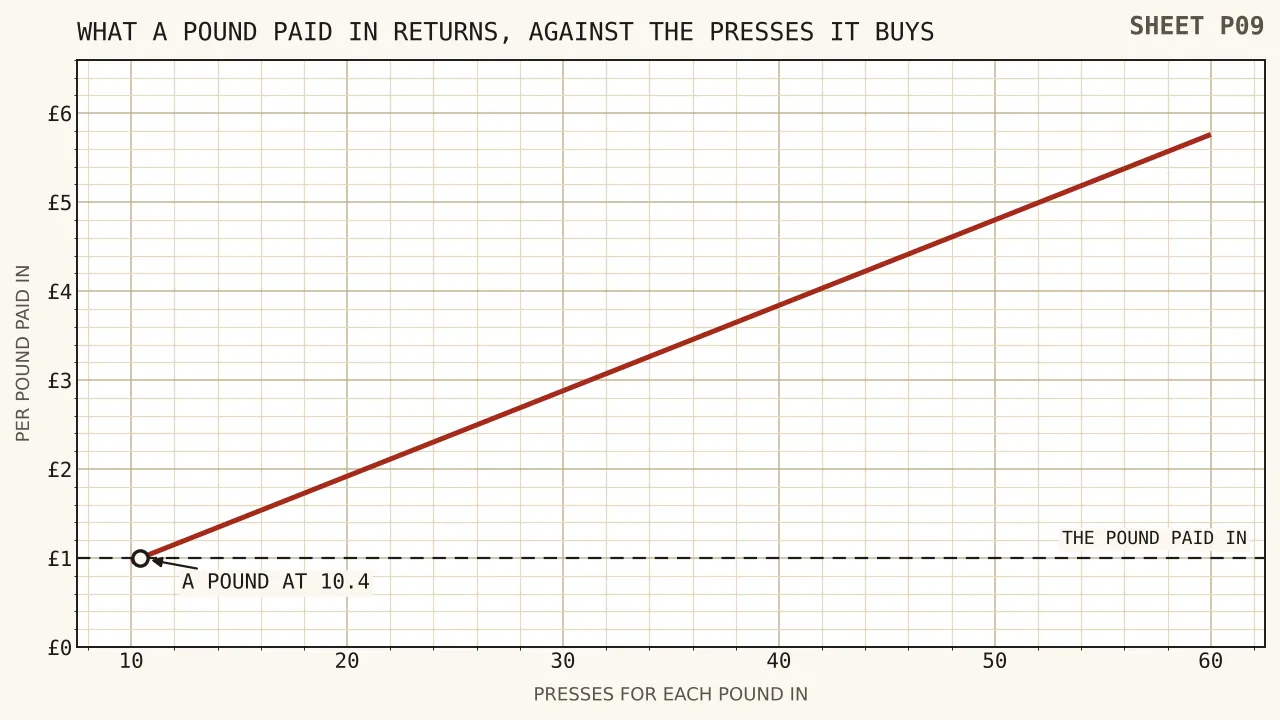
That makes this pairing the one place in the section where the arithmetic is negative at the outset. A count is usually worth a multiple of the payment: at twenty spins to the pound the expectation is £1.92 for each pound in, and at forty spins it is £3.84. At ten spins to the pound it is 96p, which is 4p short of the pound that bought it.
Two numbers hold all of that up and this site declares both. A spin is priced at 10p. Over the long run a slot gives back 96p in each pound. Nothing published fixes either figure, and no rule anywhere sets the cash value of one free spin, so a reader using a different spin price should scale every line here in proportion.
There is a second expected loss sitting beside the first, and keeping the two apart matters. The spins carry £10.00 of stake and are expected to cost the house 40p, which is 4 per cent of what it funded. The reader’s own £10.00, if it is also played through once at 10p a spin, is expected to cost the reader 40p on the same arithmetic. A reader who treats the payment as a stake rather than as a deposit is therefore looking at 80p of expected cost across 200 spins, not 40p.
The £10.00 is not lost by paying it in. It sits in a deposit balance, where a licensed cashier may not cap what comes out, so the reader who takes the spins and stops has handed over nothing permanently. What the arithmetic above prices is the trade itself: £10.00 committed, 100 spins received, £9.60 of expectation attached to them.
2
The rate against the rest of the section
Every offer of this shape reduces to a division: count over payment, multiplied by the 9.6p a spin carries. Doing it for the common pairings shows how wide the spread is, and how little the headline count tells a reader on its own.
| The pairing | Spins to the pound | Expected per pound in | Against the payment |
|---|---|---|---|
| £10.00 for 100 spins | 10 spins | 96p | 4p short of the pound |
| £20.00 for 300 spins | 15 spins | £1.44 | half again |
| £10.00 for 200 spins | 20 spins | £1.92 | nearly double |
| £10.00 for 300 spins | 30 spins | £2.88 | nearly treble |
| £5.00 for 200 spins | 40 spins | £3.84 | nearly four times |
| £5.00 for 300 spins | 60 spins | £5.76 | nearly six times |
The top row is this page and the bottom row is six times better. Both might be advertised with a three-figure count, and a reader comparing headlines alone would learn nothing from either. The division takes five seconds and settles it.
One honest qualification belongs with that table. A higher rate is not the same as a better offer, because the conditions attached to the winnings can take more than the rate gives. A count at 40 spins to the pound with a 25 times demand on the winnings is worth less than a count at 10 spins to the pound with none, and the next section prices that comparison properly.
3
Where the crossing actually is
There is a count at which an offer of this kind breaks even against the payment, and it is worth deriving once. Each spin carries 9.6p of expectation, so a payment of £10.00 is matched when the count reaches £10.00 divided by 9.6p, which is 104.2 spins. A hundred spins is just under it.
Scaled to the pound, the break-even rate is 10.42 spins for each pound paid in. Anything above that rate is expected to return more than the payment. Anything below it is expected to return less. A hundred spins on £10.00 sits at 10 spins to the pound, which is 4 per cent short.
| Payment | Count needed to match it | This page’s count |
|---|---|---|
| £5.00 | 52.1 spins | not applicable |
| £10.00 | 104.2 spins | 100 spins, just short |
| £15.00 | 156.3 spins | not applicable |
| £20.00 | 208.3 spins | not applicable |
| £25.00 | 260.4 spins | not applicable |
The shortfall is small and the point is not that a reader loses 40p. The point is the direction of travel: at this rate the count does not pay for the payment, so everything printed after the headline can only make the position worse. On a count at 40 spins to the pound there is £2.84 of room above the payment for conditions to eat into before the offer turns negative. Here there is none.
Run it backwards and it answers the other question too: at what spin price would a hundred spins match a £10.00 payment? The count has to carry £10.00 of expectation, so the stake behind each spin must be £10.00 divided by 100 and then by 0.96, which is 10.42p. A count advertised at 100 spins is therefore worth the payment only where each spin is worth slightly more than 10p, and no rule obliges anybody to print the spin value at all. Where the terms name a figure of 20p a spin, the same hundred spins carry £19.20 of expectation and the whole page doubles.
104.2 spins to match £10.00 at 9.6p a spin
4
Four minutes and ten seconds
A hundred spins has a floor under its running time. On a licensed slot the gap from one cycle opening to the next is 2.5 seconds at least. That makes the count 250 seconds of button work, which is 4 minutes and 10 seconds, and no software on a licensed site will shorten it.
Three separate rules hold that floor in place, and each of them is a thing an offshore cashier need not observe. Online gaming carries no permission for automatic play, so each cycle takes a deliberate act. Nor is there permission for functionality that shortens the wait for a result, with turbo and slam stop named in the guidance. And the system may not offer a way to play two games at once.
Four minutes is not a cost worth weighing. The reason to know the figure is the comparison it enables, because a wagering demand on the winnings is measured in the same unit and lands in a different order of magnitude entirely. Put ten turnovers against the expected £9.60 and £96.00 of staking appears, or 960 spins, or 40 minutes at the same floor pace.
| What is being counted | Spins | Time at the floor pace |
|---|---|---|
| The offer itself | 100 spins | 4 m 10 s |
| Ten turnovers of the winnings | 960 spins | 40 m |
| Twenty turnovers of the winnings | 1,920 spins | 1 h 20 m |
| Forty turnovers of the winnings | 3,840 spins | 2 h 40 m |
A clock printed against the spins is therefore generous by construction and a clock printed against a wagering demand may not be. A 24-hour window leaves 1,436 minutes spare on the first row of that table and 1,276 on the last, which sounds comfortable until a reader notices that the last row wants two hours and forty minutes of uninterrupted pressing.
5
What a demand on the winnings does
The spins themselves cannot carry a wagering demand, since somebody has already paid for them. Their winnings can. Where those winnings land in a bonus balance, the demand runs against the £9.60 this count is expected to produce, and the arithmetic is the same multiplication as any deposit match.
Take the demand, multiply by the 4 per cent edge, subtract from one, and apply the remainder to the balance. Ten turnovers keeps £5.76. Fifteen keeps £3.84. Twenty keeps £1.92. Twenty-five keeps nothing at all, and forty is expected to cost £5.76 more than the balance ever held.
| Turnovers asked | Staking it owes | Spins it needs | Expected cost | Surviving |
|---|---|---|---|---|
| None | none | none | nothing | £9.60 |
| 10 turnovers | £96.00 | 960 spins | £3.84 | £5.76 |
| 15 turnovers | £144.00 | 1,440 spins | £5.76 | £3.84 |
| 20 turnovers | £192.00 | 1,920 spins | £7.68 | £1.92 |
| 25 turnovers | £240.00 | 2,400 spins | £9.60 | nothing |
| 40 turnovers | £384.00 | 3,840 spins | £15.36 | short by £5.76 |
Ten turnovers is where a licensed demand on bonus funds halts, a position carrying the date 19 January 2026. For this offer the effect is plain. A licensed cashier can push the winnings no further than the second row, which leaves £5.76 of the £9.60. The last row is available only where no such ceiling applies.
Weighting moves those rows without moving the headline. Where the eligible game counts at 30p in the pound, the £96.00 of contribution a ten times demand asks for takes £320.00 of actual staking, which is 3,200 spins and an expected cost of £12.80. Against winnings of £9.60 that is a shortfall of £3.20, from a demand the terms still print as ten. That 30p rate reached the record through respondents to the consultation, and no up-to-date contribution table is published anywhere this site may cite.
Whether a spin counts as bonus funds for that ceiling has not been published at all. The published chain runs this far and no further: once a spin’s winnings are sitting in a bonus balance, ten turnovers is the most that may be demanded of them. A page that says the ceiling covers spins, or that it does not, is filling a gap the sources leave open.
6
A ceiling that lands on this exact count
Divide a maximum win by the 9.6p one spin carries. What comes out is the count where that ceiling starts to do the deciding. For a £10.00 ceiling the answer is 104.2 spins, which is this offer almost exactly. A hundred spins under a £10.00 ceiling is an offer where the cap and the mean are the same figure.
That coincidence is worth a sentence because it makes the cap look harmless and it is not. A ceiling at the mean removes the whole of the upper half of the distribution while leaving the lower half untouched. The expectation drops below £9.60 the moment such a cap is printed, even though the headline count has not changed and nothing in the terms looks unreasonable.
| Ceiling in the terms | Count where it starts to decide | Effect on 100 spins |
|---|---|---|
| £5.00 | 52.1 spins | decides the answer well before the end |
| £10.00 | 104.2 spins | sits exactly on the mean |
| £20.00 | 208.3 spins | clear of the mean, bites on a good run |
| £50.00 | 520.8 spins | irrelevant at this count |
The floor works the other way and is easier to see. Where terms set a smallest withdrawal of £20.00, the £9.60 expected here is less than half of it, so the average outcome is a balance that cannot be moved at all. Clearing that floor takes 2.08 times the mean, which is a good run rather than an ordinary one.
Variance deserves one line of its own, because a hundred spins is a small sample. The £9.60 is the centre of a wide distribution on a high-variance game, and ordinary outcomes run from nothing at all to several times the mean. The arithmetic settles where the centre sits and says nothing about where a session lands, and which side of the centre a reader finishes on is not knowable here.
Neither of those is prohibited. What is prohibited is a cap on withdrawals from the deposit balance, which is a different balance and a different rule. The £10.00 paid in to claim the spins is not touched by a cap on bonus winnings, and a reader meeting both in one document is reading two rules rather than a contradiction.
7
After the spins, the marketing
An offer of this kind buys the cashier something the arithmetic does not show: a verified customer with a payment history. Two published rules govern what happens next, and both are worth knowing before the £10.00 goes across.
For online gambling, a licensed operator needs an opt-in to direct marketing taken product by product and channel by channel, a requirement effective from 1 May 2025. The date moved during the process: it had been set for 17 January 2025 and was changed, which is why a page should never attach the January date to this rule.
The code provision on the subject also wants consent that is informed and specific before direct electronic marketing goes anywhere, unless the law expressly permits otherwise. So a reader who takes 100 spins and wants nothing further can decline the marketing without declining the offer, and a licensed cashier has to respect the split by product and by channel.
A limit is the third thing, and on a £10.00 offer it is the one that binds first. The offer of a financial limit comes at registration or at the first payment, set as the default choice, and declining it takes a positive act. Priced in spins, a £10 daily limit is exactly 100 spins of the reader’s own stake, which is the same count the offer hands over. Where a daily figure and a weekly figure are both set, the tighter one governs, so £10 a day beneath £100 a week leaves £70 for the week and 700 spins of stake.
The second rule is about what a product may do to a customer who has stopped. Four things lie outside what a gambling product may actively encourage: chasing a loss, lifting a stake, lifting the sum a customer had settled on, and playing on after they have said they wish to stop. Tempting back a customer who has chosen to go is what the guidance warns against, and the temptation it names by example is a free game. An offer of spins is precisely that sort of temptation, and at a licensed site it has to stop where the customer stopped.
Real-time information is a third thing a licence buys, and 17 January 2025 is when it arrived. A licensed operator puts the net spend and the time played in front of the customer as they go. On this offer that means the £10.00 and the four minutes are both on screen while they happen, rather than reconstructed afterwards from a statement.
8
The same hundred spins, unlicensed
Offers pairing a small payment with a three-figure count are staple advertising at cashiers that operate outside the British licence. The presses are identical. The rules standing around them are not, and the table prices each absence against the figures on this page.
| Required of a licence holder | Worth on this offer |
|---|---|
| A demand on bonus funds held to ten turnovers | £5.76 of the £9.60 survives rather than nothing at 25 |
| One product type to one incentive | spins ride with a casino credit, tickets would not |
| A cycle no quicker than 2.5 seconds | 100 spins take 4 m 10 s and cannot be hurried |
| No autoplay, no turbo, no slam stop | each of the hundred is a separate act |
| A stake ceiling of £5 a cycle, £2 under 25 | a demand cannot be cleared in a handful of huge spins |
| Verification before any play at all | the spins cannot land on an unchecked account |
| Marketing opted into by product and channel | the £10.00 does not buy a licence to email |
| Net spend and time shown while playing | the £10.00 and the 4 m 10 s are visible as they go |
| A deposit balance beyond the reach of a cap | the £10.00 paid in remains the reader’s |
| A complaint shut within eight weeks | and an adjudicator from the approved eight after that |
No ceiling on a turnover demand appears in the offshore rulebook readable from here, which makes the last row of the demand table two sections up a live possibility and not a hypothetical. Forty turnovers on £9.60 of winnings is 3,840 spins of staking and an expected shortfall of £5.76.
One protection a reader can use regardless deserves the final word. The national self-exclusion scheme is drawn around the British licence, so a single registration shuts every licensed cashier and nothing outside. That boundary is the scheme’s own published limit, and it is the reason an offer arriving from beyond the register deserves more suspicion than a generous headline usually gets.
Questions
- What are 100 free spins worth on a £10 deposit?
- £10.00 of funded stake and £9.60 of expectation, at 10p a spin on a game returning 96 per cent. Per pound paid in that is ten spins and 96p, which is 4p short of the pound that bought them. Both assumptions are declared on this sheet rather than drawn from any rule.
- Is ten spins to the pound a good rate?
- It is the lowest rate in this part of the market. Twenty spins to the pound returns £1.92 for each pound in, thirty returns £2.88 and forty returns £3.84. The break-even rate is 10.42 spins to the pound, so this pairing sits just below the line where a count pays for the payment that unlocked it.
- How many spins would match a £10 payment exactly?
- 104.2 of them, because each spin carries 9.6p of expectation and £10.00 divided by 9.6p is 104.2. A hundred spins is 4 per cent short of that. At other payments the figure scales: 52.1 spins for £5.00, 208.3 for £20.00, 260.4 for £25.00.
- How long does the count take to use?
- Four minutes and ten seconds at the floor pace, the gap between licensed cycles being 2.5 seconds at the shortest. Barred: autoplay, any feature that shortens a result, and two games at once. Nothing on a licensed site brings that figure down.
- What does a wagering demand on the winnings cost?
- It runs against the £9.60, not against the count. Ten turnovers leaves £5.76 standing, twenty leaves £1.92, twenty-five leaves nought, and forty is expected to take £5.76 beyond what the balance ever held. Ten turnovers is also £96.00 of staking, which is 960 spins and about 40 minutes of pressing.
- Why does a £10 maximum win matter so much here?
- Because a £10.00 ceiling starts to decide the answer at 104.2 spins, which is this offer almost exactly. A cap sitting on the mean removes the upper half of the distribution and leaves the lower half alone, so the expectation falls below £9.60 while the headline count stays where it was.
- Can I withdraw the £10 I paid in?
- A licensed cashier caps nothing on the way out of a deposit balance, so the payment itself stays reachable. A ceiling on converting bonus winnings belongs to another balance and falls outside that rule, so one document may cap the conversion and still leave the deposit untouched.
- What happens to my details after I claim?
- A licensed operator needs an opt-in taken product by product and channel by channel before marketing to anybody directly, which has been the position since 1 May 2025. The date had been set for 17 January 2025 and was moved, so the January date does not belong to this rule. Consent for direct electronic marketing also has to be informed and specific unless the law expressly permits otherwise.
- What is different at a cashier without a British licence?
- No ceiling on the demand against the winnings, so forty turnovers is possible and £9.60 of expectation becomes a £5.76 shortfall. No verification before play, no 2.5 second cycle, no bans on autoplay or slam stop, no stake ceiling, no opt-in on marketing, no net spend on screen, no protection for the deposit balance, no eight-week complaint and no approved adjudicator. Nor does the national self-exclusion scheme reach it, the licence being what draws that boundary.