Sheet P08 Revision 1 Counted 16 October 2026
200% deposit bonus: two pounds of credit, and the work behind them
Two pounds of credit arrive for each pound paid in, and £20.00 of turnover arrives with them at a ten times demand. Pay £30.00, hold £60.00 of credit, clear it at 10 turnovers and £36.00 is left. Clear it at 25 and nothing is. This sheet works the ladder from the payment up, because the payment is the only part the reader owns.
Paid in £30.00 One spin 10p Comes to £36.00 once 10 turnovers are done
What a doubled credit comes to
Every destination on this board is bought advertising. The site takes a fee if a reader goes on to register, and no figure printed below moves because of it.
The Spin Count
Gauge No 01
Betportal
Lowest multiple here
Priced at this site's own 10p a spin
What is counted
What is asked
No Great Britain licence
Licensed in Anjouan, Comoros, run by BetPortal Gaming Ltd, with Excite Ultra Media Ltd, reference ALSI-202601040-FI2.
Terms read 16 October 2026
Open the offer at Betportal, opens in a new tabThe Spin Count
Gauge No 02
WinBeast
Largest count here
Priced at this site's own 10p a spin
What is counted
What is asked
No Great Britain licence
Licensed in Curaçao, operator not named on the site.
Terms read 16 October 2026
Open the offer at WinBeast, opens in a new tabThe Spin Count
Gauge No 03
EliteSpin
Longest spin window
Priced at this site's own 10p a spin
What is counted
What is asked
No Great Britain licence
Licensed in Costa Rica, run by PrimeTier Limited.
Terms read 16 October 2026
Open the offer at EliteSpin, opens in a new tabThe Spin Count
Gauge No 04
Crown Jewelz
Multiple unpublished
No foot figure struck
What is counted
What is asked
No Great Britain licence
Licensed in Curaçao, number not verified, operator not named on the site.
Terms read 16 October 2026
Open the offer at Crown Jewelz, opens in a new tabThe figure in the third register is this site's own arithmetic and nothing an operator has published: the count at face, less the share a spin gives back at 96 per cent return to player, less what playing the wagering through costs at the same return. It describes the offer, not one reader's afternoon. Where the conditions price above the count the counter prints nothing rather than a negative sum, and where a figure the sum needs is unpublished it prints the condition in the operator's words instead.
A count has no unit of its own, so one is supplied. Where an operator publishes what a spin of its own is worth, that figure stands in the second register and is labelled as theirs. Where it does not, the second register carries this site's own 10p a spin and says so, and the foot figure moves in proportion: at half the price, half the money. The figure after it, what the count comes to for each spin, is the one that compares a large count against a small one.
Three words stand in the amount column where no figure can. Noted is a published condition that takes value away without leaving the sum a figure to take. Unpriced is a condition whose figure nobody has published, or a credit that is not a sum until a deposit of your own sets it. Own money is money of yours, which is never part of a foot figure.
Not one of the operators printed above holds a Great Britain licence, so the duties that licence carries do not reach them. Every online gambling company licensed in Great Britain has to be part of Gamstop Online, and a reader who has shut themselves out through the scheme is therefore not shut out here. The ceiling of ten times the bonus funds on a wagering requirement, in force since 19 January 2026, is a condition of that licence and binds the companies that hold one. Where a dispute goes instead is a matter for the authority named on the counter, and the Gambling Commission describes what a reader faces without a British licence as a lack of recourse if things go wrong. Nobody under 18 may hold an account at any of them.
Every term printed on a counter is the operator's own, and each counter carries the day it was read. The oldest of those readings is 16 October 2026. What binds a reader is the operator's own full terms, and not a line printed here.
1
Two pounds for one
A 200 per cent offer gives the reader twice their payment as bonus funds, which means two thirds of the balance on the screen belongs to the cashier until a condition is met. Pay £30.00 and £60.00 of credit lands. The total reads £90.00. Only £30.00 of it could be withdrawn that afternoon.
Assumptions, stated once for the whole page: 10p buys a spin, 96 per cent of what goes through a slot comes back, and weighting counts at face unless a line says otherwise. No published source sets any of the three, and the first of them is a commercial choice made by whoever writes the offer.
Per pound paid in, the sum is short. Two pounds of credit at a 10 turnover demand are expected to leave £1.20. At 20 turnovers, 40p. At 25, nothing. At 40 turnovers each pound paid in is £1.20 down, since the credit runs dry before the staking is finished and the rest comes from the reader.
That is the entire logic of this section of the site, and it is worth holding onto before any particular offer is read. A percentage multiplies the money and the obligation together. Only the multiple decides which of the two wins.
The figures below run on £30.00 paid in and £60.00 of credit, with any cap on the credit set out separately in part two. Halve the payment and every pound figure halves. Treble it and they treble. The multiple at which the sign turns over does not move, because it is fixed by the house edge and not by the size of anything.
2
Sixty pounds of credit, six hundred of staking
A turnover demand is published as a multiple and settled in button work. Ten turnovers of £60.00 asks for £600.00 through the reels, which at 10p a spin is 6,000 spins. Putting £600.00 through a slot at a 96 per cent return has an expected cost of £24.00, and £36.00 of credit is what remains.
Pace here is a matter for the licence and not for the player. No licensed slot cycle restarts inside 2.5 seconds, which puts 6,000 spins at 4 hours and 10 minutes of deliberate pressing. Nothing automatic and nothing that shortens a result is sold on a licensed site, so the four hours are a floor rather than an estimate.
| The demand | Through the reels | Spins at 10p | Time at the floor | Credit left standing |
|---|---|---|---|---|
| 10 turnovers | £600.00 | 6,000 spins | 4 h 10 m | £36.00 |
| 15 turnovers | £900.00 | 9,000 spins | 6 h 15 m | £24.00 |
| 20 turnovers | £1,200.00 | 12,000 spins | 8 h 20 m | £12.00 |
| 25 turnovers | £1,500.00 | 15,000 spins | 10 h 25 m | nothing |
| 40 turnovers | £2,400.00 | 24,000 spins | 16 h 40 m | short by £36.00 |
Read the last two columns as one figure. A 40 turnover demand on this credit asks for most of a working week of button pressing in exchange for an expected loss of £36.00. The clock is the part of a bonus that never appears in the small print, and on a big credit it is the part that decides whether the offer can be completed at all.
Raise the stake and the clock collapses while the money stays put. Slots alone carry the £5 and £2 stake caps, so £1,500.00 delivered at the £5 ceiling is 300 cycles, or 12 minutes and 30 seconds. The expected cost stays £60.00. Four per cent of the turnover is four per cent of the turnover whether it arrives in 300 cycles or 15,000.
Put the time against the money and a second reading falls out. At 10 turnovers the reader is expected to keep £36.00 for 4 hours 10 minutes of pressing, which prices the exercise at about £8.64 an hour before variance. At 20 turnovers the keep is £12.00 for 8 hours 20 minutes, or £1.44 an hour. At 25 turnovers the rate is nought an hour however long it takes, and past that the reader pays for the privilege. Those rates are long-run averages over identical spins and not a forecast for one sitting.
24,000 spins at 10p, sixteen hours and forty minutes
3
The cap, and the payment that reaches it
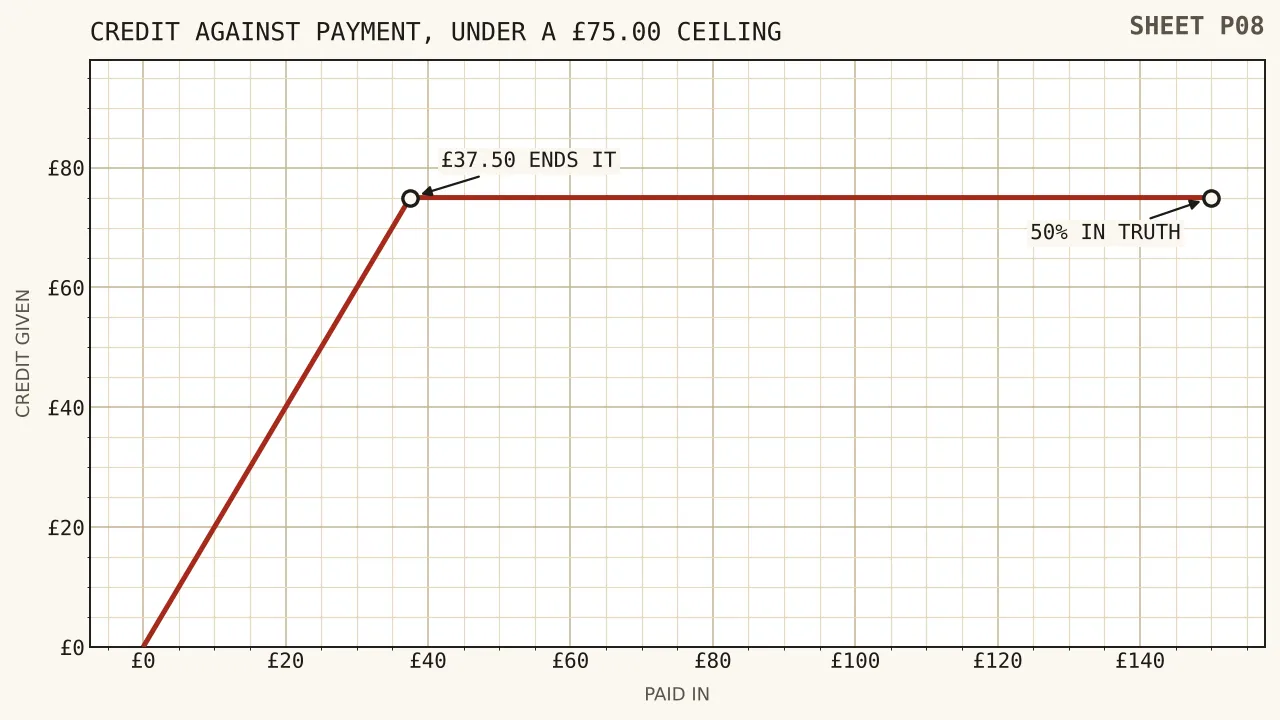
A 200 per cent headline comes with a maximum credit attached, and a payment half the size of that maximum is enough to reach it. Against a £75.00 ceiling the full rate survives up to £37.50 paid in. After that, the credit stops moving while the payment carries on.
| Payment | Credit against it | Rate the reader got | Value per pound in |
|---|---|---|---|
| £20.00 | £40.00 of credit | the full 200 per cent | 120p a pound |
| £37.50 | £75.00 of credit | still the full rate | 120p a pound |
| £50.00 | £75.00 of credit | 150 per cent | 90p a pound |
| £75.00 | £75.00 of credit | a straight doubling | 60p a pound |
| £150.00 | £75.00 of credit | half the advertised rate | 30p a pound |
So the payment that maximises the rate is the smallest one that fills the cap, and every pound after it buys conditional money more slowly than the pound before. A reader who sends £150.00 in to collect the biggest advertised credit has bought £75.00 of conditional funds with £150.00 of their own, and will keep £45.00 of it at a 10 turnover demand.
Two different ceilings get confused at this point, so it is worth separating them. A ceiling on the credit scales the offer down. Put a ceiling on what winnings may convert to and it replaces the answer outright: if £100.00 is the most that can leave, then £100.00 is what the exercise is worth, whatever the credit said.
The deposit balance is uncappable at a licensed cashier, whatever cap a bonus balance carries on its conversion. No primary source publishes a usual figure for the second of those, so the £100.00 above is a round number used to make the point and not a report of anybody’s terms.
4
Ten, the sixty before it, and the product rule
Ten is the regulated maximum for a turnover demand on bonus funds, dated 19 January 2026, where 25 is the multiple that would consume a credit entirely. On the credit worked here the ceiling means £600.00 through the reels at worst and £36.00 surviving, which is the floor a British licence puts under a 200 per cent offer.
The regulator described the practice it was ending as running up to 60 times. Priced on this page, 60 turnovers of £60.00 is £3,600.00 of staking, an expected cost of £144.00, and a shortfall of £84.00 against a payment of £30.00. A reader would have been nearly three payments worse off than if they had never claimed.
| The measure | Capped at 10 | Loose at 60 |
|---|---|---|
| Through the reels | £600.00 | £3,600.00 |
| Spins at 10p | 6,000 spins | 36,000 spins |
| Time at the floor | 4 h 10 m | 25 h |
| Expected cost | £24.00 | £144.00 |
| Against £30.00 paid in | £36.00 kept | short by £84.00 |
The ceiling is also the reason a licensed 200 per cent offer cannot be arithmetically negative on the credit. Ten turnovers at face weight keep three fifths of any credit, so the worst a licensed cashier can do to £60.00 of bonus funds is hand back £36.00 of expectation. Everything that pushes the figure under that line comes from somewhere else: a weighting below face, a payment inside the base, or a cap on what the winnings may convert.
A second rule of the same date governs the shape of the package. An incentive may carry one product type and not two, out of casino, betting, bingo and lottery. Free spins beside a casino credit are casino on both sides, so they clear together. A book of bingo tickets beside the same credit would be a second type and cannot share the requirement.
Three carve-outs sit under that rule and they run against instinct. Two products of one type may be paired. A credit the customer may spend on whatever they like is untouched. And a casino offer may travel in one email beside a betting offer, where marketing consent runs to both.
5
The desk, before the credit lands
A licensed cashier has work to do before £60.00 of credit can appear, and each piece of it is a thing an unlicensed cashier can skip. Identity first, in three items, with free-bet play and bonus play both on the far side of the check. So a 200 per cent credit cannot reach an account that has not been verified.
The one card that cannot pay for gambling at a licensed cashier is a credit card, direct or through a money transfer business, and the date on that is 14 April 2020. Priced for this page: a 200 per cent offer at 25 turnovers is expected to return nothing, and borrowing the £30.00 to claim it adds interest to an expectation of nought.
At a licensed cashier a financial limit is the default, the durations take in a week and a month, and a rise needs 24 hours plus a fresh confirmation. Where a daily £10 meets a weekly £100, £70 is what the week allows and 100 spins is what the day allows. A £30.00 payment against a £10 day is three days of deposits, so an offer window of 48 hours cannot be filled without lifting the limit first.
Those three duties are the reason a “no checks, instant credit” pitch and a British licence cannot both be true of one cashier. A reader who meets the pitch has learnt something about the licence rather than about the cashier’s generosity.
One enforcement outcome bears on the wording of bonus terms rather than on their size. A clause holding a discretion to shut accounts or keep winnings cost one licensee £170,000, in a decision dated 3 July 2025. Converted into the units of this page, the penalty is 2,833 credits of £60.00. The clause was not declared void, because a penalty is what the regulator published, and the condition it was held to breach is the one requiring fair and open dealing with customers.
6
The exit, and the two balances
Clearing a demand is half the exercise. Getting the money out is the other half, and what is published about that is worth more to a reader than any banner percentage.
Ask a licensed cashier for a withdrawal and no button exists for undoing it. A payout cannot be held hostage to information the cashier ought to have collected at the start. A deposit balance has no lawful ceiling on the way out, and the drafting the guidance rules out by example offers £50 a day with £500 a week.
The two balances behave differently and the difference is the whole of the confusion. The £30.00 paid in sits in a deposit balance and can be taken out at any time, subject to nothing. The £60.00 of credit sits in a bonus balance and is governed by the offer’s own terms, including any conversion cap. Both can be true in one set of terms without a contradiction anywhere.
One further protection belongs here because it decides whether a cleared credit can be reached at all. A licensed cashier may not make a payout conditional on documents it could have asked for at registration, and anti-money-laundering material is meant to be requested promptly rather than stored up for the moment a reader asks to be paid. Hold a payout for want of identity information that could have been gathered at the start and the operator may be in breach, which is how the regulator puts it.
A floor under withdrawals works against a credit of this size from underneath. Where £20.00 is the smallest payout allowed, the £36.00 expected after 10 turnovers clears it with room to spare, while the £12.00 expected after 20 turnovers falls short of it. At that multiple the average outcome is a balance the reader cannot move.
When a dispute starts, the clocks are published. A complaint window of 6 months, an acknowledgement inside 3 working days, and a process finished within 8 weeks. Eight names hold approval as adjudicators, with sectors attached, and remote casino is missing from one of the eight. The regulator is plain about its own limits. Ombudsman is a role it disclaims, a withdrawal dispute is not something it settles, and account records are not something it can see.
7
Weighting, and what it hides
A game counting under its face pushes more money through the reels for one published multiple, and that is how a demand inside the ceiling costs more than the ceiling implies. The multiple and the weight are one term in arithmetic, whatever the terms call them.
Respondents to the consultation quoted 30p in the pound as a contribution rate, and the regulator took the point without making a rule of it. At 10 turnovers the contribution owed on £60.00 is £600.00. Delivering it at 30p in the pound needs £2,000.00 of staking, or 20,000 spins, at an expected cost of £80.00. Against a £60.00 credit the expected outcome is a shortfall of £20.00, with the advertisement still reading 10.
| Game counts at | Staking required | Spins at 10p | Cost of it | Credit left |
|---|---|---|---|---|
| 100p in the pound | £600.00 | 6,000 spins | £24.00 | £36.00 |
| 50p in the pound | £1,200.00 | 12,000 spins | £48.00 | £12.00 |
| 30p in the pound | £2,000.00 | 20,000 spins | £80.00 | short by £20.00 |
| 10p in the pound | £6,000.00 | 60,000 spins | £240.00 | short by £180.00 |
The bottom row is not a hypothetical flourish. A game counting at a tenth turns a 10 turnover demand into the arithmetic of a 100 turnover demand, and 60,000 spins at the licensed floor pace would take over 41 hours. No current grid of game contributions is published by any citable source, so the rates in that table are illustrative and the 30p row is the one with a provenance.
A stake ceiling while a demand runs moves the clock rather than the cost. Hold one spin to a tenth of the credit, £6.00 in this case, and the £600.00 arrives in 100 cycles instead of 6,000 spins. The expected cost is £24.00 in both cases, and the variance is wider on the shorter run.
8
The same offer, off the register
Offers of this size are common at cashiers outside the British licence, and the loss a reader takes there is specific rather than atmospheric. Put it as a set of conditionals. Were the cashier licensed here, a demand on the £60.00 credit would stop at £600.00 through the reels. Were it licensed here, the £30.00 could not have been paid with a credit card. Were it licensed here, identity would be settled before the credit appeared; a limit would have been put up at the first payment; the deposit balance would leave uncapped; a complaint would be answered inside 8 weeks, with an approved adjudicator waiting; and the cashier would be a member of the national self-exclusion scheme.
Were it licensed here, a slot cycle would be held to £5 as well, or £2 below 25, and a gap of 2.5 seconds would stand between successive cycles. None of those figures appears in the offshore rulebook this site was able to read, which is Curaçao’s responsible gaming policy at version 1.0, a document dated 21 February 2025. Its treatment of bonuses is two lines long: transparent terms, and no promotion aggressive enough to push gambling into excess.
Where that book is stricter than the British one, this page says so. A reduction to a deposit limit bites there immediately while an increase is held for 7 days, against the 24 hours that applies here. Its cooling-off periods arrive on a single click, needing neither an email nor the operator’s blessing, and the lengths offered are 24 hours, 7 days, 1 month and 3 months. Offering a bonus as an inducement to carry on through a cooling-off period is forbidden there in terms.
Where it is weaker, the gap is the one that matters to a 200 per cent offer. There is no turnover ceiling in it. Forty turnovers of £60.00 is £2,400.00 of staking, an expected cost of £96.00, and a shortfall of £36.00 against a payment of £30.00. Nothing in that policy prevents it, and nothing in it caps the stake on a cycle either.
Two more losses are worth stating in figures. Out there an exclusion is arranged operator by operator, and a year is the shortest term on offer. And gaming duty here attaches to where a player ordinarily lives, so a cashier abroad owes it as well, 40 per cent of its profit, which means stepping off the register saves the reader nothing in tax and costs them every line above.
Questions
- For each pound paid in, what does a 200% deposit bonus return?
- £1.20 at a 10 turnover demand, 40p at 20, nothing at 25, and £1.20 down at 40. The figures assume a 10p spin, a slot returning 96 per cent and weighting at face, and all three are declared here rather than taken from any rule.
- How much staking does £60.00 of credit owe?
- £600.00 through the reels at 10 turnovers, which is 6,000 spins at 10p, taking 4 hours and 10 minutes at the floor pace of a licensed slot. At 25 turnovers it is £1,500.00 and 15,000 spins. At 40 it is £2,400.00 and 24,000 spins, or 16 hours 40 minutes of pressing.
- Why does the break-even multiple stay at 25 whatever the percentage?
- Because it comes from the house edge rather than the headline. Four pence in the pound, levied 25 times, comes to a hundred pence, which is why clearing a credit 25 times over empties it. The percentage decides how much credit there is to eat, not when it runs out.
- When does the cap on the credit start to bite?
- At a payment half the size of the cap. Against a £75.00 ceiling the full 200 per cent survives up to £37.50 paid in. A £50.00 payment gets 150 per cent in truth, a £75.00 payment gets a straight doubling, and a £150.00 payment gets half the advertised rate. Per pound in at 10 turnovers those are 90p, 60p and 30p.
- What is the most a British licensed cashier may demand?
- Ten turnovers of the bonus funds, dated 19 January 2026. On a £60.00 credit that is £600.00 through the reels at worst and £36.00 surviving. The regulator described what it ended as running up to 60 times. On these figures that is £3,600.00 of staking and £84.00 of shortfall against a £30.00 payment.
- Can free spins and bingo tickets ride along with the credit?
- Free spins can, bingo tickets cannot, at a licensed cashier. One product type to an incentive is the rule, out of casino, betting, bingo and lottery, and a slot sits in the casino column. A credit the customer may spend on whatever they like falls outside that rule, and a pair drawn from one type is allowed.
- Can the cashier cap what I take out?
- Not from the deposit balance. The £30.00 paid in stays withdrawable, and the guidance kills the specimen clause offering £50 a day beside £500 a week. A cap on converting bonus winnings governs the other balance and is not caught by that, so one document can leave the deposit balance open while capping the conversion.
- How much does game weighting add?
- At 30p in the pound, the rate respondents quoted to the regulator, £600.00 of required contribution takes £2,000.00 of staking, or 20,000 spins, at an expected cost of £80.00. That turns £36.00 surviving into a shortfall of £20.00 while the advertisement still says 10. No current contribution grid is published anywhere citable.
- What is given up at a cashier without a British licence?
- A ceiling of 10 on the demand. One product type to an incentive. Slot stakes held at £5 and at £2 below the age of 25. A gap of 2.5 seconds between cycles. Identity done first. No credit card. A limit offered at the desk. A deposit balance left alone. A decision inside 8 weeks and an approved adjudicator after it. And a name on the register of the national self-exclusion scheme. No turnover ceiling sits in the offshore policy this site read, which leaves 40 turnovers of £60.00 available: £2,400.00 of staking, and £36.00 of shortfall.