Sheet P07 Revision 1 Counted 16 October 2026
Deposit £5, get 200 free spins: forty spins to the pound
Forty spins for each pound paid in is the steepest rate this section carries. Two hundred spins at 10p hold £20.00 of stake the cashier funded, and the return assumed here puts £19.20 of expectation on them, which is 3.84 times the £5.00 the offer asks for. The arithmetic is generous. The conditions printed underneath it decide whether it stays that way.
Spins for each pound in 40 One spin 10p Comes to £3.84 a pound
What a count of this size comes to
Every destination on this board is bought advertising. The site takes a fee if a reader goes on to register, and no figure printed below moves because of it.
The Spin Count
Gauge No 01
Betportal
Lowest multiple here
Priced at this site's own 10p a spin
What is counted
What is asked
No Great Britain licence
Licensed in Anjouan, Comoros, run by BetPortal Gaming Ltd, with Excite Ultra Media Ltd, reference ALSI-202601040-FI2.
Terms read 16 October 2026
Open the offer at Betportal, opens in a new tabThe Spin Count
Gauge No 02
WinBeast
Largest count here
Priced at this site's own 10p a spin
What is counted
What is asked
No Great Britain licence
Licensed in Curaçao, operator not named on the site.
Terms read 16 October 2026
Open the offer at WinBeast, opens in a new tabThe Spin Count
Gauge No 03
EliteSpin
Longest spin window
Priced at this site's own 10p a spin
What is counted
What is asked
No Great Britain licence
Licensed in Costa Rica, run by PrimeTier Limited.
Terms read 16 October 2026
Open the offer at EliteSpin, opens in a new tabThe Spin Count
Gauge No 04
Crown Jewelz
Multiple unpublished
No foot figure struck
What is counted
What is asked
No Great Britain licence
Licensed in Curaçao, number not verified, operator not named on the site.
Terms read 16 October 2026
Open the offer at Crown Jewelz, opens in a new tabThe figure in the third register is this site's own arithmetic and nothing an operator has published: the count at face, less the share a spin gives back at 96 per cent return to player, less what playing the wagering through costs at the same return. It describes the offer, not one reader's afternoon. Where the conditions price above the count the counter prints nothing rather than a negative sum, and where a figure the sum needs is unpublished it prints the condition in the operator's words instead.
A count has no unit of its own, so one is supplied. Where an operator publishes what a spin of its own is worth, that figure stands in the second register and is labelled as theirs. Where it does not, the second register carries this site's own 10p a spin and says so, and the foot figure moves in proportion: at half the price, half the money. The figure after it, what the count comes to for each spin, is the one that compares a large count against a small one.
Three words stand in the amount column where no figure can. Noted is a published condition that takes value away without leaving the sum a figure to take. Unpriced is a condition whose figure nobody has published, or a credit that is not a sum until a deposit of your own sets it. Own money is money of yours, which is never part of a foot figure.
Not one of the operators printed above holds a Great Britain licence, so the duties that licence carries do not reach them. Every online gambling company licensed in Great Britain has to be part of Gamstop Online, and a reader who has shut themselves out through the scheme is therefore not shut out here. The ceiling of ten times the bonus funds on a wagering requirement, in force since 19 January 2026, is a condition of that licence and binds the companies that hold one. Where a dispute goes instead is a matter for the authority named on the counter, and the Gambling Commission describes what a reader faces without a British licence as a lack of recourse if things go wrong. Nobody under 18 may hold an account at any of them.
Every term printed on a counter is the operator's own, and each counter carries the day it was read. The oldest of those readings is 16 October 2026. What binds a reader is the operator's own full terms, and not a line printed here.
1
Forty to the pound
Divide the count by the payment and the answer is 40 spins to the pound. Priced at 10p each, that is £4.00 of stake for every pound handed across, carrying £3.84 of expectation at the return used here. Taken whole, the count holds £20.00 of stake and expects to return £19.20 against £5.00 paid in.
Expressed as a multiple of the payment, 3.84 is the steepest figure this section carries. On £5.00 a hundred spins come to 1.92 times the payment. On £10.00 three hundred come to 2.88 times, and a hundred come to 0.96 times, under the money that unlocked them.
Two declared numbers carry that. A spin costs 10p. Long-run throughput on a slot is taken to come back at 96 per cent. Nothing published anywhere fixes the worth of one free spin, so a reader whose terms name a different value should scale the whole page by the ratio.
What makes a rate this steep possible is not generosity but the cost of the thing being given away, and that is the next section. Before it, one caution: an expectation of £19.20 is the centre of a wide distribution across 200 spins of a high-variance game, not a figure to expect on the screen. Sessions finishing at nothing and sessions finishing at four times the mean are both unremarkable.
The payment is not consumed by being made. It sits in a deposit balance, which a licensed cashier may not cap on the way out, so a reader who takes the spins and leaves has committed £5.00 rather than spent it. Everything priced below is about the second balance, the one the spins pay into.
2
What the count costs the house
A count is turnover written by the cashier, and the expected cost of writing turnover is the edge. The count is £20.00 of turnover written, and the edge on it is 4 per cent, which is 80p. So the expected cost of this offer, to the business advertising it, is 80p against a payment of £5.00.
Put the other way round, the reader pays 6.25 times the expected cost of the gift. That ratio is the engine of this whole section and it is never printed anywhere. It also explains why the steepest rates sit on the smallest payments. The purchase being made is an account, verified and with a payment method behind it, and what a cashier will pay for one barely moves with the size of the payment.
| Measured | For the reader | For the cashier |
|---|---|---|
| Stake written | £20.00 of spins | £20.00 of turnover |
| Expected movement | £19.20 back | 80p of cost |
| Cash up front | £5.00 paid | nothing paid |
| Position before conditions | £14.20 up | £4.20 up |
That bottom row needs its qualification attached. Being £14.20 up in expectation describes a reader who has met no floor under a withdrawal, no ceiling over the winnings, no demand against them and no window too short for the spins. Each of them can remove the £14.20 on its own, and each gets priced below.
The non-cash part of the trade belongs in the reckoning as well. A payment at a licensed cashier arrives with a verified account behind it. Verification comes before any spinning, and bonus spins sit on the far side of the same check. So the count buys a relationship rather than turnover.
The same comparison works in spins, which keeps the unit constant. The cashier writes 200 spins and expects to lose eight of them, since 4 per cent of 200 is 8. The reader hands over £5.00, or 50 spins of their own at the same price. Fifty spins of the reader’s money against eight spins of expected cost to the house: that gap is where the offer comes from.
80p of expected cost against £5.00 paid in
3
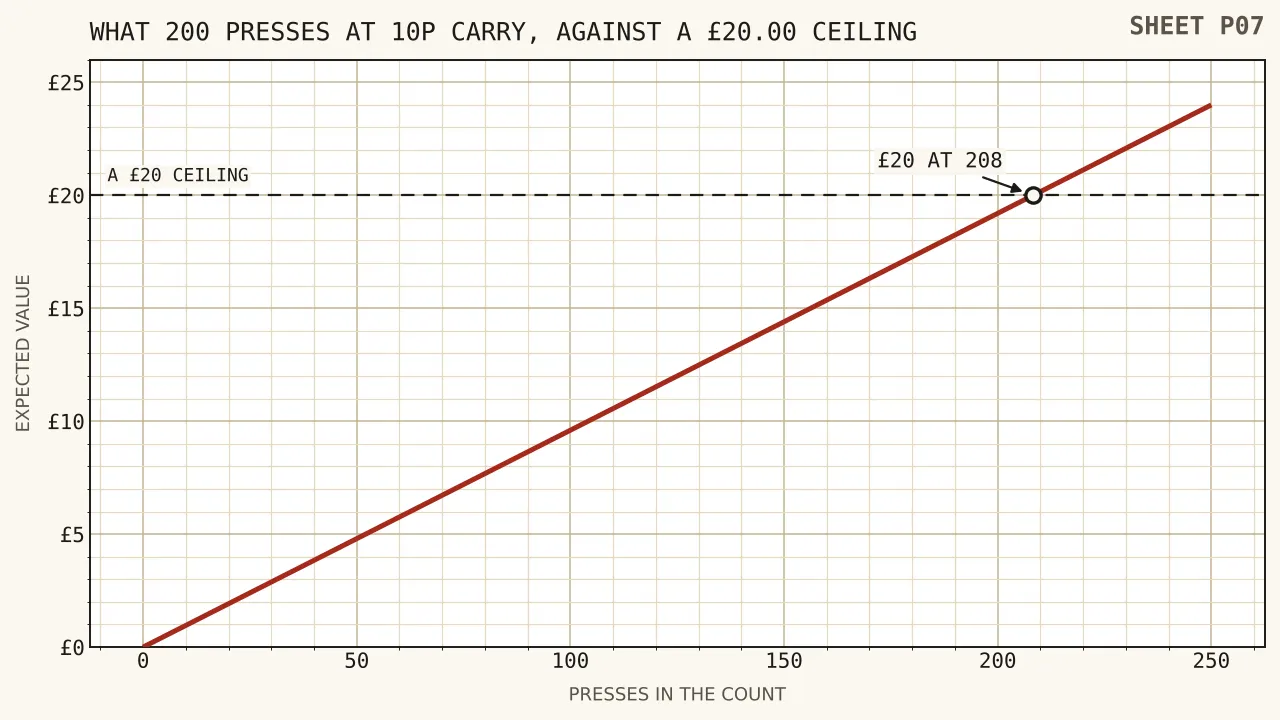
A ceiling nine spins away
Expectation runs at 9.6p a spin, so any maximum win divided by 9.6p gives the count from which that ceiling decides the answer. A £20.00 ceiling does its deciding past 208.3 spins, which is nine spins beyond the count this sheet prices.
That is the closest fit in this section and it makes the ceiling look harmless. It is not. A ceiling pitched barely above the mean cuts the top half off the distribution and leaves the bottom half untouched, so the expectation falls under £19.20 as soon as the line is printed, with no headline figure having moved.
| Ceiling printed | Takes over past | Against 200 spins |
|---|---|---|
| £5.00 | 52.1 spins | deciding from a quarter of the way in |
| £10.00 | 104.2 spins | deciding from halfway |
| £20.00 | 208.3 spins | nine spins clear of the count |
| £50.00 | 520.8 spins | no part in the answer |
| None printed | nothing | the count decides alone |
No source this site can cite publishes a usual figure for a ceiling on bonus winnings, and nothing prohibits one, so the figures in that table are chosen to show the shape. What is prohibited is the thing people confuse it with: the deposit balance, where the £5.00 sits, may not be capped by any term on the way out.
4
Eight minutes and twenty seconds
Every count has a shortest duration available to it, 24 cycles in a minute being the licensed ceiling. Two hundred spins therefore fill 8 minutes and 20 seconds, and no feature sold on a licensed site compresses it: there is nothing automatic, nothing that cuts a result short, and no second game to run alongside the first.
| Spins | Time they fill | Expectation they carry |
|---|---|---|
| 40 spins | 1 m 40 s | £3.84 of it |
| 100 spins | 4 m 10 s of work | £9.60 of it |
| 200 spins | 8 m 20 s of work | £19.20 of it |
| 400 spins | 16 m 40 s | £38.40 of it |
Set eight minutes against a 24-hour claim window and the window constrains nothing, which is a conclusion rather than a throwaway. The clock on a count is the mildest condition in this family. It becomes severe only where it is attached to a demand on the winnings, and the next section but one prices that.
Dripped out, the count keeps its expectation and gains an attendance record. Forty spins a day across five days still carries £19.20, in five sittings of 1 minute 40 seconds. Each tranche tends to arrive with its own expiry, so one day missed costs £3.84, which is what one pound of the payment returns.
Two further figures belong with the clock, because they bound what a reader can do with it. One limit caps the payments: £5 in a day beneath £50 in a week leaves the week at £35, or 350 spins funded by the reader, with a cut landing at once and a rise held a day before confirmation. And a stake ceiling caps the spins: £5 on one slot cycle, or £2 for anybody under 25, so a count cannot be converted into a handful of oversized presses.
200 spins, 8 minutes 20 seconds, £19.20 of expectation
5
What the account is worth
A rate of 40 spins to the pound only makes sense once the thing being bought is identified, and it is not turnover. It is a verified account with a payment method behind it, held by somebody who has shown they will pay something in.
Price the three things the cashier gets. First, £5.00 of certain money, against 80p of expected cost. Second, a customer who cleared a verification check, since an account at a licensed cashier cannot spin until it has. Third, a marketing relationship, and that has a rule of its own. Consent has to be given for each product and each channel separately, a requirement in force since 1 May 2025 rather than the earlier date first set for it.
The third of those is the one a reader can price only by what it is worth to the other side. A count of 200 spins costs the house 80p in expectation and buys it a verified, contactable customer. The same customer at a cashier beyond the register costs the same 80p and comes with no verification duty and no opt-in rule attached.
Two published rules sit on the way back out, and they decide whether the £19.20 is reachable at all. Cancellation is not offered on a withdrawal already requested. And papers the cashier could reasonably have collected at the outset cannot be priced into a payout later on, while material gathered against money laundering has to be asked for promptly rather than kept back for the exit.
One item on the enforcement record goes to how bonus terms are drafted rather than how big they are. A reserved discretion to shut an account or strip its winnings cost one licensee £170,000. The decision carries 3 July 2025 as its date, and the broken condition was the one on dealing fairly and openly. In this page’s units the penalty buys 8,500 counts of this size. No clause got struck down by it, since a fine is what the regulator published.
6
The rules on who the advertisement reaches
A big count on a small payment is a loud advertisement, and the advertising rules carry figures of their own. Three of them bear directly on offers shaped like this one.
The first is about appeal. Strong appeal to children or young persons is what a marketing communication must not be likely to have, and it may not carry a person or character whose example anybody under 18 is likely to follow. The second is the age rule for the people in the advertisement: under-25s, real or apparent, are kept out of gambling and out of any significant role. Those aged 18 to 24 may take a significant role only where the advertising sits somewhere a bet can be placed at once, with an operator’s own site as the example, and then as the bet’s subject alone, outside any gambling scene. Everywhere else, social media along with the rest, the under-25s stay out.
The third is about proportion, and it is the one with arithmetic in it. Proportion is wanted between a reward and the money and time a player has spent, and a promotion is not to climb faster than the spending does. The advertising regulator supplies an example of the acceptable: a single free bet once £50 has been wagered, with the proviso that such a reward is not out of the ordinary at that level of play. The condition travels with the example.
Set this offer against that example and the comparison is instructive. £5.00 paid in buys £20.00 of funded stake here, where the published example describes a modest reward after £50 of wagering. Nothing says a count of 200 spins for £5.00 breaches anything. What the comparison shows is that the proportion rule is about the relationship between the reward and the spending, and the relationship here is 4 to 1 in stake terms.
Where those rules are enforced is published too, and the record is thin on detail. Three casino advertising rulings sit on the regulator’s list, each with an outcome and a date and nothing about its subject: one upheld 14 October 2026, one upheld 16 September 2026, one not upheld on that same September date. A page can call them recent rulings in the sector and must stop there, the source saying nothing about what was at issue.
Two further rules complete the frame. A gambling marketing communication has to be socially responsible, and the particular regard named is the protection from harm of children, of young persons and of others who are vulnerable. Nor may it present gambling as an answer to money worries, as a substitute for a job, or as a path to financial security.
7
A demand on the winnings
Spins paid for in advance carry no wagering demand. Their winnings can carry one. Where those winnings go into a bonus balance, the demand bites on £19.20 and leaves the count alone. The working: demand times the 4 per cent edge, taken from one, applied to the balance.
| Turnovers asked | Staking it owes | Spins needed | Expected cost | Left standing |
|---|---|---|---|---|
| None at all | nothing | nothing | nothing | £19.20 |
| 10 turnovers | £192.00 owed | 1,920 spins | £7.68 of cost | £11.52 |
| 20 turnovers | £384.00 owed | 3,840 spins | £15.36 of cost | £3.84 |
| 25 turnovers | £480.00 owed | 4,800 spins | £19.20 of cost | nothing |
| 40 turnovers | £768.00 owed | 7,680 spins | £30.72 of cost | short by £11.52 |
Twenty-five is where the sign turns, and it comes from the edge rather than from any rulebook: 4p taken 25 times over is 100p, so a balance cleared 25 times is expected to be gone. Ten turnovers on this page is 1,920 spins, which is 1 hour 20 minutes of pressing, against the 8 minutes and 20 seconds the count itself takes. So a demand is ten times the labour of the offer carrying it.
On the licensed side the ceiling is ten turnovers of bonus funds, which has applied since 19 January 2026. That puts the first three rows of the table inside the licensed market and the last row outside it. Whether a spin amounts to bonus funds for that ceiling is unpublished in both directions. As far as the published chain reaches: winnings credited into a bonus balance carry a demand of ten at the most.
Weighting shifts those rows and leaves the headline where it was. Where a game counts 30p in the pound, the £192.00 of contribution a ten times demand wants costs £640.00 of real staking, which is 6,400 spins and £25.60 of expected cost. Against winnings of £19.20 that is a shortfall of £6.40, from a demand still printed as ten. Respondents to the consultation behind the ceiling supplied that 30p, and no contribution table of current date exists in any citable source.
Two protections on the way out belong beside those figures, since they decide whether a cleared balance is reachable at all. Cancellation is not offered on a withdrawal already requested. And papers the cashier could reasonably have collected at the outset cannot be priced into a payout later, with material gathered against money laundering to be asked for promptly instead of kept back for the exit.
A floor works from underneath and is easier to overlook. An expected £19.20 clears a smallest withdrawal of £10.00 comfortably, and one of £15.00 with £4.20 to spare. At £25.00 the floor wants 1.30 times the mean; at £50.00 it wants 2.60 times, turning a positive expectation into something that pays only after a good run.
8
Two hundred spins, unlicensed
The steepest rates in this market are advertised on both sides of the register, and a reader cannot tell the sides apart from the wording. Where the cashier sits outside the British licence, each line below becomes optional, and the second column prices the difference on this page’s figures.
| Imposed on the holder | Priced on this count |
|---|---|
| Ten turnovers as the cap on a demand | £11.52 of the £19.20 lives, where 25 would leave nought |
| A check on the holder before the account may spin | nobody collects 200 spins anonymously |
| Pace held to 24 cycles in a minute | 8 m 20 s is the floor and the real figure |
| No automatic play and nothing that shortens a result | all 200 presses are made by hand |
| A cycle staked at £5 at most, and £2 under 25 | no demand can be cleared in a handful of oversized spins |
| No gambling funded by a credit card | the payment cannot be put on borrowed money |
| A limit offered as the first payment goes in | a £5 day funds 50 spins out of the reader’s own pocket |
| A deposit balance with no ceiling on the way out | the {£5.00} remains reachable at any point |
| Under-25s kept out of the advertising | the audience rules apply to the banner as well as the terms |
| A complaint settled inside eight weeks | with one of eight approved adjudicators after it |
In the offshore document read end to end for this site, a turnover demand has no ceiling, a stake has no cap and a cycle has no floor under its pace. For a count at this rate the first of those is the expensive one: 40 turnovers on £19.20 of winnings is 7,680 spins of staking and a shortfall of £11.52, which is more than twice the payment.
What a reader keeps on either side is worth stating plainly. A licence is what bounds the national self-exclusion scheme, so registering once closes the licensed market and goes no further, a limit the scheme sets out itself. A gambling block at a bank sits in the same family of tools, and nothing here will help anybody around one.
Duty does not stop at the border either. Remote gambling played by a person ordinarily resident here brings British gaming duty with it wherever the operator sits, charged at 40 per cent of remote gaming profit. So a count from beyond the register buys the reader a larger possible multiple on the winnings and nothing else at all.
Questions
- On a fiver, what are 200 free spins worth?
- Stake of £20.00 funded, carrying £19.20 of expectation on the two figures declared here. For each pound paid in that is 40 spins carrying £3.84, a multiple of 3.84 and the steepest rate here.
- How does that compare with other pairings?
- On £5.00, a hundred spins return 1.92 times the payment. On £10.00, three hundred return 2.88 times and a hundred return 0.96 times, which is under the payment. A count on its own says nothing. The rate is what the count divided by the payment gives.
- What does the offer cost the cashier?
- 80p in expectation, being 4 per cent of the £20.00 of turnover it wrote. The reader pays £5.00 to collect it, which is 6.25 times that expected cost. What the cashier is buying is a verified account with a payment method behind it.
- At what point does a maximum win cap matter?
- At the cap divided by 9.6p, which is what one spin carries. A £20.00 cap takes over past 208.3 spins, nine spins beyond this count, so it sits barely above the mean. A £10.00 cap takes over at halfway and a £5.00 cap at a quarter of the way in.
- How long do 200 spins take?
- Eight minutes and twenty seconds. The licensed ceiling is 24 cycles a minute, nothing automatic is sold, no feature cuts a result short, and a second game cannot be run alongside, which makes that a floor.
- What would a wagering demand on the winnings cost?
- Ten turnovers of the expected £19.20 is £192.00 of staking, which leaves £11.52 and takes 1,920 spins, or 1 hour 20 minutes. Twenty turnovers leaves £3.84. Twenty-five leaves nothing. Forty is expected to cost £11.52 more than the balance held.
- What do the advertising rules say about an offer like this?
- Three things with figures in them. No marketing communication may be likely to be of strong appeal to children or young persons. Anybody who is, or appears to be, under 25 is kept out of a gambling role, with one narrow exception where a bet can be placed on the spot and the person appears as the bet’s subject rather than inside a gambling scene. And proportion is required between an inducement and what a player spends in money and time, the published example being a single free bet once £50 has been wagered.
- Can the fiver be paid with a credit card?
- Not at a British licensed cashier. A credit card cannot fund gambling there at all, routes through a money transfer business included, with effect from 14 April 2020. That is the only British rule about how a gambling payment may be funded.
- What changes at a cashier outside the British licence?
- The ten-turnover ceiling goes, so 40 turnovers on £19.20 of winnings becomes available and turns the expectation into an £11.52 shortfall. Also gone: the verification, the pace ceiling, the stake caps, the credit-card refusal, the limit at the desk, the shield around a deposit balance, and an eight-week complaint ending at an approved adjudicator. Duty here catches the operator anyway, 40 per cent of the profit it makes on remote gaming.