Sheet D17 Revision 1 Counted 16 October 2026
Free £5 no deposit: five pounds, fifty plays, three pounds out
Five pounds of credit buys 50 plays at 10p. Attach the tenfold requirement that marks the British ceiling and the turnover owed becomes £50.00, or 500 plays, with an expected £3.00 standing at the end of them. Every condition printed under the headline is measured against that three pounds rather than against the five.
Credited £5, no payment in One play 10p Settles at £3.00 after clearance
What a count of this size comes to
Every destination on this board is bought advertising. The site takes a fee if a reader goes on to register, and no figure printed below moves because of it.
The Spin Count
Gauge No 01
Betportal
Lowest multiple here
Priced at this site's own 10p a spin
What is counted
What is asked
No Great Britain licence
Licensed in Anjouan, Comoros, run by BetPortal Gaming Ltd, with Excite Ultra Media Ltd, reference ALSI-202601040-FI2.
Terms read 16 October 2026
Open the offer at Betportal, opens in a new tabThe Spin Count
Gauge No 02
WinBeast
Largest count here
Priced at this site's own 10p a spin
What is counted
What is asked
No Great Britain licence
Licensed in Curaçao, operator not named on the site.
Terms read 16 October 2026
Open the offer at WinBeast, opens in a new tabThe Spin Count
Gauge No 03
EliteSpin
Longest spin window
Priced at this site's own 10p a spin
What is counted
What is asked
No Great Britain licence
Licensed in Costa Rica, run by PrimeTier Limited.
Terms read 16 October 2026
Open the offer at EliteSpin, opens in a new tabThe Spin Count
Gauge No 04
Crown Jewelz
Multiple unpublished
No foot figure struck
What is counted
What is asked
No Great Britain licence
Licensed in Curaçao, number not verified, operator not named on the site.
Terms read 16 October 2026
Open the offer at Crown Jewelz, opens in a new tabThe figure in the third register is this site's own arithmetic and nothing an operator has published: the count at face, less the share a spin gives back at 96 per cent return to player, less what playing the wagering through costs at the same return. It describes the offer, not one reader's afternoon. Where the conditions price above the count the counter prints nothing rather than a negative sum, and where a figure the sum needs is unpublished it prints the condition in the operator's words instead.
A count has no unit of its own, so one is supplied. Where an operator publishes what a spin of its own is worth, that figure stands in the second register and is labelled as theirs. Where it does not, the second register carries this site's own 10p a spin and says so, and the foot figure moves in proportion: at half the price, half the money. The figure after it, what the count comes to for each spin, is the one that compares a large count against a small one.
Three words stand in the amount column where no figure can. Noted is a published condition that takes value away without leaving the sum a figure to take. Unpriced is a condition whose figure nobody has published, or a credit that is not a sum until a deposit of your own sets it. Own money is money of yours, which is never part of a foot figure.
Not one of the operators printed above holds a Great Britain licence, so the duties that licence carries do not reach them. Every online gambling company licensed in Great Britain has to be part of Gamstop Online, and a reader who has shut themselves out through the scheme is therefore not shut out here. The ceiling of ten times the bonus funds on a wagering requirement, in force since 19 January 2026, is a condition of that licence and binds the companies that hold one. Where a dispute goes instead is a matter for the authority named on the counter, and the Gambling Commission describes what a reader faces without a British licence as a lack of recourse if things go wrong. Nobody under 18 may hold an account at any of them.
Every term printed on a counter is the operator's own, and each counter carries the day it was read. The oldest of those readings is 16 October 2026. What binds a reader is the operator's own full terms, and not a line printed here.
1
Five pounds, and the two sums it could mean
A five pound offer with nothing to pay comes in two shapes, and they are worth different money. Shape one is a cash credit of £5.00 entered as bonus funds, which has to be turned over before it can be withdrawn. Shape two is 50 plays handed over already paid for, which carries nothing at all.
Price them both. The 50 plays put £5.00 of staking through a 96 per cent game and are expected to give back £4.80, with no obligation attached to the proceeds. The credit, at the tenfold ceiling a British licensee must now work within, produces £50.00 of turnover and an expected £3.00. Identical headlines, and £1.80 between them.
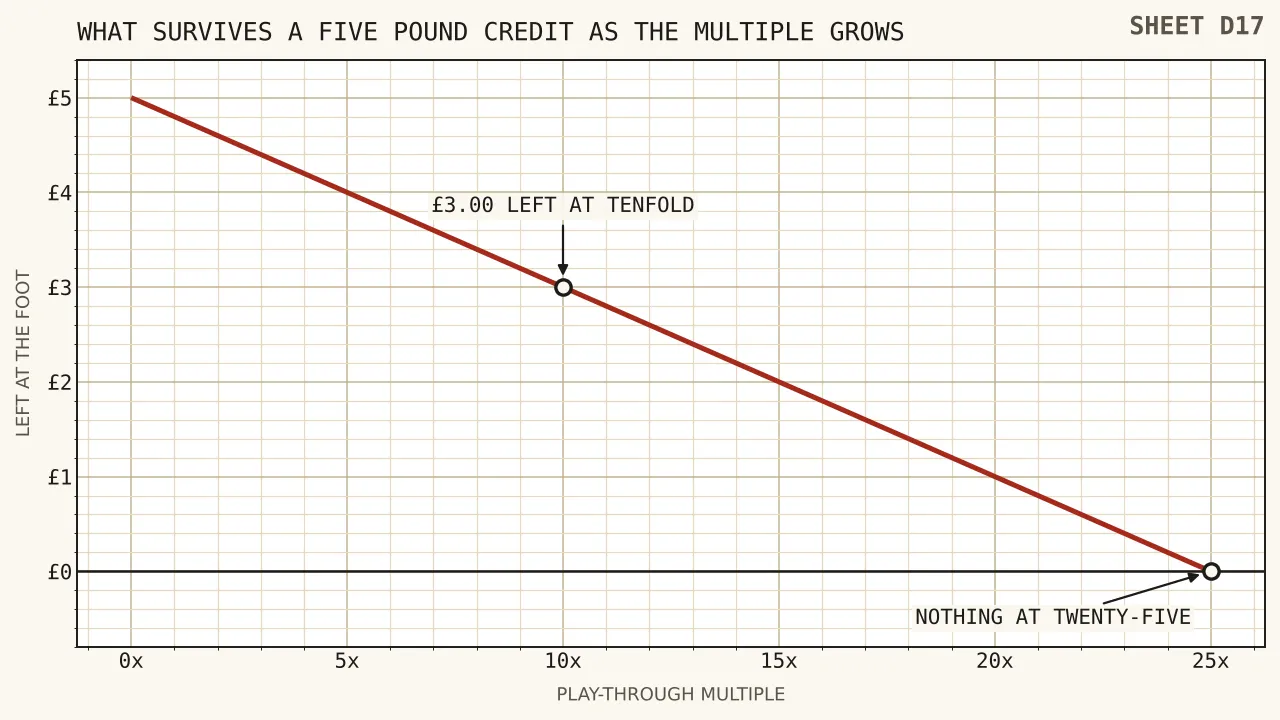
The arithmetic behind the second figure is three steps. Ten times four hundredths is forty hundredths. One less forty hundredths is sixty hundredths. Sixty hundredths of £5.00 is £3.00. Each unit of multiple above zero costs 20p of a five pound credit, so a reader can read any multiple straight off: five times leaves £4.00, fifteen times leaves £2.00, and twenty-five times leaves nothing.
Which shape an offer takes is rarely in the headline and is always in the terms. The test is whether the award names a number of plays or a sum of money. If it names a sum, look for the multiple. If it names plays, look for a requirement on what the plays win, which is a different condition on a different balance.
Both figures stand on two declared assumptions, 10p for one play and 96 pence back in the pound. Neither is set by a rule. No published source states what a free play is worth, who fixes that, or whether it has to be disclosed anywhere. So this sheet states its own numbers and shows every step, which lets a reader with a 25p award multiply the money columns by 2.5 and keep the method.
2
Fifty plays, or five hundred
The useful way to read a five pound credit is as a quantity of plays rather than a sum of money, because plays are what a reader actually spends. At 10p the credit is 50 plays. The requirement, though, is measured in turnover, and £50.00 of turnover at 10p is 500 plays. So the offer hands over fifty and asks for five hundred.
| Multiple asked | Turnover owed | Plays at 10p | Expected to survive |
|---|---|---|---|
| Nothing on the credit | nil | 50 | £4.80 |
| Five times | £25.00 | 250 | £4.00 |
| Ten times, the British ceiling | £50.00 | 500 | £3.00 |
| Fifteen times | £75.00 | 750 | £2.00 |
| Twenty-five times | £125.00 | 1,250 | nothing |
The top row is not the same product as the others. Where nothing is asked of the credit, the reader is holding 50 plays and may withdraw whatever those plays produce, so the expectation is the plain £4.80. Each row below it is an exchange: the cashier keeps 20p of the five pounds for every unit of multiple it adds, in expectation, and the reader supplies the time.
Two rows at the bottom lie outside this market. A British licensee has nothing to offer beyond ten times the bonus funds, that ceiling having arrived on 19 January 2026 with the code provision governing incentives. Scope runs to every licence, ancillary remote licences among them, and stops only at gaming machine technical and software licences, so remote casino is inside without exception.
50 plays handed over, 500 plays asked for, £1.80 of the five pounds consumed
3
Three pounds against a five pound line
A smallest-payout condition is where a five pound offer most often ends. Once a tenfold clearance is done the expected balance stands at £3.00, which puts a five pound line over the average already and a ten pound line far over it.
| Smallest payout allowed | Times the mean needed | Gap against the mean |
|---|---|---|
| £2.00 | 0.67 | cleared, with £1.00 spare |
| £3.00 | 1.00 | level with the mean |
| £5.00 | 1.67 | £2.00 |
| £10.00 | 3.33 | £7.00 |
| £20.00 | 6.67 | £17.00 |
Read the bottom two rows as a description of the product rather than as a complaint about it. A five pound credit under a ten pound payout line is an offer whose average result cannot be collected: the reader has to beat the mean by a factor of 3.33 before any money can move. Both figures are printed, both are honest, and the product of them is a promotion that usually settles at nought.
A win cap works from the other direction and, on a sum this small, usually does nothing. A cap of £50.00 on the proceeds of a five pound credit sits ten times above the mean, so it bites only on an outcome that a volatile slot will deliver rarely. A cap at £3.00 is the interesting case, because it sits exactly on the post-clearance average and therefore replaces it.
One rule protects a balance this page does not have. Terms capping withdrawals out of a deposit balance are prohibited, and the prohibition is about money a customer paid in. With no payment in there is no such balance in existence, so a payout line sitting on bonus proceeds is untouched by the prohibition.
4
Proportion, and what the advertising rules say about it
Small awards raise a question the advertising rules answer directly: how large may an inducement be, relative to what a player is spending. Proportion is the test in the advertising regulator’s casino guidance. A reward, or an inducement, is to be kept in proportion with whatever time and money the player has put in. Two further lines follow. Nor is the rate to quicken as a player spends more. Nor is it to encourage gambling of substantial amounts at a regular, fixed frequency.
An illustration of what can pass appears in the same guidance, and it is worth reproducing exactly, because a condition travels with it. A one-off reward of a free bet after £50 has been wagered could be acceptable, provided that giving a free bet is not unusual at that level for that type of gambling. The condition is part of the example and should travel with it.
Put the five pound credit against that benchmark as arithmetic. Clearing the credit at ten times means £50.00 of turnover, which is the same fifty pounds of wagering that appears in the regulator’s example, except that here the fifty pounds is the price of releasing the award rather than the trigger for a new one. The reader supplies £50 of turnover and receives an expected £3.00. Expressed as a rate, that is 6p of expected value for every pound wagered, against a 4p house edge on the same pound.
Two more lines from the casino guidance bear on an award of this size. Significant terms for a casino promotion are likely to include any minimum stakes, the details of how to take part, and any wagering requirements. Three decisions are also listed there, with an outcome each and no subject matter at all. Two were upheld: one against HRY Games, dated 14 October 2026, and one against Dribble Media Ltd a month earlier, on 16 September. The third, sharing that September date, went the other way, and White Hat Gaming Ltd was its subject. What any of the three was about goes unsaid, so naming them as recent casino advertising decisions is as far as a page may go. That page is dated 3 September 2024 and carries no last-updated label.
5
The word free, and when it may be used
Those two words, risk and free, never appear side by side on this site, and a published rule rather than a preference is the reason. The advice from the advertising regulator runs two ways. Where qualifying costs a customer a stake out of their own funds, calling the offer free is out. And the phrase pairing those two words is to be left alone unless nothing of the customer’s is genuinely exposed.
A five pound credit with no payment in passes the first half of that test, which is exactly why the second half matters. At the start the reader puts in nothing. Something of the reader’s own frequently goes in later, because a requirement of £50.00 of turnover against a credit that is expected to fall to £3.00 leaves a balance that often runs out mid-clearance, at which point continuing means funding the rest.
Where the balance is expected to run out can be worked out exactly. At twenty-five times the multiple, the expected cost of the clearance equals the whole credit, so the balance is expected to reach nothing precisely as the requirement is satisfied. Below that the clearance is expected to finish with something left; above it the reader is expected to be paying for the last stretch. Twenty-five is 1 divided by 0.04, and no figure on this site travels further.
The arithmetic also explains why a credit and a count of plays are advertised in the same words and are not the same offer. A count is already paid for, so nothing of the reader’s can be drawn in by the terms. A credit with a multiple on it can require more turnover than the credit is expected to fund, and a reader who wants to finish the clearance does so out of their own pocket.
6
What the terms must put in front of you
One code provision governs incentives on a British licence. It bites wherever a licensee holds out, to a customer or to a potential one, a reward, an incentive or an arrangement that confers money, goods, services or any other advantage. Out of it come two duties and four prohibitions.
The duties come first. Three adjectives govern the terms. Fair is one, clear is another, transparent is the third. Easy access to them is owed to everybody the offer is put in front of. Those two words, accessible and transparent, are what entitle a reader to find the multiple before signing up rather than afterwards.
The four prohibitions are worth listing in full, because three of them are rarely mentioned on a page about a small award. A licensee must not apply a wagering requirement above ten times the bonus funds. First, two types of gambling product may not be packed into one incentive. Second, the value may not be altered because a reader finished the qualifying activity inside part of the offer period rather than all of it. And it must not offer free or subsidised travel or accommodation that encourages attendance at premises on terms tied to the customer’s expected gambling.
The third of those is the one that bears on a five pound credit with a clock on it. Where an offer runs for seven days and the reader finishes the qualifying activity on day two, the value of the incentive may not be altered because they were quick about it. A reader who clears £50.00 of turnover inside 48 hours is entitled to the same award as one who takes the full week.
Customers labelled high value, VIP or something equivalent get two limbs of their own. An incentive put to them has to sit consistently with the licensing objectives, and the regulator publishes guidance on incentives for such customers which the licensee has to weigh. Scope again reaches every licence, ancillary remote ones among them, stopping at gaming machine technical and gambling software licences, and the condition page gives no effective date.
Fair terms have their own condition, separate from the incentive rules, and it has four limbs. Unfairness is barred in the terms on which gambling is offered and in the consumer notices beside them, with the Consumer Rights Act 2015 supplying the sense of the word, and a licensee has to comply with its own terms. Transparency, in the sense that same Act gives the word, is owed for contract terms and consumer notices alike, and the contract terms have to be reachable easily. Changes to terms must meet the Act’s fairness and transparency requirements, and customers must be told of material changes before those changes take effect. And unfair commercial practices are barred at any point in a licensee’s dealings with consumers, in the sense given to that phrase by the Act of 2024 on digital markets, competition and consumers.
7
Twenty minutes fifty, at the legal pace
Clearing a five pound credit takes a measurable amount of time, and the measurement comes from a technical standard rather than from an estimate. Cycles on a licensed slot are spaced at 2.5 seconds or more. Multiply by the 500 plays and the clearance occupies 1,250 seconds at the floor, which is twenty minutes and fifty seconds.
| Stake per play | Plays needed | Minimum time |
|---|---|---|
| 5p | 1,000 | 41 min 40 s |
| 10p | 500 | 20 min 50 s |
| 25p | 200 | 8 min 20 s |
| 50p | 100 | 4 min 10 s |
A stake ceiling during clearance decides which of those rows a reader is allowed. Where the terms cap the stake at a tenth of the credit, a five pound credit allows 50p a play, which puts the fastest lawful clearance at four minutes and ten seconds. Where the cap is lower, the time rises in proportion while the expected cost of clearance stays at 4 per cent of the £50.00, or £2.00, whichever row is taken.
Game weighting is the figure that lengthens all of it. Where a game contributes at 30 per cent, the rate respondents quoted to the regulator’s consultation, buying £50.00 of progress takes roughly £166.67 of staking. At 10p that is 1,667 plays and roughly 69 minutes at the pace floor, for the same expected £3.00 at the end. The rate is the respondents’; the conversion is this sheet’s.
Autoplay shortens none of that, having been made unavailable: requirement 8A obliges the system to take the customer’s commitment cycle by cycle, and the single carve-out in its guidance is the automatic posting of blinds at poker between players. The page carrying that requirement was published on 2 February 2021 and last updated on 21 January 2025.
8
Five pounds where the licence does not reach
Credits this small get their heaviest advertising from beyond Britain, where the cashier printing them holds no Great Britain licence. Part six vanishes in its entirety. No duty attaches to keeping incentive terms fair, clear, transparent and reachable. No ceiling sits over the multiple. Products may be packed together inside one incentive. And an award may be trimmed because a reader qualified quickly.
The offshore document read for this sheet says two things about bonuses and nothing else. Terms are to be communicated transparently, with clear conditions. Promotion aggressive enough to push excessive play is ruled out. That is the entirety of its bonus regime, and it contains no equivalent of the ten-times ceiling, no mixed-product prohibition and no list of significant conditions.
Where that rulebook is clearly weaker, and it matters on a page about a credit handed to a new account, is the timing of identity checks. Depositing and wagering are to be impossible there until the operator is satisfied that the player has turned 18. At registration the check against a minor runs on a confirmed date of birth, and three further steps are named as desirable where they can be done: an open-source check, a tick box in which the player declares their age, and confirmation of the payment method. Identity proper is checked at a later milestone. A government-issued document is the minimum under that authority’s know-your-customer and money-laundering policies, brought forward only where some doubt exists over a player’s age before the milestone arrives.
Set that against the British sequence. Three identifiers get settled first: a name, a postal address, a date of birth. The check then extends to play funded by a bonus, to play on a free bet, and to the prize-free versions of a licensee’s own games. The offshore position allows a tick box at the gate and a document check later. The British position puts the document check first.
Two provisions in the offshore policy run the other way, and a page that collapses the comparison into one word is unreliable in both directions. A limit comes down at once there and goes up only after a week, where 24 hours is the least a British licensee may hold an increase. Affiliates are the operator’s responsibility there, to be held to responsible gaming standards through contracts that bind, audits of their compliance and penalties where they fail. Nothing of that kind about affiliates appears in the British advertising guidance written for operators.
Self-exclusion is the loss that cannot be priced in pence. A British licence carries membership of the national online scheme as a condition of holding it. The scheme marks the boundary itself. A registration reaches the operators taking part, and for an organisation that stayed out the scheme offers nothing. Out there an exclusion is taken out at one operator and covers that operator’s domains, with encouragement to repeat it as the policy’s whole answer to the rest of the market. No line here helps anybody around an exclusion of their own making, and the number below answers on any day at any hour.
Questions
- What does a free £5 no deposit bonus come to?
- Around £3.00 where the terms ask ten times, which is the ceiling on a British licence. Ten times a 4 per cent edge is 40 per cent, so 60 per cent of the credit survives in expectation. Each unit of multiple costs 20p of a five pound credit, so five times leaves £4.00 and fifteen times leaves £2.00.
- Does five pounds of credit equal fifty free spins?
- No, and the gap is £1.80. Fifty plays at 10p are already paid for and carry nothing, so they average £4.80. Five pounds of credit at the tenfold ceiling needs £50.00 of turnover and averages £3.00. Identical headlines, and two different products underneath.
- How many spins does clearing a £5 credit take?
- Five hundred at 10p, because ten times the credit is £50.00 of turnover. At a 30 per cent game contribution rate the staking rises to about £166.67, which is 1,667 plays. At 50p a play, where a stake ceiling permits it, the same turnover takes 100 plays.
- Can I withdraw £3?
- Only if the terms allow a payout that small. A five pound smallest-payout line asks for 1.67 times the £3.00 mean and a ten pound line asks for 3.33 times, so on the second the average outcome cannot be collected at all. The prohibition on capping withdrawals applies to a deposit balance, and a no-deposit award creates none.
- How long does the clearance take at the legal minimum pace?
- Twenty minutes and fifty seconds for the 500 plays, 2.5 seconds being the least a licensed cycle may take. At 5p a play the same turnover needs 1,000 plays and 41 minutes 40 seconds. Autoplay is unavailable, because the system must take a separate commitment for each cycle.
- Are there rules about how big a bonus may be?
- There is guidance about proportion. Three lines from the advertising regulator cover it. Rewards and inducements are to stay proportionate to a player’s outlay in time and money. Promotions are not to accelerate as outlay grows. And gambling of substantial amounts at a fixed, regular frequency is not to be encouraged. Its example of something acceptable is a one-off free bet after £50 has been wagered, provided that is not unusual at that level for that type of gambling.
- Why are the words risk and free never paired here?
- Advice from the advertising regulator is against it. Qualifying at the cost of the customer’s own stake puts the description free out of reach, and the phrase that joins those two words is to be kept out as well, unless genuinely nothing of theirs is exposed. On a credit with a multiple attached, a reader who finishes the clearance after the balance has gone is funding it themselves.
- What must the terms of an incentive do?
- Be clear, transparent and fair, and be easily accessible to everybody the incentive is offered to. Four things are prohibited by the same provision. A requirement over ten times the bonus funds is one. Two gambling products inside a single incentive is another. Cutting the value because the qualifying activity got finished early is a third. Travel or accommodation, free or subsidised, offered on terms tied to expected gambling at premises, is the fourth.
- What does an unlicensed five pound credit cost me?
- Every duty in part six, since the offer stands behind no Great Britain licence. Two sentences are all the offshore policy spends on bonuses, and it caps no multiple and lists no significant condition. It also allows a declared age and a birth date at the gate, with the document check deferred to a later milestone, where a British licensee settles all three identifiers first and lets nobody play on a bonus until it has.