Sheet P04 Revision 1 Counted 16 October 2026
Deposit £10, 200 free spins, no wagering: what is left to go wrong
At 10p each, two hundred spins come to £20.00 of funded stake, of which £19.20 is expected back at the return this sheet assumes. Take the wagering demand away and that £19.20 is the answer rather than a starting point. Four conditions can still move it, and this sheet prices each of them against the count.
The count 200 spins A spin, priced 10p Comes to £19.20, nothing owed
What a count of this size comes to
Every destination on this board is bought advertising. The site takes a fee if a reader goes on to register, and no figure printed below moves because of it.
The Spin Count
Gauge No 01
Betportal
Lowest multiple here
Priced at this site's own 10p a spin
What is counted
What is asked
No Great Britain licence
Licensed in Anjouan, Comoros, run by BetPortal Gaming Ltd, with Excite Ultra Media Ltd, reference ALSI-202601040-FI2.
Terms read 16 October 2026
Open the offer at Betportal, opens in a new tabThe Spin Count
Gauge No 02
WinBeast
Largest count here
Priced at this site's own 10p a spin
What is counted
What is asked
No Great Britain licence
Licensed in Curaçao, operator not named on the site.
Terms read 16 October 2026
Open the offer at WinBeast, opens in a new tabThe Spin Count
Gauge No 03
EliteSpin
Longest spin window
Priced at this site's own 10p a spin
What is counted
What is asked
No Great Britain licence
Licensed in Costa Rica, run by PrimeTier Limited.
Terms read 16 October 2026
Open the offer at EliteSpin, opens in a new tabThe Spin Count
Gauge No 04
Crown Jewelz
Multiple unpublished
No foot figure struck
What is counted
What is asked
No Great Britain licence
Licensed in Curaçao, number not verified, operator not named on the site.
Terms read 16 October 2026
Open the offer at Crown Jewelz, opens in a new tabThe figure in the third register is this site's own arithmetic and nothing an operator has published: the count at face, less the share a spin gives back at 96 per cent return to player, less what playing the wagering through costs at the same return. It describes the offer, not one reader's afternoon. Where the conditions price above the count the counter prints nothing rather than a negative sum, and where a figure the sum needs is unpublished it prints the condition in the operator's words instead.
A count has no unit of its own, so one is supplied. Where an operator publishes what a spin of its own is worth, that figure stands in the second register and is labelled as theirs. Where it does not, the second register carries this site's own 10p a spin and says so, and the foot figure moves in proportion: at half the price, half the money. The figure after it, what the count comes to for each spin, is the one that compares a large count against a small one.
Three words stand in the amount column where no figure can. Noted is a published condition that takes value away without leaving the sum a figure to take. Unpriced is a condition whose figure nobody has published, or a credit that is not a sum until a deposit of your own sets it. Own money is money of yours, which is never part of a foot figure.
Not one of the operators printed above holds a Great Britain licence, so the duties that licence carries do not reach them. Every online gambling company licensed in Great Britain has to be part of Gamstop Online, and a reader who has shut themselves out through the scheme is therefore not shut out here. The ceiling of ten times the bonus funds on a wagering requirement, in force since 19 January 2026, is a condition of that licence and binds the companies that hold one. Where a dispute goes instead is a matter for the authority named on the counter, and the Gambling Commission describes what a reader faces without a British licence as a lack of recourse if things go wrong. Nobody under 18 may hold an account at any of them.
Every term printed on a counter is the operator's own, and each counter carries the day it was read. The oldest of those readings is 16 October 2026. What binds a reader is the operator's own full terms, and not a line printed here.
1
Twenty spins, nothing owed
Two hundred spins against a £10.00 payment is 20 spins for each pound paid in. At 10p a spin the count carries £20.00 of stake, and at a 96 per cent return it is expected to give back £19.20. Per pound paid in that is £1.92, which is nearly twice the payment.
The words that matter in the headline are the last two. Where no wagering demand attaches to the winnings, the £19.20 is the end of the arithmetic. Where one does, the figure gets multiplied by one less the demand times the 4 per cent edge, and at 25 turnovers the whole of it disappears.
| What the terms say | Staking owed on the winnings | Expected at the foot |
|---|---|---|
| No demand at all | none | £19.20 |
| Ten turnovers | £192.00 | £11.52 |
| Twenty turnovers | £384.00 | £3.84 |
| Twenty-five turnovers | £480.00 | nothing |
| Forty turnovers | £768.00 | short by £11.52 |
So the absence of a demand is worth £7.68 against a ten times condition and the whole £19.20 against a twenty-five times one. No phrase in this corner of the market is worth more, which is why it should be checked rather than assumed. The words belong in the terms, not on the banner.
Two declared figures carry the page. A spin is priced at 10p, and 96 per cent of the money through a slot comes back over the long run. No published source sets either figure, and the cash value of one free spin is fixed nowhere, so a different spin price scales every line here in proportion.
2
What no wagering does not remove
Removing the demand removes one condition out of five. The other four are all still available to whoever wrote the terms, and each of them can take more than the demand would have taken.
The first is a ceiling on the winnings. The second is a floor under what may be withdrawn. The third is a clock, either on the spins or on the winnings they produce. The fourth is the set of games the spins may be used on, which decides the return and therefore the 9.6p a spin is assumed to carry.
| The condition | What it does to £19.20 | Worst case here |
|---|---|---|
| A ceiling on the winnings | replaces the figure | a £10.00 ceiling halves it |
| A floor under withdrawals | can make it unreachable | a £25.00 floor needs 1.3 times the mean |
| A clock on the spins | rarely binds | 200 spins need 8 m 20 s of the window |
| The eligible games | moves the 9.6p a spin carries | a 90 per cent game drops it to 9p |
The fourth row is the one nobody prices. A spin carries the stake multiplied by the return, so the game matters as much as the count: 200 spins on a 90 per cent game carry £18.00 of expectation rather than £19.20, and on a 98 per cent game they carry £19.60. The spread across those three is £1.60, which is a sixth of the payment.
The duty to say something about a customer’s chances before they commit is satisfied by any of four kinds of information, joined by an “or”, so a return percentage need not appear at all. A house edge discharges it. So does the probability of the winning events. So does a plain account of the workings, and of how the prizes get handed out.
A fifth thing is worth naming because it is not a condition at all. Variance stays exactly where it was. Two hundred spins samples a high-variance game thinly, which makes £19.20 the middle of a broad spread rather than a figure to expect on the screen. Removing a wagering demand removes an expected cost; it does not narrow the distribution, and no page can say which side of the centre a particular run will finish on.
£19.20 expected, and four conditions that can still move it
3
The ceiling that lands just above
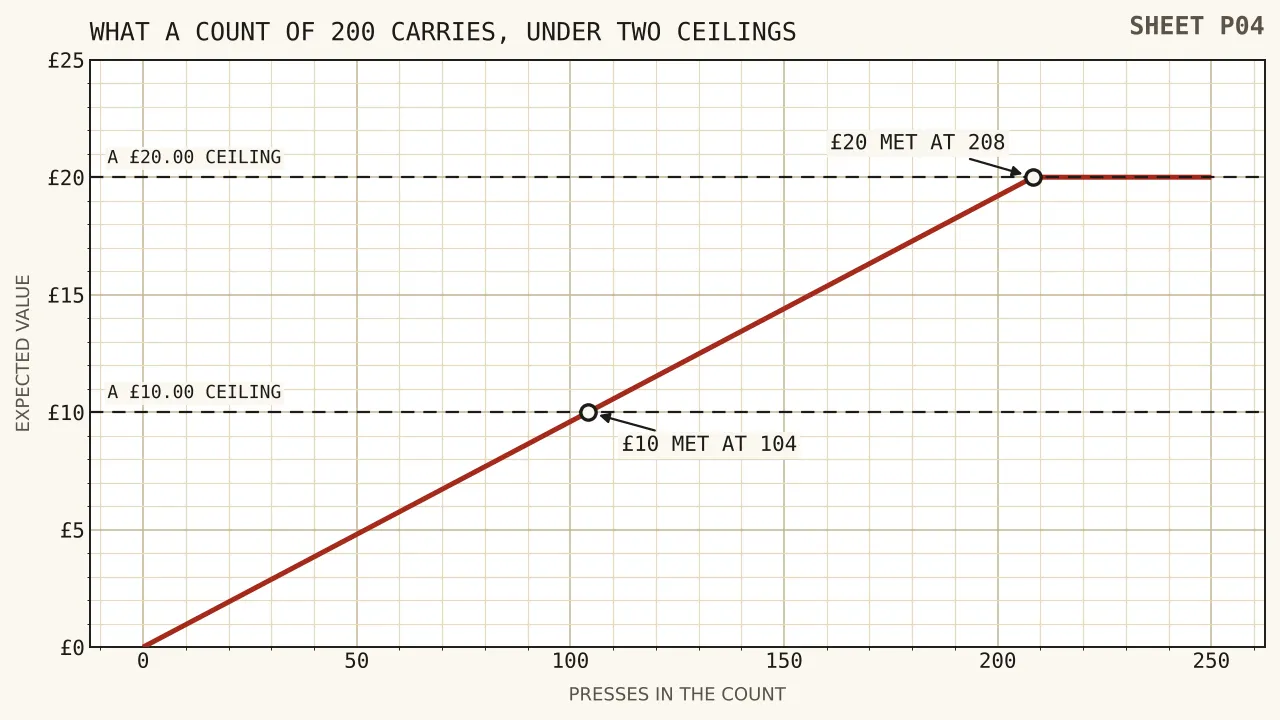
Take a maximum win, divide it by 9.6p, and out comes the count at which that ceiling takes over the arithmetic. For £20.00 the answer is 208.3 spins, which is just above this offer. A £20.00 ceiling on 200 spins therefore sits a whisker over the mean, biting only where a run goes better than average.
Move the ceiling down and it starts to decide everything. At £10.00 the crossover is 104.2 spins, so half the advertised count is adding nothing to the expectation. At £5.00 the crossover is 52.1 spins, and three quarters of the count is decoration.
| Ceiling in the terms | Crossover count | Share of 200 spins that still counts |
|---|---|---|
| £5.00 | 52.1 spins | about a quarter |
| £10.00 | 104.2 spins | about a half |
| £20.00 | 208.3 spins | all of it, just |
| £50.00 | 520.8 spins | all of it, comfortably |
| No ceiling | none | all of it |
Nothing citable here prohibits a ceiling of that kind, and no usual figure for one is published either, so those numbers show the shape of the thing rather than reporting a market. What is prohibited is different and often confused with it: a term capping what a consumer may take out of their deposit balance.
The two live in different balances. Whatever was paid in to claim the spins is a deposit balance, which cannot be fenced in on the way out. What the spins produce may land in a bonus balance instead, and a conversion ceiling over that balance is a term worth hunting for.
4
The floor underneath
A floor works the opposite way to a ceiling and is easier to miss, because it is usually printed in the banking section rather than the bonus terms. Where a cashier sets a smallest withdrawal, any balance beneath that figure stops being movable.
The £19.20 expected here clears a £10.00 floor and clears a £15.00 floor. A £25.00 floor needs 1.30 times the mean, and a £50.00 floor needs 2.60 times it, which converts an offer whose expectation is positive into one paying out only after a good run. One division does the work: the floor over the expectation gives the multiple of the mean that has to be beaten.
| Smallest withdrawal | Times the mean it asks for | Short of it on the mean |
|---|---|---|
| £10.00 | cleared on the mean | none |
| £15.00 | cleared on the mean | none |
| £20.00 | 1.04 times | 80p |
| £25.00 | 1.30 times | £5.80 |
| £50.00 | 2.60 times | £30.80 |
The floor interacts with the ceiling in a way worth one line. A £20.00 ceiling and a £20.00 floor set together describe an offer with a single payable outcome: anything under £20.00 cannot be moved, and anything over it cannot be reached. The expectation then collapses onto the probability of landing in a narrow band, which is not a figure this site can compute from published material and not a figure any cashier publishes.
Pairing a no-wagering count with a high floor is the quietest way to make a generous headline worth nothing on the average, and none of it is unlawful. Two figures multiplied together describe an offer that settles at nothing on most occasions.
One published rule does help here. Any limit on the size or the number of withdrawals has to be reasonable, and players are entitled to take money out of a deposit balance, winnings included, at any time. Players are told to check what an introductory offer restricts as well, the supplied example being a level of spend demanded ahead of any bonus arriving.
5
What the spins themselves have to be
A count with no wagering demand puts all the weight on the spins, which makes the rules about what a spin has to be worth reading. They are technical standards rather than bonus terms, and they are the part of a British licence that an offshore cashier least often matches.
Game results, and the generation sitting behind them, have to come out acceptably random, while a compensated game has no permission at all. The guidance works the second half of that out in practice. Interventions altering the probabilities are prohibited, by hand or automatically, and the outcomes have to distribute themselves as the theory says. Random numbers get used in the order they arrive, and throwing one away to produce adaptive behaviour is out.
Near-miss design is prohibited outright. A near-miss losing event put in the place of an ordinary one is prohibited, and so is any simulation of a real device which leaves that device’s own probabilities unsimulated. The guidance is blunt about it. A false near-miss result may not be displayed, and swapping one losing outcome for another is not available either.
Two further standards finish the picture. Rules, payouts and probabilities all stay put while a game is in play, and the guidance picks out a term reserving the right to change game rules at any time as one that would not be acceptable. And a result has to be shown clearly and accurately, for a stretch of time a customer could reasonably be expected to see it in.
One more standard belongs with those, because it governs what the screen may do when a spin comes in under its stake. A gambling system may not celebrate a return that is less than or equal to the total staked, and win-related sounds or visual effects are not permitted for such returns. On a 10p spin that rule is the difference between a 4p return being shown as 4p and being dressed as a win, and across 200 spins it is the difference between a count a reader can read and a count that reads as better than it was.
Priced against this page, those standards are what make 9.6p a spin a meaningful figure at all. A count of 200 spins is only worth £19.20 if the spins are what they claim to be, and on the licensed side there are published rules saying so. On the other side there is a footer.
6
Eight minutes and twenty seconds
A count has a minimum running time fixed by the licence rather than by the player. A licensed slot cycle waits 2.5 seconds behind the previous start, which puts 200 spins at 500 seconds of button work, or 8 minutes and 20 seconds.
Three rules keep that floor where it is. There is no permission for automatic play on online gaming. Features cutting the wait for a result short, turbo and slam stop among them, have no permission either. And no functionality may be offered for playing more than one game together, so the count cannot be halved across two screens.
Against a 24-hour claim window, 8 minutes and 20 seconds is nothing. The figure matters on the other side of the offer, where the winnings are concerned: a 72-hour window on £19.20 of winnings is generous where there is no demand, and tight where a ten times demand means £192.00 of staking, 1,920 spins and 80 minutes of pressing.
| What is counted | Spins | Floor on the time |
|---|---|---|
| The 200-spin count | 200 spins | 8 m 20 s |
| Ten turnovers of what the spins win | 1,920 spins | 1 h 20 m |
| Twenty-five turnovers of the winnings | 4,800 spins | 3 h 20 m |
Where a count arrives in instalments the expectation is unchanged and the attendance is not. Twenty spins a day for ten days still carries £19.20, delivered across ten visits of 50 seconds. Each tranche brings its own expiry, and a missed day costs £1.92 of expectation, which is the same figure as one pound of the payment.
7
The payment, and the limits around it
The £10.00 that unlocks the count runs into a set of published rules of its own, and two of them have figures a reader can use. The first is the limit a licensed cashier has to put in front of them. The second is the threshold at which a cashier has to start checking whether the money is affordable.
On limits, the detail is unusually exact for a regulatory requirement. From registration onwards the facility has to be reachable. The prompt itself arrives either in the course of registering or when the first payment goes in. Setting a limit is the default presentation, so a refusal takes a positive act followed by a confirmation. A box the customer can type a figure into has to be offered, the limits bind at account level as a minimum, and 24 hours, 7 days and 1 month all appear among the durations.
Priced in the units of this page, £10 for a day buys 100 spins of stake from the reader’s own money, which is half the count the offer hands across. A £70 week is 700 spins. With a daily figure and a weekly figure both set, the tighter governs, so £10 a day under £100 a week leaves the week at £70.
The directions of travel are deliberately asymmetric. Unless a technical failure gets in the way, a reduction goes in immediately. An increase takes three things: a request from the customer, a wait of 24 hours at the least, and then a positive step at the end of the wait to confirm it. A direct link on the homepage has to lead to the facilities, they have to be visible on the deposit screens as well, and the clicks needed to reach them are to be kept to a minimum.
On affordability, the thresholds are published and dated. Online customers above a monthly net deposit threshold meet light-touch financial vulnerability checks. That threshold opened at £500 in a month, dated 30 August 2024, and the figure after it was £150 in a month, from 28 February the following year. A reader making a £10.00 payment is a long way under that figure, which is the point: the checks are aimed at the pattern rather than the single deposit, and fifteen payments of this size in a month would reach it.
Enhanced financial risk assessments are a separate thing and remain at pilot stage. Three statements from the regulator go with that: no live rollout of those assessments, no effect on consumers while the pilot runs, and no effect on a credit rating from either the pilot or the light-touch checks. A page that describes either as a credit check is wrong on the regulator’s own account.
A £10 day is 100 spins of stake, half the count on offer
8
A count like this, unlicensed
A no-wagering headline is a strong advertisement, and strong advertisements appear on both sides of the register. Where the cashier operates outside the British licence, the phrase means the same thing and the rules around it do not exist. Each line below is a duty on a licence holder, priced against this count.
| Duty on a licence holder | Worth against this count |
|---|---|
| Results acceptably random, no compensated game | the 9.6p a spin carries means what it says |
| No near-miss substitution | a loss is shown as the loss the generator produced |
| No rule changes while a game is in play | the 200 spins are played under the terms they started on |
| A cycle held to 2.5 seconds at the quickest | 200 spins fill 8 m 20 s, unhurriable |
| Autoplay out, slam stop out | all 200 presses are made by hand |
| Identity checked before any play | the count cannot land on an unchecked account |
| A demand on bonus funds capped at ten turnovers | the worst case is £11.52 rather than nothing |
| Withdrawals from a deposit balance left uncapped | the £10.00 paid in stays reachable |
| Limits on withdrawal size kept reasonable | a floor cannot be set arbitrarily high |
| Eight weeks at most to settle a complaint | and one of eight approved adjudicators after it |
Read end to end, the offshore policy available here leaves turnover demands unbounded, stakes unbounded and the pace of a cycle unbounded, while near-miss design and compensated games go unmentioned. For a no-wagering count that last absence is the sharpest one, because the whole value of such an offer rests on the spins being what they are described as.
What a reader can do about it is narrow and worth stating anyway. The national scheme for self-exclusion is drawn around the British licence, so one registration reaches the licensed market and nothing beyond it. Blocking software on a device and a gambling block at a bank belong to that same family, and getting round either is not something this page assists with.
One line does not change at the border, and it is the tax line. An operator anywhere owes British gaming duty once it takes remote gambling from somebody who usually lives here, at 40 per cent of its profit. So a no-wagering count from past the register saves nothing in tax while costing the reader each row of the table above.
Questions
- What are 200 free spins with no wagering worth on £10?
- £20.00 of funded stake and £19.20 of expectation, on the 10p spin and 96 per cent return declared here. Per pound paid in that is 20 spins and £1.92. With no demand on the winnings the £19.20 is the answer rather than a starting figure, which is what makes the phrase valuable.
- How much is the absence of a wagering demand actually worth?
- £7.68 against a ten times condition, £15.36 against a twenty times one, and the whole £19.20 against anything at twenty-five or above. The arithmetic is the balance multiplied by one less the demand times the 4 per cent edge, so 25 passes consume whatever is being cleared.
- What conditions are left once the wagering is gone?
- Four. A ceiling on the winnings, which replaces the expectation rather than scaling it. A floor under what may be withdrawn, which can make the expectation unreachable. A clock, which rarely binds on the spins themselves. And the eligible games, which decide the return and therefore what a spin carries.
- At what count does a maximum win cap bite?
- At the count given by the cap divided by 9.6p. For £20.00 that is 208.3 spins, which sits a fraction above this offer. A £10.00 cap bites at 104.2 spins, so half the advertised count would be adding nothing, and a £5.00 cap bites at 52.1.
- Can a minimum withdrawal make the offer worthless?
- On the average, yes. Divide the floor by the £19.20 expected to get the multiple of the mean that must be beaten: 1.04 times at a £20.00 floor, 1.30 at £25.00, 2.60 at £50.00. Reasonable is what a limit on withdrawal size or frequency must be, and money sitting in a deposit balance can be taken out whenever the holder likes.
- Does the choice of game move the figure?
- Yes, and it is the condition nobody prices. A spin carries the stake multiplied by the return, so 200 spins are worth £18.00 on a 90 per cent game, £19.20 at 96 per cent and £19.60 at 98. Instead of a return percentage a licensee may put up the house edge, the chance of the winning events, or a plain description, those four being joined by an “or”.
- What rules say the spins are what they claim to be?
- The technical standards. Results have to come out acceptably random, as does the generation behind them. A compensated game is not permitted. Interventions shifting the probabilities are out. Near-miss substitution is prohibited, rules and payouts may not change mid-game, and the result has to be displayed clearly for long enough to be seen.
- What is the shortest a 200-spin count can take?
- Eight minutes and twenty seconds. A licensed slot cycle has to wait out 2.5 seconds from the start of its predecessor. No permission exists for autoplay, nor for anything shortening the wait for a result, nor for two games running together.
- What is missing at a cashier without a British licence?
- The technical standards on randomness and near-miss design, the cycle floor of 2.5 seconds, the bans on autoplay and on slam stop, identity checks before play, the ten-turnover ceiling that would cap a demand if one appeared, the protection of the deposit balance, the reasonableness test on withdrawal limits, and the eight-week complaint with an approved adjudicator after it. The national self-exclusion scheme stops at the licence, and The operator remains inside British gaming duty at 40 per cent of profit.