Sheet P03 Revision 1 Counted 16 October 2026
Deposit £10, get 300 free spins: thirty spins for each pound in
Three hundred spins at 10p amount to £30.00 of stake that somebody else has funded, and a game at the return assumed here is expected to hand £28.80 of it back. Divide by the payment and the rate is 30 spins, or £2.88 of expectation, for each pound paid in. The gift costs the house £1.20. The payment that unlocks it is £10.00.
Spins for each pound in 30 One spin 10p Comes to £2.88 a pound
What a count of this size comes to
Every destination on this board is bought advertising. The site takes a fee if a reader goes on to register, and no figure printed below moves because of it.
The Spin Count
Gauge No 01
Betportal
Lowest multiple here
Priced at this site's own 10p a spin
What is counted
What is asked
No Great Britain licence
Licensed in Anjouan, Comoros, run by BetPortal Gaming Ltd, with Excite Ultra Media Ltd, reference ALSI-202601040-FI2.
Terms read 16 October 2026
Open the offer at Betportal, opens in a new tabThe Spin Count
Gauge No 02
WinBeast
Largest count here
Priced at this site's own 10p a spin
What is counted
What is asked
No Great Britain licence
Licensed in Curaçao, operator not named on the site.
Terms read 16 October 2026
Open the offer at WinBeast, opens in a new tabThe Spin Count
Gauge No 03
EliteSpin
Longest spin window
Priced at this site's own 10p a spin
What is counted
What is asked
No Great Britain licence
Licensed in Costa Rica, run by PrimeTier Limited.
Terms read 16 October 2026
Open the offer at EliteSpin, opens in a new tabThe Spin Count
Gauge No 04
Crown Jewelz
Multiple unpublished
No foot figure struck
What is counted
What is asked
No Great Britain licence
Licensed in Curaçao, number not verified, operator not named on the site.
Terms read 16 October 2026
Open the offer at Crown Jewelz, opens in a new tabThe figure in the third register is this site's own arithmetic and nothing an operator has published: the count at face, less the share a spin gives back at 96 per cent return to player, less what playing the wagering through costs at the same return. It describes the offer, not one reader's afternoon. Where the conditions price above the count the counter prints nothing rather than a negative sum, and where a figure the sum needs is unpublished it prints the condition in the operator's words instead.
A count has no unit of its own, so one is supplied. Where an operator publishes what a spin of its own is worth, that figure stands in the second register and is labelled as theirs. Where it does not, the second register carries this site's own 10p a spin and says so, and the foot figure moves in proportion: at half the price, half the money. The figure after it, what the count comes to for each spin, is the one that compares a large count against a small one.
Three words stand in the amount column where no figure can. Noted is a published condition that takes value away without leaving the sum a figure to take. Unpriced is a condition whose figure nobody has published, or a credit that is not a sum until a deposit of your own sets it. Own money is money of yours, which is never part of a foot figure.
Not one of the operators printed above holds a Great Britain licence, so the duties that licence carries do not reach them. Every online gambling company licensed in Great Britain has to be part of Gamstop Online, and a reader who has shut themselves out through the scheme is therefore not shut out here. The ceiling of ten times the bonus funds on a wagering requirement, in force since 19 January 2026, is a condition of that licence and binds the companies that hold one. Where a dispute goes instead is a matter for the authority named on the counter, and the Gambling Commission describes what a reader faces without a British licence as a lack of recourse if things go wrong. Nobody under 18 may hold an account at any of them.
Every term printed on a counter is the operator's own, and each counter carries the day it was read. The oldest of those readings is 16 October 2026. What binds a reader is the operator's own full terms, and not a line printed here.
1
Thirty spins to the pound
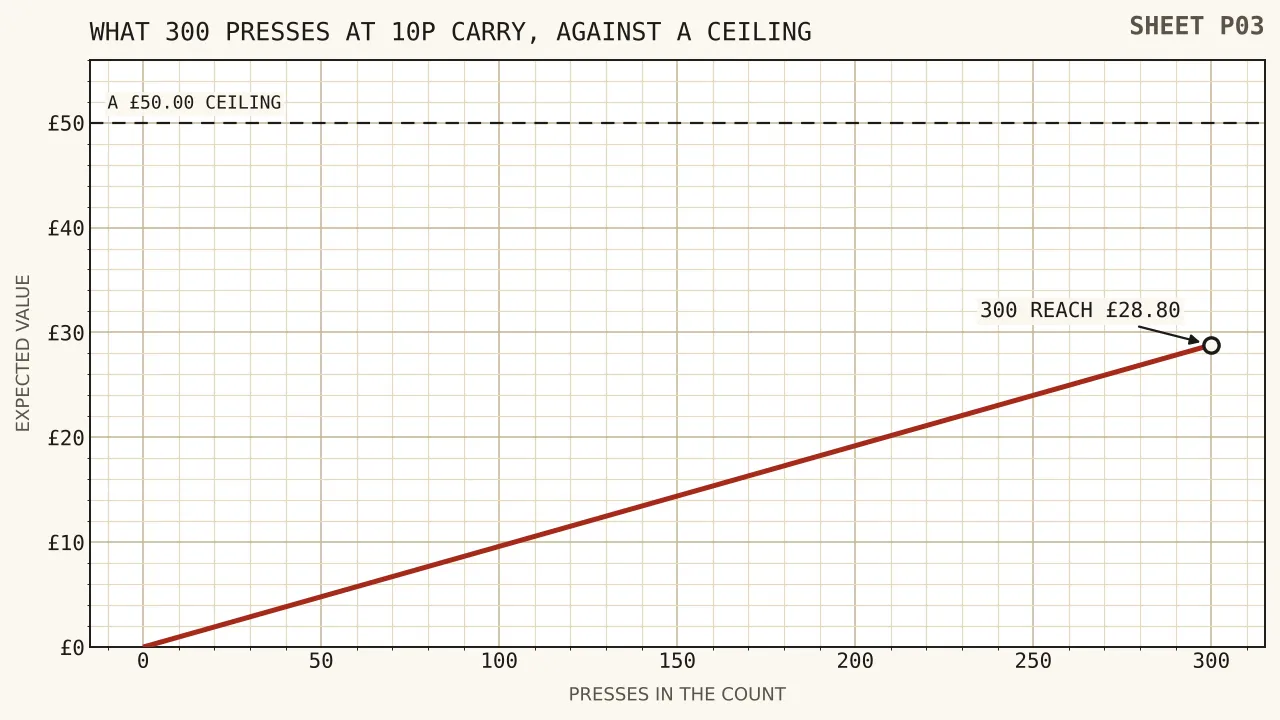
A count attached to a payment has a rate, and the rate is the only figure that compares one offer of this kind with another. Three hundred spins against £10.00 paid in is 30 spins for each pound. At 10p a spin that is £3.00 of stake for each pound handed across, and at the return assumed here it is £2.88 of expectation.
Take the whole offer and the figures are £30.00 of funded stake and £28.80 expected back. Both figures average out across identical spins over the long run, and neither forecasts a single sitting. Both rest on the two numbers declared here: a 10p spin, and 96p back in each pound.
Nothing published fixes what one free spin is worth. The regulator sets no value, names nobody as responsible for setting one, and imposes no duty to disclose it. So the 10p is this site’s assumption and the whole page scales with it: at 5p a spin the same count is £15.00 of stake and £14.40 expected, and at 20p it is £60.00 and £57.60.
What a reader should notice first is that the count is worth nearly three times the payment before any condition is applied. That is unusual in this section, where a percentage match at a ten times demand returns 60p for each pound paid in. A spin count is handed over already paid for, so nothing has to be turned over to release it.
Two things get confused on pages like this one. The count is a number of button presses funded by somebody else. The winnings from those presses are a balance, and a balance can carry a condition. Everything below part four is about conditions on the second thing, because the first one cannot carry any.
2
What the gift costs the house
Do the arithmetic from behind the till instead and the offer changes shape. The count is £30.00 of turnover written, and handing over turnover costs 4 per cent of it where the return is the one assumed here. So the expected cost of the whole count, to the business giving it away, is £1.20.
The payment that unlocks it is £10.00. That is the asymmetry worth carrying away from this page: a reader pays £10.00 of their own money to collect something whose expected cost to the house is £1.20, which is eight and a third times over. The reader is not being given £30.00. They are being given the 4 per cent of £30.00 that the house expects to lose on it.
| What is counted | For the reader | For the house |
|---|---|---|
| Stake funded | £30.00 of spins | £30.00 of turnover written |
| Expected movement | £28.80 coming back | £1.20 expected cost |
| Cash required up front | £10.00 paid in | nothing paid out |
| Position before conditions | £18.80 up on the payment | £8.80 up on the gift |
The last row needs its qualifier in the same breath. A reader expected to be £18.80 up is a reader who has not yet met a wagering condition on the winnings, a cap on what may convert, a floor under what may be withdrawn or a clock short enough to prevent the spins being used. Each of those is priced further down, and any one of them can take the whole £18.80 away.
It is also worth stating what the house gets that is not money. A payment of £10.00 arrives with three verified items attached: the customer’s name, their postal address, their birth date. All three are settled by a licensed cashier before anybody gambles, and the condition treats that trio as a floor and not a finished list. The count is the price of the relationship, not of the turnover.
The same comparison can be run in spins, which is the unit this site prefers. The house writes 300 spins and expects to lose 12 of them, since 4 per cent of 300 is 12. The reader hands over £10.00, which at 10p is 100 spins of their own stake. So the trade is 100 spins of the reader’s money against 12 spins of expected cost to the house, and the gap is the business model of this entire section.
One more figure belongs on that side of the till. A licensed cashier writing 300 spins at 10p has also written £30.00 of turnover into its own duty position, because remote gaming duty is charged on stakes received less winnings paid out. Nothing on this sheet turns that into a figure for any particular business, and the published rate is 40 per cent of profit rather than of turnover, so the point is directional only: a free count is not free of cost to the house, and the cost is a known fraction rather than a mystery.
£1.20 of expected cost against £10.00 paid in
3
The rate against other payments
Hold the count at 300 and move the payment and the rate moves with it. Hold the payment at £10.00 and move the count and the rate moves the other way. The table does both, because the pairing is what a reader is actually choosing between.
| The pairing | Spins to the pound | Stake funded | Expected back | Per pound paid in |
|---|---|---|---|---|
| £5.00 for 100 spins | 20 spins | £10.00 | £9.60 | £1.92 |
| £10.00 for 100 spins | 10 spins | £10.00 | £9.60 | 96p |
| £10.00 for 200 spins | 20 spins | £20.00 | £19.20 | £1.92 |
| £10.00 for 300 spins | 30 spins | £30.00 | £28.80 | £2.88 |
| £20.00 for 300 spins | 15 spins | £30.00 | £28.80 | £1.44 |
| £5.00 for 200 spins | 40 spins | £20.00 | £19.20 | £3.84 |
Two readings come off it. The first is that a headline count means nothing without the payment beside it: 300 spins on £20.00 is a worse rate than 200 spins on £5.00, by a factor of two and a half. The second is that the arithmetic is linear, so a reader can do it in their head by dividing the count by the payment and multiplying by 9.6p.
That last figure is the one to memorise. One spin carries 9.6p of expectation at the figures on this sheet. Thirty spins carry £2.88. Three hundred carry £28.80. Every other sum on this page is that number multiplied or reduced by a condition.
4
Twelve and a half minutes
A count has a running time and nobody prints it. Three hundred spins take 12 minutes and 30 seconds where the pace is one cycle every 2.5 seconds and no quicker, with nobody hesitating anywhere in the run.
The pace is a licence condition rather than a setting, and three further rules keep it there. Automatic play is barred on online gaming, so every cycle takes a separate act. Features that shorten the time to a result are barred as well, turbo and slam stop among them. And a gambling system may not offer functionality for playing two games at once, so the count cannot be split across two screens.
| The count | Floor on the time | Expected back |
|---|---|---|
| 50 spins | 2 m 5 s | £4.80 |
| 100 spins | 4 m 10 s | £9.60 |
| 200 spins | 8 m 20 s | £19.20 |
| 300 spins | 12 m 30 s | £28.80 |
| 500 spins | 20 m 50 s | £48.00 |
Variance is the other thing a short count buys, and it cuts both ways. Three hundred spins at 10p is a small sample of a high-variance game, so the £28.80 expected is an average the reader will rarely land on exactly. A count that finishes at £5.00 and a count that finishes at £80.00 are both ordinary outcomes. What the arithmetic fixes is the centre of the distribution, not the result, and no page can tell a reader which side of it they will be on.
That quarter of an hour is no burden, which is exactly the point. A clock on the spins themselves is the mildest condition in this family: even a 24-hour window leaves 1,439 minutes spare. A clock on a wagering requirement attached to the winnings is a different animal entirely, and the next section prices it.
Where a count arrives in instalments the sums do not change and the attendance does. Thirty spins a day for ten days is still £28.80 of expectation, delivered in ten visits of 75 seconds each. What a schedule adds is ten separate chances for a tranche to expire unused, and each missed day costs £2.88.
5
The condition that moves £28.80
The spins cannot carry a wagering requirement, because they have been paid for already. What they win can. Where the winnings from a count land in a bonus balance, a demand against that balance is the arithmetic of any deposit match, and it runs against the £28.80 rather than against the count.
The working is one multiplication. Take the balance. Multiply the demand by the 4 per cent edge, subtract the result from one, and apply what is left. Ten turnovers keeps 60 per cent of £28.80, which is £17.28. Twenty keeps £5.76. Twenty-five keeps nothing at all, four into a hundred going exactly that many times. Forty is expected to cost £17.28 more than the balance holds.
| The demand | Staking owed | Spins it takes | Cost of that staking | What is left |
|---|---|---|---|---|
| No demand at all | none | none | nothing | £28.80 |
| 10 turnovers | £288.00 | 2,880 spins | £11.52 | £17.28 |
| 20 turnovers | £576.00 | 5,760 spins | £23.04 | £5.76 |
| 25 turnovers | £720.00 | 7,200 spins | £28.80 | nothing |
| 40 turnovers | £1,152.00 | 11,520 spins | £46.08 | short by £17.28 |
The British ceiling puts the top three rows inside the licensed market and the last one outside it. A licensed demand on bonus funds stops at 10 turnovers, which has been the rule since 19 January 2026, and that is what keeps a licensed balance above nought. Nothing has been published either way on whether a spin is itself bonus funds, which leaves the ceiling’s reach over spins unstated. The published part is narrower: winnings landing in a bonus balance carry a demand of 10 at most.
Convert the second row into time and the condition shows its real size. 2,880 spins at the licensed floor pace is 2 hours of pressing, against the 12 minutes and 30 seconds the count itself took. A wagering demand on the winnings is therefore ten times the work of the offer it is attached to, and the work is the part nobody advertises.
6
Ceilings above, floors below
Two further conditions bracket the £28.80 from above and below, and both can be read off the 9.6p a spin carries. Where a ceiling is set on what the winnings may convert to, it replaces the expectation outright. A floor under what may be withdrawn can make the expectation unreachable.
Start above. Divide a ceiling by 9.6p and the answer is the count at which it begins to bind. A £20.00 ceiling binds beyond 209 spins. A £30.00 ceiling binds beyond 313. A £50.00 ceiling bites past 521, which on a count of 300 leaves it clear of the mean and biting only where a run goes unusually well. A £10.00 ceiling binds beyond 105 spins, which means two thirds of the advertised count would be adding nothing at all to the expectation.
| Ceiling in the terms | Bites past | Against 300 spins |
|---|---|---|
| £10.00 | 105 spins | the binding figure, not the count |
| £20.00 | 209 spins | still the binding figure |
| £30.00 | 313 spins | just above the mean |
| £50.00 | 521 spins | well clear of the mean |
| £100.00 | 1,042 spins | irrelevant at this count |
Now below. Where terms set a smallest withdrawal, a balance under that figure cannot be moved at all. The £28.80 expected here clears a £20.00 floor with £8.80 spare and clears a £10.00 floor comfortably. A £50.00 floor would need 1.74 times the mean, which turns an offer with a positive expectation into one that pays out only on a good run.
The two rules that matter here point in opposite directions and are often read as one. The £10.00 handed over sits in a deposit balance, where no term may fix a ceiling on what comes back out. A daily ceiling paired with a weekly one is the example of drafting the guidance rules out. A cap on converting bonus winnings works on another balance and escapes that rule. The £10.00 paid in therefore stays withdrawable whatever the count’s winnings are doing.
7
The desk, and what has to be printed
A payment of £10.00 runs into two sets of published rules before it buys anything: the ones about who the customer is, and the ones about what the advertisement had to say.
On identity, three items are settled first at a licensed desk, and a bonus spin counts as play for that purpose. That same check stands in front of the games a licensee runs with no prize attached, which is as far from a formality as a rule gets: if an account can spin at all, it has been verified.
A limit comes next. Setting a limit is the default where a cashier is licensed, a week and a month sit among the durations offered, and an increase takes 24 hours followed by a fresh confirmation. For a £10.00 payment the interaction is simple, because a £10 daily limit is exactly one day of deposits and 100 spins of stake. An offer wanting £20.00 inside 24 hours is unreachable behind such a limit without lifting it and waiting.
On the advertisement, four kinds of thing count as significant and have to be communicated clearly and prominently where leaving one out would mislead: who is eligible, what has to be deposited and wagered, the time limits for claiming and using, and the bet types or minimum odds. On this offer the second and third of those are the whole story, because the first decides whether £10.00 buys 300 spins and the third decides whether 2,880 spins of wagering can physically be completed.
One published ruling puts a date on the time-limit point. In a case dated 17 July 2024 a deadline missing from an advertisement was held to be a significant condition: a £10 free bet wanted an answer to a text message by a particular hour, and no mention of that appeared in the advertisement. The same logic applies to a spins offer with a 24-hour claim window printed nowhere near the headline.
Consumer advice from the regulator asks players to watch what an introductory offer restricts. Its own example is a level of spend demanded before any bonus gets paid over. On this page that restriction is the £10.00, and the honest way to read the pairing is as a purchase: £10.00 buys 300 spins carrying £28.80 of expectation, less whatever the conditions take.
8
The same 300 spins, off the register
Counts of this size are advertised in volume from outside the British licence. The spins themselves are the same button presses. What differs is every rule standing around them, and the table prices each one against the figures on this page.
| The rule on a licence holder | Its worth on this count |
|---|---|
| A demand on bonus funds held to 10 turnovers | £17.28 of the £28.80 survives instead of nothing at 25 |
| Verification of the customer before any spin | the 300 spins cannot reach an unchecked account |
| 2.5 seconds between slot cycles | 300 spins take 12 m 30 s and cannot be rushed |
| No autoplay and no slam stop | each of the 300 is a deliberate press |
| No two games at once | the count cannot be run on two screens |
| A stake cap of £5 a cycle, £2 under 25 | the wagering cannot be cleared in ten huge spins |
| A limit put up at the first payment in | one £10 day funds 100 spins of stake |
| No cap on withdrawals from the deposit balance | the £10.00 paid in stays the reader’s |
| An answer to a complaint inside 8 weeks | and an approved adjudicator waiting after that |
| Enrolment with the national exclusion scheme | one sign-up and the licensed market closes |
The offshore rulebook this site could read sets no ceiling on a turnover demand at all, which is the line that matters most to a count like this one. Where the winnings carry 40 turnovers rather than 10, the expected £28.80 becomes a shortfall of £17.28, and the reader funds the difference out of the £10.00 they paid and whatever follows it.
Two protections a reader can still use belong at the end. The scheme says as much itself: a business that stays outside it is beyond its reach. So a registered reader shown an offer from past the register is being shown something that registration never covered. A gambling block set by a bank belongs in the same family of protections, and no help getting around one appears on this page, deliberately.
Tax is the only line that crosses the border unchanged. An offshore cashier is inside British gaming duty once a person who usually lives here plays remote gaming with it, at 40 per cent of profit, so a missing licence saves the reader nothing and costs them every row above.
Questions
- On a tenner, what are 300 free spins worth?
- £30.00 of funded stake and £28.80 of expectation, at 10p a spin and a 96 per cent return. Per pound paid in that is 30 spins and £2.88. The figures average identical spins over the long run instead of predicting a session, and this sheet declares both assumptions instead of borrowing them from a rule.
- How much does the offer cost the business giving it?
- £1.20 in expectation. The count writes £30.00 of turnover, and 4 per cent of whatever passes through is what the game is expected to keep. The reader pays £10.00 to collect it, which is eight and a third times the expected cost of the thing.
- Is 300 spins on £10 a better rate than 200 spins on £5?
- No. Three hundred on £10.00 is 30 spins to the pound, worth £2.88 of expectation for each pound in. Two hundred on £5.00 is 40 spins to the pound, worth £3.84. The headline count is larger and the rate is a third worse, which is why the payment has to be read beside the count.
- How long do 300 spins take?
- Twelve minutes and thirty seconds at the floor pace, where no cycle may begin until 2.5 seconds after the last one did. Barred are autoplay, the features that shorten a result, and running two games together, so nothing cuts that figure down. A 24-hour claim window leaves 1,439 minutes spare.
- What does a wagering requirement on the winnings do?
- It runs against the £28.80, not against the count. Ten turnovers leaves £17.28, twenty leaves £5.76, twenty-five leaves nothing, and forty is expected to cost £17.28 more than the balance holds. Ten turnovers also means £288.00 of staking, which is 2,880 spins and about two hours at the licensed pace.
- When does a maximum win cap start to matter?
- Divide the cap by the 9.6p one spin carries. A £10.00 cap binds beyond 105 spins, £20.00 beyond 209, £30.00 beyond 313 and £50.00 beyond 521. On a count of 300 a £50.00 cap stays clear of the mean and bites only on a lucky run, while a £10.00 cap leaves two thirds of the advertised count worth nothing.
- Can the site stop me withdrawing the £10 I paid in?
- Fencing in the deposit balance is what no term may do, and the guidance illustrates the forbidden sort with a daily figure set beside a weekly one. Converting bonus winnings is capped on a different balance, outside that prohibition, so a single set of terms can hold both without contradicting itself.
- What is the most a licensed site can demand on the winnings?
- Ten turnovers of the bonus funds. That has applied since 19 January 2026, across all licences but the gaming machine technical and software ones. Whether a spin itself amounts to bonus funds is unpublished in both directions. The chain of published wording stops here: winnings landing in a bonus balance carry 10 turnovers at most.
- What changes when the cashier is unlicensed here?
- The ceiling on the demand goes, so 40 turnovers on the winnings is available and turns £28.80 of expectation into a £17.28 shortfall. Gone too: verification first, the 2.5 second cycle, the bans on autoplay and slam stop, the stake caps, the limit at the desk, the rule against capping a deposit balance, the 8-week answer with an approved adjudicator behind it, and enrolment with the scheme that shuts the licensed market in one go. The operator is still inside British duty at 40 per cent of its profit.