Sheet D14 Revision 1 Counted 16 October 2026
150 free spins no deposit: £14.40 of expectation, and what thins it
A hundred and fifty turns at 10p apiece is £15.00 of staking that the reader never funded, and £14.40 of that is what a 96 per cent game hands back on average. This is the count this site is named for, so it gets the full treatment: the pence, the seconds, the instalments, the floor, the ceiling and the multiple, each with its own number attached.
Turns awarded 150 One turn 10p Expected £14.40
What a count of this size comes to
Every destination on this board is bought advertising. The site takes a fee if a reader goes on to register, and no figure printed below moves because of it.
The Spin Count
Gauge No 01
Betportal
Lowest multiple here
Priced at this site's own 10p a spin
What is counted
What is asked
No Great Britain licence
Licensed in Anjouan, Comoros, run by BetPortal Gaming Ltd, with Excite Ultra Media Ltd, reference ALSI-202601040-FI2.
Terms read 16 October 2026
Open the offer at Betportal, opens in a new tabThe Spin Count
Gauge No 02
WinBeast
Largest count here
Priced at this site's own 10p a spin
What is counted
What is asked
No Great Britain licence
Licensed in Curaçao, operator not named on the site.
Terms read 16 October 2026
Open the offer at WinBeast, opens in a new tabThe Spin Count
Gauge No 03
EliteSpin
Longest spin window
Priced at this site's own 10p a spin
What is counted
What is asked
No Great Britain licence
Licensed in Costa Rica, run by PrimeTier Limited.
Terms read 16 October 2026
Open the offer at EliteSpin, opens in a new tabThe Spin Count
Gauge No 04
Crown Jewelz
Multiple unpublished
No foot figure struck
What is counted
What is asked
No Great Britain licence
Licensed in Curaçao, number not verified, operator not named on the site.
Terms read 16 October 2026
Open the offer at Crown Jewelz, opens in a new tabThe figure in the third register is this site's own arithmetic and nothing an operator has published: the count at face, less the share a spin gives back at 96 per cent return to player, less what playing the wagering through costs at the same return. It describes the offer, not one reader's afternoon. Where the conditions price above the count the counter prints nothing rather than a negative sum, and where a figure the sum needs is unpublished it prints the condition in the operator's words instead.
A count has no unit of its own, so one is supplied. Where an operator publishes what a spin of its own is worth, that figure stands in the second register and is labelled as theirs. Where it does not, the second register carries this site's own 10p a spin and says so, and the foot figure moves in proportion: at half the price, half the money. The figure after it, what the count comes to for each spin, is the one that compares a large count against a small one.
Three words stand in the amount column where no figure can. Noted is a published condition that takes value away without leaving the sum a figure to take. Unpriced is a condition whose figure nobody has published, or a credit that is not a sum until a deposit of your own sets it. Own money is money of yours, which is never part of a foot figure.
Not one of the operators printed above holds a Great Britain licence, so the duties that licence carries do not reach them. Every online gambling company licensed in Great Britain has to be part of Gamstop Online, and a reader who has shut themselves out through the scheme is therefore not shut out here. The ceiling of ten times the bonus funds on a wagering requirement, in force since 19 January 2026, is a condition of that licence and binds the companies that hold one. Where a dispute goes instead is a matter for the authority named on the counter, and the Gambling Commission describes what a reader faces without a British licence as a lack of recourse if things go wrong. Nobody under 18 may hold an account at any of them.
Every term printed on a counter is the operator's own, and each counter carries the day it was read. The oldest of those readings is 16 October 2026. What binds a reader is the operator's own full terms, and not a line printed here.
1
A hundred and fifty of what
This site takes its name from a count, and the count is the part of the offer that means least. A hundred and fifty is a tally of turns on a set of reels. Until somebody prices one turn, the tally converts into no amount of money whatever, and the headline is a number wearing a unit it never shows.
Three figures finish the job. The tally is 150. A turn costs 10p, which is the price declared across this site. The reels keep 4p in the pound and hand 96p back. So £15.00 of staking passes through the game, and £14.40 is the long-run mean of what comes out.
Precision about what that mean is worth matters. It averages over an indefinite number of identical sets of 150 turns. One set of 150 on a volatile slot will more often finish below £14.40 than above it, with the shortfall made up by the rare large hit. The mean is not a forecast for Tuesday night. It is the only figure on which a tally of 150 and a tally of 40 can be set side by side and compared honestly.
Where the 60p goes is worth one line, because it is the whole of the house’s take on this award. Four per cent of £15.00 is 60p. That is small in isolation. Put a wagering multiple on the proceeds and the same 4 per cent is charged again on every pound of turnover, which is why part six of this sheet deals in hundreds rather than pence.
Nothing published anywhere reachable sets the price of a free turn, names the party who sets it, or compels anyone to print it. The pence are commercial. The published standards give less than a reader might hope for. Material bearing on the chance of winning must be within easy reach before a commitment to gamble is made, and any of four things discharges that duty. The margin will do. So will the return percentage, or the probability of the winning events, or an account in words of how the game operates and how prizes are allotted. An “or” joins them, so no licensed site is obliged to print a return figure at all.
Two assumptions, declared rather than discovered, run every calculation here: 10p for one turn and 96 pence back in the pound. A reader who thinks their own award is priced at 25p can rerun the whole sheet by multiplying the money columns by 2.5, and a reader on a game publishing 94 per cent can scale the expectation by 0.979. The arithmetic is laid out so that either substitution is one step.
2
Six minutes and fifteen seconds, at the legal floor
A count has a duration and no advertisement prints it. On a licensed slot the technical standards fix the pace: once a game has started, 2.5 seconds must pass before the following cycle may begin. Multiply by 150 and the tally occupies 375 seconds, which is six minutes and fifteen seconds of pressing with no pause for thought at any point.
Three further rules hold that floor down. For each cycle the control has to go up and come down again, or an equivalent action be taken, so a button held under a thumb advances nothing. Features that shorten the wait for a result are out, named in the guidance as turbo, quick spin and slam stop. Autoplay is unavailable too, under a separate requirement obliging the system to take a fresh commitment for every cycle. On a licensed product there is no mechanism for getting through 150 turns faster than 375 seconds.
Set that against the windows an award usually carries and the comparison is lopsided. A 24-hour window holds 230 runs of 375 seconds. A 72-hour window holds 691. A seven-day window holds more than sixteen hundred. The clock on the turns themselves is the gentlest condition in this sheet, and a reader who misses it has usually mislaid the award rather than run out of time.
The clock that bites is the one attached to turnover, and part six prices it. One line of it belongs here: clearing ten times on £14.40 means 1,440 further turns, which at the lawful floor is sixty minutes exactly. A 24-hour window around that is comfortable. An hour is not, and the same hour printed next to a fortyfold multiple would demand 3,840 turns, or two hours and forty minutes, which cannot be done inside it on a licensed site at all.
375 seconds for the award, 3,600 for a tenfold clearance of what it wins
3
The same count, handed over in tranches
A hundred and fifty is a convenient number to divide, which is why awards at this size so often arrive in instalments. The arithmetic to hold on to is that splitting a tally changes nothing about its expectation. A hundred and fifty turns is £14.40 of expectation whether it lands in one piece or in fifteen. What the split changes is attendance, and the number of separate clocks with an opportunity to expire.
Price the attendance rather than the turns and a schedule declares itself. The table below takes the common divisions of 150, gives the visits each one demands, and converts a visit into the seconds it occupies at the lawful minimum pace.
| How it arrives | Visits | Seconds a visit | Expectation a tranche | Cost of missing one |
|---|---|---|---|---|
| 150 at once | 1 | 375 | £14.40 | £14.40 |
| 50 a day for 3 days | 3 | 125 | £4.80 | £4.80 |
| 30 a day for 5 days | 5 | 75 | £2.88 | £2.88 |
| 25 a day for 6 days | 6 | 62.5 | £2.40 | £2.40 |
| 15 a day for 10 days | 10 | 37.5 | £1.44 | £1.44 |
| 10 a day for 15 days | 15 | 37.5 every other visit | £0.96 | £0.96 |
Two readings matter. The first: the right-hand column is the real content of a schedule. Where a tranche expires on the day of its arrival, a skipped day deletes that day’s expectation in full. Skip four days of a fifteen-day drip and £3.84 has gone, which is a quarter of the award, lost to a diary rather than to a slot.
The second reading is about commitment. Fifteen visits of under a minute apiece is a fortnight of small obligations, and nobody counts the fortnight as part of the price. A year-long version makes it vivid: ten turns a week for fifty-two weeks is 520 turns, £52.00 of staking and an expected £49.92, spread across fifty-two separate returns to the site. The expectation is handsome and the attendance is a subscription.
One licensed-market rule cuts directly across the instalment model. Three things a gambling product may not do: urge a customer to chase a loss, press a bigger stake on them, or keep them playing after they have said they want to finish. Guidance under the requirement adds that a customer who has elected to leave should not be lured back in, and the lure it names is a free game. Daily turns on a calendar amount to an invitation to come back, and a licensed site has to withdraw that invitation at the point the customer withdraws.
A second timing duty attaches where an account shows activity across any rolling year. At intervals of six months or less, its holder must be prompted to look over their own account history and their transactions, and facilities for more frequent reminders have to be there as well. The readers most exposed to a fifty-two week drip are precisely the readers those prompts were drafted for.
4
A withdrawal floor this count can clear
At 150 turns the smallest-payout condition changes character. Below about a hundred turns a ten pound floor sits above the average and the award is unpayable on the mean. Here the mean is £14.40, so a ten pound floor is cleared with £4.40 to spare, and this is the first count in the section where the ordinary outcome is a payable one.
The method is one division. Floor over expectation returns the multiple of the average that has to be beaten. Below 1.00 the average clears it. Above 1.00 the reader needs luck, and the further above, the more of it.
| Smallest payout the terms allow | Multiple of the mean required |
|---|---|
| £5.00 | 0.35, cleared comfortably |
| £10.00 | 0.69, cleared on the mean |
| £14.40 | 1.00, the mean exactly |
| £20.00 | 1.39 |
| £30.00 | 2.08 |
| £50.00 | 3.47 |
Read the bottom row with the volatility of a slot in mind. Needing 3.47 times the mean is not impossible on 150 turns, since a single decent feature round can do it. It is simply unlikely, and the offer’s advertised value and its ordinary value have parted company by then.
Two things sit under all of this and they are regularly confused with one another. A smallest-payout rule and a ban on capping withdrawals are not opposites. The ban belongs to money the player paid in. A term that limits what may come back out of a deposit balance is prohibited, and the regulator’s model clause sets a £50 daily maximum beside a £500 weekly one. Money won from a free award, before it is cleared, is a different balance under a different set of terms. One document can honestly carry both a ban on the first and a condition on the second.
The regulator’s consumer guidance tells a player what to look for here, and the thing it names is a spend level demanded before a bonus gets paid over. That guidance was published on 20 September 2020 and last updated on 23 August 2021, which is older than most of what this site cites, so the current wording on identity and terms sits in the licence conditions rather than in it.
5
A ceiling, and the turn it starts to cost
A maximum-win term does not scale an award down. It substitutes a number for the whole calculation. Fix a stated sum as the most that may ever leave the account and the award’s expectation is bounded by that sum, whatever tally the banner carried.
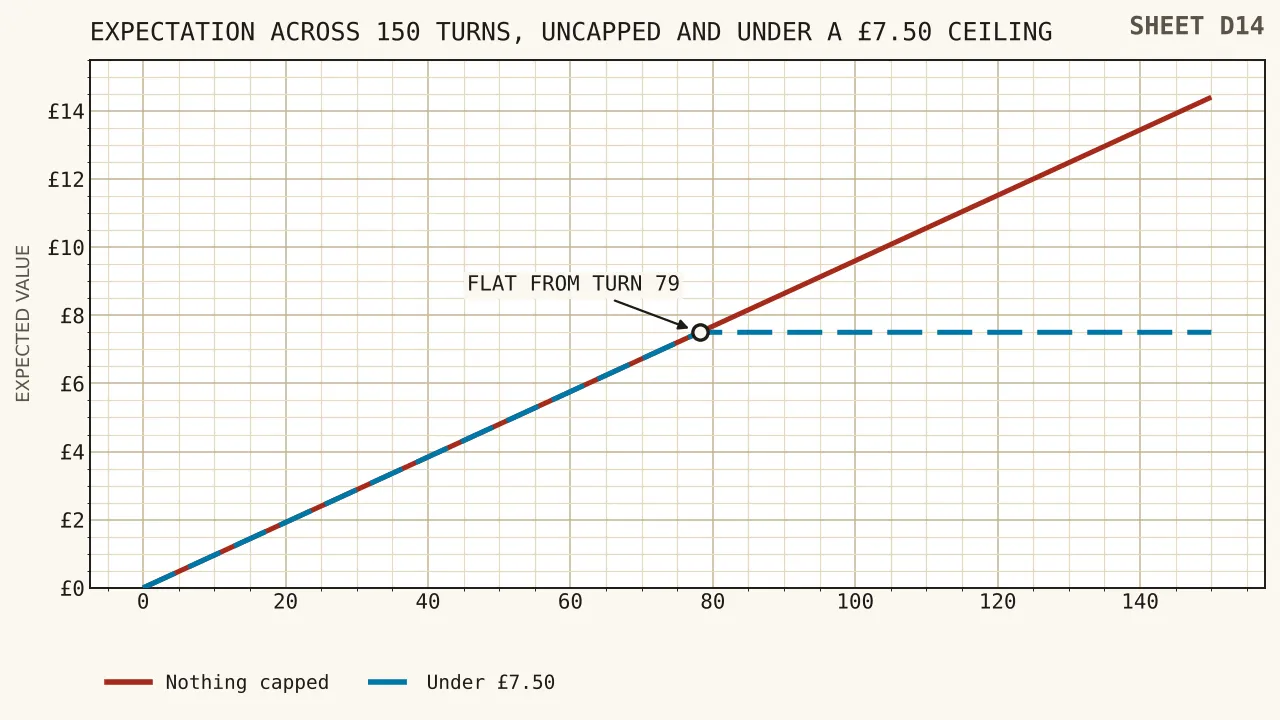
One turn adds 9.6p to the expectation at the prices here, so dividing a ceiling by 9.6 gives the turn at which the mean arrives at it. Below that turn the ceiling is decoration. At and beyond it the ceiling is the offer.
| Ceiling on the winnings | Mean arrives at turn |
|---|---|
| £2.50 | 27 |
| £7.50 | 79 |
| £12.50 | 131 |
| £14.40 | 150, the last turn of the award |
| £25.00 | 261, beyond the award entirely |
So a ceiling at £14.40 or anything over it leaves this count alone, while a ceiling at £7.50 cuts the expectation of 150 turns to roughly half, and the 71 turns after the 79th contribute nothing at all to the expectation. That is the sharpest way to read a win cap: it converts the back half of a generous tally into decoration.
Nothing published fixes a usual maximum-win figure for bonus proceeds, so the ceilings above were chosen as round sums around the award’s own mean. Take the method and run it against whatever figure appears in a particular set of terms, which is the only figure that matters.
6
What a multiple on the winnings costs
The turns themselves carry no requirement, since they are not funds and were paid for before the reader arrived. Their proceeds are another matter. Where winnings from an award land in a bonus balance, a requirement on that balance works exactly like the requirement on a deposit match, with the sums arriving in a different order.
The working is one subtraction and two multiplications. Multiple times edge, taken away from 1, times balance. With the balance at £14.40 and the edge at 4 per cent, ten times retains three fifths, twenty times retains a fifth, and twenty-five times retains nothing, because a multiple of twenty-five against a 4 per cent edge consumes the lot.
| Multiple | Turnover owed | Turns at 10p | Minutes at the legal floor | Expected to survive |
|---|---|---|---|---|
| None on the proceeds | nothing | nothing | nothing | £14.40 |
| Five times | £72.00 | 720 | 30 | £11.52 |
| Ten times | £144.00 | 1,440 | 60 | £8.64 |
| Fifteen times | £216.00 | 2,160 | 90 | £5.76 |
| Twenty times | £288.00 | 2,880 | 120 | £2.88 |
| Twenty-five times | £360.00 | 3,600 | 150 | nothing |
The fourth column is this sheet’s own addition and the one readers find most persuasive. A requirement is not only a sum of money; it is an obligation measured in button presses and in minutes. Twenty times on this award is 2,880 turns and two hours of lawful pressing, to arrive at an expected £2.88. The headline that opened the page was 150 turns.
Contribution rates can stretch those minutes further. A game that counts at below face value converts each staked pound into less progress than a pound. Respondents to the regulator’s consultation quoted 30 per cent as a rate in use, and at that rate the £144.00 of progress in the tenfold row needs about £480.00 of actual staking, which is 4,800 turns and three hours and twenty minutes at the floor pace. The rate is theirs; the conversion into hours is this sheet’s.
7
The roof over a requirement, and its reach
Half the rows in that table are unavailable to a British licensee. Social responsibility code provision 5.1.1 puts a roof on wagering requirements attached to incentives, and the roof is ten times the bonus funds. 19 January 2026 is the day it started to bite. The provision defines the requirement it caps as wagers totalling a stated value before funds turn withdrawable, and it caps the multiple only: nothing else about an incentive is touched by it.
Reach is as important as the number. The roof covers all licences, ancillary remote ones included, excepting gaming machine technical and software licences. Every remote casino licence is therefore inside it, and so is every licensed free-turn award in Great Britain. A set of terms demanding fifteen or twenty times the proceeds is, by that fact alone, a set of terms from outside this jurisdiction.
The regulator’s own figure for what the roof replaced is sixty times, applied by some licensees before the change. Sixty times on £14.40 would be £864.00 of turnover, 8,640 turns, six hours of pressing at the lawful floor, and an expectation of minus £6.34. That is what the ceiling was fixed to stop.
A second provision landed the same day and governs how an award may be assembled. Across the four types the provision names, which are lottery, bingo, casino and betting, one incentive may reach only one. Three recorded carve-outs cut against the obvious reading. Combining two products drawn from a single type is allowed, and the instance given is a lottery scratchcard next to a raffle. Two separate offers, one for betting and one for casino, may travel in a single email where consent to market both products is in place. Open credit falls outside the ban in its entirety, the illustration offered being £10 that a customer may put on betting or casino as they choose.
Two questions at the roof’s edge have no published answer and this sheet leaves them open. Bonus funds are what the capping language bites on. Whether a gifted turn counts as one of those funds has never been settled in print. Nor has the treatment of a multiple computed over deposit and bonus together, in place of the bonus by itself. What can be said runs exactly this far: proceeds credited into a bonus balance carry a multiple of no more than ten, which on this award means £144.00 of turnover and not a penny more.
8
If it goes wrong: the clocks a complaint runs on
An award of 150 turns is worth £14.40 in expectation, which is small enough that a reader may wonder whether a dispute over it is worth anybody’s afternoon. The answer depends entirely on which side of the licence the account sits, and the British side runs on published clocks.
Acknowledgement comes first. A complaint should be acknowledged as soon as reasonably possible, and in any event inside three working days of its arrival. An operator running gambling at all hours should get that acknowledgement out within a day. The whole process, internal escalation included, must finish no later than eight weeks from first receipt, a limit the guidance sources to social responsibility code provision 6.1.1.2.
The window for starting runs the other way. The right to complain has to stay open six months at least, counted from the incident itself. An operator may press a customer to come forward sooner, and may not rely on a term shutting out a complaint brought within that half-year.
Stopping the eight weeks is possible. Seven days of silence from a customer, in the face of a reasonable information request, may make it reasonable to stop the clock. It restarts where it stopped once they answer, rather than running again from the top. Three things belong in the closing letter: why the decision went as it did, confirmation that nothing further happens inside the operator, and the route onward to an independent dispute body.
That last step is where approval matters. Approval is the gate here. Eight bodies sit on the regulator’s list, and a licensee may appoint one of those and nothing else. They are ADR Group; Blexr Limited; eCOGRA; IBAS; Pegasus ADR Service; ProMediate; the Tattersalls Committee; and CEDR, which is the Centre for Effective Dispute Resolution. Sector coverage differs between them, which matters to somebody holding a casino award. Five carry remote across all sectors, namely IBAS, eCOGRA, CEDR, Blexr and ADR Group. ProMediate and the Tattersalls Committee appear for all sectors in the page’s table, although the Tattersalls Committee’s own entry lists betting alone. Pegasus ADR Service instead appears against four settings away from the internet: adult gaming centres, family entertainment premises, bingo halls, and public houses with members clubs. Remote casino is not among them. The page was published on 17 May 2021 and last updated on 15 January 2025.
One expectation needs correcting before it causes a wasted afternoon. Individual disputes are not settled by the regulator, which puts the matter in five words of its own: it is not an ombudsman. Three statements follow in its own material. Settling a gambling complaint is not within its powers, and neither is recovering money for a consumer. Neither a stuck withdrawal nor a broken game is within its power to settle. Customer accounts are not visible to it. Where it points instead is at the business first and the approved body after.
3 working days, 8 weeks, 6 months, 8 approved bodies, and a regulator that settles nothing
9
Who has to do what, and who does not
Tallies at this size are pushed hardest from outside Britain, and an offer printed out there holds no Great Britain licence. Part eight’s duties, and those set out further down, belong to a licence and not to a website, so an award carries none of them abroad. Put as questions and answers, the position is this.
Whose duty is it to pin down a name, a date of birth and a postal address before turn one? A British licence holder, under condition 17.1.1, and the same check has to be done before bonus play, before free-bet play and before any no-stake version of the games. Who must refuse a credit card, including one routed through a money service business? A British licence holder, since 14 April 2020. Who must raise the subject of a financial limit during registration, or when the first money goes in; present the limit as the default choice; extract a positive act from anybody declining one; carry durations of a day, a week and a month; cut a limit at once when asked; and sit on any increase for a day? A British licence holder, under the financial-limit standard. Who must leave a withdrawal request standing, with no option to cancel it? A British licence holder. Who must hold slot cycles 2.5 seconds apart, decline to sell turbo or slam stop, refuse to run a second game alongside the first, and keep the fanfare off any result at or beneath the stake? A British licence holder. Who must keep a single slot cycle inside £5, or inside £2 for a customer under the age of 25? A British licence holder, under regulations made on 25 February 2025. Who must belong to the national online self-exclusion scheme? Any online gambling business holding a British licence, which is how the scheme itself puts the boundary of its reach.
The answer to each of those questions, on an unlicensed site, is nobody. That is the honest shape of the comparison, and it is more useful than a verdict.
The offshore rulebook is not empty, though, and this sheet reads it rather than guessing at it. Dated 21 February 2025, and at its first version, the Curaçao responsible gaming policy sets out what it makes mandatory. The list: verification of age; information kept accessible; self-assessment for players; tracking of behaviour; player-run cooling-off and exclusion; limits on deposits; training for staff, affiliates, marketing partners and influencers; and general principles on marketing. Absent from the whole document are a cap on wagering, a stake limit, a minimum game cycle, any restriction on autoplay and any rule about celebrating a small return.
Three of its provisions are worth reporting because they are stronger than a reader expects. Four cooling-off lengths have to be on offer there, those being 3 months, 1 month, 7 days and 24 hours. One click has to be enough, with no email to send and no operator sign-off to wait on, the pause starts immediately, and it can be set product by product. Discouraging a player from taking one is forbidden to the operator, and three ways of discouraging are named: querying the decision, holding out reassurance so that it gets deferred, and dangling a promotion so that play continues. Affiliates are reached head on. Compliance by an affiliate with responsible gaming standards is put on the operator, enforced by three means the policy names: binding contracts, audits of compliance, and penalties for failure. Britain’s own advertising guidance for operators does not address affiliates in those terms at all.
The same policy tells its licensees to point players at British help. Six items are required in the footer. The licence holder has to be named. Its registered address has to appear, as does the licence number. A sentence has to say that the authority supervises the site, and the authority’s own digital seal has to be shown. Last of the six is a link to the policy on responsible gaming. A seventh item is a link out to help for a gambling addiction, with local and international resources both wanted, and GamCare, Gamblers Anonymous and GambleAware printed as the examples.
Self-exclusion is where the gap opens widest, and the British scheme describes the gap in its own terms. Participating operators are the extent of what it can exclude a person from. Where an organisation stays outside the scheme, its services are, on the scheme’s own statement, past the help available. Out there it works operator by operator. An exclusion covers whatever domains the operator in question runs, and elsewhere on the internet the policy’s remedy is encouragement to go and repeat the exercise. Nothing here assists anybody in getting round an exclusion, and the helpline below is open at every hour of the year.
Tax is the one duty an absent licence does not shake off. Wherever it is based, an operator taking remote gambling from somebody whose ordinary home is in the United Kingdom falls within British gaming duty and has to register for it. Remote gaming carries 40 per cent on operator profits, and 1 April 2026 is the date that rate began. Nothing in that touches the player, who is not the one charged, and nothing in it depends on where the licence came from.
Questions
- What is a 150 free spins no deposit offer worth in money?
- £14.40 as a long-run average, worked at 10p for one turn and a 96 per cent return on £15.00 of staking. The 60p that does not come back is the house edge across the whole award. Those two assumptions are declared rather than published, because no rule anywhere fixes what a free turn is worth.
- How long does it take to play 150 free spins?
- Six minutes and fifteen seconds, or 375 seconds, which is the floor that a licensed slot’s pace rule puts under 150 turns. 2.5 seconds must separate the start of one cycle from the start of the next, the control has to be let go and pressed for each one, and none of autoplay, slam stop, quick spin or turbo is available, so nothing shortens the tally.
- Is an award paid in daily instalments worth less than one paid at once?
- Not in expectation. Thirty turns a day for five days averages the same £14.40 as 150 turns in one sitting. What changes is attendance and the number of clocks that can run out: on that schedule each missed day deletes £2.88, and on a fifteen-day drip of ten turns a day each missed day deletes 96p.
- Can I withdraw what 150 free spins win?
- That depends on two figures rather than one. The mean of £14.40 clears a ten pound smallest-payout rule with £4.40 to spare, which makes this the first count in this section whose ordinary result is payable. At £20 the rule asks 1.39 times the mean, and at £50 it asks 3.47 times. Separately, and on a different balance, a ceiling on withdrawals of money paid in is prohibited.
- When does a maximum win cap actually cost me something?
- Divide the cap by 9.6p, the amount one turn adds to the expectation here. A £7.50 cap is reached by the mean at turn 79, so the last 71 turns of the award add nothing. A cap at £14.40 or above is reached only at the final turn or not at all, and leaves the expectation of the award untouched.
- What does a tenfold wagering requirement cost on this award?
- £144.00 of turnover, which is 1,440 turns and sixty minutes of pressing at the lawful floor pace, and it leaves an expected £8.64 of the £14.40. At twenty times the turnover is £288.00, two hours of pressing, and an expected £2.88. At twenty-five times the expectation is nothing at all.
- How much wagering may a British licensed site demand?
- The limit is a multiple of ten on the bonus funds. It arrived with code provision 5.1.1 and has bound licensees since 19 January 2026. Beforehand some licensees were asking sixty times over, a figure that comes from the regulator. On a £14.40 balance, sixty times would have meant £864.00 of turnover and an expectation below zero.
- What happens if a dispute about the award goes nowhere?
- On a British licence there are clocks. Acknowledgement has to be out inside three working days, or inside a single day at an operator trading at every hour, and eight weeks is what the full process gets. A complaint may be brought for at least six months after the incident. The case then moves to one of the eight dispute bodies the regulator approves, five of which carry remote across every sector.
- Can the Gambling Commission recover the money for me?
- No. Its own description of itself is that it is not an ombudsman. What it publishes about itself is four negatives: no power to settle a gambling complaint, no power to recover a consumer’s money, no sight of a customer account, and no means of dealing with a faulty game or a stuck withdrawal. Complain to the business first, then to the approved body it names.
- What is given up on an offshore award of 150 spins?
- All of the duties set out in part nine. Such an offer sits behind no Great Britain licence, and a duty of that sort attaches to a licence rather than to a web page. On the list: a birth date verified before bonus play, a refused credit card, the financial-limit regime, 2.5 seconds between cycles, £5 and £2 as slot stake ceilings, ten times as the roof on a multiple, eight weeks and then an approved body for a complaint, and enrolment in the national online scheme that excludes a player at every licensee. Gaming duty is the one thing that still reaches the operator, since liability follows where the player ordinarily lives.