Sheet D12 Revision 1 Counted 16 October 2026
£20 free no deposit casino: 200 presses, and the cap measured against deposits
Twenty pounds of credit is 200 presses at 10p, and it comes through a tenfold requirement with £12.00 intact. One clause shape on this market undoes that completely: a cap on conversion set at the player’s lifetime deposits. Where nothing has been deposited, lifetime deposits are nought, and nought is what converts. This sheet prices that, and the deposit it quietly requires.
The credit £20 bonus One spin 10p Comes to £12.00 at tenfold
What a credit of this size comes to
Every destination on this board is bought advertising. The site takes a fee if a reader goes on to register, and no figure printed below moves because of it.
The Spin Count
Gauge No 01
Betportal
Lowest multiple here
Priced at this site's own 10p a spin
What is counted
What is asked
No Great Britain licence
Licensed in Anjouan, Comoros, run by BetPortal Gaming Ltd, with Excite Ultra Media Ltd, reference ALSI-202601040-FI2.
Terms read 16 October 2026
Open the offer at Betportal, opens in a new tabThe Spin Count
Gauge No 02
WinBeast
Largest count here
Priced at this site's own 10p a spin
What is counted
What is asked
No Great Britain licence
Licensed in Curaçao, operator not named on the site.
Terms read 16 October 2026
Open the offer at WinBeast, opens in a new tabThe Spin Count
Gauge No 03
EliteSpin
Longest spin window
Priced at this site's own 10p a spin
What is counted
What is asked
No Great Britain licence
Licensed in Costa Rica, run by PrimeTier Limited.
Terms read 16 October 2026
Open the offer at EliteSpin, opens in a new tabThe Spin Count
Gauge No 04
Crown Jewelz
Multiple unpublished
No foot figure struck
What is counted
What is asked
No Great Britain licence
Licensed in Curaçao, number not verified, operator not named on the site.
Terms read 16 October 2026
Open the offer at Crown Jewelz, opens in a new tabThe figure in the third register is this site's own arithmetic and nothing an operator has published: the count at face, less the share a spin gives back at 96 per cent return to player, less what playing the wagering through costs at the same return. It describes the offer, not one reader's afternoon. Where the conditions price above the count the counter prints nothing rather than a negative sum, and where a figure the sum needs is unpublished it prints the condition in the operator's words instead.
A count has no unit of its own, so one is supplied. Where an operator publishes what a spin of its own is worth, that figure stands in the second register and is labelled as theirs. Where it does not, the second register carries this site's own 10p a spin and says so, and the foot figure moves in proportion: at half the price, half the money. The figure after it, what the count comes to for each spin, is the one that compares a large count against a small one.
Three words stand in the amount column where no figure can. Noted is a published condition that takes value away without leaving the sum a figure to take. Unpriced is a condition whose figure nobody has published, or a credit that is not a sum until a deposit of your own sets it. Own money is money of yours, which is never part of a foot figure.
Not one of the operators printed above holds a Great Britain licence, so the duties that licence carries do not reach them. Every online gambling company licensed in Great Britain has to be part of Gamstop Online, and a reader who has shut themselves out through the scheme is therefore not shut out here. The ceiling of ten times the bonus funds on a wagering requirement, in force since 19 January 2026, is a condition of that licence and binds the companies that hold one. Where a dispute goes instead is a matter for the authority named on the counter, and the Gambling Commission describes what a reader faces without a British licence as a lack of recourse if things go wrong. Nobody under 18 may hold an account at any of them.
Every term printed on a counter is the operator's own, and each counter carries the day it was read. The oldest of those readings is 16 October 2026. What binds a reader is the operator's own full terms, and not a line printed here.
1
Twenty pounds, converted
Two hundred presses at ten pence apiece is what twenty pounds of credit buys. Those presses carry an expected £19.20 when sent straight through a 96 per cent game, eighty pence of the stake staying behind. Eight minutes and twenty seconds is their duration at the lawful floor speed.
A credit is also a balance, though, and conditions fasten onto balances. That distinction runs through this whole section of the site: a press has been paid for already and can carry no play-through, while twenty pounds sitting in a bonus balance can carry one of up to ten times.
So two figures start the page and they are not interchangeable. The presses are expected to return £19.20. The balance a requirement computes against is £20.00. Which of the two a condition attaches to is settled by the terms and never by the headline.
| The line being counted | Figure |
|---|---|
| Credit advertised | £20.00 |
| Presses it buys at 10p each | 200 |
| Expected return on those presses | £19.20 |
| Balance a requirement works against | £20.00 |
| Survives a tenfold requirement | £12.00 |
| Shortest lawful run of 200 presses | 8 minutes 20 seconds |
Ten pence a press and 96 per cent back are assumptions this site declares rather than figures it found in a rule. Nothing in print settles what a free press is worth, and a licensed game is not obliged to publish a return percentage, four alternatives each being enough to satisfy that duty on their own. Where an offer prints its own figures, use those and every total here rescales.
2
The ladder on a twenty pound balance
Scaling is all the arithmetic of a requirement amounts to. One turn costs an expected four per cent of whatever balance it clears, four per cent being the fourpence a 96 per cent game keeps out of each pound, and the survivor comes to the credit multiplied by one less that four per cent times the multiple.
| If the terms ask for | Turnover due | Presses to produce it | Pressing time at the floor | Left at the foot |
|---|---|---|---|---|
| Nothing whatever | none due | none | none | £20.00 |
| Fivefold | £100.00 due | 1,000 presses | 41 minutes 40 seconds | £16.00 |
| Tenfold | £200.00 due | 2,000 presses | 1 hour 23 minutes | £12.00 |
| Twentyfold | £400.00 due | 4,000 presses | 2 hours 47 minutes | £4.00 |
| Twenty-five times | £500.00 due | 5,000 presses | 3 hours 28 minutes | nothing whatever |
| Fortyfold | £800.00 due | 8,000 presses | 5 hours 33 minutes | a shortfall of £12.00 |
Only the top three rows are available from a British licence holder. A play-through may ask bonus funds for ten times over and no further, under a ceiling running from 19 January 2026, and by the consultation response’s record the displaced practice had got as far as sixty times. The same provision keeps one incentive inside a single product type, of which it names four.
Twenty-five times is where the sum arrives at nothing, and the reason is arithmetic rather than policy. Twenty-five lots of four per cent make a hundred per cent, so twenty-five turns are expected to consume any balance they are set against. Twenty pounds, two hundred pounds and two pounds all reach nothing at that multiple.
The time column deserves the attention the last column usually gets. Producing two hundred pounds of turnover takes two thousand presses and an hour and twenty-three minutes at the lawful floor speed. Eight hundred pounds takes eight thousand presses and five and a half hours. A reader deciding whether twenty pounds of credit is worth having is also deciding whether an hour and a half of button pressing is worth twelve pounds in expectation.
£200.00 of turnover, 2,000 presses, 1 hour 23 minutes, to keep £12.00 of £20.00
3
The cap measured against deposits that were never made
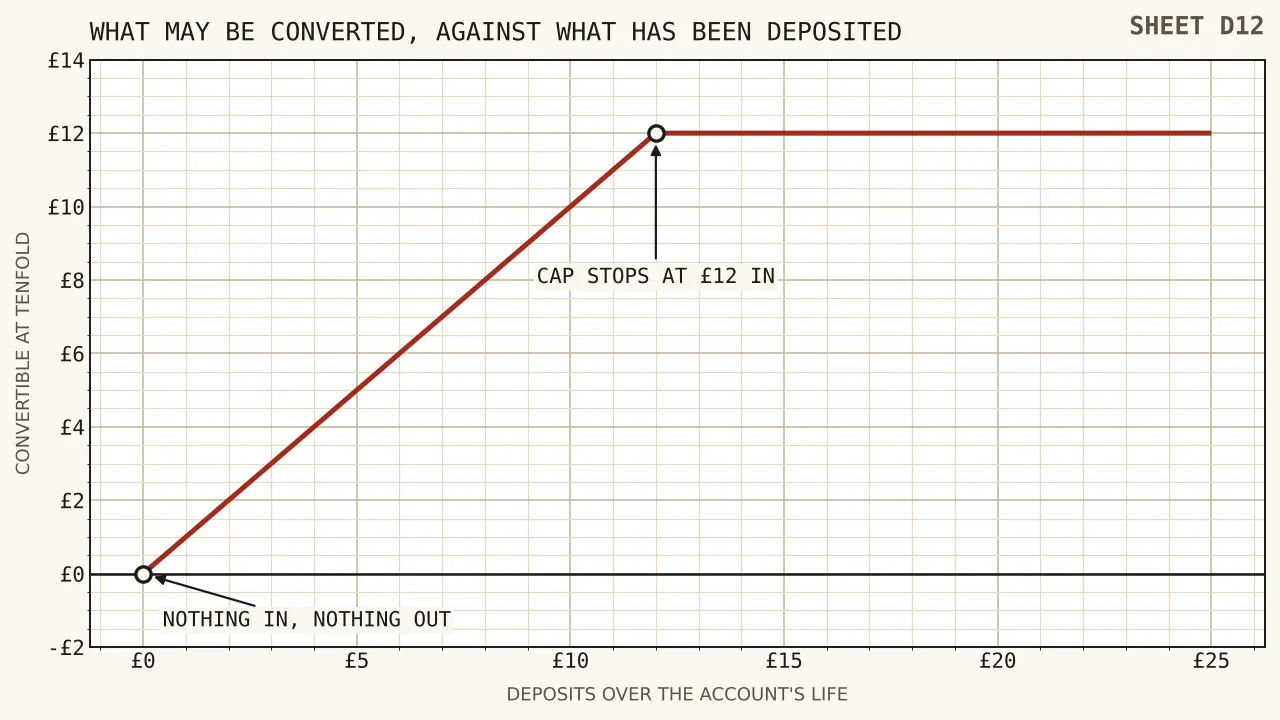
Here is the clause shape this sheet exists to price, and it is the sharpest thing on any no-deposit page. Some terms cap the amount of bonus money that may be converted into real funds, and they measure the cap not in pounds but against the player’s own deposits over the life of the account, often with an upper figure beyond which it stops rising.
On a deposit offer that clause is a scaling and nothing more. On a no-deposit offer it is an annihilation, and the arithmetic takes one line. Lifetime deposits on an account that has deposited nothing are nought. A cap set at lifetime deposits is therefore nought. Nothing converts, whatever the credit was, whatever the presses won, and whatever multiple was cleared.
| Deposits over the account’s life | Conversion cap it sets | Expected balance at tenfold | Of that, convertible | Removed by the cap |
|---|---|---|---|---|
| Nothing deposited | £0.00 | £12.00 | nothing at all | £12.00 |
| £5 deposited | £5.00 | £12.00 | £5.00 | £7.00 |
| £10 deposited | £10.00 | £12.00 | £10.00 | £2.00 |
| £12 deposited | £12.00 | £12.00 | £12.00 | nothing |
| £20 deposited | £20.00 | £12.00 | £12.00 | nothing |
| £250 deposited | £250.00 at the stated limit | £12.00 | £12.00 | nothing |
Read the first row against the second and what the clause does becomes plain. A clause of that kind does not reduce a no-deposit offer. It converts a no-deposit offer into a deposit offer, by making the value of the award a function of money the reader has not yet paid in. The headline still says that no deposit is required, and the headline is still true: no deposit is required to receive the credit. A deposit is required to keep anything the credit produces.
That is the section’s own arithmetic on a kind of term, written here as arithmetic and not as a report about anybody’s published offer. No primary source publishes a standard conversion cap, a standard maximum win on bonus winnings, or any rule turning bonus winnings into bonus funds, and this sheet invents none of them. What it does instead is show what a clause of that shape must do, by arithmetic, wherever a reader meets one.
4
The deposit such a cap quietly requires
Run that table backwards and it yields a figure a reader can use: the deposit at which the cap stops costing anything.
The cap binds while it sits below the expected balance. The expected balance at the regulated ceiling is £12.00, so the cap stops binding once lifetime deposits reach twelve pounds. Below that figure the cost of the cap is twelve pounds less whatever has been deposited. At five pounds deposited the cap costs £7.00. At ten pounds it costs £2.00. At twelve pounds and above it costs nothing.
Express it as a proportion and the result generalises to any credit. The deposit needed is the expected surviving balance, which at the tenfold ceiling is three fifths of the credit. On twenty pounds that is twelve. On fifty pounds it would be thirty. On five pounds it would be three. So a conversion cap tied to deposits asks a reader to pay in roughly 60 per cent of the credit’s face value before the credit is worth its own arithmetic.
| Credit advertised | Expected at the tenfold ceiling | Deposit at which the cap stops binding | Expected cost of staking that deposit once |
|---|---|---|---|
| £5 of credit | £3.00 | £3.00 deposited | £0.12 |
| £10 of credit | £6.00 | £6.00 deposited | £0.24 |
| £20 of credit | £12.00 | £12.00 deposited | £0.48 |
| £30 of credit | £18.00 | £18.00 deposited | £0.72 |
| £50 of credit | £30.00 | £30.00 deposited | £1.20 |
The last column is there to keep the comparison honest. Depositing twelve pounds and passing it once through a 96 per cent game costs an expected forty-eight pence, which is small against the £12.00 it unlocks. On those figures a reader who meets a deposit-linked conversion cap and wants the credit’s value is better off depositing than not. What they are not is a reader who took a no-deposit offer.
One difference between the two columns matters more than the arithmetic. The expected cost of a deposit is forty-eight pence. At hazard, meanwhile, is the whole twelve pounds, money sent through a slot being capable of returning nothing, and an expected cost averaging outcomes rather than capping any of them. A reader deciding to deposit is accepting a real exposure in order to unlock an expected figure, and this site will not pretend those are the same kind of number.
5
A ceiling and a floor on twenty pounds
Two more conditions remain and both have exact arithmetic on a credit this size.
A maximum win converts into a count. Expectation comes 9.6p to the press, so a ceiling over 9.6p yields the count where expectation gets to it, and the presses beyond that count bring nothing with them. Ten pounds gives 104 presses. Twenty pounds of credit buys 200, so a ten pound ceiling leaves about ninety-six of them idle and removes at least £9.20 from the £19.20 the presses would otherwise be expected to return.
| The figure printed | Reached at press number | Effect across the two hundred |
|---|---|---|
| £5 maximum | press 52 | 148 presses idle, £14.20 gone at least |
| £10 maximum | press 104 | 96 of them idle, and £9.20 lost at the least |
| £20 maximum | press 208 | none idle, with 80p spare |
| £100 maximum | press 1,042 | none idle, with £80.80 spare |
The twenty pound row shows the general rule again. A ceiling equal to the credit’s face value leaves headroom amounting to the house’s share and no more, eighty pence in this case, the machine’s keep being face value times the edge. Anything above face value costs the reader nothing on the average. Anything below it costs the distance down to the cap.
Those removal figures are floors under the loss rather than measurements of it, because a ceiling truncates individual outcomes instead of averages, and how much of an average goes depends on a distribution nobody publishes. Nor does any primary source state a standard maximum win for bonus winnings, so the four rows above hold round numbers picked to keep a division legible.
A withdrawal floor is the gentler of the two at this size. Against the £12.00 that survives a tenfold requirement, a ten pound floor asks for nothing unusual, a fifteen pound floor asks for 1.25 times that outcome, and a twenty-five pound floor asks for 2.08 times. Where a conversion cap has already reduced the convertible sum, though, the floor applies to whatever is left rather than to the balance, so a cap and a floor in the same terms compound: nothing convertible means nothing to withdraw, and the floor never comes into it.
One published rule governs the other pot and gets misread as covering this one. Putting a cap over the consumer’s withdrawals from a deposit balance is not available. Such a term may not be imposed on anybody, may not be put to use, may not be enforced, may not be leaned on. That protects money paid in. On an offer taking no deposit there is none of it, which is the structural point this whole sheet turns on.
6
Whose offence it is, and whose it is not
A page about a casino credit with no British licence behind it has to be exact about who is breaking what, because the loose version of this is wrong in both directions.
The statute is clear about the provider. Provide facilities for gambling without an operating licence and a criminal offence has been committed, which is how the Act frames it, subject to listed exceptions of which the first is a licence authorising the activity together with an activity carried on under that licence’s own terms and conditions. The penalties number three. Imprisonment, for no longer than fifty-one weeks. A fine, which may not exceed the standard scale’s level five. Or the pair of them at once. Six months is how those weeks read north of the border.
The requirement reaches an operator wherever it sits. It is immaterial whether the facilities get provided from inside this country or from beyond it. The section catches remote gambling wherever a single piece of the equipment used sits in Great Britain. Failing that, facilities used here are caught wherever the provider knows that they are, or ought to know as much, or knows them likely to be. That is the point-of-consumption rule, and it took effect for specified purposes on 1 November 2014; before it, the section reached remote gambling only where equipment was situated here.
Now the half that is routinely misstated. The offence in that section is committed by the person providing the facilities. That section addresses the provider all the way through, and at no point does the Act create an offence for a customer who takes part in remote gambling. A reader may therefore be told plainly that the statutory offence falls on the operator.
What cannot follow from that is a conclusion about safety, and this sheet will not draw one. Protection, not liberty, is what gets lost in the pages of this site. There is no ten-times ceiling over a multiple out there. No cap on the stake in a press. No minimum interval separating cycles. No identity check ahead of bonus play. No clock running eight weeks to an approved adjudicator. No single register shutting every account together. A reader who is not committing an offence is still a reader with none of those.
Advertising has its own section and three limits worth stating precisely. Advertising unlawful gambling is an offence in itself. Where the conduct falls under certain limbs, a person charged has a defence if they reasonably believed the gambling was lawful. Another limb carries a knowledge test, so that the offence happens only where the person knew, or ought to have known, that the gambling was unlawful. A third protects anybody whose business is delivering or transmitting communications without control over their content: doing that alone commits no offence. And where an advertisement is on display, or has been made accessible, every day on which any part of the display happens carries its own offence.
7
The tax position, stated the way it is published
Twelve pounds of expected value raises a fair question about tax, and the answer arrives by absence rather than through a charging provision. Saying so in that order is the only honest way to put it.
The revenue manual’s statement is that betting and gambling, taken as such, are not trading. Two riders travel with it. Organise an activity so as to profit from the gambling public and that will normally amount to trading. And somebody spread betting is not normally carrying on a trade, which leaves them untaxed on the profits and without relief for the losses, while the bookmaker organising the bet is taxed on theirs.
A judgment from 1925 supplies the authority and one memorable line. Where a taxpayer’s whole livelihood came from betting on horses at starting prices, the court held that no trade was being carried on, and the judge’s formulation was that a habit attracts no tax. The manual adds three refinements. A system for placing bets does not by itself make the activity a trade. Living off the proceeds does not either. Being systematic, or expert, or a student of form, is not enough.
It also marks where a gambler can be trading, offering appearance money for television programmes as its illustration, and saying that whether such winnings count as trade proceeds would turn on the facts. Hence the formulation this site keeps to: the published position has betting and gambling not amounting of themselves to a trade, which puts winnings somewhere other than trading income.
What this sheet will not do is put into the revenue authority’s mouth a sentence declaring winnings tax-free. Such a page could not be found at all. Assembling the position from the manual pages above is the only route to it, and nothing written here reaches anybody’s own circumstances or amounts to advice.
A duty does exist and it sits on the operator. Offer remote gambling other than spread betting to a person who usually lives in this country and one or more of the relevant duties falls payable. Remote gaming duty goes on the provider’s profits from that customer’s play, and the profits are the stakes taken in less the winnings paid out. On remote gaming the rate is 40 per cent from 1 April 2026, where 21 per cent applied from April 2019 and 15 per cent before then.
One feature of that regime belongs on a page about offshore credit. An operator outside this country has to register and pay wherever it offers such gambling to somebody usually living here. One that sits outside a group generally has to appoint a United Kingdom representative whom the revenue authority has approved, the exception being an operator based in an exempt jurisdiction, and the examples given there are a member state of the European Union, Norway, and Gibraltar. A missing British gambling licence therefore saves the reader nothing in tax, and saves the operator nothing either.
8
What cannot be counted, and what can
The last section of a sheet like this one is usually a list of what a reader gives up. This one begins with what this site cannot tell them, because the gaps are as useful as the figures.
No count of offshore licence holders appears here. Which licence any named brand holds, and how many sites hold a licence from any given jurisdiction, could not be established from a primary source, so no figure of that kind is published on this site. Nor will a distribution of wagering multiples be found here, or one of withdrawal caps, or one of spin values anywhere across that market. What was located on those subjects sat on trade publications, on law firm notes and on affiliate pages, and this sheet may cite none of the three.
Two jurisdictions illustrate why the gaps exist. Three attempts at one regulator’s official pages reached nothing, so no fact from that jurisdiction appears here. One thing is worth noting separately. Two companies incorporated in that territory do appear on the enforcement list the British regulator publishes, which demonstrates that an incorporation there and a British licence are two different things. For another, the body publishing the rules styles itself a gaming commission seated in a Mohawk territory in Quebec, says its gaming law empowers it to enact regulations, issues five types of licence under its regulations concerning interactive gaming, and states that complaints, queries and investigations are received and reviewed by it under the procedures in those regulations. That is the whole of what could be read, and it is reported as the whole.
What can be counted is the British side, and it can be counted duty by duty. Bonus funds carry a play-through of ten times at most. An incentive holds one product type. One online slot cycle takes five pounds of stake at most, and two pounds where the customer is beneath twenty-five. A slot keeps its cycles at least two and a half seconds from one another. Out go turbo and the slam stop. Out goes autoplay, across gaming. Out goes running two games together. Out goes a celebration where the return never beat the stake. Out goes a near miss put where a plain loss belongs. Identity gets obtained and checked ahead of any gambling at all, with bonus play and the no-stake games inside that. Credit cards are refused. What leaves a deposit balance goes uncapped. A withdrawal already requested gets no cancel button beside it. Complaints are acknowledged inside three working days and closed inside eight weeks, with an adjudicator drawn from a list of eight the regulator approves. With the licence arrives membership of the self-exclusion scheme run nationally for online accounts.
The last of those carries the warning this site closes on, and the warning is the regulator’s rather than ours. An industry warning notice bearing the date 20 January 2025 records three things. At unlicensed websites the controls on anti-money-laundering and on social responsibility may be inadequate. Customers there are left open to unfair practices, to problems of data privacy, and to fraud. And targeting of vulnerable customers happens often, people who have taken self-exclusion through the national scheme among them. A matching boundary is stated by the scheme itself, whose exclusions reach the operators taking part and go no further than those.
No page here will assist anybody in reaching a cashier they have shut themselves out of, and those two sentences are the reason rather than any policy of ours. A reader who wants the twelve pounds this sheet has priced can get it from a licensed cashier with every duty in the paragraph above attached. A reader who wants it from somewhere with no Great Britain licence is buying the same expected twelve pounds with all of those removed, and the free, confidential helpline on 0808 8020 133 is open at any hour to anybody for whom that choice has stopped feeling like a choice.
Questions
- What is £20 free with no deposit worth?
- Twenty pounds of credit is 200 presses at 10p. Put straight through a 96 per cent game those presses carry an expected £19.20. Treated as a balance under a tenfold requirement, the credit comes through with £12.00 intact, and at twenty-five times with nothing.
- What is a conversion cap tied to lifetime deposits?
- A term limiting how much bonus money may become real money, with the limit set by what the player has deposited across the life of the account. On an account that has deposited nothing, the limit is nought, so nothing converts however much the credit won and however much wagering was completed.
- Does that make a no-deposit offer worthless?
- It makes it conditional on a deposit that the headline does not mention. The headline stays true, because no deposit is needed to receive the credit. A deposit is needed to keep anything the credit produces, and on twenty pounds at the tenfold ceiling the figure at which the cap stops biting is £12.00 deposited.
- How much would I have to deposit for the cap to stop costing me?
- The expected surviving balance, which at the tenfold ceiling is three fifths of the credit. Twelve pounds on a twenty pound credit, six pounds on a ten pound credit, thirty pounds on a fifty pound one. One pass of twelve pounds through a 96 per cent game carries an expected cost of forty-eight pence, with the whole twelve at hazard meanwhile.
- How long does a tenfold requirement on £20 take to clear?
- Turnover of £200.00 falls due. Call it 2,000 presses at 10p, running an hour and twenty-three minutes at the lawful floor speed of a licensed slot. Fortyfold would be 8,000 presses and five and a half hours, and no British licence holder may ask it.
- Do I commit an offence by playing where no British licence applies?
- No. The statutory offence belongs to whoever provides the facilities without an operating licence, that section speaking about the provider from start to finish, and the Act contains no matching offence for taking part as a customer. That says nothing about safety: what a reader loses is protection, not liberty, and this sheet lists the protections item by item.
- Are winnings from an offshore casino taxed?
- Absence rather than a charging provision is how the published position gets reached. As such, betting and gambling do not amount to trading, which leaves winnings outside the category of trading income. No page could be found declaring winnings tax-free in terms, and no part of this amounts to tax advice. The duty that exists falls on the operator, follows where the player usually lives, and stands at 40 per cent on remote gaming on or after 1 April 2026.
- Why does this site not say how many offshore sites hold which licence?
- Because no primary source establishes it. Which licence a named brand holds, and how many sites hold one from a given jurisdiction, could not be sourced, and nor could any distribution of wagering multiples, withdrawal caps or spin values across that market. What turned up on those subjects sat on trade publications, law firm notes and affiliate pages, and none of those three may be cited here.
- What exactly is lost on a credit from an unlicensed cashier?
- An offer of that kind has no Great Britain licence behind it, which is what makes the losses countable. Gone: the ten-times ceiling over a play-through. Gone: the rule holding an incentive to one product. Gone: the five pound cap on an online slot cycle, and the two pound cap for anybody under twenty-five. Gone: the minimum of two and a half seconds separating cycles, along with the prohibitions covering turbo, the slam stop and autoplay. Gone: the identity check ahead of bonus play, and the refusal of credit cards. Gone: the bar on capping withdrawals out of a deposit balance. Gone: eight weeks to an approved adjudicator. Gone: membership of the national self-exclusion scheme.