Sheet D07 Revision 1 Counted 16 October 2026
20 free spins on registration: £1.92 expected, and every condition priced in presses
Somebody else funds the stake: twenty presses at 10p, so £2.00 put through a 96 per cent game, which is expected to give back £1.92. One press is worth 9.6p of that, which gives this sheet its unit: each condition in the terms can be converted into the number of presses it takes away. A tenfold requirement costs eight of the twenty. A ten pound withdrawal floor costs all of them.
The count 20 presses One spin 10p Comes to £1.92 unconditioned
What a count of this size comes to
Every destination on this board is bought advertising. The site takes a fee if a reader goes on to register, and no figure printed below moves because of it.
The Spin Count
Gauge No 01
Betportal
Lowest multiple here
Priced at this site's own 10p a spin
What is counted
What is asked
No Great Britain licence
Licensed in Anjouan, Comoros, run by BetPortal Gaming Ltd, with Excite Ultra Media Ltd, reference ALSI-202601040-FI2.
Terms read 16 October 2026
Open the offer at Betportal, opens in a new tabThe Spin Count
Gauge No 02
WinBeast
Largest count here
Priced at this site's own 10p a spin
What is counted
What is asked
No Great Britain licence
Licensed in Curaçao, operator not named on the site.
Terms read 16 October 2026
Open the offer at WinBeast, opens in a new tabThe Spin Count
Gauge No 03
EliteSpin
Longest spin window
Priced at this site's own 10p a spin
What is counted
What is asked
No Great Britain licence
Licensed in Costa Rica, run by PrimeTier Limited.
Terms read 16 October 2026
Open the offer at EliteSpin, opens in a new tabThe Spin Count
Gauge No 04
Crown Jewelz
Multiple unpublished
No foot figure struck
What is counted
What is asked
No Great Britain licence
Licensed in Curaçao, number not verified, operator not named on the site.
Terms read 16 October 2026
Open the offer at Crown Jewelz, opens in a new tabThe figure in the third register is this site's own arithmetic and nothing an operator has published: the count at face, less the share a spin gives back at 96 per cent return to player, less what playing the wagering through costs at the same return. It describes the offer, not one reader's afternoon. Where the conditions price above the count the counter prints nothing rather than a negative sum, and where a figure the sum needs is unpublished it prints the condition in the operator's words instead.
A count has no unit of its own, so one is supplied. Where an operator publishes what a spin of its own is worth, that figure stands in the second register and is labelled as theirs. Where it does not, the second register carries this site's own 10p a spin and says so, and the foot figure moves in proportion: at half the price, half the money. The figure after it, what the count comes to for each spin, is the one that compares a large count against a small one.
Three words stand in the amount column where no figure can. Noted is a published condition that takes value away without leaving the sum a figure to take. Unpriced is a condition whose figure nobody has published, or a credit that is not a sum until a deposit of your own sets it. Own money is money of yours, which is never part of a foot figure.
Not one of the operators printed above holds a Great Britain licence, so the duties that licence carries do not reach them. Every online gambling company licensed in Great Britain has to be part of Gamstop Online, and a reader who has shut themselves out through the scheme is therefore not shut out here. The ceiling of ten times the bonus funds on a wagering requirement, in force since 19 January 2026, is a condition of that licence and binds the companies that hold one. Where a dispute goes instead is a matter for the authority named on the counter, and the Gambling Commission describes what a reader faces without a British licence as a lack of recourse if things go wrong. Nobody under 18 may hold an account at any of them.
Every term printed on a counter is the operator's own, and each counter carries the day it was read. The oldest of those readings is 16 October 2026. What binds a reader is the operator's own full terms, and not a line printed here.
1
Twenty presses, converted
Two multiplications and the offer is priced. Twenty times ten pence gives £2.00 of stake. Ninety-six per cent of two pounds gives £1.92 as the expected return. Fourpence a pound is what the machine keeps, so eight pence is what it keeps from twenty presses.
Duration comes third and never appears in an advertisement. Two and a half seconds has to separate one game cycle from the next on a licensed slot, so fifty seconds is the fastest twenty presses may lawfully be taken. Less than a minute of play, and an expected return under two pounds, is the whole physical shape of the thing.
The figure that does the work on this page is the one in between. Divide £1.92 by twenty and each press is worth 9.6p of expectation. Hold that in mind and a reader gains a currency: any condition that removes value from the offer can be restated as the number of presses it has quietly taken back.
| What is being counted | Figure |
|---|---|
| Presses awarded | 20 |
| Unit price, declared by this site | 10p |
| Stake funded on the reader’s behalf | £2.00 |
| Expected return at 96 per cent | £1.92 |
| Expectation carried by one press | 9.6p |
| Shortest lawful duration | 50 seconds |
The 10p is declared rather than discovered. No published source states what one free press is worth, who settles the figure, or whether anybody has to disclose it, so this sheet names its assumption and shows the working. An offer stating its own unit price overrides the assumption, and at 5p a press this whole page halves while at 20p it doubles.
2
Every condition, priced in presses
Here is the device this sheet is built on. A condition in the small print subtracts money from an expected £1.92. Divide that subtraction by 9.6p and the condition is expressed in the same unit as the headline, which makes a reader’s comparison direct instead of abstract.
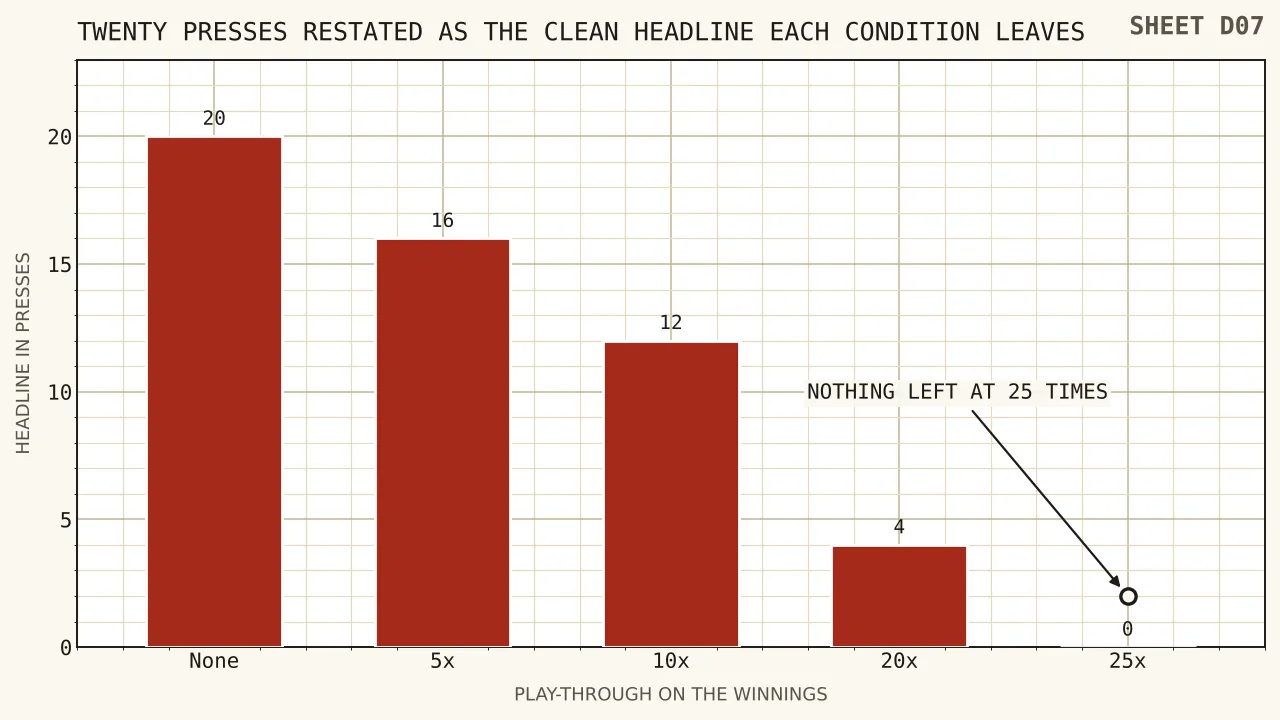
Work the first one through slowly and the rest follow. A tenfold requirement on the winnings leaves three fifths of a balance, because each turn is expected to cost four per cent and ten turns cost forty. Scale £1.92 down to three fifths and £1.15 remains, which means £0.77 has gone. At 9.6p a press that is eight presses. A headline of twenty presses with tenfold wagering on the proceeds is, in expectation, a headline of twelve presses with nothing attached.
| The condition | Expected value left | Value removed | Presses it costs | Equivalent clean headline |
|---|---|---|---|---|
| Nothing attached | £1.92 | none | none | 20 presses |
| Fivefold wagering | £1.54 | £0.38 | 4 presses | 16 presses |
| Tenfold wagering | £1.15 | £0.77 | 8 presses | 12 presses |
| Twentyfold wagering | £0.38 | £1.54 | 16 presses | 4 presses |
| Twenty-five times | nothing | £1.92 | all 20 | no presses at all |
| A £1 ceiling on winnings | £1.00 at most | £0.92 at least | at least 10 presses | 10 presses or fewer |
| A 5p unit instead of 10p | £0.96 | £0.96 | 10 presses | 10 presses |
Three things come out of that table and all three are usable in a shop window. The first is that halving the unit price costs the reader exactly as much as a twentyfold wagering requirement. Both take ten presses’ worth. A reader choosing between a twenty-press offer at 10p with heavy wagering and a twenty-press offer at 5p with none is choosing between two identical expectations.
The second is that a one pound ceiling is the most expensive condition in the list after the wall itself. It takes at least ten presses, because an expected £1.92 cannot exceed a one pound cap, and the loss is bounded below rather than exactly: the true cost depends on the shape of the slot’s payouts, which nothing published sets out.
The third is the wall. Every press goes at twenty-five times over, since twenty-five turns costing four per cent apiece are expected to eat whatever balance they are set against. No count is large enough to survive it: a hundred presses, a thousand presses and twenty presses all come to nothing when multiplied by nought.
Tenfold wagering costs 8 presses, a 5p unit costs 10, twenty-five times costs all 20
3
The withdrawal floor, which is the whole story here
One condition outweighs every other at this count, and it is usually printed in the banking terms where nobody reads it.
A smallest-withdrawal figure cannot be converted into presses, because it does not scale the expectation down. It makes the expectation unpayable and leaves the reader needing an unusual session instead of an average one. The arithmetic is a division: a ten pound floor against an expected £1.92 asks the reader to finish on 5.21 times the mean.
| Smallest withdrawal | Multiple of the mean needed | Gap to close | Count whose mean would reach it |
|---|---|---|---|
| £2.00 | 1.04 times | £0.08 | 21 presses |
| £5.00 | 2.60 times | £3.08 | 53 presses |
| £10.00 | 5.21 times | £8.08 | 105 presses |
| £20.00 | 10.42 times | £18.08 | 209 presses |
The right-hand column is the honest comment on the pairing. Ten pounds as a minimum withdrawal is a figure designed for a count in the hundreds. Set it beside twenty presses and the bar stands over five times the height of whatever is jumping at it. Nobody is being tricked. Two numbers that were never chosen together have been printed on one page.
One protection a reader might reach for does not help. Capping the withdrawals from a deposit balance is prohibited outright, and what the prohibition governs is money the customer paid in. A reader who has deposited nothing has no deposit balance, so for the life of a no-deposit offer the rule guards an empty pot while the floor does its work in the other one.
The regulator does point players at exactly this pairing, and its consumer advice is worth paraphrasing because the original carries a slip of grammar. A reader is told to look for restrictions attached to an introductory offer, and the example given is a spend level demanded before the bonus arrives. A withdrawal floor five times above the expected outcome is that restriction wearing different clothes.
4
Eligibility: who the offer is actually for
An offer made on registration is an offer defined by eligibility, and eligibility is a regulated category rather than a marketing preference.
Eligibility restrictions come first in the regulator’s catalogue of conditions needing clear and prominent treatment wherever an omission would mislead, and three examples sit under that heading: a location bar, an age bar, and new customers only. Those three sit on almost every twenty-press offer, and each one is capable of making a reader ineligible after they have registered rather than before.
New customers only is the first and the most slippery, because the word customer has to be defined somewhere and the definition is rarely in the advertisement. A household, a shared address, a payment card already used elsewhere on the same platform: each can turn a new customer into an existing one. This sheet records no figures on how often that happens, because none are published, and notes instead that the condition belongs in the material rather than three clicks away.
Age is the second, and it is the one with real machinery behind it. Before a customer may gamble, a licensee must have obtained and verified information establishing identity, and the condition works to a floor of three items, which are a date of birth, a postal address and a name. More may be asked for. Play funded from a bonus falls inside the duty, which puts twenty free presses inside it, and the no-stake versions of a licensee’s own games fall inside it too. Verification cannot be postponed to the withdrawal: a request to be paid must not be the moment a licensee first demands information it could reasonably have sought earlier.
Location is the third, and a reader meeting a geographical restriction has usually met it before the offer. The licensing requirement itself tracks the player and not the operator. Whether the facilities get provided inside the United Kingdom or outside it is immaterial. Remote gambling is reached where a piece of the equipment sits in Great Britain, and, where none does, wherever the facilities are used here by somebody the provider knows or ought to know about. That point-of-consumption rule has a date, 1 November 2014, and before it the Act reached remote gambling only where the equipment was situated here.
5
The lines drawn at twenty-five years old
Two separate rules single out customers under twenty-five, and a page about a sign-up offer is the right place to set them beside each other, because the people most likely to be opening a first account are the people both rules are written about.
The first is the stake cap. A statutory instrument fixed the total an individual may stake in one game cycle, and it fixed two figures: five pounds generally, two pounds where the individual is under twenty-five years old. 25 February 2025 is the date the instrument was made. No calendar date appears in its commencement clause, only a formula running six weeks on from the making, which is why the dates have to come from the regulator’s guidance: five pounds arrived on 9 April 2025 and two pounds on 21 May 2025. For six weeks a flat five pound cap applied to everybody, which is why the lower figure started later. Online slots are the whole of the reach, and no other casino game is touched.
Priced against this page, a two pound cap is twenty presses at 10p in a single cycle, so it does not constrain a reader using the offer as the offer intends. Where it matters is on the clearing: a requirement that has to be worked through at no more than two pounds a cycle takes at least as many cycles as the staking divided by two, and a tenfold requirement on £1.92 is £19.20 of staking, so at least ten cycles and, at 10p a press, 192 presses.
The second rule is about advertising rather than stake. A gambling advertisement may not show anybody gambling, or playing a significant part, who is under twenty-five or looks it. People aged eighteen to twenty-four may play a significant role only where the advertisement sits somewhere a bet can be placed directly, such as the operator’s own site, and only where they are presented as the subject of the bet rather than in a gambling setting. The regulator’s own advertising page puts the general position bluntly: in all other instances, social media included, under-25s must not feature.
The self-exclusion figures for that age group are published and they belong here. Under-25 registrations were up 26 per cent on the previous year in data released during July 2026, and nearly a third of all self-exclusions come from that age group. Across every age, a quarter of registrants took the six-month term; among the under-25s the share taking it was 38 per cent. Those are the people a registration offer reaches, and the shortest available exclusion is the one they choose most.
6
A ceiling that sits eight pence above the mean
At this count a ceiling is unusually easy to read, because the crossover lands almost exactly on the headline.
Each press brings 9.6p of expectation along with it, so a ceiling divided by 9.6p yields the count after which that ceiling, rather than the count, settles the matter. For two pounds the answer is 21 presses. Twenty presses sit one press below that, which means a two pound ceiling on this offer stands eight pence above the expected outcome. The headroom is almost nothing, and a reader who has a fortunate session will meet the cap rather than the balance.
| Ceiling printed | Starts to bind beyond | Headroom over £1.92 |
|---|---|---|
| £1 maximum | 11 presses | binding already |
| £2 maximum | 21 presses | £0.08 |
| £5 maximum | 53 presses | £3.08 |
| £10 maximum | 105 presses | £8.08 |
| £50 maximum | 521 presses | £48.08 |
Two statements about those rows. On the maximum a bonus win may reach, no primary source prints a standard figure at all, so those tabulated ceilings are round numbers chosen for a legible division and not a report of what any cashier publishes. A ceiling over bonus winnings also occupies different ground from the bar on capping what leaves a deposit balance. One document can hold both of them without contradiction, and the balance holding the money decides which one is in play.
Put the ceiling and the floor together and a reader has the two numbers that matter most. Ask whether the interval between them contains £1.92. A two pound floor under a fifty pound ceiling contains it, barely. A ten pound floor under a two pound ceiling contains nothing at all, because nothing above two pounds can be won and nothing under ten pounds can be taken out.
7
The clock, and which clock it is
Two windows usually run on an offer like this one, and the shorter one is rarely the dangerous one.
The window on the presses barely matters. Twenty presses need fifty seconds at the lawful floor speed, and a twenty-four hour window holds 1,728 times that much time. Unless the presses expire within minutes of landing, the award’s own clock costs a reader nothing.
The window on the clearing is the one to read. Ten times an expected £1.92 comes to £19.20 of staking, which at 10p is 192 presses, and eight minutes once the floor speed is applied. Fortyfold is £76.80, 768 presses and thirty-two minutes. Neither is a hardship inside a week. Inside twenty-four hours the fortyfold version asks for half an hour of uninterrupted pressing on the day the offer arrives, which for most readers is the condition that ends the exercise.
What a window cannot do is change the expected cost of the staking. What it does instead is change the chance of the staking being finished, and an unfinished requirement forfeits the balance. A figure computed on the assumption of completion is worth nothing where completion is unlikely, which is why a short window outranks a modest multiple on any reading.
A deadline of either kind is a significant condition. One published ruling, dated 27 August 2025, puts the cost of hiding one in concrete terms. A five pound voucher proved unusable on 14 March, with a race meeting behind that, and the advertisement had said nothing of it. Of the rulings listed on the regulator’s page about free bets and bonuses, that is the only one the page itself describes in the language of a breach.
8
What the licence is worth on a £1.92 offer
At the offshore end of the market an offer this size holds no Great Britain licence, and the useful way to price the difference is to set out what a reader is able to do rather than what a regulator demands. Each sentence below is an action available to the reader, and each one exists because a licence makes it exist.
Ask a licence holder for a deposit limit and one has to be provided. Among the durations available are a day, a week and a month, and the figure itself goes into a free text box rather than coming off a menu the operator drew up. Ask for it to be lowered and it falls immediately. Ask for it to be raised and nothing happens for at least twenty-four hours, after which you have to confirm again. Decline to set one and the system has to make you say so, because setting a limit is required to be the default.
Refuse to send a document at the withdrawal stage and the licensee cannot use that refusal as a reason to hold money, where it could reasonably have asked earlier. Ask to withdraw and there will be no cancel button beside the request to tempt you into reversing it. Ask for a cap on what you may take out of your own deposit balance to be lifted and the answer is that no such cap is permitted in the first place.
Complain and a clock starts. Acknowledgement comes within three working days, or within a single day at a site whose gambling never closes. The whole process, any internal escalation included, has eight weeks. Six months at the least from the incident in which to bring the complaint at all. Then a named independent adjudicator from the regulator’s approved list, which runs to eight entities with differing sector coverage. Register once with the national online self-exclusion scheme and every licensed operator is shut at the same moment.
Now the same list without a British licence. Deposit limits are required by the Curaçao responsible gaming policy, though not in those terms, and on one point that policy is the stricter: a rise waits a week out there against a day here. Nowhere in it is there a ceiling over a wagering multiple. No stake cap appears. No minimum interval between game cycles appears. Autoplay goes unmentioned, and so does any fanfare over a return at or beneath the stake. Identity gets handled by requiring an operator to be satisfied the player has turned eighteen ahead of any deposit or wager, and the document check itself waits for later milestones instead of the first press.
Two points run the other way, and an honest page carries them. Affiliates get reached directly in that policy, which hands the operator responsibility for their compliance, to be enforced by contract, by audit and by penalty. The British regulator’s advertising page mentions affiliates nowhere, and touches third parties only on the question of keeping advertisements off sites that infringe copyright. Its complaints route exists in substance too. The player gets six months. The operator gets four weeks, plus a single extension of four more on written notice. Resolving a dispute is compulsory out there, and the player is charged nothing for it.
Self-exclusion is where the gap is widest, and the scheme itself states the boundary. What it reaches is the set of operators taking part, and a service run by anybody outside that set is past its help. Out there an exclusion is arranged one cashier at a time, running from a year to a lifetime and not revocable by the player once confirmed. On a £1.92 offer that is the whole of the argument: the sum at stake is under two pounds, and the difference in what surrounds it is the entire reason to prefer one side of the line.
Questions
- What is a 20 free spins sign-up offer worth?
- £2.00 of stake at 10p a press, and an expected £1.92 back on a 96 per cent game. Each press carries 9.6p of that, which is the unit this sheet uses to price the conditions.
- How do I compare two offers with different terms?
- Convert each condition into presses. A fivefold requirement costs four of the twenty, tenfold costs eight, twentyfold costs sixteen and twenty-five times costs all of them. Halving the unit price from 10p to 5p also costs ten presses, so a 5p offer with no wagering and a 10p offer at twentyfold are worth the same.
- Can a £10 minimum withdrawal leave me unpaid?
- On the average, yes. A ten pound floor takes 5.21 times the mean outcome to clear from an expected £1.92. Five pounds takes 2.60 times, two pounds takes 1.04 times. A count up in the hundreds is what a ten pound figure was designed around.
- Does a maximum win cap matter at twenty presses?
- A low one does. The count past which a ceiling binds is the ceiling divided by 9.6p, which for two pounds is 21 presses, leaving twenty presses one short. A two pound ceiling therefore stands eight pence above the expected outcome, and a one pound ceiling is already binding, costing at least ten presses’ worth.
- What does “new customers only” actually exclude?
- More than a reader expects, and the definition is rarely in the advertisement. Eligibility heads the regulator’s catalogue of significant conditions, and the three examples under it are a location bar, an age bar, and new customers only. Such a condition belongs inside the material itself rather than several clicks from it.
- Why is twenty-five the age that keeps appearing?
- Two separate rules use it. One cycle on an online slot carries a stake cap of five pounds, falling to two where the customer is beneath twenty-five, and the regulator’s guidance dates the two figures 9 April 2025 and 21 May 2025. Separately, nobody who is or seems to be under twenty-five may be shown gambling in an advertisement, with a narrow exception for 18 to 24 year olds on an operator’s own site.
- Do I have to prove my identity for a twenty-press offer?
- Yes, before the play. A licence holder must obtain and verify information establishing identity first, working to a floor of a date of birth, a postal address and a name. Bonus-funded play falls inside the duty, free bets fall inside it, and so do the games a licensee lets people play for nothing. A request to be paid may not be the first point at which paperwork gets demanded, in any case where asking sooner would have been reasonable.
- How long does the wagering take if there is any?
- Ten times an expected £1.92 works out at £19.20 of staking. Reckon on 192 presses, and on eight minutes once two and a half seconds per cycle has been built in. Fortyfold is £76.80, 768 presses and thirty-two minutes. A week accommodates either. Twenty-four hours accommodates only the first comfortably.
- What do I lose taking the same offer from an unlicensed site?
- Every action set out in the final section here. An offer of that sort has no Great Britain licence behind it. Nothing then obliges the cashier to hand over a deposit limit on request with a day, a week and a month among its durations. Nothing makes a reduction take effect at once. A wagering multiple meets no ceiling. One press meets no stake cap. Game cycles meet no minimum interval. And no single register shuts every account in one action. A rise in a limit waits seven days under the Curaçao policy against a day here, and affiliates are reached directly by it, so the comparison does not run all one way.