Sheet V03 Revision 1 Counted 16 October 2026
Mobile casinos: the same spin, a smaller screen, and three extra duties
A spin costs what it costs whatever it is played on, so 320 spins at 10p is £32.00 of staking and an expected £30.72 back. What a phone changes is not the arithmetic but the duties attached to the screen: a running figure for spend and time, a bar on running two products at once, and a pace floor that differs between slots and the rest of the casino. This sheet prices all of it.
Spins on the phone 320 One spin 10p Expected £30.72
What a count of this size comes to
Every destination on this board is bought advertising. The site takes a fee if a reader goes on to register, and no figure printed below moves because of it.
The Spin Count
Gauge No 01
Betportal
Lowest multiple here
Priced at this site's own 10p a spin
What is counted
What is asked
No Great Britain licence
Licensed in Anjouan, Comoros, run by BetPortal Gaming Ltd, with Excite Ultra Media Ltd, reference ALSI-202601040-FI2.
Terms read 16 October 2026
Open the offer at Betportal, opens in a new tabThe Spin Count
Gauge No 02
WinBeast
Largest count here
Priced at this site's own 10p a spin
What is counted
What is asked
No Great Britain licence
Licensed in Curaçao, operator not named on the site.
Terms read 16 October 2026
Open the offer at WinBeast, opens in a new tabThe Spin Count
Gauge No 03
EliteSpin
Longest spin window
Priced at this site's own 10p a spin
What is counted
What is asked
No Great Britain licence
Licensed in Costa Rica, run by PrimeTier Limited.
Terms read 16 October 2026
Open the offer at EliteSpin, opens in a new tabThe Spin Count
Gauge No 04
Crown Jewelz
Multiple unpublished
No foot figure struck
What is counted
What is asked
No Great Britain licence
Licensed in Curaçao, number not verified, operator not named on the site.
Terms read 16 October 2026
Open the offer at Crown Jewelz, opens in a new tabThe figure in the third register is this site's own arithmetic and nothing an operator has published: the count at face, less the share a spin gives back at 96 per cent return to player, less what playing the wagering through costs at the same return. It describes the offer, not one reader's afternoon. Where the conditions price above the count the counter prints nothing rather than a negative sum, and where a figure the sum needs is unpublished it prints the condition in the operator's words instead.
A count has no unit of its own, so one is supplied. Where an operator publishes what a spin of its own is worth, that figure stands in the second register and is labelled as theirs. Where it does not, the second register carries this site's own 10p a spin and says so, and the foot figure moves in proportion: at half the price, half the money. The figure after it, what the count comes to for each spin, is the one that compares a large count against a small one.
Three words stand in the amount column where no figure can. Noted is a published condition that takes value away without leaving the sum a figure to take. Unpriced is a condition whose figure nobody has published, or a credit that is not a sum until a deposit of your own sets it. Own money is money of yours, which is never part of a foot figure.
Not one of the operators printed above holds a Great Britain licence, so the duties that licence carries do not reach them. Every online gambling company licensed in Great Britain has to be part of Gamstop Online, and a reader who has shut themselves out through the scheme is therefore not shut out here. The ceiling of ten times the bonus funds on a wagering requirement, in force since 19 January 2026, is a condition of that licence and binds the companies that hold one. Where a dispute goes instead is a matter for the authority named on the counter, and the Gambling Commission describes what a reader faces without a British licence as a lack of recourse if things go wrong. Nobody under 18 may hold an account at any of them.
Every term printed on a counter is the operator's own, and each counter carries the day it was read. The oldest of those readings is 16 October 2026. What binds a reader is the operator's own full terms, and not a line printed here.
1
The screen does not change the price
A mobile casino is a casino reached through a phone, and the arithmetic of an offer is indifferent to the device. A tally becomes money once somebody prices one spin, and the price lives in the terms rather than in the hardware.
Take 320 spins, a size often quoted on an app install or a first deposit. Priced at the 10p used across this site, that tally carries £32.00 of staking. A game returning 96 per cent is expected to give back £30.72, and the house keeps £1.28. One spin is worth 9.6p of expectation, which is the figure to multiply by whatever tally a reader meets.
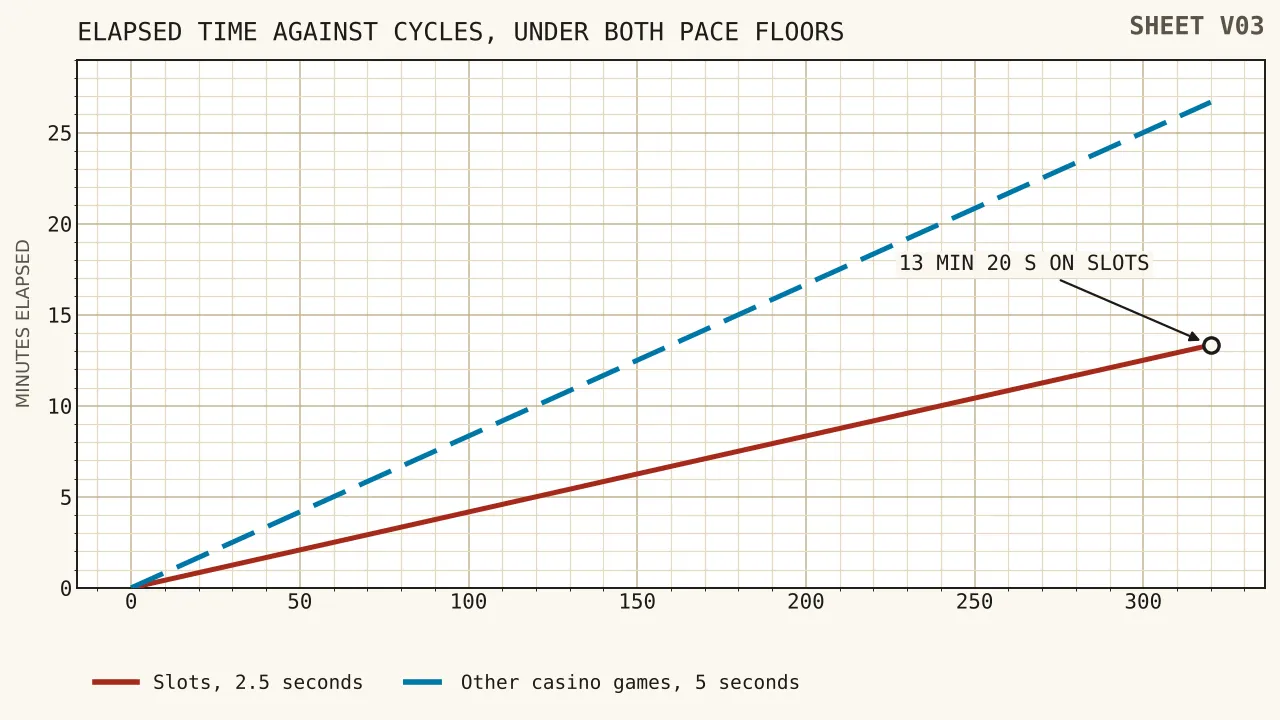
Time is where a phone does change something, though not in the way readers expect. A licensed slot owes 2.5 seconds after a game starts before the next cycle may open, so 320 spins occupy 800 seconds, or 13 minutes and 20 seconds.
One more conversion is worth keeping, because it turns any mobile offer into a figure a reader can hold. Multiply a tally by 9.6 for the pence of expectation at this price, and by 2.5 for the seconds it occupies: 80 spins is 768p and 200 seconds, 320 spins is 3,072p and 800 seconds, 500 spins is 4,800p and 1,250 seconds. Divide the first by the second, in minutes, and the rate comes out at £2.30 a minute every time, which is the clearest demonstration on this sheet that a bigger tally buys time rather than value.
That floor is the same on a phone as on a desktop. What a phone changes is where those 13 minutes get spent: in a queue, on a bus, in a waiting room, which is a point about attention rather than arithmetic, and this sheet prices the arithmetic.| One spin priced at | Staking | Expected | Per minute of play |
|---|---|---|---|
| 2p | £6.40 | £6.14 | 46p |
| 5p | £16.00 | £15.36 | £1.15 |
| 10p | £32.00 | £30.72 | £2.30 |
| 20p | £64.00 | £61.44 | £4.61 |
| 50p | £160.00 | £153.60 | £11.52 |
The last column divides the expectation by the 13 minutes 20 seconds the tally takes, and it is the figure a reader can compare against anything else they might do with that time. At 10p a spin a 320-spin award repays attention at £2.30 a minute. At 2p it repays 46p a minute. The tally is identical in both rows and so is the time.
Both assumptions behind those figures are declared rather than published. What a free spin is worth, who fixes that figure, and whether disclosure is compulsory are three things no reachable source states. Nor does a British licence compel the publishing of a return percentage. Four alternatives satisfy that information duty, joined by the word or, which lets a probability or a margin stand in. A reader who finds the figure a game publishes should substitute it for the 96 used here.
2
What has to be on the screen as you play
One rule applies to a phone screen more visibly than anywhere else, and it has a date. Since 17 January 2025, under a set of changes to remote games, a customer has to be shown their net spend and their elapsed gambling time as they go. That is a running total on the screen rather than a statement at the end of the month.
Convert it into this sheet’s units and the duty becomes concrete. At 10p a spin, a reader 160 spins into a 320-spin award has staked £16.00, has spent at least 6 minutes and 40 seconds doing it, and is entitled to see both figures as they stand. Net spend is the figure that matters, setting the returns against the stakes, and on a game at 96 per cent the expected net spend over the whole award is £1.28.
A second change took effect on the same date and bites hardest on a device that can hold several games at once. Operator-led functionality for playing multiple simultaneous products is banned, and the example the release gives is roulette and blackjack tables. On a phone that removes the tiled, several-games-at-once layout from a licensed product.
A technical requirement reaches the same ground from another direction, covering casino games with poker between players left out: no functionality may be offered that would make several games playable together. Split-screen and multi-screen features are covered by its guidance, along with combinations of games that would enable simultaneous play. Two rules, then, and both of them stop a licensed app from doubling the rate at which a reader can lose money.
One date needs care, because the implementation timetable moved once. An opt-in for direct marketing, taken channel by channel and product by product, began on 1 May 2025 rather than on the January date, a sequence which the published release confirms. A page that attaches the January date to marketing consent has the wrong rule.
Net spend and time, in real time, from 17 January 2025
3
Two pace floors, and which one applies
A phone makes it easy to move between a slot and a live table, and the two carry different minimum speeds. Getting them the right way round is the point of this part.
For slots the minimum is 2.5 seconds from the time a game is started until the next game cycle can be commenced. Outside slots, and leaving poker between players aside, the casino minimum is 5 seconds. That five-second figure began to bind in January 2025, on the seventeenth, a date the regulator records on its page listing the updates effective then. Within that standard not one requirement carries its own commencement date, so the date attaches to the five-second rule by itself and leaves the shorter floor unmarked.
| Tally of cycles | Slots, at 2.5 seconds | Other casino games, at 5 seconds | Difference |
|---|---|---|---|
| 20 | 50 s | 100 s | 50 s |
| 100 | 4 min 10 s | 8 min 20 s | 4 min 10 s |
| 320 | 13 min 20 s | 26 min 40 s | 13 min 20 s |
| 1,000 cycles | 41 min 40 s | 1 hr 23 min | 41 min 40 s |
Three further rules hold both floors in place, and on a touchscreen each one is worth stating plainly. It must always be necessary to release and then depress the start button, or take equivalent action, to commence a game cycle, so holding a finger on the screen advances nothing. A cycle is defined as opening when the player sets the game going, and as closing once every amount staked or won has gone, or else reached the player or been put within their reach, the start control being free once more. Each cycle is to be committed to on its own. Autoplay is unavailable for online gaming, since a commitment has to be taken for every game cycle separately, and the guidance carves out nothing beyond blinds posted automatically at poker between players.
Features that shorten the wait are out as well. Reducing the time until a result is presented may not be permitted to a customer, and the guidance names three that are out: slam stop, quick spin and turbo. Three limits on that rule are recorded as well. Bonus and feature games where nothing further is staked fall outside it. Scratch-all and reveal-all features are not prohibited. Nor are games in which the stake is lost unless the customer acts to end the game.
So a licensed app cannot be made to run faster than 24 slot cycles a minute, or 12 cycles a minute of anything else in the casino. That is the ceiling on pace, it is the same on every device, and it is the one rule on this page that a reader can verify with a stopwatch.
4
What the display may not do with a result
On a small screen the presentation of a result does more work than the result itself, and three requirements govern it.
The first concerns accuracy and duration. Clearly and accurately, the system has to display the game’s result, or the event’s, next to what the customer gambled, holding it there long enough for reading. On a phone, where a result can be swiped away in a moment, the duration half of that requirement is the operative one.
The second concerns celebration. A return no greater than the total stake gambled may not be celebrated by the system, which rules out the sounds and the on-screen flourishes that mark a win. Three alternatives appear in the guidance: show the total awarded as a figure, show the paying lines briefly, and sound a short note as the credit arrives. Set that against the arithmetic here and the reason is plain. On a 320-spin award at 10p, plenty of results come back under the 10p that was staked, and animation costs least where the sums are smallest.
The third concerns the state of play. Information letting the customer understand the current state has to be displayed as play goes on, and the guidance records lotteries as outside that duty. On a phone, with a game occupying the whole screen and no surrounding furniture, that display is the only place a reader can see where they stand.
One design prohibition belongs with those three because it is about what a screen may suggest. Prohibited is any design or feature liable to leave a customer with the wrong idea of how likely some result is, and two instances get named. The first imitates a physical device while running odds that device never had. The second dresses a plain loss up as a near miss. Its guidance is blunt about both: a near-miss result may not be displayed falsely, and one losing outcome may not take the place of another.
5
A tally in pence and in minutes
A mobile offer is usually quoted as a tally and sometimes as a tally per day, so this part converts both into the two units that matter. The arithmetic is the same throughout: 9.6p of expectation a spin at 10p, and 2.5 seconds a cycle at the lawful floor.
| Tally advertised | Staking at 10p | Expected | Minutes at the floor | Expectation a minute |
|---|---|---|---|---|
| 20 spins | £2.00 | £1.92 | 0.83 | £2.30 |
| 80 spins | £8.00 | £7.68 | 3.33 | £2.30 |
| 320 spins | £32.00 | £30.72 | 13.33 | £2.30 |
| 40 a day for 8 days | £32.00 | £30.72 | 1.67 a visit | £2.30 |
| 10 a day for 32 days | £32.00 | £30.72 | 0.42 a visit | £2.30 |
Two things fall out of that. The rate per minute is constant at a given spin price, so a tally does not get better or worse by being larger: it gets longer. And the bottom two rows have the same expectation as the third, because splitting a tally changes the schedule and not the sum. What a drip adds is visits and expiry dates: on the 32-day schedule a single missed day removes 96p of expectation, and four missed days remove £3.84.
A requirement on the proceeds is the one condition that changes the money rather than the schedule. Where the winnings off the spins are credited into a bonus balance, a multiple can attach, and ten times the funds is the ceiling for a British licensee, set by the code provision on incentives and binding since 19 January 2026. On a £30.72 balance that is £307.20 of turnover, which is 3,072 further spins at 10p and 128 minutes at the floor pace, leaving three fifths of the balance, or £18.43.
Two hours of pressing on a phone is a different proposition from two hours at a desk, which is the one place where the device changes a judgement rather than a figure. The time is the same. The setting in which a reader has to find it is not.
6
Reaching a limit in as few taps as possible
One financial-limit requirement is written as if for a phone, and it is the one readers never hear about. Facilities for setting a limit must be provided via a direct link on the homepage and be clearly visible and accessible. They must also be clearly visible and accessible on deposit pages or screens, or via a link on them. And the system must minimise the number of clicks or pages customers make in order to access financial limit facilities.
On a small screen that last sentence is the whole of the protection. A control that takes six taps to reach on a phone is a control most people will not reach, and the standard addresses that directly by making the number of steps itself a compliance question.
The rest of the limit regime converts neatly into this sheet’s units. The facilities have to be easy to reach at any time once registration has happened, and a prompt arrives either inside the registration itself or at the first deposit or payment. The customer gets a free text box for the purpose, or its telephone equivalent, and a limit bites at account level at the very least. Gross deposit limits have to be available, meaning a ceiling on money entering the account over a duration that is stated, and the label deposit limit is reserved to something answering that description; its prominence must match that of any other limit type. The durations on offer must include 24 hours, 7 days and 1 month.
| Limit set | Spins it funds | Minutes at the floor |
|---|---|---|
| £5 in 24 hours | 50 | 2.1 |
| £10 in 24 hours | 100 | 4.2 |
| £32 in 7 days | 320 | 13.3 |
| £70 in 7 days | 700 | 29.2 |
The third row is this page’s own tally, which makes the point better than any argument: a weekly deposit limit of £32.00 funds exactly the 320 spins the offer gave away, and takes 13 minutes and 20 seconds to use. A limit is not an abstraction. It is a tally in disguise.
Two directions, two speeds, and the asymmetry is the same on every device. An increase runs through three stages: the customer asks, a day of cooling off follows, and only a fresh positive act once that day is spent puts the new figure into effect. A reduction is implemented immediately unless a systems or technical failure prevents it. A limit is also the default. The facilities present it that way, an action is needed to decline it, and confirmation that the customer wants none has to be taken before any deposit or play follows.
7
Blocking the device, not the account
A phone is a device, and a device can be blocked in a way an account cannot. The published facts about the software that does it are worth setting out precisely, because the free route in Britain is not published by the company that makes it.
The software writes itself Gamban, with no capital in the middle. Its own site describes blocking built in layers, reaching gambling websites and apps that run into the tens of thousands around the world, with a single licence covering installation on each major platform and two stores, Apple’s and Google Play, named as the download points. Its footer carries a copyright line for 2026 and gives no company number or registered address.
On its own pages there is no free route for a British user. Registration brings a trial of seven days at no cost, and the company records as well that residents of Ohio pay nothing, under a scheme carrying that state’s name. Nothing on the company’s own pages sets out a British free route.
The free British route is published by GamCare instead, and it has a name: TalkBanStop. It pairs three organisations. GamCare is Talk, providing the National Gambling Helpline. Ban is the blocking component, and the page there puts it at 15 devices as a maximum, enough to cover a household. The national self-exclusion scheme is Stop. No charge falls on anyone who rings the National Gambling Helpline, or who takes up the charity’s own support and treatment, as the charity itself states it.
Two cautions belong with that, and both are about the source rather than the service. That TalkBanStop page is a news item carrying 12 April 2021, and how long the free access lasts is nowhere stated on it. So a page may say the charity opens a no-cost path to the software for callers on the helpline, while a duration or a device tally may not be presented as current absent something fresher. The company’s own silence on a British free route forms the second half, and a citation ought to carry both halves together.
The helpline is the thing worth putting into a phone, being the one number here that answers. The National Gambling Helpline is run by GamCare on 0808 8020 133, and it is staffed round the clock, on every date in the calendar, by phone, by live chat or by WhatsApp. Calls cost nothing, the number in international form runs +44 8088 020 133, and the support extends to the caller, to a friend of theirs or to a family member. A professional may make a referral where the person consents to it.
8
Two tools, two different jobs
Readers routinely conflate the national self-exclusion scheme with blocking software, and on a phone the difference matters more than anywhere else, because the two work on different objects.
The scheme works on accounts. Membership binds each online gambling firm licensed in Great Britain, so one registration reaches each licensed account, and the licence rather than the website sets how far it goes. Four options stand at registration: half a year, twelve months, five years, or five years renewing themselves, and deactivation stays shut off until the minimum period chosen has run out.
The software works on devices. It blocks sites and apps on whichever phone or computer carries it, which is why its own wording reaches a tally of gambling destinations in the tens of thousands, and an installation on all the major platforms under one licence.
Set them side by side and the gap each leaves is visible. An unlicensed site is untouched by the scheme, which says as much: the help on offer extends to shutting someone out of the gambling services run by participating Gambling Operators, and it records plainly that reaching anything outside that group lies beyond what it can do. The software does not touch an account, so a registered account remains open on any device without the software installed. Used together they cover both objects, which is precisely why the free British route pairs them with a helpline rather than offering one alone.
| The tool | What it acts on | What it leaves open |
|---|---|---|
| The national scheme | accounts at every licensed operator | sites outside the scheme, on any device |
| Blocking software | sites and apps on the devices it is installed on | any account, reached from a device without it |
| The helpline | a conversation, at any hour | nothing technical, by design |
No sentence on this page assists anybody around either tool, and that is on purpose. Those facts are laid out so a reader can act on them, and it is why the number appears in the care block at the foot of every sheet here.
Two figures put the scheme’s scale in view, and both come from a release dated 16 July 2026. Registrations stood at 614,738 consumers. Sign-ups across January to June 2026 ran 16 per cent higher, with May the busiest single month on record at 12,236.
9
How large the mobile market is, and the gap in the record
A page about mobile casinos ought to say what share of the market is mobile. This one cannot, no primary source within reach having published that split. The gap is recorded here rather than filled with a figure from a trade article.
What is published is the size of the whole. Across April 2025 to March 2026 the gross gambling yield for Great Britain came to £17.5 billion, up by 4.4 per cent on the preceding year, with £13.2 billion of that left once all reported lotteries are taken out, a rise of 4.7 per cent. Within that, £8.3 billion sat with remote casino, betting and bingo, up by 6.9 per cent against the year before. The annual report puts online casino games at £5.7 billion, with slots alone accounting for £4.8 billion of it. Publication of those figures came on 17 September 2026, and the year they cover ends in March 2026.
Two further published figures are worth having, with the same caveat that neither is split by device. Active accounts are reported at 25.7 million as the last quarter of that series closed, and at 31 March 2026 the register carried 2,154 operators, between them 3,097 licensed activities.
Participation has its own survey and its own warning. A third annual survey of gambling across Great Britain, published on 16 July 2026, reports 47 per cent of participants aged 18 or over saying they had gambled in some form within the previous four weeks, and the statistics hub gives its period as January 2025 to January 2026. Excluding people who played lottery draws only, the figure is 27 per cent. The report also gives 2.4 per cent of the population with a problem gambling severity score of 8 or more in 2025, a level the regulator describes as stable across the survey’s three years, with approximately 20,000 adults interviewed each year.
A warning travels with those numbers and belongs here too. Comparing this survey directly against surveys built on different methodologies is not appropriate, and the comparison that works is between one wave of it and the next. One further published figure exists, and it must never be passed off as an adult participation rate: among young people, 30 per cent had put money of their own into gambling over the preceding 12 months, measured across the first half of 2025 and published that November.
So the honest summary for this page is that the licensed online sector is large and growing, that nobody publishes what share of it arrives through a phone, and that a reader should distrust any page that gives them a mobile percentage without naming its source.
10
The same phone, an unlicensed app
Offers reached through a phone get advertised from beyond Britain as heavily as from within it, and nothing printed out there carries a Great Britain licence. On this page the losses are specific, because parts two to four are all duties attached to the screen.
| On the screen | British licence | No British licence |
|---|---|---|
| Net spend and time, running live | required since 17 January 2025 | no published requirement |
| Several products at once | banned, operator-led functionality included | unaddressed |
| Slot pace | 2.5 seconds between cycles, minimum | no figure published |
| Other casino games | 5 seconds a cycle at least | no figure published |
| Autoplay and turbo | both unavailable | no rule |
| A sub-stake return | may not be celebrated | no rule |
| Reaching a limit | homepage link, clicks minimised | no access rule published |
That second column is read off the offshore document rather than assumed. Over in the Curaçao policy on responsible gaming, first version, 21 February 2025 on its face, no minimum interval between cycles is fixed at all. Autoplay and accelerated results go unmentioned in it. So does any rule about celebrating a small return, and so does any duty to display spend or time while play continues.
What it does require, and a fair comparison includes it, is a set of footer disclosures that a phone screen has to carry. The footer there carries seven items: the licence holder’s name, its registered address, the licence number, a line saying that the authority supervises the site, that authority’s digital seal, a link onward to the responsible gaming policy, and a link to addiction help at home and overseas, where GamCare, Gamblers Anonymous and GambleAware are printed as the overseas instances. The policy writes GamCare without the capital C in the middle.
Two of its provisions are stricter than the British ones and belong in the comparison. In one click the facility must reach four cooling-off lengths, 24 hours first, then seven days, then a month, then a quarter, needing neither an email nor a sign-off from the operator, biting the moment it is chosen, and choosable vertical by vertical. Nothing may be done to put a customer off using them, not a question about the decision, not comfort offered so that it waits, not a bonus or promotion dangled to keep the play alive. And out there a reduction to a deposit limit lands at once while an increase waits out seven days, against 24 hours at the least on a British licence.
On a device its weakness is self-exclusion, and what separates the two regimes there is structure rather than degree. Self-exclusion there means a player shutting themselves out by choice, across every online gaming activity or only some of them, at a single named operator. That operator then has to exclude them across all of its domains, and to encourage them to exclude themselves at other gambling sites too. Its periods start at twelve months, with three, five and ten years available as well as a lifetime, and a confirmed exclusion is not revocable by the player until the period has run. Twelve months is therefore the shortest term out there against six here, and for every other site the offshore remedy is encouragement in place of a register.
For a reader holding a phone, that is the practical distinction on which this whole page turns. One registration with the national scheme reaches every licensed account on every device. Blocking software reaches every site and app on one device. An unlicensed app sits outside the first and inside the second, and no sentence here helps anybody around either of them.
Questions
- Is a spin worth less on a phone?
- No. The expectation is the tally times the spin price times the return, and none of those three depends on the device. Price a spin at 10p against a 96 per cent return and 320 of them stake £32.00 for an expected £30.72, on a phone or anywhere else.
- What has to be shown on the screen while I play?
- A running figure for net spend and for elapsed gambling time, on display by operator duty from 17 January 2025 onward. Net spend is the figure that counts, because it sets returns against stakes: across a 320-spin award at 10p the expected net spend is £1.28.
- Can a licensed app let me play several games at once?
- No, and two rules say so. Where the operator builds the means to run several products together, that is banned, and two tables side by side, roulette on one and blackjack on the other, is the illustration given. Separately, across casino games other than poker between players, functionality making simultaneous play of several games possible may not be offered, and the guidance names split-screen and multi-screen layouts as examples.
- How fast can a mobile casino game run?
- Twenty-four slot cycles a minute, the gap owed between one start and the next being 2.5 seconds. Outside slots, and with poker between players set aside, 5 seconds is the floor for a casino game, which caps a minute at twelve cycles. The five-second figure took effect on 17 January 2025; the standard gives no commencement date for the 2.5-second one.
- How long does a 320-spin mobile offer take to use?
- 13 minutes and 20 seconds at the lawful floor, which works out at £2.30 of expectation a minute at 10p a spin. Splitting the tally does not change the money: 40 a day for eight days has the same £30.72 expectation, with eight visits of 1 minute 40 seconds instead of one sitting.
- Why can a losing spin not be celebrated?
- Because a return at or beneath the whole amount staked may not be celebrated by the gambling system, and the sounds and the visuals tied to a win are off-limits for it. The guidance suggests displaying the total awarded, briefly showing the winning lines, and playing a short sound when the result is credited.
- How quickly should I be able to find a deposit limit on a phone?
- In as few steps as the system can manage. A direct link on the homepage is required, visibility on deposit pages or screens is required, and the system has to keep the clicks and pages a customer passes through to the fewest it can. At 10p a spin, a £10 daily limit funds 100 spins and a £70 weekly limit funds 700.
- Is there free blocking software for a British phone?
- There is a free route, and GamCare publishes it rather than the software company. TalkBanStop is its name, bringing together the helpline, the blocking software and the country’s self-exclusion scheme. The page carrying it is a news item from April 2021, dated the twelfth, and it is silent on how long the free access runs.
- Does the software block my accounts as well?
- No, and that is the distinction to hold on to. The national scheme acts on accounts and reaches every licensed operator, because membership is a condition of the British licence. The software acts on devices, blocking sites and apps on the phone or computer it is installed on. Each leaves the other’s gap open, which is why the free route pairs them.
- What share of online gambling happens on mobile?
- No primary source reachable from here publishes that split, so this sheet does not give a figure. The size of the whole is published: a gross gambling yield of £17.5 billion across Great Britain for the year ending March 2026, with £8.3 billion from remote casino, betting and bingo taken as one sector, £5.7 billion in online casino games, and £4.8 billion in slots.
- What is missing from an unlicensed app?
- The duties attached to the screen. Nothing published requires a running display of spend and time. Nothing bars several products running at once. Nowhere does a minimum interval between cycles appear; nor a bar on autoplay or turbo; nor anything stopping a return at or below the stake from being cheered; nor a rule on how a limit facility must be reached. Footer disclosures and cooling-off at one click are both required by the offshore policy read here, so the comparison does not run one way only.